Regional Growth Strategy Review Report
A draft report by Golder Associates reviewing the successes and challenges of the CRD's Regional Growth Strategy and recommendations for transition to a Regional Sustainability Strategy.
Regional Growth Strategy Review Report
March 01, 2013
Submitted to: Marg Misak-Evans Senior Manager Regional & Strategic Planning Capital Regional District 625 Fisgard Street Victoria, BC V8W 1R7
Report Number: 1214420002-008-R-RevA
Distribution: 1 Copy - Capital Regional District 2 Copies - Golder Associates Ltd.
Executive Summary
This document provides a review of successes and challenges of the CRD's Regional Growth Strategy (adopted 2003) and recommendations for strengthening regional policies as the CRD transitions to a Regional Sustainability Strategy.
RGS Policy & Implementation Review Conclusions
Overall the Capital Regional District is effectively planning regionally as a federation of member municipalities. The RUCSPA and urban containment policies have proven effective at managing growth and keeping urban settlement relatively compact.
Policy
RGS policies have generally proven sufficient to achieve many of the desired outcomes, notably, increasingly compact communities, continued robust growth in core communities, core green space (sea to sea green/blue belt) acquisitions are on target, there is substantial completion of the regional trail network, and considerable progress has been made across the region toward creating more complete communities.
Weaknesses that may be addressed include overly conceptual mapping in some cases, vague policy language describing what is rural, and what is urban, an inconsistently applied RUCSPA boundary, and the lack of sub regional differentiation for matters such as servicing standards where, for example, public water service to agricultural uses may be appropriate.
The opportunities for policy changes identified in this report and summarized below represent for the most part strengthening and polishing in terms of depth and breadth rather than fundamental change.
The addition of new sub-strategies - climate change and food systems - will serve to strengthen the core RGS component of the new RSS. The new draft Regional Transportation Plan, the update of the Regional Housing Affordability strategy (RHAS) the new Community Health & Well-Being project, and the update to the Integrated Solid Waste & Resource Management Plan are parallel initiatives that will also inform and support the RSS.
In our view the expanded RGS, the new sub-strategies and the parallel planning initiatives will serve as a robust and resilient trilogy of policy instruments guiding the region to a sustainable future.
Implementation
There are notable implementation achievements: all member municipalities have adopted Regional Context Statements that were accepted by the CRD Board, a Regional Transportation Plan is near completion, an affordable housing strategy was completed and in the process of being updated, and a housing secretariat has been established.
However, implementation has proven more challenging than setting the right policy direction. Failure to execute master implementation agreements has served to limit success. Challenges have persisted in determining consistency between the RGS and member municipality's OCPs as well as consistency between the RGS and the region's own bylaws. More robust implementation of the RGS should include:
- Further discussion on the merits of implementation agreements relative to other means of implementation such as sub-strategies and parallel plans;
- A clear process for amendments, including a minor amendment process;
- Establishing protocols for consistency review of municipal and Electoral Area OCPs;
- Improved bylaw consistency for the Juan de Fuca Electoral Area, and other regional bylaws pertaining to matters addressed in the RSS; and
- Continued monitoring and reporting.
Summary of Recommendations for the Transition of the RGS to the RSS
These recommendations follow from the key questions posed in Section 13 of this review.
How should the RUCSPA be updated?
- Maintain the RUCSPA with minor modifications and extensions; provide greater clarity on the nature and extent of urban, rural resource, and rural settlement patterns of development.
- Permit water servicing for residential and agricultural uses within avowedly rural areas beyond the RUCSPA.
- Incorporate technical, fiscal, and equity criteria into the servicing policy.
- Explore a more consistent approach to establishing the RUCSPA boundary, e.g. matching urban areas of the OCP, not merely municipal boundaries; or avoiding the use of the RUCSPA boundary to encompass fully serviced development.
- Review rural settlement policy and mapping to consider rural settlements. Consider greater clarity on what type of development is appropriate in the rural/resource area.
What elements of the existing RGS are supportable and should be retained? What should be added?
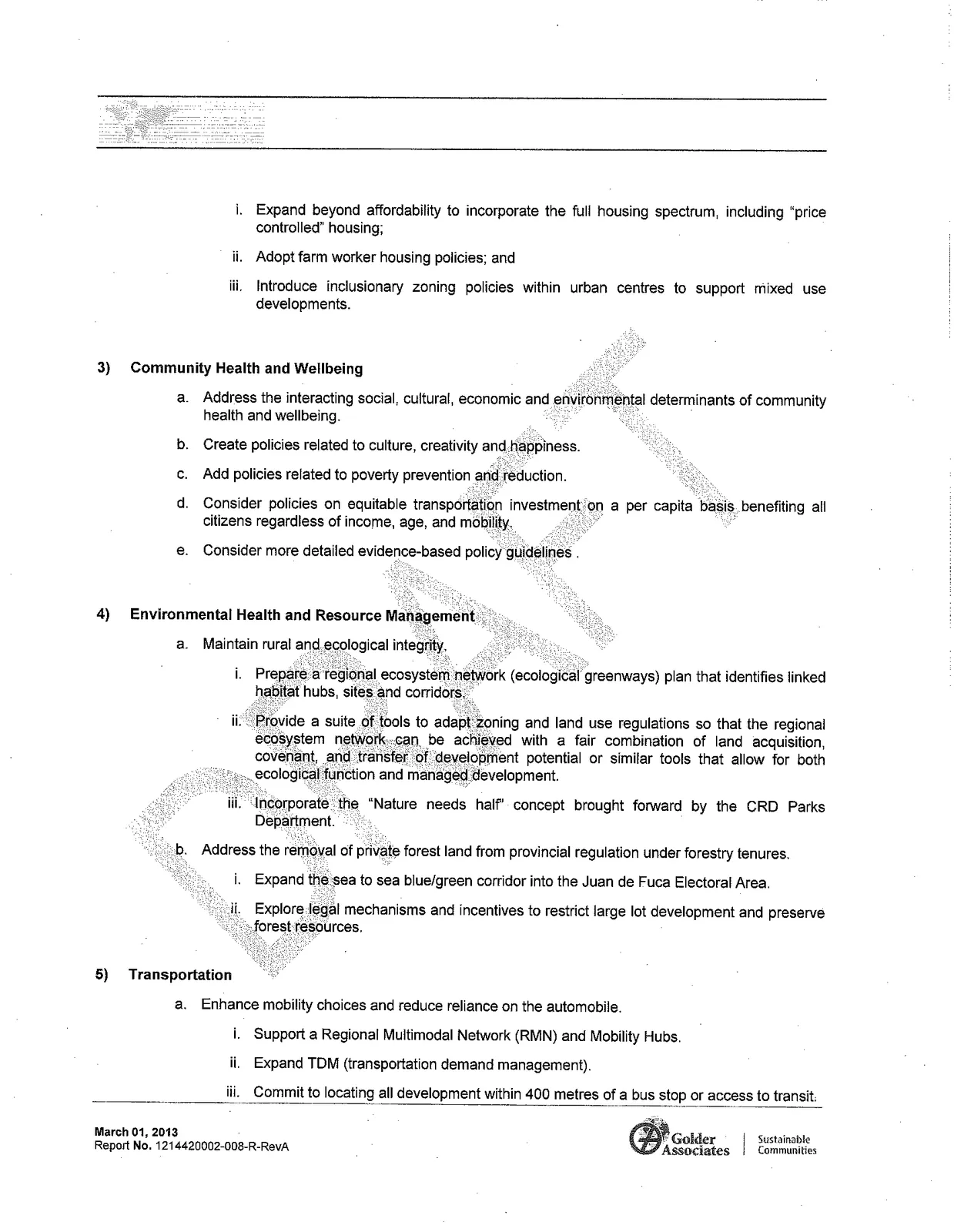
1) Growth Management a. Create sub-regional policies that reflect urban and rural characteristics, the anticipated rate of growth, and the anticipated level of servicing. b. Explore a performance based approach to key strategies and policies that provide greater flexibility to local governments. This may include, for example, sub-regional density targets, growth targets and thresholds that support RSS outcomes, while providing greater autonomy to local governments in attracting and managing growth. c. Expand the urban centre hierarchy where feasible and higher levels of urban density and mix of land uses explored. d. OCPs, zoning bylaws, and approved development proposals have modified the policy and regulatory landscape. Review these commitments on a sub-regional basis in order to recalibrate targets and sub-regional growth strategies. e. Strengthen integration between land use and transportation. i. Target growth around future rapid transit corridors and mobility hubs. ii. Increase dwelling unit density to urban transit-supportive levels (medium and high density) within 600 m of rapid and frequent transit stations and corridors by 2020, in urban centres and settlements where adequate servicing capacity exists. iii. Introduce inclusionary and minimum density zoning policies within urban centres to support mixed-use developments. iv. Achieve a minimum jobs-to-population ratio of 0.6 in the core centres, 0.4 to 0.5 in the western communities. f. Further clarify the nature and extent of rural development i. Agree on large minimum lot sizes to preserve rural character. ii. Create rural centre designations to distinguish between existing low density rural residential uses and mixed use rural service centres.
2) Regional Housing Affordability Strategy a. Affordable housing for all segments of society is a top priority: expand the housing spectrum to include a range of market rate housing for all household types and work force categories. b. The RHAS should look at the affordability of housing for people at different income levels (e.g. moderate income earners as well as low income earners). c. Transition the Regional Housing Trust Fund to a regional housing levy. d. Set targets for the creation of new units of subsidized housing, market rental housing, affordable market ownership housing, supportive housing, the percentage of households in core housing need. e. Consider the following elements in an updated Regional Housing Affordability Strategy: i. Expand beyond affordability to incorporate the full housing spectrum, including "price controlled" housing; ii. Adopt farm worker housing policies; and iii. Introduce inclusionary zoning policies within urban centres to support mixed use developments.
3) Community Health and Wellbeing a. Address the interacting social, cultural, economic and environmental determinants of community health and wellbeing. b. Create policies related to culture, creativity and happiness. c. Add policies related to poverty prevention and reduction. d. Consider policies on equitable transportation investment on a per capita basis benefiting all citizens regardless of income, age, and mobility. e. Consider more detailed evidence-based policy guidelines.
4) Environmental Health and Resource Management a. Maintain rural and ecological integrity. i. Prepare a regional ecosystem network (ecological greenways) plan that identifies linked habitat hubs, sites and corridors. ii. Provide a suite of tools to adapt zoning and land use regulations so that the regional ecosystem network can be achieved with a fair combination of land acquisition, covenant, and transfer of development potential or similar tools that allow for both ecological function and managed development. iii. Incorporate the "Nature needs half" concept brought forward by the CRD Parks Department. b. Address the removal of private forest land from provincial regulation under forestry tenures. i. Expand the sea to sea blue/green corridor into the Juan de Fuca Electoral Area. ii. Explore legal mechanisms and incentives to restrict large lot development and preserve forest resources.
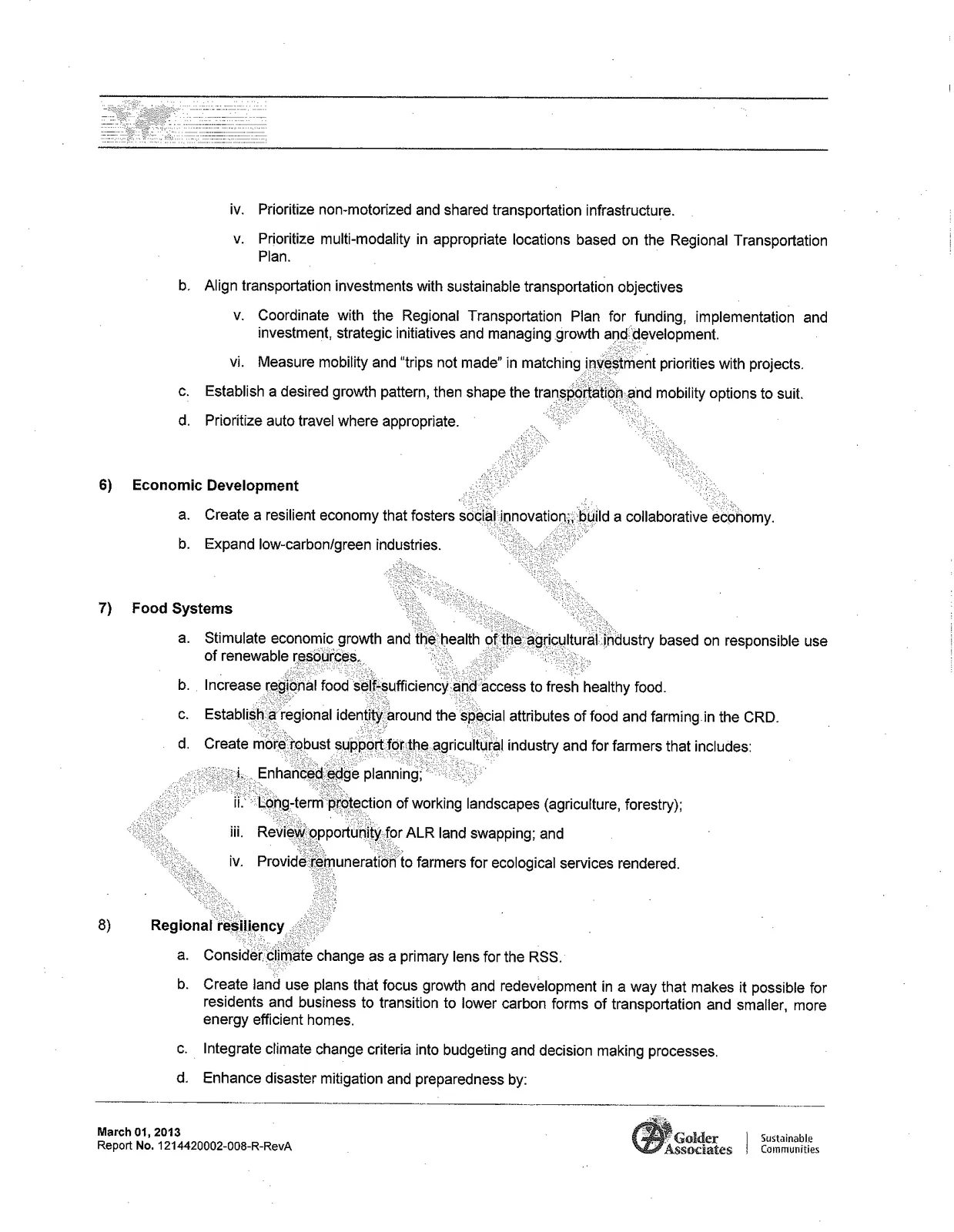
5) Transportation a. Enhance mobility choices and reduce reliance on the automobile. i. Support a Regional Multimodal Network (RMN) and Mobility Hubs. ii. Expand TDM (transportation demand management). iii. Commit to locating all development within 400 metres of a bus stop or access to transit. iv. Prioritize non-motorized and shared transportation infrastructure. v. Prioritize multi-modality in appropriate locations based on the Regional Transportation Plan. b. Align transportation investments with sustainable transportation objectives v. Coordinate with the Regional Transportation Plan for funding, implementation and investment, strategic initiatives and managing growth and development. vi. Measure mobility and "trips not made" in matching investment priorities with projects. c. Establish a desired growth pattern, then shape the transportation and mobility options to suit. d. Prioritize auto travel where appropriate.
6) Economic Development a. Create a resilient economy that fosters social innovation; build a collaborative economy. b. Expand low-carbon/green industries.
7) Food Systems a. Stimulate economic growth and the health of the agricultural industry based on responsible use of renewable resources. b. Increase regional food self-sufficiency and access to fresh healthy food. c. Establish a regional identity around the special attributes of food and farming in the CRD. d. Create more robust support for the agricultural industry and for farmers that includes: i. Enhanced edge planning; ii. Long-term protection of working landscapes (agriculture, forestry); iii. Review opportunity for ALR land swapping; and iv. Provide remuneration to farmers for ecological services rendered.
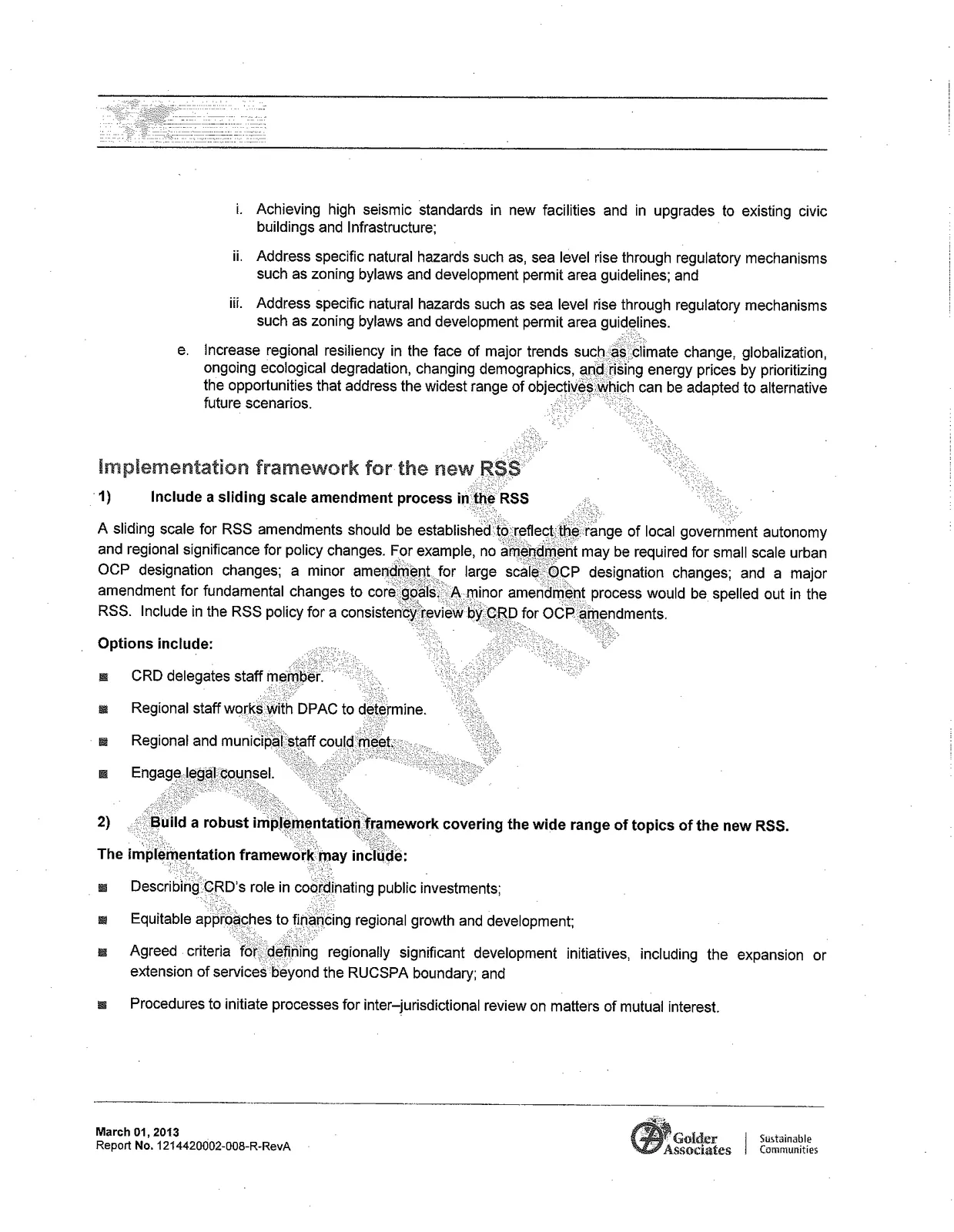
8) Regional resiliency a. Consider climate change as a primary lens for the RSS. b. Create land use plans that focus growth and redevelopment in a way that makes it possible for residents and business to transition to lower carbon forms of transportation and smaller, more energy efficient homes. c. Integrate climate change criteria into budgeting and decision making processes. d. Enhance disaster mitigation and preparedness by: i. Achieving high seismic standards in new facilities and in upgrades to existing civic buildings and Infrastructure; ii. Address specific natural hazards such as, sea level rise through regulatory mechanisms such as zoning bylaws and development permit area guidelines; and iii. Address specific natural hazards such as sea level rise through regulatory mechanisms such as zoning bylaws and development permit area guidelines. e. Increase regional resiliency in the face of major trends such as climate change, globalization, ongoing ecological degradation, changing demographics, and rising energy prices by prioritizing the opportunities that address the widest range of objectives which can be adapted to alternative future scenarios.
Implementation framework for the new RSS
1) Include a sliding scale amendment process in the RSS
A sliding scale for RSS amendments should be established to reflect the range of local government autonomy and regional significance for policy changes. For example, no amendment may be required for small scale urban OCP designation changes; a minor amendment for large scale OCP designation changes; and a major amendment for fundamental changes to core goals. A minor amendment process would be spelled out in the RSS. Include in the RSS policy for a consistency review by CRD for OCP amendments.
Options include:
- CRD delegates staff member.
- Regional staff works with DPAC to determine.
- Regional and municipal staff could meet.
- Engage legal counsel.
2) Build a robust implementation framework covering the wide range of topics of the new RSS.
The implementation framework may include:
- Describing CRD's role in coordinating public investments;
- Equitable approaches to financing regional growth and development;
- Agreed criteria for defining regionally significant development initiatives, including the expansion or extension of services beyond the RUCSPA boundary; and
- Procedures to initiate processes for inter-jurisdictional review on matters of mutual interest.
Document Images
(7)