MNAI Motion for 2026 Budget
Background material and resources supporting the motion for a Municipal Natural Asset Inventory (MNAI).
MNAI Motion for 2026 Budget
Background
The TOVR needs to recognize the financial benefits for the residents of View Royal in managing our assets in the most cost-effective and resilient way. Natural assets are land based - trees, pollinator gardens, and rain gardens, streams, ponds, ditches, soil, coastlines, and green spaces - therefore they appreciate in value, unlike man-made structures (constructed assets) which continually depreciate.
View Royal should strive to use natural assets like trees, shrubs, ditches, ponds, creeks and wetlands to provide stormwater services ....and consider natural assets a vital part of View Royal’s asset infrastructure and for the role they play in climate mitigation and adaptation.
As a cohort of staff has already completed the NAM Roadmap Program, the logical progression from this would be to build on this investment and begin the actual inventory process. Are staff investing the right amount of time in the management of natural assets? These municipal natural assets need to be identified and protected in our OCP through strong bylaws and regulations. How have natural assets been considered by staff and incorporated in operations?
BC already has Climate Adaptation & Flood Strategies that enable such Regulations to be written. These strategies already emphasize the need to manage natural assets and incorporate Nature-based Solutions: https://www2.gov.bc.ca/assets/gov/environment/climate-change/adaptation/cpas.pdf From Flood Risk to Resilience: a B.C. Flood Strategy to 2035
Because NAM is an overall strategy that connects to OCPs & other strategy documents, it can be mentioned in OCPs, but isn't really contained "inside" OCPs. Saanich's green diagram describes how NAM interfaces between all the municipal strategy documents & implementation (like bylaws) https://www.saanich.ca/EN/main/local-government/asset-management-program/natural-asset-management.html
We would like to emphasize here that the amount of park area per resident in View Royal has been cut in half since 15 years ago just because of the increase in population. We have lost a huge amount of trees in the Burnside/Helmcken development and the one beside the FourMile and the one at Helmcken and the Island Hwy.
Resources:
- Natural asset management - Being smart with what we've got
- Nature is Infrastructure: How to Include Natural Assets in Asset Management Plan
- Climate-ready-communities-a-toolkit-for-local-government-Sierra-Club-BC-2025.pdf
Funding Sources
FCM Green Municipal Fund for Climate Adaptation https://fcm.ca/en/funding https://greenmunicipalfund.ca/local-leadership-climate-adaptation https://greenmunicipalfund.ca/funding/climate-ready-plans-processes - actually $140k per municipality A well-defined climate adaptation plan builds on this by outlining targeted actions to reduce the impacts of climate challenges, protect infrastructure like water management systems and energy grids, and enhance public health. https://fcm.ca/en/programs/municipalities-climate-innovation-program https://fcm.ca/en/resources
BC Gov't Infrastructure incl. Green Infrastructure https://www2.gov.bc.ca/gov/content/governments/local-governments/grants-transfers/grants
MFABC Sustainability Bonds, Green Categories: Terrestrial/Aquatic Biodiversity (watersheds, species at risk), Flood Management https://mfa.bc.ca/investors/sustainability (some grants >$100k) Environmental Conservation and Remediation projects, with Green categories such as Terrestrial and Aquatic Biodiversity (including watersheds and species at risk), and Sustainable Water and Wastewater Management for flood management.
Natural Assets Initiative & Canadian Gov't - long list of funds inc. Green Infrastructure https://naturalassetsinitiative.ca/documents/funding-for-municipal-natural-asset-management/ https://housing-infrastructure.canada.ca/plan/icp-pic-INFC-eng.html (via Housing, Infrastructure and Communities Canada)
UBCM / BC Gov't Asset Management Reporting https://www.ubcm.ca/ccbf
Recommendation:
That the TOVR endorse the following motion:
Whereas climate change is a leading driver of increased costs and disruptions at the local government level that requires action from all levels of government,
Therefore, be it resolved that Council direct staff to commence work towards completing a 2026 Municipal Natural Asset Inventory for the TOVR and direct staff to include natural assets in any updates to the corporate Asset Management Policy.
Also, be it resolved that appropriate funds be dedicated for an MNAI in the 2026 budget and that staff also apply for funding from all potential sources such as FCM (refer to the above list).
About Natural Asset Inventories
Natural asset inventories provide information on the types of natural assets a local government relies upon, their condition, and the risks they face.
Natural Asset Management, and associated Natural Asset Inventories, have been implemented by over 35 BC municipalities and over 150 Canadian municipalities, including many on Vancouver Island, such as Colwood, Saanich, Nanaimo, and Courtney, as well as another in progress in Victoria.
Saanich’s natural assets provide a minimum of between $21 – $125 million per year in public benefits across a range of municipal services and co-benefits, and the estimated replacement value is between $1.2 and $8.7 billion (see graphic below).
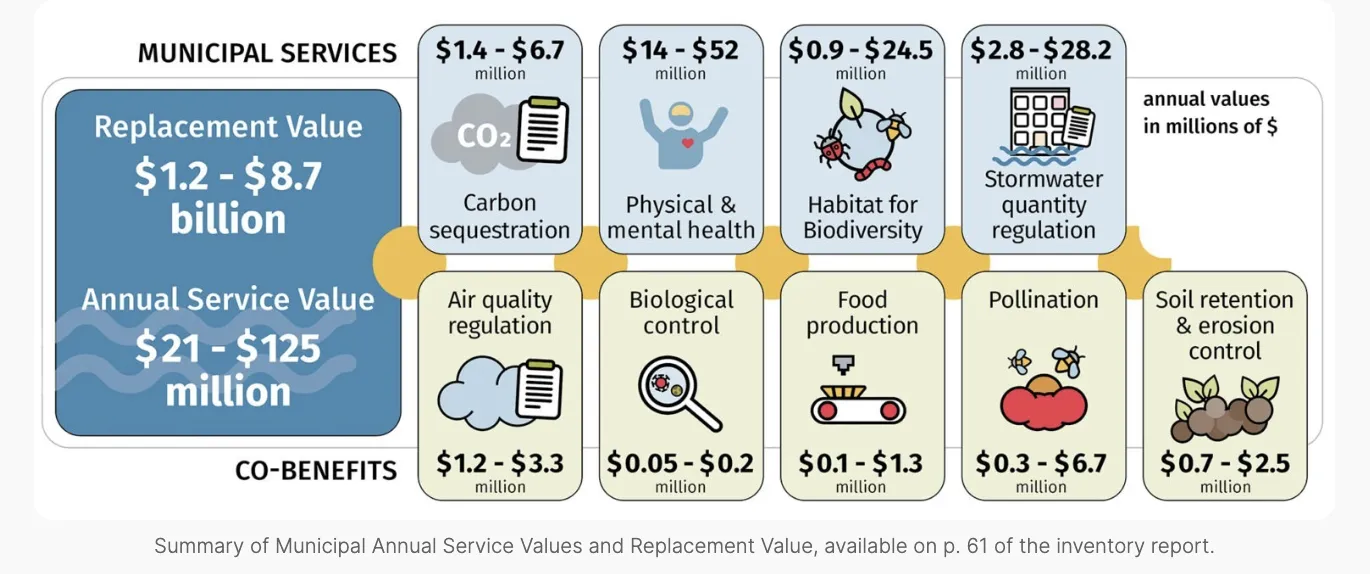
Colwood: https://naturalassetsinitiative.ca/communities/city-of-colwood/ Natural Asset Inventory: https://naturalassetsinitiative.ca/wp-content/uploads/2023/08/MNAI-Inventory-Cluster-2-Colwood-report-106.pdf
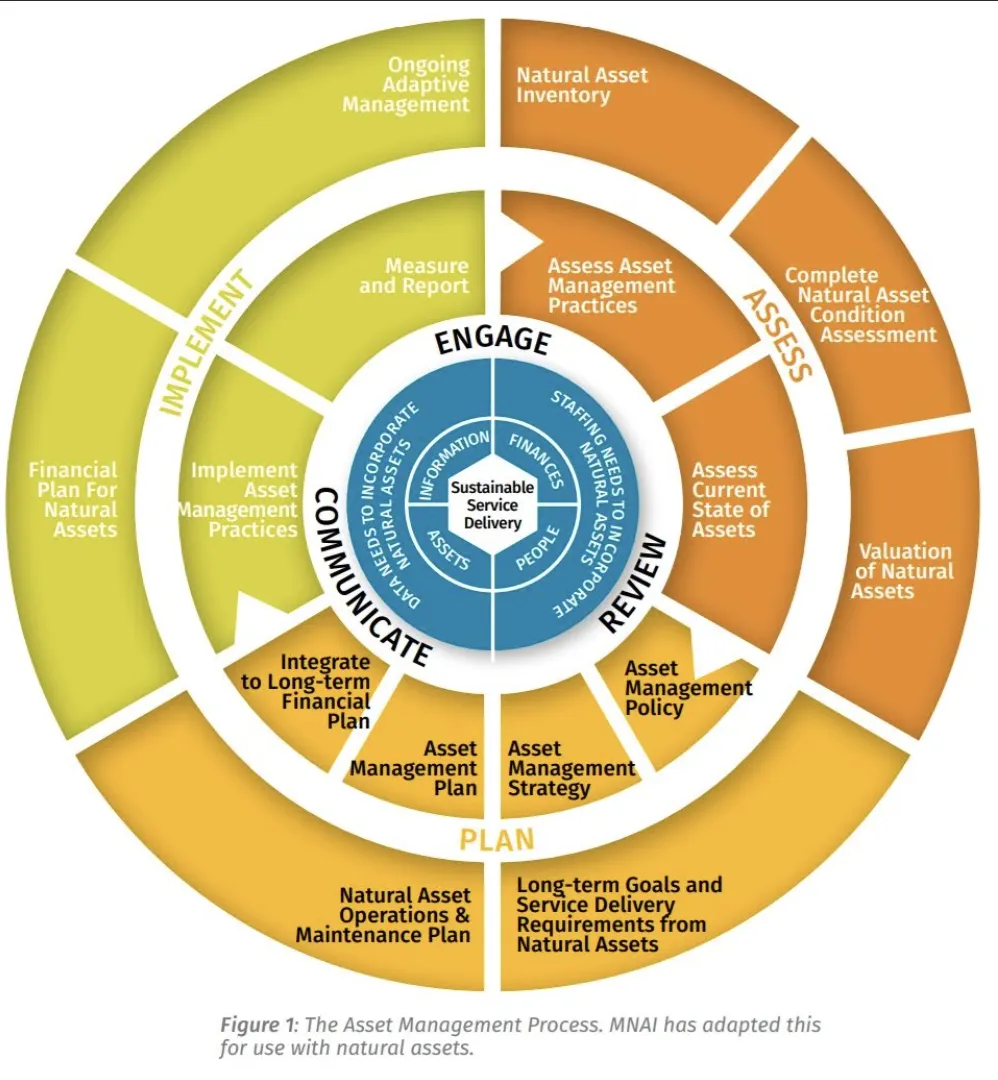
IMAGE OF NAM PROCESS
The Inventory provides financial analysis tools to allow Municipal Staff to make better cost-benefit decisions:
a) Natural assets lower the cost of engineered infrastructure (pipes & culverts for stormwater), and reduce energy and water usage in times of drought & heat. Municipalities can avoid paying for engineered infrastructure replacements, or reduce the costs of those replacements.
b) Natural infrastructure is typically lower cost in and has longer lifespans that engineered infrastructure (wetlands and riparian areas for stormwater management, urban forests for cooling)
c) Natural assets offer co-benefits that engineering infrastructure cannot: economic development (eg., tourism, outdoor recreation), public health & safety, biodiversity for pollination (for food production), urban cooling, absorbing excess rainwater from engineered assets that cannot handle atmospheric rivers, etc.
d) Natural assets save on insurance costs for municipality and citizens (and some insurance companies are eliminating insurance coverage in areas prone to atmospheric rivers or sea level rise): https://www.intactcentreclimateadaptation.ca/
More info: https://naturalassetsinitiative.ca/the-price-of-nature/ https://naturalassetsinitiative.ca/lowering-development-cost-charges-through-eco-asset-approach/
Google Resources on Natural Asset Inventories
Setting the Bar: Natural Asset Inventories standard out now - Natural Assets Initiative https://naturalassetsinitiative.ca › NEWS Jul 27, 2023 — The voluntary Standard, published through CSA Group
Natural asset inventories identify, map, and assess the condition of ecosystems—such as wetlands, forests, and streams—that provide essential community services like flood mitigation, water filtration, and carbon sequestration. They serve as the foundational first step in natural asset management, allowing local governments to value, protect, and manage these resources for sustainable, cost-effective infrastructure services. Key aspects of natural asset inventories include:
- Purpose: To create a data-driven understanding of natural features to inform decision-making, such as incorporating them into official community plans and climate adaptation strategies.
- Components: Inventories typically include an asset registry (data table) and a map or dashboard showing the location, type, and condition of assets.
- Methodology: A national standard (CSA W218) now exists to provide consistent, comparable data for these inventories.
- Components of an Inventory: Examples include wetlands, forests, lakes, rivers, creeks, and meadows.
- Next Steps: Following the inventory, local governments often move towards valuation, modeling, and full integration into asset management plans.
These inventories are crucial for moving beyond aesthetic appreciation of nature toward managing them as critical, functional infrastructure.
CSA Group publishes National Standard for Natural Asset ... CSA Group https://www.csagroup.org › news › csa-group-publishes-... Jul 27, 2023 — This National Standard of Canada defines minimum requirements for the development and reporting of a natural asset inventory.
Natural Asset Management District of Saanich https://www.saanich.ca › main › local-government › nat... On July 8, 2024, Council received the Natural Assets Inventory report, which provides preliminary information about the natural assets within the District of ...
Natural Asset Inventory City of Colwood https://www.colwood.ca › sustainability-climate-action Natural assets are land based - streams, ponds, ditches, trees and green spaces - therefore they appreciate in value, unlike man-made structures
Natural Asset Inventories - ESSA Technologies essa.com https://www.essa.com › Explore ESSA › Services The first step in natural asset management is to build an inventory of ecosystem components and the associated ecosystem services those assets provide.
CSA W218:23 - Specifications for Natural Asset Inventories Climate Insight https://climateinsight.ca › csg › csa-w21823---specificat... This Standard provides minimum requirements for the development and reporting of a natural asset inventory, which is the first step towards natural asset ...
Videos What is a Natural Asset Inventory? | Leq'á:mel First Nation YouTube · BC First Nations Forestry Council Nov 4, 2025
3:00 A natural asset inventory recognizes the value of natural assets like watercourses and helps communities understand the cost of replacing them.