Project Summary N-114: Cool it! Climate action leadership training
Funding for school workshops to encourage student actions that reduce household carbon footprints.
Project Summary
Project Name: Cool it! Climate action leadership training Project ID: 1-2-01400-580 CC140-16 Priority: Discretionary Public Engagement: Not applicable
Submitted by: J. Chow, Senior Planner Director: Leanne Taylor, Development Services
Executive Summary
The Capital Regional District funds a limited number of workshops run by the non-profit BC Sustainable Energy Association in schools to encourage students and their families to choose actions to reduce their household’s carbon footprint. Students also learn about climate change, sustainability, and local community climate programs. By providing top up funding for additional workshops to reach more kids in View Royal schools, this initiative would respond to the declared climate action emergency by encouraging action on greenhouse gas emissions at a community level and support the public education objectives of the Community Climate Action Strategy.
Business problem and opportunity
CRD funded one View Royal elementary school class in the 2022 school year, leaving a waitlist of three classes (approximately 75 students and families), and two View Royal elementary school classes in 2023 school year. In addition to building climate awareness at home for students and their families, data from the 2023-2024 Cool It! Final Report (Attachment 2) shows that the average greenhouse gas emission reduction would be 4.3 tonnes of carbon dioxide equivalent per class if they commit to maintain their actions for one year.
Proposed project objectives
Provide top-ups to fund up to four school classes per year in View Royal to learn about and reduce community greenhouse gas emissions.
Business risks
A lost opportunity to motivate approximately up to 75 View Royal families per year to take personal actions to address the Climate Emergency and reduce community greenhouse gas emissions if the Town does not participate in this regional program.
Proposed sources of funding
Provincial grant reserve account – Local Government Climate Action Program (LGCAP) 1-1-00500-185
Costs and benefits
| Costs | FY1 | FY2 | FY3 | FY4 | FY5 | 5-year Total |
|---|---|---|---|---|---|---|
| Capital | 0 | 0 | 0 | 0 | 0 | 0 |
| Operational | 3,100 | 3,200 | 3,300 | 3,400 | 3,500 | 16,500 |
| Total | 3,100 | 3,200 | 3,300 | 3,400 | 3,500 | 16,500 |
| Benefits | |
|---|---|
| Tangible | Measurable greenhouse gas emissions from year-end report |
| Intangible | Increase awareness and behavioral changes in citizens to reduce greenhouse gas emissions |
Recommendation
THAT the Committee recommend the 2026-2030 Financial Plan include Cool it! Climate action leadership training each year to be funded by a provincial grant reserve account – LGCAP.
Additional Information
Attachments:
- 2024 08 24 CRD email re: BCSEA Cool It! Workshop (2 pages)
- 2023-2024 CRD Cool It! Program Final Report excerpt (5 pages)
- 2024-2025 CRD Cool It! Funding Proposal (3 pages)
Attachment 1. 2024 08 24 CRD email re: BCSEA Cool It! Workshop
From: Megan Rowe mrowe@crd.bc.ca Sent: August 26, 2024 3:56 PM To: […] Jeff Chow JChow@viewroyal.ca […] Subject: BCSEA Cool It! Workshops - Final Report and Top-Up Opportunity
Dear CRD Climate Action Inter-Municipal Working Group members,
With September just around the corner, we’re reaching out to see if there is any interest in having your municipality top-up the BCSEA Cool It! Climate Leadership workshops within your community for the 2024/25 school year. To limit administration for you, we have offered this service for the past number of years.
As a refresher, the Cool It! Program consists of an interactive workshop followed by a four-week take-home climate challenge, and a wrap-up session to review learnings and share successes. It targets Grade 4 – 7 (elementary school) and Grades 8-10 (high school program). We have worked closely with BCSEA to include locally relevant context and content within the curriculum over the years.
Results from 2023/2024 (see final report attached):
- Workshops Delivered: 104 total (72 elementary, 32 high school)
- CRD-Funded Workshops: 35, distributed across the region based on student population
- Municipal top-ups: The City of Victoria (16 workshops), District of Saanich (36 workshops), District of Central Saanich (5 workshops), District of Sooke (5 workshops), and District of Oak Bay (7 workshops) funded additional workshops in their respective municipalities
- Student Engagement: 2,423 students engaged (1,683 elementary, 740 high school)
- Actions Completed: Students collectively completed 15,704 climate and sustainability actions
- Waitlists: There were class waitlists for workshops in Langford, Colwood, View Royal, Metchosin, Esquimalt, and North Saanich
Planning for 2024/2025 (see funding proposal attached):
- CRD-Funded Workshops: The CRD intends to fund 35 workshops and distribute evenly throughout the region again – approximately 25 workshops for grades 4-7 and 10 workshops for grades 8-12
- Municipal Top-Up Costs: $600 for elementary school workshops and $720 for high school workshops
Attached you will find the 2023/24 Final Report and the funding proposal for the 2024/25 school year.
If your municipality is interested, please reach out directly by EOD September 6, 2024. If you are interested, but need additional time, please be in touch as well. I am happy to provide additional information as needed. As always, the CRD will be covering a base number of workshops within your community, so no pressure if this does not align with your plans.
Thank you,
Megan
Megan Rowe (she/they) Climate Action Program Assistant | Parks, Recreation & Environmental Services
Attachment 2. 2023-2024 CRD Cool It! Program Final Report excerpt
Executive summary
During the 2023/24 school year, the Capital Regional District, District of Saanich, City of Victoria, District of Central Saanich, District of Oak Bay and the District of Sooke, collectively provided generous support to the BC Sustainable Energy Association’s (BCSEA) Cool It! Climate Leadership Training Program (The Cool It! Program) enabling the delivery of the program to up to 78 elementary classes and 29 high school classes across the CRD.
Ultimately, the Cool It! Program was delivered to 104 classes (72 elementary and 32 high school). The program reached 2,423 students (1,683 elementary and 740 high school). Students collectively completed 15,704 climate and sustainability actions.
Based on feedback collected in recent years from schools and teachers, The Cool It! Program continues to offer the option of both in-person or virtual workshop delivery. As in previous years, the decision on the most appropriate delivery method for each class was left in the hands of participating teachers.
The four-week Cool It! Climate Challenge encouraged students to choose from a variety of actions that would reduce theirs and their family’s carbon and ecological footprints. It also provided opportunities for further investigation and reflection about issues related to climate change and sustainability as well as highlighting avenues for participation in local community action and programs.
Qualitative and quantitative data was collected from student actions prompted by their participation in the Cool It! Climate Challenge. Through energy conserving and emissions saving actions at home, along with research and inquiry activities, we expect participating student’s actions across the CRD to result in an estimated annual saving of a total of 450 tonnes of carbon dioxide emissions (CO2e) if they commit to maintain their actions for one year. Overall, students did a fantastic job, with strong participation and engagement in both the workshop and the climate challenge components of the program.
The 2023-24 program curriculum
BCSEA has developed a unique program curriculum for both elementary and high school classes. This includes the content covered in workshops, actions provided in the climate challenge, and the format and language in which those actions are presented. For both curriculums, a climate workshop (two in the case of high school classes) and participation in a four-week climate challenge comprise the main components of the program.
Workshops During the 2023-24 school year, BCSEA offered teachers the option of participating in an in-person or virtual workshop – depending on which mode of learning best suited their class. Each elementary class participated in a 60-minute workshop at the beginning of the program and a 30-minute wrap-up session after completing their four-week climate challenge. Each high school class participated in two 60-minute workshops, spaced roughly two weeks apart.
In the workshops, all students learnt about the fundamentals of climate change science, debunked common climate myths and misconceptions, watched videos detailing the scientific processes of climate change, practiced evaluating the production and consumption life cycle of everyday items, explored the causes, impacts and solutions to climate change, and learnt about taking climate action with their friends and families and in their local communities. High school classes used their second workshop to explore more advanced concepts related to climate science and the public and private solutions being developed. As well as discussing concepts of climate justice and the social and economic impacts of climate change, both locally and globally.
After four weeks, a wrap-up session was held with each class to share their successes and challenges, recap the key messages and learnings from the workshop and celebrate their collective results.
Climate Challenge After their initial workshop, students participated in the Cool It! Climate Challenge for the next four weeks.
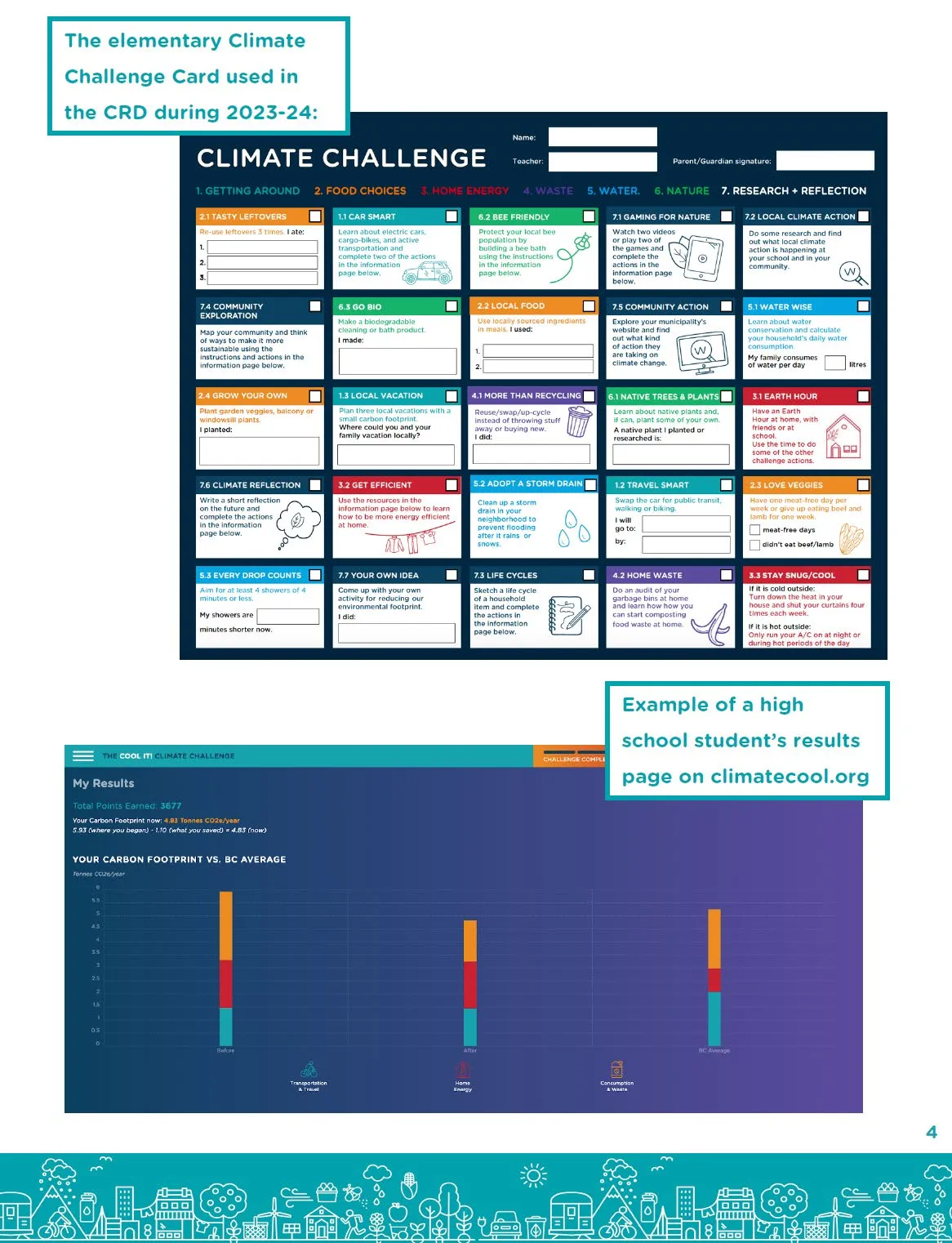
Elementary students were given a Climate Challenge Card - an interactive PDF document containing 25 unique actions that could be used digitally or printed out and completed by hand. When an action is completed, students check-off the corresponding square on the card as well as enter additional answers and information where required. A 15-page supplementary booklet was also provided, which offered additional information about each action, extra support to complete it, and opportunities to for optional further research and investigation alongside additional resources.
High school students registered on BCSEA's online platform climatecool.org. The platform guided each student through weekly action-taking. Students completed a simple quiz when registering to determine a baseline CO2e footprint for them and their family. This footprint was then dynamically recalculated at the end of each week to reveal the impact of their actions on their initial footprint. Like the elementary challenge, the climatecool.org platform provided high school students with additional, locally relevant resources and information and encouraged them to extend their research, investigation, and action-taking beyond the challenge itself.
Traditionally, the Cool It! Program focuses on gathering quantitative data through the collation of completed actions and measuring outcomes (where possible) in carbon dioxide emissions savings. While some actions yielded a quantifiable emissions reduction, other actions yielded qualitative results through individual reflection, personal investigation, and research.
CRD & partner municipality funded classes
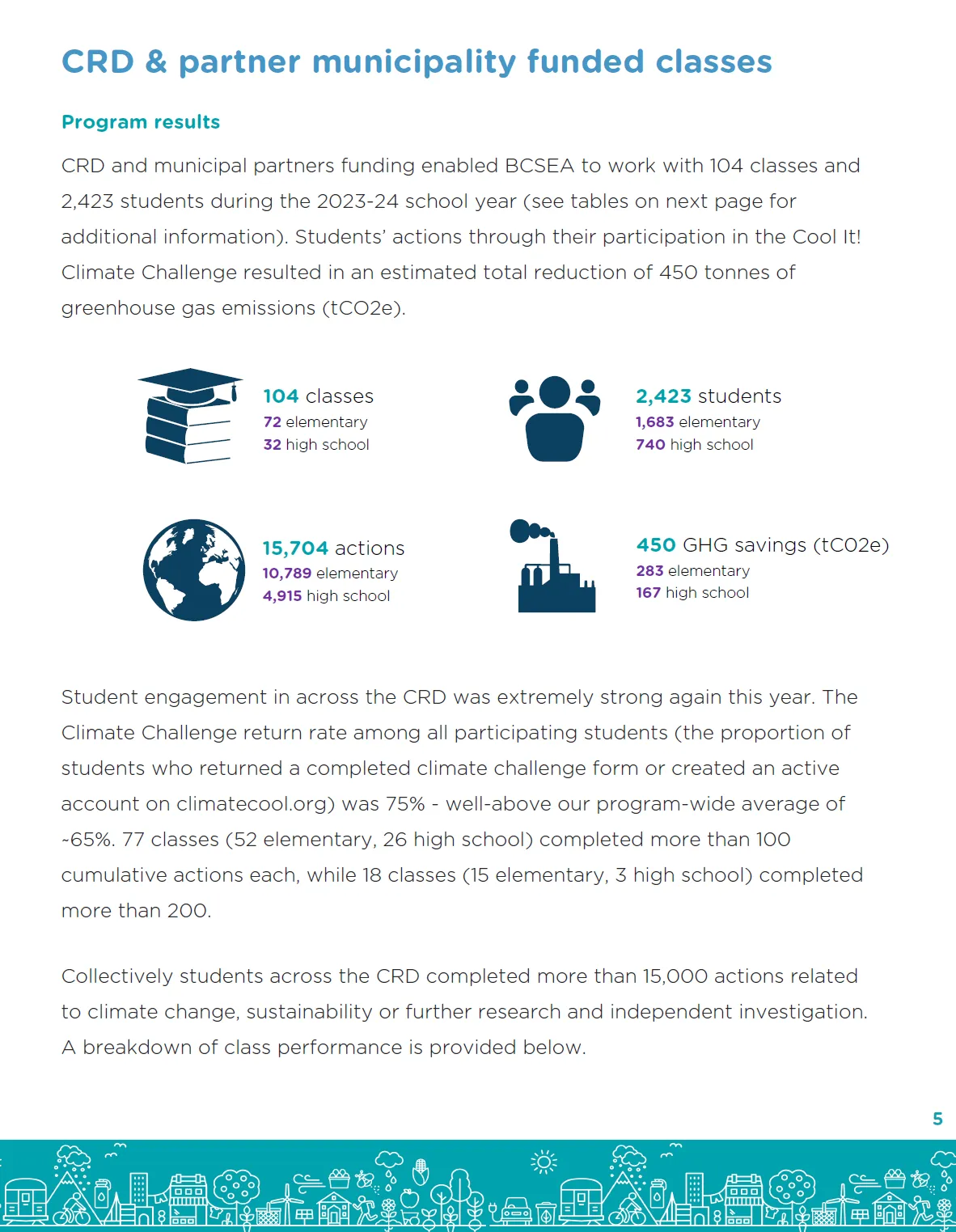
Program results CRD and municipal partners funding enabled BCSEA to work with 104 classes and 2,423 students during the 2023-24 school year (see tables on next page for additional information). Students’ actions through their participation in the Cool It! Climate Challenge resulted in an estimated total reduction of 450 tonnes of greenhouse gas emissions (tCO2e).
- 104 classes: 72 elementary, 32 high school
- 2,423 students: 1,683 elementary, 740 high school
- 15,704 actions: 10,789 elementary, 4,915 high school
- 450 GHG savings (tCO2e): 283 elementary, 167 high school
Student engagement in across the CRD was extremely strong again this year. The Climate Challenge return rate among all participating students (the proportion of students who returned a completed climate challenge form or created an active account on climatecool.org) was 75% - well-above our program-wide average of ~65%. 77 classes (52 elementary, 26 high school) completed more than 100 cumulative actions each, while 18 classes (15 elementary, 3 high school) completed more than 200.
Collectively students across the CRD completed more than 15,000 actions related to climate change, sustainability or further research and independent investigation. A breakdown of class performance is provided below.
Attachment 3. 2024-2025 CRD Cool It! Funding Proposal
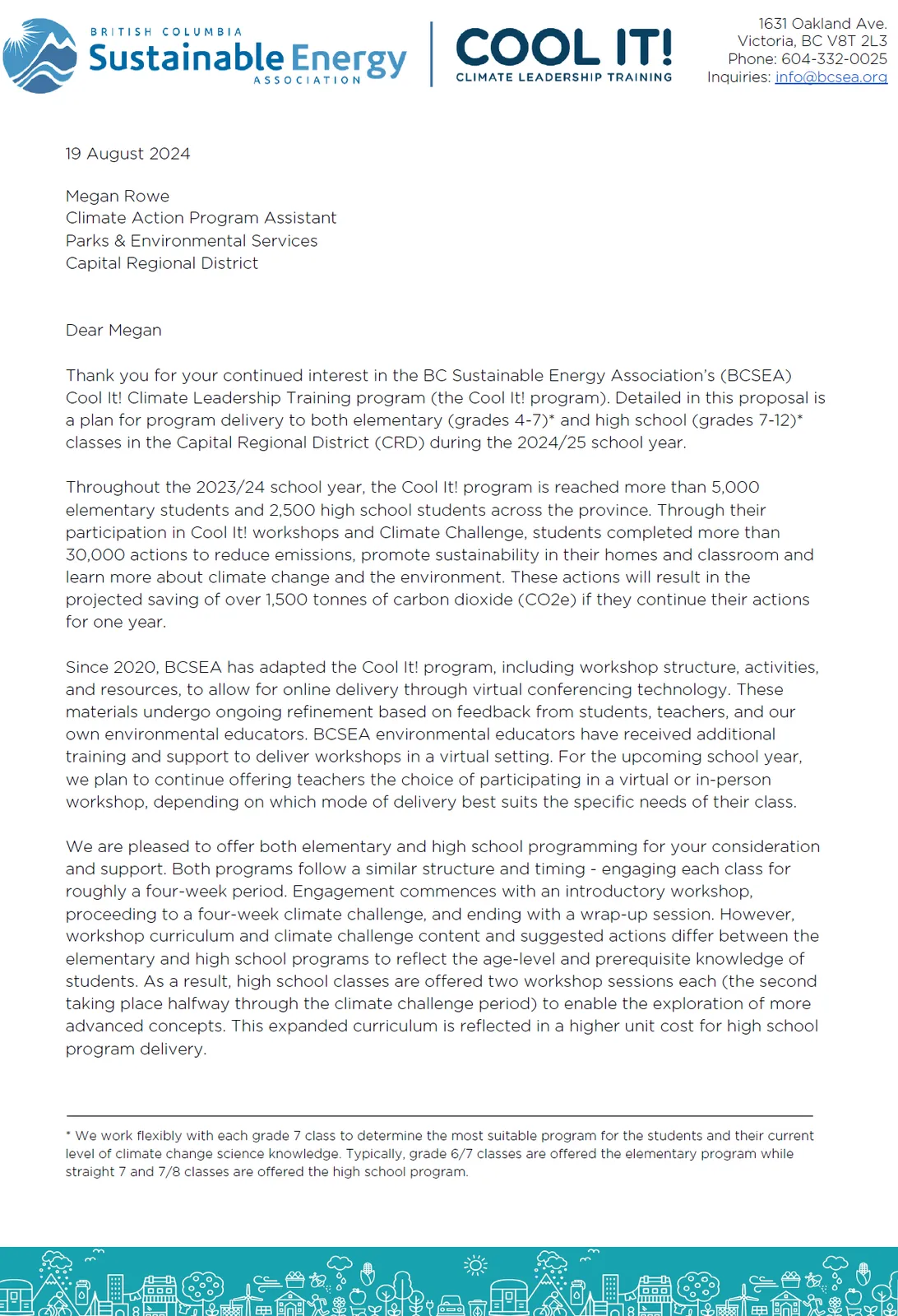
19 August 2024
Megan Rowe Climate Action Program Assistant Parks & Environmental Services Capital Regional District
Dear Megan
Thank you for your continued interest in the BC Sustainable Energy Association’s (BCSEA) Cool It! Climate Leadership Training program (the Cool It! program). Detailed in this proposal is a plan for program delivery to both elementary (grades 4-7)* and high school (grades 7-12)* classes in the Capital Regional District (CRD) during the 2024/25 school year.
Throughout the 2023/24 school year, the Cool It! program is reached more than 5,000 elementary students and 2,500 high school students across the province. Through their participation in Cool It! workshops and Climate Challenge, students completed more than 30,000 actions to reduce emissions, promote sustainability in their homes and classroom and learn more about climate change and the environment. These actions will result in the projected saving of over 1,500 tonnes of carbon dioxide (CO2e) if they continue their actions for one year.
Since 2020, BCSEA has adapted the Cool It! program, including workshop structure, activities, and resources, to allow for online delivery through virtual conferencing technology. These materials undergo ongoing refinement based on feedback from students, teachers, and our own environmental educators. BCSEA environmental educators have received additional training and support to deliver workshops in a virtual setting. For the upcoming school year, we plan to continue offering teachers the choice of participating in a virtual or in-person workshop, depending on which mode of delivery best suits the specific needs of their class.
We are pleased to offer both elementary and high school programming for your consideration and support. Both programs follow a similar structure and timing - engaging each class for roughly a four-week period. Engagement commences with an introductory workshop, proceeding to a four-week climate challenge, and ending with a wrap-up session. However, workshop curriculum and climate challenge content and suggested actions differ between the elementary and high school programs to reflect the age-level and prerequisite knowledge of students. As a result, high school classes are offered two workshop sessions each (the second taking place halfway through the climate challenge period) to enable the exploration of more advanced concepts. This expanded curriculum is reflected in a higher unit cost for high school program delivery.
* We work flexibly with each grade 7 class to determine the most suitable program for the students and their current level of climate change science knowledge. Typically, grade 6/7 classes are offered the elementary program while straight 7 and 7/8 classes are offered the high school program.
2024/25 class sponsorship
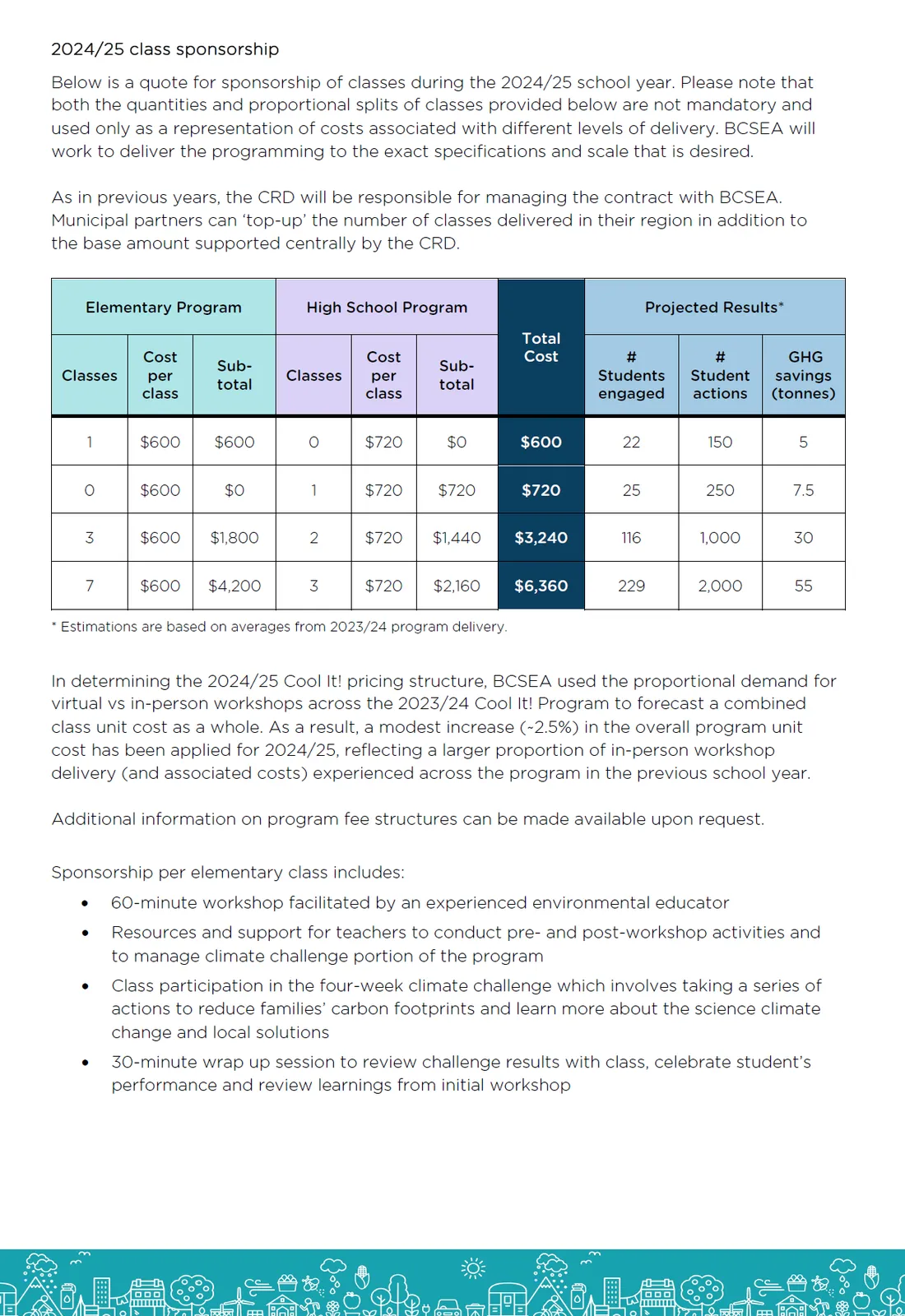
Below is a quote for sponsorship of classes during the 2024/25 school year. Please note that both the quantities and proportional splits of classes provided below are not mandatory and used only as a representation of costs associated with different levels of delivery. BCSEA will work to deliver the programming to the exact specifications and scale that is desired.
As in previous years, the CRD will be responsible for managing the contract with BCSEA. Municipal partners can ‘top-up’ the number of classes delivered in their region in addition to the base amount supported centrally by the CRD.
| Elementary Program | High School Program | Total Cost | Projected Results* | ||||||
|---|---|---|---|---|---|---|---|---|---|
| Classes | Cost per class | Sub-total | Classes | Cost per class | Sub-total | # Students engaged | # Student actions | GHG savings (tonnes) | |
| 1 | $600 | $600 | 0 | $720 | $0 | $600 | 22 | 150 | 5 |
| 0 | $600 | $0 | 1 | $720 | $720 | $720 | 25 | 250 | 7.5 |
| 3 | $600 | $1,800 | 2 | $720 | $1,440 | $3,240 | 116 | 1,000 | 30 |
| 7 | $600 | $4,200 | 3 | $720 | $2,160 | $6,360 | 229 | 2,000 | 55 |
* Estimations are based on averages from 2023/24 program delivery.
In determining the 2024/25 Cool It! pricing structure, BCSEA used the proportional demand for virtual vs in-person workshops across the 2023/24 Cool It! Program to forecast a combined class unit cost as a whole. As a result, a modest increase (~2.5%) in the overall program unit cost has been applied for 2024/25, reflecting a larger proportion of in-person workshop delivery (and associated costs) experienced across the program in the previous school year.
Additional information on program fee structures can be made available upon request.
Sponsorship per elementary class includes:
- 60-minute workshop facilitated by an experienced environmental educator
- Resources and support for teachers to conduct pre- and post-workshop activities and to manage climate challenge portion of the program
- Class participation in the four-week climate challenge which involves taking a series of actions to reduce families’ carbon footprints and learn more about the science climate change and local solutions
- 30-minute wrap up session to review challenge results with class, celebrate student’s performance and review learnings from initial workshop
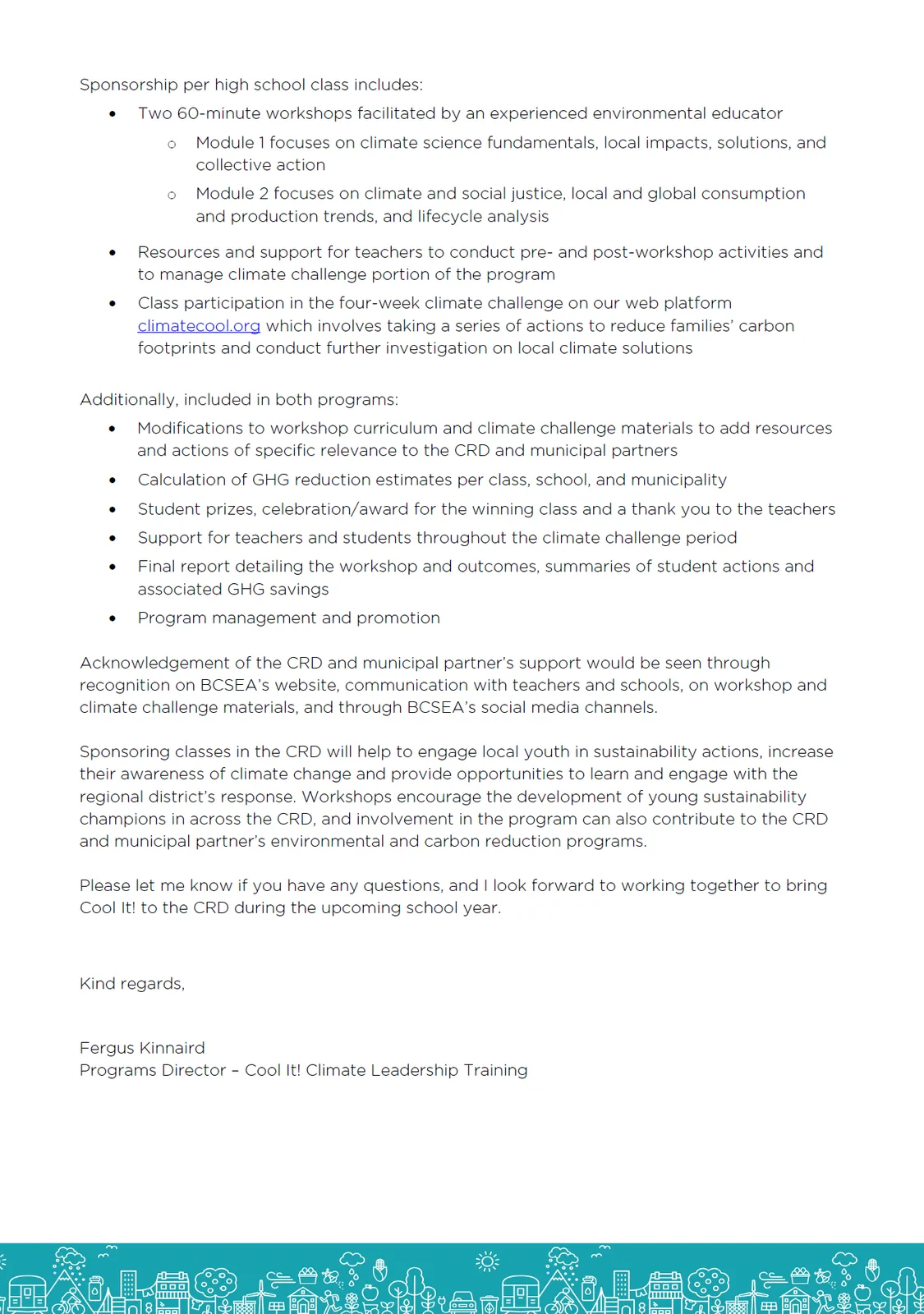
Sponsorship per high school class includes:
- Two 60-minute workshops facilitated by an experienced environmental educator
- Module 1 focuses on climate science fundamentals, local impacts, solutions, and collective action
- Module 2 focuses on climate and social justice, local and global consumption and production trends, and lifecycle analysis
- Resources and support for teachers to conduct pre- and post-workshop activities and to manage climate challenge portion of the program
- Class participation in the four-week climate challenge on our web platform climatecool.org which involves taking a series of actions to reduce families’ carbon footprints and conduct further investigation on local climate solutions
Additionally, included in both programs:
- Modifications to workshop curriculum and climate challenge materials to add resources and actions of specific relevance to the CRD and municipal partners
- Calculation of GHG reduction estimates per class, school, and municipality
- Student prizes, celebration/award for the winning class and a thank you to the teachers
- Support for teachers and students throughout the climate challenge period
- Final report detailing the workshop and outcomes, summaries of student actions and associated GHG savings
- Program management and promotion
Acknowledgement of the CRD and municipal partner’s support would be seen through recognition on BCSEA’s website, communication with teachers and schools, on workshop and climate challenge materials, and through BCSEA’s social media channels.
Sponsoring classes in the CRD will help to engage local youth in sustainability actions, increase their awareness of climate change and provide opportunities to learn and engage with the regional district’s response. Workshops encourage the development of young sustainability champions in across the CRD, and involvement in the program can also contribute to the CRD and municipal partner’s environmental and carbon reduction programs.
Please let me know if you have any questions, and I look forward to working together to bring Cool It! to the CRD during the upcoming school year.
Kind regards,
Fergus Kinnaird Programs Director - Cool It! Climate Leadership Training