B.C.'s short-term rental legislation - Overview
Information printout regarding provincial regulations for short-term rental accommodations.
Home / Housing and tenancy / Short-term rentals / B.C.'s short-term rental legislation
B.C.'s short-term rental legislation
Last updated on April 1, 2026
Like many jurisdictions, B.C. is regulating short-term rentals to help return more short-term rental units into homes for people. Learn more about B.C.'s Short-Term Rental Accommodations Act and regulations on this page.
On this page:
- Overview of B.C.'s Short-Term Rental Accommodations Act
- Helping more people find a place to live
- Strengthening local government tools to enforce short-term rental bylaws
- Establishing provincial oversight of short-term rentals
- Short-term rentals versus tenancies
- News releases
Overview of B.C.'s Short-Term Rental Accommodations Act
B.C. is facing a housing crisis, with a shortage of all forms of attainable housing, including long-term rentals. The rise of the short-term rental of entire homes has taken away much needed homes for British Columbians, making it more challenging to find affordable long-term places to live.
The purpose of the Act is to:

The rules help balance the need to create more long-term homes for residents, including people who work in the tourism and hospitality industry, with the need to accommodate visitors, particularly in smaller communities and those communities that are heavily reliant on tourism.
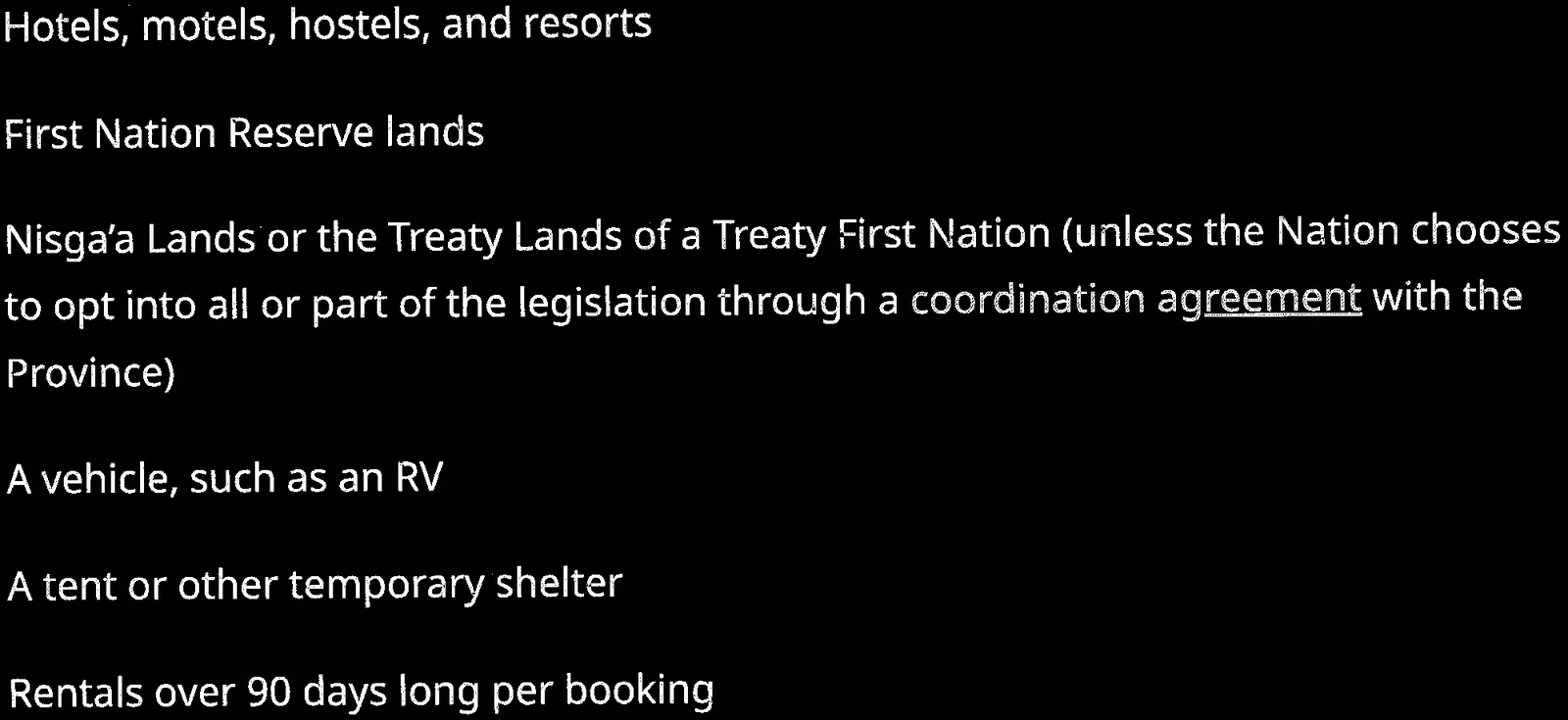
The Act applies to short-term rentals being offered to the public including:
- Platforms where people reserve and pay for the accommodation, which may include, for example, Airbnb, VRBO, or Booking.com
- Offers on other web listing forums, for example, Facebook Marketplace, Kijiji, and Craigslist
- Listings in classified ads in newspapers
The Act does not apply to:
Helping more people find a place to live
Principal residence requirement
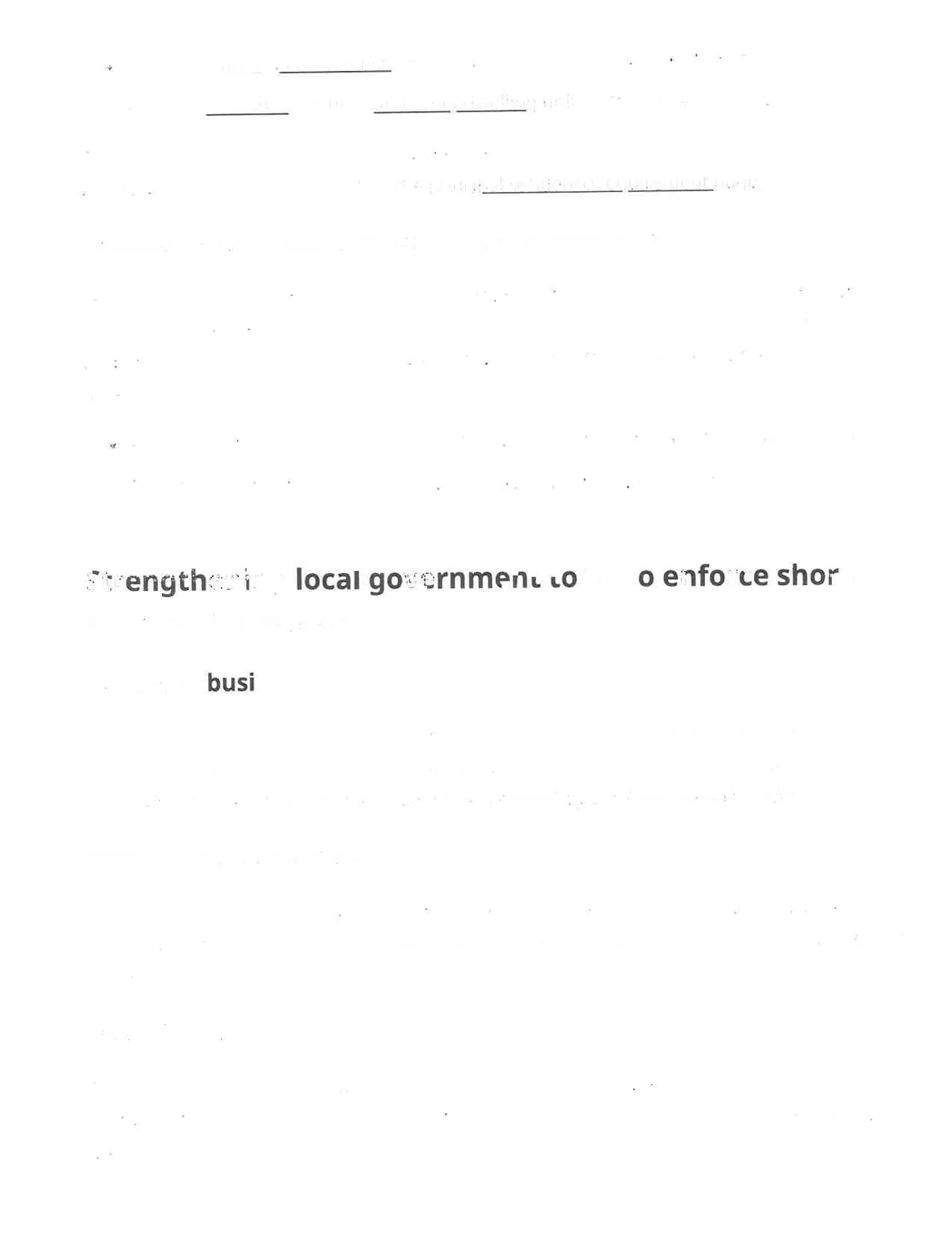
The provincial principal residence requirement limits short-term rentals to:
- The host's principal residence, the usual place where they make their home
- Plus one secondary suite or accessory dwelling unit on the same property
This requirement does not apply everywhere. Find more information on the provincial principal residence requirement on the principal residence requirement page.
Changes to legal non-conforming use protections
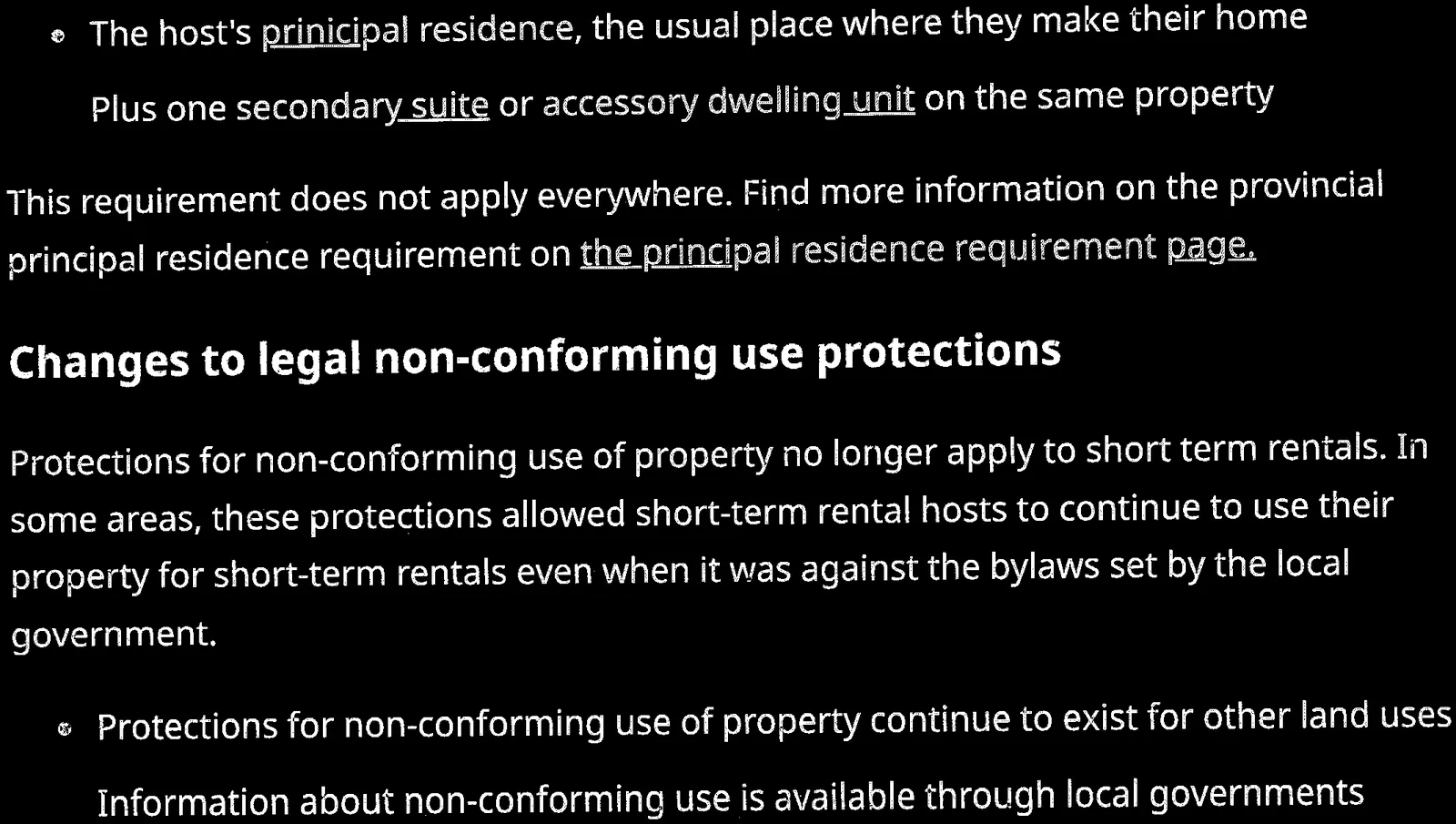
Protections for non-conforming use of property no longer apply to short term rentals. In some areas, these protections allowed short-term rental hosts to continue to use their property for short-term rentals even when it was against the bylaws set by the local government.
- Protections for non-conforming use of property continue to exist for other land uses
- Information about non-conforming use is available through local governments
Strengthening local government tools to enforce short-term rental bylaws
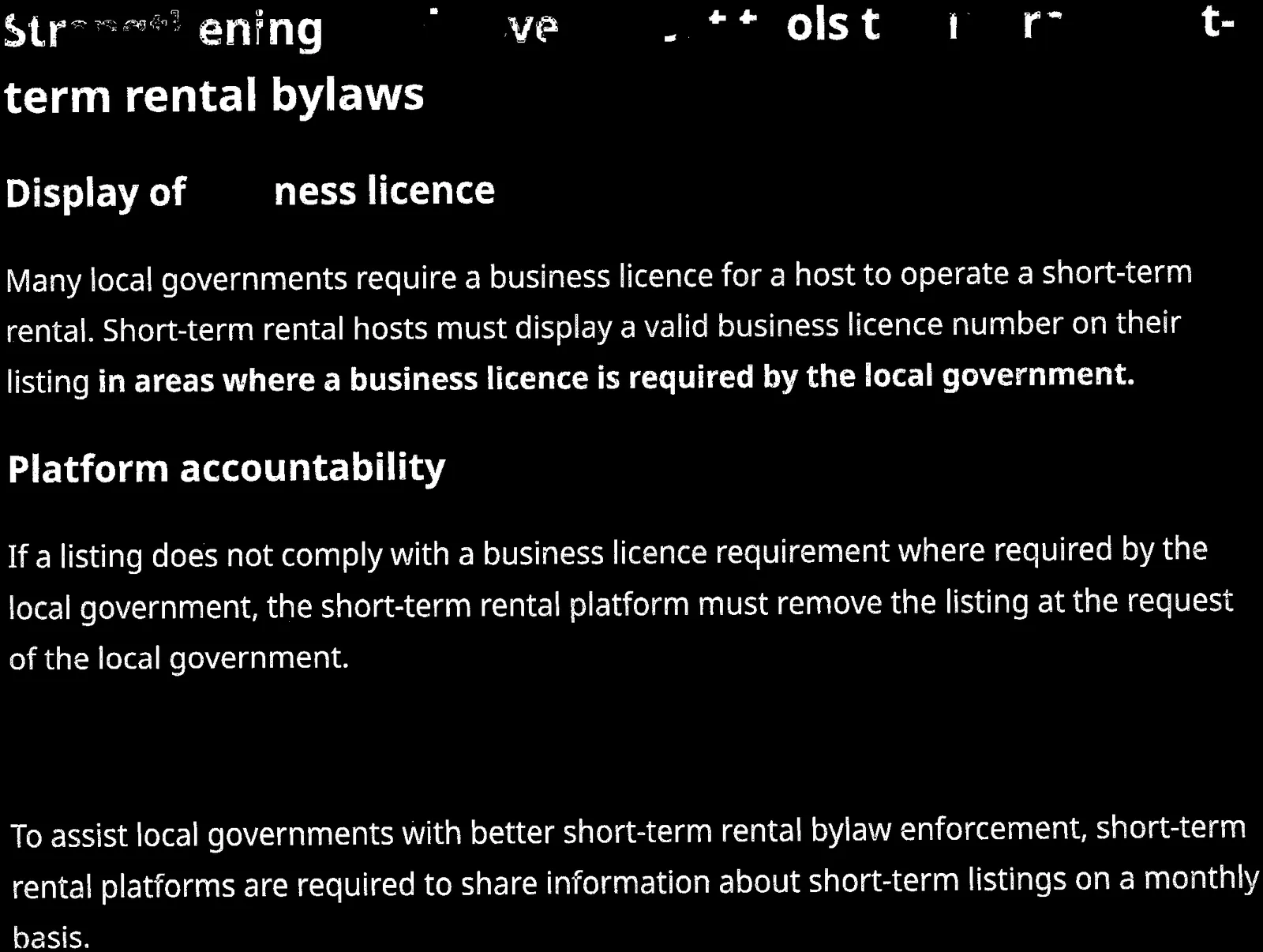
Display of business licence
Many local governments require a business licence for a host to operate a short-term rental. Short-term rental hosts must display a valid business licence number on their listing in areas where a business licence is required by the local government.
Platform accountability
If a listing does not comply with a business licence requirement where required by the local government, the short-term rental platform must remove the listing at the request of the local government.
Data sharing
To assist local governments with better short-term rental bylaw enforcement, short-term rental platforms are required to share information about short-term listings on a monthly basis.
This information is confidential and will not be disclosed to the public.
Increased fines and tickets
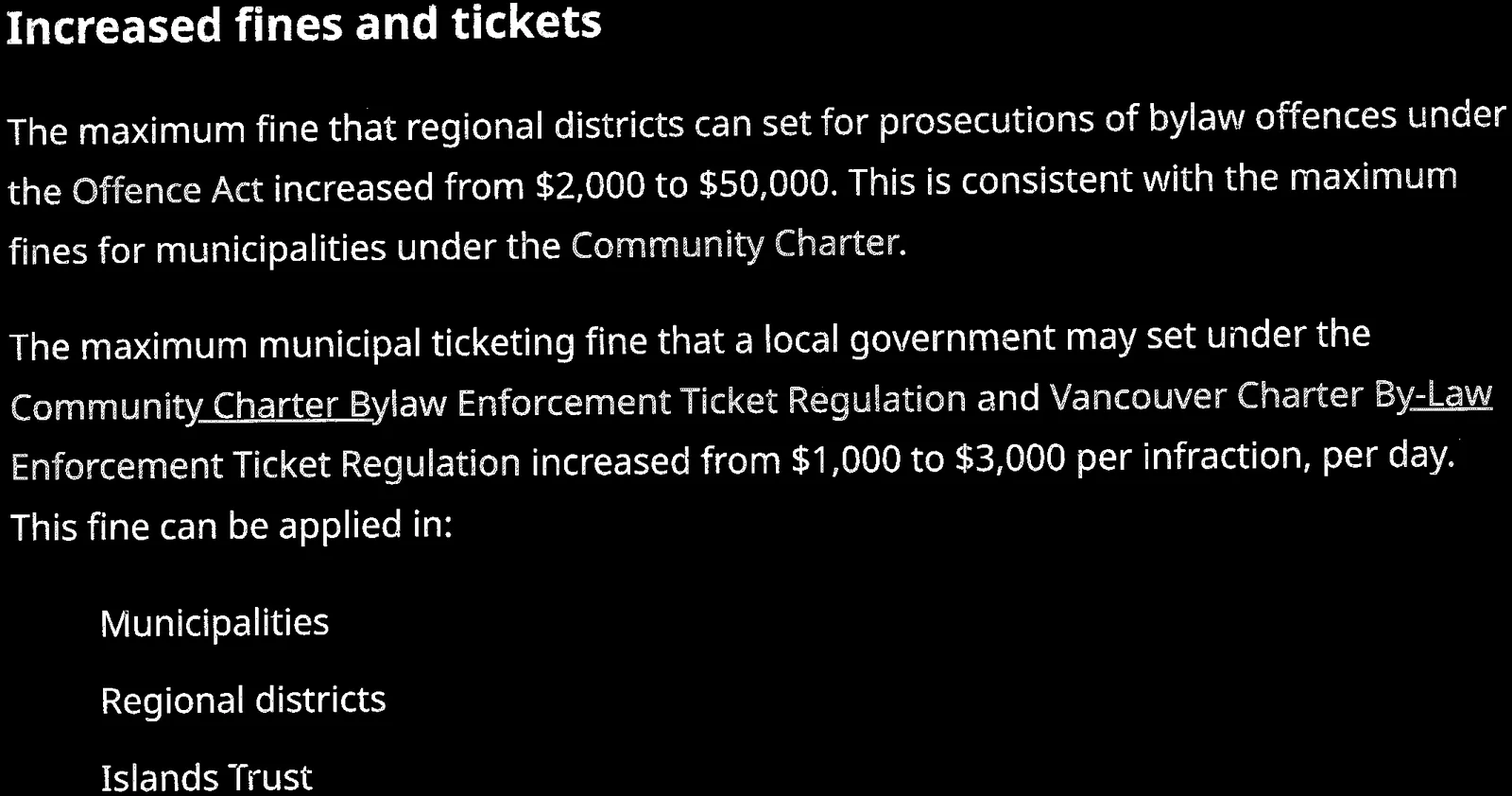
The maximum fine that regional districts can set for prosecutions of bylaw offences under the Offence Act increased from $2,000 to $50,000. This is consistent with the maximum fines for municipalities under the Community Charter.
The maximum municipal ticketing fine that a local government may set under the Community Charter Bylaw Enforcement Ticket Regulation and Vancouver Charter By-Law Enforcement Ticket Regulation increased from $1,000 to $3,000 per infraction, per day. This fine can be applied in:
- Municipalities
- Regional districts
- Islands Trust
New business licensing authority for regional districts
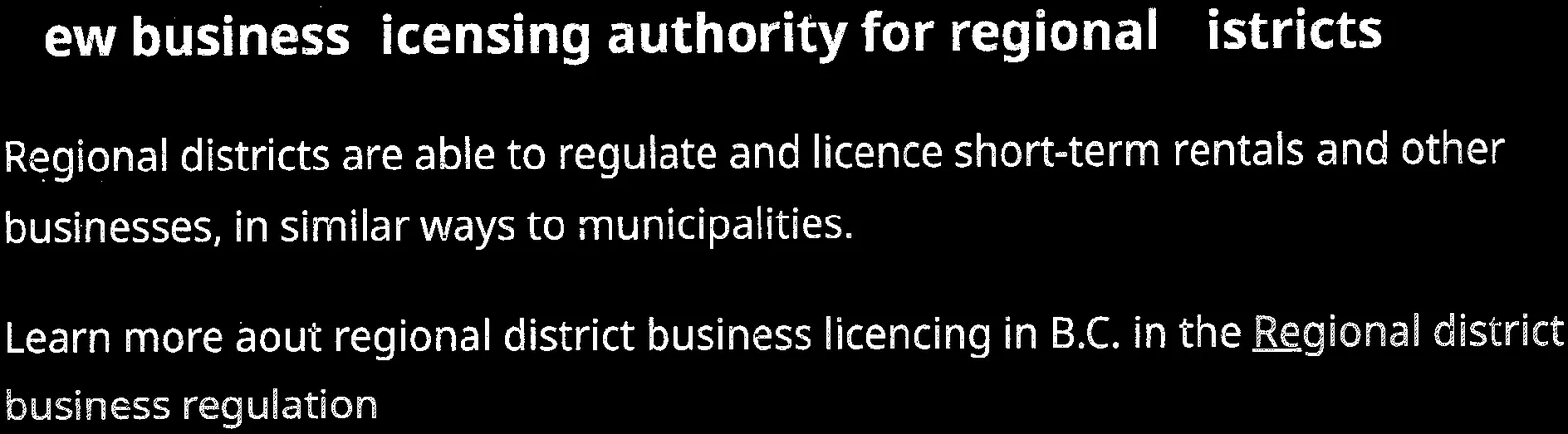
Regional districts are able to regulate and licence short-term rentals and other businesses, in similar ways to municipalities.
Learn more about regional district business licencing in B.C. in the Regional district business regulation.
Establishing provincial oversight of short-term rentals
Provincial short-term rental registry
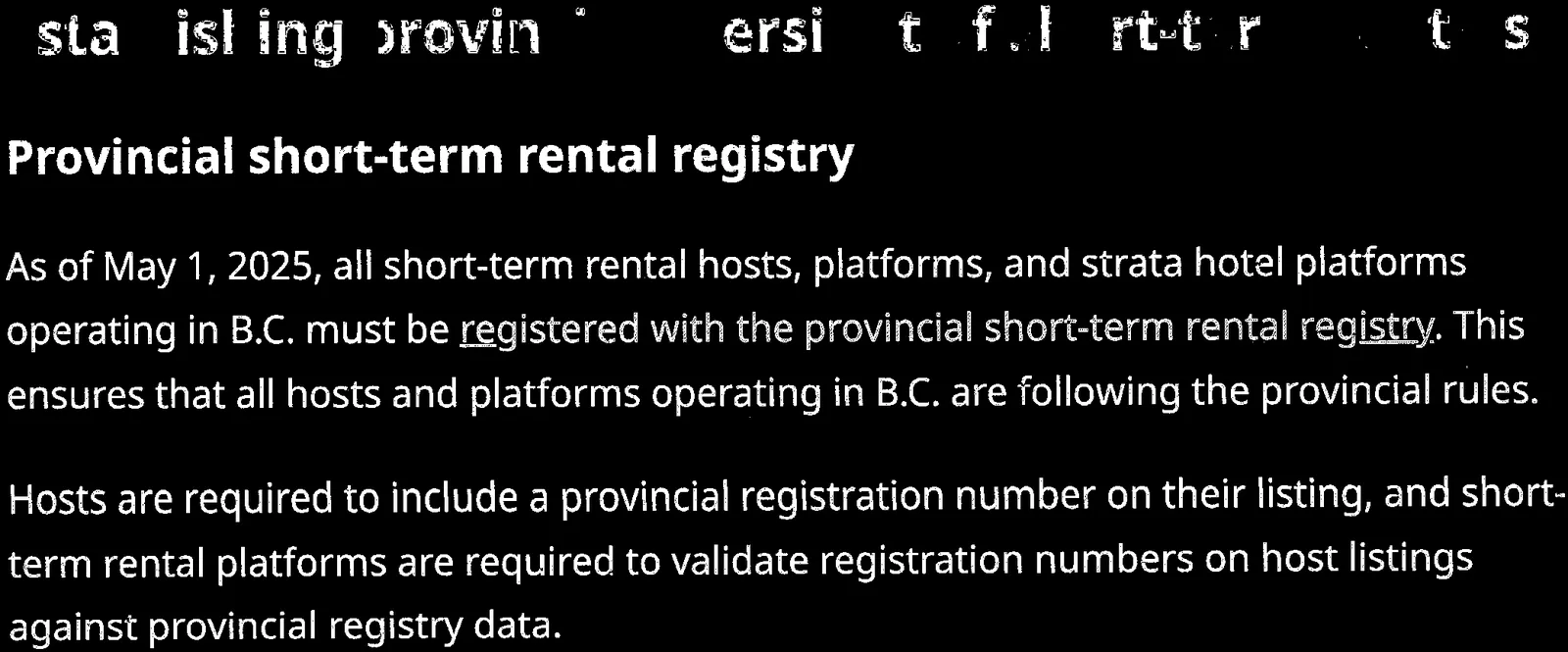
As of May 1, 2025, all short-term rental hosts, platforms, and strata hotel platforms operating in B.C. must be registered with the provincial short-term rental registry. This ensures that all hosts and platforms operating in B.C. are following the provincial rules.
Hosts are required to include a provincial registration number on their listing, and short-term rental platforms are required to validate registration numbers on host listings against provincial registry data.
To process registration applications, the new provincial short-term rental registry team will:
Provincial compliance and enforcement unit
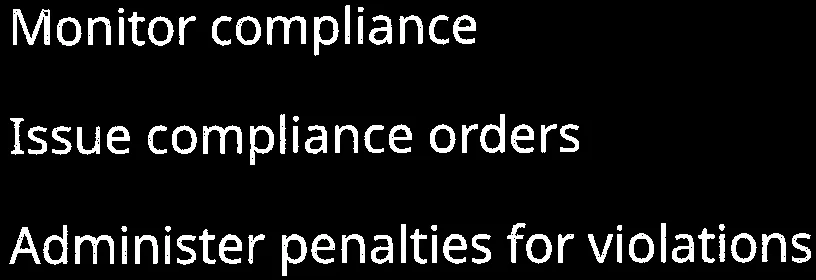
To ensure the provincial rules are followed, the new provincial compliance and enforcement unit will:
Short-term rentals versus tenancies
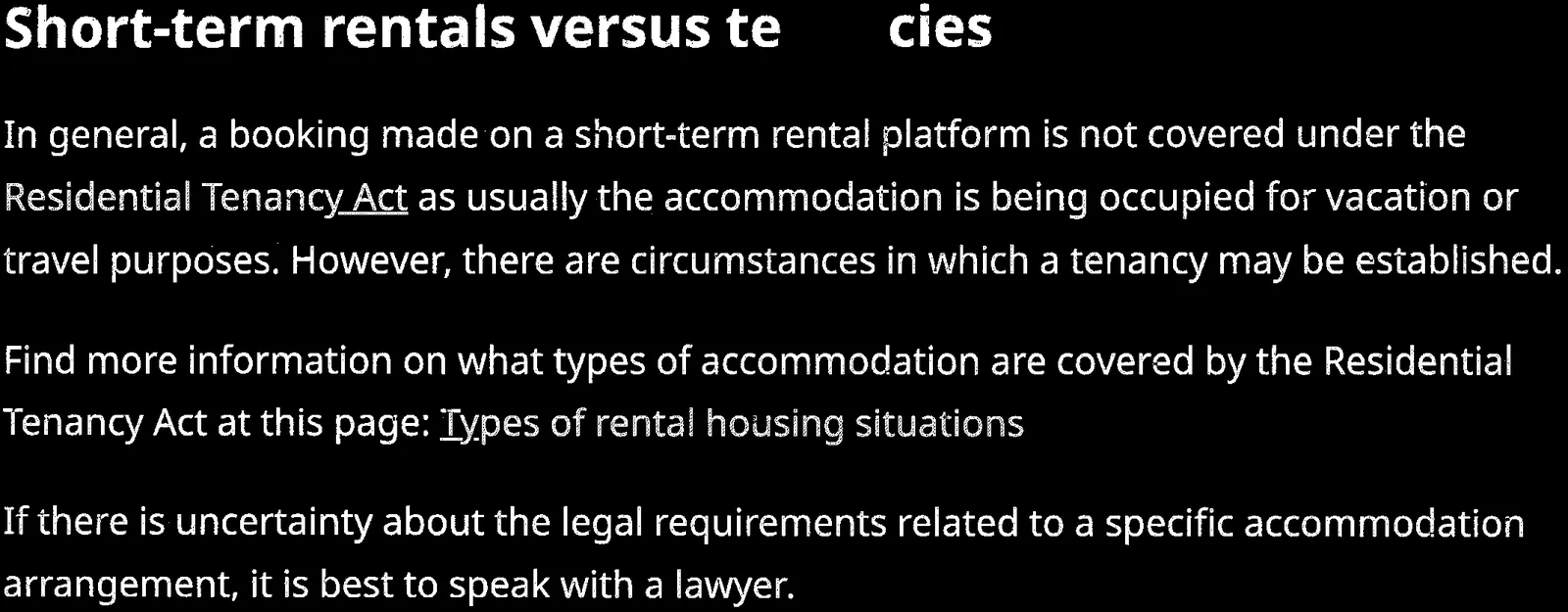
In general, a booking made on a short-term rental platform is not covered under the Residential Tenancy Act as usually the accommodation is being occupied for vacation or travel purposes. However, there are circumstances in which a tenancy may be established.
Find more information on what types of accommodation are covered by the Residential Tenancy Act at this page: Types of rental housing situations
If there is uncertainty about the legal requirements related to a specific accommodation arrangement, it is best to speak with a lawyer.
News release
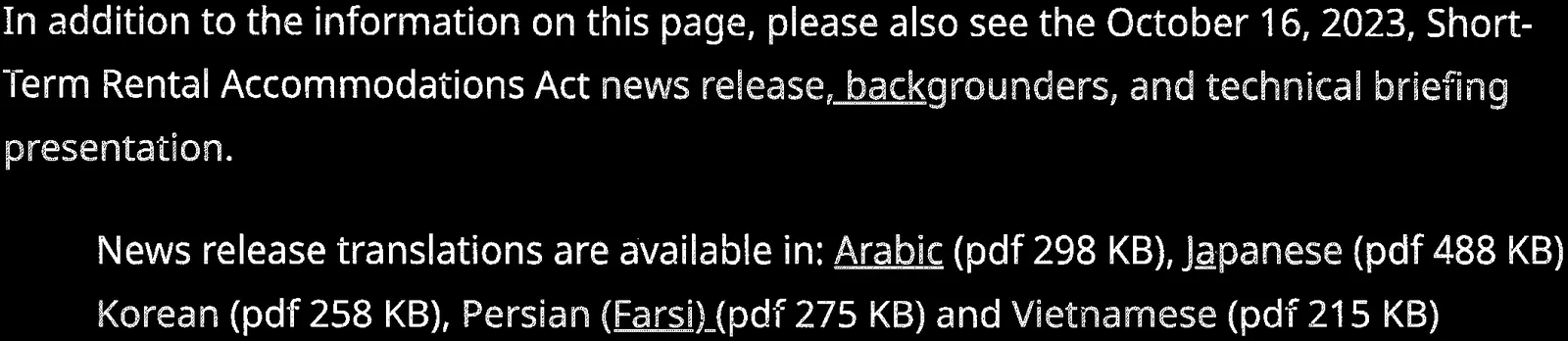
In addition to the information on this page, please also see the October 16, 2023, Short-Term Rental Accommodations Act news release, backgrounders, and technical briefing presentation.
- News release translations are available in: Arabic (pdf 298 KB), Japanese (pdf 488 KB), Korean (pdf 258 KB), Persian (Farsi) (pdf 275 KB) and Vietnamese (pdf 215 KB)
- News release and backgrounder translations are available in: French (pdf 293 KB), Chinese simplified (pdf 627 KB), Chinese traditional (pdf 740 KB), Hindi (pdf 182 KB), Punjabi (pdf 322 KB) and Tagalog (pdf 246 KB)
Subscribe
Subscribe for emailed updates on the Short-Term Rental Accommodations Act, regulations and related information.
Disclaimer
The information on this webpage on the Province of British Columbia's Short-Term Rental Accommodations Act and regulations is provided for the user's convenience as a basic starting point. It is not a substitute for getting legal advice or other professional advice. If there is a conflict between the information on this webpage and the legislation or regulations, the legislation and regulations prevail. The interpretation of legislation is also affected by court decisions. This information may be subject to change, including due to the legislative process.
Contact information

Did you find what you were looking for?