Greater Victoria Hotel Development Working Group Process, Final Report, and Recommendations
A presentation outlining the findings of the hotel development working group, identifying a supply gap of at least 2,000 rooms.
Greater Victoria Hotel Development Working Group Process, Final Report, and Recommendations

Introduction
- DGV appreciated participation in the Working Group by the CAO, and the Director of Planning of the Town of View Royal
- DGV was also happy to partner on the View Royal Hotel Development Incentive Report conducted by Floor 13. That information also fed into the Greater Victoria Hotel Development Working Group Process and Final Report.
- We appreciate the deepening partnership between DGV and the Town of View Royal.
Overview: Hotel Development Working Group
- Destination Plan study showed a need for 2000 new hotel rooms over the next 10 years in Greater Victoria
- The Greater Victoria Hotel Development Working Group was convened to capitalize on a rare window of opportunity for hotel development (demand + capital availability + other building typologies being less profitable)
- Working Group brought together local governments, Songhees Development Corporation, lenders, developers, and industry experts
- The result: an actionable report and recommendations for partnerships, process, and policy changes needed to meet the demand for new hotels
Hotel Inventory and Supply Gap
Greater Victoria’s hotel inventory has declined significantly over the past decade, falling by 25% since 2016. This is largely due to the removal or conversion of existing, older hotel stock that has not been replaced at the same pace by new hotel development.
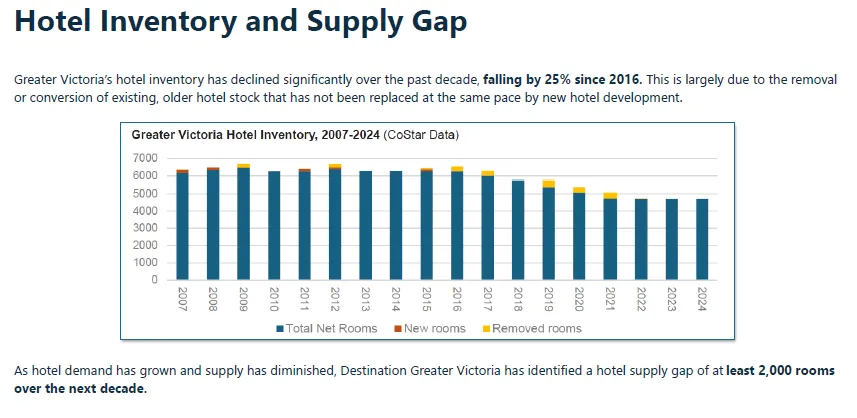
As hotel demand has grown and supply has diminished, Destination Greater Victoria has identified a hotel supply gap of at least 2,000 rooms over the next decade.
Anticipated Types of Hotel Development
The Greater Victoria Hotel Development Working Group identified several types of hotels that are needed to meet visitor demand and fill the hotel supply gap.
Meeting the projected supply gap will require approximately 2,000 new hotel rooms, representing 15 to 20 new developments across Greater Victoria over the next decade.
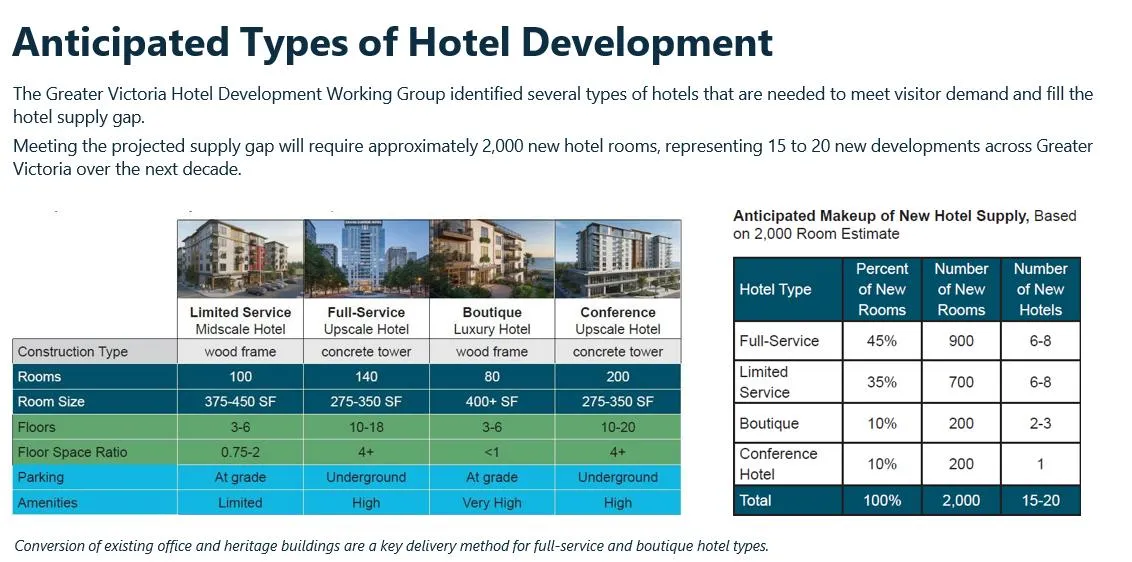
Conceptual Hotel Development Specifications
| Feature | Limited Service Midscale Hotel | Full-Service Upscale Hotel | Boutique Luxury Hotel | Conference Upscale Hotel |
|---|---|---|---|---|
| Construction Type | wood frame | concrete tower | wood frame | concrete tower |
| Rooms | 100 | 140 | 80 | 200 |
| Room Size | 375-450 SF | 275-350 SF | 400+ SF | 275-350 SF |
| Floors | 3-6 | 10-18 | 3-6 | 10-20 |
| Floor Space Ratio | 0.75-2 | 4+ | <1 | 4+ |
| Parking | At grade | Underground | At grade | Underground |
| Amenities | Limited | High | Very High | High |
Anticipated Makeup of New Hotel Supply, Based on 2,000 Room Estimate
| Hotel Type | Percent of New Rooms | Number of New Rooms | Number of New Hotels |
|---|---|---|---|
| Full-Service | 45% | 900 | 6-8 |
| Limited Service | 35% | 700 | 6-8 |
| Boutique | 10% | 200 | 2-3 |
| Conference Hotel | 10% | 200 | 1 |
| Total | 100% | 2,000 | 15-20 |
Conversion of existing office and heritage buildings are a key delivery method for full-service and boutique hotel types.
Financial Feasibility Factors
Six factors impact the financial feasibility of hotel projects:
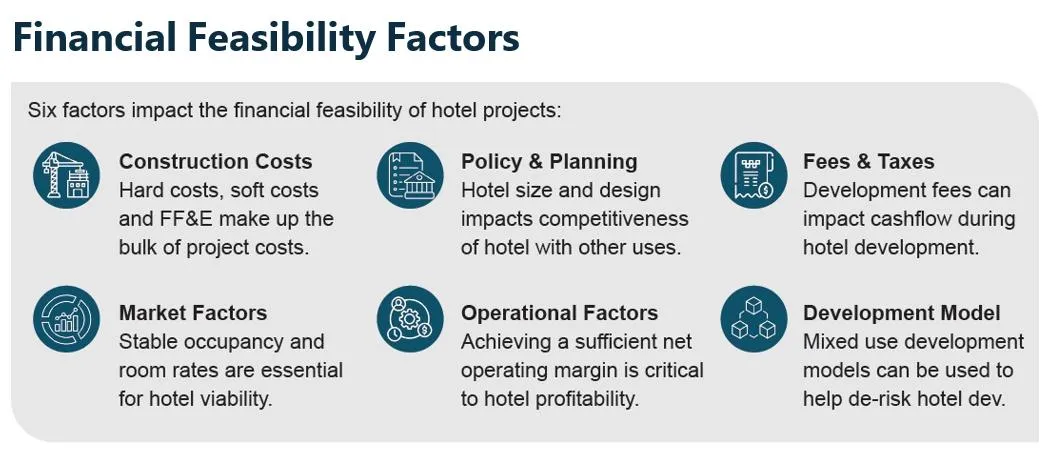
- Construction Costs: Hard costs, soft costs and FF&E make up the bulk of project costs.
- Policy & Planning: Hotel size and design impacts competitiveness of hotel with other uses.
- Fees & Taxes: Development fees can impact cashflow during hotel development.
- Market Factors: Stable occupancy and room rates are essential for hotel viability.
- Operational Factors: Achieving a sufficient net operating margin is critical to hotel profitability.
- Development Model: Mixed use development models can be used to help de-risk hotel dev.
Financial Feasibility
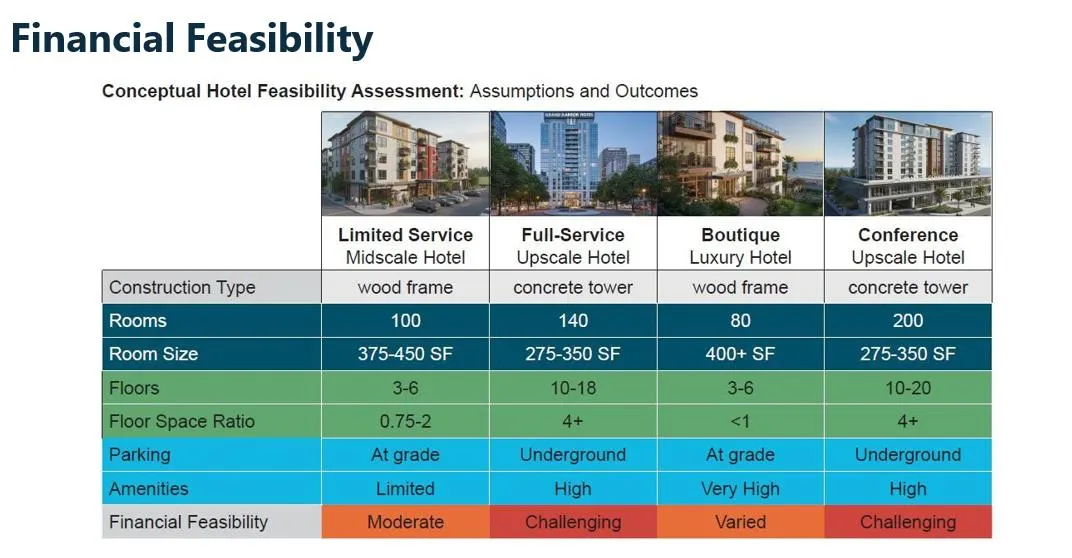
Feasibility Assessment Outcomes
- Limited Service Midscale Hotel: Moderate
- Full-Service Upscale Hotel: Challenging
- Boutique Luxury Hotel: Varied
- Conference Upscale Hotel: Challenging
Even in this unique window of opportunity, our conceptual pro-formas showed that hotel developments are challenging and require support in the form of policy and process changes to be attractive and viable.
Community and Economic Benefits of Hotels
- The Working Group also sought to build awareness of the community and economic benefits of hotels among Working Group members, the public and potential investors.
- The final report highlights some of the incredible community contributions of existing hotels.
- Hotel approvals will bring strong community benefit, just as existing hotels already provide.
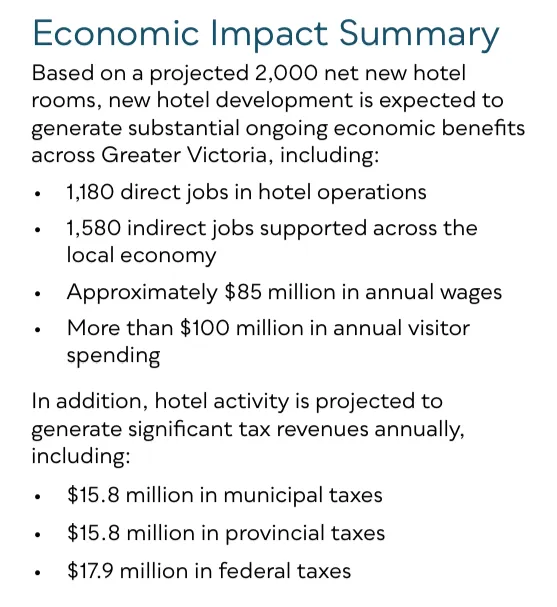
Economic Impact Summary
Based on a projected 2,000 net new hotel rooms, new hotel development is expected to generate substantial ongoing economic benefits across Greater Victoria, including:
- 1,180 direct jobs in hotel operations
- 1,580 indirect jobs supported across the local economy
- Approximately $85 million in annual wages
- More than $100 million in annual visitor spending
In addition, hotel activity is projected to generate significant tax revenues annually, including:
- $15.8 million in municipal taxes
- $15.8 million in provincial taxes
- $17.9 million in federal taxes
Recommendations
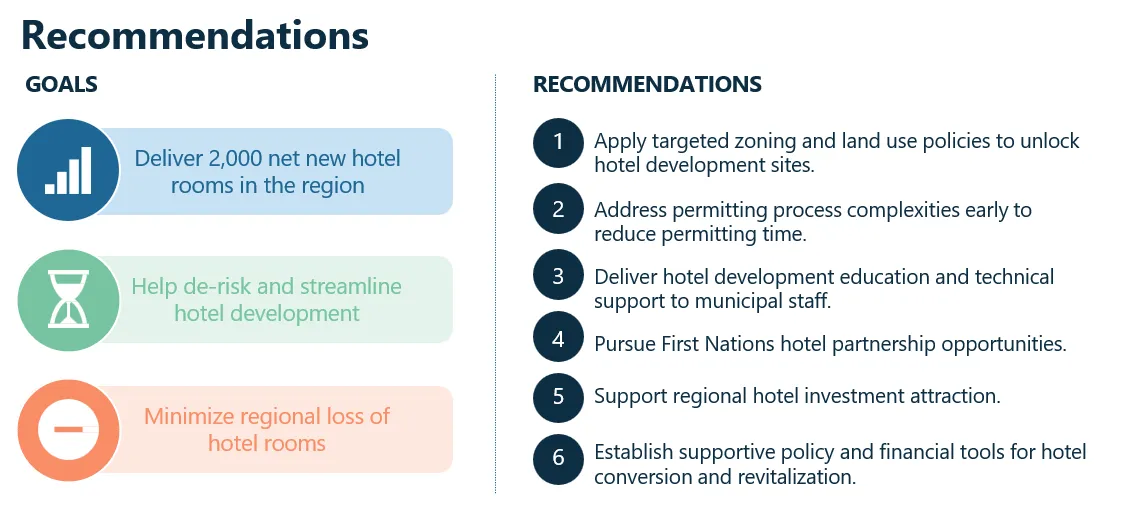
GOALS
- Deliver 2,000 net new hotel rooms in the region
- Help de-risk and streamline hotel development
- Minimize regional loss of hotel rooms
RECOMMENDATIONS
- Apply targeted zoning and land use policies to unlock hotel development sites.
- Address permitting process complexities early to reduce permitting time.
- Deliver hotel development education and technical support to municipal staff.
- Pursue First Nations hotel partnership opportunities.
- Support regional hotel investment attraction.
- Establish supportive policy and financial tools for hotel conversion and revitalization.
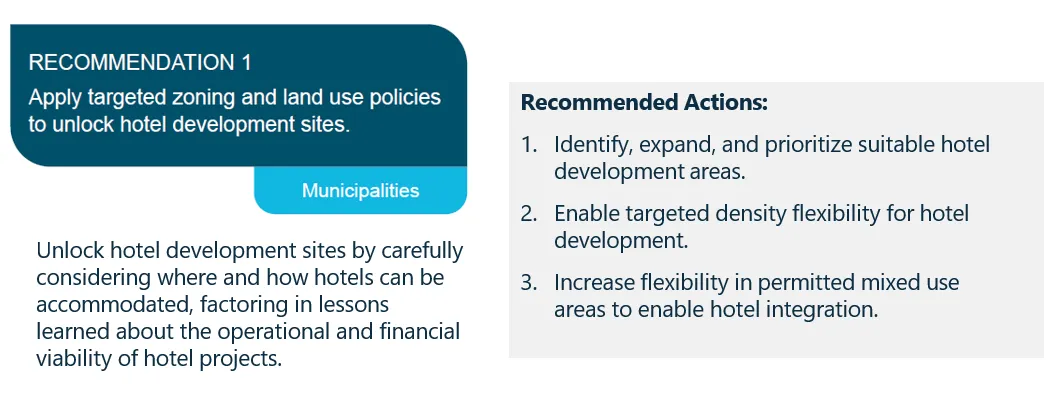
RECOMMENDATION 1
Apply targeted zoning and land use policies to unlock hotel development sites. Responsibility: Municipalities
Unlock hotel development sites by carefully considering where and how hotels can be accommodated, factoring in lessons learned about the operational and financial viability of hotel projects.
Recommended Actions:
- Identify, expand, and prioritize suitable hotel development areas.
- Enable targeted density flexibility for hotel development.
- Increase flexibility in permitted mixed use areas to enable hotel integration.
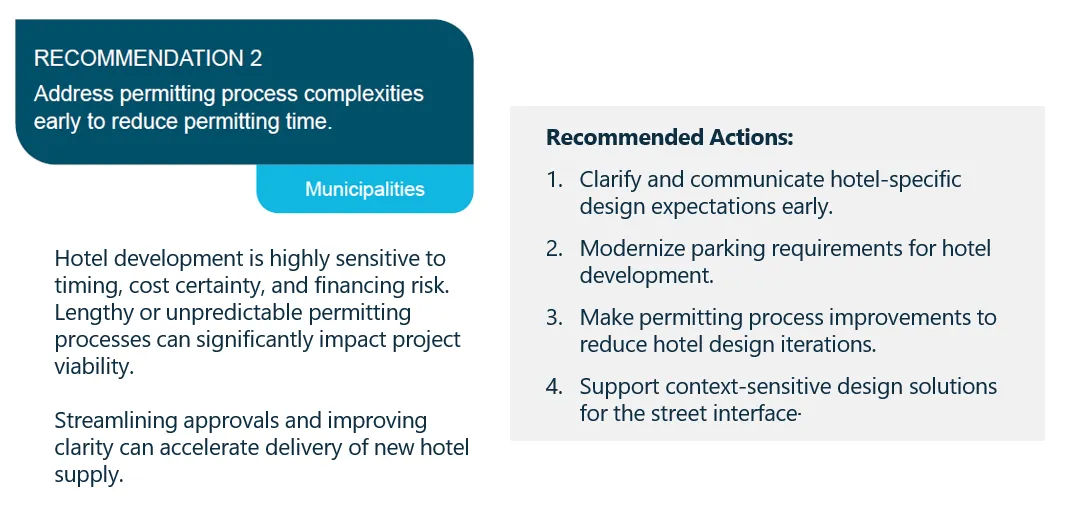
RECOMMENDATION 2
Address permitting process complexities early to reduce permitting time. Responsibility: Municipalities
Hotel development is highly sensitive to timing, cost certainty, and financing risk. Lengthy or unpredictable permitting processes can significantly impact project viability.
Streamlining approvals and improving clarity can accelerate delivery of new hotel supply.
Recommended Actions:
- Clarify and communicate hotel-specific design expectations early.
- Modernize parking requirements for hotel development.
- Make permitting process improvements to reduce hotel design iterations.
- Support context-sensitive design solutions for the street interface.
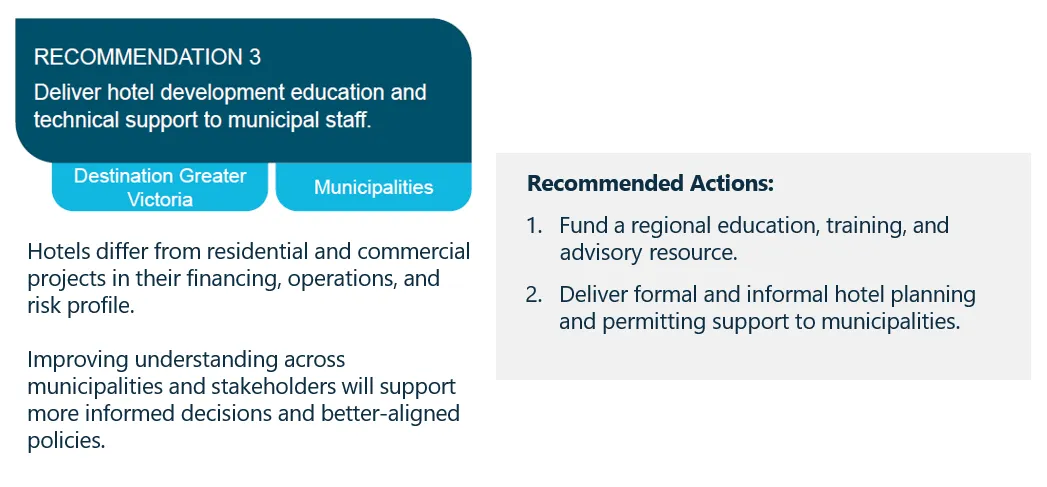
RECOMMENDATION 3
Deliver hotel development education and technical support to municipal staff. Responsibility: Destination Greater Victoria and Municipalities
Hotels differ from residential and commercial projects in their financing, operations, and risk profile.
Improving understanding across municipalities and stakeholders will support more informed decisions and better-aligned policies.
Recommended Actions:
- Fund a regional education, training, and advisory resource.
- Deliver formal and informal hotel planning and permitting support to municipalities.
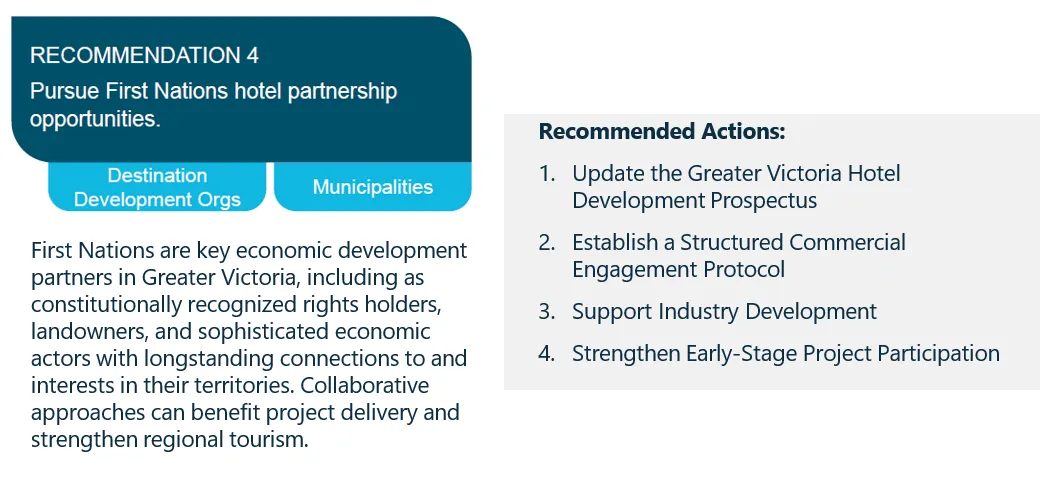
RECOMMENDATION 4
Pursue First Nations hotel partnership opportunities. Responsibility: Destination Development Orgs and Municipalities
First Nations are key economic development partners in Greater Victoria, including as constitutionally recognized rights holders, landowners, and sophisticated economic actors with longstanding connections to and interests in their territories. Collaborative approaches can benefit project delivery and strengthen regional tourism.
Recommended Actions:
- Update the Greater Victoria Hotel Development Prospectus
- Establish a Structured Commercial Engagement Protocol
- Support Industry Development
- Strengthen Early-Stage Project Participation
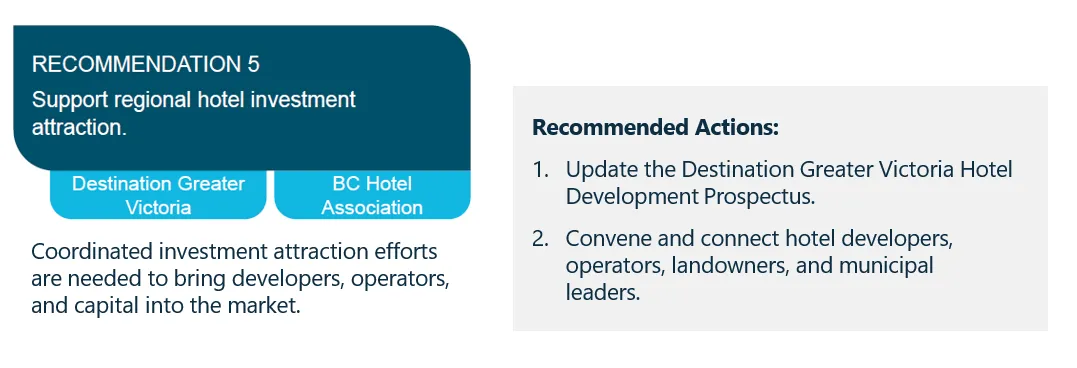
RECOMMENDATION 5
Support regional hotel investment attraction. Responsibility: Destination Greater Victoria and BC Hotel Association
Coordinated investment attraction efforts are needed to bring developers, operators, and capital into the market.
Recommended Actions:
- Update the Destination Greater Victoria Hotel Development Prospectus.
- Convene and connect hotel developers, operators, landowners, and municipal leaders.
Greater Victoria Working Group Results
- Working Group members were very happy with the process and offered enthusiastic support for the final report.
- Appetite among Working Group members to continue to work collaboratively.
- Demonstrated strong regional destination development leadership to local governments and other partners.
- Province of BC, included Greater Victoria Hotel Development as an investment opportunity in their new BC tourism investment attraction efforts.
- City of Victoria and other partners have already adopted some of the learnings and process improvements.
- DGV is now presenting the report and recommendations to city councils across the region.
Short-Term Vacation Rentals
- Tax fairness
- Community livability and retention of housing as homes
- Human trafficking concerns