OFFICIAL COMMUNITY PLAN REVIEW AND UPDATE: FINAL DRAFT
Staff report introducing the final draft of the Official Community Plan (OCP) after extensive public and stakeholder engagement.
TOWN OF VIEW ROYAL COMMITTEE OF THE WHOLE REPORT
TO: Committee of the Whole DATE: May 15, 2026 FROM: Stirling Scory RPP, MCIP, Senior Planner; Leanne Taylor RPP, MCIP, Director of Development Services MEETING DATE: June 9, 2026
OFFICIAL COMMUNITY PLAN REVIEW AND UPDATE: FINAL DRAFT
RECOMMENDATION:
THAT the Committee recommend amendments to Council, if any, to the final draft of the Official Community Plan;
AND THAT the final draft of the Official Community Plan be updated to incorporate the Committee’s amendments prior to first reading of the bylaw;
AND FURTHER THAT the necessary bylaw be prepared to proceed with first reading of the final draft of the Official Community Plan.
ALTERNATIVE OPTIONS:
THAT the Committee recommend to Council that the necessary bylaw be prepared to proceed with first reading of the final draft of the Official Community Plan.
PURPOSE:
The purpose of this report is to introduce the final draft of the Official Community Plan (OCP) to the Committee of the Whole for review and feedback.
BACKGROUND:
This OCP review and update began in December 2024, when Council awarded the contract to Urban Systems Ltd. Following six rounds of substantial public engagement, stakeholder workshops, many OCP Review Advisory Committee, Committee of the Whole and Council meetings on the OCP, and considerable amount of staff time and resource, a final draft of the OCP has been prepared for the Committee’s review and feedback (refer to Attachment 3).
Prior to completing a final draft of the OCP, there was substantial public engagement on the first draft between March 20 and April 19, 2026. Staff mailed approximately 3500 – 4000 postcards to all residents and businesses in View Royal, which included a QR code and links to raise awareness and provide easy access to the survey on the draft OCP. In addition, two ads were published in the Goldstream Gazette, and there have been multiple posts on the Town’s social media platforms to promote the survey. The Town received a total of 47 survey responses.
During this engagement period, the planning team also communicated and engaged with other departments, the OCP Review Advisory Committee, Council, Songhees and Xwsepsum First Nations, the Capital Regional District, School District 61, Island Health, BC Transit, Westshore Chamber of Commerce, CNIB Victoria, and many other stakeholders and community groups, and the public. Council reviewed and provided feedback on the first draft at a special Council meeting on March 31 and the Regular Council meeting on April 7, 2026.
After the final round of engagement closed, staff and the consultant edited the draft by incorporating the comments and feedback received on the document. All the comments that were received during this engagement period are included in a What We Heard Report – Phase 2: Draft OCP Engagement (refer to Attachment 1).
ANALYSIS:
Engagement on Draft Official Community Plan
Preparation of the final draft OCP is the result of the collective efforts of Council, the Committees, representatives of the Nations, stakeholders, staff, and the public over the past 18 months through six rounds of engagement. The final round of engagement included a survey with specific questions related to the draft vision statement and goals, and ten objective and policy chapters. To make participation flexible and accessible, respondents could choose to answer the full survey or focus on certain sections of the OCP. Participants were able to provide feedback through multiple-choice selection and open-ended feedback questions. The detailed results and verbatim comments are provided in the attached What We Heard Report – Phase 2: Draft OCP Engagement.
Overall, participants indicated that they were supportive of the vision statement, goals, objectives and policies. A summary of the key findings is provided below.
Draft Vision Statement
Participants indicated that overall, they are very supportive or supportive of the draft vision statement.
- Very Supportive (8, 31%); Supportive (14, 54%); Neutral (2, 8%); Unsupportive (2, 8%); Very Unsupportive (0, 0%); I am not sure (0, 0%)
Draft Goals
Overall, respondents are very supportive or supportive of the 12 draft goals:
- Mobility & Connectivity – Very Supportive (12, 48%); Supportive (9, 36%); Neutral (2, 8%); Unsupportive (2, 8%); Very Unsupportive (0, 0%); I am not sure (0, 0%)
- Diverse & Affordable Housing – Very Supportive (11, 44%); Supportive (10, 40%); Neutral (3, 12%); Unsupportive (1, 4%); Very Unsupportive (0, 0%); I am not sure (0, 0%)
- Growth Management & Community Character Preservation – Very Supportive (8, 32%); Supportive (13, 52%); Neutral (0, 0%); Unsupportive (3, 12%); Very Unsupportive (1, 4%); I am not sure (0, 0%)
- Natural Amenities – Very Supportive (15, 60%); Supportive (9, 36%); Neutral (0, 0%); Unsupportive (0, 0%); Very Unsupportive (1, 4%); I am not sure (0, 0%)
- Community Well-being – Very Supportive (11, 44%); Supportive (9, 36%); Neutral (2, 8%); Unsupportive (3, 12%); Very Unsupportive (0, 0%); I am not sure (0, 0%)
- Community Safety & Security – Very Supportive (13, 52%); Supportive (7, 28%); Neutral (2, 8%); Unsupportive (3, 12%); Very Unsupportive (0, 0%); I am not sure (0, 0%)
- Climate Action & Resilience – Very Supportive (10, 40%); Supportive (11, 44%); Neutral (2, 8%); Unsupportive (1, 4%); Very Unsupportive (1, 4%); I am not sure (0, 0%)
- Economic Development – Very Supportive (7, 29%); Supportive (14, 58%); Neutral (2, 8%); Unsupportive (0, 0%); Very Unsupportive (1, 4%); I am not sure (0, 0%)
- Reconciliation – Very Supportive (6, 25%); Supportive (7, 29%); Neutral (7, 29%); Unsupportive (2, 8%); Very Unsupportive (2, 8%); I am not sure (0, 0%)
- Community Input & Governance – Very Supportive (10, 42%); Supportive (13, 54%); Neutral (0, 0%); Unsupportive (1, 4%); Very Unsupportive (0, 0%); I am not sure (0, 0%)
- Regional Partnerships – Very Supportive (11, 44%); Supportive (8, 32%); Neutral (6, 24%); Unsupportive (0, 0%); Very Unsupportive (0, 0%); I am not sure (0, 0%)
- Sustainable Service Delivery & Asset Management – Very Supportive (12, 50%); Supportive (10, 42%); Neutral (2, 8%); Unsupportive (0, 0%); Very Unsupportive (0, 0%); I am not sure (0, 0%)
Draft Policy Objectives
Overall, respondents are very supportive or supportive the objectives of the ten policy chapters.
- Land Use – Very Supportive (12, 40%); Supportive (13, 43%); Neutral (1, 3%); Unsupportive (3, 10%); Very Unsupportive (1, 3%); I am not sure (0, 0%); Other (0, 0%)
- Housing¹ – Very Satisfied (6, 15%); Satisfied (24, 60%); Neutral (4, 10%); Unsatisfied (3, 8%); Very Unsatisfied (2, 5%); I am not sure (1, 3%); Other (0, 0%)
- Transportation and Mobility – Very Supportive (8, 27%); Supportive (14, 47%); Neutral (1, 3%); Unsupportive (4, 13%); Very Unsupportive (2, 7%); I am not sure (1, 3%); Other (0, 0%)
- Community Infrastructure and Services – Very Supportive (9, 32%); Supportive (17, 61%); Neutral (1, 4%); Unsupportive (1, 4%); Very Unsupportive (0, 0%); I am not sure (0, 0%); Other (0, 0%)
- Economic Development – Very Supportive (8, 36%); Supportive (11, 50%); Neutral (3, 14%); Unsupportive (0, 0%); Very Unsupportive (0, 0%); I am not sure (0, 0%); Other (0, 0%)
- Natural Environment – Very Supportive (8, 29%); Supportive (17, 61%); Neutral (1, 4%); Unsupportive (2, 7%); Very Unsupportive (0, 0%); I am not sure (0, 0%); Other (0, 0%)
- Climate Action and Sustainability – Very Supportive (11, 52%); Supportive (7, 33%); Neutral (1, 5%); Unsupportive (0, 0%); Very Unsupportive (2, 10%); I am not sure (0, 0%); Other (0, 0%)
- Parks, Trails, and Recreation – Very Supportive (18, 56%); Supportive (12, 38%); Neutral (1, 3%); Unsupportive (1, 3%) Very Unsupportive (0, 0%); I am not sure (0, 0%); Other (0, 0%)
- Community Well-being and Culture² – Very Supportive (11, 48%); Supportive (9, 39%); Neutral (1, 4%); Unsupportive (2, 9%); Very Unsupportive (0, 0%); Other (0, 0%)
- Reconciliation³ – Very Supportive (4, 27%); Supportive (3, 20%); Neutral (4, 27%); Unsupportive (2, 13%); Very Unsupportive (2, 13%); I am not sure (0, 0%)
¹ This question asked if participants were “satisfied” instead of “supportive”. The project team did not notice the difference in wording until after the survey was published and answers were being submitted. ² The project team noticed that the “I am not sure” option was missing after the survey was published and survey responses were submitted. ³ The project team noticed that the “other” option was missing after the survey was published and survey responses were submitted.
Redline Final Draft OCP and Additional Comments
At the March 31, 2026, Special Council Meeting, Council requested a redline version of the final draft document to identify how Council’s resolutions were incorporated into the final draft OCP. A copy of the redline version of the final draft OCP can be found in Attachment 2. The document also includes a table with Council’s 43 resolutions from the Special Council Meeting on March 31, 2026, and the Regular Council Meeting on April 7, 2026, and actions taken to address these resolutions in the final draft OCP.
Several edits were also completed following comments and feedback provided by the representatives of the Songhees and Xʷsepsəm Nations, OCP Review Advisory Committee, staff, and the public. The extent of these changes was too complex to show in a redline version of the document but are included as updates to the final draft OCP. Updates include formatting and layout changes, further refinements to content, objectives, policies, and actions, revisions to mapping, graphics and photos, and general spelling, grammar and punctuation checks.
Should the Committee wish to make further changes to the final draft OCP, then these would need to be presented as motions to ensure clarity and form part of the public record. If the motions are approved by Council at the following Council meeting, then changes would be incorporated into the document ahead of first reading of the bylaw.
Next Steps
Bylaw Process
Depending on the outcome of the Committee of the Whole meeting, the next step would be to draft a bylaw to adopt the new Official Community Plan. The diagram below provides a summary of this process.
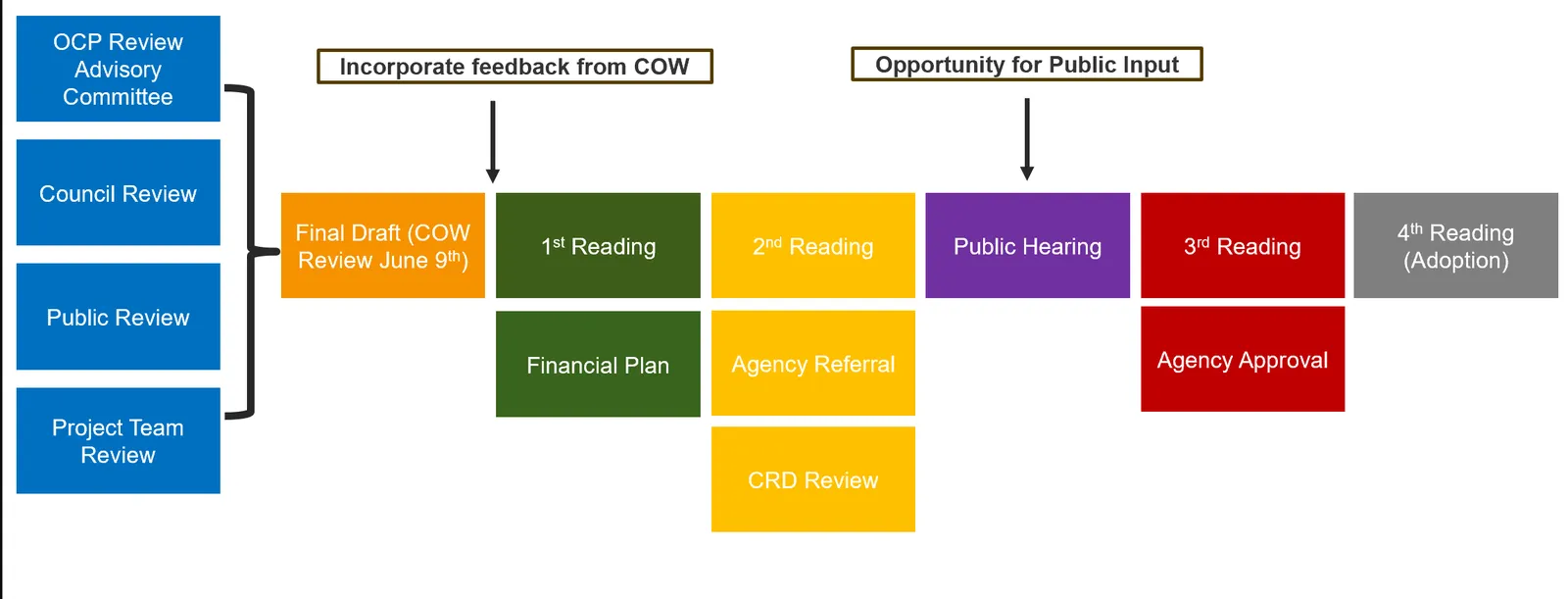
First and second reading of the bylaw could occur in July. Following second reading, a referral will be sent to agencies including the School Board and Capital Regional District, in accordance with the Local Government Act (LGA). The draft bylaw will also receive a legal review. The public hearing could be scheduled to take place in September, subject to Council approval. Notice of the public hearing will be advertised in accordance with the Town’s Public Notice Bylaw No. 1106, 2022 and sections 464, 465 and 466 of the LGA. A public hearing will give the public an opportunity to provide feedback on the proposed bylaw.
Third reading would occur after the public hearing. Bylaw adoption would happen at a subsequent meeting in September. The aim is to complete the project prior to the next election.
Force and Effect of the new OCP
The new OCP would become effective on the date it is adopted and all future development applications made after the date of adoption would be required to comply with the newly adopted OCP. Updates to the Town’s master plans, policies, and strategic priorities would also need to align with the new OCP. If any changes are proposed after the adoption of the OCP, then these would be subject to a bylaw amendment process.
Public Hearings and Rezoning Applications
Under Bill 44, a local government must not hold a public hearing on a proposed zoning bylaw if the bylaw is consistent with the Official Community Plan and permits a residential development in which at least half of the gross floor area of all buildings and other structures is residential. Adoption of the OCP would not change this process. Non-residential rezoning applications would still require public hearings.
Impacts and implications can be summarized as follows:
| Category | Description |
|---|---|
| Community Impact: | The final draft OCP provides an opportunity for the Committee to weigh in on the proposed bylaw updates prior to Council’s consideration of bylaw readings. The final draft OCP represents the culmination of feedback provided by Council, the OCP Review Advisory Committee, First Nations, stakeholders, the public and staff. Adoption of the new OCP will ensure that the Town may continue to grow and develop to meet the needs and interests of the community. |
| Financial Implication: | The review of the final draft is covered in the existing budget of the OCP review and update. |
| Inter-governmental Relations Impact: | The OCP will be referred to external agencies and the Songhees and Xʷsepsəm Nations, once Council initiates bylaw readings. |
ALIGNMENT:
The recommended option aligns with the Town’s following core guiding documents as follows:
| Guiding Document | Alignment Details |
|---|---|
| Strategic Plan: | Sustainable Development Goal 1: Managed Growth Official Community Plan (OCP) review to align with Housing Needs Report and Zoning Bylaw, update Development Permit Area design guidelines, and other aspects of the OCP. Goal 3: Access a broad range of housing options to meet the needs of various ages, family types and incomes. Community Engagement and Good Governance Goal 1: Strong and active citizen participation in community engagement in Town of View Royal meetings, open houses, surveys, budget development. |
| Official Community Plan: | 2011 Official Community Plan: Community Vision Goal 2: Create an inclusive community that provides housing, transportation and healthy living options, and services and facilities for families and individuals of diverse backgrounds, culture, ages and economic means. Goal 9: Ensure that all citizens of View Royal have opportunities to be informed and meaningfully involved in planning and decision-making processes. |
| Other Policy Documents: | N/A |
PUBLIC PARTICIPATION GOAL:
The desired level of public participation for the recommended option is:
☐ Inform ☒ Consult ☐ Involve ☐ Collaborate ☐ Empower ☐ N/A
TIME CRITICAL:
The report is time critical as the desire is to complete the project in September, prior to the election. There are several steps that need to happen to achieve this target date.
CONCURRENCE:
| Role | Initials | Comments |
|---|---|---|
| Chief Administrative Officer | SS | I concur with the recommendation. |
REVIEWED BY:
| Role | Initials |
|---|---|
| Director of Corporate Administration/Deputy CAO | N/A |
| Director of Finance & Technology | N/A |
| Director of Development Services | LT |
| Director of Engineering | N/A |
| Director of Protective Services | N/A |
ATTACHMENTS:
- What We Heard Report – Phase 2: Draft OCP Engagement, June 2026
- Redline Version Draft Official Community Plan
- Final Draft Official Community Plan
Document Images
(1)