View Royal 2050: Our Future View Official Community Plan Redline Draft
The full redlined draft version of the Official Community Plan showing amendments and tracking changes.
View Royal 2050: Our Future View
Official Community Plan DRAFT
Territorial Acknowledgement
The Town of View Royal humbly acknowledges that it is situated upon the unceded traditional territories of the lək̓ʷəŋən (Lekwungen) Peoples, known today as the Xʷsepsəm (Esquimalt) and Songhees Nations. We honour and respect the history, languages, ceremonies, and culture of the First Nations peoples, including the Xʷsepsəm and Songhees Nations, as well as the Métis, Inuit, and Non-Status Aboriginal Peoples whose presence and culture enrich the community.
These lands have been stewarded by the lək̓ʷəŋən Peoples since time immemorial, and their connection to the land and waters and Title and rights in these territories remain intact. As a local government, we are settlers and guests on these lands and acknowledge our responsibility to the land, its resources, and its people. We give thanks to the lək̓ʷəŋən People—past, present, and future—for their stewardship, care, and leadership on these lands.
Part One: The Plan Context
1.0 Plan Overview
1.1 WHAT IS AN OFFICIAL COMMUNITY PLAN?
This Official Community Plan titled “View Royal 2050: Our Future View" represents the Town’s vision and goals for the coming decades. It is a comprehensive, long-term policy document that guides how the community will grow and respond to key opportunities that arise. The Official Community Plan provides direction for land use decisions and addresses the provision of community services and amenities. This plan will ensure that future changes and growth align with the community’s values and priorities, supporting a sustainable and vibrant View Royal for generations to come.
Typically, all local government master plans, policies, and bylaws are updated following the adoption of a new Official Community Plan to ensure consistency in policy direction across documents. This consistency informs decision-making by Town Council and staff, in addition to priority setting during annual strategic planning and budgeting cycles.
The Official Community Plan is intended to serve as a living document that would be amended from time to time and updated every 5 years to remain relevant as the community evolves and grows. The last comprehensive Official Community Plan review and update occurred in 2011 and much has changed globally, regionally, and locally. This Official Community Plan addresses the context of View Royal in the years 2025 and 2026.
LEGISLATIVE REQUIREMENTS
The Local Government Act grants local governments in BC the authority to adopt an Official Community Plan. This legislation outlines what must be discussed in an Official Community Plan, along with other items that a local government may choose to include. It also outlines requirements for public and interest holder consultation, such as provincial agencies, school districts, and Indigenous communities.
In November 2023, the provincial government released legislation requiring municipalities to develop an Interim Housing Needs Report, to identify the 5- and 20-year housing needs projected for the community over the next 20 years and support a subsequent review and update of their Official Community Plans and zoning bylaws by December 31, 2025 to align with the Interim Housing Needs Report. The Town fulfilled its legislative requirements by adopting three new land use designations, including the Hospital Transit-Oriented Area, Neighbourhood Village, and Small-Scale, Multi-Unit Housing to provide the necessary housing capacity to meet its housing need, and align with zoning bylaw amendments.
C-62-26 THAT background information be provided on the provincial housing legislation,including but not limited to Bill 44 (Housing Statutes Amendment Act), in the Official Community Plan, which limits Council's decision-making authority. (Section 1.1 was revised to further clarify the legislative requirements under Bill 44)
The legislation requires that municipalities prepare Housing Needs Reports every five years, and review and update their Official Community Plans and zoning bylaws thereafter. The next Housing Needs Report must be completed by December 31, 2028, and the Official Community Plan and zoning bylaw alignment must be completed in 2030.
SMALL-SCALE, MULTI-UNIT HOUSING AND TRANSIT ORIENTED AREAS AND PUBLIC HEARINGS
In November 2023, the province adopted Bill 44: Housing Statutes (Residential Development) Amendment Act, 2023 and Bill 47: Housing Statutes (Transit-Oriented Areas) Amendment Act, 2023 to increase the supply of housing and streamline development approvals.
Under Bills 44 and 47, the province mandated municipalities to update zoning bylaws to permit Small-Scale, Multi-Unit Housing (SSMUH), and designate Transit-Oriented Areas, by June 2024. To satisfy the provincial legislation, the Town amended all existing single-family and duplex zones in the Zoning Bylaw to permit SSMUH, which allows up to 3, 4, or 6 dwelling units, depending on lot size and location in the Town.
The Town also amended the Zoning Bylaw to add a new Transit-Oriented Area designation. The Town’s Transit-Oriented Area is located west of the existing Victoria General Hospital Transit Exchange, which is further discussed in Section 5.3. Higher densities are planned to be accommodated to help provide more housing in this area.
Under Bill 44, a local government must not hold a public hearing on a proposed zoning bylaw if the bylaw is consistent with the Official Community Plan and permits a residential development in which at least half of the gross floor area of all buildings and other structures is residential.
HOUSING TARGET ORDER
Since receiving the Housing Target Order in July 2024, the Town has completed two housing target reports, a third will be completed in the summer of 2026 and reviewed by Council in the fall. At this time, the approximate total number of completed units is 499. The Town is on track to complete its housing target order within the five-year period.
REGIONAL PLANNING FRAMEWORK
As a member municipality within the Capital Regional District, View Royal’s Official Community Plan must be consistent with the Regional Growth Strategy per requirements outlined in the Local Government Act. Conformity to the Regional Growth Strategy is discussed in greater detail in section 16.0 Regional Context Statement.
1.2 HOW WE GOT HERE
A SUMMARY OF THE PROCESS
The Official Community Plan update is being carried out in three phases, each phase focusing on specific content in the document. The work completed between January 2025 and the summer of 2026 focused on the completion of the first two phases, with the third phase scheduled for completion in 2027.
Phase 1 (January 2025 to December 2025) The first phase focused on establishing a new vision for the Official Community Plan, a foundational element of the document that provides a forward thinking target for where the community envisions it will be in the future. This vision statement is supported by 12 new goals, which act as guiding principles for decision-making.
This phase also required that the Town align its 2024 Interim Housing Needs Report with the Official Community Plan by December 31, 2025, a date established through provincial legislation. The alignment required that the land use map be updated to provide capacity to meet the anticipated 20-year housing need, and to establish housing policies that addressed each of the six key components as part of the standardized Housing Needs Report methodology.
Phase 2 (October 2025 to July 2026) The second phase shifted focus to a review of the nine policy chapters in the Official Community Plan. Each policy chapter is built on a series of objectives, which outline the overall purpose of the policies. The policies inform decision making processes in the Town which aid in development and planning processes, operations, budgeting, and additional plan and policy development.
To support each of the policy chapters, actions were created to clearly identify what is required to achieve desired outcomes, the timing, and which municipal department is responsible. This phase also required a review and update of the Regional Context Statement, to ensure alignment with the Regional Growth Strategy.
Phase 3 (Fall 2026 to 2027) The final phase will focus on updating Form and Character and Environmental Development Permit Areas and guidelines. In addition, this phase will also consider the opportunity to develop new Development Permit Areas, including hazard areas prone to wildfire and flooding.
A SUMMARY OF ENGAGEMENT
The update of the Official Community Plan has provided multiple engagement touchpoints to inform updates to the Plan. The phased approach outlined above has supported a comprehensive process that balances technical analysis with community feedback to shape a vision, goals, and policies that reflect the needs and aspirations of View Royal residents.
Throughout the process, Council, the Committee of the Whole, and the Town’s Official Community Plan Review Advisory Committee have provided input and perspectives on key issues related to the Official Community Plan update. Together, they have participated at key milestones by reviewing draft materials, sharing community insights, and providing feedback on engagement activities, and emerging policy directions.
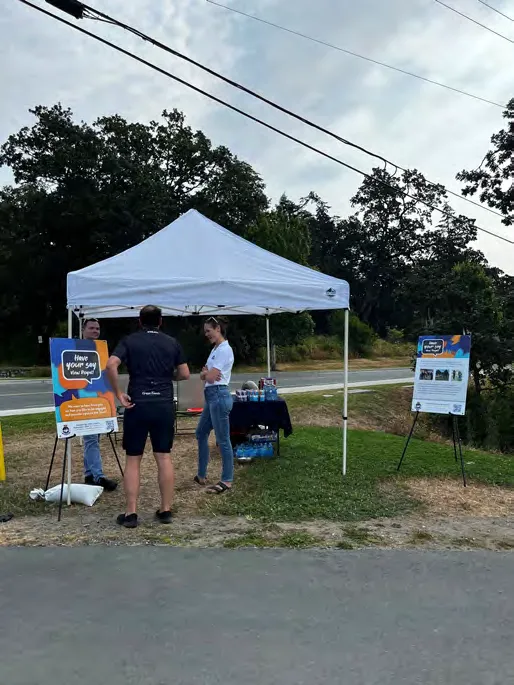
Official Community Plan Review Advisory Committee: A group of community members appointed by Council to assist with the review and provide feedback on draft content and engagement material.
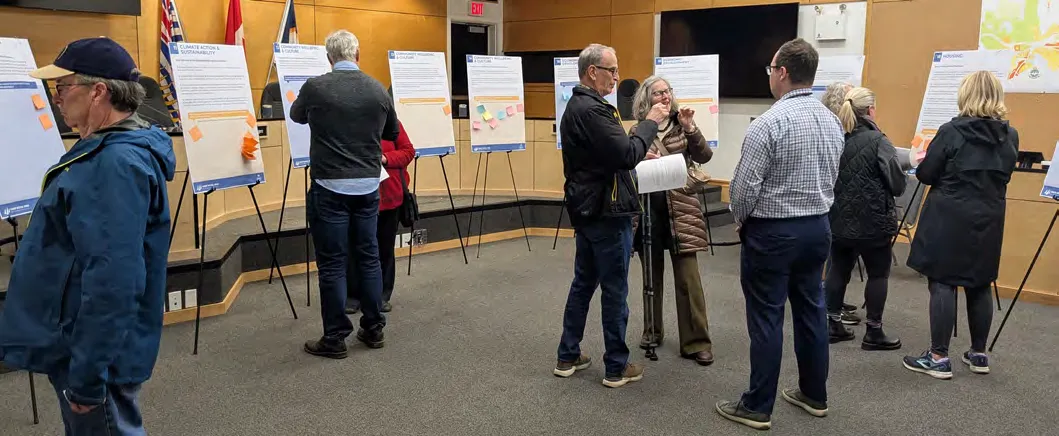
Across these engagement touchpoints, residents participated through surveys, open houses, workshops, pop ups, and stakeholder meetings. Feedback from each phase was summarized in What We Heard Reports and shared with Council and the Official Community Plan Advisory Committee to help inform the evolving draft, which is a reflection of the cumulative input received through each stage of engagement.
The draft Official Community Plan reflects five rounds of community engagement, each focused on a different component of the Plan. While participation levels varied between engagement phases, feedback received was considered alongside technical studies, legislative requirements, and Council feedback.
Infographic engagement statistics:
- 8 pop-up events
- 6 open houses
- 6 workshops
- 2,110 video views
- 540 survey responses
- 86 youth survey responses
- 54 map comments
- 7 OCP Advisory Committee meetings
- Project website (engage.viewroyal.ca): 3,452 unique visitors, 6,681 views, 181 people on mailing list
- 199 social media posts
- 6 stakeholder emails
- 12 subscriber email campaigns
- 17 presentations to Council / Committee of the Whole
ENGAGEMENT AT A GLANCE
2024
- September: Staff met with the Esquimalt Nation Executive team
2025
- January 13: Official Community Plan Advisory Committee Meeting #1
- January 24: View Royal 2050 website launch
- January 24 – February 18: Vision and Guiding Principles Survey
- February 5, 8, 10, 13: Vision and Guiding Principles Pop-ups
- February 21 – 28: Youth Vision Survey
- February 24: Official Community Plan Advisory Committee Meeting #2
- March 6: Official Community Plan Business Mixer Workshop
- March 7 – April 4: Community Growth Survey and Social Mapping Activity
- March 8: Community Growth Open House and Workshop
- March 12: Community Growth Open House
- March 13: Community Growth Virtual Workshops (2)
- March 26, 28: Community Growth Engagement Pop-ups
- April: Staff met with Esquimalt Nation Executive team and Councillors
- May 5: Official Community Plan Advisory Committee Meeting #3
- June 2: Official Community Plan Advisory Committee Meeting #4
- June 4: Staff presented on the Official Community Plan to Songhees Chief and Council
- July 18 – September 7: Vision and Goals Survey
- August 20: Vision and Goals Pop-up
- August 25: Official Community Plan Advisory Committee Meeting #5
- October 7 – November 12: Western Gateway Community Corridor Survey
- October 18: Western Gateway Community Corridor Open House and Workshop
- October 21: Western Gateway Corridor Focus Group: Business & Land Owner Workshop
- October 22: Western Gateway Community Corridor Open House
- November 3: Official Community Plan Advisory Committee Meeting #6
- November 8 – November 30: Policy Review Survey
- November 8, 13: Policy Review Open Houses
2026
- February 24: Special Council Meeting on the Western Gateway Corridor
- March 30: Official Community Plan Review Advisory Committee Meeting - First Draft Official Community Plan Review
- March 31: Special Council Meeting - First Draft Official Community Plan Review
- April 7: Council Meeting - First Draft Official Community Plan Review
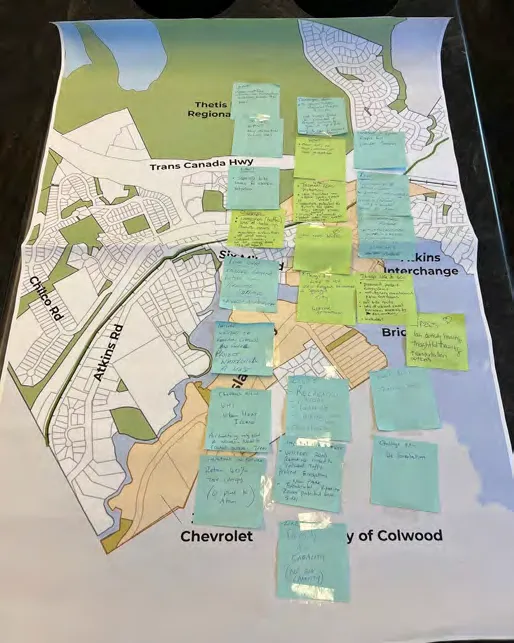
ENGAGEMENT TOUCHPOINT #1: VISION AND GUIDING PRINCIPLES (JANUARY - FEBRUARY 2025) Participants were asked to provide input on the future vision of View Royal. Feedback was collected through an online survey and pop-ups.
Key Takeaways:
- 2 surveys
- 1 workshop
- 4 pop-up events
- Participants identified the following foundational values for their future community: protecting parks and natural areas; maintaining safe and walkable neighbourhoods; improving transportation options; and supporting diverse and affordable housing.
Who Participated:
- 130 survey participants
- 86 youth survey participants
- 36 workshop participants
- 158 pop-up event participants
How People Heard:
- 1,158 Engage View Royal project website visits
- 9 Facebook posts, 2 Instagram posts, and 6 Bluesky posts
- 250 stakeholder emails
- 30 posters
- 1 Inside View Royal e-newsletter
- 1 newspaper ad
- 1 news releases
- 1 project video
- 4 pop-up events
ENGAGEMENT TOUCHPOINT #2: HOW WE GROW ENGAGEMENT (MARCH – APRIL 2025) Participants were asked to provide feedback on how and where the community may grow and change over the next 20 years. Participants were asked to consider the Town’s existing growth areas and corridors, and provide feedback on potential opportunities for additional housing, services, employment space, and amenities.
Key Takeaways:
- 1 survey
- 1 online mapping activity
- 2 pop-up events
- 2 virtual community workshops
- 1 open house
- Participants indicated overall support for an increase in residential height and density and mixed-use development in both existing growth areas and along corridors in the community.
Who Participated:
- 176 survey responses
- 54 social map responses
- 42 open-house participants
- 11 virtual workshop participants
- 16 pop-up event participants
How People Heard:
- 930 Engage View Royal project website visits
- 19 Facebook posts, 19 Instagram posts, and 19 Bluesky posts
- 250 stakeholder emails
- 17 posters
ENGAGEMENT TOUCHPOINT #3: VISION SURVEY (JULY - SEPTEMBER 2025) Participants were asked to provide feedback on three draft vision statements and 11 community goals, developed from earlier feedback.
Key Takeaways:
- 1 survey
- 1 pop-up event
- Participants preferred vision statement that focused on the community’s relationship with nature and green space, and the need to be forward thinking as a community leader to ensure action is taken on environmental stewardship, climate action, affordable housing, and economic development.
Who Participated:
- 85 survey responses
- 16 pop-up event participants
How People Heard:
- 886 Engage View Royal project website visits
- 11 Facebook posts, 11 Instagram posts, and 8 Bluesky posts
- 250 stakeholder emails
- 17 posters
- 1 Inside View Royal e-newsletter
- 1 pop-up event
- 1 news releases
ENGAGEMENT TOUCHPOINT #4: WESTERN GATEWAY COMMUNITY CORRIDOR (OCTOBER - NOVEMBER 2025) The Western Gateway Corridor was identified as a key growth area with opportunities for new housing, businesses, services and employment space. Participants were asked to provide feedback on the three growth scenarios for the Western Gateway Corridor, including low, medium, or high potential development scenarios.
Key Takeaways:
- 1 survey
- 2 workshops
- 2 open-houses
- Participants preferred a medium growth scenario that focused on the development of the Western Gateway south of Parson’s Bridge as a commercial and light industrial area, and the area north of Parson’s Bridge as a mixed-use neighbourhood village. Feedback provided through engagement informed a proposed land use scenario for the Corridor area.
Who Participated:
- 59 survey responses
- 11 workshop participants
- 7 focus group business workshop participants
- 43 open house participants
How People Heard:
- 668 Engage View Royal project website visits
- 9 Facebook posts, 9 Instagram posts, and 7 Bluesky posts
- 250 stakeholder emails
- 10 posters
- 2 Inside View Royal e-newsletters
- 1 news releases
- 1 newspaper ad
- 50 hand delivered notices to residents
- 50 (approximately) notices to businesses
ENGAGEMENT TOUCHPOINT #5: POLICY REVIEW ENGAGEMENT (NOVEMBER 2025) Participants were asked to provide feedback on draft policies from each of the policy chapters in the draft Plan. This gave participants an early snapshot of draft content. Early feedback helped shape and further revise new draft policies on major topic areas, such as housing, transportation and mobility, economic development, parks and recreation, environment, climate action, and infrastructure.
Key Takeaways:
- 1 survey
- 2 open house events
- The survey respondents indicated that they support the draft policies overall. However, there are some policies that respondents provided mixed feedback on, indicating that further review and revisions could be required if desired.
- Participants identified the challenges with traffic congestion, the need to provide more diverse and accessible employment opportunities and services in the community, and more affordable housing. The preservation and enhancement of the Town’s parks and natural spaces is also important to the community.
Who Participated:
- 43 survey responses
- 16 open house participants
1.2.1 HOW PEOPLE HEARD:
- 579 Engage View Royal project website visits
- 11 Facebook posts, 11 Instagram posts, and 8 Bluesky posts
- 250 stakeholder emails
- 1 Inside View Royal e-newsletters
- 1 newspaper ad
- 1 news releases
- 2 newspaper ads
ENGAGEMENT TOUCHPOINT #6: FIRST DRAFT REVIEW (MARCH TO APRIL 2026) Participants were asked to review and provide feedback on the draft Official Community Plan through an online survey. To make participation flexible and accessible, respondents could choose to answer the full survey or focus only on specific chapters within the draft Official Community Plan. A supporting summary document highlighted the major shifts in the draft document from the previous (2011) Official Community Plan was also made available for participants.
Key Takeaways:
- 1 survey
- The survey respondents expressed strong support for the draft vision statement, goals, and policy objectives, particularly those related to natural amenities, housing, mobility, community well-being, and sustainable service delivery.
- While feedback was generally positive, some respondents raised concerns related to growth management, transportation impacts, and reconciliation, with several participants seeking greater clarity on how policies would be implemented and balanced with community character.
Who Participated:
- 47 survey responses
1.2.2 HOW PEOPLE HEARD:
- 1,035 Engage View Royal project website visits
- 14 Facebook posts, 14 Instagram posts, and 12 Bluesky posts
- 1 town-wide postcard mail-out, sent to approximately 3,500 homes and businesses
- 250 stakeholder emails
- 1 project video
- 1 Inside View Royal e-newsletters
- 2 newspaper ads
- 2 news releases
1.3 HOW TO USE THIS OFFICIAL COMMUNITY PLAN
The primary objective of this Official Community Plan is to establish a clear framework for decision-making to guide View Royal Council and staff, residents, partners, agencies, developers, and other interest holders in the Town. All sections are interconnected and considered through the lens of the vision statement and twelve goals, which are referenced in Section 2.0 of View Royal 2050. When evaluating concepts within the Official Community Plan and determining how policies apply to specific developments, projects, or decisions, it is crucial to acknowledge the broad scope of the document and how the initiative would be considered holistically across all policy areas of the Official Community Plan.
The Official Community Plan will be interpreted and applied with care by Council, staff, residents, partners and other interest holders in the town. Departure from the plan must demonstrate clear public benefit and support the community’s vision and goals for growth and development.
Navigating the Official Community Plan requires consideration of its six parts, descriptions for which are provided below.
Part One: The Plan Context This part encompasses introductory elements of the plan, including what an Official Community Plan is, presentation of the community’s vision and goals for the year 2050, discussion on the Town’s commitment to ongoing reconciliation and government-to-government relationships with the Xʷsepsəm and Songhees Nations, and providing context on the community related to its geography, traits, and community statistics, along with context on regional trends that were factors considered at the time of writing this plan.
Part Two: Land Use This part outlines how View Royal will develop over time and how land may be used. It includes objectives and general policies for growth and development that will be considered as part of the development approvals process. In addition, land use designations are identified and apply to different areas of the community, with each designation providing specific context, intended uses, heights, and densities, and supporting policies that apply.
C51-23 THAT the introductory and guiding language of the Official Community Plan emphasize its role as a covenant with the public, reflecting the community's collective investment and expectations for growth and development; AND THAT the Official Community Plan include clear direction that it is to be interpreted and applied with care by Council, staff, developers, and the public; AND FURTHER THAT any proposed amendments to the Official Community Plan demonstrate clear public benefit, particularly where such amendments represent a significant departure from the existing plan. (Refer to second paragraph under section 1.3)
Part Three: Reconciliation This part outlines objectives and policies that support View Royal’s reconciliation and government-to-government relationships efforts with Xʷsepsəm and Songhees Nations and enable the Nation’s journeys towards self-determination. Part Three provides objectives and policy direction to support collaboration and long-term partnerships with Xʷsepsəm and Songhees Nations by focusing on strengthening government-to-government relationships, advancing First Nations presence and cultural recognition in the community, and supporting reconciliation in decision-making, land use decisions, land stewardship, and economic development.
Part Four: Policies This part provides high-level direction across a range of topic areas within the scope of a local government through objectives and policies. These are organized by chapters, including Housing, Transportation and Mobility, Community Infrastructure and Services, Economic Development, Natural Environment and Hazards, Climate Action and Sustainability, Parks, Trails, and Recreation, and Community Well-Being and Culture.
Part Five: Implementation This part describes how the Town may transform the policy direction outlined in Parts Two and Three into concrete actions. Actions are categorized into one of four timeframes for implementation (short-, medium-, long-term, and ongoing) with relevant policies and implementing Town departments referenced. This part also includes the Regional Context Statement, which explains how the Official Community Plan aligns with the Capital Regional District’s Regional Growth Strategy.
Part Six: Development Permit Areas This part identifies and designates seven development permit areas in the Town applicable to areas that require special development considerations. The permit areas are split across two development permit area classifications: Form and Character, and Environmental. Development permit guidelines inform the Town in the decision-making process when considering a development permit application. Overall, the intent of development permit areas is to achieve the following:
- Protection of the natural environment, its ecosystems and biological diversity;
- Protection of the public, buildings, and development from hazardous conditions;
- Establishment of objectives for the form and character of garden suite development; and
- Establishment of objectives for the form and character of commercial, industrial or multi-family residential development.
2.0 View Royal 2050
2.1 OVERVIEW
The Official Community Plan’s vision and goals are intended to guide the community to the year 2050. The policy direction of this plan stems from these key guiding statements. The vision and goals are informed by input received from the community as part of engagement undertaken in 2025 and 2026.
2.2 VISION
The following statement outlines the Town’s aspirations to the year 2050 and beyond:
View Royal is a thriving, welcoming, inclusive community where people live close to nature, services, and amenities that foster health and well-being.
2.3 GOALS
1. MOBILITY & CONNECTIVITY Goal: Provide a variety of transportation options within a well-connected network to support mobilizing all ages and abilities.
While private vehicles are still the primary method of travel, the Town continues to strive towards the creation of an improved transportation network. Developing a well-connected regional network will ensure that residents are able to get where they need to go via different transportation modes: walking, cycling, rolling, transit, and vehicular use. The Town will work closely with the Capital Regional District and nearby municipalities to address ongoing traffic challenges and streamline local and regional connections.
2. DIVERSE AND AFFORDABLE HOUSING Goal: Provide diverse, attainable, and affordable housing types and tenures for all residents.
Encouraging the development of a wide range of market and non-market housing options will ensure existing and future residents can continue to call the Town home. Emphasis will be placed on housing that supports aging-in-place, multi-generational households, and the creation of more rental and home ownership opportunities. Where possible, these options will be within close proximity to transportation and everyday services and amenities.
What is affordable and attainable housing? What constitutes ‘affordable’ is directly tied to a household’s gross annual income. Households who spend less than 30% of their before-tax income on housing are deemed to have ‘affordable’ housing. Attainable housing considers what a household needs in terms of size and type of housing, as well as what level of housing costs may be appropriate for a household given the cost of living in a community.
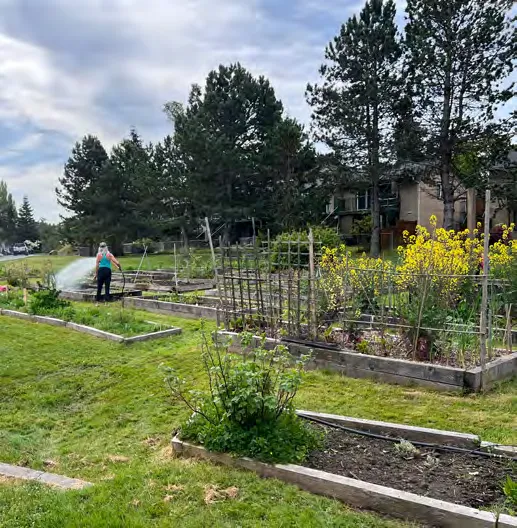
3. GROWTH MANAGEMENT & COMMUNITY CHARACTER PRESERVATION Goal: Allow for context-sensitive, fiscally responsible growth and development throughout the community.
As a desirable community to live in, View Royal must balance opportunities for growth and the need for infrastructure services, while ensuring the character of the community is considered to complement or inspire new development. Natural amenities comprise much of the Town’s existing character, and these attributes are highly valued by the community. New development must ensure these amenities can be appreciated by existing and new residents alike.
C-71-26 THAT the goal titled "Growth Management & Community Character Preservation" in "View Royal 2050" in the Official Community Plan be amended to read: "New development must ensure these natural amenities can be appreciated by existing and new residents alike". (Refer to revisions made to Goal 3)
4. COMMUNITY WELL-BEING Goal: Enhance community well-being by providing safe, inclusive, and accessible spaces, while integrating arts and culture into everyday life.
Community well-being is achieved when every member feels safe, included, and has access to essential services and opportunities. It means embracing diversity and ensuring that all voices are heard and valued, creating a sense of belonging for everyone. Integrating arts and culture enriches our community by celebrating creativity and heritage, fostering a vibrant and dynamic environment that brings people together and enhances the quality of life for all.
5. RECONCILIATION Goal: Strengthen government-to-government relationships with the Xʷsepsəm and Songhees Nations to support their efforts towards self-determination and autonomy. Collaborate with both Nations on shared priorities and decision-making that advance reconciliation across Town programs and services.
View Royal is located on the traditional, ancestral, and unceded territories of the lək̓ʷəŋən speaking peoples. To support community interest in advancing reconciliation efforts and government-to-government relationships, the Town will continue to build relationships with the Xʷsepsəm and Songhees Peoples. Emphasis will be placed on facilitating increased collaboration, supporting the Nations’ efforts towards self-determination, celebrating values and culture, and fostering synergies between our communities to better understand where alignment exists on core values.
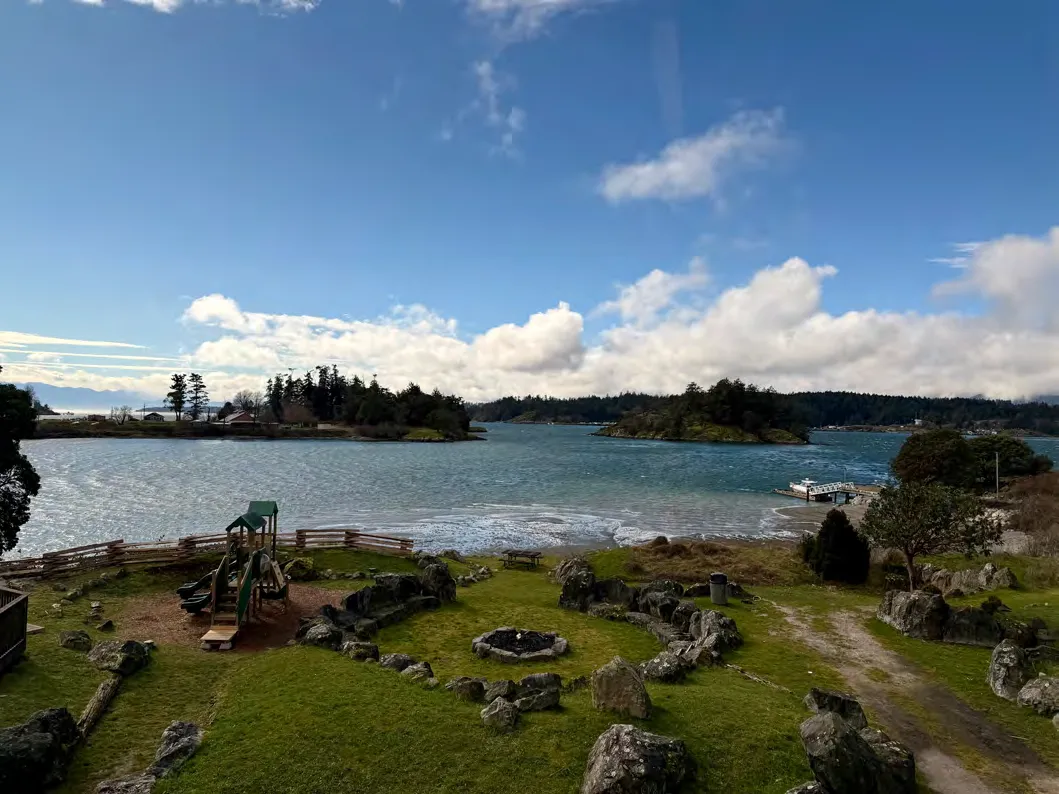
Reconciliation is the ongoing process of establishing and maintaining mutually respectful relationships between Indigenous and non-Indigenous Peoples, grounded in recognition and respect of rights, histories, traditions, cultures, languages, and perspectives of Indigenous Peoples, and commitment to learning from and working in partnership with First Nations
6. NATURAL AMENITIES Goal: Preserve, protect, and expand the Town’s natural assets and amenities.
Parks, trails, and green space are regularly identified as some of the greatest benefits of living in the Town. Ensuring the coastal and forested landscapes are preserved and protected for the enjoyment of current and future generations is a community priority. These efforts will include ensuring a balanced approach to growth and adopting strong climate change adaptation and mitigation strategies.
Natural amenities are place-based attributes created by the environment that provide local benefits. Examples of natural amenities may be parks where community members can hike, lakes where kayaking can be enjoyed, trees that clean the air, and creeks that support with managing drainage.
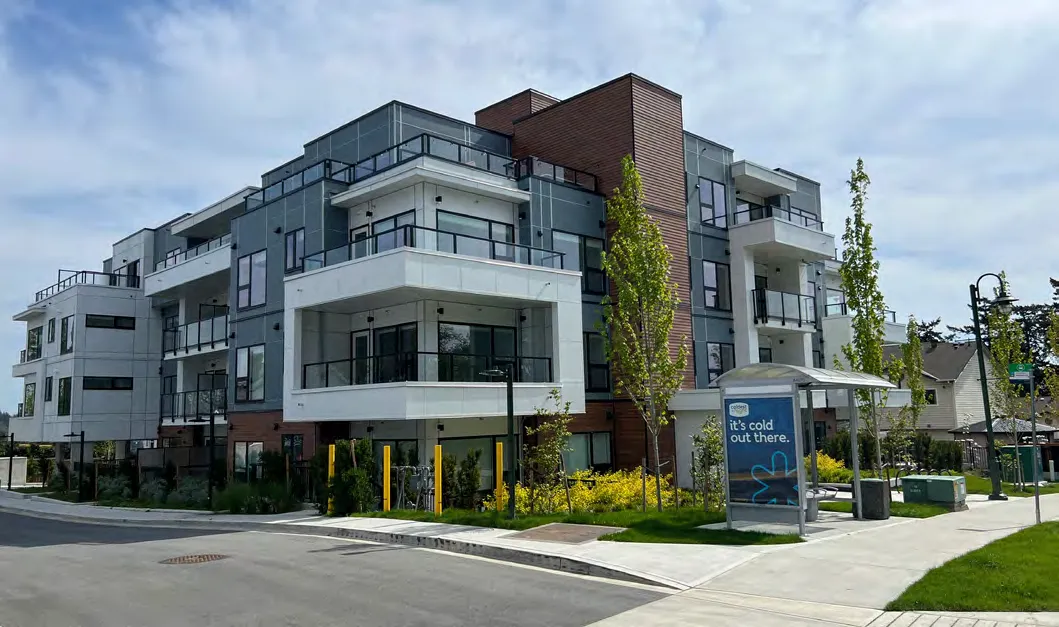
7. COMMUNITY SAFETY & SECURITY Goal: Foster a safe and secure community that is prepared for emergencies.
Community safety and security are achieved when people feel that their needs and quality of life are a priority. It means integrating best practices related to Crime Prevention Through Environmental Design and working collaboratively to better understand what community safety and security means to View Royal residents and business owners. Preparing and responding to health and climate emergencies, such as pandemics, climate disasters, earthquakes, etc., will strengthen the community over the long-term.
C-47-26 THAT the goal titled “Community Safety & Security” in the Official Community Plan be amended to include that Crime Prevention Through Environmental Design(CPTED) principles be considered in the review of all applications for new commercial and residential development. (See revisions in Goal 7)
8. CLIMATE ACTION AND RESILIENCE Goal: Undertake climate adaptation and mitigation initiatives to support the community’s resiliency.
As a forested coastal town, View Royal is particularly vulnerable to wildfires, coastal storms, flooding, and sea level rise attributable to the changing climate. In response, the Town is taking initiative to become a low carbon community, reduce its greenhouse gas emissions, and adopt climate adaptation and mitigation strategies to continue maintaining a high quality of life for everyone.
Greenhouse gas emissions, commonly known as GHGs, are gases released by human activities such as the burning of fossil fuels. These gases trap heat in the atmosphere and impact the global climate.
9. ECONOMIC DEVELOPMENT Goal: Identify and incentivize opportunities for tourism and mixed-use and non-residential development to support local and regional economic priorities.
Encouraging non-residential growth through development incentivization and policy amendments will support View Royal’s economy and further develop employment lands, including the Western Gateway Employment District Corridor and Transit-Oriented Development areas. By attracting investment and business into the Town, this additional economic activity will support local demand for shops, restaurants, and services within walking distance of neighbourhoods and create more opportunities for regional economic growth in adjacent communities. In addition, many opportunities exist to expand and enhance tourism in View Royal due to its central location within the Capital Regional District, and become a regional hub for health and medical services adjacent to the Victoria General Hospital.
10. COMMUNITY INPUT AND GOVERNANCE Goal: Ensure View Royal community members are meaningfully informed and involved in the advancement of community goals and priorities.
As View Royal grows and evolves, the Town will continue to build capacity and seek feedback and input from all community members, especially from those who have been marginalized or historically underrepresented. Through good governance, community leaders will steward decision-making processes and ensure they remain transparent.
C-56-26 THAT the goal titled "Community Input and Governance” in the Official Community Plan be amended to read: “Ensure View Royal community members are meaningfully informed and involved in the advancement of community goals and priorities.” (Refer to revisions made to Goal 10)
11. REGIONAL PARTNERSHIPS Goal: Continue to strengthen the Town’s relationships with partners and stakeholders, including member municipalities, on regional matters.
View Royal is a gateway community bordering seven jurisdictions within the Capital Regional District. Maintaining strong relationships with these local governments and First Nation communities is important to ensure alignment on regional priorities, such as the enhancement of regional transportation management and connectivity.
12. SUSTAINABLE SERVICE DELIVERY THROUGH ASSET MANAGEMENT Goal: Manage the Town’s assets over their full lifecycle to support long-term, sustainable service delivery that meets community needs.
The Town provides a wide range of services though the management of engineered and natural assets (e.g. roads, culverts, parks). Recognizing the importance of ensuring equitable and sustainable services for current and future generations, emphasis will be placed on a holistic and systematic approach to asset management that balances service delivery with cost and risk.
Asset management is an integrated approach to planning, operating, and maintaining physical infrastructure and amenities, such as roads, sewer systems, and treatment facilities, amongst others.
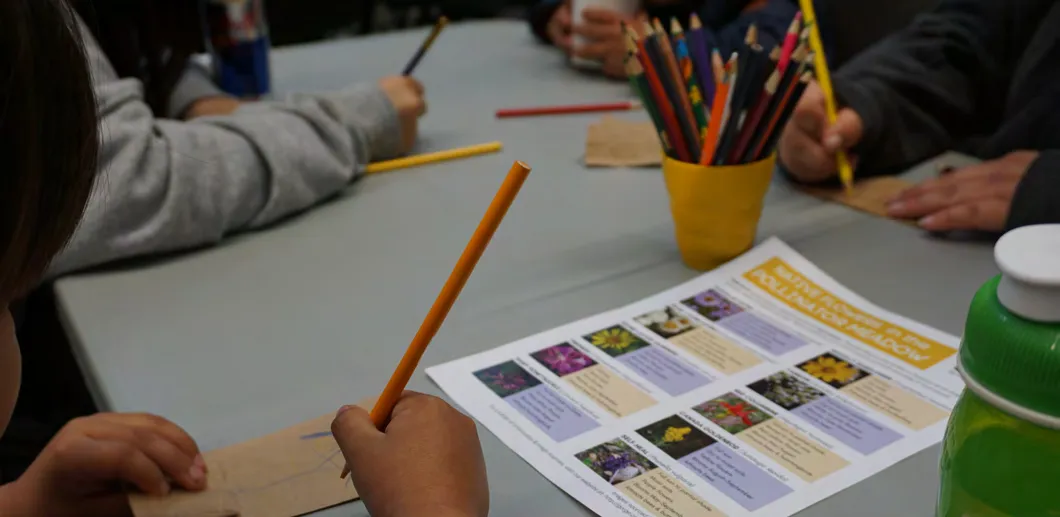
2.4 COMMITMENTS AND TARGETS
Delivering on the View Royal 2050 vision requires steady progress toward clear targets and milestones that support the Town’s long-term goals. A number of commitments and targets are identified throughout this Official Community Plan to support the achievement of the vision and goals identified in sections 2.2 and 2.3. These commitments represent outcomes the Town will seek to achieve through policy, partnerships and advocacy. Tracking the targets can aid Town staff, Council, and the community in keeping apprised of progress towards their achievement.
A summary of this Official Community Plan’s commitments and targets is provided in this section, which is intended to complement the Action Plan in Section 15.0. Unless otherwise stated, targets are measured from a 2025 baseline. Both sections may guide annual departmental planning, budgeting, and coordination. Progress will be reviewed and reported on at least annually through the Town’s strategic priority setting and planning process. Commitments, targets and actions may be updated over time to reflect changes in policy or new information.
C-45-26 THAT clear targets for the full range of affordable housing be established and included within the Official Community Plan and associated bylaws and policies; AND THAT a ratio for housing (non-market versus full market) be set and adjusted using best available data. (Refer to targets 1 and 2 below).
OUR COMMITMENTS AND TARGETS
- Achieve 1 unit of below-market housing for every 15 units of market housing constructed in View Royal.
- Achieve 1 unit of supportive housing for every 44 units of market housing constructed in View Royal.
- Achieve a minimum replacement of 1:1 for all below-market and affordable rentals that are lost through redevelopment.
- Require new multi-unit residential developments of four or greater storeys, with the exception of seniors housing, supportive housing, and affordable rental housing projects, to allocate a minimum of 30% of units with two bedrooms or more and a minimum of 10% of units with three bedrooms or more.
- Achieve 10% of units in all new multi-unit housing developments of four or more storeys to be accessible or adaptable units designed and constructed in accordance with the BC Building Code, or an equivalent standard.
- Pursue the following mode share targets by the year 2050: 25% walking, cycling and micromobility; 15% public transit; and 60% private vehicle.
- Achieve 30% canopy coverage by 2045.
- Achieve a 45% reduction in emissions below 2007 levels by 2030, and a 100% reduction in emissions below 2007 levels by 2050.
- Achieve a minimum of 5.0 hectares (12.4 acres) of parkland per 1,000 people, residents living within a 400 m radius, or a 5-minute walk of usable park space, excluding regional parks and schools.
3.0 Reconciliation
3.1 CONTEXT
In 2007, the United Nations passed the United Nations Declaration on the Rights of Indigenous Peoples (UNDRIP), a legally non-binding resolution. In 2015, Canada’s Truth and Reconciliation Commission (TRC) released 94 Calls to Action. The following actions call upon municipal governments to take action:
- Action 43: fully adopt and implement UNDRIP as the framework for reconciliation;
- Action 47: repudiate concepts used to justify European sovereignty;
- Action 57: provide education to public servants on the history of Aboriginal Peoples and intercultural competency skills-based training;
In 2019, the Province of British Columbia enacted the Declaration on the Rights of Indigenous People Act (DRIPA), becoming the first jurisdiction in Canada to formally adopt the internationally recognized standards. The Declaration on the Rights of Indigenous People Act provides the framework for reconciliation in British Columbia, focusing on four themes:
- the right to self-determination;
- the right to be recognized as distinct Peoples;
- the right to free, prior, and informed consent; and
- the right to be free from discrimination.
The United Nations Declaration on the Rights of Indigenous Peoples, commonly referred to as UNDRIP, was adopted in 2007 as a tool to support the rights of Indigenous peoples. It provides guidance on matters related to self-determination, culture, and land rights, and serves as a framework for reconciliation within Canada. The Province of British Columbia aims to endorse UNDRIP through its Declaration on the Rights of Indigenous Peoples Act.
C-72-26 THAT the action items listed under "Context" in the section "Reconciliation" be relocated to the section titled "Action Plan" to ensure all action items in the Official Community Plan are located in the same section. (The actions pertaining to TRC document remain in this section and actions to be undertaken by the Town are in the Implementation section).
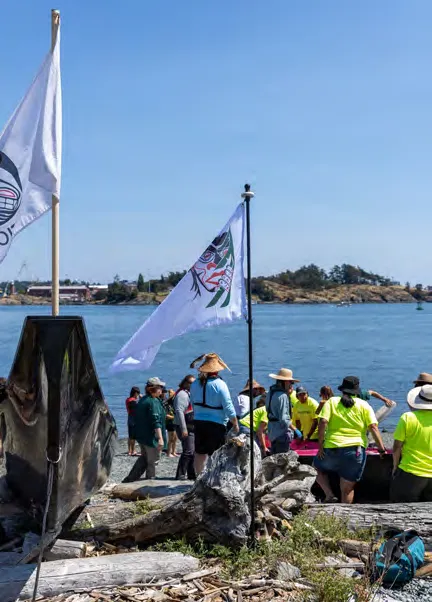
The journey of Truth and Reconciliation for municipalities in relation to the United Nations Declaration on the Rights of Indigenous Peoples adoption and implementation begins after foundational groundwork has been established. View Royal is committed to integrating a reconciliation-centric approach to current and future planning initiatives, as evident in the policy direction threaded throughout this Official Community Plan, and particularly in Part Three which aims to establish a joint vision for reconciliation. The Town aims to take concrete and meaningful actions towards reconciliation and government-to-government relationships, beginning with incremental relationship-building measures.
View Royal is committed to actively supporting economic reconciliation by creating partnerships that advance the Nations' economic interests and capacity, and by encouraging initiatives that promote local economic development led by Xʷsepsəm and Songhees Nations. View Royal is also committed to creating opportunities to collaborate with the Xʷsepsəm and Songhees Nations to ensure municipal planning is grounded in the history, ongoing land stewardship, and enduring presence of the lək̓ʷəŋən Peoples. As stewards of the land, View Royal recognizes its responsibility to protect and sustain the natural environment for future generations, ensuring that decisions made today honour both First Nations and municipal values. The recognition of the Xʷsepsəm and Songhees Nations remains central to View Royal’s planning for both the present and the future.
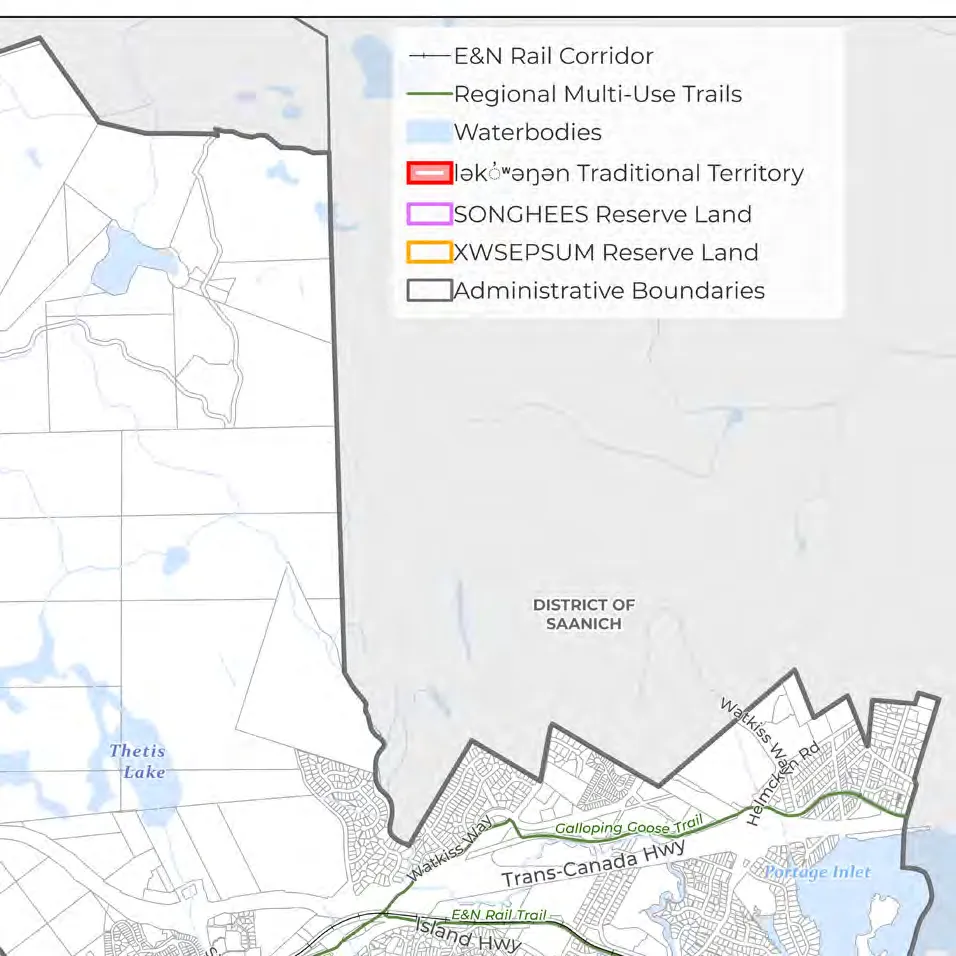
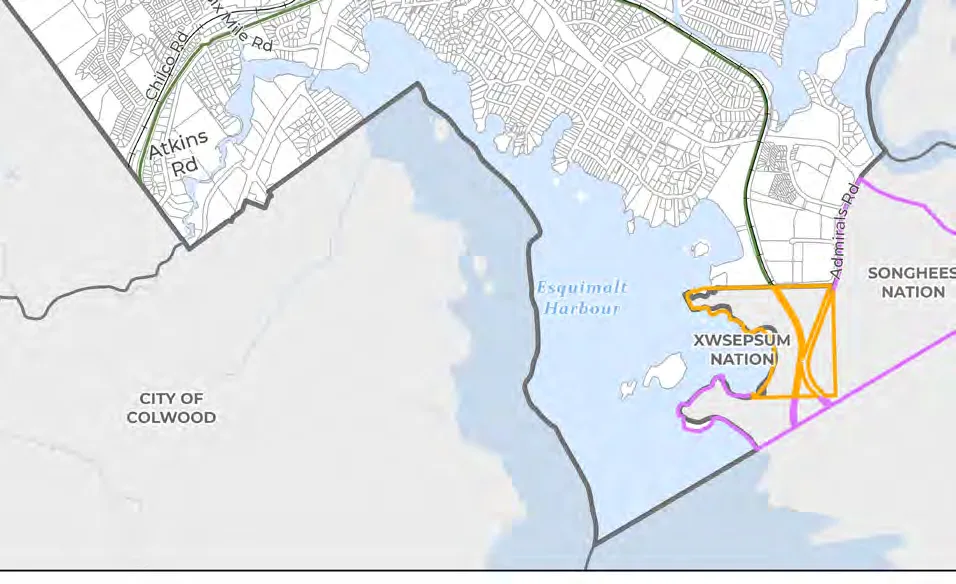
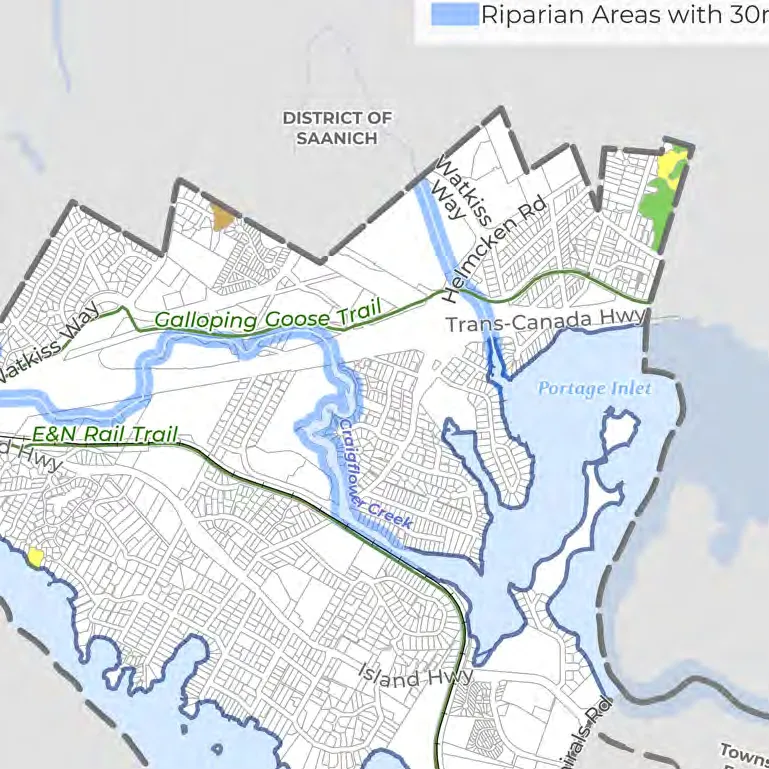
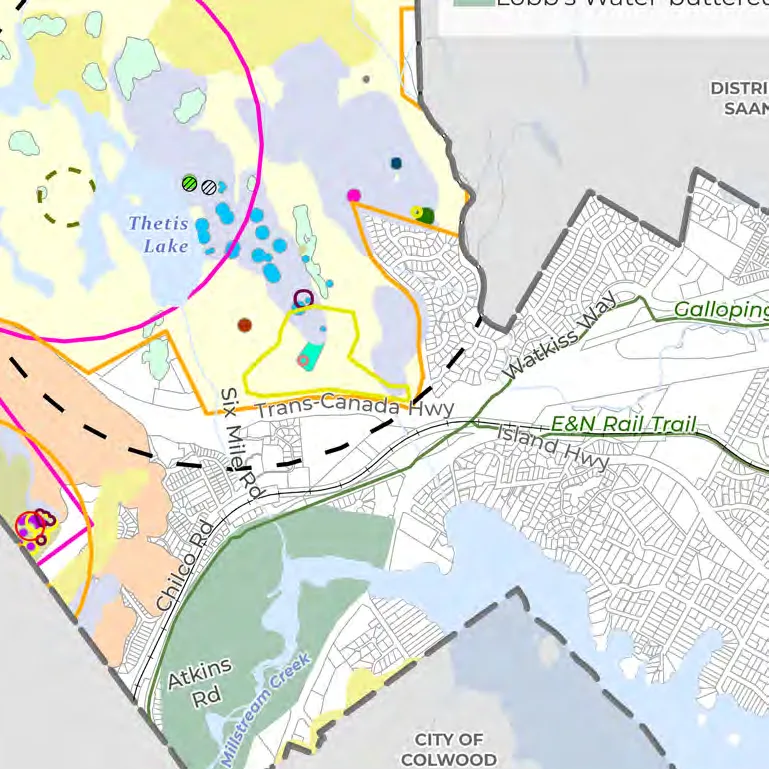
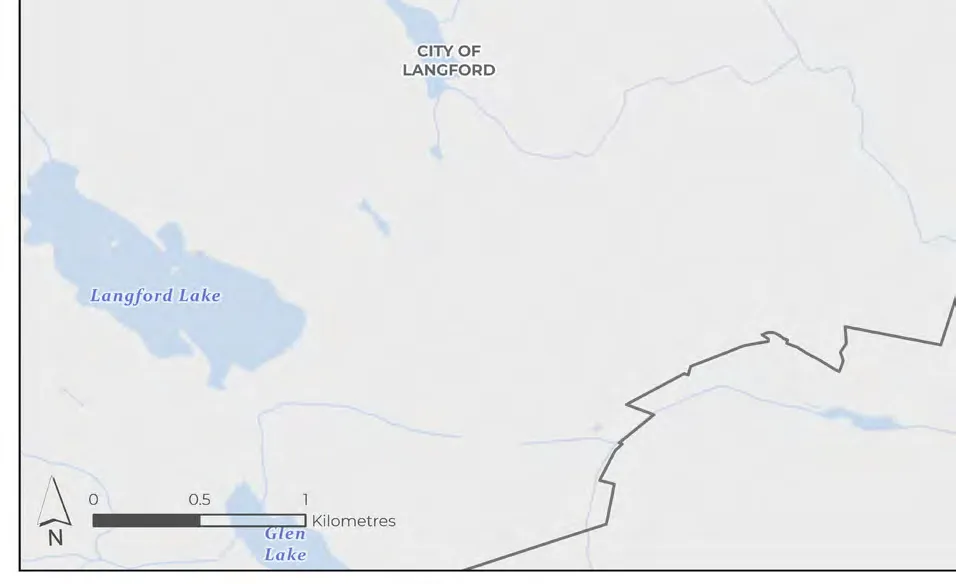
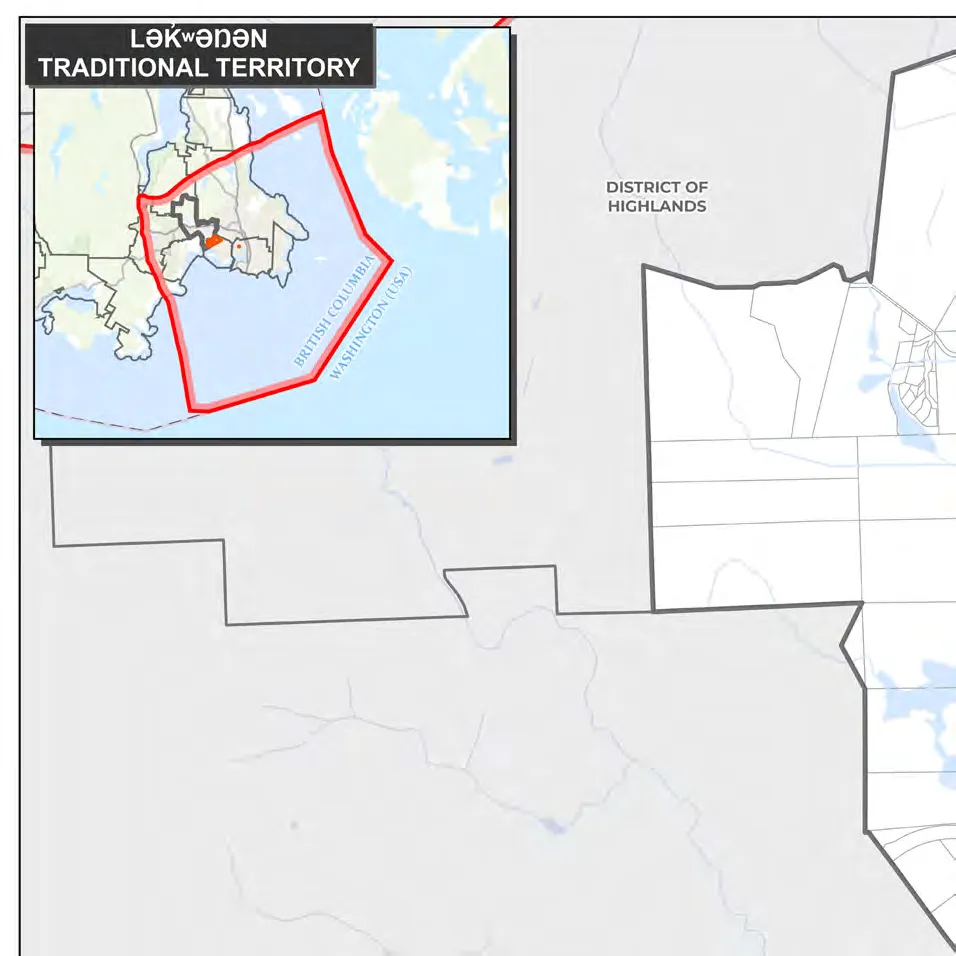
The Xʷsepsəm and Songhees Nations are stewards of both reserve lands and the broader traditional territory, which extends across much of the Greater Victoria area, including what is now known as View Royal, Esquimalt, Langford, Colwood, and Oak Bay, as shown on Figure 1. The Xʷsepsəm and Songhees Nations are actively planning for their communities within current reserve boundaries and through potential acquisition of future lands. View Royal’s commitment to reconciliation and government-to-government relationships acknowledges the Nations’ rights to make decisions over their lands, resources, and economic future, and strives to ensure that municipal processes empower and reflect their aspirations.
3.2 XʷSEPSƏM NATION TODAY
Xʷsepsəm Nation, also spelled Xwsepsum, is a Nation located on the waters of Esquimalt Harbour, immediately adjacent to the Songhees Nation and Town of View Royal. The Nation has approximately 385 members who are descendants of the lək̓ʷəŋən People, with close to half living in the main community on the approximately 19-hectare Esquimalt reserve.
The Nation’s connection with the land and resources of its large territory goes back thousands of years. In that time, Xʷsepsəm Nation have learned to live in a finely balanced relationship with the seasons, the lands, the tides, and the seasons of their lives that have sustained them. Xʷsepsəm has repaid the land through their commitment to stewardship and through ceremonies which are understood as their Sacred Trust. The Sacred Trust has been transmitted through oral teachings, usually contained in the stories of the Nation, and they articulate a set of Natural Laws. The Sacred Trust determines the relationships between the land, water, and resources, the Community and the Spiritual Path.
Xʷsepsəm Nation’s mission statement is rooted in a desire for promoting the importance of traditional teaching and values, and importantly for View Royal, a desire of the Nation to work with their partners for beneficial goals. It is important that the Town cultivates a respectful and meaningful partnership with Xʷsepsəm Nation through its commitment to reconciliation.
The Nation’s mission is: Our mission is to build a legacy for present and future generations of Esquimalt Nation members by ensuring our work is rooted in the teachings and natural laws that flow from the Sacred Trust. We will promote and advance holistic health, self-sufficiency and safety of Esquimalt Nation members by offering meaningful programs and services, and working with our partners for mutually beneficial goals.
3.3 SONGHEES NATION TODAY
Songhees Nation are a lək̓ʷəŋən People with a longstanding and ongoing presence in the region. The Nation has approximately 690 members, with over half living on the Songhees Reserve located immediately adjacent to the Town of View Royal and Xʷsepsəm First Nation. The community is approximately 60 hectares and is developed with a mix of residential and commercial areas.
The Songhees community is comprised of five main families and several smaller families descended from the Lək̓ʷəŋən speaking signatories of the Douglas Treaties in 1850. Traditional governance is by consensus among extended family heads, guided by their families. Today, the community is still guided by consensus among families represented by advisory committees, focus groups and an elected Chief and Council. Referendums and ratification votes are held for important Community decisions.
The Nation’s mission, vision, and values are significant, serving as a reflection of the relationship that View Royal seeks to establish and its intent to encapsulate the core principles upheld by the Nation.
The Nation’s mission is: Songhees Nation strives to achieve community vision through good governance, delivering programs and pursuing projects and initiatives for the benefit of the Songhees People.
The Nation’s vision is: A healthy, self-reliant, progressive community that honours tradition and culture and invests in future generations.
The Nation’s Values are: With One Heart and One Mind, we commit to help one another, to forgive one another and to love one another with respect, honesty and courage.
4.0 The History of View Royal
C-53-26 THAT a section titled "The History of View Royal" be added to the Official Community Plan. (Section 4.0 has been renamed)
4.1 COLONIAL SETTLEMENT
The early documented history of View Royal began in the 1850s when the Puget Sound Agricultural Company commenced corporate farming along the shores of Esquimalt Harbour. This company was a subsidiary of the Hudson’s Bay Company and was responsible for colonizing and settling communities across Vancouver Island under the Royal Charter of Grant from the British Empire. The establishment of agricultural enterprises was a significant shift from the long-established fur trade economy at the time.
The development of Maple Point farm began in 1853 by Mr. Kenneth McKenize. The area was renamed Craigflower Manor and was completed in 1856 with the addition of a sawmill, flour mill, blacksmith shop, brick kiln, slaughterhouse, general store, as well as multiple farm dwellings. Maple Point School, later known as Craigflower Schoolhouse, was completed in 1855 and provided education to those living in Craigflower Country, as well as the surrounding area. The school provided living space for the teacher’s family as well as boarders. The Craigflower Schoolhouse remains the oldest surviving school building in Western Canada.
Craigflower Manor is located at 1801 Admirals Road, at the intersection of Admirals Road and Island Highway, and the Craigflower Schoolhouse is located at 2755 Admirals Road, on the Gorge Waterway, within the District of Saanich. Each site is located at opposite ends of the Craigflower Bridge.
Four Mile Pub at 199 Island Highway and the Six Mile Pub at 494 Island Highway are two historic sites, originally operated as ‘roadhouses’. The pubs have been serving patrons for over 160 years. Originally built for mail delivery service for stagecoaches along the E&N railway, the sites continue to operate as well-loved local eateries. The Six Mile Pub stands at the site of the former Millstream Mill.
The name View Royal was originally coined circa 1910 by a real estate developer promoting the area's “royal views” of Esquimalt Harbour. At the time, the area was marketed as a getaway destination with seasonal cottages. Urbanization of View Royal started to take off by the 1930s, which saw increased development near Esquimalt Harbour and Portage Inlet.
4.2 PHYSICAL SETTING
View Royal is located on Southern Vancouver Island in the Capital Regional District. It is situated between the West Shore, which includes the District of Sooke, District of Metchosin, City of Colwood, District of Highlands, City of Langford, and the region’s core area, comprising the City of Victoria, Township of Esquimalt, Xʷsepsəm Nation, Songhees Nation, District of Oak Bay, and District of Saanich. Its geographic location and major transportation corridors such as the Trans-Canada Highway, regional Island Highway, and regional trails (Galloping Goose and E&N Trail) allow the community to function as a gateway within the region, serving as an integral connection point between the West Shore and the core areas of Greater Victoria. While View Royal’s location presents various opportunities for the community’s future growth and development, its location also poses local and regional challenges.
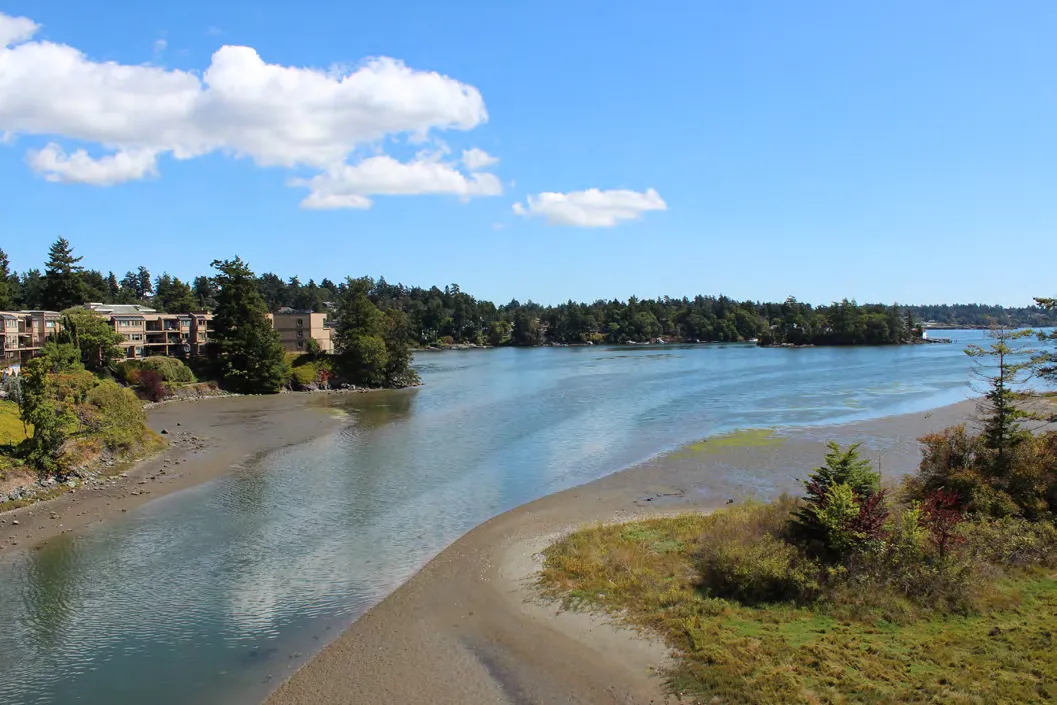
View Royal is a growing community of over 12,500 people. It is largely residential and offers a high standard of living with natural amenities like the Esquimalt Harbour, Portage Inlet, Thetis Lake Regional Park, and Craigflower and Millstream Creeks. View Royal is shaped by a rich variety of ecosystems, including its marine environments, estuaries, and freshwater lakes, as well as terrestrial environments from moist Douglas Fir forests to Garry Oak meadows. View Royal also hosts historic structures, the most notable being Craigflower Manor.
4.3 COMMUNITY TRAITS
Since incorporation in 1988, the Town of View Royal has been transforming from a quiet suburb into a distinct and vibrant community, complete with its own unique neighbourhoods, commercial services, and highly desired parks and green spaces. View Royal is home to the regionally critical Victoria General Hospital, a growing development node supporting health care and services in the Capital Regional District. Residents enjoy recreation services through West Shore Parks and Recreation, which oversees the Juan de Fuca Recreation Centre, along with the many parks and natural green spaces located throughout the Town. The Western Gateway Corridor straddles the View Royal and Colwood border, offering a mix of business, as well as much future development potential. The community is serviced by two other large commercial hubs, including the Eagle Creek Shopping Centre, located just east of Victoria General Hospital and Admirals Walk, located along Admirals Road.
- Current population (2025): 12,539
- Projected population (2050): 21,574
- Growth scenario: Medium Growth of 2.2% annually
C-73-26 THAT the paragraph titled “Housing Trends” in “Regional Trends” in the Official Community Plan be amended to include updated information on the current number of housing units constructed. (Regional trends section was deleted from the document as the project team felt that it was not necessary to keep in the OCP as it did not add significant value to the document as a whole)
Part Two: Land Use
5.0 Land Use
Land Use determines the physical framework of the community, providing direction for how and where View Royal will grow in the future. This plan provides guidance on the approach and priorities for where development and growth are supported and in what form.
5.1 GENERAL FRAMEWORK AND CONSIDERATIONS
5.1.1 CONTEXT
View Royal has a long rural and suburban history, but has transformed into a vibrant community with local and regional services. Most of the land within the Urban Containment Boundary has been developed. Future growth will have to occur through redevelopment and infill of existing lands. There are also land use and density constraints as a result of View Royal’s geographical location and limited transportation commuter infrastructure.
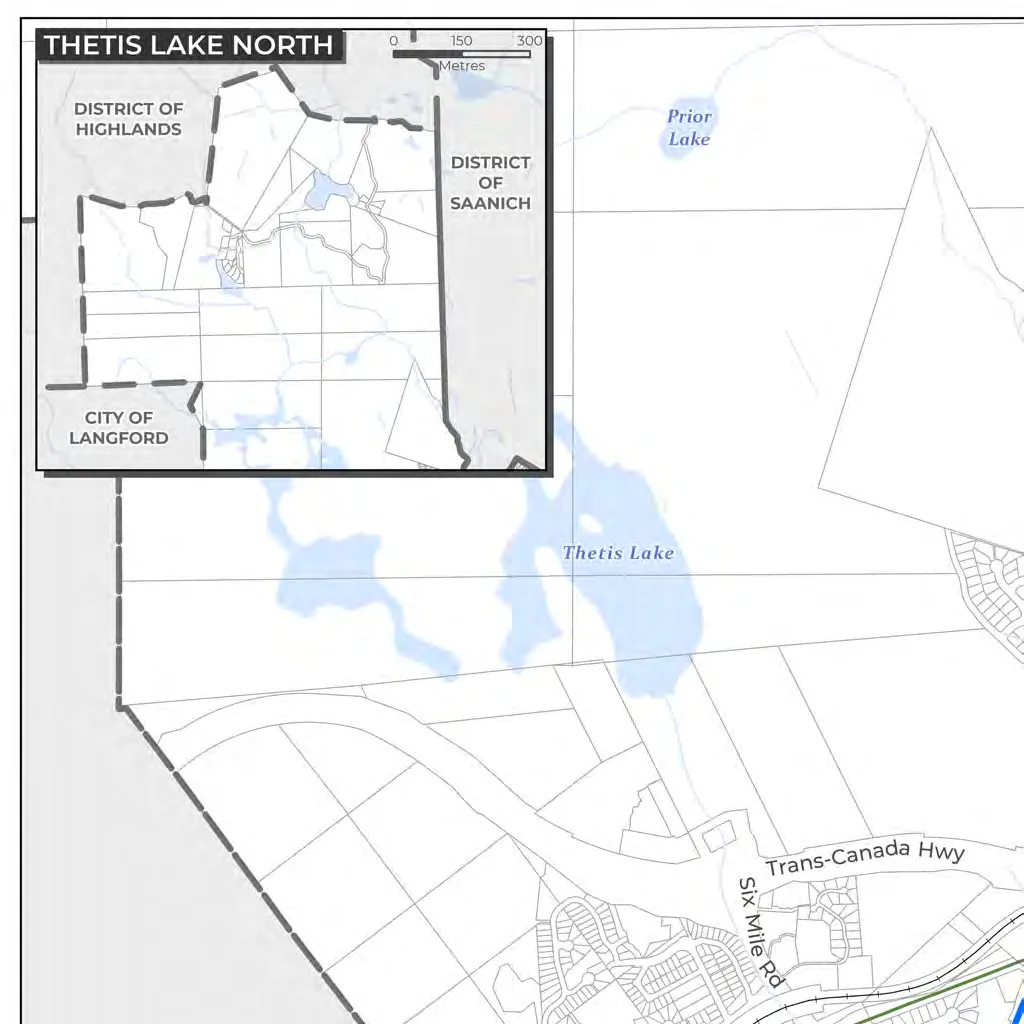
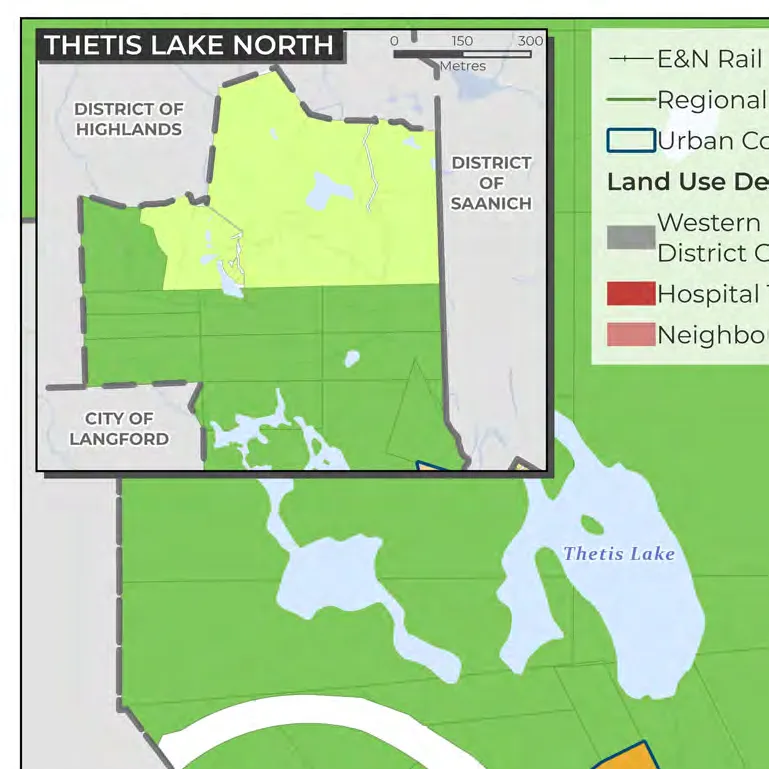
Thetis Lake Regional Park is an expansive natural regional recreational amenity located in the north part of View Royal. It provides a buffer between developed areas and the rural areas to the north of Thetis Lake Regional Park. The Thetis Lake area has some existing low-density housing, but it is largely preserved and protected for long-term green space use.
C-76-26 THAT the following be added to the section titled "Land Use" in the Official Community Plan: "Land Use and density are constrained by the region's 'pinch point' geography and limited transportation commuter infrastructure. (Revisions made to first paragraph under subsection 5.1.1)
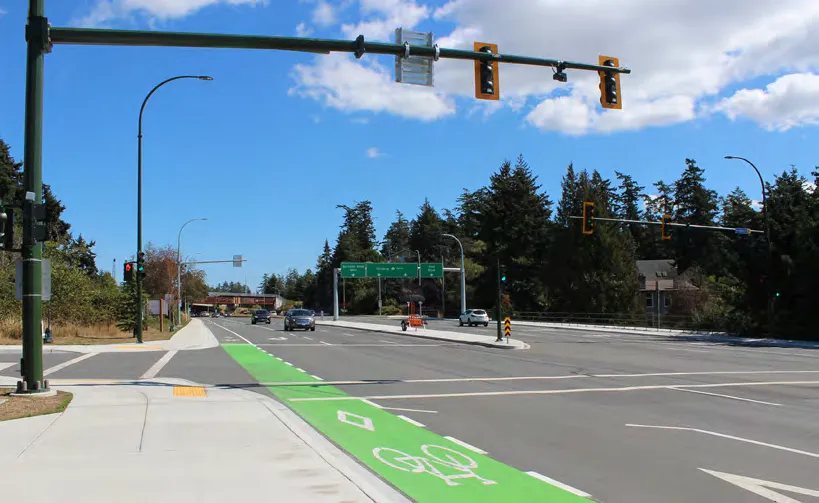
Higher residential density and commercial activity in View Royal are currently concentrated along Island Highway, Admirals Road, Helmcken Road and at key intersections. These areas are referred to as corridors (as shown on Map 3) and provide the potential for further infill development and opportunities for enhancement as there are many underutilized parcels of land that could accommodate residential and commercial growth near transit and active transportation infrastructure.
In recent years, commercial and institutional development along with multi-unit residential development have steadily increased, highlighting the growing demand for businesses and services in View Royal. For example, the opening of Eagle Creek Village in 2016 has encouraged further development of the Victoria General Hospital area as an important node with mixed-use, providing key commercial, office, retail, restaurant, healthcare, and other related services. The regional significance of this area was recognized through the designation of the Hospital Transit-Oriented Area (see Section 5.3) in 2024.
View Royal has two mobility hubs – the Atkins Mobility Hub and the Hospital Mobility Hub – which serve as key intersections of land use and transportation. These mobility hubs act as central community gathering spots that promote connection and access to community and regional services and amenities.
Mixed-use is a development typology that accommodates a variety of uses with clear and convenient connections to the public realm. Mixed-use developments typically have retail, commercial, civic, or industrial uses located on the ground level and lower floors, and residential or office units occupying the upper floors. Mixed-use developments provide conveniently located amenities and services accessed by multi-modal transit within a neighbourhood.
Mobility Hubs are mobility-oriented development areas that offer seamless access to multiple transportation modes, connecting people to key destinations, employment, and services with quality public spaces and clear wayfinding. Mobility Hubs are the strategic intersection of frequent transit corridors and shared mobility infrastructure supported by high-density residential and employment land uses.
The vision for View Royal is to provide more commercial space, amenities, and services to a growing community in the form of mixed-use development focused along the five major corridors (as shown on Map 3, Section 8.0), including Admirals Road, Helmcken Road, Island Highway from Admirals Road to Atkins Road, Watkiss Way, and the Western Gateway Corridor portion of Island Highway from Atkins Road to the Colwood border. The intersection of Helmcken Road and Island Highway, Six-Mile Road and Island Highway, and Watkiss Way and Helmcken Road have the opportunity to be established as walkable areas providing neighbourhood level, mixed-use amenities and services.
The following Official Community Plan Goals may be achieved through the policy direction provided in this section:
- Mobility and Connectivity
- Diverse and Affordable Housing
- Growth Management and Community Character Preservation
- Economic Development
- Reconciliation
5.1.2 OBJECTIVES
- Spaces for Sustainable, Compact, and High-Density Development: Create a more complete, walkable, and sustainable community by directing most new growth to the corridors and mobility hubs which focus on mixed-use, transit-oriented development and urban design.
- Small-Scale, Multi-Unit Housing and Infill Development: Encourage the development of new compact housing near amenities, services, and transit-serviced routes within existing Small-Scale Multi-Unit Housing areas inside the Urban Containment Boundary as desirable forms of small-scale infill development.
- Quality and Complementary Built Form: Support high-quality development that complements existing built forms and achieves sustainable urban and building design, safety, and dynamic public and private spaces.
- Community Connections: Continue to advance opportunities to enhance existing connections and identify opportunities to establish new access connections between neighbourhoods and mobility hubs.
- Manage Development and the Natural Environment: Manage development to protect, preserve, and enhance the natural environment, parks, trails, and waterbodies and recognize these spaces as vital physical features that define the Town.
- Functional, Connected Green Spaces: Establish a functional and interconnected greenspace and trail network in the Western Gateway Corridor, focusing on the areas along Millstream Creek and Esquimalt Harbour. This network will support ecological connectivity, recreational opportunities, and enhanced access for residents, while integrating within the Town’s broader system of parks, trails, and natural spaces.
- Spaces for People: Enhance the social fabric of the community by planning and designing public and private spaces that meet the diverse daily needs of residents to foster a sense of community, encourage social cohesion, and interaction through planned and unplanned events and activities.
C-58-26 THAT the bullet "Land Use Objectives and Policies" in the Official Community Plan be amended to read: "Manage development to protect, preserve, and enhance the natural environment, parks, trails, shoreline, and waterbodies. (See revisions made to Objective 5)
5.1.3 GENERAL POLICIES
A. Create viable conditions for local businesses to thrive and provide for the diverse needs of residents by directing higher levels of housing and employment densities to nodes, mobility hubs, and corridors. B. Prioritize the review of development applications that meet one or more of the following criteria for approval by Council or staff for permit issuance: i) Below-market housing developments; ii) Purpose-built rental housing; iii) Supportive housing; iv) Age-friendly housing; v) Provide significant public benefit, including parks, and/or community facilities; vi) Housing led by non-profit organizations; vii) Hotel development; or viii) Advance overall Official Community Plan objectives. C. Strengthen connections between existing residential neighbourhoods, nodes, corridors, and mobility hubs by: i) Providing multi-modal trails and pathways; ii) Creating linear parks; and iii) Enhancing public spaces and streetscape improvements (i.e. street trees, landscaping, wide sidewalks, street furnishings, pedestrian scale lighting, etc.). D. Integrate existing neighbourhood characteristics into the design of new developments to acknowledge the unique social, cultural, and environmental characteristics of the town. E. Encourage the development of public gathering places such as parks, plazas, and landscaped seating areas near activity-generating uses, including nodes, corridors, and mobility hubs. F. Developments of four storeys or greater should incorporate commercial or public use space. G. Do not support rezoning or bylaw variances that would facilitate the subdivision of waterfront lots in order to protect the integrity of the shoreline, aquatic environments, and ecologically sensitive areas. H. Do not support aggregate extraction activities within Town boundaries. Aggregate materials should be sourced from neighbouring regional communities to meet development needs, given the non-existence of aggregate extraction operations within View Royal. I. Explore the viability of density bonusing for the Hospital Transit-Oriented Area and Western Gateway Corridor to determine building heights and density that are viable for development. Findings could be integrated into the Zoning Bylaw and Official Community Plan. J. Apply Universal Design principles and guidelines for accessibility when designing public space and improvements. K. Maintain the Urban Containment Boundary by continuing to direct urban development and improvements to areas within the boundary, thereby preserving agricultural land, natural areas, and rural character. L. Integrate community safety principles and best practices into all design guidelines, such as the Crime Prevention Through Environmental Design framework or equivalent. This includes: i) Increasing visual permeability of areas such as building entrances, stairwells, building facades, playgrounds, etc. through the strategic use of windows, fencing material, and landscaping; ii) Orienting driveways and paths towards building entrances and windows; iii) Lighting pathways and other areas where opportunities for natural surveillance exist; iv) Developing public spaces in ways that encourage activity and natural surveillance, including sidewalk patios, seating areas, dynamic spaces that accommodate community uses (such as markets, festivals, placemaking projects, etc.), and other amenities; v) Landscaping to provide a natural barrier between conflicting uses and clear definition of spaces; vi) Providing clear signage, pavement markers, and other visual cues to provide clear direction for transitional spaces between public, semi-public, and private spaces; and vii) Opportunities for placemaking through street art and festivals.
5.1.4 CORRIDOR POLICIES
A. Establish the corridors as shown on Map 3 as main thoroughfares that serve local residents and those travelling through the community to other areas of the region. This can be achieved by supporting applications for development along corridors that provide: i) a mix of local- and regional-serving amenities and businesses; ii) maximum permitted housing densities established through applicable land use designations outlined in Sections 5.2 to 5.13 of this Part; iii) infrastructure that allows for walkable connections between the corridor and surrounding neighbourhoods; iv) support for increased frequency of transit service through the concentration of employment and housing densities; and v) strong public realm design elements that support walkability, such as public gathering space, landscaping, seating, and lighting features, amongst others.
5.1.5 MOBILITY HUB POLICIES
A. Establish the Atkins Neighbourhood Village and the Hospital Transit-Oriented Area as View Royal’s mobility hubs, as shown on Map 4, to create conditions for the following: i) Centralized access to a range of services and amenities; ii) Convenient access to transportation services such as bus stops, cycling routes, local and regional multi-use trails, bike parking, car share options, amongst others; iii) Increased accessibility, safety, and comfort for everyone by ensuring inclusion of wide sidewalks, pedestrian-friendly road crossings, increased connections, accessible parking, accessible building access, and passenger loading areas; iv) Encourage and support local economic development; and v) Integrated public spaces and amenities into site design such as landscaping features, trees, outdoor amenity spaces, public art, and seating elements. B. Encourage transit supported uses and medium to high densities such as mixed-use community-wide destination retail, small format retail, health services, community and social services, recreation facilities, educational, and arts and cultural spaces. C. The public realm component of new development in mobility hubs should be designed in a manner that allows for strong pedestrian, cycling, rolling, and transit connections to other existing and new development within the same mobility hub. Proposals that strengthen connections between the two mobility hubs will be supported.
5.1.6 REDEVELOPMENT POLICIES
A. Consider incorporating provisions for density bonusing to secure community and neighbourhood amenities associated with new development such as parks, plazas, playgrounds, community meeting spaces, heritage retention, and frontage improvements. B. Where growth is planned, consider financial tools to collect funds for community amenities such as community centres, recreation facilities, libraries, childcare facilities, landmarks, and public spaces. C. Collaborate with the Xʷsepsəm and Songhees Nation on land use and development opportunities that are mutually beneficial, and explore land use directions that further advance the Official Community Plan, long-term reconciliation, and meets the needs of the Xʷsepsəm and Songhees Nations. D. Maintain alignment of the Development Cost Charges Bylaw with market trends, and ensure the costs of providing infrastructure services associated with community growth are recovered. E. Where heritage, archeological or cultural assets that may be significant to the Town, Xʷsepsəm or Songhees Nations are potentially impacted by redevelopment, require applicants to protect, rehabilitate, restore, and/or formally designate these assets, as appropriate on a case-by-case basis and in consultation with the Town and/or First Nations, by securing commitment through tools such as a covenant on title, or other protocols. F. Support the reuse or retrofit of historically significant buildings, structures, and sites identified in the Town’s Heritage Register in a manner that preserves the heritage features of significance. G. Explore opportunities to establish a standard for required professional reporting requirements for development applications. H. Explore the opportunity to integrate Development Approval Information authority into the Development Application Procedures Bylaw to give Town staff the authority to request additional information about a development proposal, such as environmental reports, renderings, etc. that would aid the Town in its evaluation. I. Notwithstanding the permitted building heights (i.e. number of storeys) within the Land Use Designations, consideration for increased building heights for rezoning and amendments to the Official Community Plan may be considered where proposed developments would achieve one or more of the following: i) Advance overall plan objectives; ii) Are on sites with substantial grade differences; iii) Meet specified density bonus zoning provisions; iv) Achieve retention of high value trees or natural features and increased on-site open space; v) Demonstrate site design and architectural excellence; or vi) Provide a significant public benefit, including securing non-market or supportive housing, parks, or community facilities. J. Expand housing choice by supporting sensitive and strategic infill development, ensuring that new housing integrates seamlessly with the existing character, scale, and livability of established residential areas. K. Where redevelopment is considered, the built form should respect the natural topography and ecology integrity of the site, including but not limited to, natural contours, rocky outcrops and bluffs, environmentally sensitive areas, and other natural areas. L. To ensure new development is thoughtfully integrated into existing neighbourhoods, consider developing Infill Design Guidelines. M. Development should strive to assemble properties in a manner that: i) Facilitates a desirable and replicable pattern of development that supports livability and enables neighbouring sites to develop to an equal standard; ii) Accommodates desired housing types and forms, including a mix of unit sizes; and iii) Enables high-quality built forms, landscaping, and tree planting, and contributes to the public realm.
C-77-26 THAT the policy under “Redevelopment Policies” in the section titled “Land Use” in the Official Community Plan be amended to read: “Where heritage, archeological or cultural assets that may be significant to the Town, Songhees and Xʷsepsәm Nations…”. (Refer to revisions made to policy 5.1.6(e))
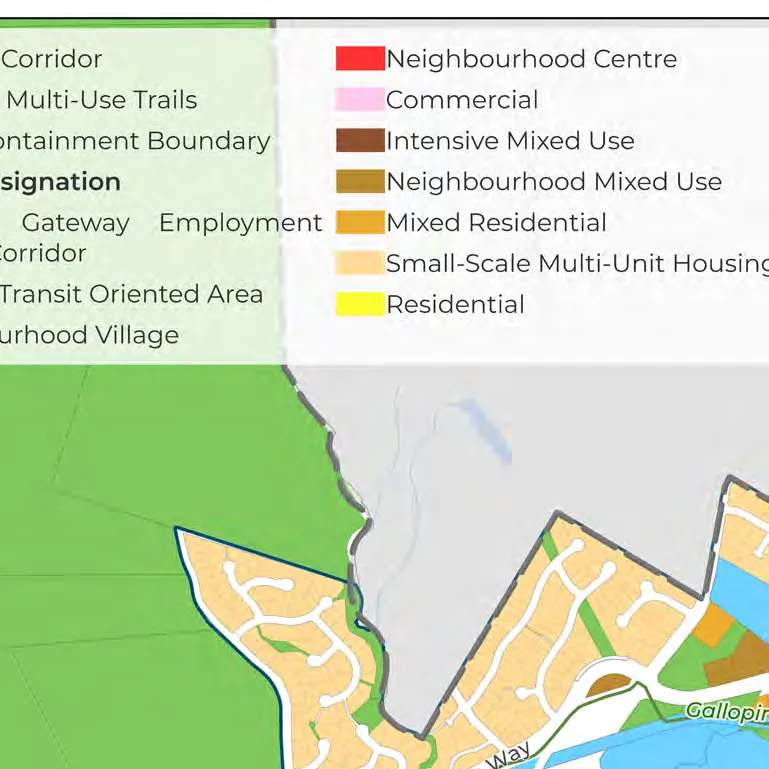
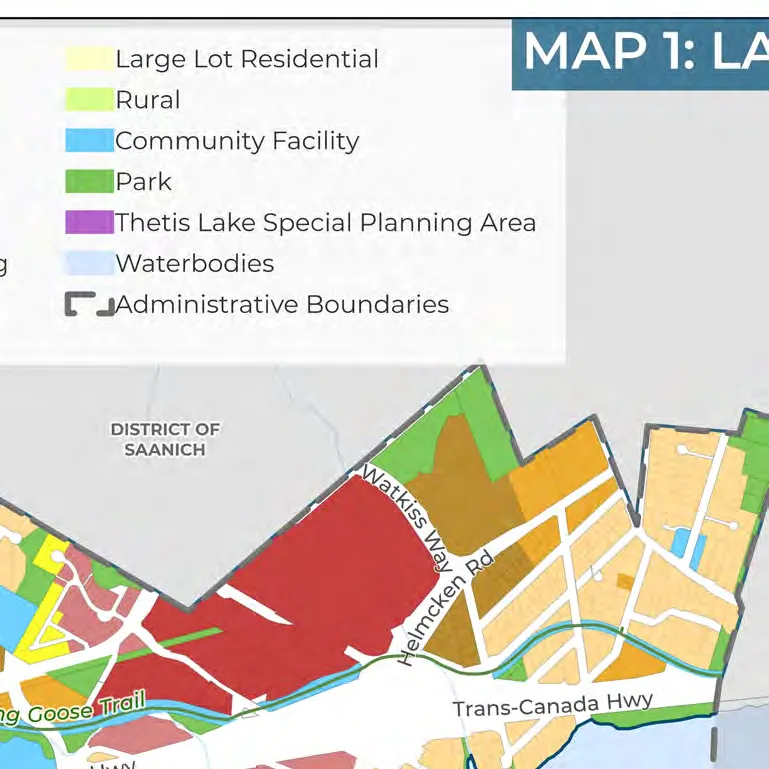
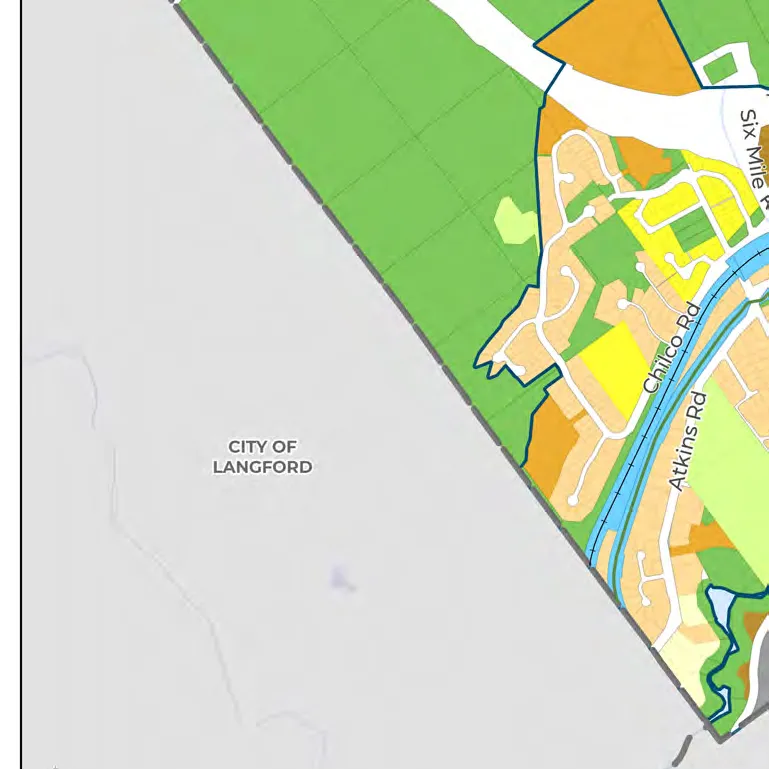
Map 1: Land Use
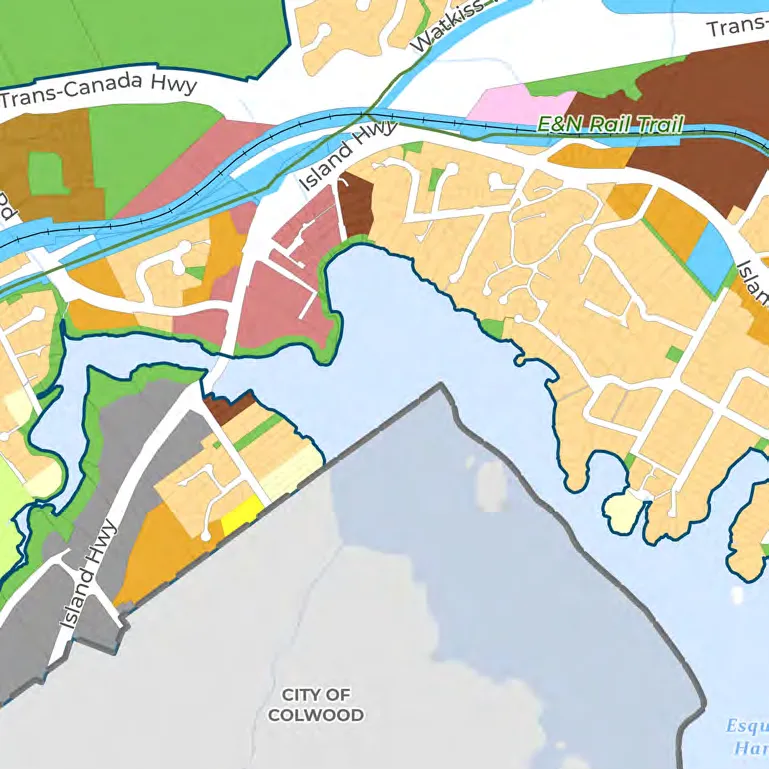
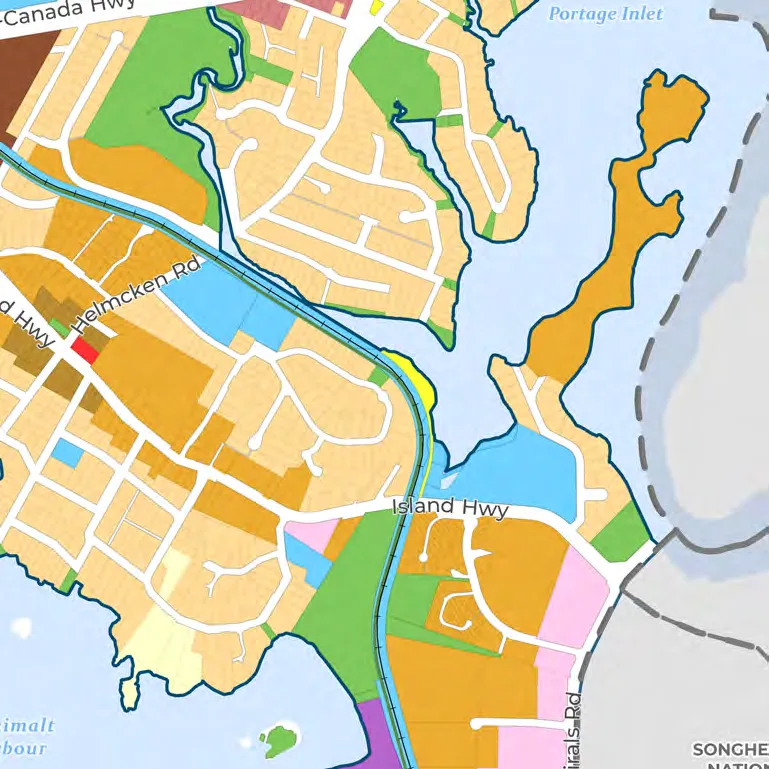
Density describes the intensity of people, jobs, housing units, commercial units, or industrial units within a defined area. Building height and Floor Space Ratio are common measures of density. In View Royal, density is classified as follows:
- Low-density – buildings with heights up to 3 storeys
- Medium-density – buildings with heights between 4 and 6 storeys
- High-density – buildings with heights 7 storeys or greater
Maximum density is expressed as Floor Space Ratio or FSR, which is the ratio of built (or buildable) area to land area. FSR is a tool used by planners, designers, and developers to model building mass in relation to lot. Density regulations and FSR exclusions for all land uses are specified in the Zoning Bylaw.
5.1.7 LAND USE DESIGNATIONS SUMMARY
The following land use designations shall apply to lands within View Royal, as shown in Map 1:
| Designation | Description | Maximum Height/Density |
|---|---|---|
| Western Gateway Employment District Corridor | Uses include a mix of flexible and adaptable building forms that support a range of employment functions suitable for commercial, light industrial, arts and culture, and tourist accommodations. Supported uses include commercial retail, restaurants, visitor accommodations, artist studios, and offices; light industrial space including distribution, repair, light manufacture, technology, and processing; and research, innovation and technology uses. | Up to 6 storeys; Up to 2.5 FSR |
| Hospital Transit-Oriented Area | Uses include a mix of residential (e.g. apartments), commercial (e.g. visitor accommodations, restaurants, retail, office), institutional (e.g. hospital), and civic uses (e.g. daycares, libraries, public gathering and amenity spaces). | Up to 10 storeys; Up to 3.5 FSR |
| Neighbourhood Village | Uses include mixed-use buildings, such as multi-unit housing, community care facility, and community serving commercial and civic uses (e.g., daycares, libraries, public gathering and amenity spaces). This designation also supports schools, offices, restaurants, retail, grocery stores, and community spaces. | Up to 6 storeys; Up to 2.5 FSR |
| Neighbourhood Centre | Uses include small-scale mixed-use development, including apartments with community-serving commercial and civic uses, such as daycares, schools, libraries, offices, restaurants, retail, small grocery stores, and community spaces. | Up to 6 storeys; Up to 3.0 FSR |
| Commercial | Uses include a variety of commercial uses, including retail, offices, technology, services, and restaurants. | Up to 4 storeys; Up to 2.5 FSR |
| Intensive Mixed Use | Uses include low-rise mixed-use development in the form of townhouses and low-rise apartments, designed to include ground floor commercial space and upper floors designated for residential dwellings. Ground floor commercial space may include: retail, restaurants, medical offices, offices, and civic uses (e.g. daycares, libraries, public gathering and amenity spaces). | Up to 4 storeys; Up to 2.5 FSR |
| Neighbourhood Mixed Use | Uses include low-rise mixed-use development in the form of townhouses and low-rise apartments, designed to include ground floor commercial space and upper floors designated for residential dwellings. Ground floor commercial space may include: retail, restaurant, medical offices, offices, civic uses (e.g. daycares, libraries, public gathering and amenity spaces). | Up to 3 storeys; Up to 1.5 FSR |
| Mixed Residential | Uses include detached and attached dwellings, such as single detached, duplexes, secondary suites, garden suites, rowhouses, townhouses, houseplexes, and apartments. | Up to 3 storeys / 1.25 FSR; Up to 4 storeys / 1.6 FSR for apartments |
| Small-Scale Multi-Unit Housing | Uses include detached and attached dwellings, such as single detached, duplexes, secondary suites, garden suites, rowhouses, townhouses, houseplexes, and apartments. | Up to 3 storeys; Up to a maximum of 6 dwelling units |
| Residential | Uses include single-detached and attached dwellings, duplexes, rowhouses, townhouses, houseplexes that are accessed via separate entrances at the ground level, secondary suites, and garden suites. | Up to 2.5 storeys; Up to 0.6 FSR for appropriate infill |
| Large Lot Residential | Uses include detached homes on large lots and yards. | Up to 2.5 storeys |
| Rural | Uses include single-detached dwellings on large rural lots, as well as recreation, and agriculture. | Up to 2 storeys; Up to 1 unit per 10 hectares permitted |
| Community Facility | Uses include government buildings and publicly owned facilities providing a range of services, amenities, and utilities for the community, including health care facilities, emergency service buildings, community halls, libraries, water and sewer treatment plants and facilities, and schools. | Varies |
| Parks, Trails and Open Space | Uses include a mix of active and passive parks, trails, natural and green spaces, and outdoor recreation facilities. | N/A |
| Thetis Cove Special Planning Area | This land use designation has been created with the expectation that this land will be transferred to Xʷsepsəm Nation within the lifespan of this Official Community Plan. | N/A |
C-64-26 THAT the Neighbourhood Village designation land uses be amended to include "Community Care Facility" in the Official Community Plan. (Community care facility added to description)
5.2 WESTERN GATEWAY EMPLOYMENT DISTRICT CORRIDOR DESIGNATION
5.2.1 CONTEXT
The Western Gateway Corridor is made up of four distinct land use designations, including the Western Gateway Employment District Corridor, as shown on Map 1. This land use designation is strategically located along the corridor to create a future employment hub that attracts investment and enhances services and amenities in the community and region.
The Western Gateway Employment District Corridor land use designation supports medium-density commercial and light industrial land uses located along the Island Highway from the Colwood border to the south of Parsons Bridge. It is View Royal’s vision that this corridor will transform into a medium-density employment hub for the Town, the West Shore, and the broader region.
In addition, this corridor will support the Atkins Neighbourhood Village located to the north. The corridor will also support future transportation investment and surrounding residential areas by providing an abundance of employment opportunities, services, and amenities.
Employment opportunities facilitated through a mix of light industrial, commercial, arts and culture, and hospitality uses are encouraged. As discussed in Section 10.0, the Town aims to support new and existing businesses in the research, technology and innovation sectors, as well as those that support tourism and the healthcare industry, such as hotels, research labs, and biomedical services, amongst others. Given the Town’s central location within the region and existing healthcare assets such as the Victoria General Hospital, such investment opportunities would be highly supported in the Western Gateway Employment District Corridor.
Development in the corridor is intended to support pedestrian-oriented activity, encourage non-auto-oriented travel, and increase connections to the Millstream Creek greenway, as well as access to the nearby public waterfront along Millstream Creek and Esquimalt Harbour. Urban design that supports a strong public realm will be highly encouraged for new development, with connections to transit, trails, pedestrian-friendly streetscapes, and bike lanes provided wherever possible, particularly those that support the objectives of the transportation and mobility objectives outlined in Section 8.0.
5.2.2 PERMITTED HEIGHTS AND DENSITIES
A. Heights and densities permitted in this land use designation are as follows: i) Building heights up to 6 storeys ii) Maximum density of 2.5 Floor Space Ratio
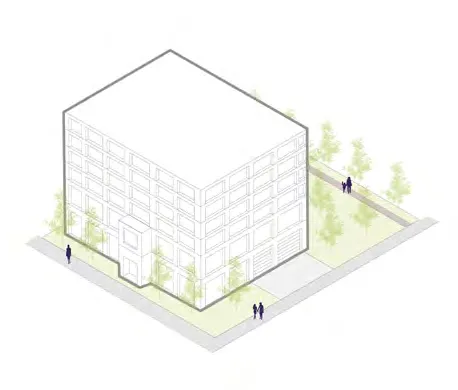
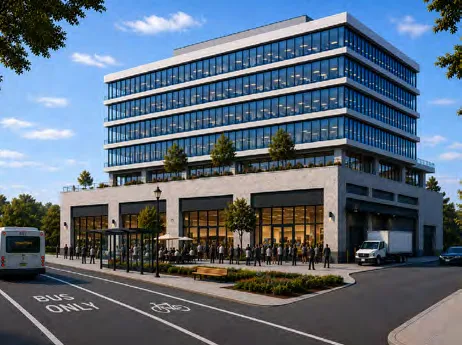
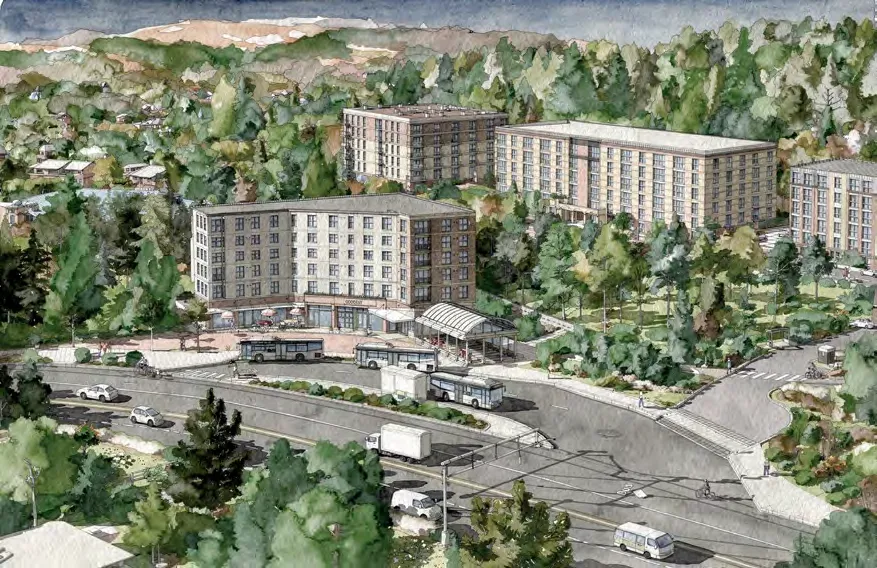
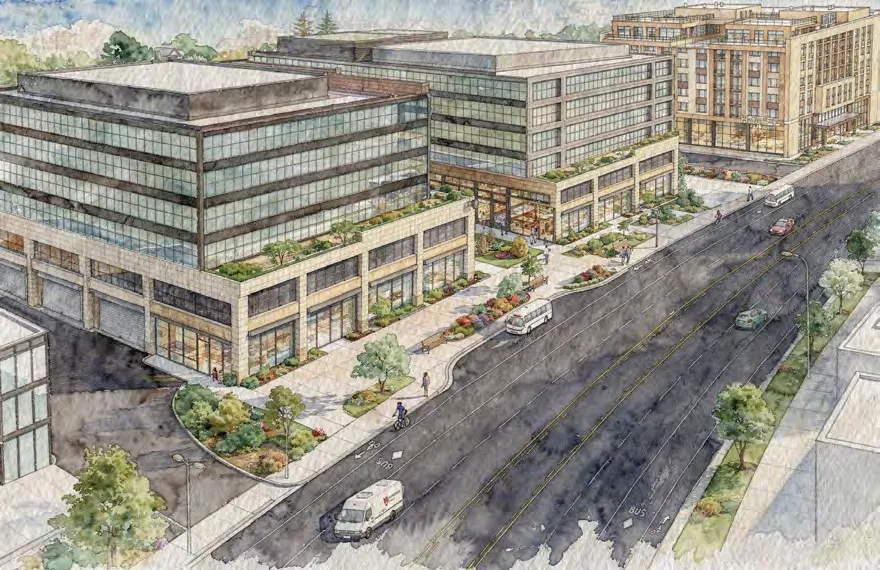
C-44-26 THAT staff develop a visual representation of the proposed Western Gateway Community Corridor, illustrating its intended character, design, and land use, in order to support public understanding and engagement in the Official Community Plan process. (refer to two new concept drawings [Images 38 and 39])
5.2.3 POLICIES
A. Collaborate with the City of Colwood to establish the Western Gateway Corridor as a regional employment hub, that prioritizes economic development and attracts business investment. B. Encourage redevelopment of lands designated as Western Gateway Employment District Corridor to promote medium-density mixed-use development, with an emphasis on commercial, light industrial, arts and culture, and hospitality uses, and a high-quality urban design. Development in the Western Gateway Employment District Corridor land use designation should aim to achieve: i) A mix of employment uses including office, retail, hotel, research labs, community/civic use, arts and culture, and light industrial (e.g. light manufacturing and processing of goods, distribution). ii) Integration of entertainment, arts and culture uses in the Atkins Mobility Hub. iii) Strong public realm design and a pedestrian-friendly streetscape that is designed to attract visitors to the area through orienting buildings towards the street, locating parking underground, below-grade, and behind the building and using landscaping features such as plantings, street trees, and seating to welcome users to the space, providing sidewalk and trail connections to transportation options, Millstream Creek, the waterfront, and other key businesses in the corridor, and supporting the nearby Atkins Mobility Hub. iv) Compatibility with nearby residential development through thoughtful design and landscape buffers, where appropriate. v) Long-term protection of Millstream Creek and the shoreline by dedicating park land for green space and / or recreational trails wherever possible. vi) Enhanced economic development opportunities for the Town, particularly local businesses and investments in emerging industries. C. Enable the provision and viability of light industrial development by establishing greater flexibility in the design and configuration of buildings with industrial uses, such as exploring opportunities to support stacked development and buildings with high ceiling heights on the first two floors, amongst others.
C-49-26 THAT the Western Gateway Community Corridor section of the Official Community Plan be enhanced to include an entertainment and cultural precinct, specifically in the Atkins hub. (Refer to policies 5.2.3 (B)(i) and (ii))
5.3 HOSPITAL TRANSIT-ORIENTED AREA DESIGNATION
5.3.1 CONTEXT
Provincial regulations have designated the area west of Victoria General Hospital around the existing bus exchange as a Transit-Oriented Area, as shown on Map 4. To comply with Bill 47: Housing Statues (Transit-Oriented Areas) Amendment Act, the Hospital Transit-Oriented Area designation applies to lands within 200 metres of the Hospital Transit-Oriented Area’s prescribed bus exchange.
The hospital is expected to expand its services and construct new buildings in the coming decade, ideally co-locating with primary care facilities and ancillary medical service providers. Higher density residential uses in the form of apartments have started developing in recent years and are planned to continue to be built along Watkiss Way, Hospital Way, and Erskine Lane to provide more housing, support the expanding demand for amenities and services, and take advantage of current and future investments in bus rapid transit.
The Victoria General Hospital Transit Exchange is presently served by a single frequent transit service route. The service connects Victoria, View Royal, Colwood, and Langford on a single route, providing rapid bus service within the region. There is potential to expand frequent transit service and provide additional rapid transit service if the parcels within the Transit-Oriented Area surrounding the hospital are developed to densities that can support such service. The Victoria General Hospital Transit Exchange is ideally located to become a major mobility hub for the community because it is located near the Helmcken Park and Ride, Galloping Goose Regional Trail, and Highway 1. Helmcken Road is another key corridor, which connects neighbourhoods in View Royal and the neighbouring District of Saanich.
The Hospital Transit-Oriented Area is envisioned as a vibrant, high-density mixed-use community that integrates residential, tourist accommodation, medical, and commercial spaces to support the Victoria General Hospital and regional rapid transit system. Transit, cycling, and walking are envisioned to be the primary modes of transportation in this area to encourage active transportation connections, enhance the public realm, and create a safe, walkable, pedestrian-friendly environment for residents and visitors alike.
5.3.2 PERMITTED HEIGHTS AND DENSITIES
A. Heights and densities permitted in this land use designation are as follows: i) Building heights up to 10 storeys ii) Maximum density of up to 3.5 Floor Space Ratio
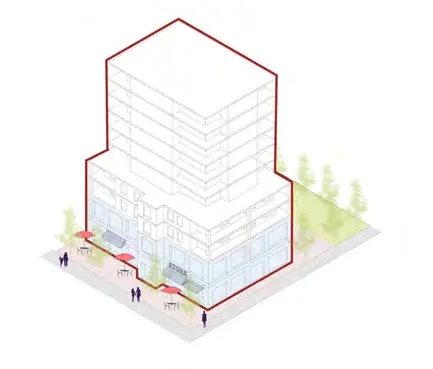
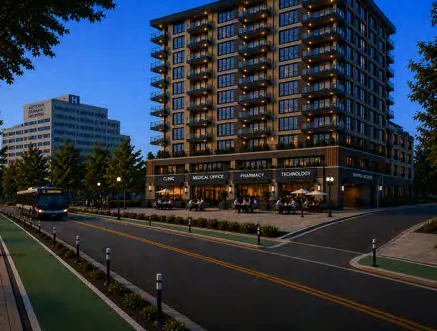
5.3.3 POLICIES
A. Encourage redevelopment of lands designated as Hospital Transit-Oriented Area. B. Prioritize high-density, mixed-use development in the Hospital Transit-Oriented Area that aims to provide, or create conditions for the following: i) New residential dwellings, medical-related office spaces, tourist accommodations, and retail uses that benefit from and support Victoria General Hospital. ii) A regional health hub with facilities that provide comprehensive care across all stages of life. iii) Provide a mix of housing types and tenures to diversify the housing stock, including opportunities for family-friendly, senior, below-market and affordable housing options. iv) Diverse employment and commercial services that strengthen the local economy and support or complement existing local businesses and services. v) Rapid and frequent transit service routes. vi) Ground floor commercial space that activates the streetscape and public realm. vii) Underground or sub-surface parking facilities that promote a safe and enjoyable pedestrian environment. viii) A high-quality streetscape and public realm to accommodate people gathering, socializing, and recreating including plazas, playgrounds, greenspace, or other off-street public spaces. ix) Improved access and traffic circulation within the area. x) Construction of, or partnership with the Town to provide, active transportation infrastructure to connect new development to the Victoria General Hospital Transit Exchange, Victoria General Hospital, Galloping Goose Regional Trail, Eagle Creek Village, and the established residential area southeast of Helmcken Road.
C-48-26 THAT the Town position the Victoria General Hospital precinct, including the Transit-Oriented Area, as a regional health centre with facilities that provide comprehensive care across all stages of life. (See policies 5.3.3 (ii) and (iii)).
5.4 NEIGHBOURHOOD VILLAGE DESIGNATION
5.4.1 CONTEXT
Neighbourhood Villages are situated near the lands comprising and surrounding the Atkins Neighbourhood Village and Hospital Mobility Hubs to create density conditions that support rapid and frequent transit service, as shown on Map 4. The Neighbourhood Village designation includes mixed-use buildings, such as multi-unit housing and community serving commercial and civic uses such as schools, offices, restaurants, retail, grocery stores, community care facilities, and community spaces.
To comply with the Bill 47: Housing Statues (Transit-Oriented Areas) Amendment Act, the Neighbourhood Village designation applies to lands within 201 - 400 metres of the Hospital Transit-Oriented Area’s prescribed bus exchange. It is acknowledged that many lands in this designation are already built out or are under development, reducing the likelihood of redevelopment within the lifespan of this Official Community Plan.
5.4.2 PERMITTED HEIGHTS AND DENSITIES
A. Heights and densities permitted in this land use designation are as follows: i) Building heights up to 6 storeys ii) Maximum density of up to 2.5 Floor Space Ratio
Rapid Transit and Frequent Transit are two types of transit service.
| Service Type | Description | Frequency |
|---|---|---|
| Rapid Transit | Routes are designed to move large volumes of passengers between major destinations and stop less often than Frequent Transit service. | Customers can expect buses to arrive at least every 15 minutes between 7:00 a.m. and 10:00 p.m. every day of the week. |
| Frequent Transit | Routes operate at a 15 minute frequency between a specific period of time. Routes generally operate on arterial roads, serve corridors with mixed land use and provide connections between urban centres. | Customers can expect buses to arrive every 15 minutes or better service, 7:00 a.m. to 7:00 p.m., Monday through Friday. |
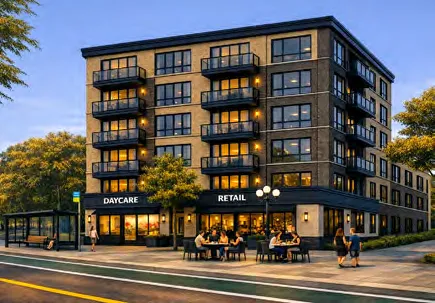
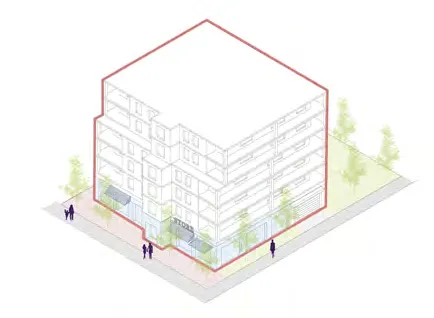
5.4.3 POLICIES
A. Enable better transit service and connections of mobility hubs through increased densities and public realm design. B. Create walkable and safe linkages to the surrounding neighbourhoods, parks, and trails at the following locations: i) The Neighbourhood Village designated area within the Western Gateway Corridor, between the Atkins Neighbourhood Village, Parsons Bridge, and Price Bay Road. ii) The Neighbourhood Village designation within the Hospital Transit-Oriented Area providing access to Craigflower Creek, the Galloping Goose Regional Trail, View Royal Park, and other existing parks. C. Prioritize medium-density, mixed-use development in the Neighbourhood Village and promote the village designation as vibrant hubs that aims to provide, or create conditions for the following: i) Provide a mix of housing types and tenures to diversify the housing stock, including opportunities for family-friendly, senior, below-market and affordable housing options. ii) Diverse local-serving commercial uses that strengthen the local economy and support or complement existing local businesses and services. iii) Ground floor commercial space that activates the streetscape and public realm. iv) Incorporate community spaces that support arts, culture and recreation opportunities for residents and visitors. v) Underground or sub-surface parking facilities that promote a safe and enjoyable pedestrian environment. vi) A high-quality streetscape and public realm to accommodate people gathering including outdoor seating, plazas, or other off-street public spaces.
5.5 NEIGHBOURHOOD CENTRE DESIGNATION
5.5.1 CONTEXT
The Neighbourhood Centre designation allows medium-density, mixed-use development to serve local neighbourhood needs. The designation currently applies to a single parcel at the intersection of Island Highway and Helmcken Road, as shown on Map 1. This designation is envisioned to encourage walkability by providing multi-unit housing forms and community-serving commercial and civic uses with active street frontages.
5.5.2 PERMITTED HEIGHTS AND DENSITIES
A. Heights and densities permitted in this land use designation are as follows: i) Building heights up to 6 storeys ii) Maximum density of up to 3.0 Floor Space Ratio
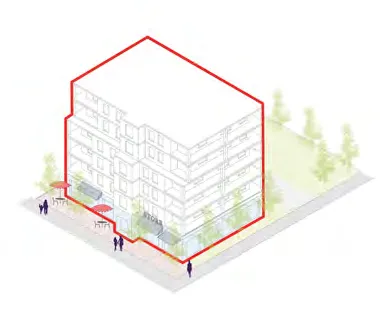
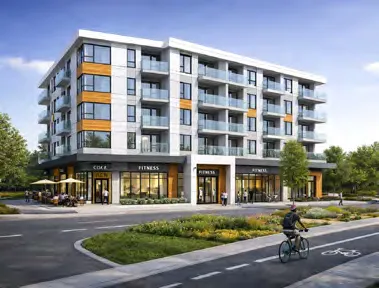
5.5.3 POLICIES
A. Encourage mixed-use residential and commercial development at the intersection of the Island Highway and Helmcken Road to support greater transit service and mobility, and to provide greater access to services that meet the daily needs of residents in surrounding established neighbourhoods. B. Ground floor commercial and civic uses may include schools, offices, restaurants, retail, small grocery stores, and community spaces. C. Mixed-use development should be reviewed to consider the following: i) Opportunities to establish connections across Island Highway and Helmcken Road to enhance pedestrian safety. ii) Pedestrian-friendly street frontages that accommodate people arriving by all modes. iii) Strong and safe connections to surrounding residential areas, the waterfront, Helmcken Road, and View Royal Elementary School. iv) High-quality architecture, landscaping and public realm that enhances the neighbourhood context. v) Underground or sub-surface parking facilities that promote a safe and enjoyable pedestrian environment.
5.6 COMMERCIAL DESIGNATION
5.6.1 CONTEXT
Lands in the Commercial designation should help create more local jobs as View Royal grows, while providing services and amenities to residents. The designation permits a variety of commercial uses, including retail, office, technology, services, and restaurants. Commercial services are primarily located along the Admirals Road and Island Highway Corridors.
5.6.2 PERMITTED HEIGHTS AND DENSITIES
A. Heights and densities permitted in this land use designation are as follows: i) Building heights up to 4 storeys ii) Maximum density of up to 2.5 Floor Space Ratio
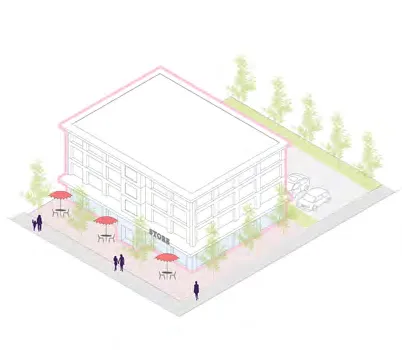
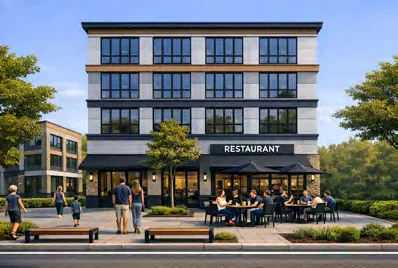
5.6.3 POLICIES
A. Promote development of commercial lands along the Admirals Road Corridor as a commercial centre that supports a mix of employment uses, including retail, office, technology, services, and restaurants. B. Encourage new development along Admirals Road and adjacent areas to facilitate a strong pedestrian-oriented streetscape. Development applications should be reviewed to consider opportunities for: i) Incorporating high quality urban design features in buildings and public spaces; ii) Strong and safe pedestrian and cycling connections; and iii) Active street frontages. C. Support public space enhancements along Admirals Road, Hallowell Road, and Island Highway, in collaboration with Xʷsepsəm and Songhees Nations, to create a safe, walkable, and enjoyable pedestrian environment, and to reinforce the development of this area as the Admirals Road Corridor. Enhancements may include: i) Sidewalk widening and improvements; ii) Coordinated street furnishing and lighting standards; iii) Public art, banners and gateway features; iv) Wayfinding signage; and v) Improved bike facilities and crossings.
5.7 INTENSIVE MIXED USE DESIGNATION
5.7.1 CONTEXT
The Intensive Mixed Use designation is intended to provide low-rise mixed-use development in the form of townhouses and low-rise apartments, designed to provide ground floor commercial space and upper floors designated for residential dwellings. Lands with this designation are located throughout View Royal, including the Fort Victoria RV Park, the Western Gateway Corridor, and near the Atkins Mobility Hub, as shown on Map 1.
5.7.2 PERMITTED HEIGHTS AND DENSITIES
A. Heights and densities permitted in this land use designation are as follows: i) Building heights up to 4 storeys ii) Maximum density of up to 2.5 Floor Space Ratio
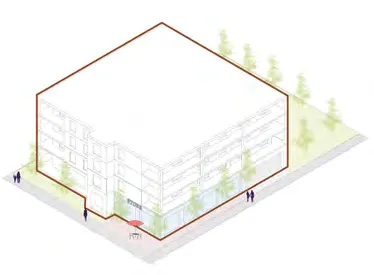
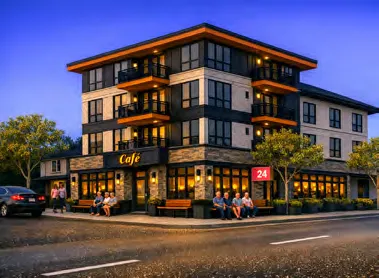
5.7.3 POLICIES
A. Support low-rise mixed-use development in the form of townhouses and low-rise apartments, with ground floor commercial space. B. Ground floor commercial uses may include retail, restaurants, medical offices, offices, and civic uses (e.g. daycares, libraries, public gathering and amenity spaces). C. Mixed-use development should be reviewed to consider the following: i) Pedestrian-friendly street frontages that accommodate people arriving by all modes of transportation. ii) Strong and safe connections to surrounding residential areas, the Western Gateway Corridor, the Atkins Mobility Hub, the local and regional multi-use trails, and Island Highway. iii) High-quality architecture, landscaping and public realm that enhances the neighbourhood context.
5.8 NEIGHBOURHOOD MIXED USE DESIGNATION
5.8.1 CONTEXT
The Neighbourhood Mixed Use designation supports the development of corridors and mobility hubs with low-rise multi-unit residential and commercial uses serviced by active and public transportation infrastructure. As View Royal grows, mixed-use development will be crucial for creating a walkable community where residents can easily access daily needs such as work, education, childcare, recreation, and health services without passenger vehicles.
Key Neighbourhood Mixed Use areas include the Helmcken Corridor (Eagle Creek Village), Island Highway at the intersection of Helmcken Road, and Lakeside Village south of Thetis Lake along Six Mile Road, as shown on Map 1. The proximity of the Neighbourhood Mixed Use area at Eagle Creek Village to the Hospital Transit-Oriented Area will support the View Royal’s vision of a vibrant mixed-use transit-supported mobility hub. It is acknowledged that most of Eagle Creek Village and Lakeside Village are built out at this time (the two commercial centres were constructed in the late 2010s), reducing the likelihood of redevelopment within the lifespan of this Official Community Plan.
5.8.2 PERMITTED HEIGHTS AND DENSITIES
A. Heights and densities permitted in this land use designation are as follows: i) Building heights up to 3 storeys ii) Maximum density of up to 1.5 Floor Space Ratio
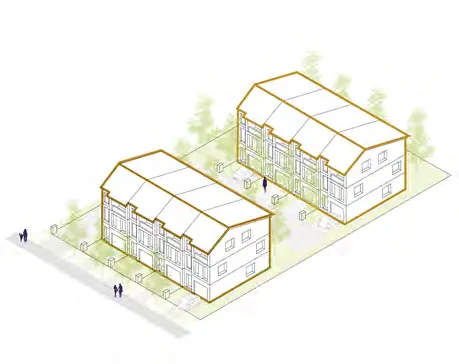
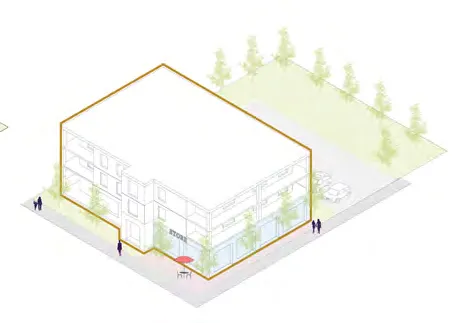
5.8.3 POLICIES
A. Support low-rise mixed-use development, such as townhouses and low-rise apartments with ground floor commercial space and upper floors designated for residential dwellings. B. Ground floor neighbourhood-serving commercial uses may include one or more of the following: retail, restaurant, medical office, office, and civic use (e.g., daycare, library, amenity space). C. Encourage mixed-use development near the intersection of Island Highway and Helmcken Road to support greater transit service and mobility. D. Mixed-use development should be reviewed to consider the following: i) Opportunity to establish connections across Island Highway and Helmcken Road to enhance pedestrian safety. ii) Pedestrian-friendly street frontages that accommodate people arriving by all modes. iii) Strong and safe connections to surrounding residential areas, the waterfront, Helmcken Road, and View Royal Elementary School. iv) High-quality architecture, landscaping and public realm that enhances the neighbourhood context.
5.9 MIXED RESIDENTIAL DESIGNATION
5.9.1 CONTEXT
The Mixed Residential designation permits detached and attached dwellings, such as small lots, duplexes, secondary suites, garden suites, rowhouses, townhouses, houseplexes, and apartments. Its purpose is to increase housing choices along key corridors and in areas where services and amenities are concentrated. Mixed Residential is primarily located along Island Highway, Christie Point, to the west of Admirals Corridor, and in several other areas. Medium density development in these areas will help improve mobility, including access to non-automobile transportation options, especially near the Atkins Mobility Hub.
5.9.2 PERMITTED HEIGHTS AND DENSITIES
A. Heights and densities permitted in this land use designation are as follows: i) Building heights up to 3 storeys/Maximum density of up to 1.25 Floor Space Ratio ii) Building heights up to 4 storeys/Maximum density of up to 1.6 Floor Space Ratio for apartments
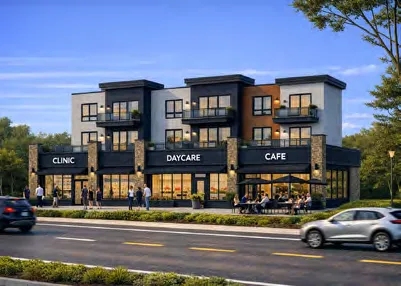
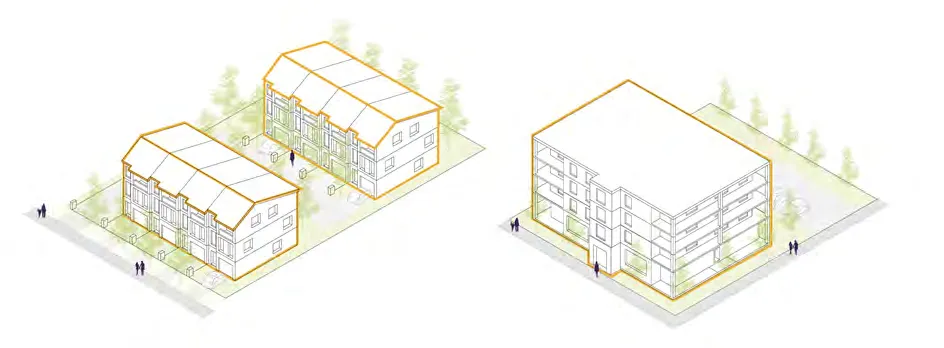
5.9.3 POLICIES
A. Support a variety of housing options, including opportunities for infill and gentle density in the form of duplexes, secondary suites, garden suites, rowhouses, townhouses, houseplexes, and apartments in established neighbourhoods. B. Mixed Residential development along corridors should be carefully reviewed to consider the following: i) Right-of-way conditions and pedestrian safety, including connections across Island Highway and Helmcken Road. ii) Pedestrian-friendly street frontages that accommodate people arriving by all modes of transportation. iii) Strong and safe connections to surrounding residential areas, the waterfront, Helmcken Road, and View Royal Elementary School. iv) High-quality architecture, landscaping and public realm that enhances the neighbourhood context.
5.10 SMALL-SCALE MULTI-UNIT HOUSING DESIGNATION
5.10.1 CONTEXT
The Small-Scale, Multi-Unit Housing designation supports a variety of housing types in established residential neighbourhoods including detached and attached dwellings, duplexes, secondary suites, garden suites, rowhouses, townhouses, houseplexes, and apartments up to three storeys in height. This designation has been established to align with the province’s Bill 44: Housing Statutes (Residential Development) Amendment Act and applies in many of the established low-density residential neighbourhoods in the community. Small-Scale, Multi-Unit Housing offer greater housing choice and improve attainability. It is anticipated that Small-Scale, Multi-Unit Housing will be a key factor in addressing the demand for ground-oriented housing in View Royal.
5.10.2 PERMITTED HEIGHTS AND DENSITIES
A. Heights and densities permitted in this land use designation are as follows: i) Building heights up to 3 storeys ii) Maximum density of up to 4 dwelling units or 6 dwelling units for parcels within 400m of a Prescribed Transit Stop
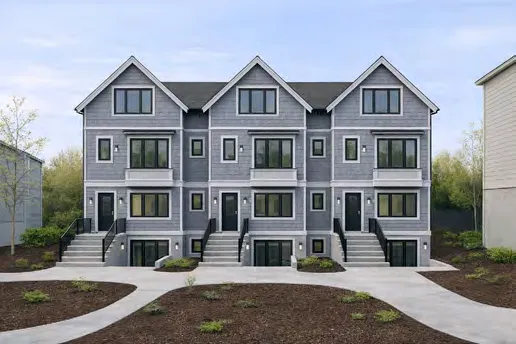
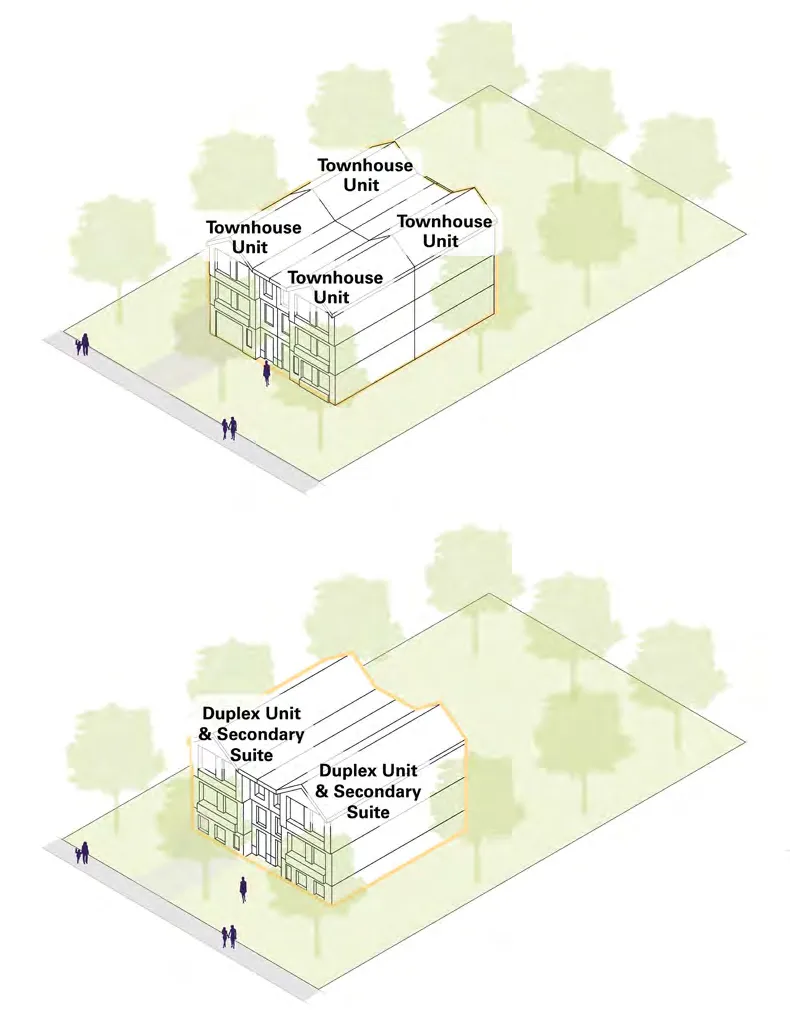
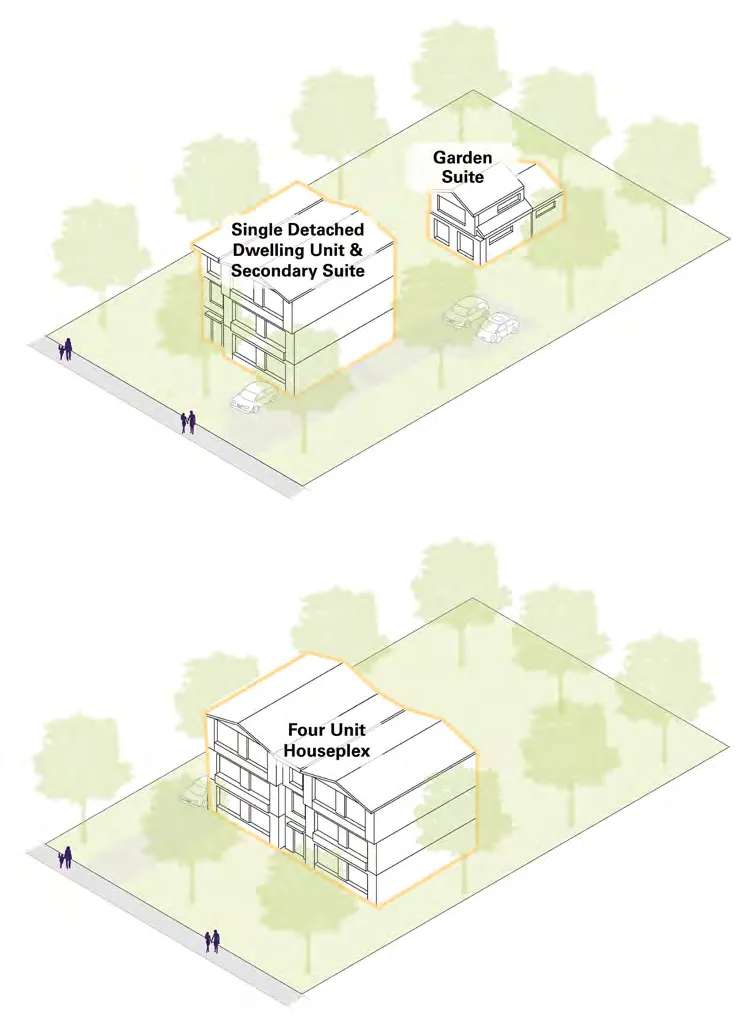
5.10.3 POLICIES
A. New development should contribute to and enhance the residential form and character of the surrounding neighbourhood. B. Protect and enhance the tree canopy and preserve natural features. C. Strengthen connections between existing residential neighbourhoods and mixed-use developments, such as those included in View Royal’s mobility hubs and corridors (as shown on Maps 3 and 4), through urban design, public space improvements, and pedestrian, bike, and transit supportive facilities. D. When reviewing applications for infill developments, adhere to the redevelopment policies outlined in Section 5.1.6.
5.11 RESIDENTIAL DESIGNATION
5.11.1 CONTEXT
The Residential designation supports development of single detached dwellings, secondary suites, garden suites, duplexes, rowhouses, and townhouses that are accessed via separate entrances at the ground level. This designation applies to parcels that do not meet provincial legislative criteria for Small-Scale Multi-Unit Housing.
5.11.2 PERMITTED HEIGHTS AND DENSITIES
A. Heights and densities permitted in this land use designation are as follows: i) Building heights up to 2.5 storeys ii) Maximum density of up to 0.6 Floor Space Ratio for appropriate infill
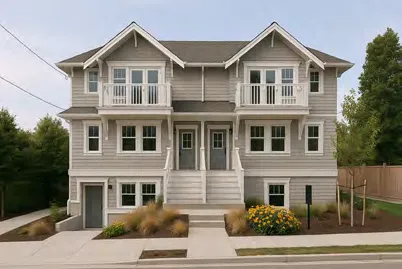
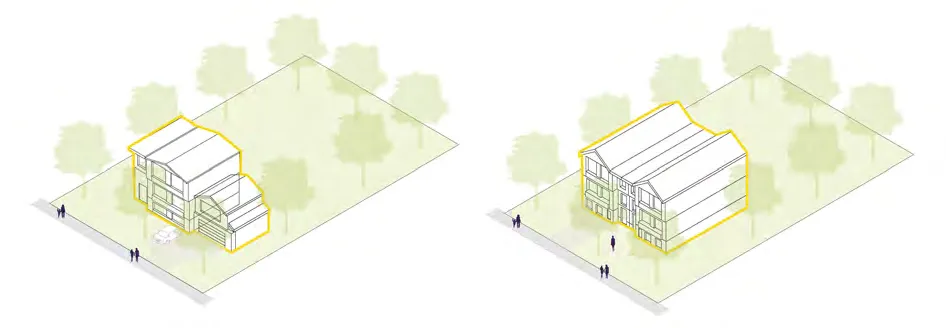
5.11.3 POLICIES
A. Support low density housing forms in existing residential neighbourhoods, including detached and attached dwellings, such as the following: single detached dwellings, duplexes, secondary suites, and garden suites. B. New development should contribute to and enhance the residential form and character of the surrounding neighbourhood. C. Strengthen connections between existing residential neighbourhoods and mixed-use developments, such as those included in View Royal’s mobility hubs and corridors (as shown on Maps 3 and 4), through urban design, public space improvements, pedestrian, bike, and transit supportive facilities. D. Protect and enhance the tree canopy and preserve natural features. E. When reviewing applications for infill developments, adhere to the redevelopment policies outlined in Section 5.1.6.
5.12 LARGE LOT RESIDENTIAL DESIGNATION
5.12.1 CONTEXT
Large Lot Residential consists of detached dwellings that are located on large lots within established neighbourhoods. Limited redevelopment is anticipated for these parcels.
5.12.2 PERMITTED HEIGHTS AND DENSITIES
A. Heights and densities permitted in this land use designation are as follows: i) Building heights up to 2.5 storeys
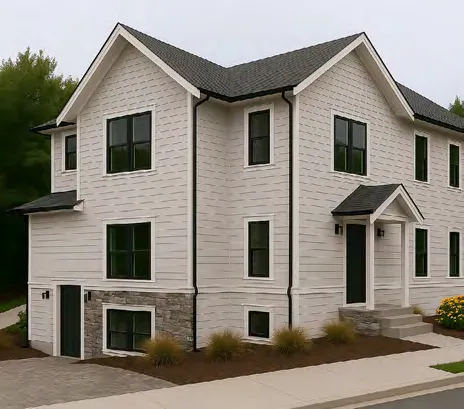
5.12.3 POLICIES
A. Support detached dwellings and secondary suites in existing residential neighbourhoods. B. Protect and enhance the tree canopy and preserve natural features. C. New development should be designed in a way that complements the existing surrounding neighbourhood.
5.13 RURAL DESIGNATION
5.13.1 CONTEXT
The Rural designation applies to lands used for agriculture, recreation, or for large lot residential uses. These lands are primarily located north of Thetis Lake Regional Park outside the Urban Containment Boundary, with the exception of two parcels on Atkins Road, as shown on Map 1. There is limited servicing available to parcels designated as Rural and therefore, development potential is limited.
5.13.2 PERMITTED HEIGHTS AND DENSITIES
A. Heights and densities permitted in this land use designation are as follows: i) Building heights up to 2 storeys ii) Maximum density of up to 1 unit per 10 hectares
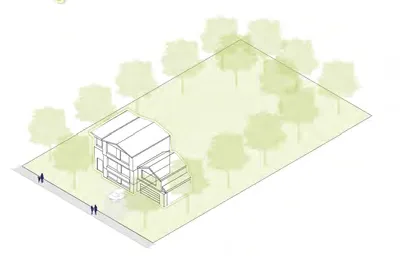
5.13.3 POLICIES
A. Support the retention of rural lands north of Thetis Lake Regional Park by maintaining the Urban Containment Boundary. B. Maintain farming, agriculture, and low-density residential as the primary land use on rural lands, to preserve the rural character of the area.
5.14 COMMUNITY FACILITY DESIGNATION
5.14.1 CONTEXT
The Community Facility designation applies to existing government buildings and publicly owned facilities providing a range of civic and institutional services and uses, amenities, and utilities for the community including health care facilities, emergency service buildings, community halls, libraries, supportive housing, places of worship, schools, public childcare, transit facilities such as park and rides and bus exchanges, and utility services such as water, sanitary sewer, and hydro.
The Town’s prominent community facilities include the following:
- Town Hall and Public Safety Building on Island Highway;
- Three schools, including Shoreline Community Middle School, View Royal Elementary, and Eagle View Elementary;
- Three community centres, including the Strawberry Vale Community Club, View Royal Community Association, and Victoria Scottish Community Centre;
- Victoria General Hospital;
- Capital Regional District’s Infrastructure and Water Services building on Island Highway; and
- Two existing park and ride facilities located in the Atkins Neighbourhood Village and on Helmcken Road.
5.14.2 PERMITTED HEIGHTS AND DENSITIES
A. Heights and densities permitted in this land use designation vary from site to site.
5.14.3 POLICIES
A. Promote a variety of public, non-profit, or utility uses, including community halls/centres, schools, public health facilities, community care facilities, supportive housing, emergency facilities, libraries, government buildings, childcare, and schools. B. Retain existing Community Facility parcels and seek opportunities to expand and consolidate parcels to accommodate future growth. C. Ensure all community facilities provide accessibility infrastructure at all existing and new community facilities to ensure these spaces may be reasonably accessed by people of all mobility levels. D. Support the development of the Atkins Mobility Hub as a Community Facility that will provide rapid transit service and support the growth of surrounding land uses. E. Encourage institutional landowners to preserve on-site open space and make it publicly accessible where possible. F. Where redevelopment is being considered on Community Facility designated land: i) Prioritize the retention of community or non-profit ownership of the property. ii) Support the use of the site for non-profit rental housing or non-market housing where the development can also provide a community facility, commercial uses, or other compatible uses.
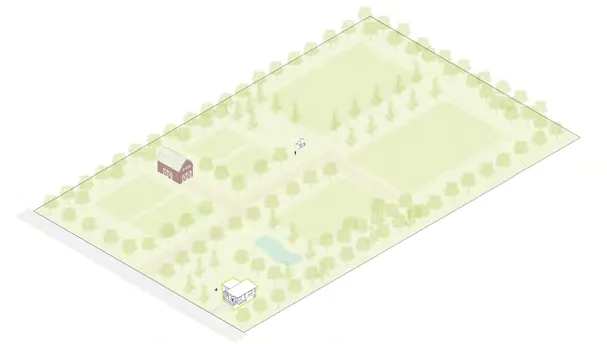
5.15 PARKS, TRAILS AND OPEN SPACE DESIGNATION
5.15.1 CONTEXT
The Parks, Trails, and Open Space designation applies to active and passive parks, trails, natural conservation areas, green spaces, waterfront areas, and outdoor recreation facilities. Parks, Trails, and Open Spaces provide opportunities to facilitate walkable connections to key areas within the community, including mobility hubs.
The Parks, Trails, and Open Space designation may apply to the Provincial Agricultural Land Reserve parcels, which are intended for long-term farm use to support the local economy and food security. As shown on Map 2, the Agricultural Land Reserve applies to the following areas:
- Chilco Park;
- Little Road unnamed park;
- Trans Canada Highway and Atkins Neighbourhood Village road right-of-way at Burnside Road West;
- View Royal Park; and
- Marler Park and 4 neighbouring parcels.
The Town could consider excluding these parcels from the Agricultural Land Reserve in the future as they no longer serve the intended purpose of the Agricultural Land Reserve designation; however, no immediate action is planned.
5.15.2 PERMITTED HEIGHTS AND DENSITIES
A. Heights and density permissions are not applicable for this land use designation.
5.15.3 POLICIES
A. Enhance on-site green space by considering the needs of green space requirements over parking space requirements, when considering a development variance permit, development permit, temporary use permit, an official community plan amendment or zoning bylaw amendment. B. Protect the natural environment along Millstream Creek and support opportunities for fish habitat, wildlife corridors, historic interpretation signage, public access to the shoreline, and connection to the Western Gateway Corridor and nearby Neighbourhood Village. Continue to support the preservation of Thetis Lake and Mill Hill Regional Parks as important recreational amenities and significant natural resources. C. Continue to support the preservation of Thetis Lake and Mill Hill Regional Parks as important recreational amenities and significant natural resources. D. Collaborate with Capital Regional District and the View Royal FireSmart Program to develop and implement strategies to mitigate the risk of wildfires within Thetis Lake and Mill Hill Regional Parks. E. Improve local and regional access and connections to Thetis Lake and Mill Hill Regional Parks from surrounding neighbourhoods. F. Collaborate with the Capital Regional District to expand regional park boundaries where appropriate. G. Ensure that current and future use of land designated as Agricultural Land Reserve is compliant with Agricultural Land Commission legislation and regulations.
Map 2: Agricultural Land Reserve Lands
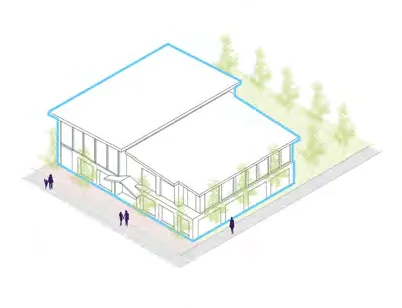
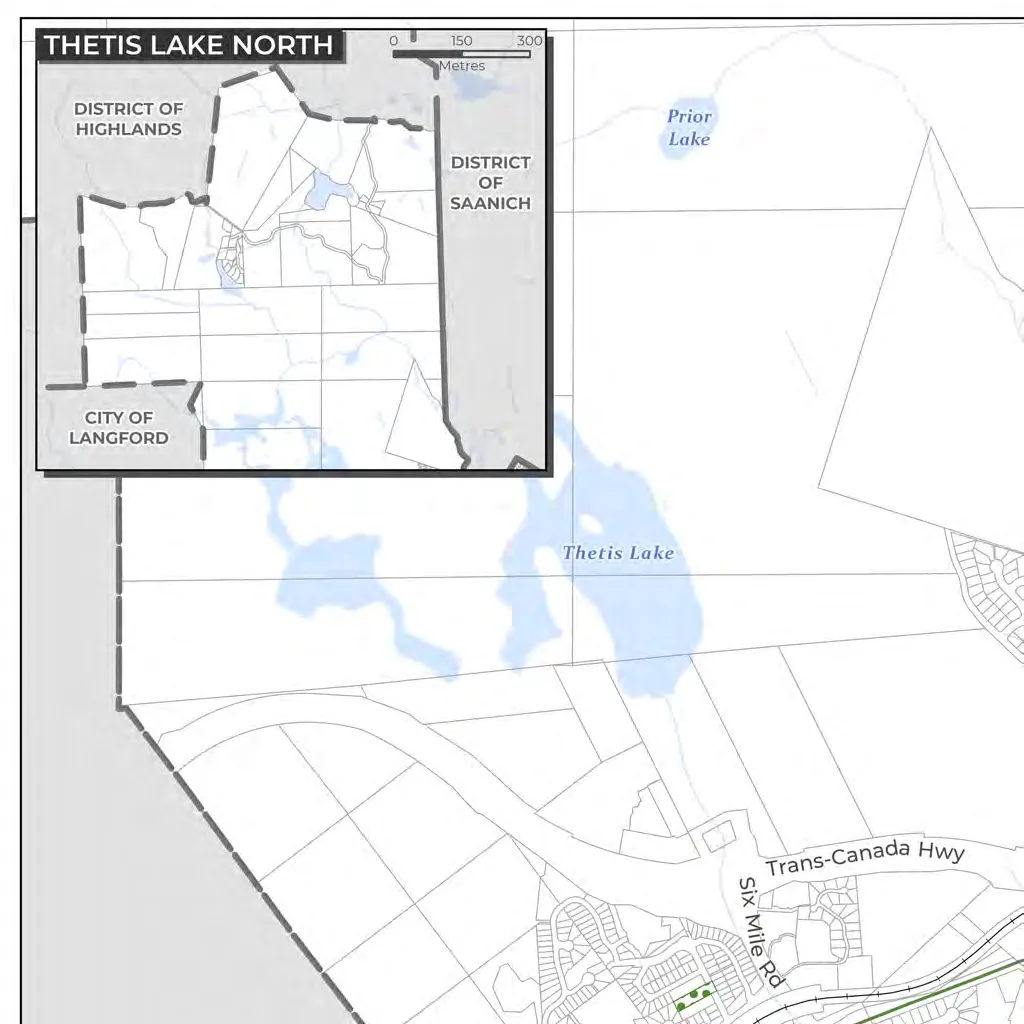
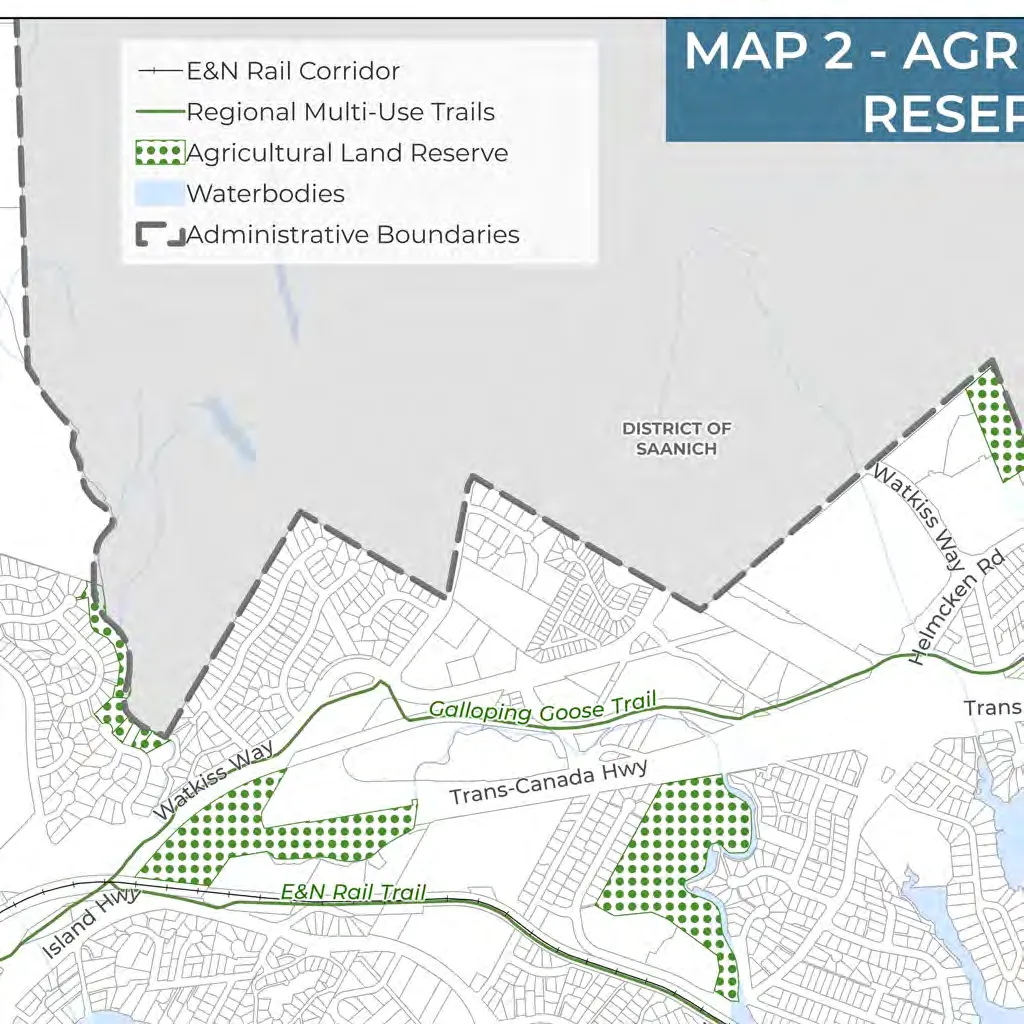
5.16 THETIS COVE SPECIAL PLANNING AREA DESIGNATION
5.16.1 CONTEXT
The land designated as Thetis Cove Special Planning Area, as shown on Map 1, is located in the area known as Thetis Cove. This land is adjacent to the Xʷsepsəm Nation Reserve. The Province purchased the land to transfer to the Xʷsepsəm Nation as part of the negotiations at the Recognition of Indigenous Rights and Self-Determination table. The transfer of land is likely to occur within the lifespan of this Official Community Plan.
5.16.2 PERMITTED HEIGHTS AND DENSITIES
A. Heights and density permissions are not applicable for this land use designation.
5.16.3 POLICIES
A. Collaborate with Xʷsepsəm and Songhees Nations to return the land to Xʷsepsəm Nation to advance reconciliation efforts. B. Review the Town’s boundary following the transfer of the lands to Xʷsepsəm Nation.
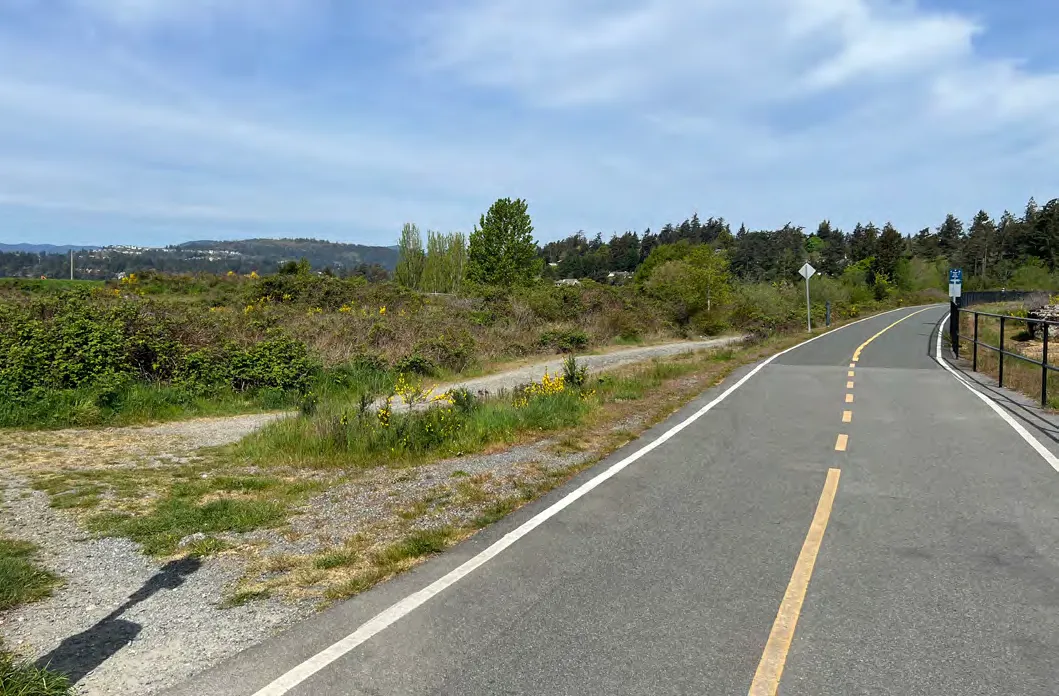
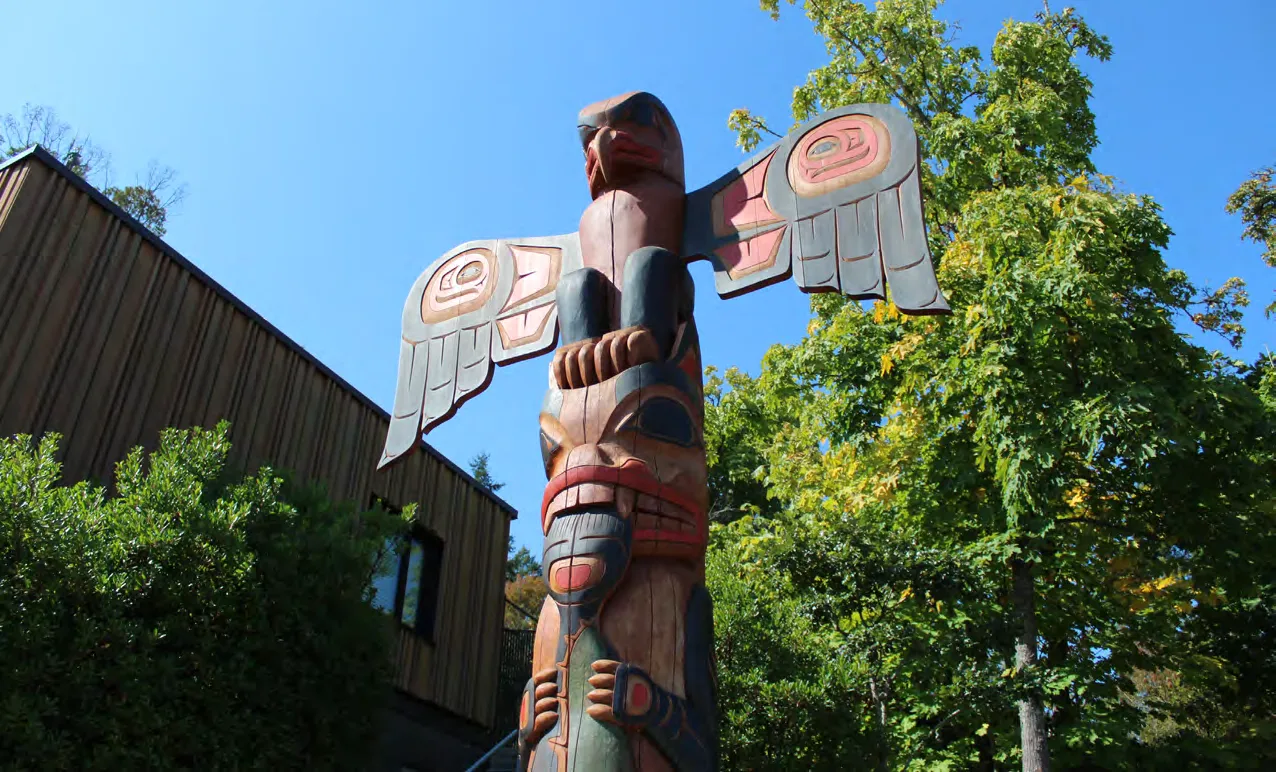
Part Three: Reconciliation
6.0 Reconciliation
6.1 CONTEXT
View Royal approaches reconciliation as a long-term priority grounded in relationship building, learning, collaboration, accountability, and action. View Royal is committed to integrating a reconciliation-centric approach to current and future Town initiatives. This includes recognizing the impacts of colonization on the community as it is today and acknowledging the injustices experienced by the First Nations peoples whose lands the Town is located upon. It will take time and commitment for View Royal to advance decolonizing practices and build respectful, meaningful relationships with the Xʷsepsəm and Songhees Nations.
Given the influence of Official Community Plans on long-term community initiatives and decision-making processes, this section focuses on practical and achievable policy direction to support ongoing reconciliation, collaboration, partnership, and relationship-building initiatives with the Xʷsepsəm and Songhees Nations so that community planning and priorities reflect the enduring presence and stewardship of the lək̓ʷəŋən Peoples. Through a reconciliation, collaboration and relationship-building lens, the Town worked with the advisors representing Xʷsepsəm and Songhees Nations on the review and update of the Official Community Plan. Both Nations provided comments on many aspects of the Official Community Plan to strengthen the objectives and policies and guide the Town on important matters related to self-determination, culture, land stewardship, and economic development.
The following Official Community Plan Goals may be achieved through the objectives and policy direction provided in this section:
- Community Well-Being
- Economic Development
- Reconciliation
- Regional Partnerships
6.2 OBJECTIVES
6.2.1 GOVERNMENT-TO-GOVERNMENT RELATIONSHIPS AND RECONCILIATION IN DECISION-MAKING Build respectful, government-to-government relationships with the Xʷsepsəm and Songhees Nations, and integrate reconciliation frameworks into View Royal’s community planning initiatives, particularly for decisions impacting the Nations’ interests and self-determination goals.
6.2.2 INDIGENOUS PRESENCE, IDENTITY, AND CULTURAL EXPRESSION Recognize, respect, and enhance the presence of Indigenous Peoples by promoting an inclusive atmosphere for those identifying as Indigenous in View Royal, and ensure that representation of Indigenous communities reflects their historical, continuing, and enduring significance within the community.
6.3 POLICIES
6.3.1 GENERAL A. Identify a joint vision for reconciliation in View Royal in partnership with the Xʷsepsəm and Songhees Nations. B. Continue to develop and implement existing Memorandums of Understanding and/or protocol agreements with the Xʷsepsəm and Songhees Nations around shared commitments.
6.3.2 COMMITMENT TO CULTURAL AWARENESS AND LEARNING A. Align municipal policies with the United Nations Declaration on the Rights of Indigenous Peoples & the provincial Declaration on the Rights of Indigenous Peoples Act to ensure Indigenous rights are explicitly recognized. B. Work with Xʷsepsəm and Songhees Nations to identify and deliver appropriate public education and reconciliation programming for View Royal residents and staff. C. Respect Indigenous data governance and sovereignty including through application of principles for Ownership, Control, Access, and Possession of data principles, and collaborate with Xʷsepsəm and Songhees Nations on municipally based data gathering.
6.3.3 ADVANCING RECONCILIATION IN LAND USE DECISIONS A. Remain committed to recognizing the Xʷsepsəm and Songhees Nations’ rights to make decisions over their lands, resources, and economic future that reflect their laws, values, and community priorities. B. Proactively engage, and collaborate meaningfully and respectfully, with Xʷsepsəm and Songhees Nations on land use initiatives and decisions by which they may be affected to respect rights recognition and shared decision making. C. Follow procedures and protocols for respectful engagement and consultation as outlined by Xʷsepsəm and Songhees Nations referrals processes. D. Support economic reconciliation with lək̓ʷəŋən Peoples by collaborating on land use and development projects led by Xʷsepsəm and Songhees Nations. E. Consider the impact of land use decisions to the long-term needs of the Xʷsepsəm and Songhees Nations and ensure land use directions support and advance reconciliation efforts. F. Promote awareness of the responsibility of the Town and property owners to protect archeological sites and artifacts, including those of Indigenous significance, and encourage compliance under the Heritage Conservation Act.
6.3.4 UNDERSTANDING INDIGENOUS LAND AND WATER MANAGEMENT A. Work with Xʷsepsəm and Songhees Nations to learn about Indigenous land and water stewardship practices, values, and rights. B. Work actively with Xʷsepsəm and Songhees Nations to integrate Indigenous knowledge systems with Western science for land and water stewardship initiatives, such as habitat restoration, culturally informed ecological management, resilient food systems, and conservation of natural assets.
6.3.5 SUPPORTING ECONOMIC RECONCILIATION AND RIGHT TO SELF-DETERMINATION A. Collaborate with Xʷsepsəm and Songhees Nations to identify and pursue opportunities for Indigenous led land and economic development initiatives, such as Nation-led housing, mixed use, and economic projects. B. Support Indigenous-led economic initiatives through locally-forged business partnerships with Xʷsepsəm and Songhees Nations and support Indigenous business development and Indigenous development corporations.
6.3.6 CELEBRATING INDIGENOUS IDENTITY WITHIN VIEW ROYAL A. Expand Indigenous cultural representation in public space, by supporting public art from Xʷsepsəm and Songhees artists, seeking opportunities for First Nations naming of parks, facilities, and streets, and exploring opportunities to develop interpretive materials co-authored with Xʷsepsəm and Songhees Nations to reflect the current presence of lək̓ʷəŋən People.
C-59-26 THAT the Official Community Plan exclude policies to reduce off-street parking requirements, except where such reductions are required by provincial legislation. (Policy 6.3.3(g) was removed).
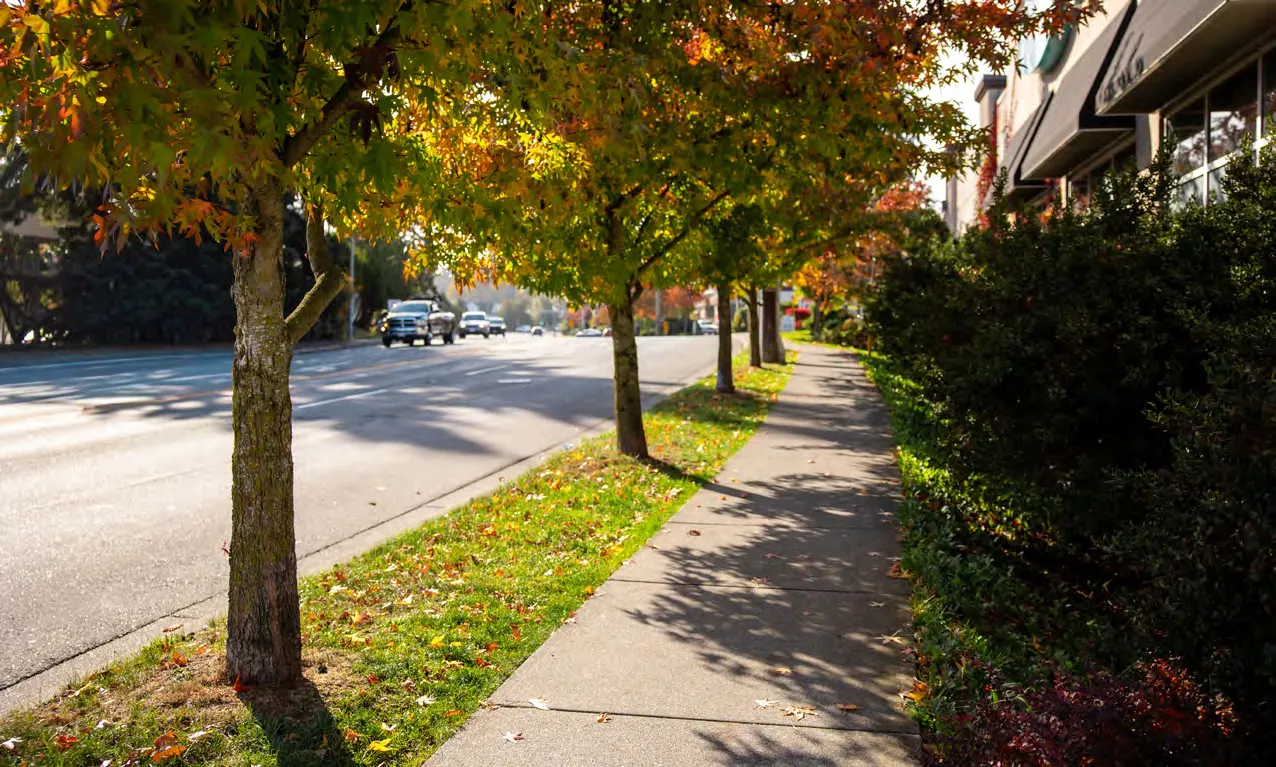
Part Four: Policies
7.0 Housing
7.1 CONTEXT
Housing in View Royal and the Capital Regional District as a whole is increasingly challenged by rising land and construction costs, demographic shifts, and limited land availability for new development. Many residents are living in housing that is no longer suitable for their needs, including older adults seeking to downsize and families seeking attainable, appropriately sized homes. Inadequate housing options and growing risks of homelessness further highlight the need for greater diversity in housing types and tenures.
The 2024 View Royal Interim Housing Needs Report outlined the most current housing conditions in the community and found that 0.9% of owner households and 7.81% of renter households are in extreme core housing need in 2021.
A total of 842 dwelling units are necessary to address extreme core housing need, persons experiencing homelessness, suppressed household formation, anticipated growth, rental vacancy rate adjustment, and local demand in View Royal by 2026, and a total of 2,889 dwelling units are need by 2041. The Interim Housing Needs Report estimates that the total number of Extreme Core Housing Need dwelling units needed by 2041 is 174, this is approximately 12 new units per year between 2026 and 2041. Considering the lifetime of this Official Community Plan extends beyond the year 2041 to 2050, a total of 4,189 units may be necessary to meet long-term housing needs in the community, based on findings identified in the Interim Housing Needs Report.
With little vacant land remaining within the Urban Containment Boundary, most new residential development will occur through the redevelopment of older housing stock and infill within existing neighbourhoods. Addressing community housing needs and desires will require an expanded supply of ground oriented, family-friendly housing, such as secondary and garden suites, duplexes, houseplexes, rowhouses, and townhouses. The development of new detached dwellings that occupy a smaller building footprint may also be viable to fill housing gaps and address community needs.
The purpose of this section is to provide policy direction that supports suitable, attainable, and affordable housing forms for all residents.
- A household is said to be in extreme core housing need if its housing falls below at least one of the adequacy, affordability or suitability standards and it would have to spend 50% or more of its total before-tax income to pay the median rent of alternative local housing that is acceptable (meets all three housing standards)
- Suppressed household formation is said to be new households that would have been formed but are not due to a lack of attainable options. The persons who would have formed these households include, but are not limited to, many adults living with family members or roommates and individuals wishing to leave unsafe or unstable environments but cannot due to a lack of places to go.
- Rental vacancy rate adjustment adds surplus rental units to restore local vacancy rates to levels representing a healthy and well-functioning rental housing market. Typically, rates between 3% and 5% are considered healthy vacancy rates.
The following Official Community Plan Goals may be achieved through the objectives and policy direction provided in this section:
- Diverse and Affordable Housing
- Regional Partnerships
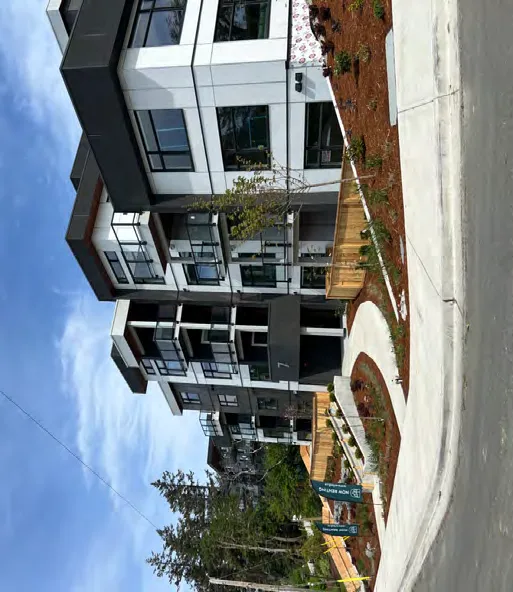
The Town’s 2024 Housing Needs Assessment Report identifies the breakdown of existing housing need in View Royal and the type of housing that is required to address this need.
7.2 OBJECTIVES
7.2.1 HOUSING DIVERSITY AND SUPPLY Support the diversification and overall supply of housing throughout the Town, including affordable, supportive, and non-market rental housing.
7.2.2 AGE-FRIENDLY HOUSING Encourage accessible housing design that allows residents to age-in-place and enables residents to live and remain in their community, despite differences and changes in individual lifestyle, income, and health.
7.2.3 PRESERVE STABLE LONG-TERM RENTALS Seek opportunities to preserve long-term rental housing stock that is suitable, adequate, and affordable, to ensure long-term housing stability and affordability in the community.
7.2.4 HOUSING FOR PEOPLE Continue to support the provision of a diverse range of housing types and tenures to meet the diverse needs of current and future residents, including families, seniors, people with diverse abilities, physical disabilities, and low-income households.
7.2.5 HOUSING PARTNERSHIPS Explore opportunities to develop new partnerships and strengthen existing partnerships with non-profit housing providers, BC Housing, and the Capital Region Housing Corporation to ensure View Royal can continue to support affordable housing initiatives in the community.
7.3 POLICIES
7.3.1 GENERAL A. Continue to update the Housing Needs Report every five years using the provincial standardized Housing Needs Report Method, following the timeline and requirements specified in the Local Government Act to inform housing priorities. B. Research what forms of amenity space are needed and desired to create strong, socially connected communities and explore how the Zoning Bylaw may implement amenity space requirements in multi-unit residential developments.
C-80-26 THAT the policy under the section titled “Housing Supply” regarding promoting ground-oriented residential development through expanding zoning permissions be removed from the Official Community Plan. (Policy removed) C-60-26 THAT policies to pre-zone sites for multi-unit housing development be excluded from the Official Community Plan, except for sites already pre-zoned as Transit-Oriented Areas and/or Small Scale Multi-Unit Housing by provincial legislation. C-45-26 THAT clear targets for the full range of affordable housing be established and included within the Official Community Plan and associated bylaws and policies; AND THAT a ratio for housing (non-market versus full market) be set and adjusted using best available data. (Refer to policy 7.3.3(a) below). C-79-26 THAT the policy under the section titled “Housing Supply” regarding the delegation of authority to expedite development approval permitting from Council to staff be removed from the Official Community Plan. (Policy removed) (Policies removed)
7.3.2 HOUSING SUPPLY A. Continue to consider opportunities to facilitate an increase in housing supply by streamlining development approval and permitting processes. B. Research what forms of non-traditional housing ownership and building construction types (e.g. market rental, cooperatives, mixed market and non-market projects, mass timber, prefabrication) are needed, desired, and may be viable. C. Review annual housing starts data to identify and track progress towards housing goals, and to find opportunities to increase housing supply. D. Continue to review, monitor and enforce zoning regulations that regulate Short-Term Rental accommodations to increase the availability of long-term rental housing supply, and prevent the commercialization of residential dwellings.
C-61-26 THAT the current form and character development permit area requirements be retained for residential developments of two units or less, including duplexes and garden suites. (Policy 6.3.2(g) was deleted and Policy 7.3.2 (a) was revised and no longer refers to exploring opportunities for delegated authority)
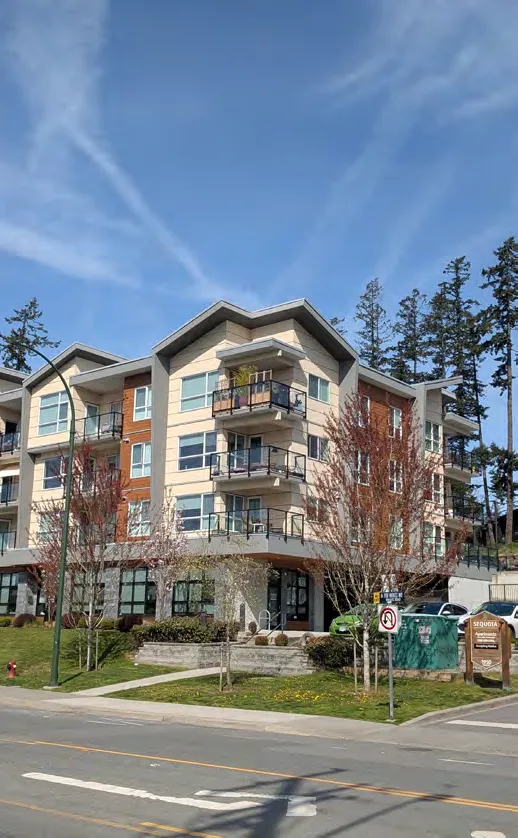
7.3.3 AFFORDABLE AND RENTAL HOUSING A. Support the attainment of affordable housing in View Royal by achieving a minimum of 1 unit of below-market housing for every 15 units of market housing, and 1 unit of supportive housing for every 44 units of market housing being built in the Town. B. Undertake financial feasibility analyses to identify if density bonusing and inclusionary zoning are viable tools to utilize in the Zoning Bylaw to increase affordable market and non-market rental housing supply.
C-59-26 THAT the Official Community Plan exclude policies to reduce off-street parking requirements, except where such reductions are required by provincial legislation. (Policy deleted) C-81-26 THAT the policy under the section titled “Affordable and Rental Housing” regarding advocating to review taxation-related barriers and support development of market rental units be removed from the Official Community Plan. (Policy deleted) C-82-26 THAT the policy under the section titled “Affordable and Rental Housing” regarding the provision of incentives for non-market housing through municipal tools be removed from the Official Community Plan. (Policy deleted)
C. Collect in-kind and cash-in-lieu contributions towards affordable housing, where possible, through the establishment of relevant tools, including reserve funds and amenity contribution policies. D. Protect below-market and affordable rentals where redevelopment of existing ground-oriented rental and cooperative housing units are proposed by considering how to retain rental units of the same quantity, size, and where possible, maintain the equivalent monthly rental rate for tenants. Achieve a minimum replacement of 1:1 for all below-market and affordable rentals that are lost through redevelopment. E. Where the redevelopment of an existing cooperative housing site is considered, an increase in residential density will be supported only if additional cooperative housing units are provided. F. Continue to review the Town’s Tenant Assistance Policy to ensure it is designed to mitigate the loss of existing affordable units and protect tenants who are displaced during the redevelopment or renovation of older rental buildings. G. Investigate additional measures to protect tenants displaced by the redevelopment or renovation of purpose-built rental housing, such as regulations that ensure existing tenants have adequate time to find new housing, are provided compensation where applicable, and receive priority for new housing.
C-46-26 THAT a policy be established to protect existing below-market housing units by requiring a minimum one-for-one replacement of all below-market units lost through redevelopment; AND THAT this policy be incorporated into the Official Community Plan and related bylaws, ensuring that redevelopment proposals maintain or replace below-market housing as a condition of approval; AND FURTHER THAT increased residential density be allowed in the redevelopment of existing co-operative housing sites. (Refer to policies 7.3.3(d) and (e).
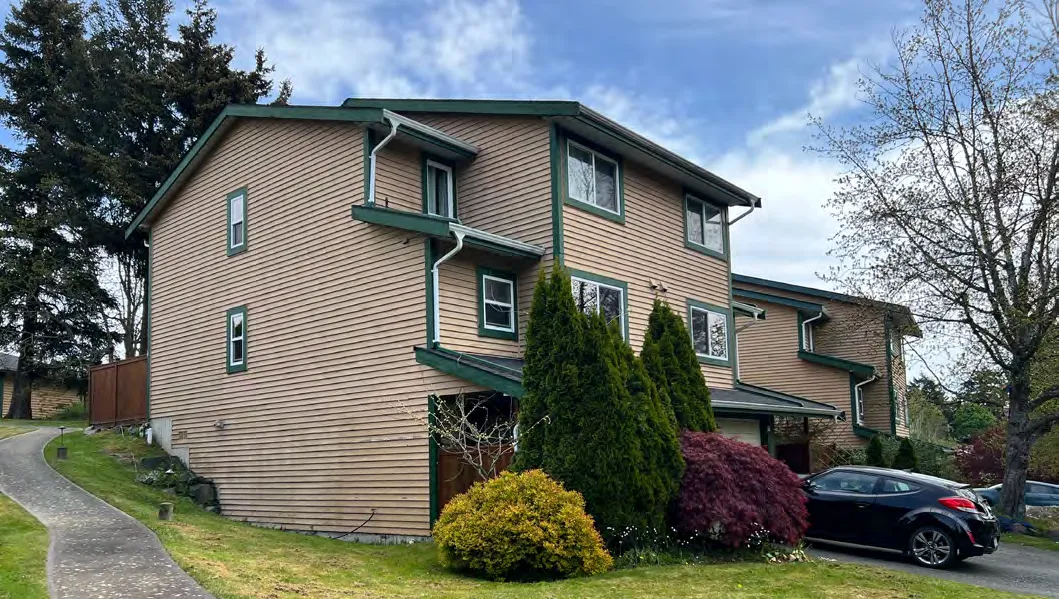
7.3.4 FAMILY HOUSING A. Support family-oriented housing by requiring new multi-unit residential developments of four or greater storeys, with the exception of seniors housing, supportive housing, and affordable rental housing projects, to allocate a proportion of units as follows: i) a minimum of 30% of units with two bedrooms or more; and ii) a minimum of 10% of units with three bedrooms or more B. Investigate how family housing needs can be better addressed in View Royal, including access to supports and amenities such as childcare facilities, schools, and parks. C. Promote ground-oriented, family-friendly housing within neighbourhoods close to schools and amenities.
7.3.5 ACCESSIBILITY IN HOUSING A. Incorporate Universal Design principles in the design of common and amenity spaces, such as entryways, hallways, stairwells, patios, and multi-purpose rooms, amongst others. B. Achieve 10% of units in all new multi-unit housing developments of four or more storeys to be accessible or adaptable units, particularly in below-market developments, and at least be designed and constructed in accordance with the BC Building Code, or an equivalent standard. These units should be provided on the ground floor wherever possible.
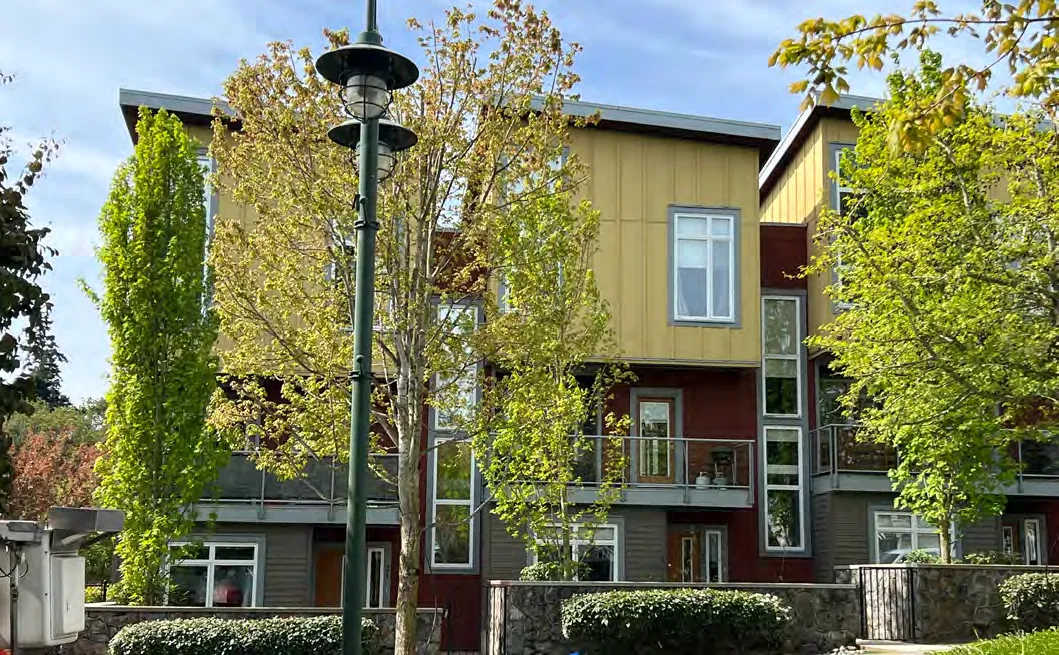
7.3.6 COORDINATION AND PARTNERSHIPS A. Strengthen partnerships to deliver more affordable housing and supportive housing. B. Build community capacity to support the development of affordable housing, for example by connecting non-profits with funding streams, land opportunities, and market developers for potential partnerships. C. Work together with housing agencies, stakeholders, and senior levels of government to identify sites and collaborate, where possible, on the provision of supportive housing projects with social and mental health support. D. Continue annual financial contributions to the Regional Housing Trust Fund, administered by the Capital Region Housing Corporation, to support the acquisition, development, and retention of housing that is affordable to households with low or moderate incomes. E. Continue to collaborate with the Capital Regional District and other regional stakeholders to implement the Regional Housing Affordability Strategy and continue to support and contribute to regional housing initiatives and programs.
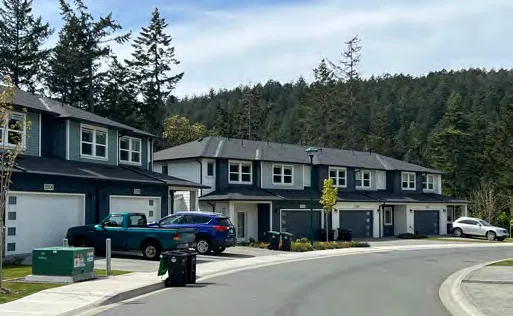
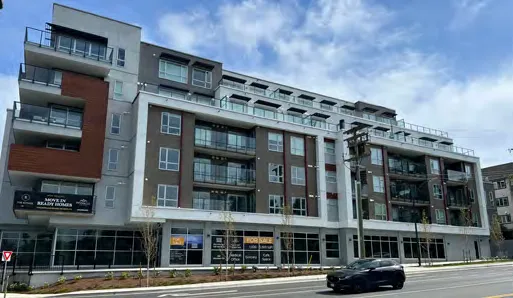
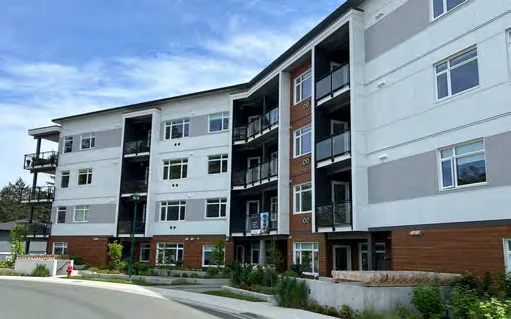
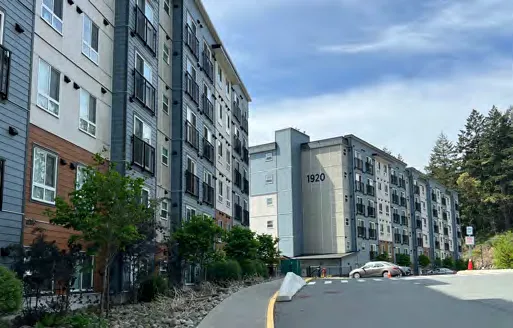
8.0 Transportation and Mobility
8.1 CONTEXT
The transportation and mobility choices existing within a community define how community members can get around. View Royal’s central location with the Capital Regional District and as the gateway to the West Shore makes it well-connected to the broader region. The Trans-Canada Highway (owned and maintained by the Ministry of Transportation and Transit), Island Highway, Galloping Goose Regional Trail, E&N Rail Trail, and BC Transit’s bus routes including the 95 Blink Rapid Bus, number 14 (Vic General / UVic), and number 40 (UVic/Dockyard via McKenzie-Admirals) traverse View Royal and provide connections to key destinations within adjacent communities and beyond.
Within View Royal, there are five key corridors along which amenities and services are concentrated, as shown on Map 3: Island Highway, Admirals Road, Helmcken Road, Watkiss Way, and the Western Gateway Corridor. These corridors serve key transportation functions in their ability to move goods and people within the Town and provide connections to neighbouring communities. It is anticipated that higher levels of density will be concentrated along these corridors to enable alternate modes of transportation beyond the private car and to ensure that residents can easily access the services and amenities they need daily near their home. The foundation for this is embedded within the Official Community Plan’s land use policy, included in Part Two.
Each of the corridors noted are also supported by one of View Royal’s two mobility hubs. As shown on Map 4, these are located at the site of the provincially designated Hospital Transit-Oriented Area, which comprises the existing Victoria General Hospital Transit Exchange and the Atkins Neighbourhood Village. Both mobility hubs are located within proximity to the Galloping Goose Regional Trail and the Trans-Canada Highway which provide opportunities for travel within the region by cycling, rolling, walking, or car. In addition, they are each serviced by transit routes that provide connections within View Royal and beyond. BC Transit is updating the Victoria Regional Transit Plan to address network design priorities and infrastructure and service improvements. A bus rapid transit route already serves the Atkins Mobility Hub, and additional connections may be identified for the Hospital Transit-Oriented Area and Atkins Mobility Hub, as shown on Map 4, once BC Transit has adopted the Victoria Regional Transit Plan. Increased densities are permitted in and around these mobility hubs to promote alternate modes of transportation through enhanced public realm design that creates a pedestrian-friendly environment and provides connections to key active transportation infrastructure such as trails.
- Corridors are primary transportation routes where increased development density is generally encouraged to maximize accessibility for vehicles, public transit, and pedestrians. In View Royal, key corridors include Admirals Road, Helmcken Road, Island Highway, and the Western Gateway Employment District Corridor.*
- Mobility Hub means a strategic location offering access or connections to multiple modes of transport, including transit, cycling, walking, rolling, and private vehicles. These hubs are usually central to concentrations of medium- to high-density development. View Royal has two mobility hubs - the provincially designated Hospital Transit-Oriented Area which comprises the existing transit exchange located at Victoria General Hospital and the Atkins Neighbourhood Village located adjacent to Island Hwy and the Galloping Goose trail.*
The objectives and policies included in this section aim to enhance mobility options for getting around View Royal and travel through the community by employing strategies that encourage alternate transportation behaviours and choices. Such strategies will address primary concerns of residents related to traffic congestion along major routes such as the Trans-Canada Highway and Island Highway by creating alternative modes for a smoother travel experience. In addition, reduced reliance on the automobile yields reduced greenhouse gas emissions, cleaner air, and a healthier community.
The following Official Community Plan Goals may be achieved through the objectives and policy direction provided in this section:
- Mobility & Connectivity
- Community Well-Being
- Climate Action and Resilience
- Regional Partnerships
- Sustainable Service Delivery through Asset Management
C-63-26 THAT the Official Community Plan be amended to consistently address the Atkins area as the Atkins Neighbourhood Village. (Edits have been made throughout the document)
Map 3: Corridors
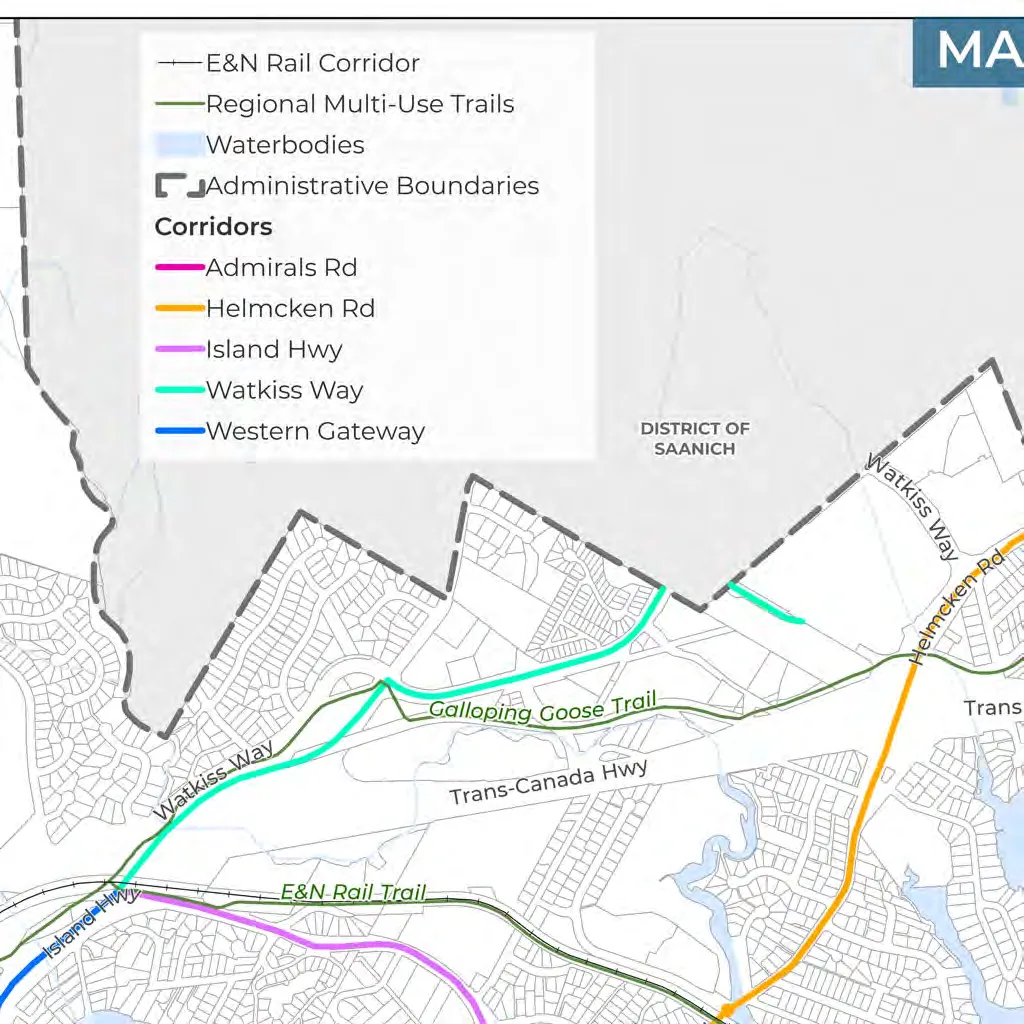
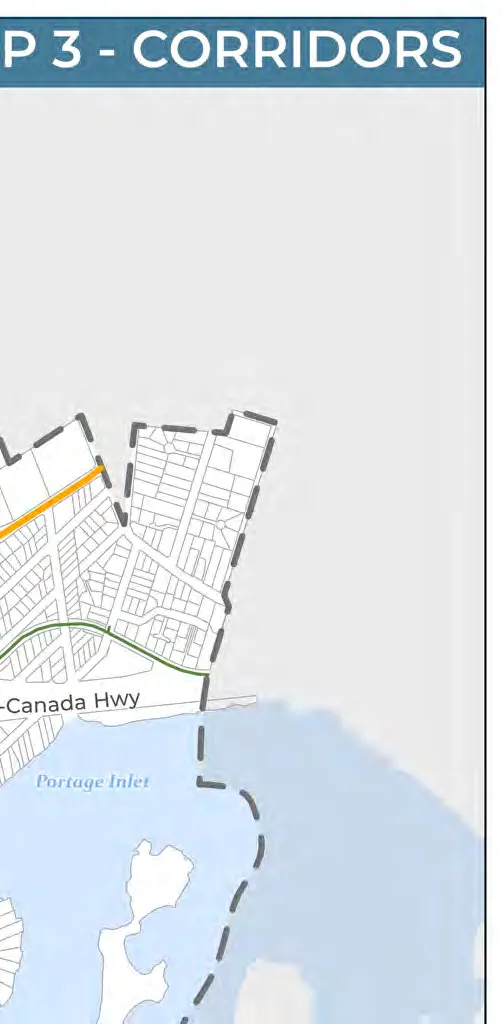
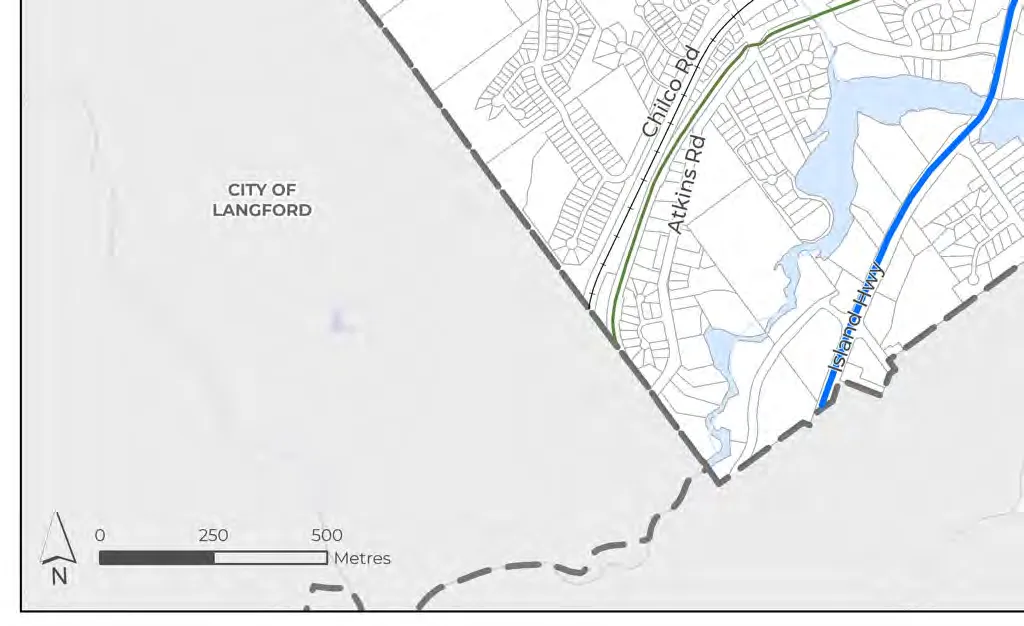
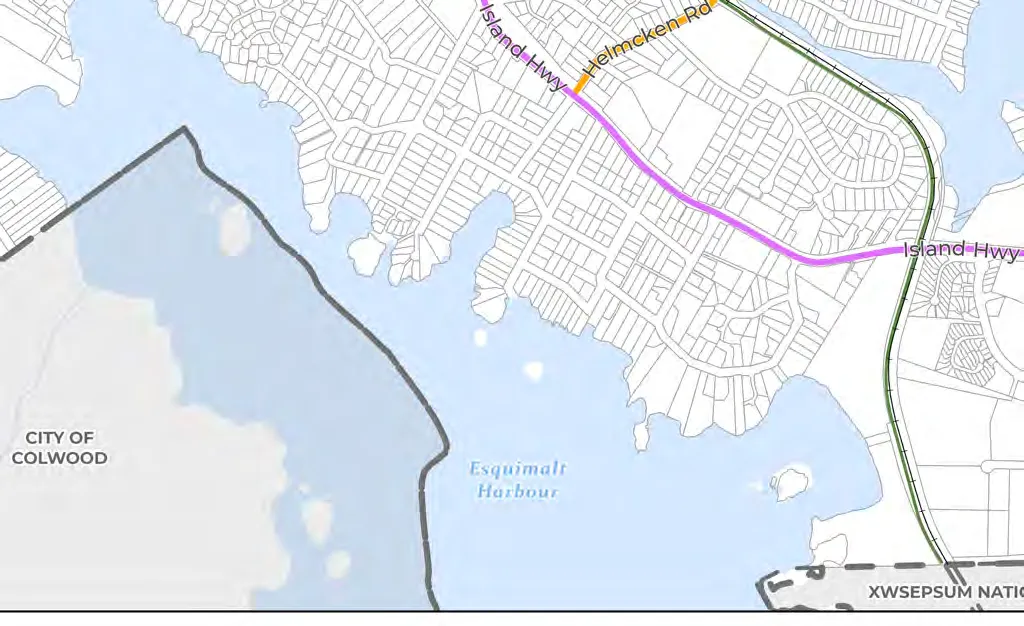
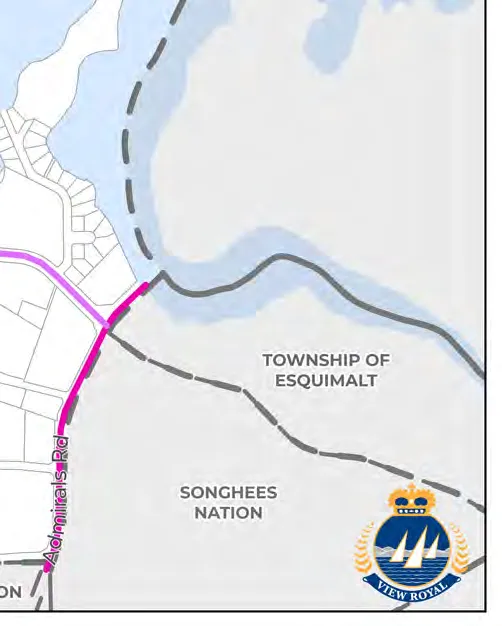
C-55-26 THAT the map titled "View Royal's Corridors" in the Official Community Plan be amended to include Watkiss Way as a corridor. (See revision on Map 3)
Map 4: Mobility
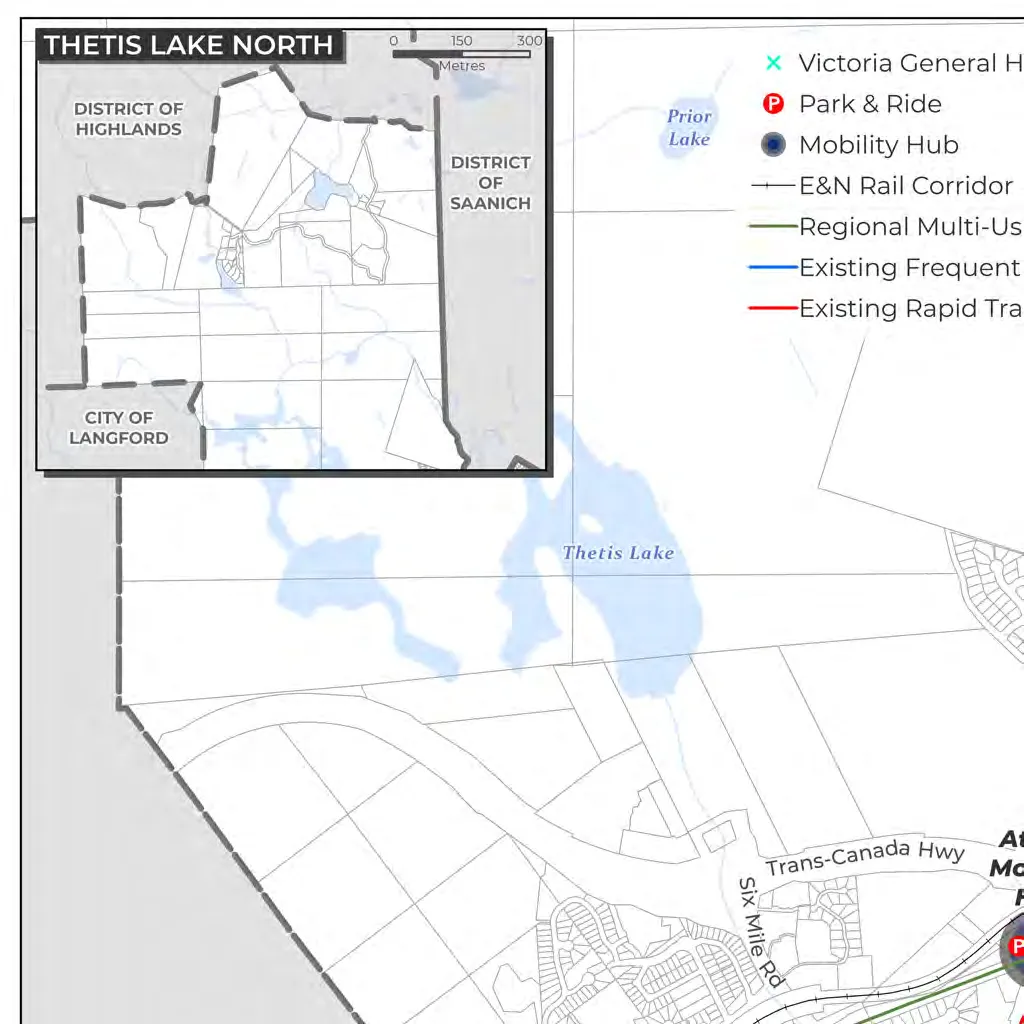
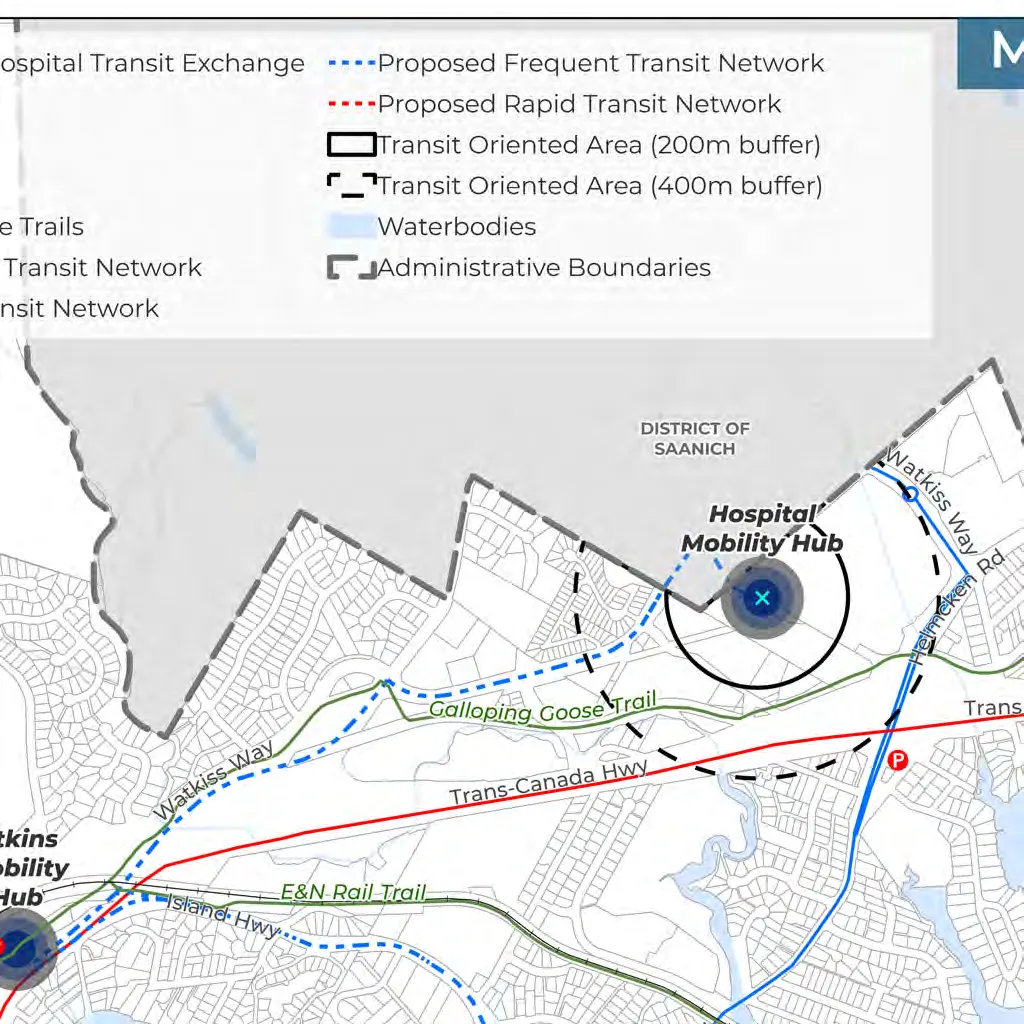
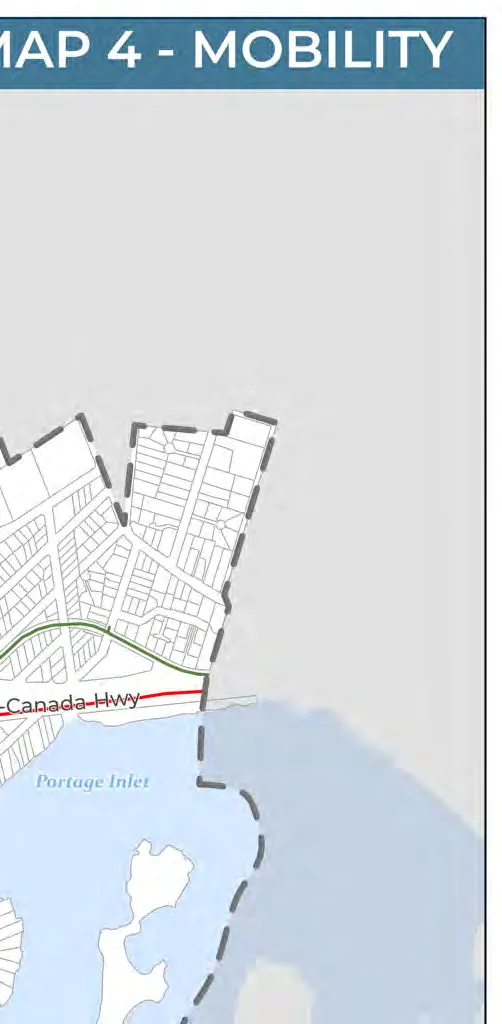
8.2 OBJECTIVES
Transportation in all forms connects people and places, and plays a significant role in residents’ daily lives, getting to work, school, or accessing recreational amenities. View Royal’s transportation network also advances the Official Community Plan’s objectives for economic development, climate action, housing affordability, and community equity.
8.2.1 BUILDING A CONNECTED MULTIMODAL COMMUNITY Support and encourage the development of View Royal’s active transportation network, which prioritizes walking, cycling, and public transit networks as part of an interconnected multi-modal transportation system within the community.
8.2.2 STRENGTHEN TRANSPORTATION CONNECTIONS AND REGIONAL DESTINATIONS Strengthen transit and active transportation connections to key regional destinations to and from View Royal by collaborating with BC Transit, neighbouring municipalities and regional partners to improve multi-modal connections to parks, regional trails, schools, commercial and institutional centres, the Canadian Forces Base Esquimalt, Victoria General Hospital, University of Victoria, and the West Shore communities.
8.2.3 EQUITABLE, SAFE, AND EFFICIENT MOBILITY Continue to work towards a future transportation and mobility network that provides equitable opportunities for all, and allows users to travel safely, reliably, and comfortably throughout the community regardless of their mode of travel.
8.2.4 REGIONAL TRAFFIC AND RESIDENT NEEDS Recognize the unique challenge that View Royal faces as a connection point between Victoria’s urban core, the Saanich Peninsula communities, and the West Shore, and continue to prioritize the needs of residents to move around the Town and mitigate the traffic congestion impacts of regional commuters. Continue to support and encourage programs that will achieve the Town’s mode-share targets and place a greater emphasis on walking, cycling, and transit, over private vehicles.
8.2.5 AFFORDABLE, EQUITABLE TRANSPORTATION OPTIONS Continue to support and encourage programs and tactics that will help the Town in achieving its mode share targets and mitigate local transportation impacts by supporting safe and comfortable multi-modal transportation choices. Moving forward, a greater emphasis on walking, cycling, and transit, over private vehicles should be prioritized.
8.2.6 CLIMATE ACTION THROUGH TRANSPORTATION CHOICE Reduce greenhouse gas emissions by supporting efficient and accessible transit service and active transportation options.
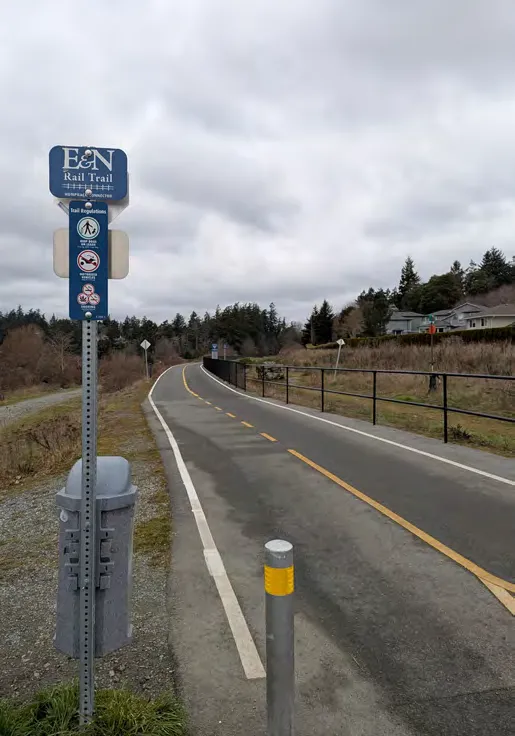
8.3 POLICIES
8.3.1 GENERAL A. To support safe and reliable multi-modal systems for the movement of people throughout View Royal, in accordance with the priorities and strategies established in the Transportation Master Plan and Active Transportation Network Plan, priorities for transportation infrastructure investments should be based on the following modal hierarchy: i) Foundation Access – Pedestrians, people using mobility aids, and emergency personnel and equipment ii) High-Capacity, Low-Impact Mobility - Transit iii) Active and Low-Speed Mobility – Cycling and micro-mobility devices iv) Efficient Shared Use – Shared vehicles v) Economic Backbone – Commercial vehicles vi) Low Priority – Private vehicles B. To improve overall transportation efficiency and ensure that local roads remain available for emergency vehicles, service delivery, school buses and transit in the community, encourage commuter traffic to utilize regional rapid transit corridors, including Island Highway and Trans-Canada Highway.
C-70-26 THAT the Official Community Plan encourage commuter traffic to utilize regional rapid transit corridors, including routes such as Island Highway and Trans-Canada Highway, to improve overall transportation efficiency and help ensure local roads remain available for emergency vehicles, service deliveries, school buses, and transit operations within the community. (Refer to policy 8.3.1(B))
C. Pursue the following mode share targets by 2050:
| Mode | Mode Share (2022) | Mode Share Target (2050) |
|---|---|---|
| Walking, Cycling and Micro-mobility | 12% | 25% |
| Public Transit | 6% | 15% |
| Private Vehicle | 80% | 60% |
Mode share means the proportion of trips using a particular type of transportation to get around, such as walking, cycling, transit, scooting, ride share, or private vehicles.
Micro-mobility means transport via a small, typically electric, lightweight device that allows for individual human transport, such as a scooters, hoverboards, bicycles, and skateboards.
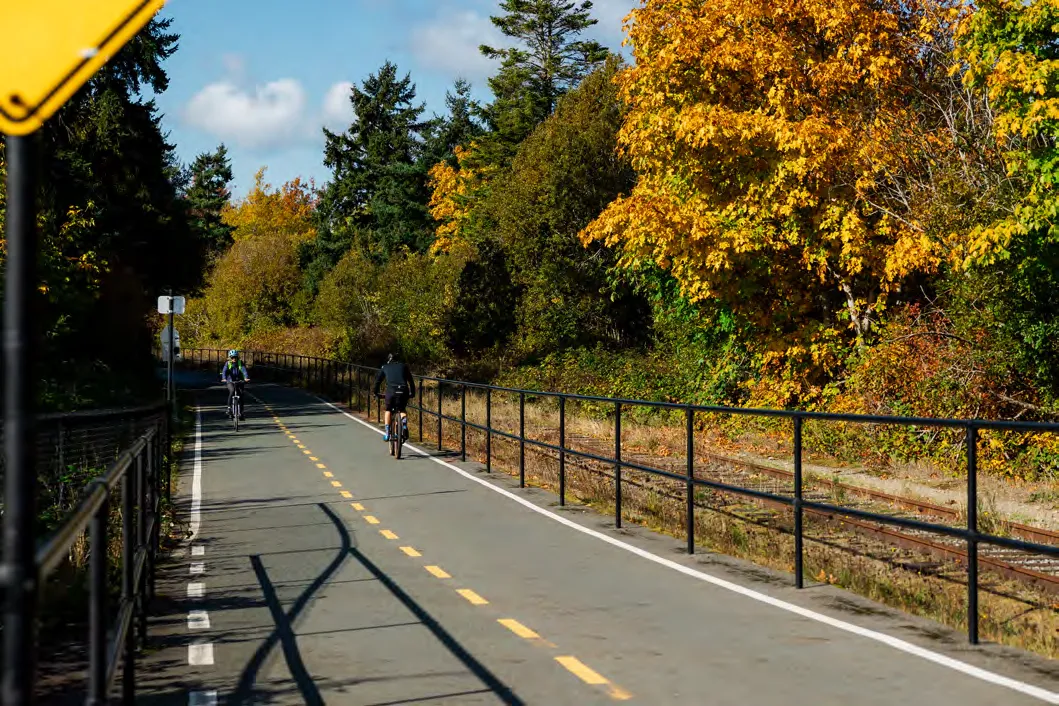
C-74-26 THAT the pie chart titled “Percentage of Population per Dwelling Type (2021)” in the Official Community Plan be amended to include labels with both category names and percentages to improve accessibility in visual data.
8.3.2 ACCESSIBILITY AND INCLUSIVITY A. Apply Universal Design principles in transportation infrastructure design wherever possible to allow all people, including people with disabilities, to use sidewalks, trails, and transit. B. Prioritize transportation improvements in locations with higher concentrations of equity-deserving people to support safe and comfortable access to essential goods and services.
8.3.3 TRANSIT A. Collaborate with BC Transit and neighbouring local governments to establish safe, accessible and high-quality transit service. Service improvement and expansion should prioritize areas of high ridership potential, as discussed in Part Two and shown on Map 4, which include mobility hubs and other areas with high employment and resident population density. B. Ensure that bus stops and stations are planned and designed in accordance with BC Transit’s infrastructure design guidelines and include seating, shade trees, plantings, weather protection, lighting, signage, and accessible paths to and from the stop. C. Pursue transit-supportive infrastructure to facilitate reliable transit service in View Royal and collaborate with the Ministry of Transportation and Transit and BC Transit on similar improvements to provincial corridors.
8.3.4 ACTIVE TRANSPORTATION A. Eliminate barriers to active transportation by creating an extensive active transportation network that supports walking, rolling, cycling, and transit opportunities for all ages and abilities (as shown on Maps 5, 6, and 7), improves key intersections along transportation routes to support safe and reliable travel, and provides end-of-trip facilities. B. Separate active transportation users from vehicle traffic on busy streets, where possible, and seek out low-speed and low-volume streets where people are safe and comfortable as an alternative to travelling on busy streets. C. Develop high-quality active transportation connections to the mobility hubs, as shown on Map 4, to encourage multi-modal trips. D. Ensure transportation infrastructure is designed to reflect community needs and best practices in accessible design, with reference to the British Columbia Active Transportation Design Guide and relevant regional design guidelines. E. Active transportation services and infrastructure are to be designed to support safety, comfort and access at all times, including mitigating against the impacts of weather. F. Advocate for trail widening, separated facilities for different user groups, and lighting along the Galloping Goose Regional Trail within View Royal to improve safety and comfort for all active modes of transportation. G. Provide accessible wayfinding within View Royal to connect residents to active transportation networks and encourage the use of View Royal's active transportation corridors. H. Collaborate with neighbouring municipalities and regional authorities to align active transportation networks and develop safe and comfortable inter-community active transportation connections. I. Develop infrastructure and programs that encourage active travel for students, parents, and staff.
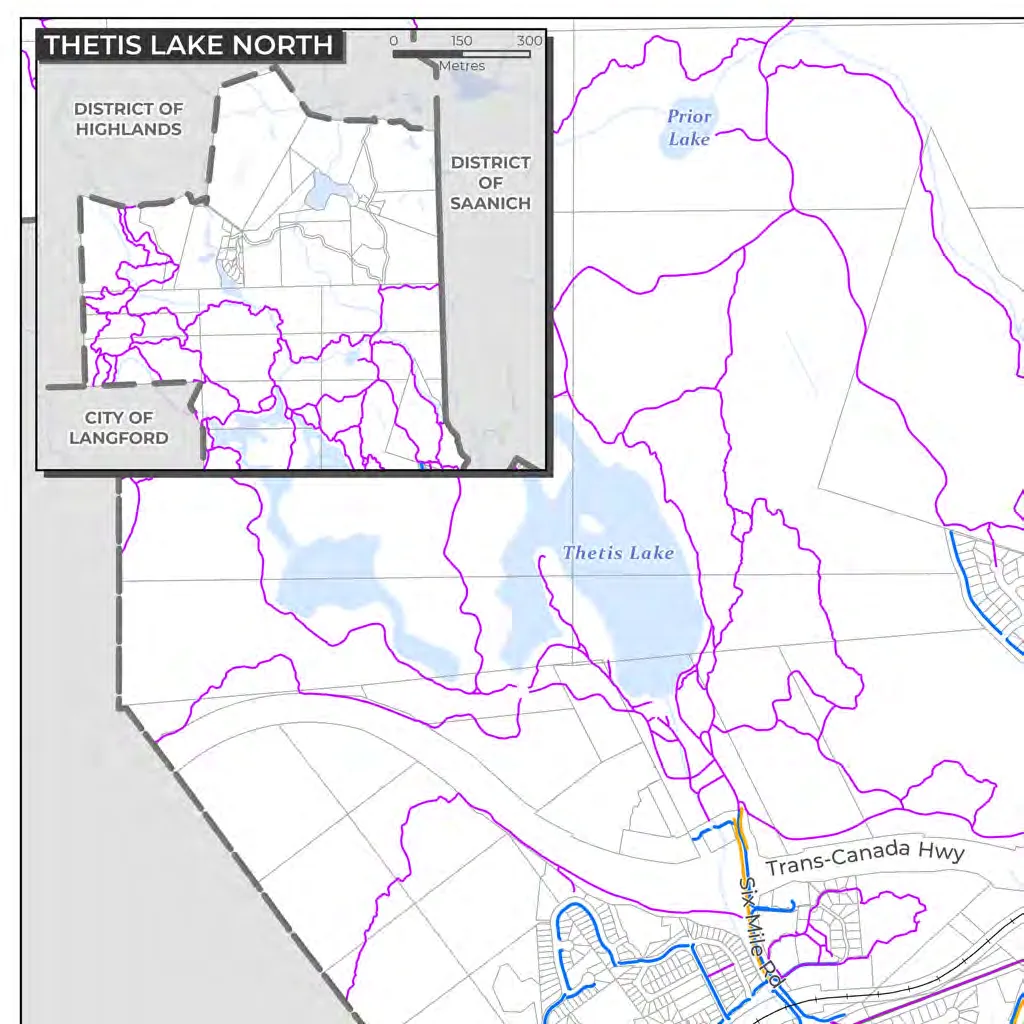
Map 5: Existing Active Transportation Network
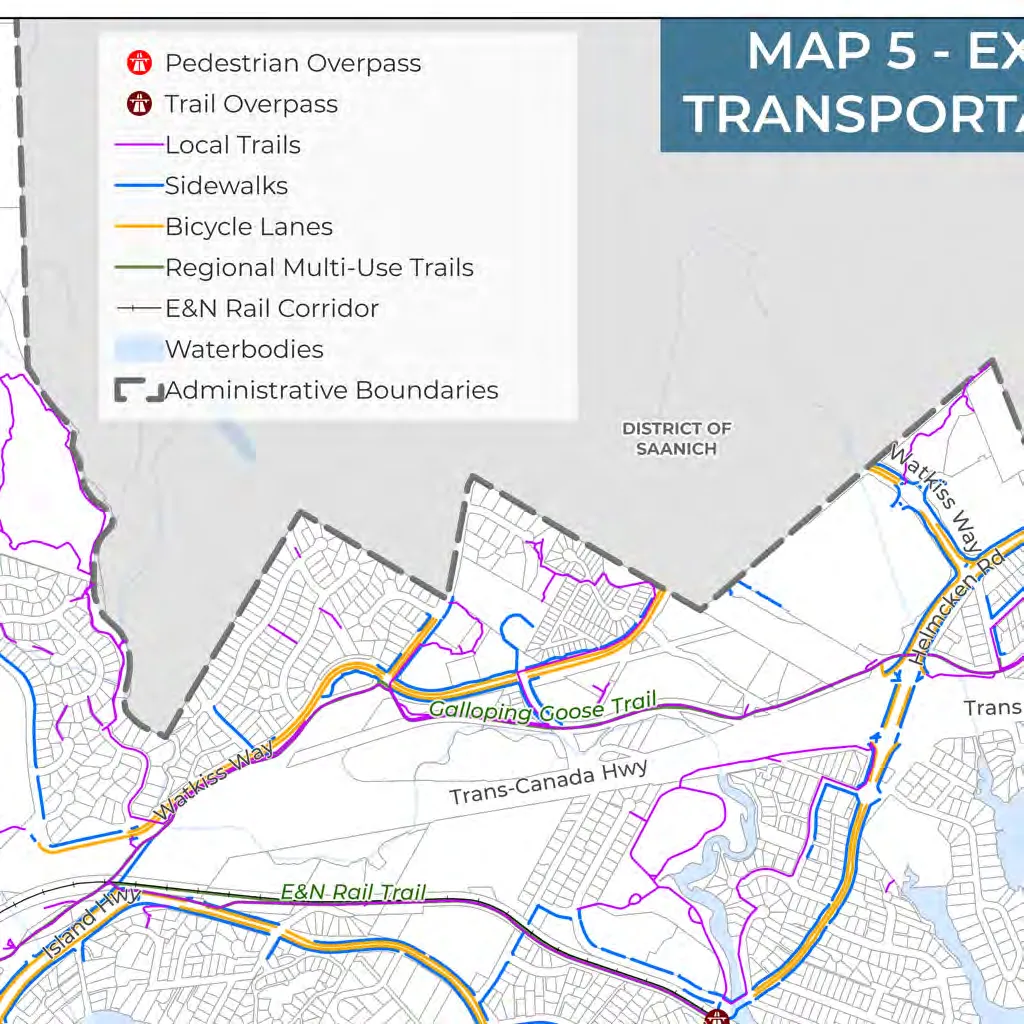
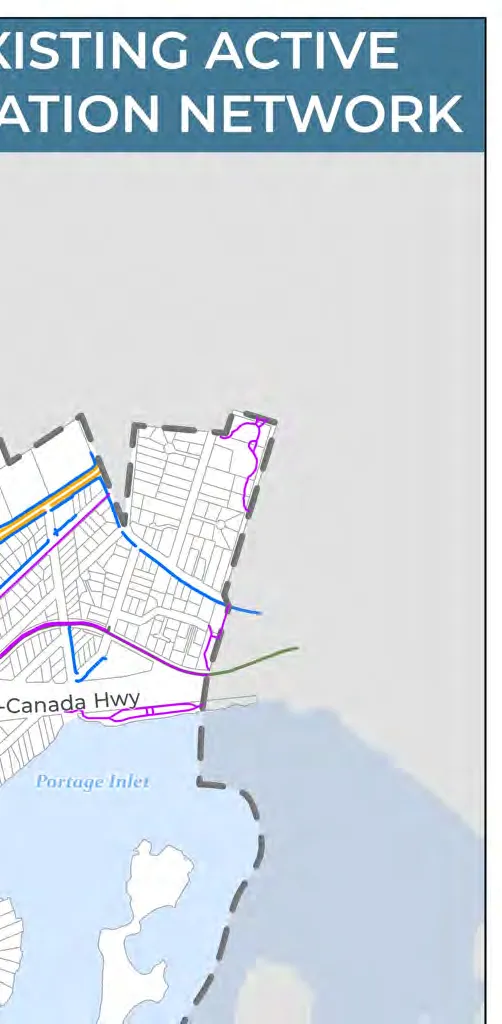
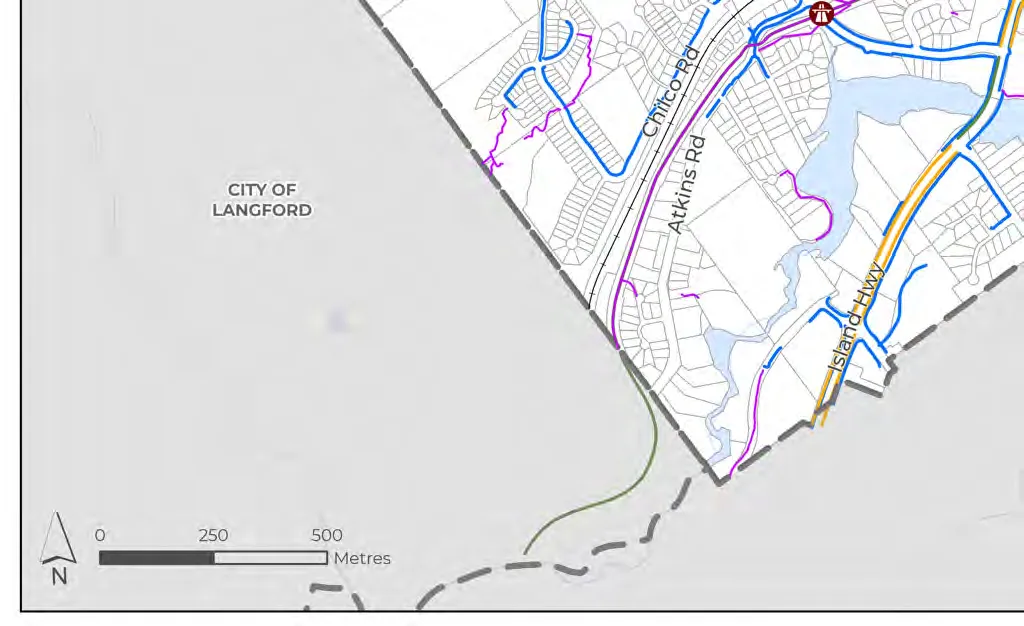
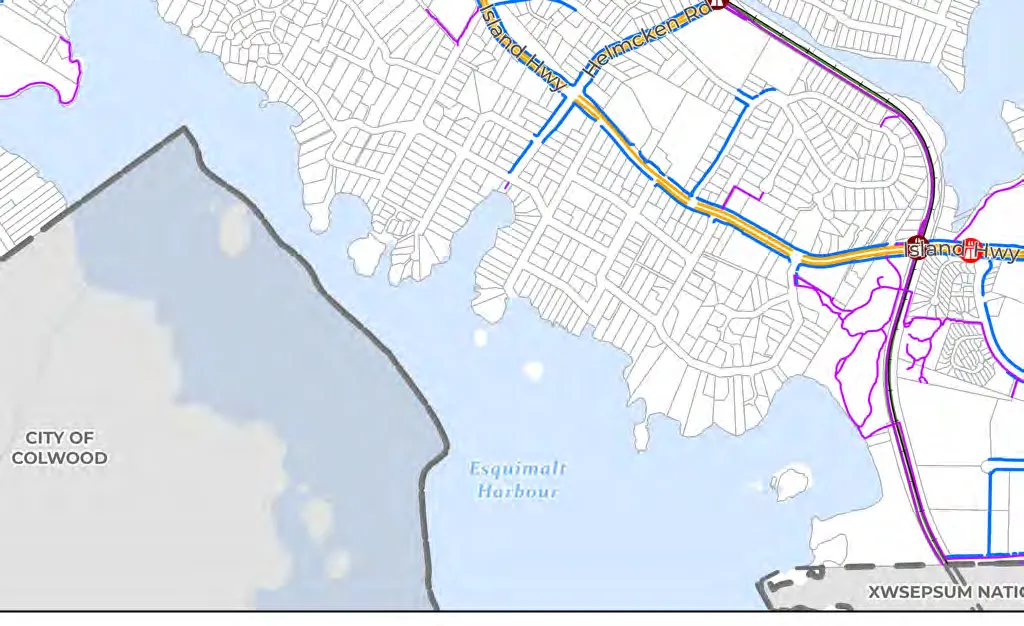
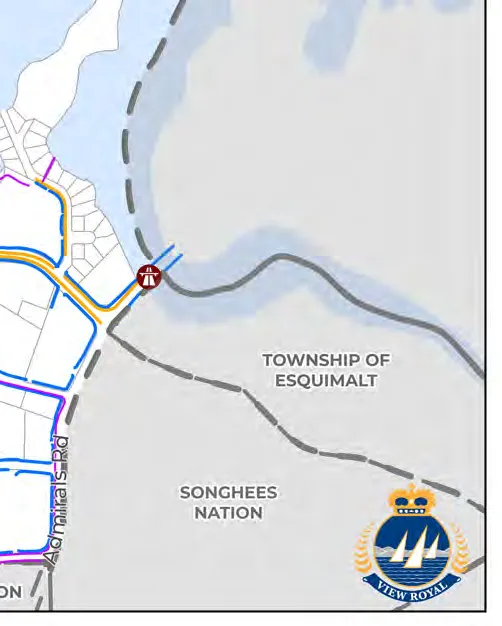
Map 6: Future Pedestrian Network
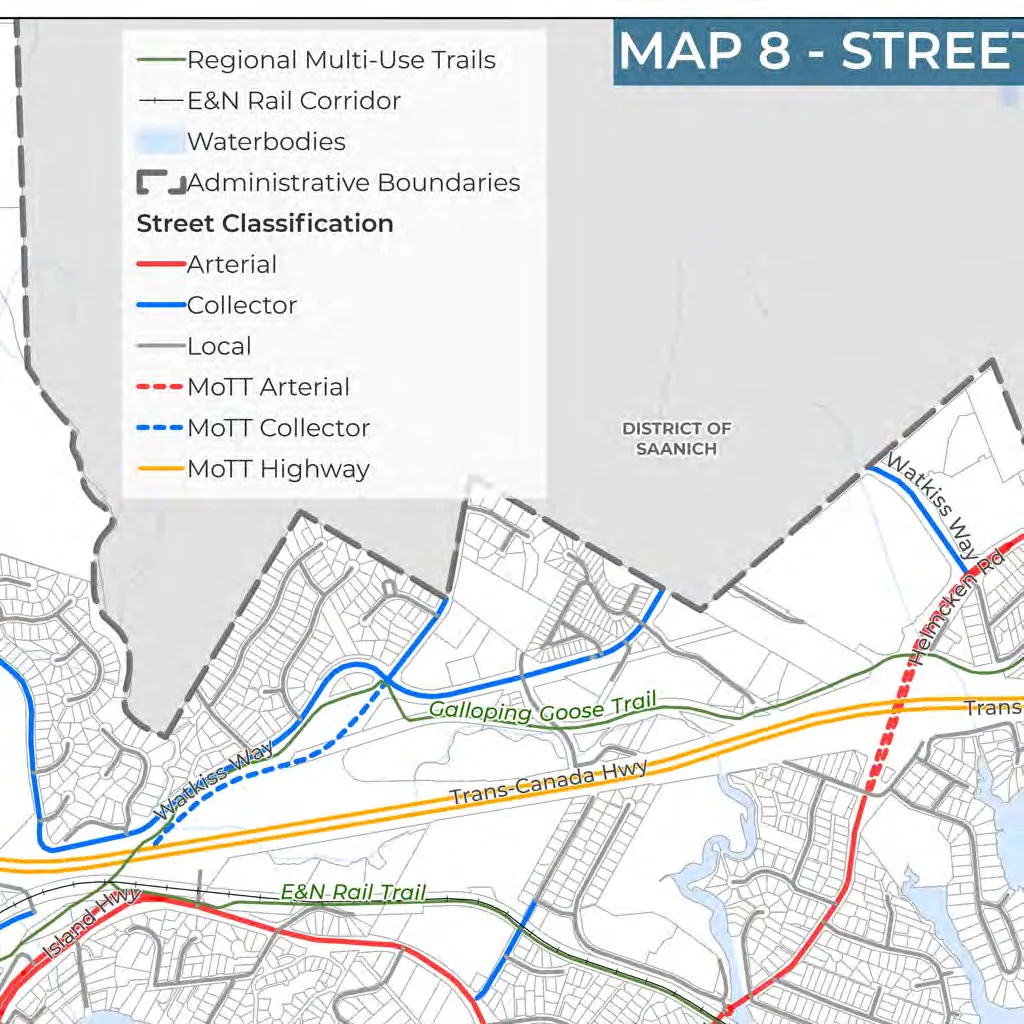
Map 7: Future Cycling Network
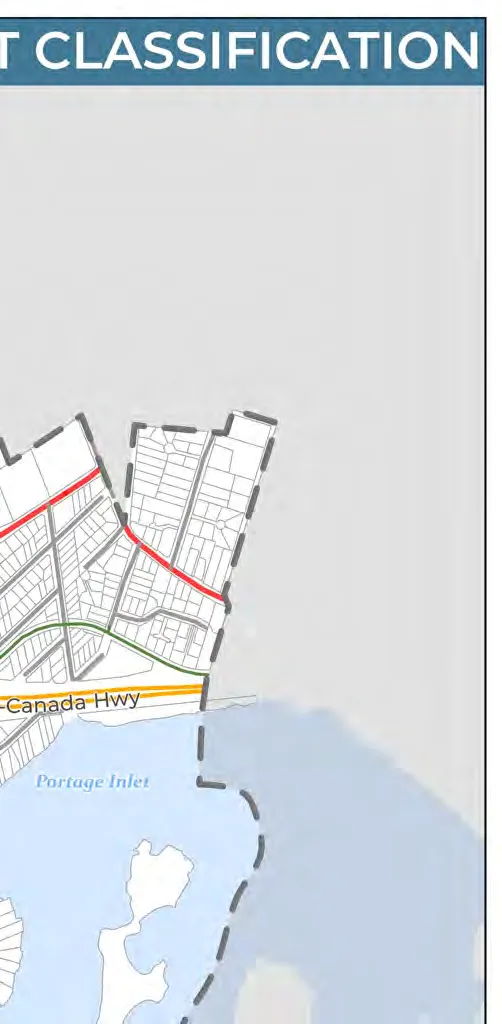
8.3.5 STREET NETWORK A. Reduce serious injuries and fatalities on View Royal streets through infrastructure improvements, targeted enforcement, and education to reinforce safe behaviours. B. Investigate opportunities to improve road safety where vehicle collisions, or collisions involving vulnerable road users are most common. C. Support safe vehicle speeds, reduce cut-through vehicle traffic, and provide safe and reliable movement for people walking, cycling, and driving on View Royal streets. D. Plan, design, and maintain streets in View Royal according to the street network classifications as shown on Map 8 and as described below: i) Highway - Major corridors serving regional and inter-regional trips. Highways are under British Columbia Ministry of Transportation & Transit jurisdiction. ii) Arterial – Streets that support View Royal residents make longer-distance trips outside the community. Arterial streets typically support higher traffic volumes and higher travel speeds, separated active transportation facilities, and high-order public transit service, with limited driveway and local street access. iii) Collector – Streets that support both mobility and access, connecting neighbourhoods to the Arterial and Highway street network. Collector streets are intended to support transit service, goods movement and emergency response, and active transportation. iv) Local – Streets that connect neighbourhoods to more major streets (Arterial, Collector), best suited to limited traffic volumes and slow travel speeds to support safe streets and neighbourhoods. E. Transportation investment and planning decisions will consider residents’ needs over regional traffic and minimize the negative impacts of through traffic on View Royal neighbourhoods and Xʷsepsəm and Songhees Nations. F. Continue to address traffic congestion in View Royal, including collaborating with Xʷsepsəm and Songhees Nations and regional partners, such as the Ministry of Transportation and Transit, Capital Regional District, BC Transit, and neighbouring municipalities. G. Actively collaborate with the Ministry of Transportation and Transit to mitigate the impact of provincial transportation corridors and regional travel on the Town’s transportation network. H. Support designated goods movement and prioritize emergency service corridors to ensure safe and efficient movement of these vehicles within the transportation network. I. Enhance and beautify View Royal’s streets through landscaping, street trees, placemaking, and other appropriate measures to improve comfort and safety and support multi-faceted use of public rights-of-way using fiscally sustainable levels of service delivery. J. Collaborate with the City of Colwood to improve multi-modal transportation along the Western Gateway Employment District Corridor designation, as shown on Map 1, and to nearby destinations. Future design of the corridor should consider improving the pedestrian and cyclist experience, reducing traffic congestion, enhancing intersection safety, and beautifying the streetscape.
C-70-26 THAT the Official Community Plan encourage commuter traffic to utilize regional rapid transit corridors, including routes such as Island Highway and Trans-Canada Highway, to improve overall transportation efficiency and help ensure local roads remain available for emergency vehicles, service deliveries, school buses, and transit operations within the community. (Refer to policies 8.3.5 (e) and (f))
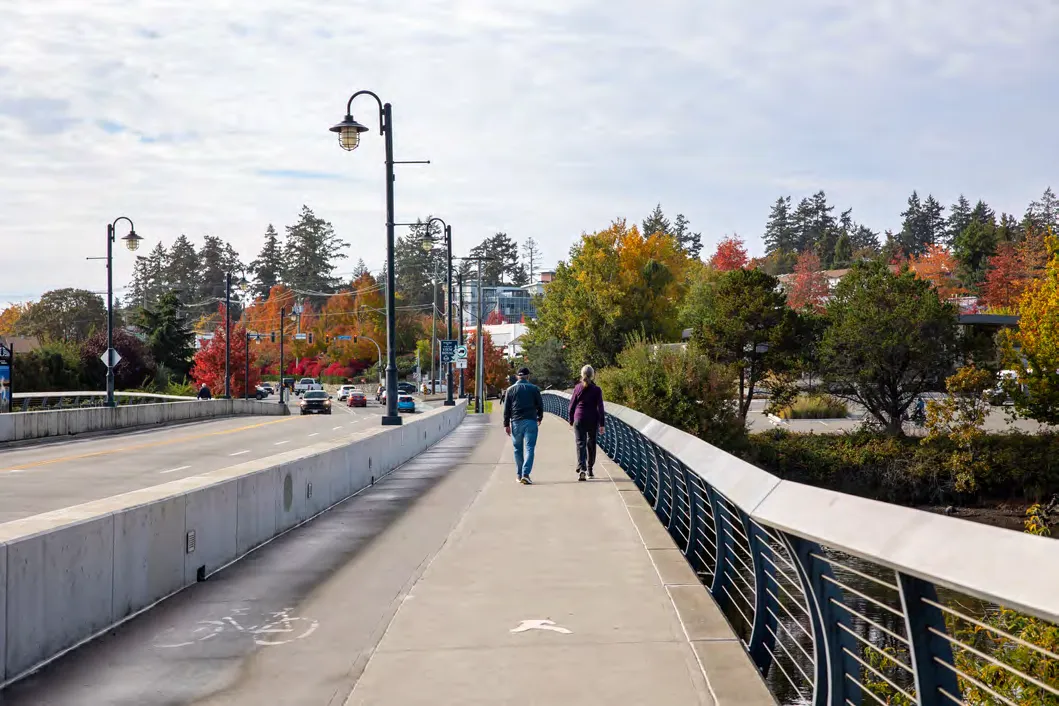
Map 8: Street Classification
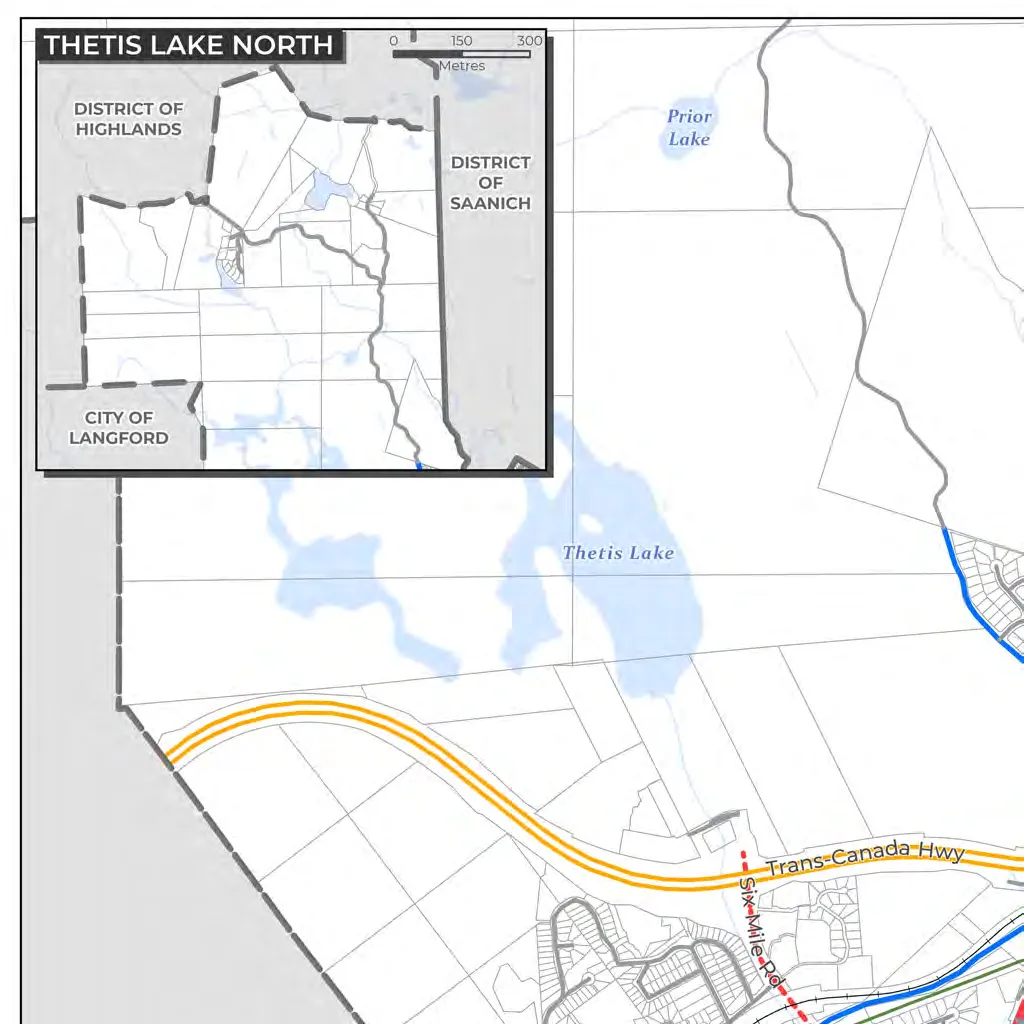
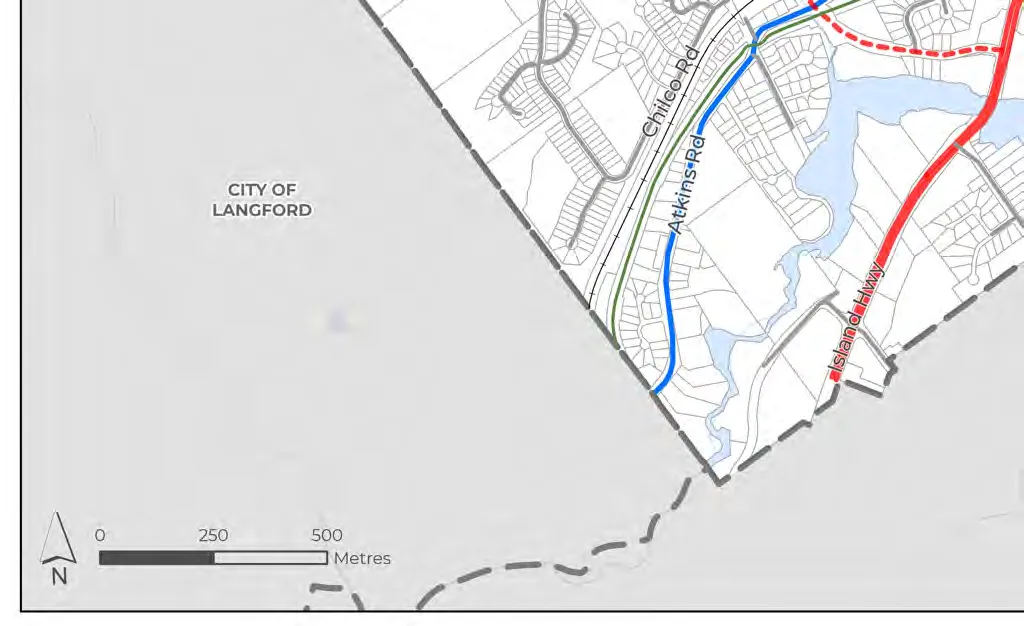
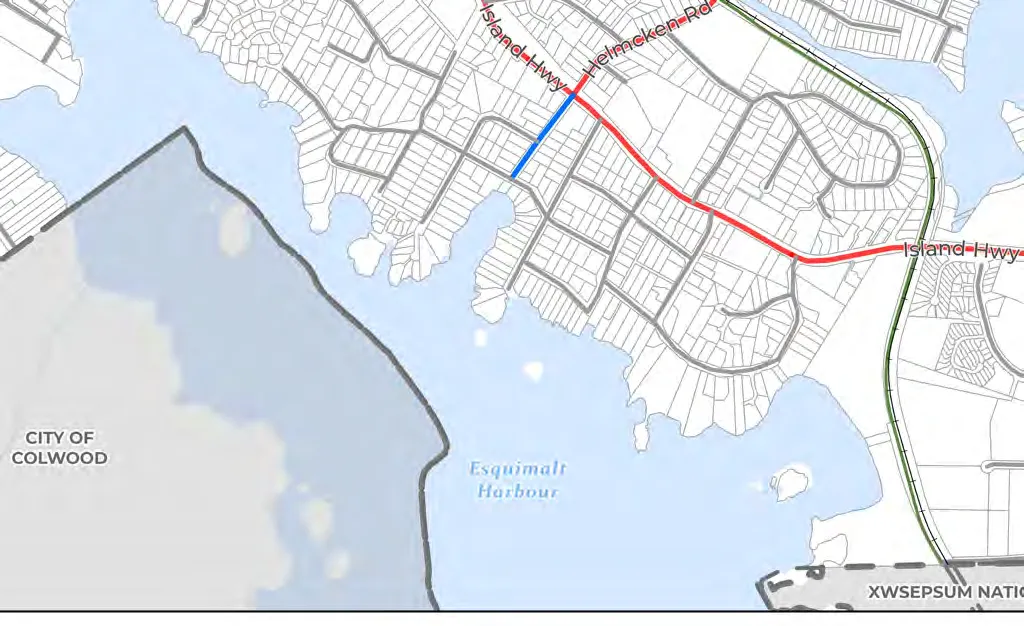
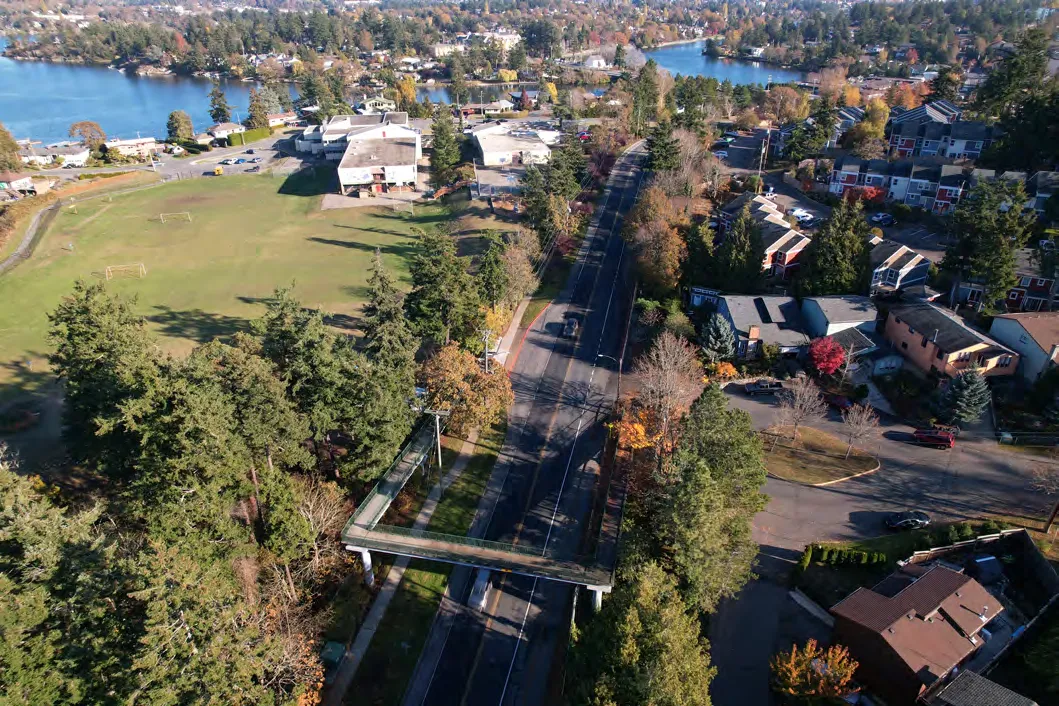
8.3.6 REGIONAL TRANSPORTATION PROJECTS A. Continue to collaborate with Xʷsepsəm and Songhees Nations, Island Corridor Foundation, Capital Regional District, municipal partners, and senior levels of government to establish a vision for the future use of the E&N corridor. B. Advocate and explore opportunities to support the Reconciliation Corridor Initiative for regional light rail transit through collaboration with Xʷsepsəm and Songhees Nations, the Island Corridor Foundation, Capital Regional District, the Province, and neighbouring municipalities. C. Support the Capital Regional District’s Regional Transportation Service and due consideration of key corridors and priorities in View Royal as part of the Regional Multi-modal Network.
C-54-26 THAT the E&N Rail Corridor continue to be recognized as a transportation corridor in the Official Community Plan; AND THAT the E&N Rail Corridor remain as a strategic priority. (Refer to policies 8.3.6(a) and (b))
8.3.7 PARKING + TRANSPORTATION DEMAND MANAGEMENT A. Seek to meet site transportation demand through appropriate on-site parking supply and transportation demand management measures that reduce reliance on private vehicles. B. Prioritize accessible parking and loading space requirements for residential, commercial, industrial, and institutional uses. C. Ensure that commercial and light industrial uses provide parking and loading spaces that support the functional needs of businesses. D. Optimize the use of the Town’s public curb spaces with consideration of different demands, including mobility, parking, commercial uses, public space, and waste collection, among others. E. Manage on-street parking to best serve public needs, considering local parking demand, surrounding land use, and the need to accommodate other curbside functions. F. Collaborate with major employers in View Royal, such as Victoria General Hospital and the Capital Regional District, to support sustainable transportation and mitigate traffic and parking impacts. G. Work with regional partners to implement electric vehicle charging infrastructure, informed by the Capital Region EV Infrastructure Road Map and Capital Region Public Electric Vehicle Charging Guide, to increase the supply of EV charging infrastructure in new development, public parking lots, and on-street, where appropriate.
- Transportation Demand Management comprises strategies that seek to improve the movement of people and goods, reduce dependence of the private car, and encourage travel via modes of alternate transport, such as transit, cycling, walking, rolling, and car share. Common desired outcomes of implementing transportation demand management strategies are reduced traffic congestion, lowered demand for parking, and cleaner air. Examples of transportation demand management strategies include shared mobility service programs such as e-scooter and e-bike rentals, transit subsidies, and car share programs, amongst others.*
C-59-26 THAT the Official Community Plan exclude policies to reduce off-street parking requirements, except where such reductions are required by provincial legislation.
9.0 Community Infrastructure and Services
9.1 CONTEXT
The Town owns and maintains infrastructure, such as sewers, bridges, and buildings, to provide environmental, recreational, transportation, and protection services. Certain services are provided through third-party service providers, such as road and drain maintenance, and curbside waste and organics collection, including lawn and garden waste drop-off services. View Royal’s potable water supply is provided by the Capital Regional District. Transportation, and parks, trails, and recreation are discussed in their own unique sections (Sections 8.0 and 13.0, respectively).
The Town seeks to provide infrastructure and services to meet the needs of the population and plan for the long-term sustainable delivery of these services that are impacted by both climate change and development on these systems as the community grows. Community members have expressed a desire to see infrastructure and assets provided and maintained in a manner that is both environmentally and fiscally responsible.
SEWER SYSTEM The Town’s sewer system, as shown on Map 9, comprises a number of pump stations that are electronically monitored. Some lands are located lower than the gravity sewer system, so grinder pumps are located on these properties. The pump stations all work together to pump sewage waste towards the Capital Regional District Sewer Trunk System, ultimately discharging into Craigflower Pump Station and subsequently to the Macaulay Point Pump Station in Esquimalt, both of which are operated and maintained by the Capital Regional District. The system provides services to lands located within the Town’s Urban Containment Boundary, leaving those located north of Thetis Lake to be serviced by on-site private septic systems.
STORMWATER SYSTEM The Town’s stormwater system, commonly referred to as ‘drainage’, as shown on Map 10, is largely comprised of manholes and drain mains, open ditches, and culverts that drain by gravity into Craigflower and Millstream Creeks or directly into Portage Inlet and Esquimalt Harbour.
WATER SYSTEM View Royal is connected to the regional water distribution system that is owned, operated, and maintained by the Capital Regional District, as part of the Juan de Fuca Water Distribution System. Buildings within the town are connected to a water metering system that measures water consumption. Areas located within the Town’s Urban Containment Boundary have sufficient water supply for both potable water and fire protection purposes, while those located north of Thetis Lake do not have community water service. Many properties in this area of View Royal rely on alternative water supply sources for this reason. Four water supply mains exist within the Town’s boundary, as shown on Map 11. These mains carry water from the Sooke Reservoir to the Town, and the jurisdictions located beyond.
SOLID WASTE Residential garbage and household organic waste excluding that from large multi-unit residential developments is collected on a weekly basis by a company contracted by the Town to provide this service. Waste classified as garbage is disposed of at the Hartland Landfill, operated and owned by the Capital Regional District. Organic waste is taken to a composting facility. Recycling is a regional service provided through the Capital Regional District’s Blue Box Recycling Program.
The following Official Community Plan Goals may be achieved through the objectives and policy direction provided in this section:
- Growth Management & Community Character Preservation
- Natural Amenities
- Climate Action and Resilience
- Regional Partnerships
- Sustainable Service Delivery through Asset Management
Map 9: Sewer Servicing System
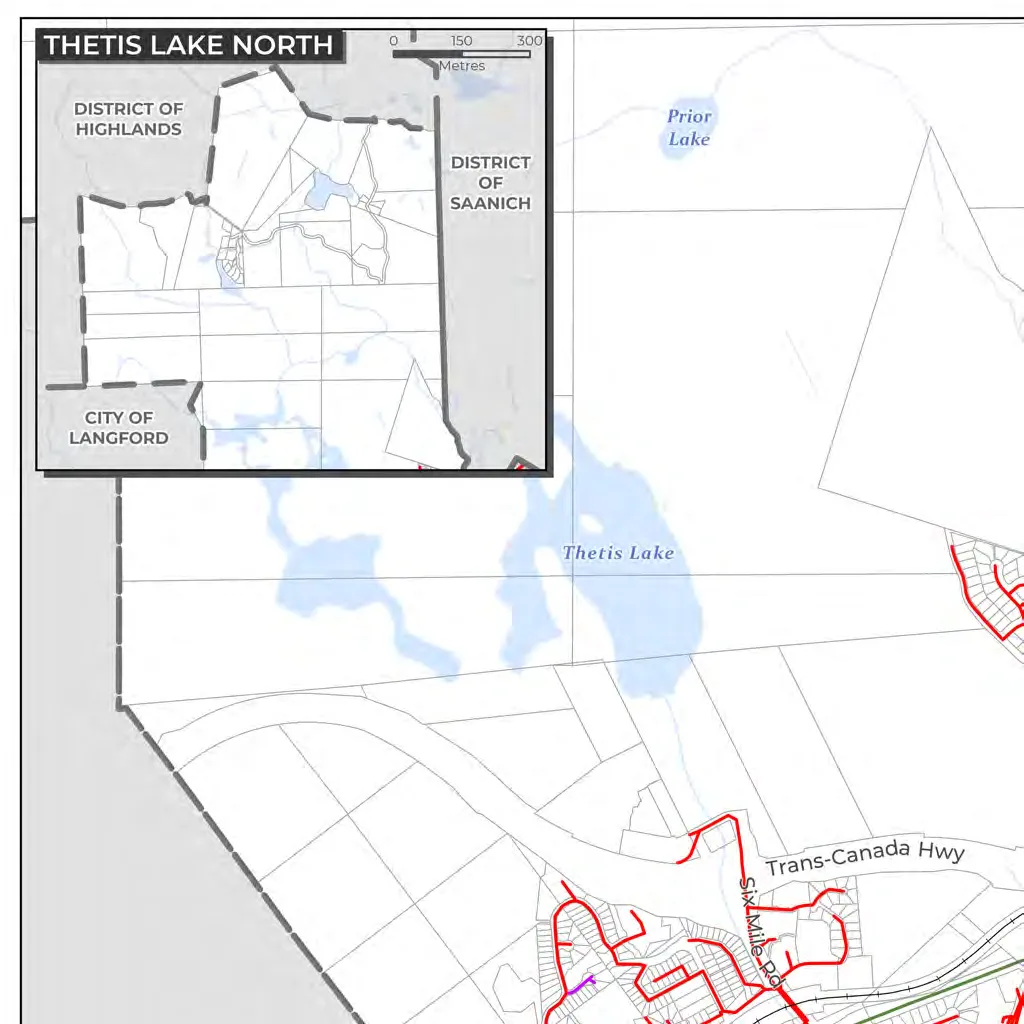
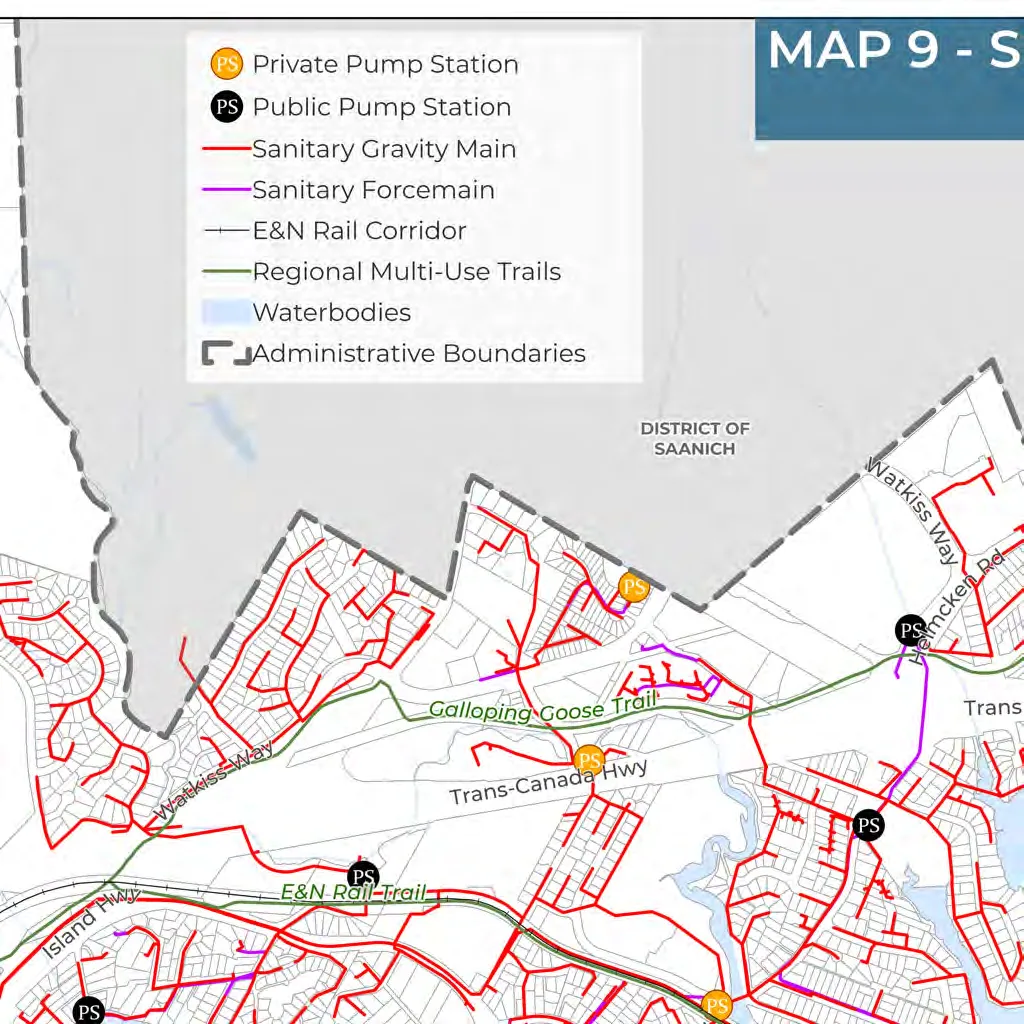
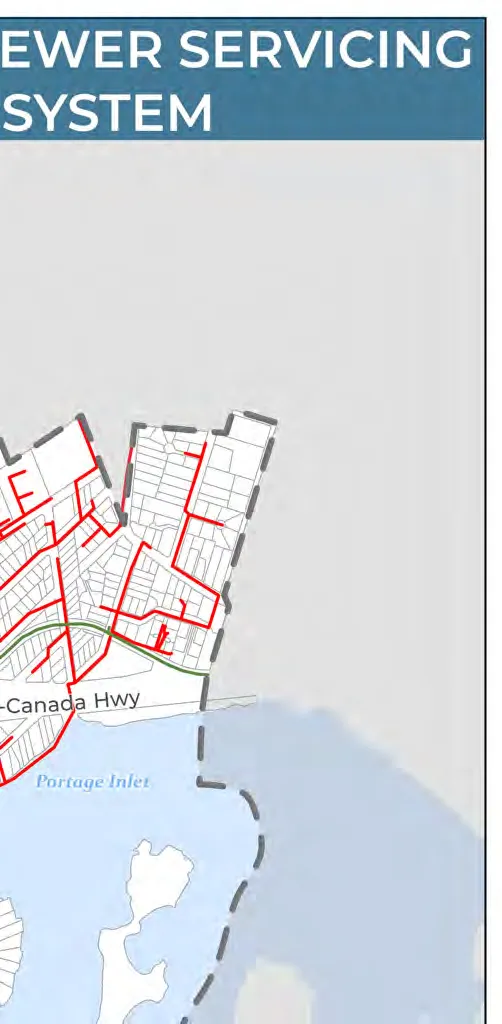
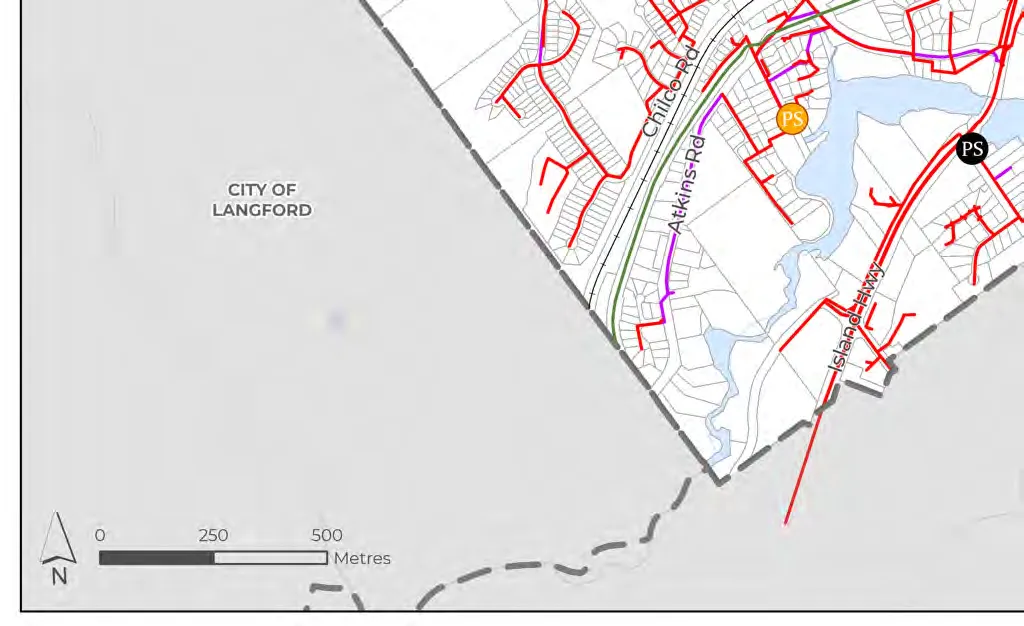
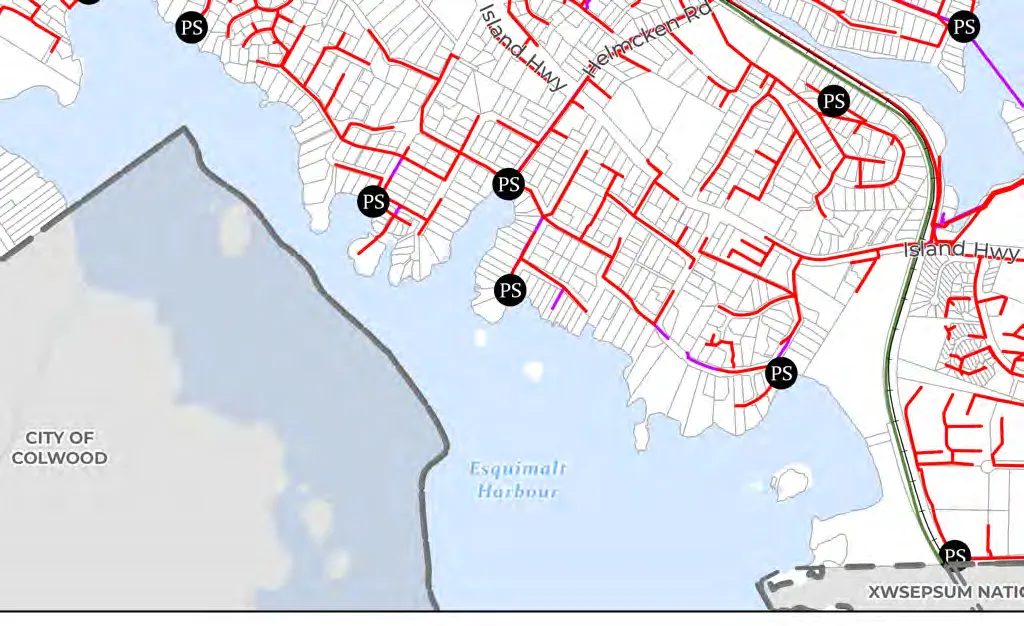
Map 10: Stormwater Servicing System
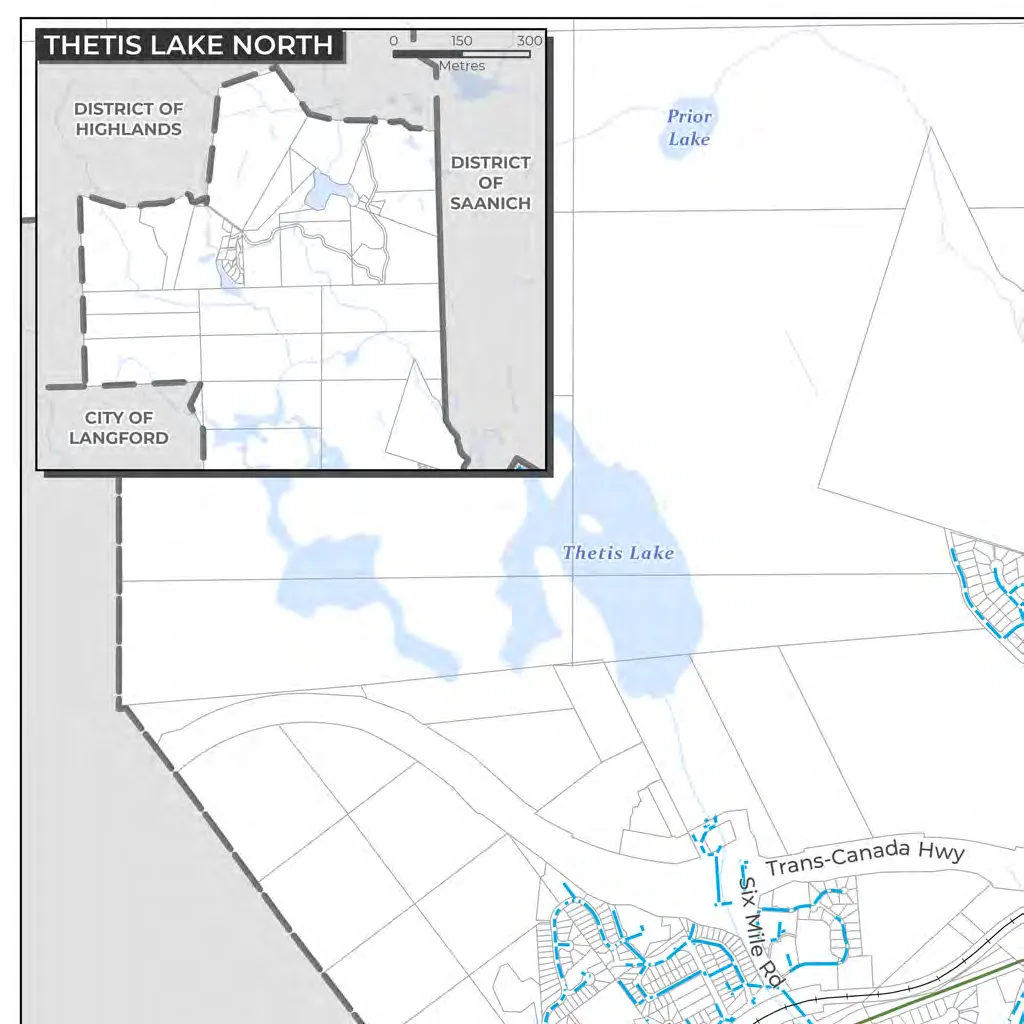
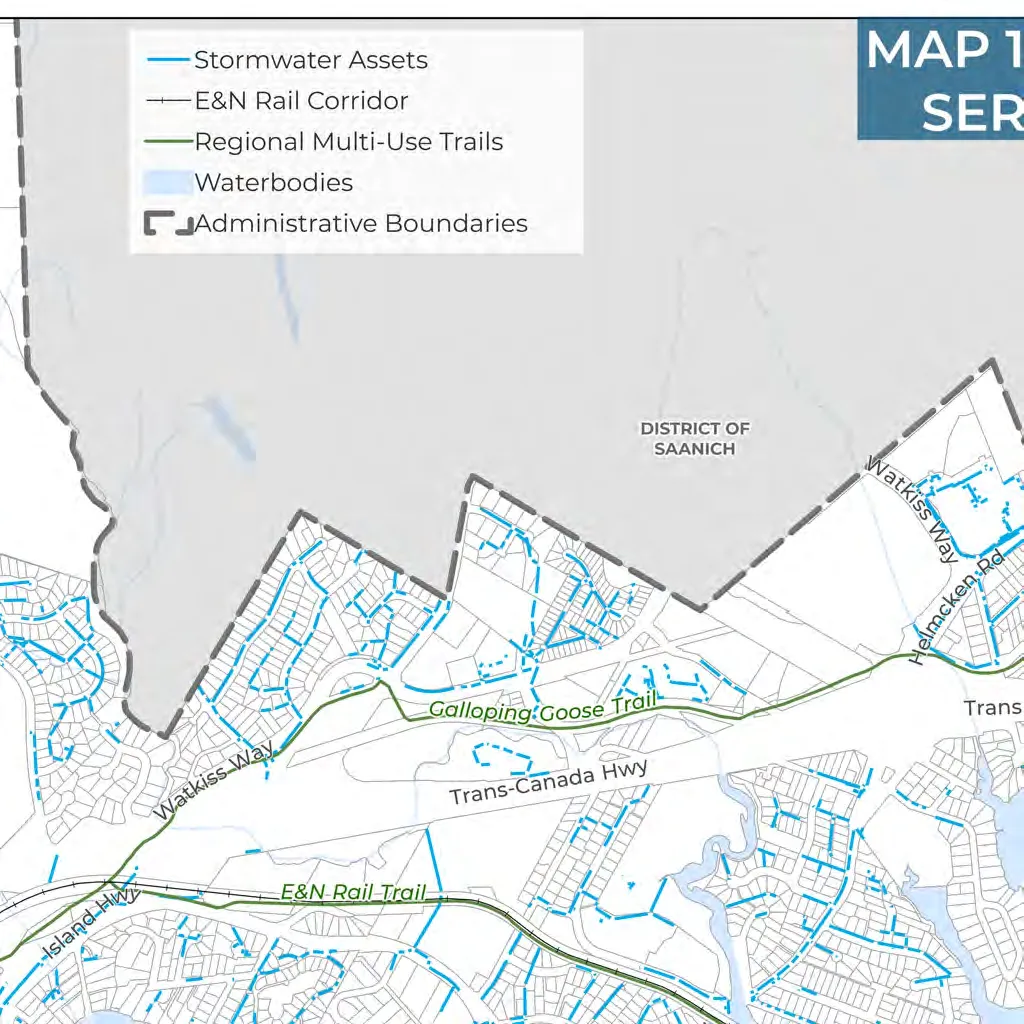
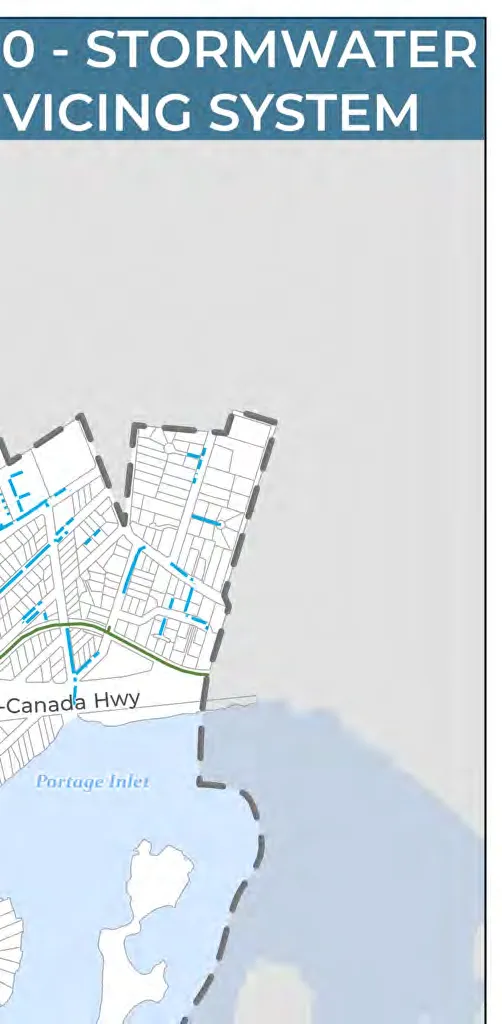
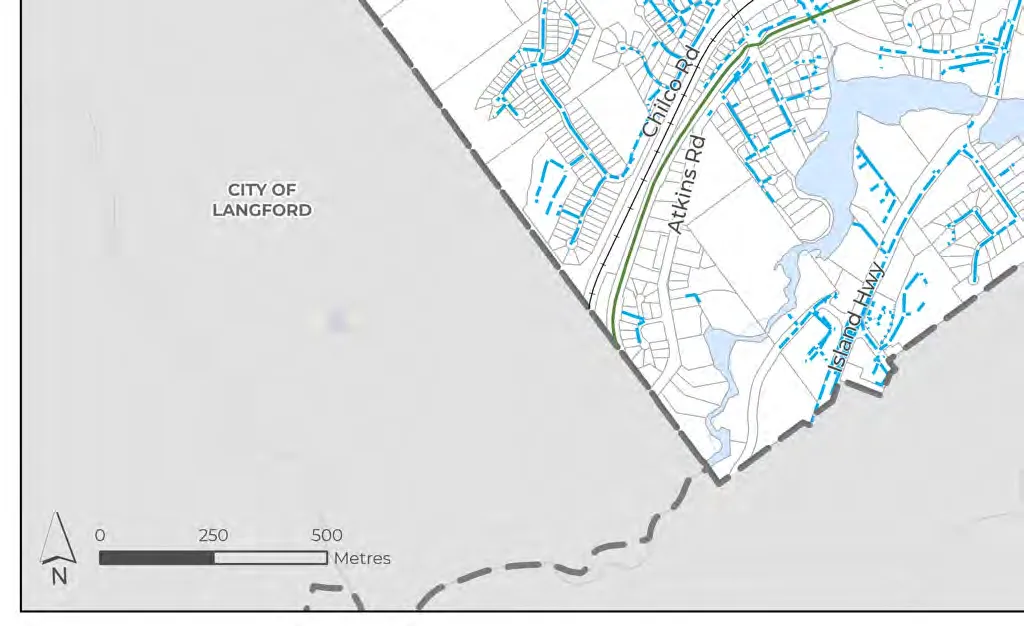
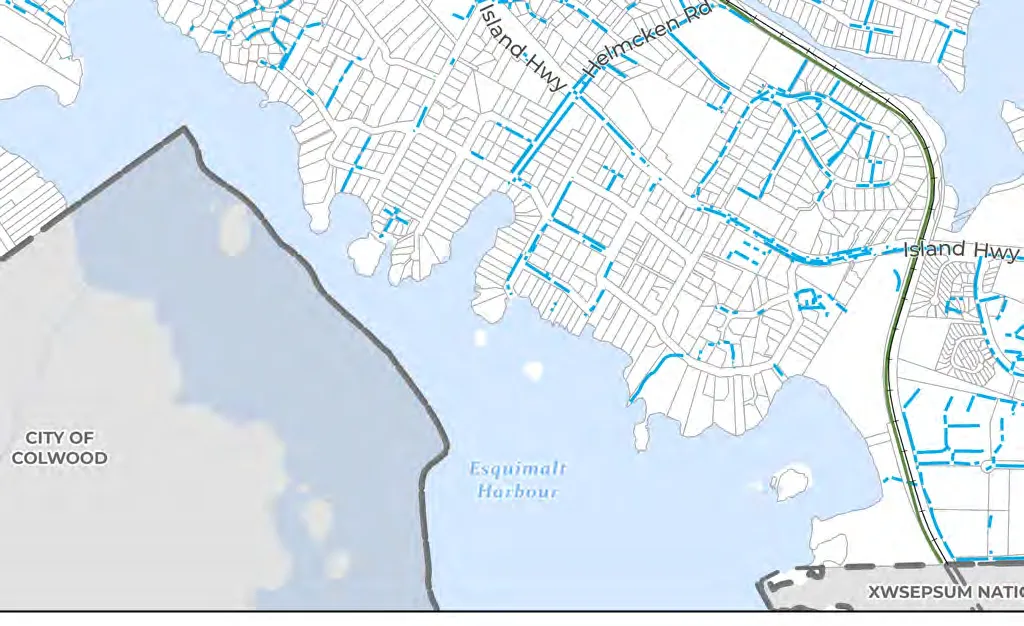
Map 11: Water Servicing System
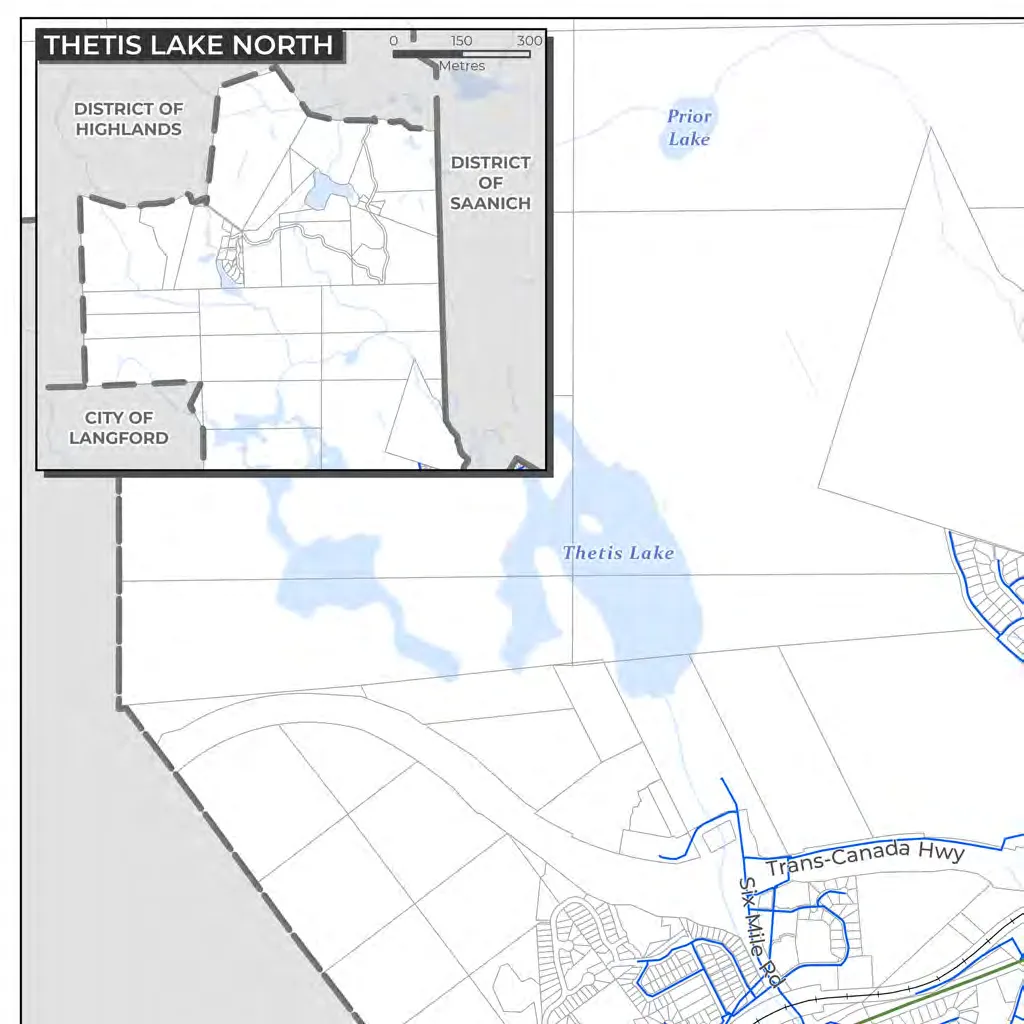
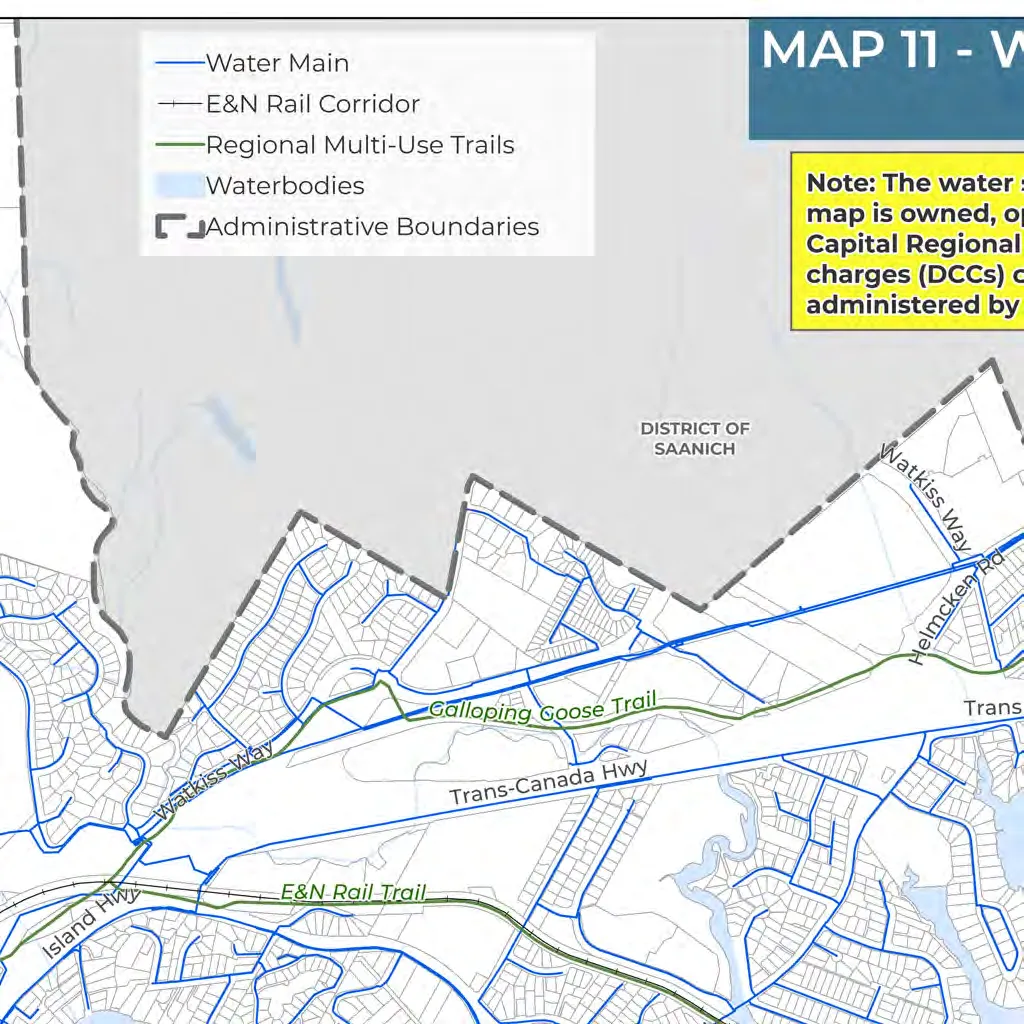
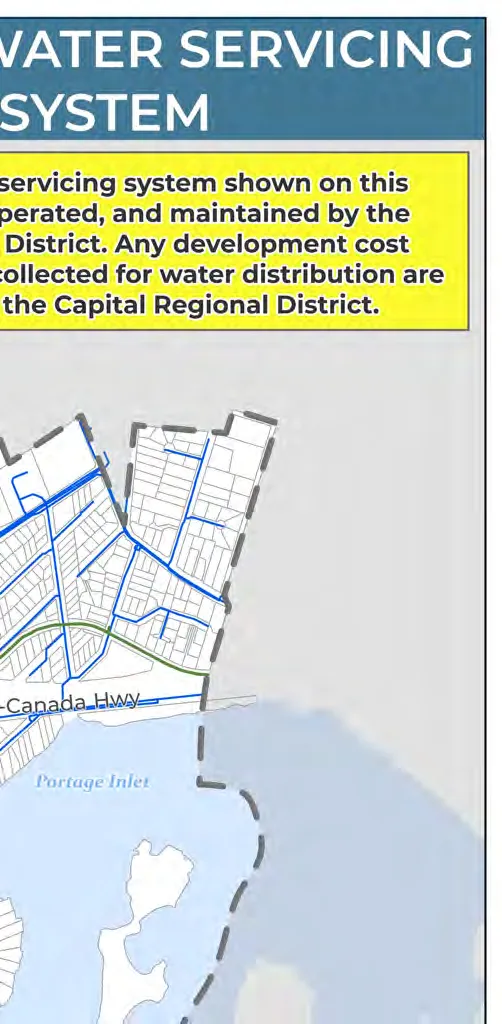
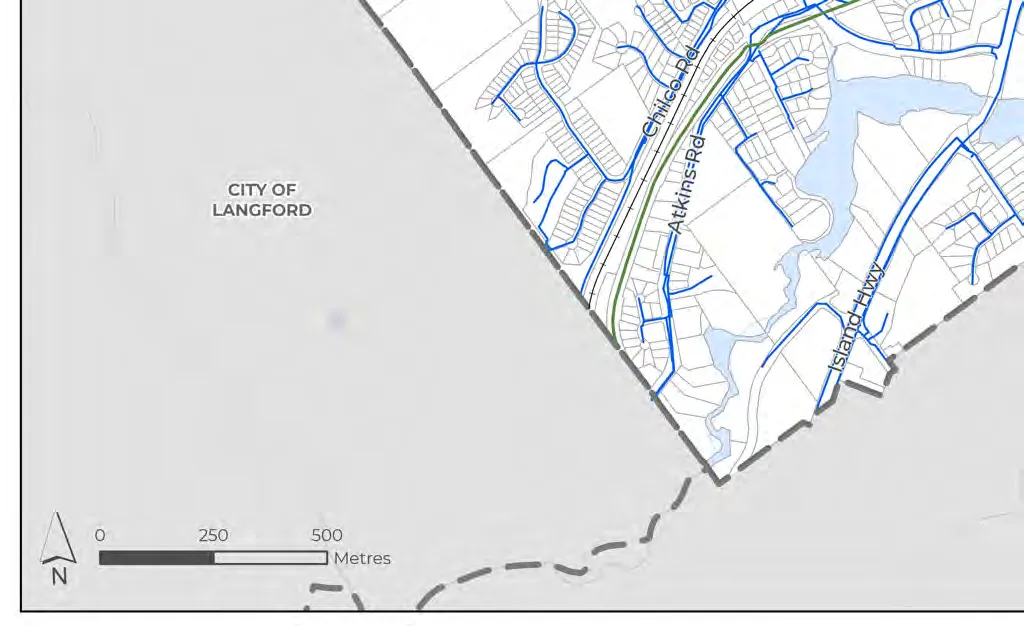
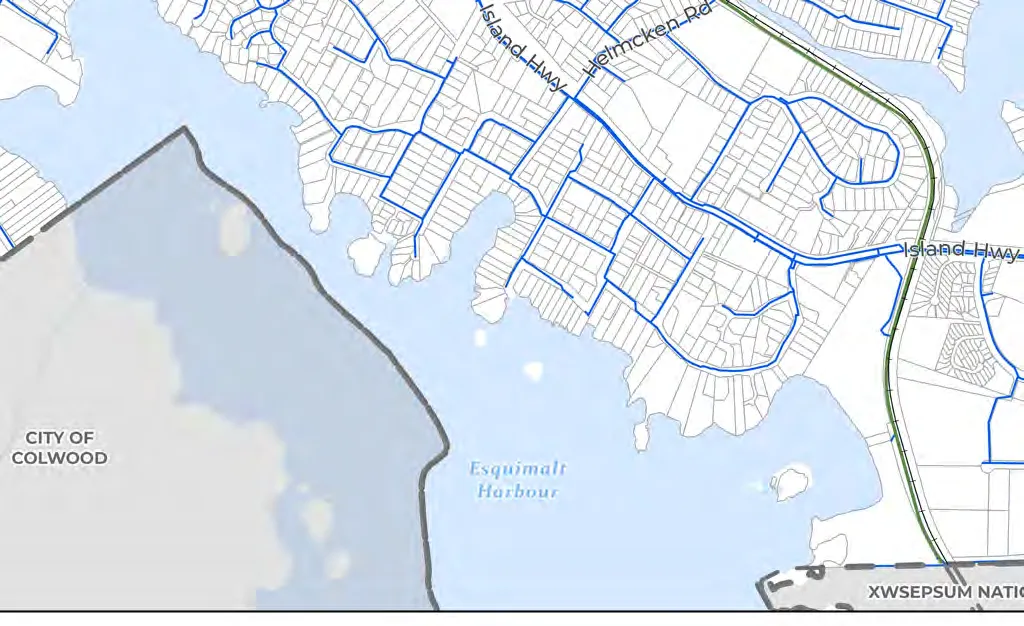
9.2 OBJECTIVES
9.2.1 SUSTAINABLE INFRASTRUCTURE Ensure that infrastructure investment and renewal decisions are guided by the Town’s Asset Management Policy and long-term financial plan. To maximize best value and service delivery of the Town's critical assets, align asset management programs, policies, and plan with the requisite funding and resources.
9.2.2 FISCAL RESPONSIBILITY AND DECISION MAKING Ensure that infrastructure and service delivery are planned and implemented in a fiscally responsible manner, and that reserves are funded so that investments are equitably funded by current and future generations.
9.2.3 SERVICE DELIVERY Continue to provide a sustainable level of service for critical infrastructure systems to align with community expectations.
9.2.4 INFRASTRUCTURE INVESTMENT, GROWTH, AND COORDINATION Continue to coordinate infrastructure investments, including maintenance, upgrades, renewals, and improvements to ensure sustainable service delivery, and consider alignment with existing and future land use and growth considerations.
9.2.5 NATURAL ENVIRONMENT Consider the preservation of the natural environment’s integrity and the protection of human health in infrastructure and service delivery when making decisions. Growth should be balanced with the capacity of natural systems.
9.2.6 CLIMATE CHANGE IMPACTS Consider ongoing studies and review of climate projections in the design, upgrade, operations, and maintenance of new and existing infrastructure to make informed decisions on the optimal method of service delivery.
C-65-26 THAT the bullet under “Objectives” in “Community Infrastructure and Services” in the Official Community Plan be amended to read: “Guide infrastructure investments using asset management programs that maximize the value and lifespan of public and natural assets. (Addressed in objectives 9.2.1, 9.2.2, and 9.2.4)
9.3 POLICIES
9.3.1 GROWTH MANAGEMENT AND DEVELOPMENT A. Plan new and upgraded infrastructure and services to support compact and sustainable development, and prioritize investments that support existing and new housing, employment, and civic uses. B. Ensure that development will only occur if appropriate infrastructure systems (water, wastewater, and sewer) with sufficient capacity are in place or provided as part of a development. Infrastructure upgrades should be planned for and installed through municipal finance initiatives. C. Ensure that extension of infrastructure services in areas outside the Urban Containment Boundary or for developments that do not conform with the policies of this plan will not be supported. D. Plan new infrastructure in conjunction with roads, community facilities, parks, and other public spaces. Planning considerations should include: i) Stormwater management ii) Watershed systems and functions iii) Inflow and infiltration reduction iv) Opportunities to integrate parks, greenways, natural systems, and tree canopy improvements v) Transportation safety, pedestrian, cyclist, and transit connections. E. Exercise the Town’s legislative authority to obtain road dedications for sustainable transportation infrastructure as a condition of a building permit.
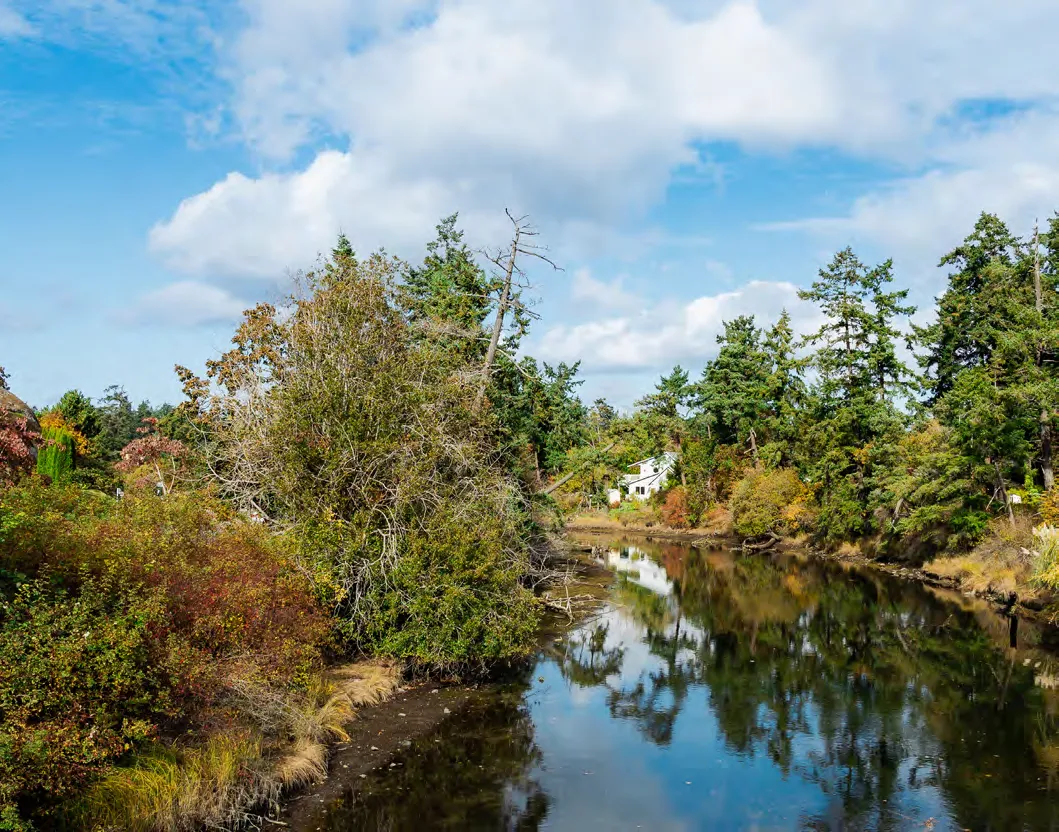
9.3.2 INFRASTRUCTURE INVESTMENT A. Use the Town’s master plans and Asset Management Strategy as guides to identify future infrastructure priorities and upgrades, and understand required reserve contributions for long term service demand and delivery. B. Prioritize infrastructure and services investments that best address local needs and maximize community benefits. C. Ensure that the cost of infrastructure investments is borne by those that benefit the most from the provision of the service; with the cost of new or upgraded systems being funded by the developments that trigger them or benefitting property owners.
9.3.3 INFRASTRUCTURE STANDARDS A. Ensure infrastructure is designed in a manner that aligns with the community’s goals and desired levels of service, as well as adheres to the Town’s engineering specifications including the latest Master Municipal Construction Documents so that all infrastructure in View Royal is being constructed to a standard that aligns with best engineering practices. B. Aim to advance green infrastructure (e.g. natural assets, enhanced assets, and engineered assets) practices. C. Consider the full life cycle of infrastructure services, including operations, maintenance and service levels, when designing new systems and upgrades. D. Facilitate adequate operation and maintenance programs to maximize the life of infrastructure systems, reduce the frequency of replacement, ensure proper functionality, and reduce the risk of critical failures. E. Continue to explore strategies and solutions to understand and reduce the inflow and infiltration of stormwater into the sanitary sewer system.
- Green infrastructure refers to natural and semi-natural engineered systems that support with managing drainage. Examples include green roofs, permeable pavements, and rain gardens, amongst others.*
9.3.4 INFRASTRUCTURE FOR A HEALTHY ENVIRONMENT A. When considering infrastructure renewal priorities, considerations will be given to upgrades to infrastructure and services that will enhance resiliency to the risks and impacts of climate change and disasters. B. Continue to incorporate climate change factors into the Subdivision and Development Servicing Bylaw to ensure that both onsite and offsite infrastructure considers the effects of climate change. C. Continue to explore opportunities to establish a natural asset inventory while supporting the protection, maintenance, and enhancement of existing natural assets and amenities. D. Work with adjacent jurisdictions in the Capital Regional District and other organizations to advance efforts in watershed management and drinking water protection that align with the Drinking Water Protection Act and Regulation. E. Support stormwater management practices that emphasize infiltration and detention, where possible, to minimize the negative effects (e.g. erosion, sediments, and contaminants) of stormwater discharge into Portage Inlet, Gorge Waterway, Esquimalt Harbour, Craigflower Creek, Hospital Creek, Millstream Creek and other natural watercourses and water bodies. F. Consider stricter source control measures and potential upgrades to reduce runoff from private property to mitigate downstream drainage impacts. G. Continue to prioritize sewer infrastructure upgrades and inflow and infiltration reduction to reduce overall sewer flows in the system, mitigating the risk of liquid waste overflowing into the natural environment. H. Investigate opportunities to mitigate downstream drainage impacts, in alignment with regional and provincial standards, and the level of service expected of the public. Opportunities could include rainwater collection, greywater reuse (such as using treated water for irrigation), and dual piping systems.
9.3.5 SOLID WASTE MANAGEMENT A. Continue to work with the Capital Regional District and the private sector to maintain three-stream waste separation systems (garbage, recycling, composting) as a means of reducing the amount of solid waste sent to the landfill. Ensure that all collection programs are convenient and well-promoted to increase participation at the unit level, building level, in businesses and public institutions. B. Support small-scale composting on appropriate residential properties and in community gardens. C. Support regional initiatives to reduce construction waste and encourage sustainable waste reduction. D. Consider opportunities to collaborate with the Capital Regional District and waste collection service providers to improve waste and organics collection for multi-unit residential developments with more than four dwelling units.
10.0 Economic Development
10.1 CONTEXT
A strong and diverse local economy is essential to View Royal’s long-term resilience. New and existing businesses provide employment opportunities to residents of both the Town and the broader region. These businesses also provide the community with key services that are necessary for everyday life. The Town is aiming to collaborate with Destination Greater Victoria, West Shore Chamber of Commerce, Xʷsepsəm and Songhees Nations, local businesses, recreation providers, and the broader community to understand what is possible for the local economy and to leverage View Royal’s full economic potential.
View Royal has significant potential to become a regional economic hub – it has many existing conditions and assets that contribute to a strong local economy, and that can be leveraged further to grow the economic standing of the Town. This includes its central location within the Capital Regional District and prime access to major transportation routes such as the Trans-Canada Highway, the regional Island Highway, the Galloping Goose Regional Trail, and the E & N Rail Trail, as well as high-quality local parks and proximity to significant regional parks like Thetis Lake. In addition, View Royal is home to Victoria General Hospital, which has plans for future growth and expansion, as expressed by Island Health. Further, the lands surrounding the hospital have been designated by the Province as a transit-oriented area that will support the greatest density in the community and future increased levels of transit service. Such conditions may support growth in both the tourism and health services sectors, amongst others, resulting in strong demand for commercial tourist accommodations.
Part Two - Land Use aims to establish further conditions that will support new and existing businesses in View Royal by supporting higher density forms of development in areas that are close to existing or planned transit services and active transportation infrastructure. Concentrating populations will allow for a stronger client base for new and existing businesses, leading to greater economic vitality, and in turn, provide residents with access to the services they need within close proximity to their home.
The objectives and policies in this section aim to support economic development in View Royal by attracting new investment in the community and supporting existing businesses.
The following Official Community Plan Goals may be achieved through the objectives and policy direction provided in this section:
- Economic Development
- Regional Partnerships
10.2 OBJECTIVES
10.2.1 LOCAL INVESTMENT AND ECONOMIC GROWTH Continue to create conditions that attract local investment and economic growth in the Town, particularly within the Town’s higher density land use designations, as discussed in Section 5.0 and shown on Map 1, including the Hospital Transit-Oriented Area, Neighbourhood Village, and Western Gateway Employment District Corridor.
10.2.2 CREATING A DESTINATION COMMUNITY Support development and local investments that make View Royal more than a drive-through community, but a destination that provides unique and interesting local and regional tourist destinations for visitors.
10.2.3 CAPITALIZE ON REGIONAL CONNECTIONS Explore, identify, and capitalize on opportunities that strengthen the community’s central location as a gateway to the West Shore and the Greater Victoria area, to attract and support entrepreneurs, the health sector, new businesses, and arts and culture.
10.2.4 SUPPORT FOR LOCAL BUSINESS Understand and support the changing needs of local businesses to create a supportive and economically viable market to thrive in the long-term. Consider the needs of traditional fixed businesses and flexible business models, such as farmers, artisans, and mobile vendors.
10.2.5 INVEST IN COMMUNITY HEALTH AND WELL-BEING Recognize and explore the complex relationship between community health and well-being, and the local economy. Consider opportunities to expand the health industry and increase access to local health services and locally grown food sources.
10.2.6 RECREATIONAL TOURISM Consider opportunities to support recreational tourism and economic development that capitalize on the Town’s parks and trails and proximity to regional recreational amenities. Focus on attracting hotel development in the Town to support leisure and business travel.
10.2.7 PARTNERSHIPS Create strong, dynamic partnerships with Xʷsepsəm and Songhees Nations, the business community and related organizations, educational institutions, BC Transit, and regional and provincial governments to drive economic development, foster innovation, and attract transformative investment opportunities to establish View Royal as a thriving economic hub.
10.3 POLICIES
10.3.1 STRENGTHENING THE LOCAL ECONOMY A. Engage Xʷsepsəm and Songhees Nations, South Island Prosperity Partnership, Capital Regional District, neighbouring municipalities, the local business community, and related stakeholders to identify the economic vision for View Royal and the broader community as an important regional player. B. Explore economic development partnerships with Xʷsepsəm and Songhees Nations that further advance sustainable initiatives and economic prosperity, remove barriers, and are mutually beneficial. C. Continue to collaborate with Destination Greater Victoria to attract hotel and business investment, leverage the Town’s existing assets, and support and market View Royal as a tourist destination within the region. D. Collaborate with the West Shore Chamber of Commerce to identify opportunities to better support new and existing businesses, and expand economic development opportunities within the Town.
C-83-26 THAT staff explore and pursue collaboration with Destination Greater Victoria to support and enhance tourism initiatives. (Added policy 10.3.1(c))
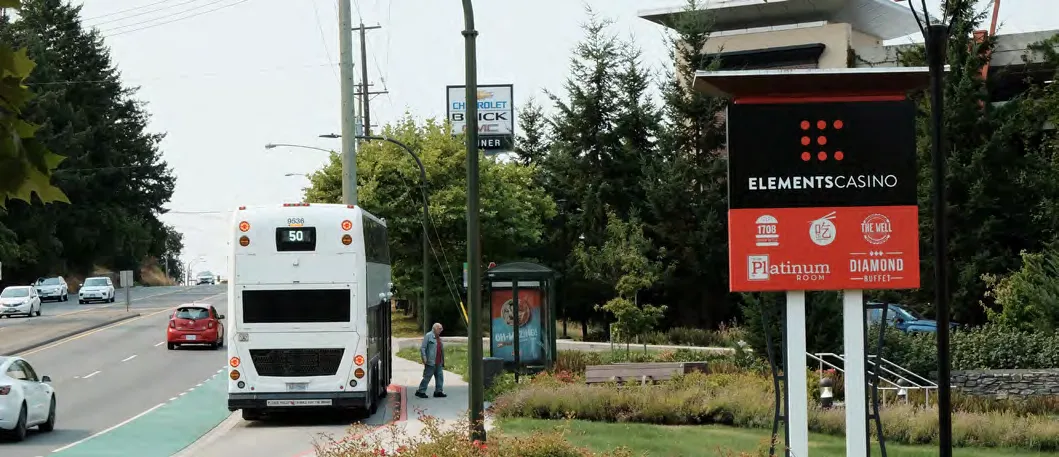
E. Identify opportunities for economic innovation, attracting and retaining new business, and stimulating new investment to advance the Town’s commitment to creating a more diverse, equitable, and inclusive community. F. Leverage View Royal’s existing community assets and destinations, including Portage Park, Thetis Lake Regional Park, the Galloping Goose and E & N trails, Victoria General Hospital and medical services, as well as the Town’s regional location along the Trans-Canada Highway, its proximity to the West Shore, and regional destinations such as Royal Roads University, to generate new economic and tourism opportunities for View Royal and the broader region. G. Explore opportunities for expanding the health services industry throughout View Royal, but particularly in the area surrounding Victoria General Hospital, to create a medical services hub through the provision of medical offices, pharmacies, research labs, and related services. H. Continue to liaise with the local business community to understand how the Town can better support local businesses, and strategically respond to emerging business sectors in the region. I. Identify opportunities to streamline processing times for business licenses, particularly for small or locally owned businesses. J. Concentrate growth and economic investment along the Town’s corridors as shown on Map 3, while leveraging transportation infrastructure improvements to drive job and housing creation, and improve accessibility. K. Understand the economic and land use conditions necessary to support the viability of light industry and similar employment uses on lands designated as Western Gateway Employment District Corridor, as shown on Map 1, to identify what action the Town can take to facilitate these conditions, given the benefits that light industry will generate for the local economy, such as a diversified tax base and living wages for residents. L. Explore opportunities and partnerships to attract hotel development and other accommodation uses to View Royal. M. Explore incentives to attract hotel development, including but not limited to, density bonusing, parking reductions, streamlined application processes, and flexible zoning to allow for a variety of uses to support hotel development to service both the healthcare sector and broader visitor market. N. Support neighbourhood-compatible home-based businesses in areas where residential use is permitted to promote the continued provision of alternative employment options, reduced commutes, and more local services. O. Support home-based businesses in rural areas that fit with the character of the neighbourhood. P. Explore ways to better support high-tech uses in View Royal.
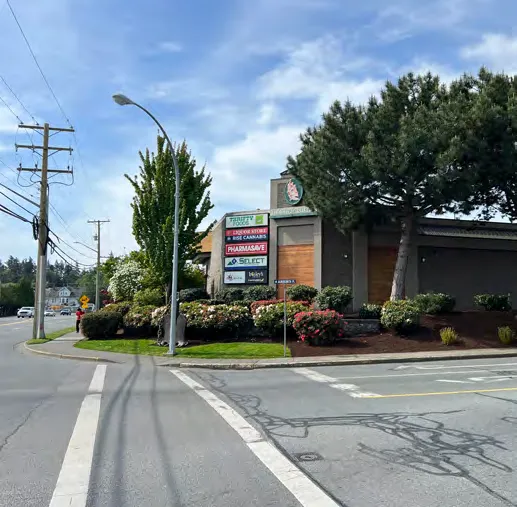
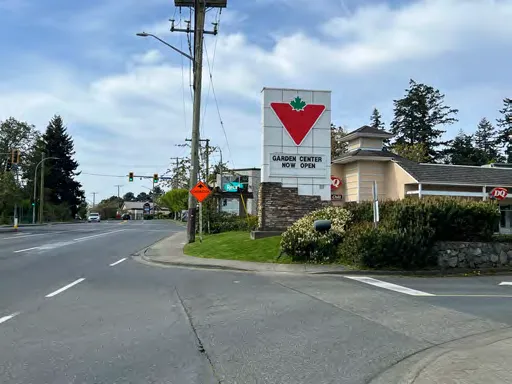
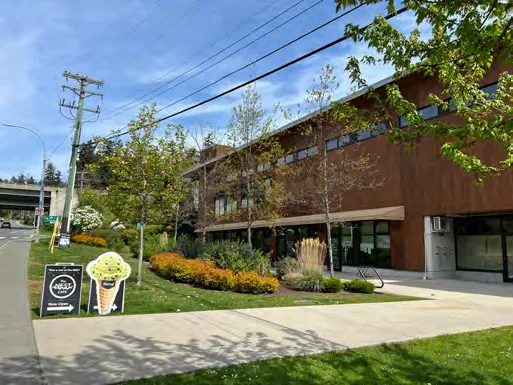
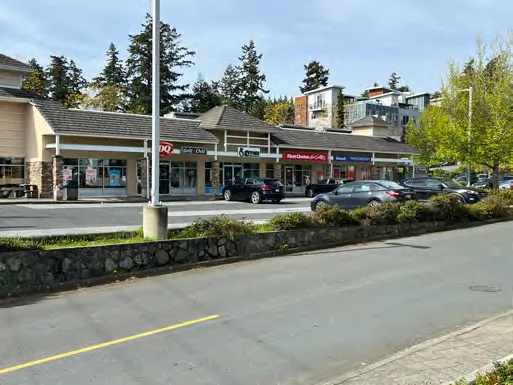
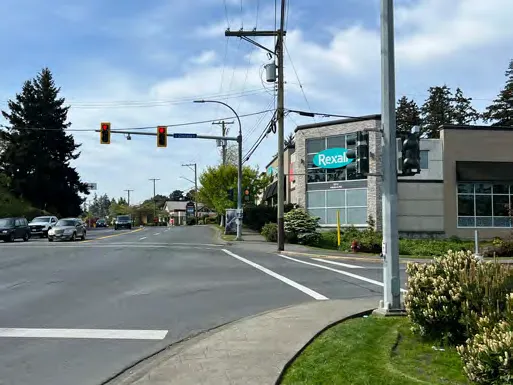
11.0 Natural Environment and Hazards
11.1 CONTEXT
The natural environment is interconnected with how View Royal approaches growth, its character and identity, and its long-term stewardship and sustainability objectives. Maintaining, restoring, and expanding healthy ecosystems provides important ecosystem services, including clean air, shade for cooling, natural drainage systems, and erosion mitigation, alongside opportunities for people to connect with nature.
View Royal comprises a diverse array of marine, freshwater, and terrestrial ecosystems and habitats, as shown on Map 12 Environmentally Sensitive Areas. Marine ecosystems comprise Esquimalt Harbour and Portage Inlet, including their coastal shorelines. Freshwater ecosystems merge with the salt waters of these two water bodies in the estuaries of Craigflower, Hospital, and Millstream Creeks. Thetis, Prior, Pike, and McKenzie Lakes all comprise freshwater ecosystems that include foreshore and riparian areas. Terrestrial ecosystems exist throughout the town, though are particularly prevalent in Thetis Lake and Mill Hill Regional Parks, in the form of mature Coastal Douglas Fir forests along with rocky outcrops and Garry Oak meadows. These natural spaces provide important habitat for wildlife and species at risk, as shown on Map 13.
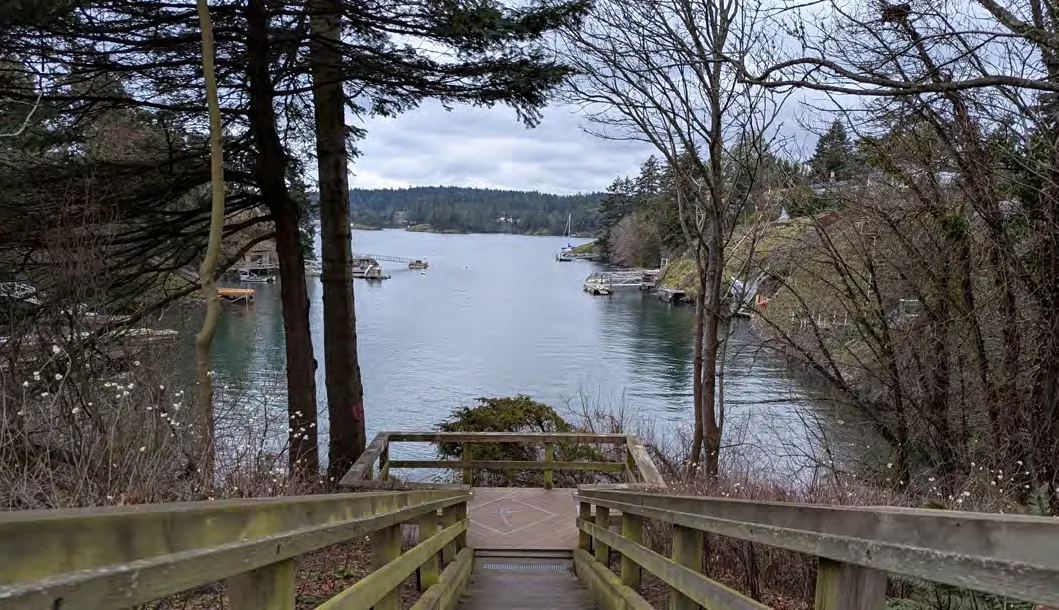
In addition to providing habitat for many species, the natural environment also poses some natural hazards such as flooding, tsunamis, steep slopes exceeding 30%, as shown on Map 14, and wildfires. These hazards all pose risks to public safety and potential impacts to the built environment. Construction activities occurring within any zones where the risk to public safety is deemed high because of a natural hazard are subject to the Development Permit Area Guidelines included in Part 6 of this Official Community Plan. This includes restrictions to development in areas where slopes are equal to or greater than 30%, as shown on Map 14, and where flooding or slope instability may occur. This section discusses considerations and strategies for emergency response to events occurring as a result of such natural hazards, plus wildfires and earthquakes.
Access to the natural environment is a key priority for the View Royal community. Overall health and well-being may be correlated with the level of access that community members have to the natural environment, whether that be through public green space or on privately-owned lands. This section aims to work in tandem with Sections 13 and 14 of the Official Community Plan to recognize that protection of the natural environment as places for people to recreate, both passively and actively, will positively impact the physical and mental health of residents. Many natural features and habitats shown on Maps 12 and 13 are designated as parkland as shown on Map 15. The reduction of greenhouse gas emissions, expanded upon in Section 12, and other air pollutants are also essential to maintaining a healthy environment in View Royal and advancing community-wide sustainability for years to come.
It is important to note the key role that trees play in protecting the natural environment, mitigating the impacts of climate change, and improving overall community health and well-being. Many studies discuss the benefits that trees can provide for both physical and mental health, in terms of their ability to provide shade, clean air, and a connection to the natural environment. Areas of high tree canopy coverage may also act as corridors connecting wildlife habitat areas. The Town’s Urban Forest Strategy, endorsed by Council in 2026, aims to recognize the importance of trees in View Royal through establishing a tree canopy coverage goal of 30%. This section aims to further support the vision of the strategy and recognize the role of the urban forest in protecting the natural environment.
The following objectives and policies outline how View Royal can strengthen the long term resilience of the Town’s natural environment and reduce community risk from natural hazards. Together, they support protection from flooding, tsunamis, landslides, wildfires, and earthquakes, while safeguarding environmentally sensitive areas, urban forests, and aquatic environments from potential impacts of development.
- Environmentally sensitive areas are ecosystems and/or habitats that provide high value to the natural environment through their ability to support biodiversity, animal and plant species, and natural systems such as purifying the air and water. View Royal has a number of sensitive and significant terrestrial, aquatic, and riparian ecosystems that provide habitat for many species. Examples include:
- Terrestrial ecosystems: old growth and mature forests such as those found in Thetis Lake and Mill Hill Regional Parks
- Aquatic ecosystems: saltwater habitats provided in large waterbodies and their shorelines such as the Portage Inlet
- Riparian ecosystems: freshwater streams and lakes that have the potential to support fish habitat, such as Craigflower Creek and Thetis Lake*
The following Official Community Plan Goals may be achieved through the objectives and policy direction provided in this section:
- Natural Amenities
- Community Well-Being
- Community Safety & Security
- Climate Action and Resilience
- Reconciliation
- Regional Partnerships
- Sustainable Service Delivery and Asset Management
Map 12: Environmentally Sensitive Areas
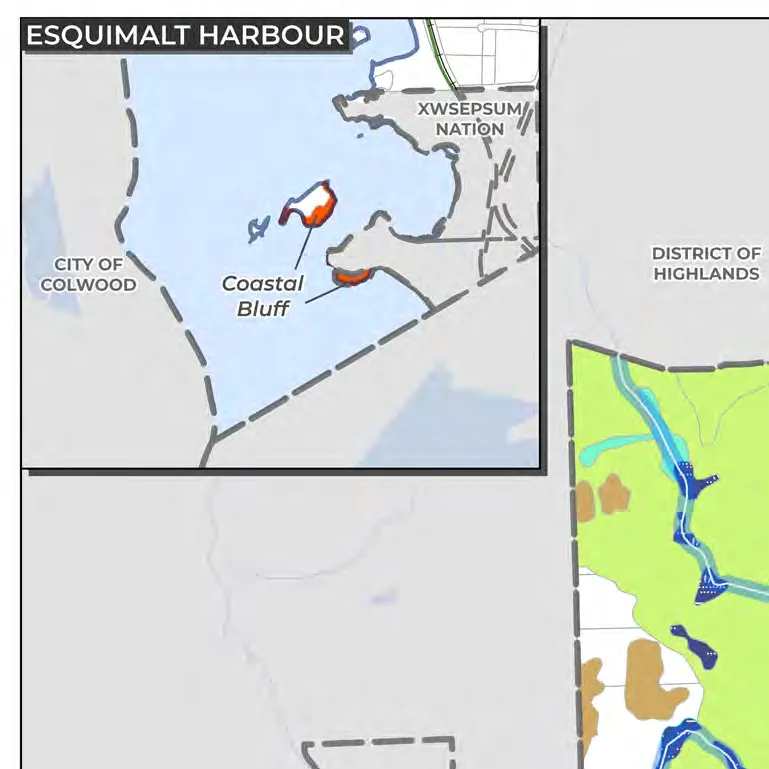
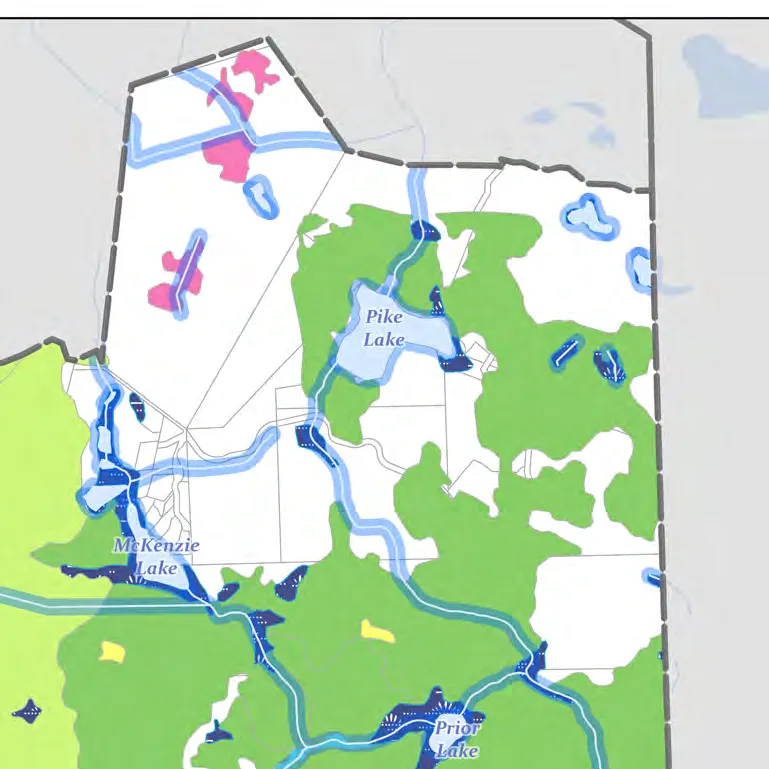
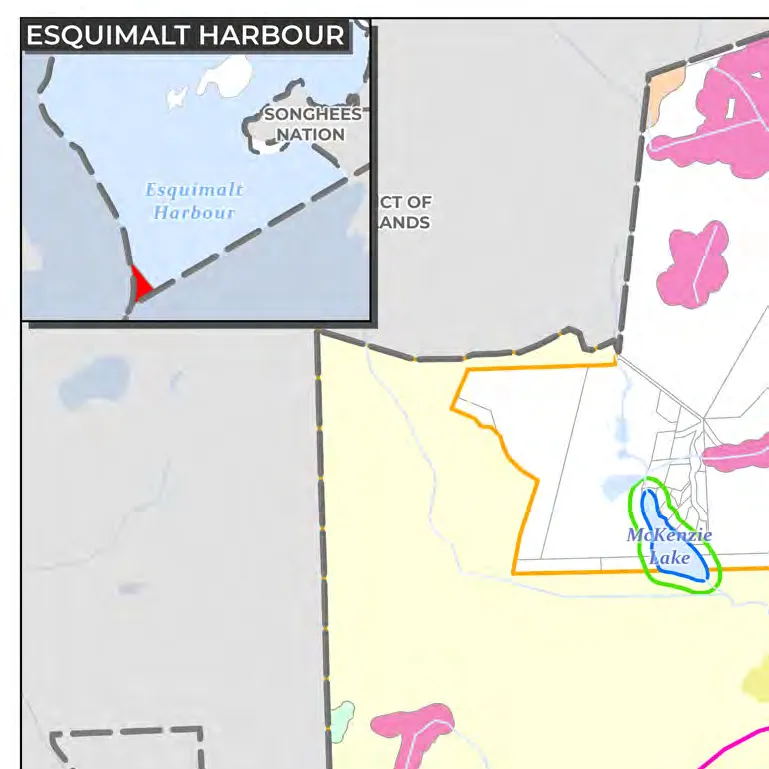
Map 13: Species at Risk
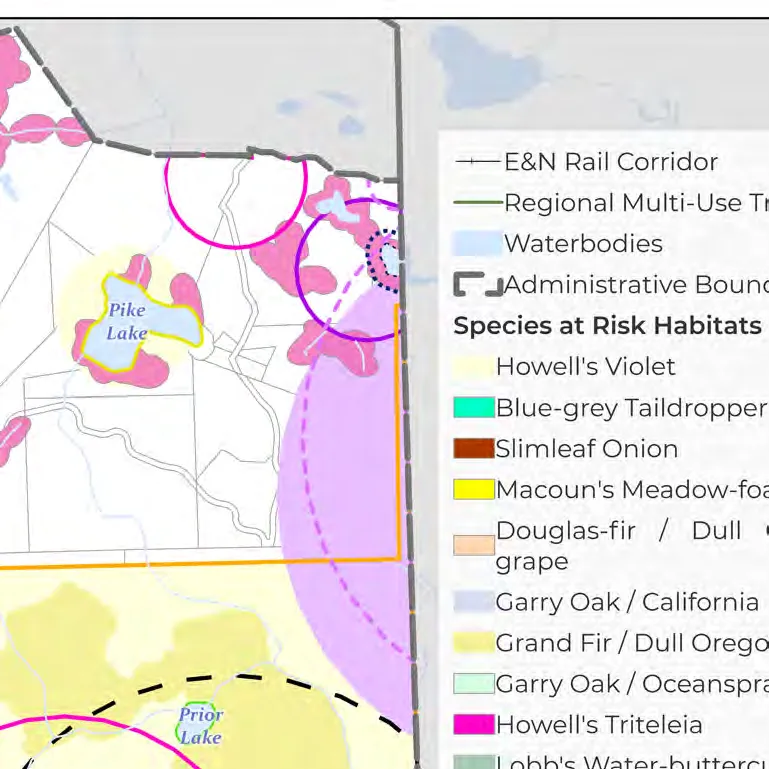
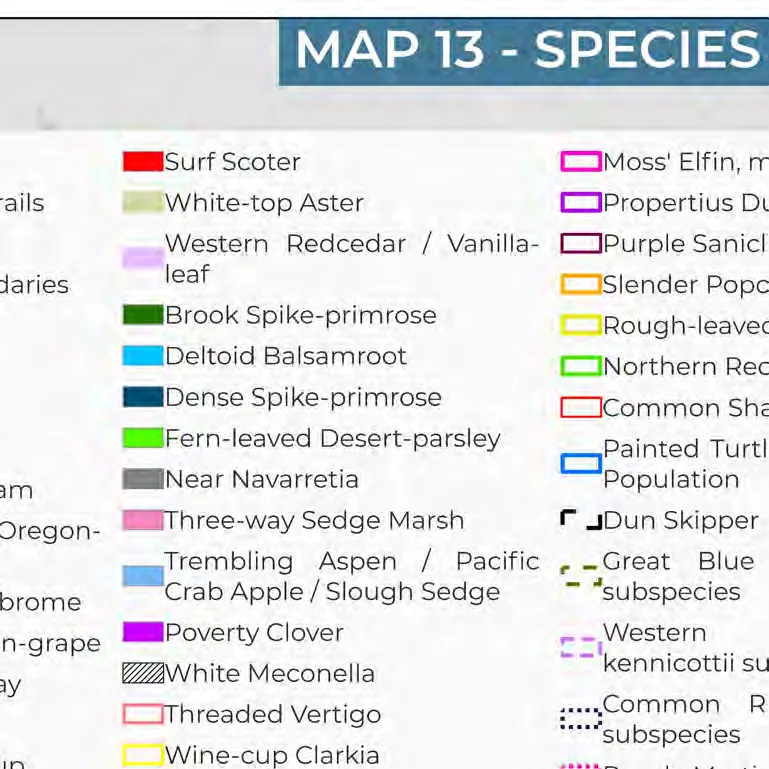
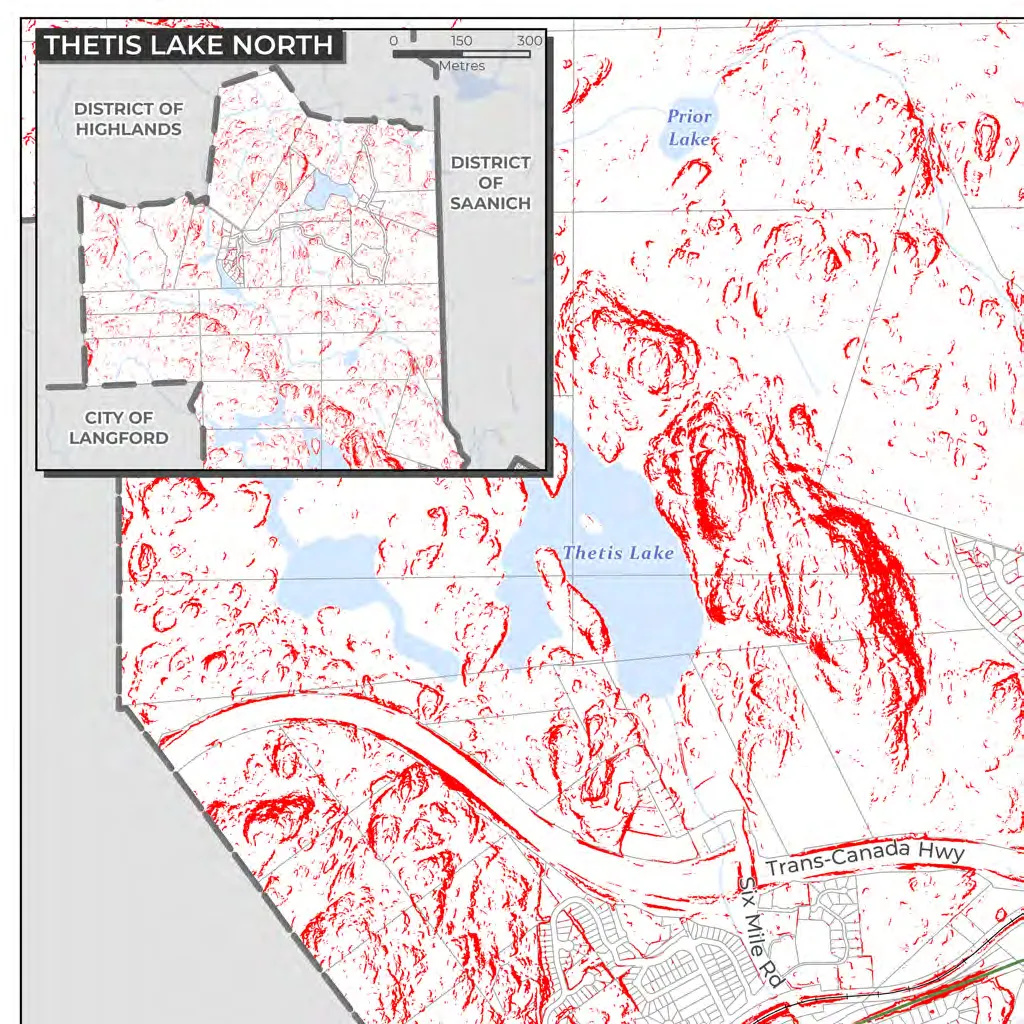
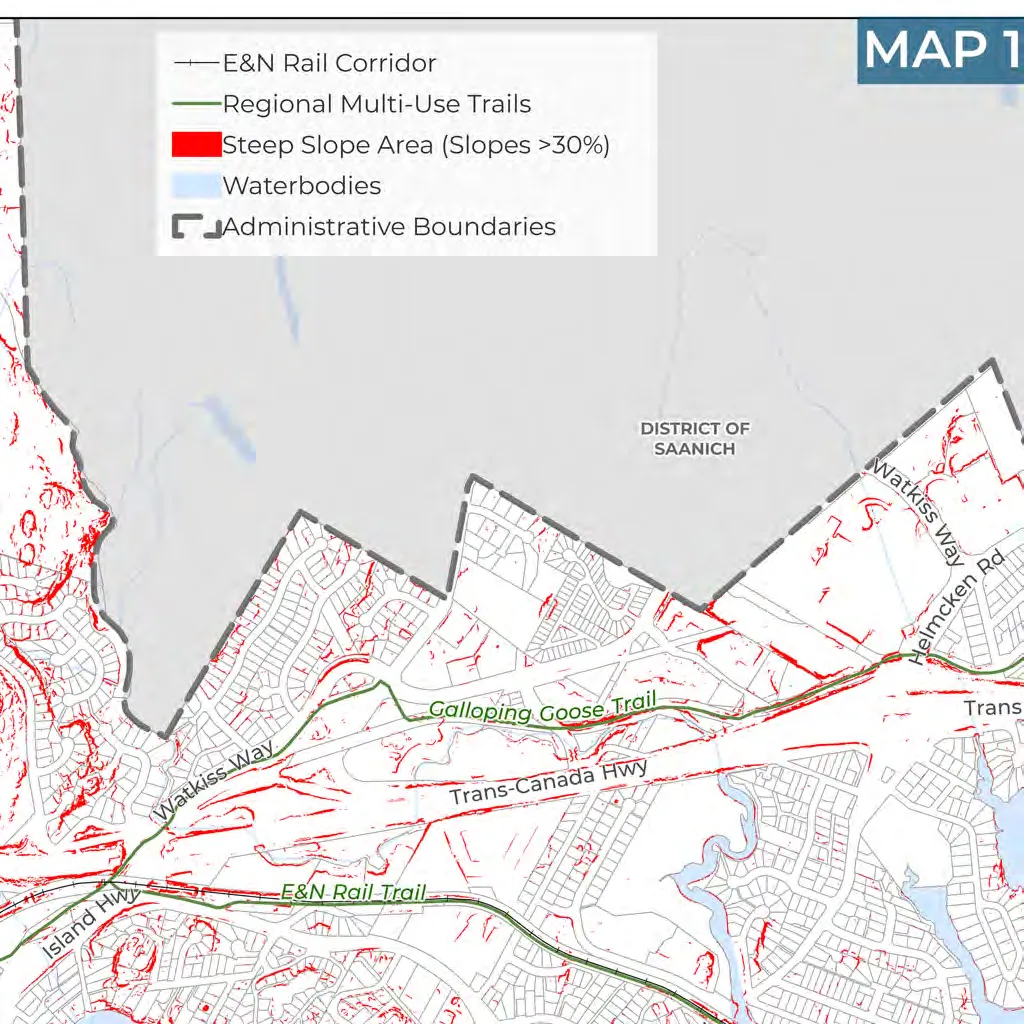
Map 14: Steep Slopes
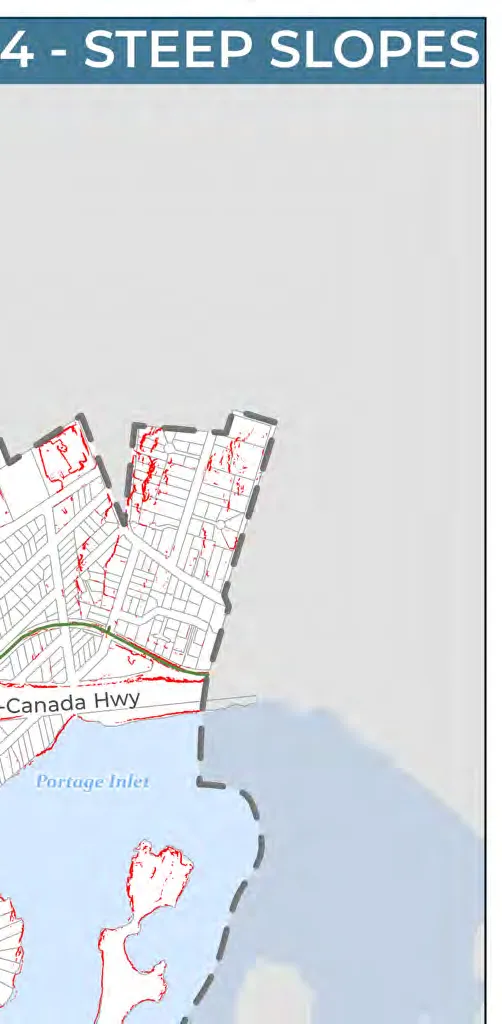
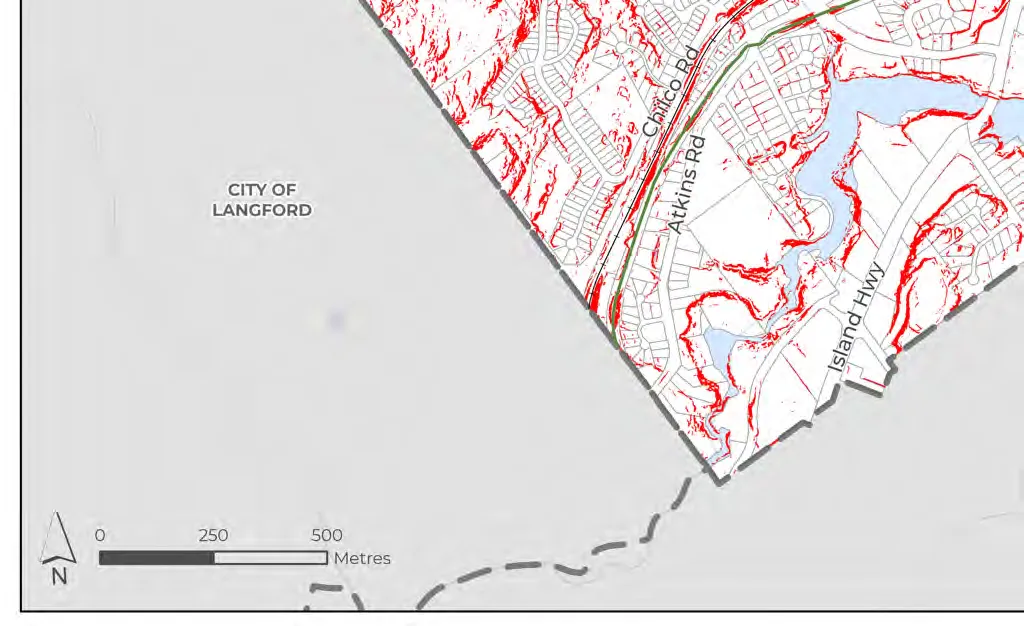
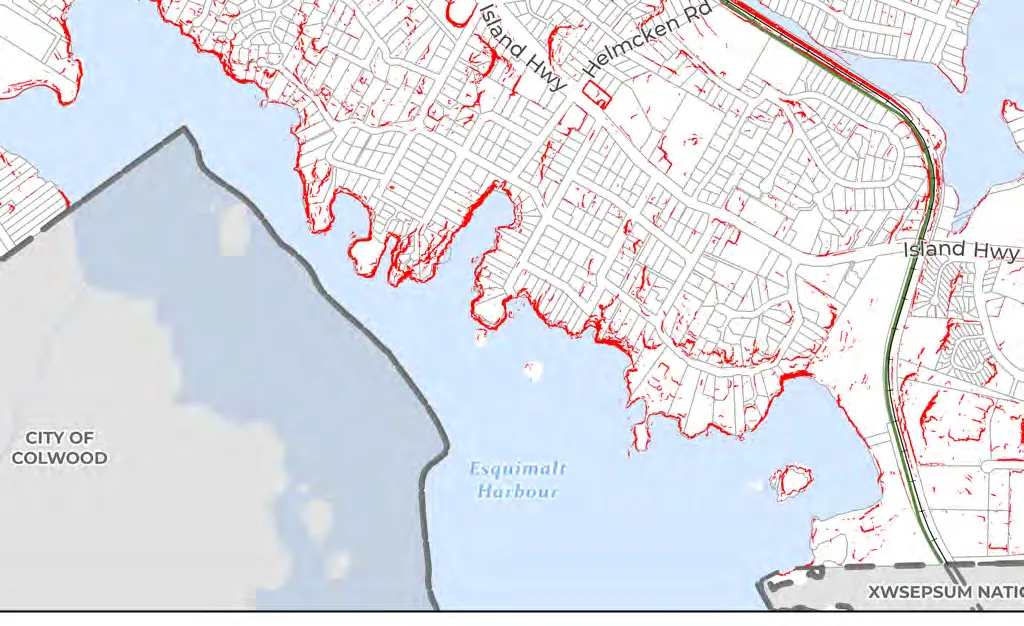
11.2 OBJECTIVES
11.2.1 BALANCED GROWTH AND NATURAL ENVIRONMENT PROTECTION Continue to find balance between development opportunities and protecting the Town’s distinct natural beauty to ensure these valued natural assets are thoughtfully maintained.
11.2.2 PUBLIC SAFETY AND HAZARDS Mitigate public safety risks associated with natural hazards, including flooding, tsunamis, landslides, wildfires, and earthquakes.
11.2.3 TERRESTRIAL AREAS, NATURAL SHORELINES AND WATERCOURSES Protect and restore sensitive terrestrial areas, watercourses, and shorelines to preserve their long-term ecological and hydrological functions and continue to recognize their contributions toward overall community health, recreation, and climate resilience.
11.2.4 URBAN FORESTS Identify, protect, and enhance the Town’s urban forest and tree canopy to support ecological functions, biodiversity, climate resilience, community health, and economic growth.
11.2.5 FIRST NATIONS LAND STEWARDSHIP Collaborate with the Xʷsepsəm and Songhees Nations to incorporate Indigenous knowledge and perspectives into environmental planning, actively support and engage in the stewardship of their traditional territories, and formally acknowledge cultural heritage values, including archaeological and culturally significant sites.
11.3 POLICIES
11.3.1 GENERAL A. Encourage residents, businesses, schools, and community groups to get involved in conserving the health of the natural environment. Community-based initiatives such as the following are encouraged: i) Habitat restoration and monitoring; ii) Construction of community gardens; iii) Habitat clean-up days; and iv) Tree planting programs. B. Continue to collaborate with the federal and provincial governments, the Capital Regional District, other municipalities, Xʷsepsəm and Songhees Nations, schools, and local organizations to strengthen local and regional resilience against natural hazards, conduct community engagement and public education related to emergency management, and develop and distribute environmental conservation and community stewardship information to the public.
11.3.2 ENVIRONMENTAL PROTECTION AND RESTORATION A. Protect and conserve the long-term health and sustainability of important terrestrial, aquatic, and riparian ecosystems, species of concern, and environmentally sensitive areas as shown on Maps 12 and 13. Protection and conservation strategies may include: i) Development Permit Area designations; ii) Parkland acquisition at the time of subdivision or rezoning; and iii) Application of Section 219 covenants to prohibit development. B. Prioritize land acquisitions and/or dedications over Section 219 covenants to conserve, protect, and restore natural areas for the future. C. Consider the management of natural assets that provide municipal services through the Town’s Asset Management Program. D. Advocate for the management of natural assets, such as natural green space and watercourses, within the Town’s boundaries that provide non-municipal services. E. Continue to identify, review, and designate environmentally sensitive areas as Development Permit Areas in Part 6 to ensure that these lands are adequately protected from new development. F. Support adaptive ecosystem management, evidence-based decision making, and the procurement of current information and datasets to inform ecosystem and urban forest management in View Royal. G. Ensure the protection of aquatic habitat, riparian ecosystems and shorelines. Protection and conservation strategies should be in accordance with the current Riparian Area Protection Regulation. H. Limit resource extraction, agriculture, and related uses north of Thetis Lake Regional Park and ensure that any resource extraction activity does not threaten the long-term integrity of the natural environment. I. Pursue a collaborative approach to environmental conservation and management by partnering with the federal and provincial governments, the Capital Regional District, Xʷsepsəm and Songhees Nations, and local organizations to protect, restore and enhance the natural environment in View Royal. J. Partner with Xʷsepsəm and Songhees Nations to learn and incorporate Indigenous stewardship practices into View Royal’s environmental restoration and conservation efforts. K. Explore opportunities to limit pet access and activities that have detrimental impacts on environmentally sensitive areas and natural areas. L. Consider opportunities to manage resident access to environmentally sensitive areas and natural areas by providing defined access opportunities that protect native vegetation and do not harm the health of ecosystems. M. Consider opportunities to reduce or ban the use of pesticides, herbicides, and other toxins like microplastics. N. Explore opportunities to undertake further studies and research to identify initiatives that can contribute to enhancing air quality in the community (i.e., prohibiting woodburning stoves), while also supporting the Town’s goal of net zero greenhouse gas emissions.
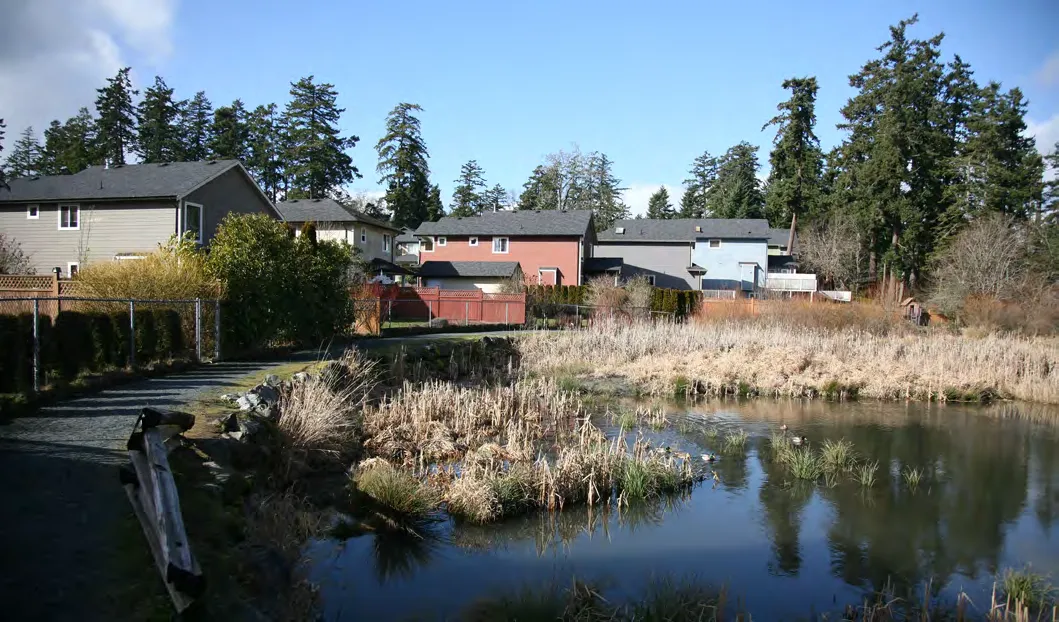

11.3.3 HABITAT PROTECTION AND ENHANCEMENT A. Identify opportunities to establish new, and protect existing, nature and wildlife corridors that facilitate the movement of wildlife and greater biodiversity across View Royal through the pursuit of a wildlife corridor study. B. Acknowledge the role of trees within the road right of way in providing habitat for species and acting as wildlife corridors. C. Continue to protect, restore and enhance habitats and ecosystems that support migratory, rare and endangered species, and species at risk as shown on Map 12, and address threats to biodiversity, such as invasive species, disease, and climate change. D. Where development is proposed and an existing wildlife habitat area is present on a site, an application must demonstrate how the area will be enhanced or how a net benefit will be added to the site through development. Supporting documentation from a Qualified Environmental Professional demonstrating the improvement is required. E. Protect the integrity of watersheds and riparian areas to preserve biodiversity, support healthy habitats, and mitigate flood risk.
11.3.4 WATERSHEDS A. Work collaboratively with the Capital Regional District, neighbouring municipalities, Xʷsepsəm and Songhees Nations, and other organizations to protect and enhance local and regional watersheds and the Capital Regional District Gorge Waterway Initiative. B. Support the implementation of the Capital Regional District’s watershed plans for Millstream Creek, Hospital Creek, and Craigflower Creek. C. Identify opportunities to daylight channelled watercourses and culverts, where possible.
11.3.5 URBAN FOREST A. Pursue the protection and enhancement of View Royal’s urban forest in alignment with the Urban Forest Strategy while maintaining public safety and mitigating risks from natural hazards, including wildfires. B. Continue to identify, explore, and understand the role of the Town’s urban forest, and its relationship with the Town’s parks, urban spaces, active transportation network, and open spaces. C. Continue to identify and explore the complex role that the Town’s urban forest has in ecology, the natural environment and its many systems, climate change mitigation, the economy, and the community’s well-being and health. D. Continue to build, enhance, and increase the Town’s urban forest, to achieve a 30% canopy coverage target for the Town by 2045, in alignment with the Town’s Urban Forest Strategy. E. Consider opportunities to protect and retain trees that are affected by development, where possible, and explore the possibility of relocating affected trees, or undertake alternative methods of development and construction. F. Support and encourage the protection of trees that contribute to the Town’s natural and cultural heritage through implementation of the Urban Forest Strategy and the Tree Protection Bylaw. G. Enhance the pedestrian transit service experience by prioritizing the installation of new boulevard and shade trees and identify opportunities to protect existing trees within 400 m of a prescribed frequent transit stop, along highway, arterial and collector roads in the Town.
11.3.6 VEGETATION AND LANDSCAPING A. Protect existing and plant new climate adaptive native plants and trees in alignment with the Tree Protection Bylaw, Urban Forest Strategy, and Development Permit Area Guidelines through the pursuit of educational programs, incentives, and regulations. B. Actively promote the removal of invasive vegetation and species to restore natural habitats and educate the community about their responsibility to remove invasive species on their property. C. Consider opportunities to plant climate adaptive native plants and trees on municipal lands. Exceptions may be allowed for seasonal projects, such as hanging baskets and targeted annual gardens. D. Consider establishing landscaping standards for public and private lands that considers current and anticipated climate stresses that may impact the viability of certain vegetation and tree species. E. Integrate the use of FireSmart Landscaping practices including promoting the use of fire-resistive plants and trees, and avoiding the use of highly flammable vegetation.
11.3.7 NATURAL HAZARDS RISK MITIGATION AND EMERGENCY RESPONSE PRACTICES A. Continue to designate lands susceptible to natural hazards (e.g. wildfire, tsunamis, floods, steep slopes greater than 30%), as Development Permit Areas to protect the public and development from potential threats to safety. B. Integrate FireSmart principles into Town policies, regulations, and practices. C. Utilize FireSmart practices for new development, as described in the FireSmart Residential Development Guide and FireSmart Home Development Guide. D. Continue to maintain the FireSmart Education Program and FireSmart Library Program with local schools. E. Review and implement recommendations from the Community Wildfire Resiliency Plan. F. Continue to assess, monitor and educate on vegetation structure ignition, and where possible, continue to reduce risk to homes within the community. G. Improve urban resilience to wildfire threats through programming, educational opportunities, and adaptive design. H. Prioritize emergency access and egress routes to areas within the community and ensure they are properly maintained in the event of a natural hazard such as flooding, tsunamis, landslides, wildfires, or earthquakes. I. Consider the provincial Flood Hazard Area Land Use Management Guidelines in the preparation of land use planning policies, regulations, and bylaws, where subdivision and development in flood-prone areas are proposed. J. When considering land use and planning decisions where a concentration of high-value or high population density uses are proposed or exist, consider a 2.0m global sea level rise (approximately 200 years) relative to the year 2000 sea level. K. Protect public safety from risks posed by development on steep slopes and in or near flood hazard areas. L. Identify flood-prone areas as special planning areas with tailored flood plain construction levels, policies for risk mitigation, infrastructure adaptation and emergency preparedness. M. Promote climate-resilient development by encouraging elevation of structures, use of non-combustible and flood-resistant materials, and incorporation of green infrastructure. N. Support managed retreat or land use transition in areas where long-term flood risk is incompatible with continued development. O. Support the identification and mapping of community assets and infrastructure that are susceptible to natural hazards, including municipally owned buildings, roads, and bridges. Explore options to enhance the resilience of these assets and infrastructure to mitigate possible negative effects. P. Collaborate with the Capital Regional District, Province, Crown Corporations (i.e., BC Hydro), and private service providers (Fortis BC, Telus, Shaw, etc.) that provide or operate key infrastructure in the Town, such as roads, communications, gas, electricity, to identify and map the location of these assets, to be able to identify and understand the risks from natural hazards. Q. Continue to promote and educate residents on the use of WestShore Alert to notify residents of natural hazards such as flooding, tsunamis, landslides, wildfires, earthquakes, and major storm events.
- Managed retreat is the strategic relocation of people and structures, often accompanied by ecological restoration and a permanent change in land use in support of decreasing the vulnerability to natural hazards and flooding in light of climatic shifts due to climate change.*
- Land use transition refers to the gradual change of land use from one use to another over time in support of an intended outcome, such as ecological and hazard resilience.*
12.0 Climate Action and Sustainability
12.1 CONTEXT
The impacts of climate change are evident in View Royal through unprecedented events that are occurring more frequently, such as wildfire smoke, extreme heat, and localized flooding. In response, the Town declared a climate emergency on March 5, 2019, to stress the importance of the situation at hand. Since that time, the Town has worked collaboratively on climate initiatives, including a Community Climate Action Strategy, but further work is required to position the town as a local climate leader in the future. As a signatory to the BC Climate Action Charter in 2007, the Town is committed to becoming a carbon-neutral and climate-resilient community.
Climate change impacts underscore the need to proactively adapt and mitigate the effects of climate change. Municipal decisions regarding land use, development, transportation, infrastructure, and waste management significantly impact greenhouse gas emissions and the impacts are cumulative. By acknowledging these long-term climate impacts, the Town can make choices and take actions to help move the community towards climate sustainability by reducing greenhouse gas emissions and being prepared for future conditions.
Climate change is intertwined with all aspects of the community, making it one of the prominent themes in the Official Community Plan. This section outlines the objectives and policies to guide the Town’s efforts in climate change awareness, mitigation, and sustainability.
The following Official Community Plan Goals may be achieved through the objectives and policy direction provided in this section:
- Community Safety & Security
- Climate Action and Resilience
- Regional Partnerships
12.2 OBJECTIVES
12.2.1 NET-ZERO EMISSIONS Advocate to senior levels of government and collaborate with neighbouring municipalities and community members to achieve a net-zero emissions level by 2050.
12.2.2 CLIMATE CONSCIOUS DECISION MAKING Acknowledge the role that municipal decisions have in impacting and shaping local and regional climates and consider decision-making through a climate conscious approach. Allocate resources accordingly to undertake initiatives to adapt to the changing climate and mitigate risks.
12.2.3 COASTAL CLIMATE ADAPTATION AND RESILIENCE Develop an understanding and approach to respond to the unique challenges that View Royal faces as a coastal community and the impacts of coastal flooding and sea-level rise due to climate change and global warming.
12.2.4 CLIMATE CONSCIOUS DEVELOPMENT Approach development through a low carbon climate lens that prioritizes climate resiliency, sustainable development, reduces greenhouse gas emissions related to transportation, land use, building, and service delivery.
12.2.5 COMMUNITY HEALTH AND WELL-BEING Acknowledge the strong link between community health, well-being, and climate change and ensure that View Royal is prepared to mitigate any potential negative impacts on public health resulting from this linkage.
12.2.6 PARTNERSHIPS Pursue constructive, impactful, and collaborative partnerships with the Capital Regional District, other local governments and First Nations in the region, senior levels of government, community groups, and other agencies to pursue comprehensive actions related to all facets of climate change mitigation, adaptation, and resilience.
12.3 POLICIES
12.3.1 TAKING ACTION A. Continue the Town’s commitment as a signatory to the 2007 BC Climate Charter. B. Continue to understand the impacts and effects of climate change in recognition of the Town’s declaration of a climate emergency and identify opportunities to develop climate actions in strategic plans to work towards carbon neutrality.
12.3.2 REDUCTION OF GREENHOUSE GAS EMISSIONS A. Achieve the provincial targets for community-wide greenhouse gas emissions including a 45% reduction in emissions below 2007 levels by 2030, and a 100% reduction in emissions below 2007 levels by 2050. B. Collaborate with other municipalities in the Capital Regional District, senior levels of government, public agencies, and organizations to reduce greenhouse gas emissions through initiatives related to land use, building energy efficiency and transportation planning, infrastructure design, water and energy conservation, solid waste management, and green procurement of goods and services.
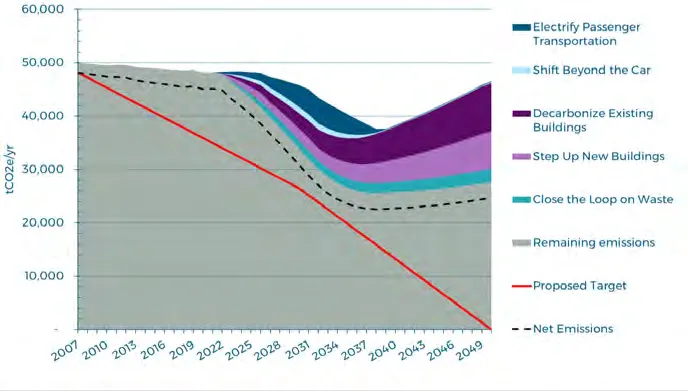
C-87-26 THAT the table illustrating the Town's commitment to reducing greenhouse gas emissions by 2050 from the View Royal Community Climate Action Strategy be included in the section on “Climate Action and Sustainability” in the Official Community Plan. (Added figure [Image 167])
C. Advocate to senior levels of government to support View Royal’s climate goals and targets, and natural hazard (e.g. flooding, wildfire) mitigation and response objectives. This support may include legislation, policy, programs, and data that provides the Town with the funding and resources necessary to address the climate emergency. D. Explore the creation of a Corporate Energy and Emissions Strategy for the Town that identifies opportunities for reducing greenhouse gas emissions caused by Town operations, transport, facilities, and waste management. E. Investigate opportunities to transition the Town’s fleet of vehicles to electric and low emission vehicles. F. Research a “buy-clean” procurement policy that prioritizes the purchase of low- and no-carbon materials and products for the Town. G. Continue to support the Community Climate Action Strategy’s recommended initiatives to reduce greenhouse gas emissions, including the following: i) Encourage active and accessible transportation and transit; ii) Accelerate the adoption of zero-emissions vehicles; iii) Enhance energy efficiency and low carbon heating in new buildings; iv) Support deep energy retrofits and fuel switching for buildings; and v) Divert organics from the landfill and capture value from waste.
12.3.3 BUILT ENVIRONMENT A. Explore options to incorporate sustainability considerations into the Development Permit Area guidelines, Building Bylaw, and Zoning Bylaw, such as enhanced landscaping requirements to improve tree canopy coverage, more broadly permitting urban agriculture to advance food security goals, and increasing requirements for bike parking, amongst others. B. Continue to support enhanced energy efficiency and low carbon heating in new buildings by requiring new development to meet or exceed the requirements of the BC Energy and Zero Carbon Step Codes. C. Encourage new development to exceed the requirements of the BC Energy and Zero Carbon Step Codes. D. Determine the viability of reusing building demolition materials for construction purposes. E. Consider adopting policies and programs to encourage decarbonization of existing buildings, such as deep energy retrofits and fuel switching.
The BC Energy and Zero Carbon Step Codes are provincially-legislated measures that aim to achieve zero carbon and net-zero energy ready buildings.
12.3.4 INFORMATION AND EDUCATION A. Support climate change education and identify opportunities to collaborate with youth on climate change planning and action through local youth organizations and school programs.
12.3.5 CLIMATE ADAPTATION A. Continue to work with neighbouring municipalities, the Capital Regional District, and Xʷsepsəm and Songhees Nations on the development and implementation of strategies to mitigate the impacts caused by climactic events, such as sea-level rise, increased wildfire risk, altered seasonal temperatures and precipitation, air pollution, and waterborne contaminants. B. Continue to develop and implement new regulations and policies to protect and enhance public safety during natural hazard events that may be a result of climate change. C. Continue to develop and implement strategies to mitigate wildfire risk in View Royal by: i) Implementing recommendations from the Community Wildfire Resiliency Plan; ii) Maintaining the View Royal FireSmart Program; iii) Integrating FireSmart principles into the Town’s bylaws and policies; and iv) Applying a Wildfire Interface Hazard Development Permit Area to the Wildfire Urban Interface areas of the community where wildfire risk is high and incorporate FireSmart principles within the guidelines accordingly. D. Prepare and maintain an Emergency Management Plan for the community to prepare for, prevent, mitigate, respond to, and recover from the effects of natural disasters, natural hazards, and climate change. E. Explore opportunities to create a Climate Adaptation and Mitigation Strategy with the Xʷsepsəm and Songhees Nations to integrate traditional knowledge of land stewardship into climate action policy and decision-making, identify local and regional climate action, and partner on the implementation of these actions together. F. Review and update to the Community Heat Resilience Plan to enhance the Town’s preparedness for extreme heat events. G. Explore the development of a Comprehensive Sea Level Rise Adaptation Plan to guide the long term resilience of View Royal by: i) Identifying assets, infrastructure, and populations vulnerable to sea level rise; ii) Evaluating adaptation options across physical, ecological, and policy domains; iii) Prioritizing actions based on risk, feasibility, and community values; and iv) Establishing timelines and funding strategies for implementation. H. Integrate the findings of the Coastal Hazard Mapping and Risk Assessment Report into Town regulations and policies to proactively address the risk of sea level rise and coastal flooding in View Royal.
13.0 Parks, Trails, and Recreation
13.1 CONTEXT
Parks, trails, and recreation spaces offer opportunities for play, exploration, exercise, and connection. For View Royal residents, access to green space and recreation is an essential part of daily life. The Town’s parks, green spaces, trails, and waterfront all contribute to the community’s appeal and are key features of the Town. These amenities encourage active lifestyles, support local ecosystems, and provide recreational options that benefit both locals and visitors.
The community boasts a wide range of regional parks and trails, including Thetis Lake Regional Park, Mill Hill Regional Park, the Galloping Goose Regional Trail, and E&N Trail. Furthermore, there are many local parks, such as View Royal Park, Portage Park, Helmcken Park, Centennial Park, Chilco Park, and Nursery Hill Park, to name a few. The Town provides recreation services to residents as one of the municipal members of the West Shore Parks & Recreation Society, which owns and operates the Juan de Fuca Recreation Centre located in Colwood. Through partnerships, View Royal residents also enjoy access to other recreation facilities in the region. View Royal’s public schools also function as community programming spaces. These amenities are shown on Map 15.
The objectives and policies outlined in this section aim to further implement the vision established in the Parks Master Plan, as well as provide guidance for new priorities relating to parkland acquisition and improvements, trails, and recreation, with a forward-looking lens as the community grows over the lifespan of this Official Community Plan.
The following Official Community Plan Goals may be achieved through the objectives and policy direction provided in this section:
- Mobility & Connectivity
- Natural Amenities
- Community Well-Being
- Regional Partnerships
- Sustainable Service Delivery and Asset Management
Map 15: Parks, Open Spaces, Trails, and Community Facilities
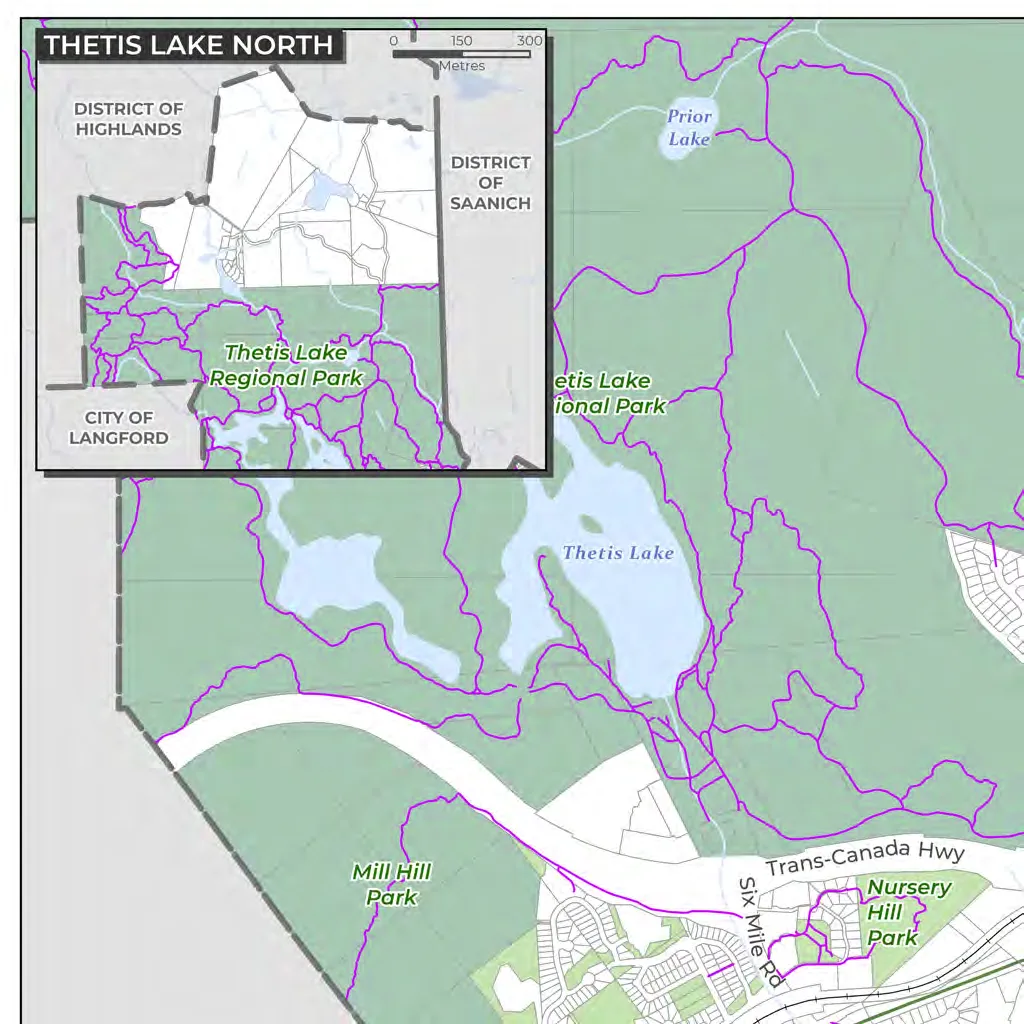
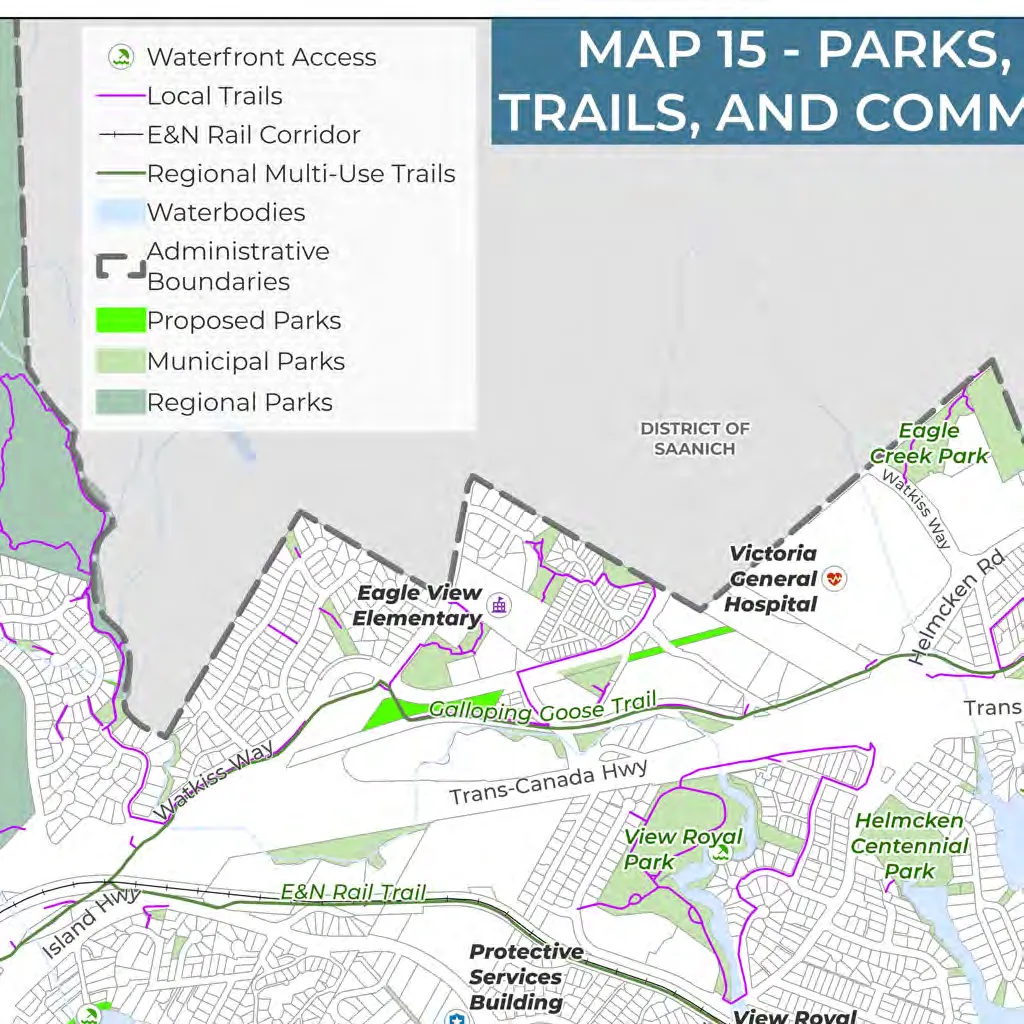
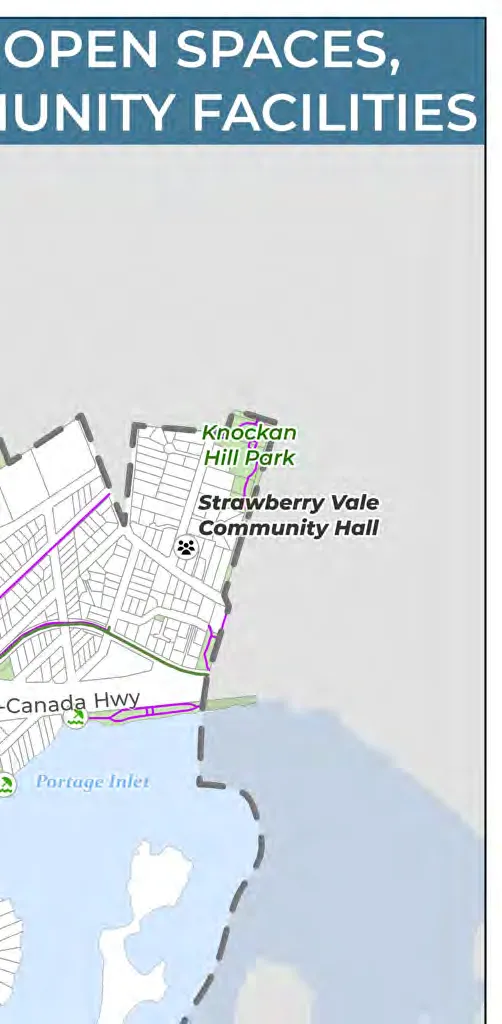
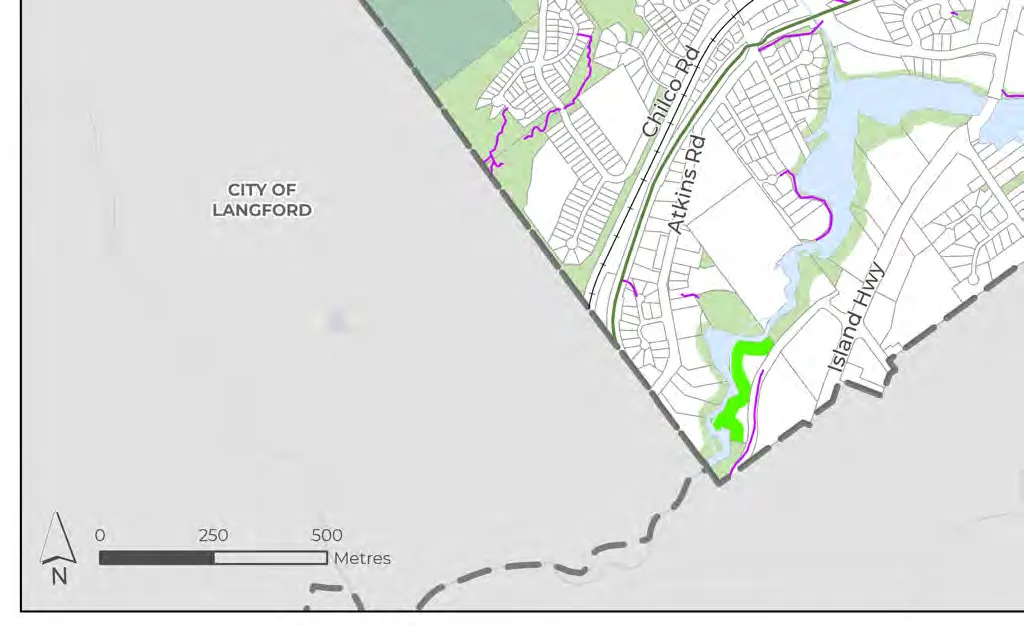
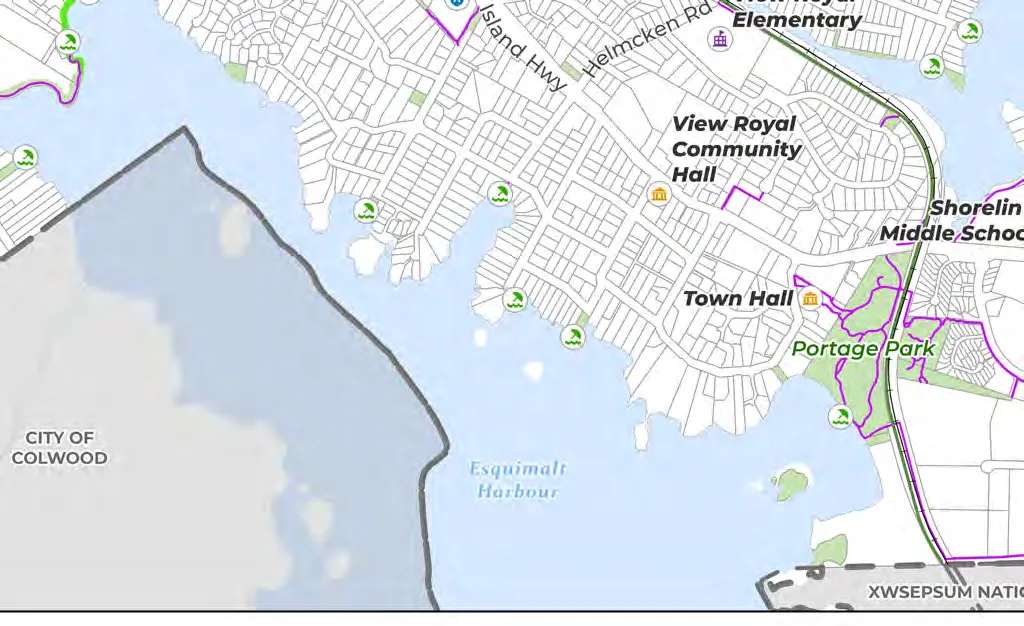
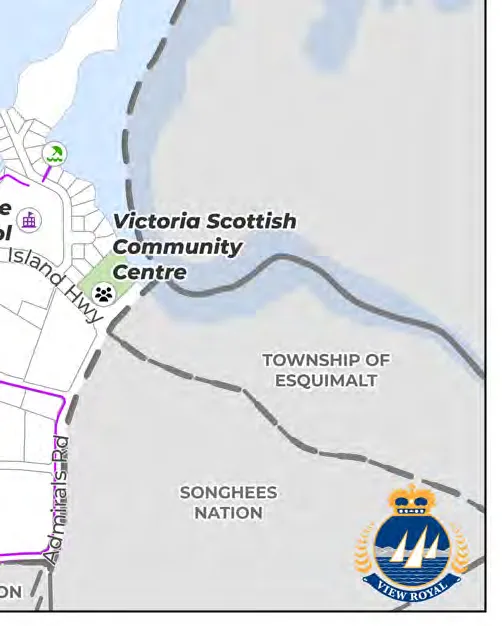
13.2 OBJECTIVES
13.2.1 HEALTHY, EQUITABLE, AND SAFE PARKS, TRAILS, AND RECREATION FACILITIES Continue to promote parks, trails, and recreation facilities as contributors to the overall health and well-being of residents and visitors, and explore opportunities to expand, design, and maintain these amenities for all ages and abilities to support a healthy and active lifestyle.
13.2.2 ACCESSIBLE PARKS, TRAILS, AND RECREATION FACILITIES Continue to explore opportunities to provide parks, trails, and recreation amenities that meet the diverse social, recreational, and wellness needs of current and future residents. Consideration of the type and location of these amenities should be considered at a community-wide and neighbourhood level, and within the Town’s financial and service capacity.
13.2.3 PROTECT ECOLOGICAL AND ENVIRONMENTAL FUNCTIONS Continue to recognize and protect the role parks play in maintaining the ecological integrity of our environment and contributing to climate change adaptation, mitigation, and resilience.
13.2.4 PARTNERSHIP AND COLLABORATION Continue to strengthen existing partnerships and consider opportunities for new partnerships with local and regional governments and non-profit organizations to expand local and regional recreational opportunities.
13.2.5 LEVEL OF SERVICE Achieve a sustainable level of service delivery for parks, trails, and recreation services that reasonably addresses community demand for access to public spaces, and is within the Town’s financial and resource capacity levels.
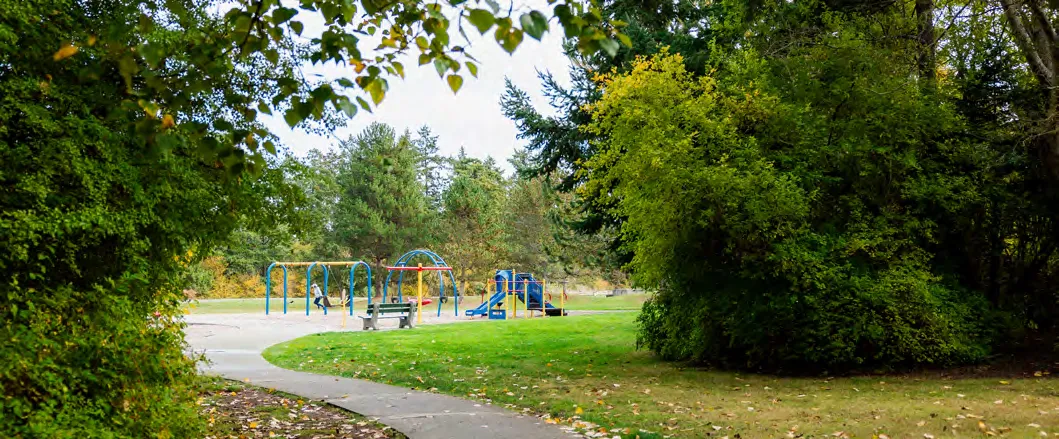
13.3 POLICIES
13.3.1 GENERAL A. Apply an equitable, diverse, and inclusive approach to the delivery of parks, trails, and recreation services in View Royal through the consideration of resident ages, and abilities in the identification of priorities and the design of such spaces and infrastructure. B. Ensure parks, trails, and recreation planning are integrated with broader community planning efforts in the Town, including land use and transportation decisions, and public realm design. C. Continue to identify and understand gaps in the Town’s parks, trails, and recreation offerings, and consider opportunities to enhance these amenities so that they are more adequate, usable, and accessible for all residents. D. Aim to achieve a minimum of 5.0 hectares (12.4 acres) of parkland per 1,000 people, residents living within a 400m radius, or a 5-minute walk of usable park space excluding regional parks and schools, while considering other significant factors affecting acquisition and access to parkland, such as transportation corridors and the Trans-Canada Highway. E. Continue to explore opportunities to remove barriers and improve access for people of all abilities to parks, recreational facilities, public waterfront areas, viewpoints, and greenways while remaining sensitive to the preservation of natural habitat areas. F. Support the safety and comfort of parks and recreation facility users by applying design principles and practices that address crime prevention in public spaces.
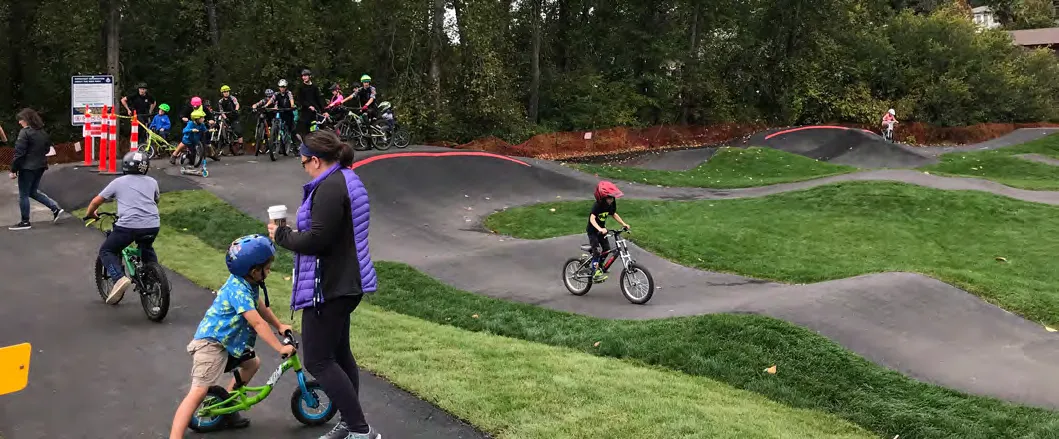
13.3.2 PARKLAND ACQUISITION A. Prioritize parkland acquisition in neighbourhoods where supply is deficient. Special attention should be given to areas with high concentrations of underserved demographic groups, children and teenagers, and other groups with unique recreation and access needs. B. Pursue the acquisition of parkland through dedication at the time of rezoning or subdivision. Considerations should include land size, location, access, topography, presence of any hazardous conditions, treed areas, native ecosystem integrity, historic contamination risk and liability, cultural significance, and maintenance requirements to determine if the proposed parkland is appropriate for Town ownership. C. Explore how to integrate urban park types into the existing parks system to enhance streetscapes, such as pocket parks, road ends, and plazas, particularly in or near areas of high pedestrian activity. D. In reviewing development proposals for waterfront sites, encourage new public water and shoreline accesses, parks, and boat launches with consideration to current Flood Hazard Land Use Management Guidelines that recommend preparing for a 2.0m global sea level rise (approximately 200 years) relative to the year 2000 sea level.
13.3.3 PARK IMPROVEMENTS A. Partner with community organizations, West Shore Parks and Recreation, and the Capital Regional District where possible to acquire, improve, and manage parkland amenities. B. Continue to maintain and enhance existing parks to a high standard and consider the development of new facilities as needed. C. Support investment in View Royal Park as the Town’s primary park to enhance access to recreation activities that attract a broad range of users. D. Explore opportunities to provide weather protection infrastructure in public parks and gathering spaces, including shade and rain coverage features. E. Prioritize parkland improvements where green space is not readily available, and in areas with high concentrations of underserved demographic groups, children and teenagers, and other groups with unique recreation and access needs. F. Emphasize aspects of historical and cultural significance in View Royal parks, as well as through collaboration with the Xʷsepsəm and Songhees Nations.
C-84-26 THAT the policy under the section titled “Park Improvements” in the Official Community Plan regarding emphasizing aspects of historical and cultural significance in parks be amended to read: “Emphasize aspects of historical and cultural significance in View Royal parks, as well as through collaboration with the Songhees and Xʷsepsәm Nations. (Refer to revisions to Policy 13.3.3(f))
13.3.4 RECREATION A. Continue to support the Town’s inter-municipal facility sharing agreement for the West Shore Recreation Centre. Explore options for increasing local benefits from this partnership. B. Explore opportunities for partnerships with the Capital Regional District, School District 61, West Shore Parks and Recreation, community organizations, and other users to deliver additional recreational opportunities for View Royal residents. C. Support non-motorized water recreation in View Royal and continue to explore opportunities to improve access to the water for non-motorized vessels in Esquimalt Harbour and Portage Inlet at key waterfront locations. D. Enhance recreation amenities within parks without compromising critical habitat or sensitive species. E. Work with the Canadian Forces Base Esquimalt to develop and implement signage promoting safe boating practices in Esquimalt Harbour.
Non-motorized vessels are human-propelled watercraft such as kayaks, stand-up paddleboards, and canoes, amongst others.
C-85-26 THAT a policy be added in the Official Community Plan regarding the collaboration with CFB Esquimalt to develop and implement signage promoting safe boating practices in Esquimalt Harbour. (Added new policy 13.3.4 (e))
13.3.5 IMPROVING CONNECTIONS BETWEEN PARKS AND RECREATION FACILITIES A. Ensure all community members have equitable access to parks, green spaces, recreation facilities, schools and residential areas by enhancing linear parks, public trails, active transportation corridors, transit opportunities, and sidewalk connections.
13.3.6 PARKS AND THE NATURAL ENVIRONMENT A. Preserve and restore environmentally sensitive areas within parks wherever possible. B. Acknowledge the role that natural assets such as trees and wetlands play in providing ecosystem services, stormwater management, temperature regulation, and climate resilience in View Royal parks by maintaining and enhancing these natural assets. C. Explore opportunities to educate the community on natural systems that exist within parks through interpretive signage and information boards. D. Protect ecosystems in natural parks through sensitive management and minimal construction, ensuring that any works shall be carried out in an environmentally sensitive manner with proper consultation with a qualified professional. E. Rehabilitate areas affected by invasive plants and species using climate adaptive native vegetation and trees in View Royal parks. Where feasible, implement preventative measures to protect native habitats. F. Consider the criteria required to develop construction standards for trails and structures to avoid and mitigate harmful impacts on the natural environment.
14.0 Community Well-Being and Culture
14.1 CONTEXT
Community well-being in View Royal is shaped by the social, cultural, and economic conditions that support residents’ health, safety, belonging, and ability to participate in society. As View Royal grows and diversifies, the Town’s role in supporting social needs continues to evolve, with an emphasis on equity, inclusion, accessibility, and collaboration with the Xʷsepsəm and Songhees Nations and other partners in the region.
COMMUNITY HEALTH AND WELL-BEING Community health is important to residents, and the character of a community is directly related to the quality of life and social, mental and physical well-being experienced by its residents. As the host for one of the region’s two major hospitals (Victoria General Hospital), View Royal plays a key role in facilitating healthcare services for local and regional residents alike, and generally supports expanding the services provided at this facility in the future.
Community well-being extends far beyond mental and physical health services. It encompasses various community facilities and spaces, including parks, trails, and recreational and community facilities, as shown on Map 15. Schools and daycares in View Royal are essential, offering education for youth, opportunities for social, educational, and recreational enrichment, and support for local families. Parks, trails, and recreation areas (see Section 13.0) play a significant role in supporting the mental, physical, and social health of the community through access to nature and opportunities for connection and exercise.
Contemplating and addressing the needs and abilities of residents across demographic groups is vital to ensure the well-being of all community members. Prioritizing accessibility is key to creating a more equitable community, allowing everyone to safely, comfortably, and fully participate in life in View Royal. The Town’s demographic data indicates that there is a growing aging population, based on the last Census period (2021), which means meaningful steps must be taken now to support the needs of residents to age in place in the future. A more complete overview of the Town’s demographics is available for review in the Community Profile in Appendix A.
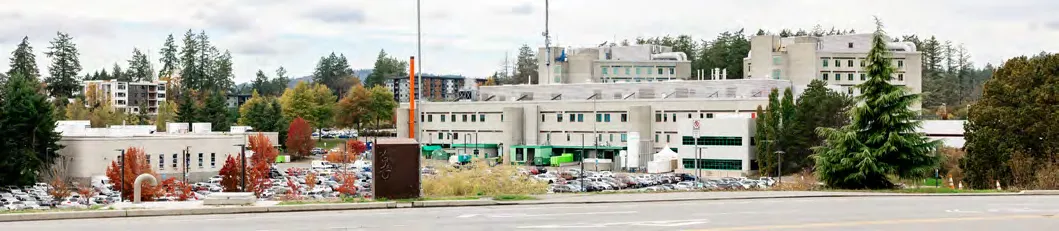
COMMUNITY CULTURE View Royal’s heritage resources, arts and cultural spaces, creative sector, and community organizations help foster a safe, welcoming, and inclusive community with a strong sense of place. View Royal is home to some of the oldest buildings in the Capital Regional District and some of Canada’s National Historic Sites. The Craigflower Manor site, completed in 1856, is one of the four original farms the Hudson’s Bay Company set up in the Greater Victoria Area. The Town is a full participant in the Capital Regional District Arts & Culture Support Service, which provides operating and project grants to local festivals, performing arts, general arts, and visual arts of non-profit organizations such as the Art Gallery of Greater Victoria, Ballet Victoria, the Victoria Jazz Society, and the Victoria Symphony. This partnership aims to acknowledge the key role that arts and culture play in fostering a sense of place and community and contributing to overall well-being. It is a priority of the Town to partner with the Xʷsepsəm and Songhees Nations to integrate aspects of Indigenous culture into the community fabric wherever possible, such as public art, interpretive signage, and the hosting of public events and festivals, amongst others.
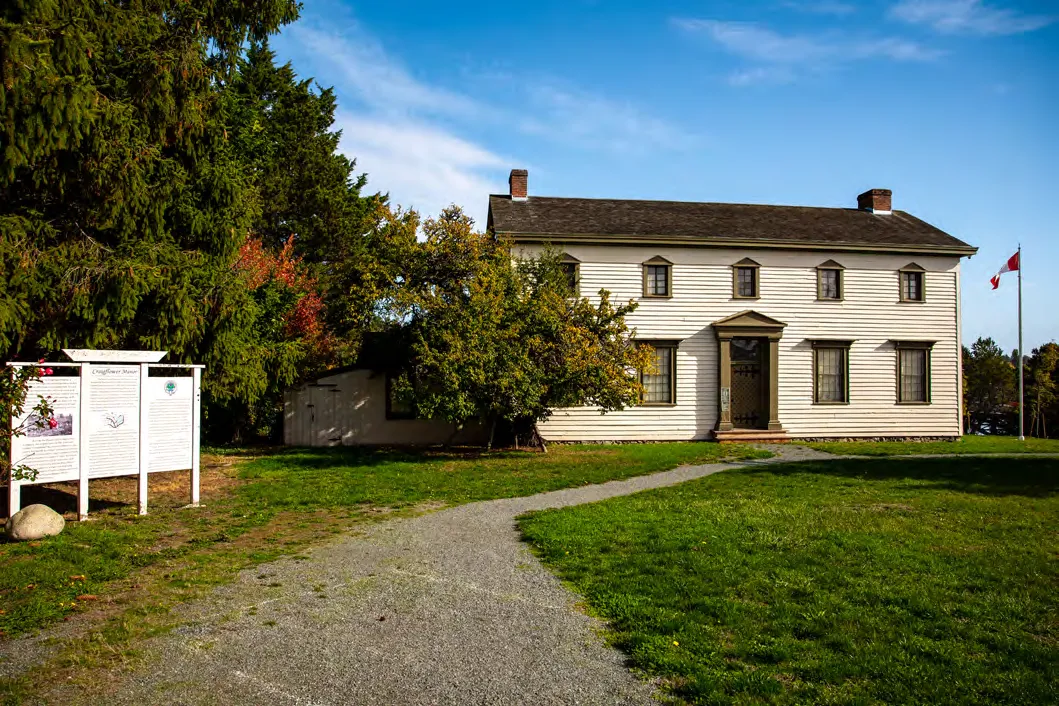
FIRE PROTECTION The Department operates out of the Town’s Public Safety Building located on Island Highway, and it is comprised of a mix of career and paid on call part time fire fighters. The department is responsible for fire-related incidents and emergency response, fire prevention and inspections, disaster responses, training, and public education. The Fire Department has joint agreements with neighbouring municipalities, including Langford, Colwood, and Esquimalt to provide fire and emergency management coverage and reliable service for residents and businesses in the area. In addition, the Fire Department provides fire emergency response as well as emergency disaster management for the Xʷsepsəm and Songhees Nation.
POLICE SERVICE The Town of View Royal is policed by the West Shore Royal Canadian Mounted Police Detachment, located in Langford. The West Shore Royal Canadian Mounted Police also serve the City of Langford, City of Colwood, District of Metchosin, District of Highlands, and the Xʷsepsəm and Songhees Nations. To ensure the Royal Canadian Mounted Police have the space required to serve the West Shore's growing population over the next 25 years, the ownership group (consisting of Langford, Colwood and View Royal) have embarked on an expansion of the facility.
This section aims to advance objectives and policies that strengthen community health and well-being, cultural identity, enhance accessibility and inclusion, protect heritage, and expand opportunities for youth, families, and seniors, while fostering a safe, connected, and culturally rich community where all residents can thrive.
The following Official Community Plan Goals may be achieved through the objectives and policy direction provided in this section:
- Community Well-Being
- Community Safety and Security
- Community Input and Governance
- Regional Partnerships
14.2 OBJECTIVES
14.2.1 HISTORIC AND CULTURAL IDENTITY Celebrate the diverse heritage of View Royal by identifying, recognizing, protecting, and celebrating natural, cultural, and built heritage resources, including those of significance to the Xʷsepsəm and Songhees Nations.
14.2.2 ARTS AND COMMUNITY REPRESENTATION Support the enrichment of arts, culture, and heritage by attracting artists through the provision of spaces and events, programs, and policies. Collaboration with Xʷsepsəm and Songhees Nations and neighbouring municipalities is encouraged.
14.2.3 CREATING A DIVERSE, EQUITABLE, AND INCLUSIVE COMMUNITY Enhance the quality of life for all residents by fostering an environment where diversity, equity, and inclusion are promoted and embedded in Town policies, programs, and spaces. Successful implementation of a diverse, equitable, and inclusive approach recognizes and addresses the evolving needs of View Royal’s residents and understands and respects the diverse needs of persons of all ages, abilities, identities, and backgrounds.
14.2.4 COMMUNITY AND IDENTITY Strengthen the sense of belonging, shared identity, and emotional connections within View Royal to establish a strong sense of place and community.
14.2.5 COMMUNITY SAFETY AND SUPPORT Ensure that View Royal is a safe community by working with emergency services, the community, volunteer groups, and residents with diverse living and lived experiences who wish to advance community safety, health, and well-being.
14.2.6 THE IMPORTANCE OF YOUTH, FAMILIES, AND FUTURE LEADERS Attract and retain youth and families in the community and foster an environment that encourages growth, support, and enrichment for future community leaders. The success of youth and families relies heavily on the investments and resources provided to them in their neighbourhoods and broader community.
14.2.7 COMMUNITY EMPOWERMENT THROUGH KNOWLEDGE AND INVOLVEMENT Identify and develop innovative approaches to civic engagement to ensure that all community members have an opportunity to participate in the Town’s decision-making processes. Opportunities to empower community members through education and volunteerism are encouraged.
14.3 POLICIES
14.3.1 BUILT, NATURAL, AND CULTURAL HERITAGE A. Continue to identify and add heritage properties to the Town’s Heritage Register. B. Clarify and evolve heritage protection in View Royal through creation of a Heritage Protection program. C. Encourage adaptive reuse of heritage buildings where appropriate. Work with property owners to find innovative solutions that will permit change while preserving and celebrating key heritage values. D. Recognize the role of the View Royal Community Archives as an important resource for local history by advancing and encouraging volunteerism, grants, material donations, and collaborating with the Xʷsepsəm and Songhees Nations. E. Continue to advocate and support the Province with the preservation of Craigflower Manor as a provincial heritage asset by ensuring its ongoing maintenance, restoration, and integration into the community’s cultural landscape. F. Collaborate with Xʷsepsəm and Songhees Nations and community organizations to support increased public education and awareness of the history of View Royal. This may include educational campaigns and exhibits, collaborations with local schools, installations of historical plaques or markers, permanent displays, and public events or meetings. G. Encourage the creation and enhancement of public gathering spaces such as plazas, parks, community halls, schools, outdoor performance areas, waterfront areas, and streets. H. Encourage the hosting of local cultural events and activities, such as annual celebrations, fairs and festivals, outdoor markets, and arts and sports events. Partner with the organizations that host these events, where possible. I. Encourage opportunities for local First Nations art to be included in the design and construction of new development.
14.3.2 ARTS AND CULTURE A. Continue to advocate for the development of a West Shore arts and culture facility to service the West Shore communities. B. Support maker spaces, art, and production studios in the Western Gateway Corridor. C. Create community and cultural spaces that promote health and well-being, social belonging, and creativity.
C-86-26 THAT the Official Community Plan include a policy to continue to advocate for the development of a West Shore Arts and Recreation facility to serve the western communities. (Added new subsection 14.3.2)
14.3.3 LOCAL GOVERNANCE AND CIVIC ENGAGEMENT A. Continue to implement the Community Engagement Strategy, applying International Association of Public Participation principles and an equity-focused approach to engagement that seeks participation from all demographic and socioeconomic groups, with particular focus on elevating the voices of equity-deserving peoples. B. Support and build neighbourhood capacity in strengthening social connections, climate action, and community resilience through neighbourhood-driven initiatives. C. Commit to transparent, ongoing public dialogue about growth management strategies, emphasizing how proactive planning can protect established neighbourhoods and guide change in a manner that benefits the entire community. D. Encourage applicants proposing development to consult with stakeholders and the broader public prior to the statutory consultation phase of a development application. E. Consider opportunities to improve knowledge of and access to volunteer opportunities, including standing committees, within the Town. F. Explore opportunities and actions to strengthen civic engagement, especially among underrepresented community members, by building their capacity and knowledge of municipal processes to foster diverse involvement in Town initiatives.
The International Association of Public Participation is a global organization that instills best practices of public participation amongst entities in service of the public interest. The Town has endorsed International Association of Public Participation’s pillars of engagement.
C-57-26 THAT the Official Community Plan include a policy for the creation and maintenance of standing committees. (Refer to policy 14.3.3(e))
14.3.4 SUPPORTING YOUTH AND SENIOR POPULATIONS A. Encourage diverse, quality, accessible and affordable daycare programs, including early childhood daycare, preschool, and out-of-school care spaces through partnerships, coordination, advocacy to senior governments and ongoing supportive land use policies and regulations. B. Investigate opportunities to provide childcare spaces as a public amenity in new development, preferably near schools, parks, transit and other amenities. C. Ensure that youth interests are appropriately integrated into Town initiatives, events, and activities. This may involve conducting outreach in View Royal Schools, disseminating information regarding youth initiatives through Town update channels such as RSS feeds and social media, and adapting Town programs and activities to accommodate the needs of youth when applicable. D. Continue to support opportunities for youth to be involved in leadership roles in recreational and leisure activities, as a municipal member of West Shore Parks and Recreation. E. Undertake efforts to understand how the Town can partner with community organizations, public agencies, and the Province to better accommodate an aging population. F. Ensure that the interests of seniors are appropriately integrated in Town initiatives, events, and activities. This could include support services, housing that facilitates aging in place, and engaging with and supporting caregivers who assist seniors.
14.3.5 COMMUNITY HEALTH AND SAFETY A. Collaborate with Island Health to enhance health care services, ancillary services, and access to clinics, as well as the redevelopment of existing facilities where appropriate. B. Increase the number of medical practitioners to support the needs of View Royal residents. C. Continue to advocate for and support community-based and public agency initiatives to prevent crime and reduce potential harm to individuals, such as Block Watch, school, and Royal Canadian Mounted Police community-outreach programs. D. Ensure the Town is equipped to respond to any local and regional states of emergency. E. Continue to coordinate policing matters with the West Shore Royal Canadian Mounted Police. F. Collaborate with Xʷsepsəm Nation to regularly review the Memorandum of Understanding between View Royal and Xʷsepsəm Nation for Protective Services to support continuous and appropriate fire and emergency service provision. G. Enhance community knowledge of fire prevention and life safety measures.
C-50-26 THAT the Town actively seek and encourage ways to ensure a supply of general practitioners and nurse practitioners for View Royal residents. (Refer to policies 14.3.5(a) and (b))
14.3.6 CREATING AN INCLUSIVE COMMUNITY A. Improve wayfinding to key destinations to ensure residents and visitors of all ages, abilities, and incomes can easily access Town locations. B. Ensure all public buildings and spaces integrate principles of Universal Design to allow anyone in the community to enjoy time in a space, regardless of their abilities or age. C. Continue to seek out and provide equitable access to a broad range of inclusivity measures in the public realm, such as barrier free access, lighting, and seating, that support the mental and physical