ATTACHMENT 9: Construction Impact Assessment and Tree Management Plan
Detailed arborist report evaluating construction impacts on onsite and offsite trees.
110 High St. View Royal, BC
Construction Impact Assessment and Tree Management Plan
Box 48153 RPO Uptown Victoria, BC V8Z 7H6 Ph: (250) 479-8733 ~ Fax: (250) 479-7050 Email: tmtreehelp@gmail.com
PREPARED FOR: Rise BC Developments Ltd. 537 Prince Robert Lane Victoria, BC V9B 1C7
PREPARED BY: Talbot, Mackenzie & Associates Shannon Murray– Consulting Arborist ISA Certified # PN-9024A Tree Risk Assessment Qualified
DATE OF ISSUANCE: June 3rd, 2022
1. INTRODUCTION
Talbot Mackenzie & Associates was asked to complete a tree inventory and impact assessment for the trees at the following proposed project:
- Site: 110 High St
- Municipality: Town of View Royal
- Client: Terrazza Builders Inc
- Dates of Site Visits: April 14, 2022
- Site Conditions: a residential lot, construction
- Weather During Site Visit: Sunny, Clear
The purpose of this report is to address the tree inventory and arborist report components of the Town of View Royal Tree Protection Bylaw No. 695, for the proposed construction work. The impact assessment section of this report (section 6) is based on the site plan (June 2, 2022) – Prepared by Nigel Banks and the Site survey (January 14, 2019) prepared by Wey Mayenburg Land Surveying Inc.
2. TREE INVENTORY METHODOLOGY
Talbot Mackenzie & Associates visited the subject site on April 14, 2022 to address compliance with the Town of View Royal’s tree protection Bylaw 695. For the purpose of this report, the size, health, and structural condition of onsite and offsite trees (within influencing distance of the proposed construction) were recorded. Metal Tags were attached to on-site trees within influencing distance of the proposed work.
3. EXECUTIVE SUMMARY
This site consists of 14 on site trees, 12 of which are bylaw-protected, and 6 off-site trees within influencing distance of the proposed work. 6 of the on-site protected trees are possible for retention (579, 580, 581, 582, 584, 587) provided the project arborist be on site to supervise excavation within the CRZ, tree protection fencing be installed according to Appendix A and paving within the CRZ follow the specifications in Appendix C. The section of the western duplex building that overlaps the CRZ of 584 will be built on surface slabs (garage) and cantilevered over the ground (primary building) to mitigate damage to roots from excavating a foundation within the CRZ. Some elevation pruning will likely be required on this tree to mitigate damage to trunk tissue from height of proposed building, details for which can be found in section 7 of this report.
There are 6 off-site trees within influencing distance of the proposed project, all of which may be possible for retention provided the tree protection methods outlined in this report are followed. An additional 3 municipal trees are located along the High Street frontage, all of which may be possible for retention provided the protection measures in this report are followed. We recommend some structural pruning on Arbutus tree M1 to remove dead section of the crown and reduce for end-weight to relieve stress on weak union.
The removal of the 6 on site protected trees required for this project will require 12 replacement trees. We recommend the replacement locations be proposed once a landscape plan has been derived for the project site.
4. TREE INVENTORY DEFINITIONS
Tag: Tree identification number for onsite trees on a metal tag attached to tree with nail. NT: No tag due to inaccessibility or ownership by municipality or neighbour. DBH: Diameter at breast height – diameter of trunk, measured in centimetres at 1.3m above ground level. For trees on a slope, it is taken at the average point between the high and low side of the slope. ~ Approximate due to inaccessibility or on neighbouring property Dripline: Indicates the diameter of the crown spread measured in metres to the dripline of the longest limbs. Relative Tolerance Rating: Relative tolerance of the tree species to construction related impacts such as root pruning, crown pruning, soil compaction, hydrology changes, grade changes, and other soil disturbance. This rating does not take into account individual tree characteristics, such as health and vigour. Three ratings are assigned based on our knowledge and experience with the tree species: Poor (P), Moderate (M) or Good (G). Critical Root Zone: A calculated radial measurement in metres from the trunk of the tree. It is the optimal size of tree protection zone and is calculated by multiplying the DBH of the tree by 10, 12 or 15 depending on the tree’s Relative Tolerance Rating. This methodology is based on the methodology used by Nelda Matheny and James R. Clark in their book “Trees and Development: A Technical Guide to Preservation of Trees During Land Development.”
- 15 x DBH = Poor Tolerance of Construction
- 12 x DBH = Moderate
- 10 x DBH = Good
To calculate the critical root zone, the DBH of multiple stems is considered the sum of 100% of the largest stem and 60% of the diameter of each additional stem. It should be noted that these measures are solely mathematical calculations that do not consider factors such as restricted root growth, limited soil volumes, age, crown spread, health, or structure (such as a lean).
Health Condition:
- Poor - significant signs of visible stress and/or decline that threaten the long-term survival of the specimen
- Fair - signs of stress
- Good - no visible signs of significant stress and/or only minor aesthetic issues
Structural Condition:
- Poor - Structural defects that have been in place for a long period of time to the point that mitigation measures are limited
- Fair - Structural concerns that are possible to mitigate through pruning
- Good - No visible or only minor structural flaws that require no to very little pruning
Suitability ratings are described as follows:
Rating: Suitable.
- A tree with no visible or minor health or structural defects, is tolerant to changes to the growing environment and is a possible candidate for retention provided that the critical root zone can be adequately protected.
Rating: Conditional.
- A tree with good health but is a species with a poor tolerance to changes to its growing environment or has a structural defect(s) that would require that certain measures be implemented, in order to consider it suitable for retention (ie. retain with other codominant tree(s), structural pruning, mulching, supplementary watering, etc.)
Rating: Unsuitable.
- A tree with poor health, a major structural defect (that cannot be mitigated using ANSI A300 standards), or a species with a poor tolerance to construction impacts, and unlikely to survive long term (in the context of the proposed land use changes).
Retention Status:
- Remove - Not possible to retain given proposed construction plans
- Retain - It is possible to retain this tree in the long-term given the proposed plans and information available. This is assuming our recommended mitigation measures are followed
- Retain * - See report for more information regarding potential impacts
Table 1. Tree Inventory
| Tag # | Surveyed? | Location | Bylaw protected? | Common Name | Botanical Name | dbh (cm) | crown spread (m) | Critical root zone radius (m) | Health Condition | Structural Condition | Relative tolerance | General field observations/remarks | Tree retention/location comments | Retention status |
|---|---|---|---|---|---|---|---|---|---|---|---|---|---|---|
| M1 | Yes | City | Yes | Arbutus | Arbutus menziesii | 49,50 | 10 | 12.307 | Fair-poor | Poor | Poor | Bark inclusion between 2 stems at 1m, deadwood, historical pruning wounds with associated decay, canker | May be possible for retention provided project arborist be on site to supervise excavation within CRZ, tree protection fencing to be installed according to Appendix A. Recommend some deadwood and weight reduction pruning to alleviate stress on weak points in structure. Paving within CRZ to follow specifications in Appendix C. | Retain |
| M2 | Yes | City | Yes | Garry oak | Quercus garryana | 65 | 10 | 6.825 | Fair | Fair | Good | Large formation off of southwest side of tree base (potential fruiting body), deadwood | May be possible for retention provided project arborist be on site to supervise excavation within CRZ, tree protection fencing to be installed according to Appendix A. | Retain |
| M3 | Yes | City | Yes | Garry oak | Quercus garryana | 32 | 5 | 3.36 | Fair-poor | Fair-poor | Good | Suppressed by OS1, sparse buds, deadwood, historical pruning wounds at 2m with associated decay | May be possible for retention provided project arborist be on site to supervise excavation within CRZ, tree protection fencing to be installed according to Appendix A. | Retain |
| 579 | Yes | On | Yes | Garry oak | Quercus garryana | 41 | 6 | 4.305 | Fair | Fair | Good | Asymmetrical crown | May be possible for retention provided project arborist be on site to supervise excavation within CRZ, tree protection fencing to be installed according to Appendix A. | Retain |
| 580 | Yes | On | Yes | Garry oak | Quercus garryana | 50 | 7 | 5.25 | Fair | Fair | Good | Asymmetrical crown, deadwood | May be possible for retention provided project arborist be on site to supervise excavation within CRZ, tree protection fencing to be installed according to Appendix A. | Retain |
| OS1 | No | Off | Yes | Douglas fir | Pseudotsuga menziesii | 90 | 12 | 13.95 | Fair-poor | Fair | Poor | Bowed too, deadwood, sparse foliage at top | May be possible for retention provided project arborist be on site to supervise excavation within CRZ, tree protection fencing to be installed according to Appendix A. | Retain |
| Nt1 | No | On | No | Laburnum | Laburnum spp | 11,13,14 | 4 | 2.982 | Fair-poor | Poor | Good | Deadwood. Suppressed | May be possible for retention provided project arborist be on site to supervise excavation within CRZ, tree protection fencing to be installed according to Appendix A. | Retain |
| 581 | Yes | On | Yes | Garry oak | Quercus garryana | 41 | 8 | 4.305 | Fair | Fair-poor | Good | Lean to west, suppressed, asymmetrical crown, deadwood, | May be possible for retention provided project arborist be on site to supervise excavation within CRZ, tree protection fencing to be installed according to Appendix A. | Retain |
| Nt2 | No | On | Yes | Douglas fir | Pseudotsuga menziesii | 17,11 | 5 | 3.658 | Good | Fair | Poor | 2 stems | Located within proposed driveway, necessary for removal | Remove |
| 582 | Yes | On | Yes | Garry oak | Quercus garryana | 37 | 7 | 3.885 | Fair | Fair | Good | Measured over ivy, ivy on lower trunk, deadwood, asymmetrical crown | May be possible for retention provided project arborist be on site to supervise excavation within CRZ, tree protection fencing to be installed according to Appendix A. Paving within CRZ to follow specifications in Appendix C. | Retain |
| 583 | Yes | On | Yes | Plum | Prunus sp | 31,25 | 6 | 4.83 | Fair-poor | Poor | Good | Deadwood, historical limb failures with associated decay, fruiting bodies in union between stems | Located within proposed driveway, necessary for removal | Remove |
| 584 | Yes | On | Yes | Garry oak | Quercus garryana | 71 | 11 | 7.455 | Fair | Fair | Good | Ivy obstruction view of lower trunk, deadwood | May be suitable for retention. CRZ overlap with proposed western building. garage building to be suspended on a slab on grade. Project arborist to supervise excavation within CRZ and Tree protection fencing to be installed according to Appendix A. Recommend some elevation pruning to be conducted by Isa certified arborist according to best practice. | Retain |
| Os2 | No | Off | Yes | Douglas fir | Pseudotsuga menziesii | 90 | 10 | 13.95 | Fair | Fair | Poor | Minimal view of bottom of tree, deadwood and hangers, on slightly lower grade than subject site | CRZ overlap with proposed western building. May be possible for retention provided tree protection fencing be installed according to Appendix A and project arborist be on site to supervise excavation within CRZ. | Retain |
| 585 | Yes | On | Yes | Plum | Prunus sp | 36,56 | 7 | 8.148 | Fair | Fair-poor | Good | Historical pruning and limb failure wounds with associated decay | Located within footprint of proposed western building, not suitable for retention | Remove |
| 586 | Yes | On | Yes | Cedar | Thuja plicata | 37 | 5.735 | Dead | Dead | Poor | Dead | Located within footprint of proposed western building, not suitable for retention | Remove | |
| Nt3 | Yes | On | Yes | Apple | Malus sp | 17,11,12 | 3 | 3.85 | Fair | Fair-poor | Moderate | Lean to west | Located within footprint of proposed western building, not suitable for retention | Remove |
| Nt4 | Yes | On | Yes | Apple | Malus sp | 3x11, 14 | 4 | 4.225 | Fair-poor | Fair | Moderate | Historical pruning wounds with associated decay | Located in proposed driveway, not suitable for retention | Remove |
| Nt5 | Yes | On | Yes | Apple | Malus sp | 17,23 | 5 | 4.15 | Fair | Fair | Moderate | Historical pruning wounds with associated decay | Located within footprint of proposed accessory building, not suitable for retention | Remove |
| 587 | Yes | Shared | Yes | Douglas fir | Pseudotsuga menziesii | 100 | 12 | 15.5 | Fair | Fair-poor | Poor | Deadwood, codominant tops with narrow union | Small CRZ overlap with proposed accessory building, may be possible for retention provided tree protection fencing be installed according to Appendix A. Paving within CRZ to follow specifications in Appendix C. | Retain |
| Os3 | No | Off | Yes | Cherry | Prunus sp | 60 | 8 | 6.3 | Fair | Fair | Good | Historical pruning wounds with associated decay | May be possible for retention provided tree protection fencing be installed according to Appendix A. Paving within CRZ to follow specifications in Appendix C. | Retain |
| Os4 | No | Off | Yes | Douglas fir | Pseudotsuga menziesii | 80 | 10 | 12.4 | Fair | Fair | Poor | Neighbour house built on edge of tree, long outstretched limb, deadwood | Small CRZ overlap with proposed accessory building, may be possible for retention provided tree protection fencing be installed according to Appendix A. Paving within CRZ to follow specifications in Appendix C. | Retain |
| Os5 | Yes | Off | Yes | Douglas fir | Pseudotsuga menziesii | 90 | 10 | 13.95 | Fair | Fair | Poor | Deadwood | Small CRZ overlap with proposed accessory building, may be possible for retention provided tree protection fencing be installed according to Appendix A. | Retain |
*Location and ownership of unsurveyed trees are approximated for the purpose of this report without being surveyed by a registered BC Land Survey Survey
5. SITE INFORMATION & PROJECT UNDERSTANDING
The subject site is a rural residential lot with residential sites on all surrounding sides. The onsite trees inventoried for this project consist of native and non-native species dispersed throughout the property. Notable sized offsite Douglas-fir trees are located beyond the North and Western property lines and Garry oaks beyond the Southern property lines. 3 municipal trees are located along the High St frontage. It is our understanding that the proposal is to demolish the existing house and build 2 attached residences on an altered footprint with one conjoined driveway, which will also connect to the proposed accessory building at the West End of the property.
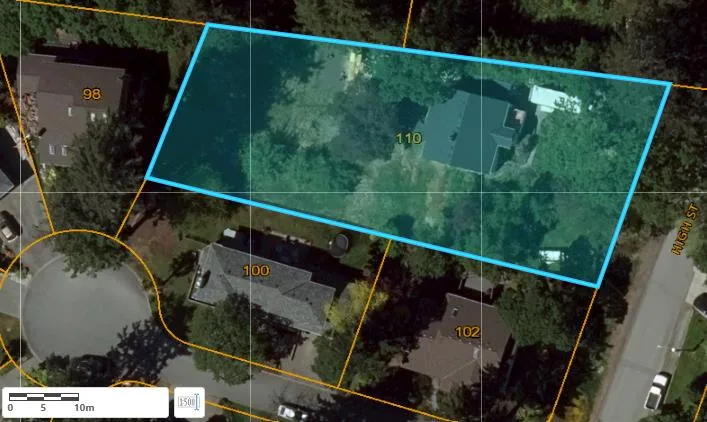
Figure 1: Site context air photo. The subject site is outlined in blue.
6. CONSTRUCTION IMPACT ASSESSMENT
6.1 RETENTION AND REMOVAL OF PRIVATE OFFSITE TREES
There are 6 private off-site trees within influencing distance of the proposed development. These trees may be possible for retention provided tree protection fencing be installed according to Appendix A and the project arborist be on site to supervise excavation within CRZ’s of the trees. Any paving within the CRZ’s of offsite trees (OS3, OS4) should follow the specifications outlined in Appendix C.
Retain and protect:
- OS1, OS2, OS3, OS4, OS5, OS6
6.2 RETENTION AND REMOVAL OF MUNICIPAL TREES
There are 3 municipal trees along the High St frontage that may be possible for retention provided tree protection fencing be installed according to Appendix A and the project arborist be on site to supervise any excavation within CRZ. Any paving within the CRZ’s of municipal trees (M1) should follow the specifications outlined in Appendix C.
Retain and protect 3 municipal trees
- M1, M2, M3
6.3 RETENTION AND REMOVAL OF ONSITE TREES
The following bylaw-protected onsite trees (indicated by Tag #) are located where they are possible for retention provided tree protection fencing be installed in accordance with Appendix A and the project arborist be on site to supervise any excavation or fill placement within the critical root zones. Any paving within the CRZ’s of onsite trees intended for retention (587, 582) should follow the specifications outlined in Appendix C.
Retain and protect 6 protected onsite trees
- 579, 580, 581, 582, 584, 587
Remove 6 protected onsite trees
- 583, 585, 586, Nt3, Nt4, Nt5
6.4 TREE REPLACEMENT
Pursuant to the town of View Royal Tree Protection Bylaw No. 1069, the tree replacement calculations are as follows:
| Quantity of Existing trees | # of Trees Retained | # of Trees Removed | Relevant Bylaw section (if applicable) | Replacement Tree Ratio | Replacement Trees Required |
|---|---|---|---|---|---|
| Onsite (bylaw protected size) | |||||
| 12 | 6 | 6 | 4(b) | 2:1 | 12 |
| City owned Trees (live) | |||||
| 3 | 3 | 0 | N/A | N/A | N/A |
| Private offsite Trees | |||||
| 6 | 6 | 0 | N/A | N/A | 0 |
| Total: | 2:1 | 12 |
7. IMPACT MITIGATION
Tree Protection Barrier
The areas surrounding the trees to be retained should be isolated from the construction activity by erecting protective barrier fencing (see Appendix A for municipal barrier specifications). Where possible, the fencing should be erected at the perimeter of the critical root zone. The barrier fencing to be erected must be a minimum of 4 feet in height, of solid frame construction that is attached to wooden or metal posts. A solid board or rail must run between the posts at the top and the bottom of the fencing. This solid frame can then be covered with flexible snow fencing. The fencing must be erected prior to the start of any construction activity on site (i.e. demolition, excavation, construction), and remain in place through completion of the project. Signs should be posted around the protection zone to declare it off limits to all construction related activity. The project arborist must be consulted before this fencing is removed or moved for any purpose.
Arborist Supervision
All excavation occurring within the critical root zones of protected trees should be completed under supervision by the project arborist. Any severed or severely damaged roots must be pruned back to sound tissue to reduce wound surface area and encourage rapid compartmentalization of the wound. In particular, the following activities should be completed under the direction of the project arborist:
- Any excavation required for the driveway within the CRZ’s of OS3, 582, 587, M1, OS4,
- Any excavation required for the building footprint within the CRZ’s of 584, 587, OS2, OS3, OS4, OS5
- Elevation pruning required on Garry oak 584 to be completed by an ISA certified arborist according to industry best practices, removing no more than 25% of the live crown tissue. Recommended pruning scope illustrated in Photograph 5.
Methods to Avoid Soil Compaction
In areas where construction traffic must encroach into the critical root zones of trees to be retained, efforts must be made to reduce soil compaction where possible by displacing the weight of machinery and foot traffic. This can be achieved by one of the following methods:
- Installing a layer of hog fuel or coarse wood chips at least 20 cm in depth and maintaining it in good condition until construction is complete.
- Placing medium weight geotextile cloth over the area to be used and installing a layer of crushed rock to a depth of 15 cm over top.
- Placing two layers of 19mm plywood.
- Placing steel plates.
Demolition of the Existing Buildings
The demolition of the existing houses, driveways, and any services that must be removed or abandoned, must take the critical root zone of the trees to be retained into account. If any excavation or machine access is required within the critical root zones of trees to be retained, it must be completed under the supervision and direction of the project arborist. If temporarily removed for demolition, barrier fencing must be erected immediately after the supervised demolition.
Paved Surfaces Above Tree Roots
If the new paved surfaces within the CRZ of tree to be retained require excavation down to bearing soil and roots are encountered in this area, this could impact their health and structural stability. If tree retention is desired, a raised and permeable paved surface should be constructed in the areas within the critical root zone of the trees. The “paved surfaces above root systems” diagram and specifications is attached.
The objective is to avoid root loss and to instead raise the paved surface and its base layer above the roots. This may result in the grade of the paved surface being raised above the existing grade (the amount depending on how close roots are to the surface and the depth of the paving material and base layers). Final grading plans should take this potential change into account. This may also result in soils which are high in organic content being left intact below the paved area.
To allow water to drain into the root systems below, we also recommend that the surface be made of a permeable material (instead of conventional asphalt or concrete) such as permeable asphalt, paving stones, or other porous paving materials and designs such as those utilized by Grasspave, Gravelpave, Grasscrete and open-grid systems.
Mulching
Mulching can be an important proactive step in maintaining the health of trees and mitigating construction related impacts and overall stress. Mulch should be made from a natural material such as wood chips or bark pieces and be 5-8cm deep. No mulch should be touching the trunk of the tree. See “methods to avoid soil compaction” if the area is to have heavy traffic.
Scaffolding
This assessment has not included impacts from potential scaffolding including canopy clearance pruning requirements. If scaffolding is necessary and this will require clearance pruning of retained trees, the project arborist should be consulted. Depending on the extent of pruning required, the project arborist may recommend that alternatives to full scaffolding be considered such as hydraulic lifts, ladders or platforms. Methods to avoid soil compaction may also be recommended (see “Minimizing Soil Compaction” section).
Landscaping and Irrigation Systems
The planting of new trees and shrubs should not damage the roots of retained trees. The installation of any in-ground irrigation system must take into account the critical root zones of the trees to be retained. Prior to installation, we recommend the irrigation technician consult with the project arborist about the most suitable locations for the irrigation lines and how best to mitigate the impacts on the trees to be retained. This may require the project arborist supervise the excavations associated with installing the irrigation system. Excessive frequent irrigation and irrigation which wets the trunks of trees can have a detrimental impact on tree health and can lead to root and trunk decay.
Arborist Role
It is the responsibility of the client or his/her representative to contact the project arborist for the purpose of:
- Locating the barrier fencing
- Reviewing the report with the project foreman or site supervisor
- Locating work zones, where required
- Supervising any excavation within the critical root zones of trees to be retained
- Reviewing and advising of any pruning requirements for machine clearances
Blasting
Any intended blasting to remove the rock outcropping around trees 583 and 852 should be reviewed by the project arborist prior to work commencing as this may affect the retention suitability of on-site and off-site trees.
Review and site meeting
Once the project receives approval, it is important that the project arborist meet with the principals involved in the project to review the information contained herein. It is also important that the arborist meet with the site foreman or supervisor before any site clearing, tree removal, demolition, or other construction activity occurs and to confirm the locations of the tree protection barrier fencing.
Servicing
No servicing plans have been provided showing servicing to proposed primary or accessory buildings. We recommend that servicing to proposed buildings be located outside of CRZ of any trees intended for retention. If services are to be routed inside the CRZ of any protected trees, the project arborist must be on site to supervise excavation.
8. LIMITATIONS OF REPORT
This arboricultural field review report was prepared by Talbot Mackenzie & Associates for the exclusive use of the Client and may not be reproduced, used or relied upon, in whole or in part, by a party other than the Client without the prior written consent of Talbot Mackenzie & Associates. Any unauthorized use of this report, or any part hereof, by a third party, or any reliance on or decisions to be made based on it, are at the sole risk of such third parties. Talbot Mackenzie & Associates accepts no responsibility for damages, if any, suffered by any third party as a result of decisions made or actions based on this report, in whole or in part.
Arborists are professionals who examine trees and use their training, knowledge, and experience to recommend techniques and procedures that will improve a tree’s health and structure or to mitigate associated risks. Trees are living organisms whose health and structure change and are influenced by age, continued growth, climate, weather conditions, and insect and disease pathogens. Indicators of structural weakness and disease are often hidden within the tree structure or beneath the ground. The arborist’s review is limited to a visual examination of tree health and structural condition, without excavation, probing, resistance drilling, increment coring, or aerial examination. There are inherent limitations to this type of investigation, including, without limitation, that some tree conditions will inadvertently go undetected. The arborist’s review followed the standard of care expected of arborists undertaking similar work in British Columbia under similar conditions. No warranties, either express or implied, are made as to the services provided and included in this report.
The findings and opinions expressed in this report are based on the conditions that were observed on the noted date of the field review only. The Client recognizes that passage of time, natural occurrences, and direct or indirect human intervention at or near the trees may substantially alter discovered conditions and that Talbot Mackenzie & Associates cannot report on, or accurately predict, events that may change the condition of trees after the described investigation was completed.
It is not possible for an Arborist to identify every flaw or condition that could result in failure nor can he/she guarantee that the tree will remain healthy and free of risk. The only way to eliminate tree risk entirely is to remove the entire tree. All trees retained should be monitored on a regular basis. Remedial care and mitigation measures recommended are based on the visible and detectable indicators present at the time of the examination and cannot be guaranteed to alleviate all symptoms or to mitigate all risk posed.
Immediately following land clearing, grade changes or severe weather events, all trees retained should be reviewed for any evidence of soil heaving, cracking, lifting or other indicators of root plate instability. If new information is discovered in the future during such events or other activities, Talbot Mackenzie & Associates should be requested to re-evaluate the conclusions of this report and to provide amendments as required prior to any reliance upon the information presented herein.
9. IN CLOSING
We trust that this report meets your needs. Should there be any questions regarding the information within this report, please do not hesitate to contact the undersigned.
Yours truly,
Talbot Mackenzie & Associates
Prepared by:
Shannon Murray BSc ISA Certified Arborist PN – 9024A Tree Risk Assessment Qualification Email: tmtreehelp@gmail.com
Document Images
(2)