Attachment 21. Arborist Report - Lakeside Village Commercial
Consultant report evaluating the health of Garry Oak trees on site and recommending retention and mitigation strategies.
July 29, 2013
Town of View Royal Planning Department 45 View Royal Avenue Victoria, BC, V9B 1A6
To whom it may concern:
Re: Lakeside Village Commercial
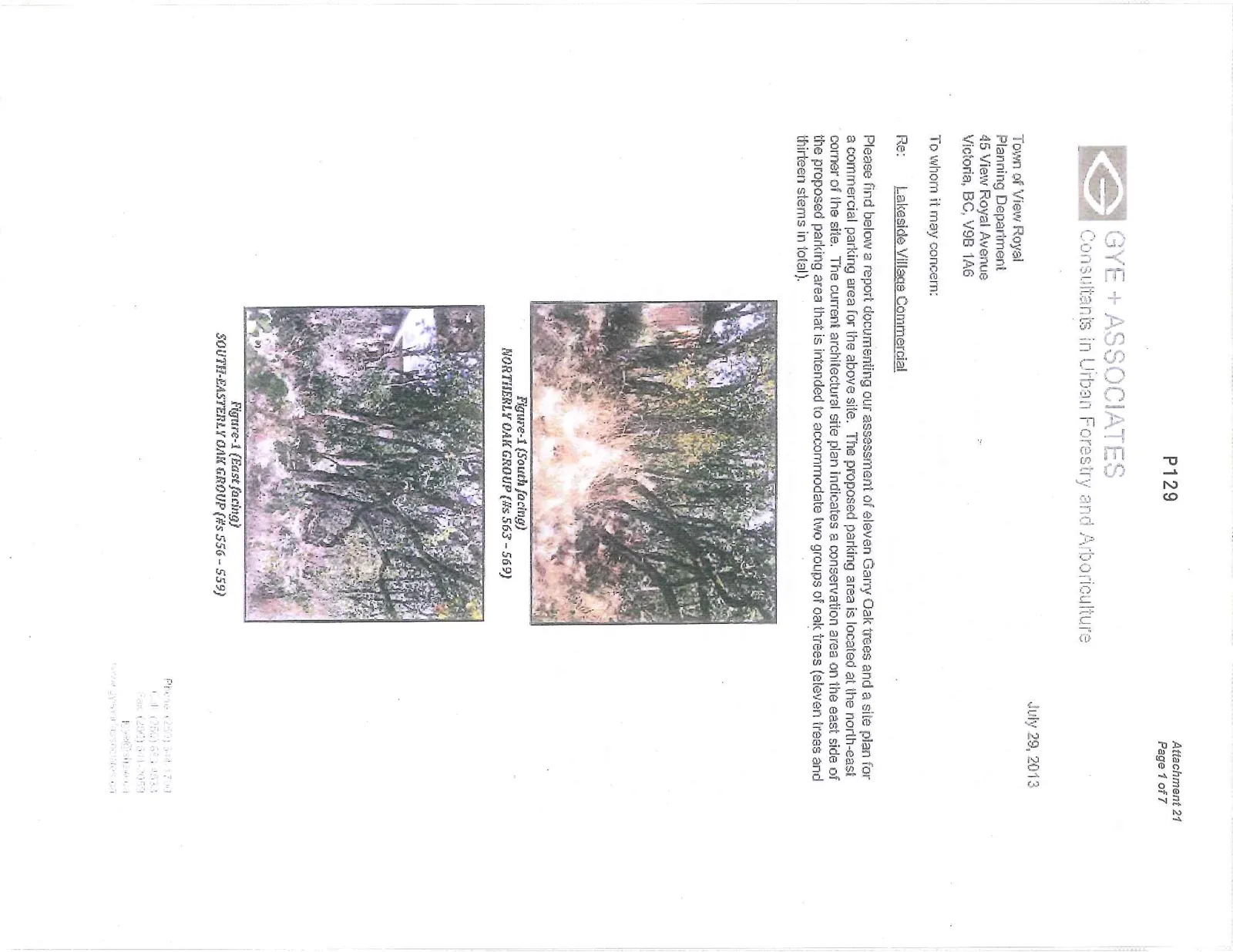
Please find below a report documenting our assessment of eleven Garry Oak trees and a site plan for a commercial parking area for the above site. The proposed parking area is located at the north-east corner of the site. The current architectural site plan indicates a conservation area on the east side of the proposed parking area that is intended to accommodate two groups of oak trees (eleven trees and thirteen stems in total).
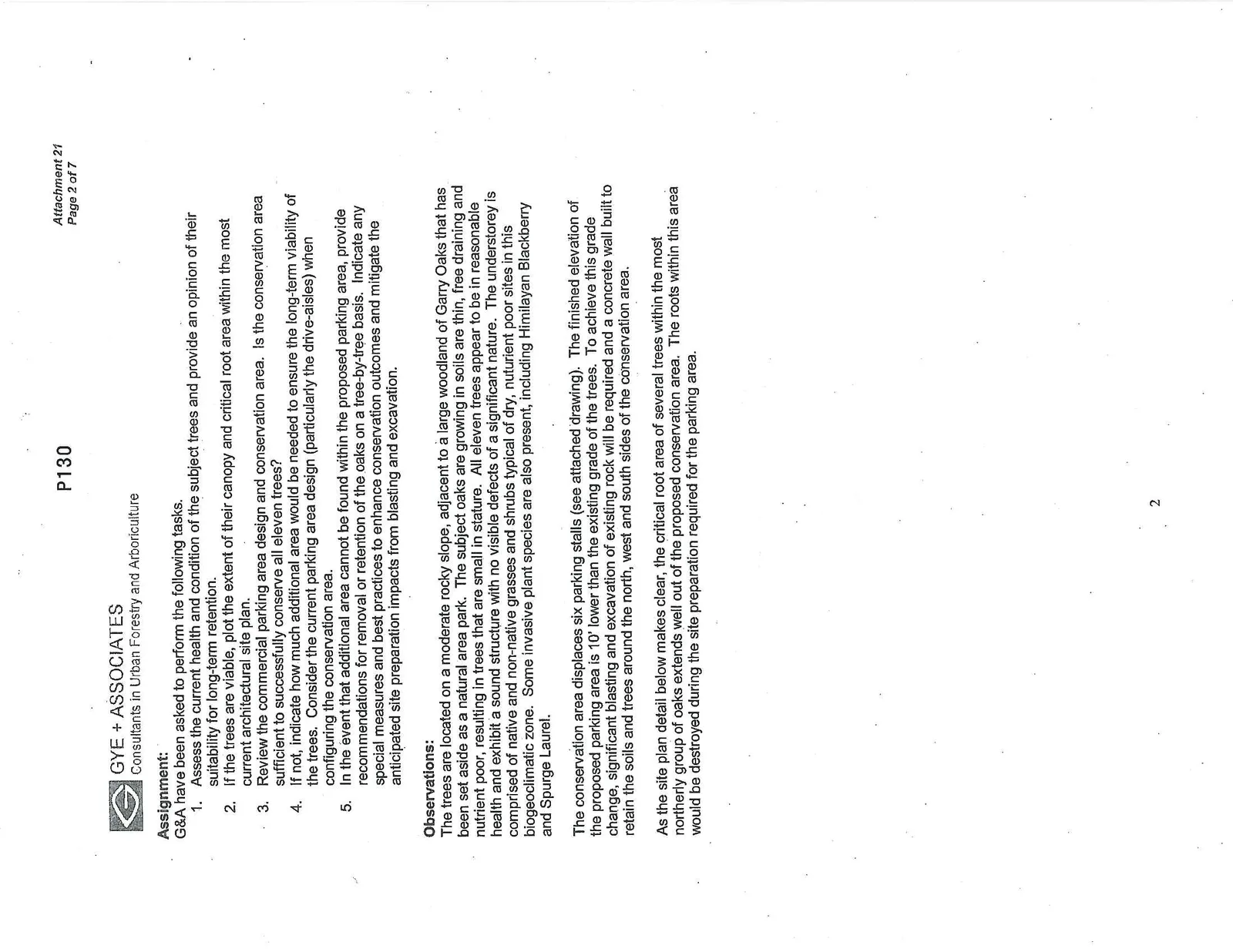
Assignment:
G&A have been asked to perform the following tasks.
- Assess the current health and condition of the subject trees and provide an opinion of their suitability for long-term retention.
- If the trees are viable, plot the extent of their canopy and critical root area within the most current architectural site plan.
- Review the commercial parking area design and conservation area. Is the conservation area sufficient to successfully conserve all eleven trees?
- If not, indicate how much additional area would be needed to ensure the long-term viability of the trees. Consider the current parking area design (particularly the drive-aisles) when configuring the conservation area.
- In the event that additional area cannot be found within the proposed parking area, provide recommendations for removal or retention of the oaks on a tree-by-tree basis. Indicate any special measures and best practices to enhance conservation outcomes and mitigate the anticipated site preparation impacts from blasting and excavation.
Observations:
The trees are located on a moderate rocky slope, adjacent to a large woodland of Garry Oaks that has been set aside as a natural area park. The subject oaks are growing in soils are thin, free draining and nutrient poor, resulting in trees that are small in stature. All eleven trees appear to be in reasonable health and exhibit a sound structure with no visible defects of a significant nature. The understorey is comprised of native and non-native grasses and shrubs typical of dry, nutrient poor sites in this biogeoclimatic zone. Some invasive plant species are also present, including Himalayan Blackberry and Spurge Laurel.
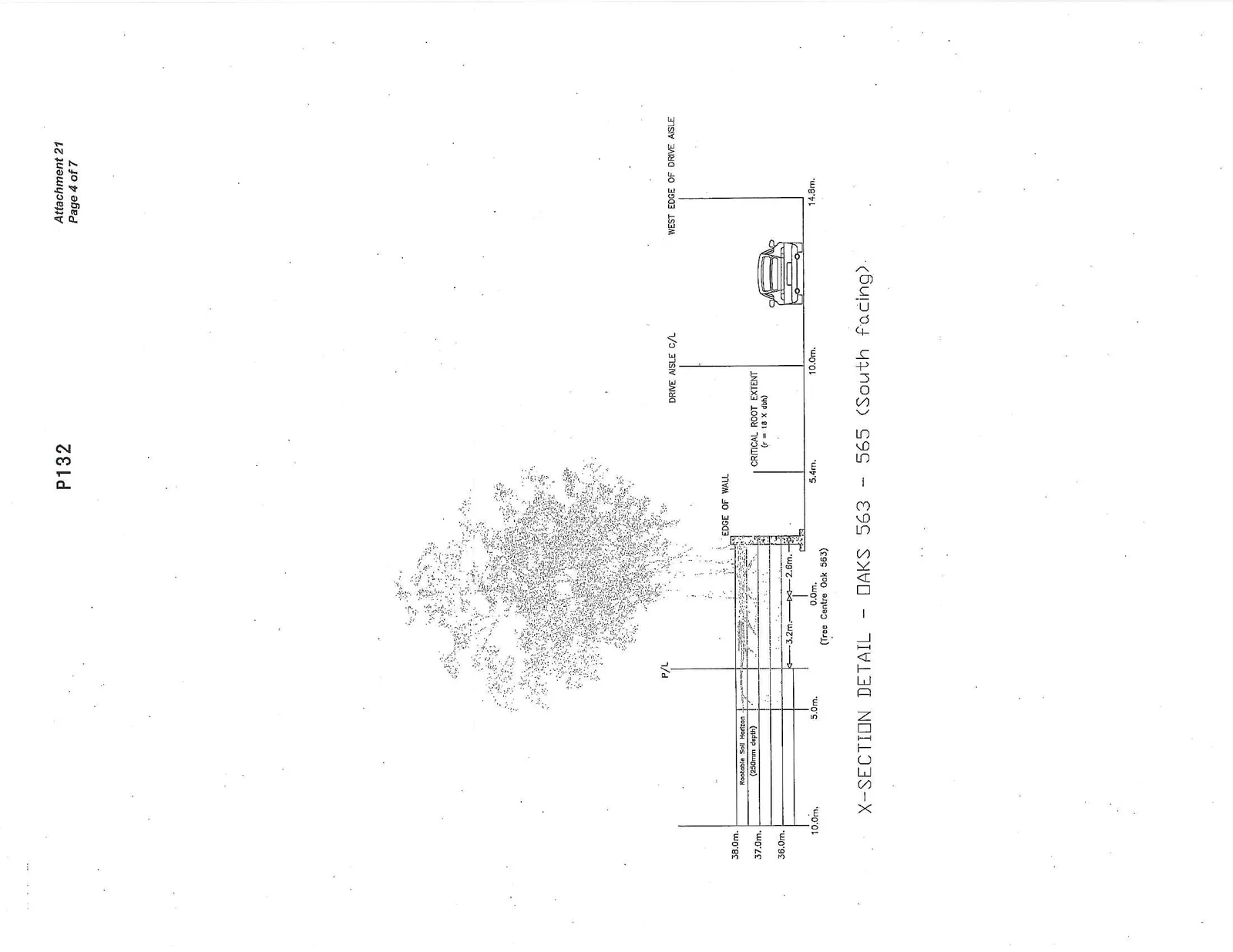
The conservation area displaces six parking stalls (see attached drawing). The finished elevation of the proposed parking area is 10' lower than the existing grade of the trees. To achieve this grade change, significant blasting and excavation of existing rock will be required and a concrete wall built to retain the soils and trees around the north, west and south sides of the conservation area.
As the site plan detail below makes clear, the critical root area of several trees within the most northerly group of oaks extends well out of the proposed conservation area. The roots within this area would be destroyed during the site preparation required for the parking area.
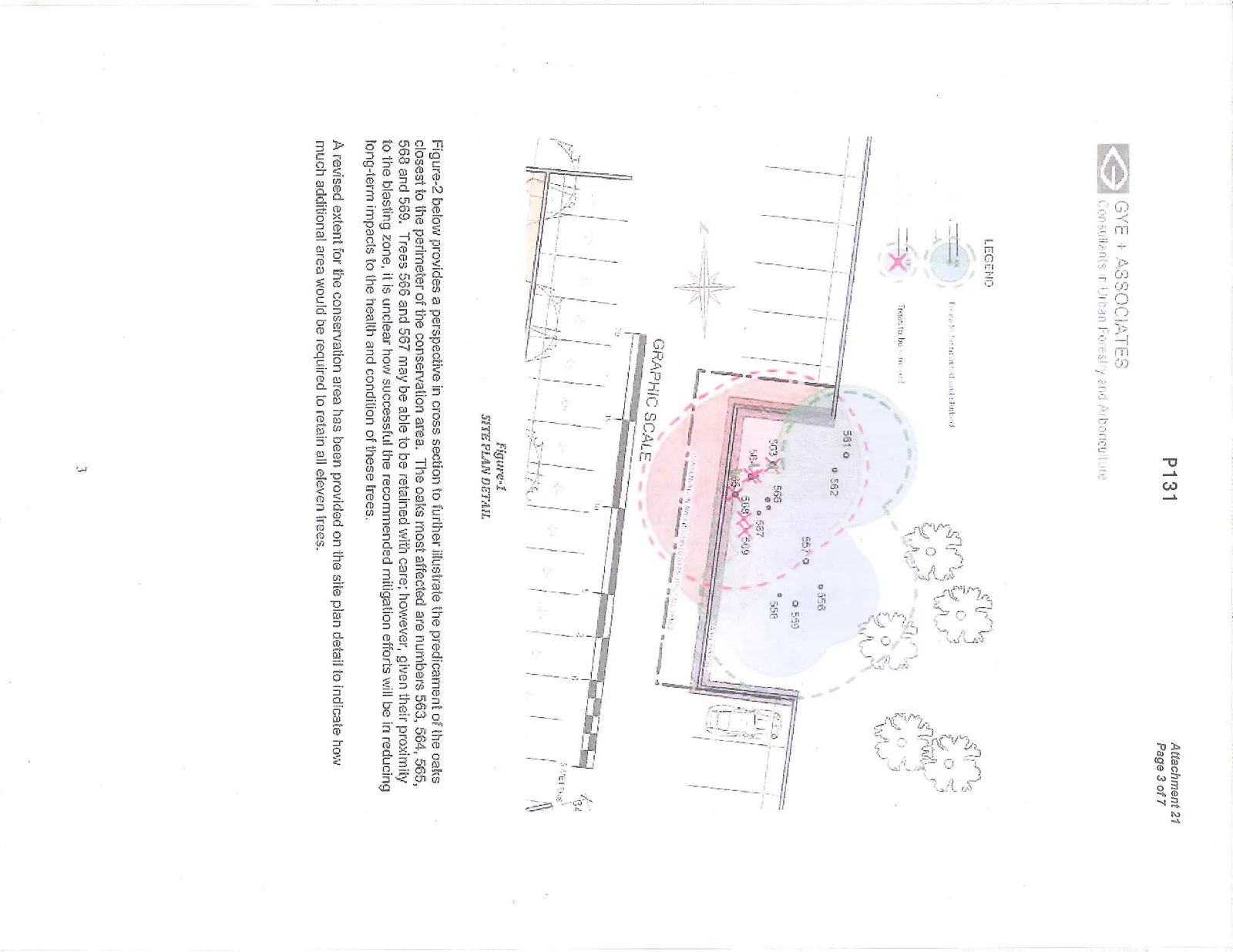
Figure-2 below provides a perspective in cross section to further illustrate the predicament of the oaks closest to the perimeter of the conservation area. The oaks most affected are numbers 563, 564, 565, 568 and 569. Trees 566 and 567 may be able to be retained with care; however, given their proximity to the blasting zone, it is unclear how successful the recommended mitigation efforts will be in reducing long-term impacts to the health and condition of these trees.
A revised extent for the conservation area has been provided on the site plan detail to indicate how much additional area would be required to retain all eleven trees.
Discussion:
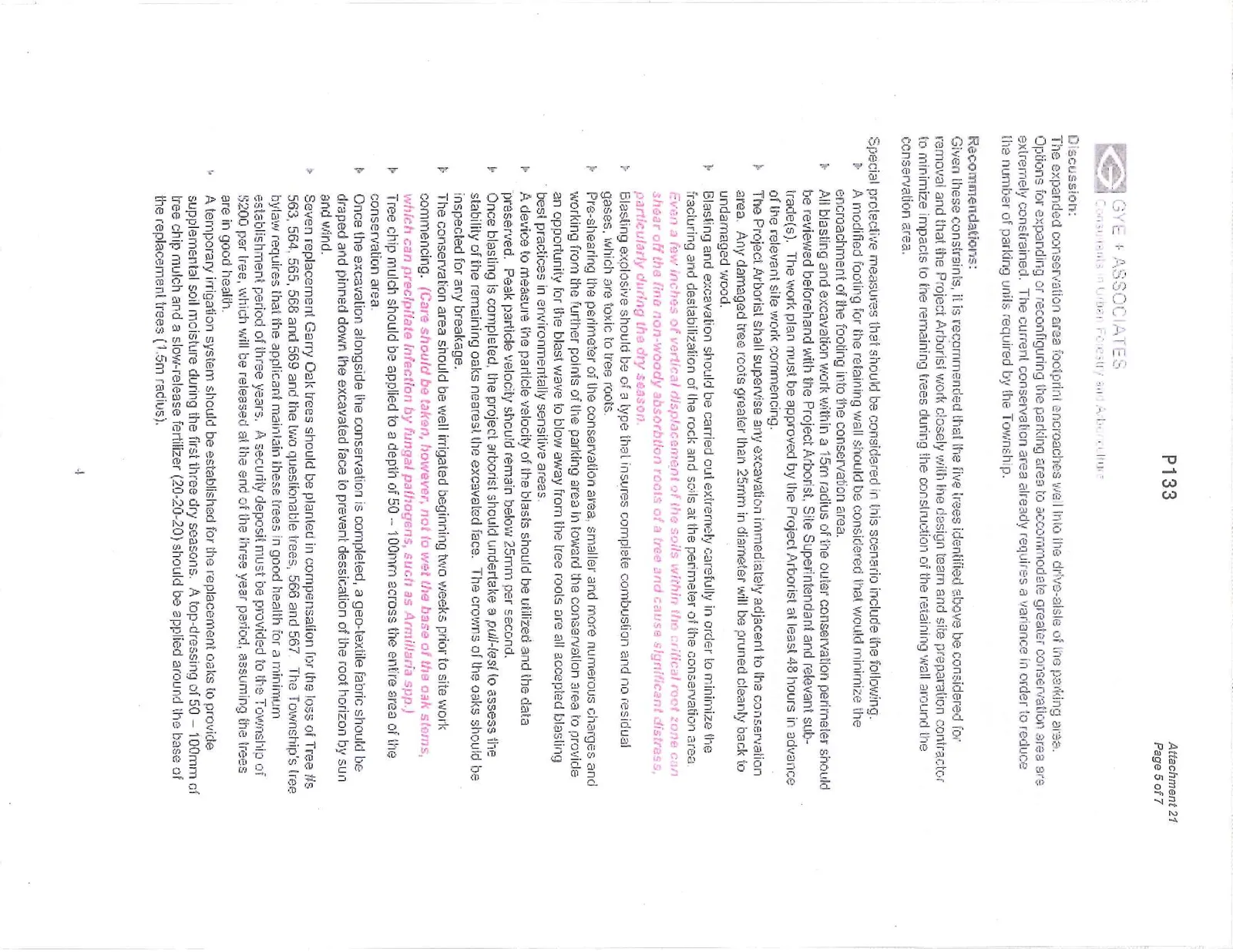
The expanded conservation area footprint encroaches well into the drive-aisle of the parking area. Options for expanding or reconfiguring the parking area to accommodate greater conservation area are extremely constrained. The current conservation area already requires a variance in order to reduce the number of parking units required by the Township.
Recommendations:
Given these constraints, it is recommended that the five trees identified above be considered for removal and that the Project Arborist work closely with the design team and site preparation contractor to minimize impacts to the remaining trees during the construction of the retaining wall around the conservation area.
Special protective measures that should be considered in this scenario include the following.
- A modified footing for the retaining wall should be considered that would minimize the encroachment of the footing into the conservation area.
- All blasting and excavation work within a 15m radius of the outer conservation perimeter should be reviewed beforehand with the Project Arborist, Site Superintendent and relevant sub-trade(s). The work plan must be approved by the Project Arborist at least 48 hours in advance of the relevant site work commencing.
- The Project Arborist shall supervise any excavation immediately adjacent to the conservation area. Any damaged tree roots greater than 25mm in diameter will be pruned cleanly back to undamaged wood.
- Blasting and excavation should be carried out extremely carefully in order to minimize the fracturing and destabilization of the rock and soils at the perimeter of the conservation area. Even a few inches of vertical displacement of the soils within the critical root zone can shear off the fine non-woody absorbtion roots of a tree and cause significant distress, particularly during the dry season.
- Blasting explosive should be of a type that insures complete combustion and no residual gases, which are toxic to tree roots.
- Pre-shearing the perimeter of the conservation area, smaller and more numerous charges and working from the further points of the parking area in toward the conservation area to provide an opportunity for the blast wave to blow away from the tree roots are all accepted blasting best practices in environmentally sensitive areas.
- A device to measure the particle velocity of the blasts should be utilized and the data preserved. Peak particle velocity should remain below 25mm per second.
- Once blasting is completed, the project arborist should undertake a pull-test to assess the stability of the remaining oaks nearest the excavated face. The crowns of the oaks should be inspected for any breakage.
- The conservation area should be well irrigated beginning two weeks prior to site work commencing. (Care should be taken, however, not to wet the base of the oak stems, which can precipitate infection by fungal pathogens, such as Armillaria spp.)
- Tree chip mulch should be applied to a depth of 50 - 100mm across the entire area of the conservation area.
- Once the excavation alongside the conservation is completed, a geo-textile fabric should be draped and pinned down the excavated face to prevent dessication of the root horizon by sun and wind.
- Seven replacement Garry Oak trees should be planted in compensation for the loss of Tree #s 563, 564, 565, 568 and 569 and the two questionable trees, 566 and 567. The Township's tree bylaw requires that the applicant maintain these trees in good health for a minimum establishment period of three years. A security deposit must be provided to the Township of $200 per tree, which will be released at the end of the three year period, assuming the trees are in good health.
- A temporary irrigation system should be established for the replacement oaks to provide supplemental soil moisture during the first three dry seasons. A top-dressing of 50 - 100mm of tree chip mulch and a slow-release fertilizer (20-20-20) should be applied around the base of the replacement trees (1.5m radius).
Certification and Limits of Report:
This report and the opinions expressed within it have been prepared in good faith and to accepted arboricultural standards within the scope afforded by its terms of reference and the resources made available to the consultant. No other trees associated with this site have been assessed by G&A at this time.
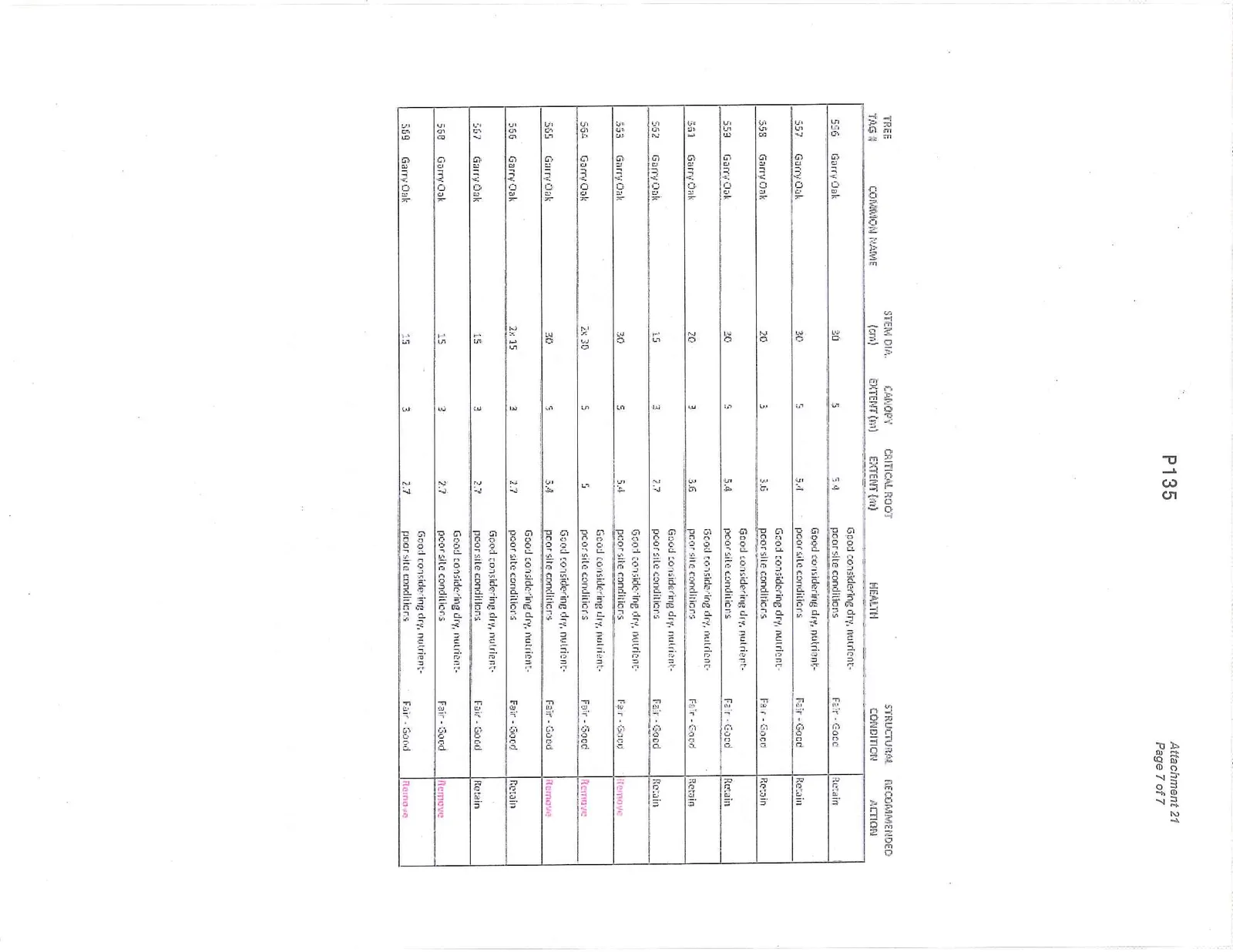
Tree Data
| TREE TAG # | COMMON NAME | STEM DIA. (cm) | CANOPY EXTENT (m) | CRITICAL ROOT EXTENT (m) | HEALTH | STRUCTURAL CONDITION | RECOMMENDED ACTION |
|---|---|---|---|---|---|---|---|
| 556 | Garry Oak | 30 | 5 | 5.4 | Good considering dry, nutrient-poor site conditions | Fair - Good | Retain |
| 557 | Garry Oak | 30 | 5 | 5.4 | Good considering dry, nutrient-poor site conditions | Fair - Good | Retain |
| 558 | Garry Oak | 20 | 3 | 3.6 | Good considering dry, nutrient-poor site conditions | Fair - Good | Retain |
| 559 | Garry Oak | 30 | 5 | 5.4 | Good considering dry, nutrient-poor site conditions | Fair - Good | Retain |
| 561 | Garry Oak | 20 | 3 | 3.6 | Good considering dry, nutrient-poor site conditions | Fair - Good | Retain |
| 562 | Garry Oak | 15 | 3 | 2.7 | Good considering dry, nutrient-poor site conditions | Fair - Good | Retain |
| 563 | Garry Oak | 30 | 5 | 5.4 | Good considering dry, nutrient-poor site conditions | Fair - Good | Remove |
| 564 | Garry Oak | 2x 30 | 5 | 5 | Good considering dry, nutrient-poor site conditions | Fair - Good | Remove |
| 565 | Garry Oak | 30 | 5 | 5.4 | Good considering dry, nutrient-poor site conditions | Fair - Good | Remove |
| 566 | Garry Oak | 2x 15 | 3 | 2.7 | Good considering dry, nutrient-poor site conditions | Fair - Good | Retain |
| 567 | Garry Oak | 15 | 3 | 2.7 | Good considering dry, nutrient-poor site conditions | Fair - Good | Retain |
| 568 | Garry Oak | 15 | 3 | 2.7 | Good considering dry, nutrient-poor site conditions | Fair - Good | Remove |
| 569 | Garry Oak | 15 | 3 | 2.7 | Good considering dry, nutrient-poor site conditions | Fair - Good | Remove |
Document Images
(4)