Schedule ‘B’ Town of View Royal 2014 Revenue Policy Disclosure
Policy disclosure document outlining revenue sources, funding objectives, property tax distribution, and permissive tax exemptions.
Schedule ‘B’
Town of View Royal 2014 Revenue Policy Disclosure
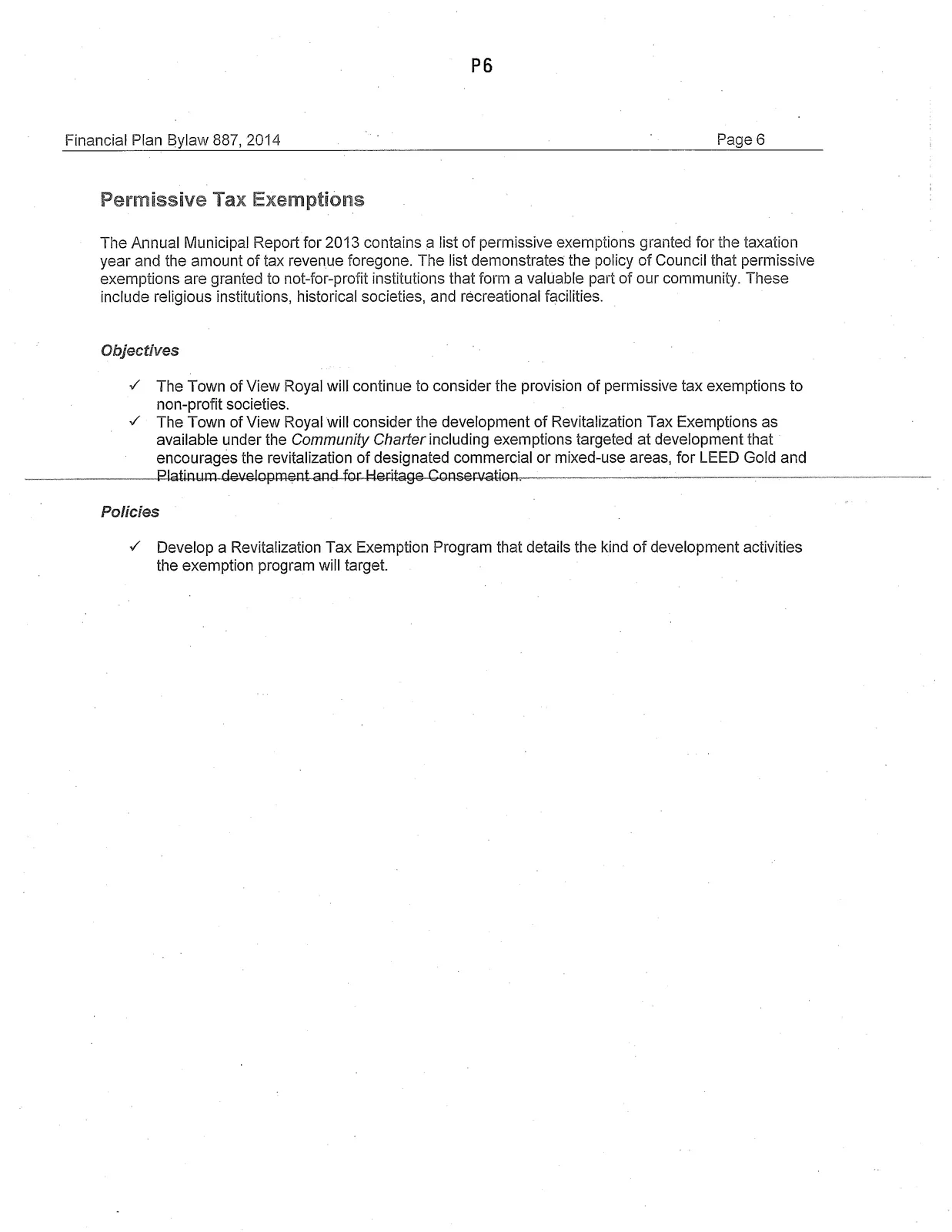
In accordance with Section 165(3.1) of the Community Charter, the Town of View Royal is required to include in the Five Year Financial Plan, objectives and policies regarding each of the following:
- The proportion of total revenue that comes from each of the funding sources described in Section 165(7) of the Community Charter,
- The distribution of property taxes among the property classes, and
- The use of permissive tax exemptions.
Funding Sources
Table One shows the proportion of total proposed 2014 revenue to be raised from each funding source. One column shows the proposed revenue including Conditional Government Transfers and one column shows the proposed revenue excluding Conditional Government Transfers. Conditional Government Transfers are funds provided by other governments or government agencies for specifically defined projects. Without this additional funding, the projects would not occur or an increase in property value taxes or user fees would be required.
Property value taxes form the largest proportion of the revenue of the municipality. The system of property taxation is relatively easy to administer and understand. It provides a stable and consistent source of revenue for many services that are difficult or undesirable to fund on a user-pay basis. These include services such as police protection, fire protection, most transportation services and street-lighting. For these reasons, property value taxation will continue to be the major source of municipal revenue.
Casino Grant funding is the second largest individual source of funding received in the form of a grant from the Province related to the Great Canadian Casino, located in the Town of View Royal. The Town has entered into a partnership agreement with several adjoining local governments to share 55% of this grant; the Town of View Royal retains 45% for its own use. The Town of View Royal uses its 45% to fund activities in the community such as:
- membership in the Greater Victoria Public Library,
- membership in recreation services provided by the West Shore Parks and Recreation Society,
- grants to local community organizations,
- funding capital improvements, and
- debt repayments on capital borrowing.
User fees and charges form the third largest portion of revenue. Many municipal services, such as sewer usage, can be measured and charged for on a user-pay basis. This basis attempts to fairly apportion the value of a municipal service to those who make use of it. Other services where revenues are related to costs include planning, zoning, and development and inspection services.
Objectives
- The Town of View Royal will be financially sustainable.
- The Town of View Royal will reduce its Casino Grant funding contributions to municipal operations and focus the casino grant funding priority on municipal infrastructure.
Policies
- In 2010, the Town of View Royal started to transition the funding of membership in the Greater Victoria Public Library (GVPL) from the Casino Grant funding to Property Value Taxes with the goal of a yearly transition equal to 1.5% increase in the Property Value Tax each year until Property Value Tax funds 100% of the GVPL. In 2014, this transfer will be $nil.
- The Town of View Royal will examine municipal services to determine the suitability of user fees as the primary source of funding. Property Value Taxes will pay for the cost of annual operations that would be difficult or undesirable to fund on a user-pay basis.
- The Town of View Royal will examine the life cycle costs of all new infrastructure and new services before initiating. Operating, maintenance, and replacement costs for all existing infrastructure will be included in its Five Year Financial Plan.
- Services funded by user fees shall pay an administration fee.
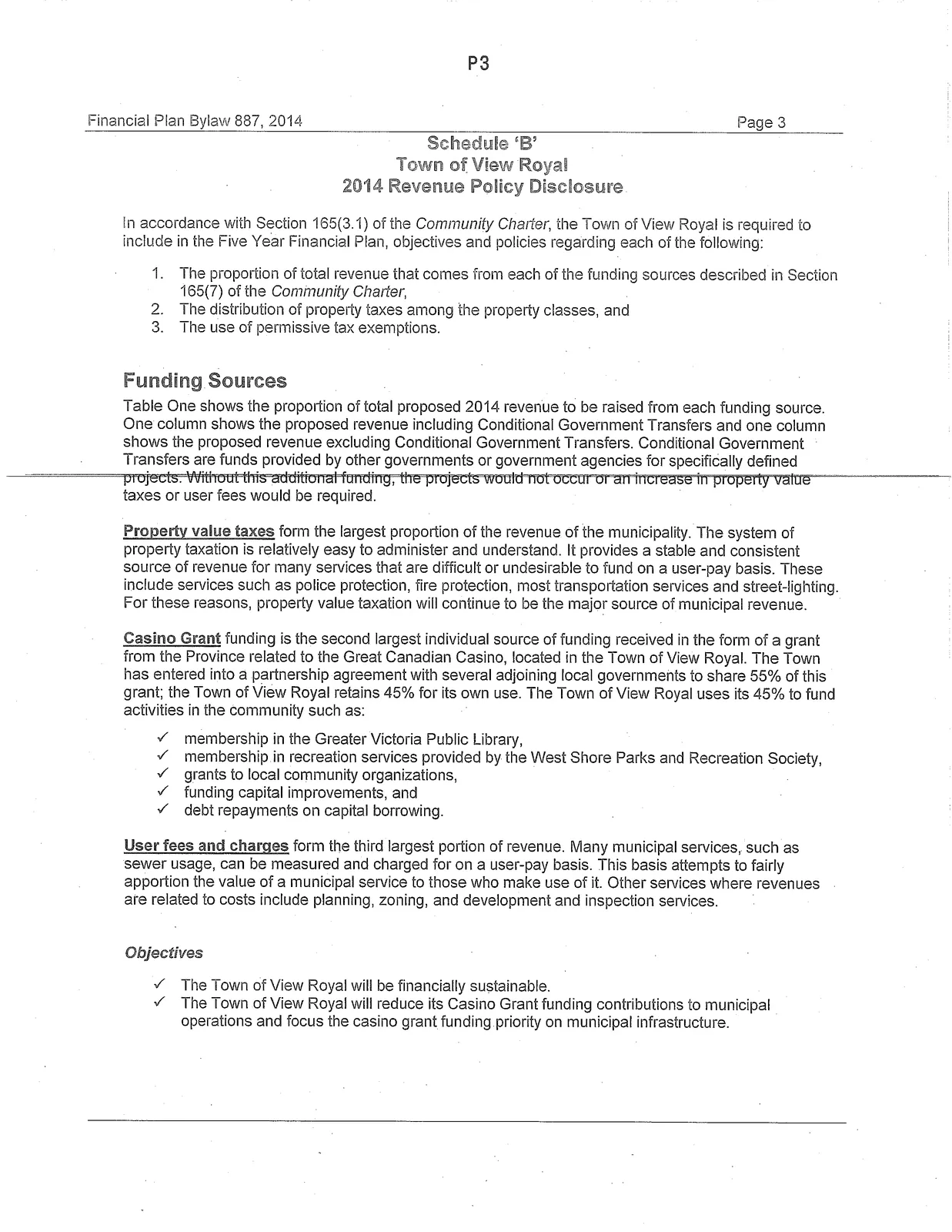
Table One: Proportions of Total Revenue
| Revenue Source | % Total Revenue ($) Including Conditional Grants and Contributions ** | % of Total Revenue ($) Excluding Conditional Grants and Contributions ** |
|---|---|---|
| Property value taxes | 52.83 | 69.55 |
| Sales of services | 8.08 | 10.64 |
| Utility user rates and connection fees | 9.53 | 12.55 |
| Other revenue | 1.87 | 2.46 |
| Grants and Contributions - casino | 20.33 | 0.00 |
| Grants and Contributions - other | 6.75 | 4.00 |
| Contribution from developers | 0.61 | 0.80 |
| Total | 100.00 | 100.00 |
** Conditional Government Transfers towards 2014 capital projects total $1,700,260 Conditional Government Transfers towards 2014 operational projects total $1,217,370.
Distribution of Property Tax Rates
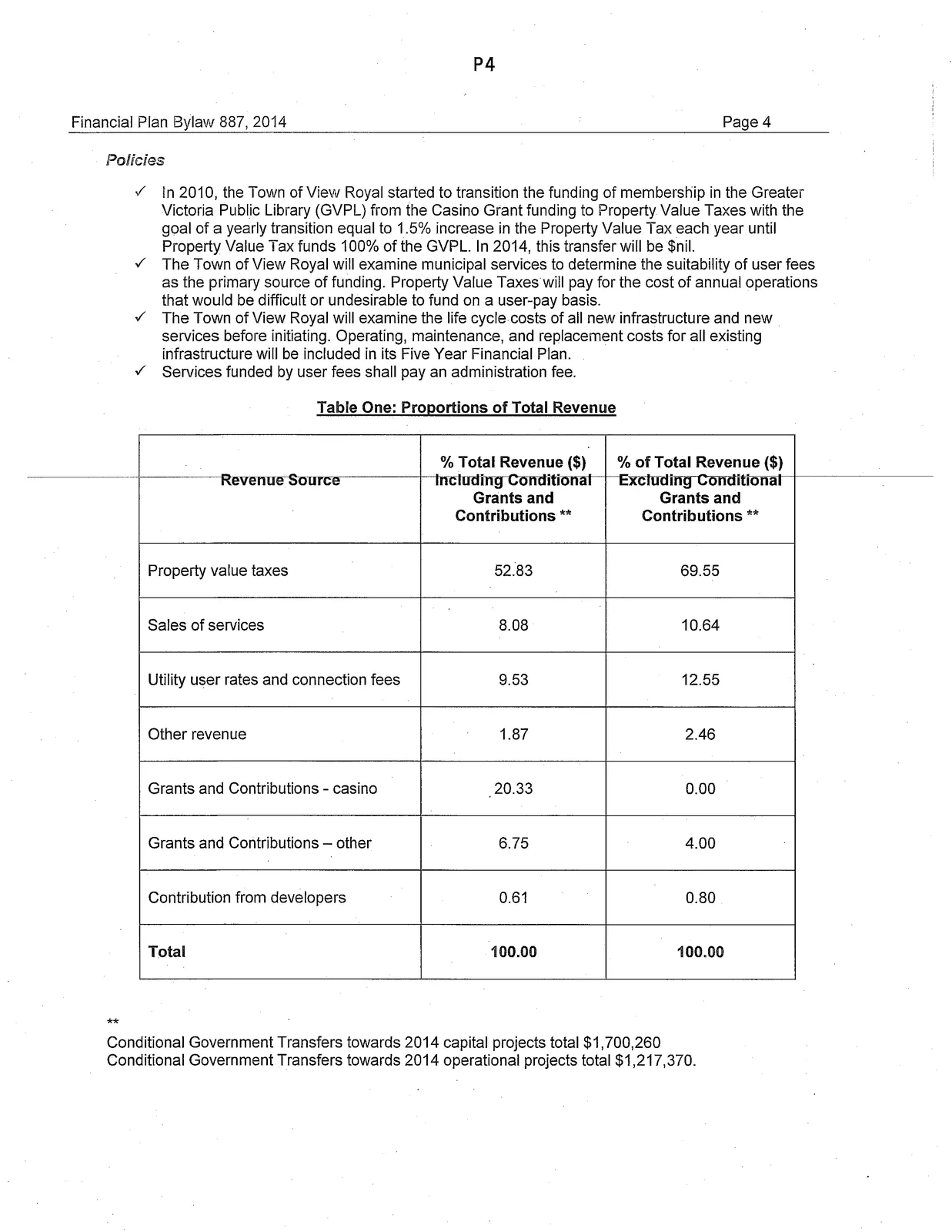
Table Two provides the distribution of property tax revenue among the property classes. The practice of Council has been to set tax rates in order to maintain tax stability. This is accomplished by Council considering:
- The historical proportion of taxes paid by each property classification before consideration of non-market changes in the property class, and
- The Tax levy on an average home and business.
This practice allows the various taxpayers in the municipality to be confident that, in any year, their property tax bill will only increase proportionate to the increase in tax revenue required year over year.
Objectives
- To ensure property value taxes remain affordable / reasonable for services provided.
- To maintain consistent tax increases for average property values in all property classes.
Policies
- Regularly review the affordability of property value taxes for each property class relative to other classes.
- Regularly review and compare the Town of View Royal’s distributions of tax burden relative to other municipalities in British Columbia.
Table Two: Distribution of Property Tax Revenue
| Property Class | Property Value Tax $ Value | Property Value Tax % of Total | Property Assessment * Value | Property Assessment * % of Total |
|---|---|---|---|---|
| Residential (01) | 4,493,982 | 73.65 | 1,688,677,603 | 90.66 |
| Utilities (02) | 12,468 | 0.20 | 377,200 | 0.02 |
| Light Industry (05) | 19,112 | 0.31 | 2,298,000 | 0.12 |
| Business (06) | 1,518,722 | 24.89 | 165,285,450 | 8.87 |
| Recreational/Non-profit (08) | 56,490 | 0.93 | 6,221,000 | 0.33 |
| Farm (09) | 1,280 | 0.02 | 60,496 | 0.00 |
| Total | 6,102,054 | 100.00 | 1,862,919,749 | 100.00 |
Permissive Tax Exemptions
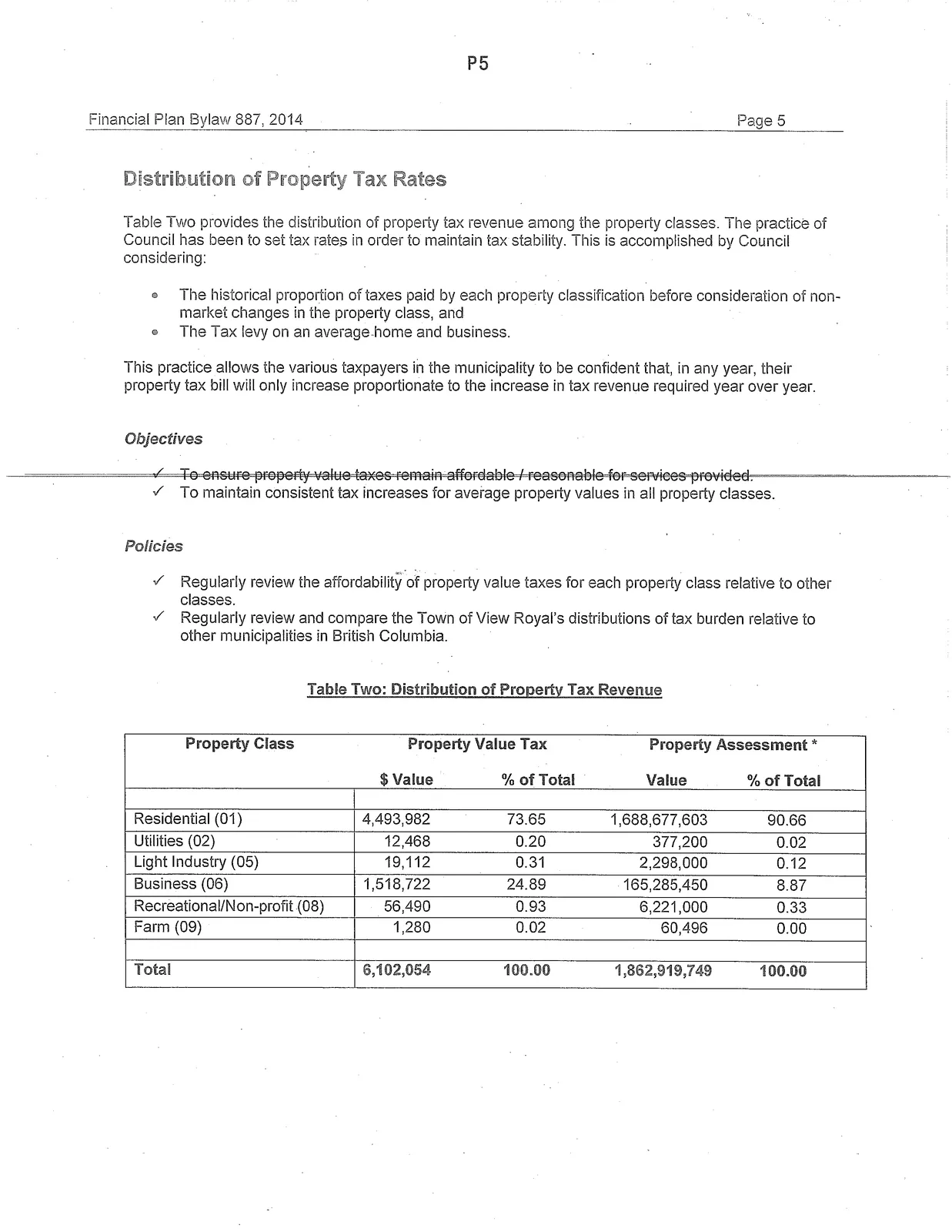
The Annual Municipal Report for 2013 contains a list of permissive exemptions granted for the taxation year and the amount of tax revenue foregone. The list demonstrates the policy of Council that permissive exemptions are granted to not-for-profit institutions that form a valuable part of our community. These include religious institutions, historical societies, and recreational facilities.
Objectives
- The Town of View Royal will continue to consider the provision of permissive tax exemptions to non-profit societies.
- The Town of View Royal will consider the development of Revitalization Tax Exemptions as available under the Community Charter including exemptions targeted at development that encourages the revitalization of designated commercial or mixed-use areas, for LEED Gold and Platinum development and for Heritage Conservation.
Policies
- Develop a Revitalization Tax Exemption Program that details the kind of development activities the exemption program will target.