Native Plant Demonstration Garden Portage Park Final Report
Final report on the restoration and coordination of the native plant garden at Portage Park, funded by a Grant-in-Aid.
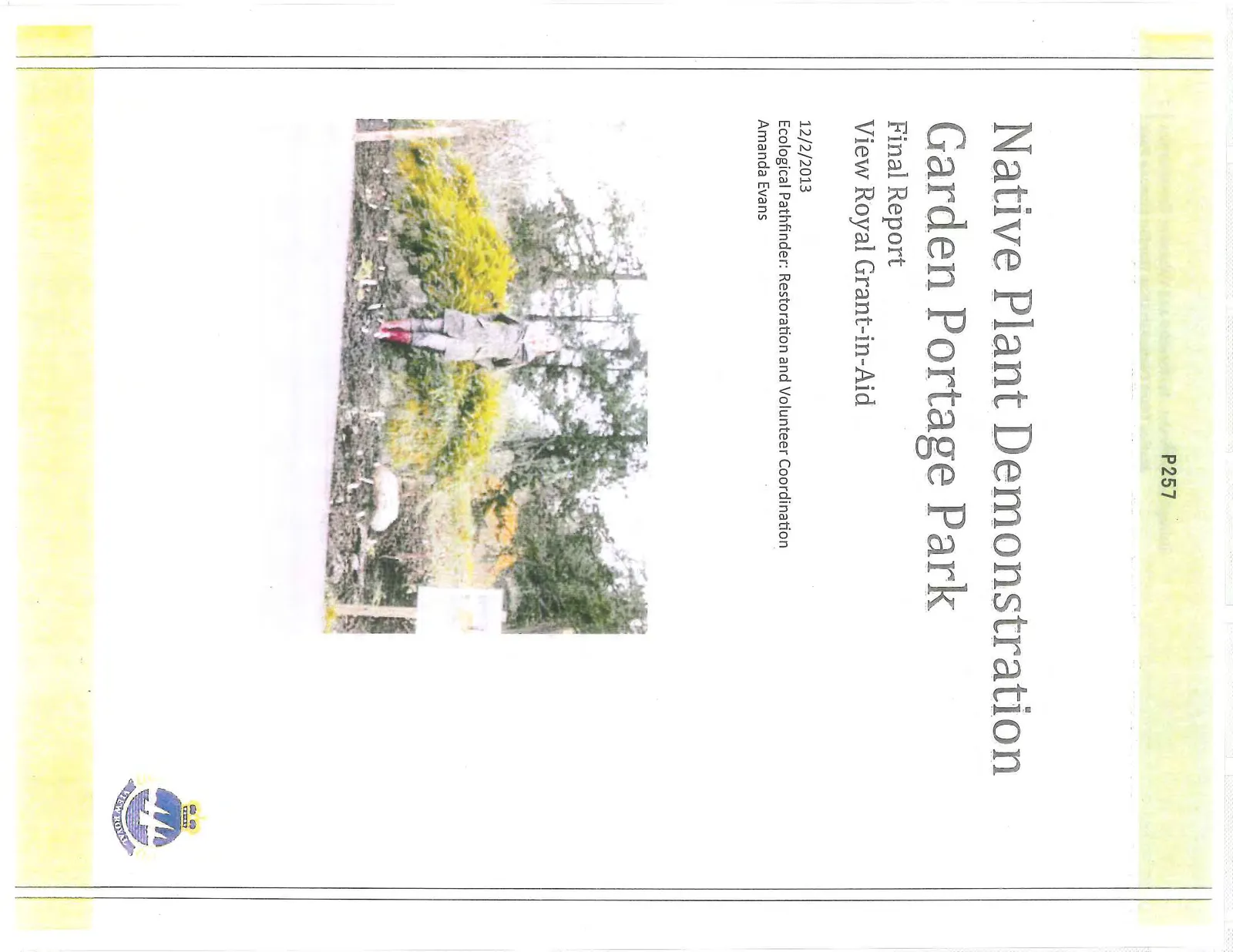
Native Plant Demonstration Garden Portage Park
Final Report
View Royal Grant-in-Aid
12/2/2013 Ecological Pathfinder: Restoration and Volunteer Coordination Amanda Evans
This report summarizes the work accomplished for the Native Plant Demonstration Garden project in Portage Park as part of the Grant-in-Aid received from the Town of View Royal. The project took place between January and November 2013. The project will continue over the long-term and will be maintained through the Portage Park Restoration Project and Volunteer Program (View Royal) coordinated by Amanda Evans.
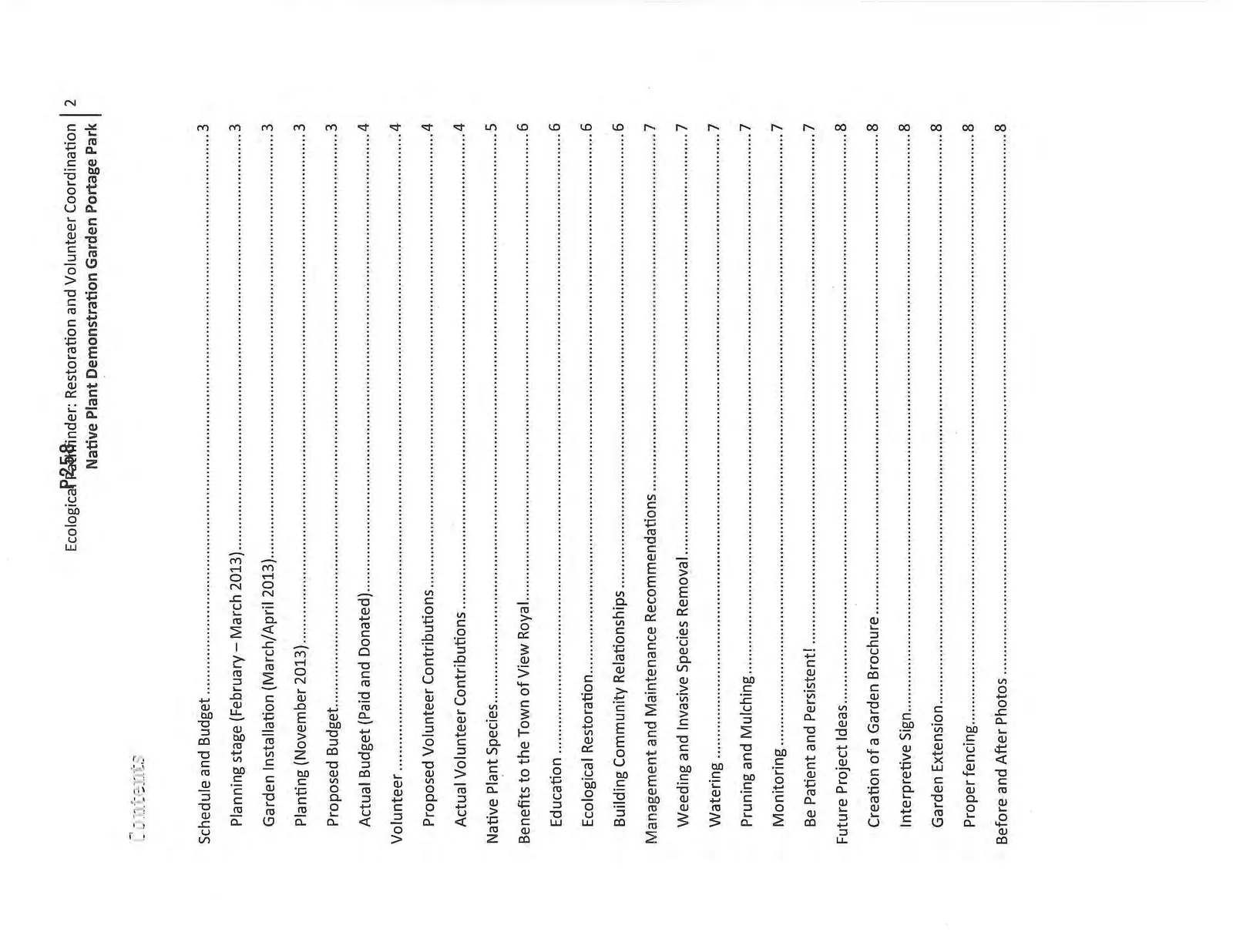
Schedule and Budget
The project fulfilled the project schedule and budget as part of the proposal submitted to View Royal in January 2013.
Planning stage (February – March 2013)
A group of Environmental Studies students from the University of Victoria, coordinated by Amanda Evans, developed the plan for the garden. This planning project included describing the ecological characteristics of the site, researching and determining the most suitable native plant species, and describing each of the recommended species. The plan was written by the student group and fulfilled the final project for their Ecological Restoration course.
Garden Installation (March/April 2013)
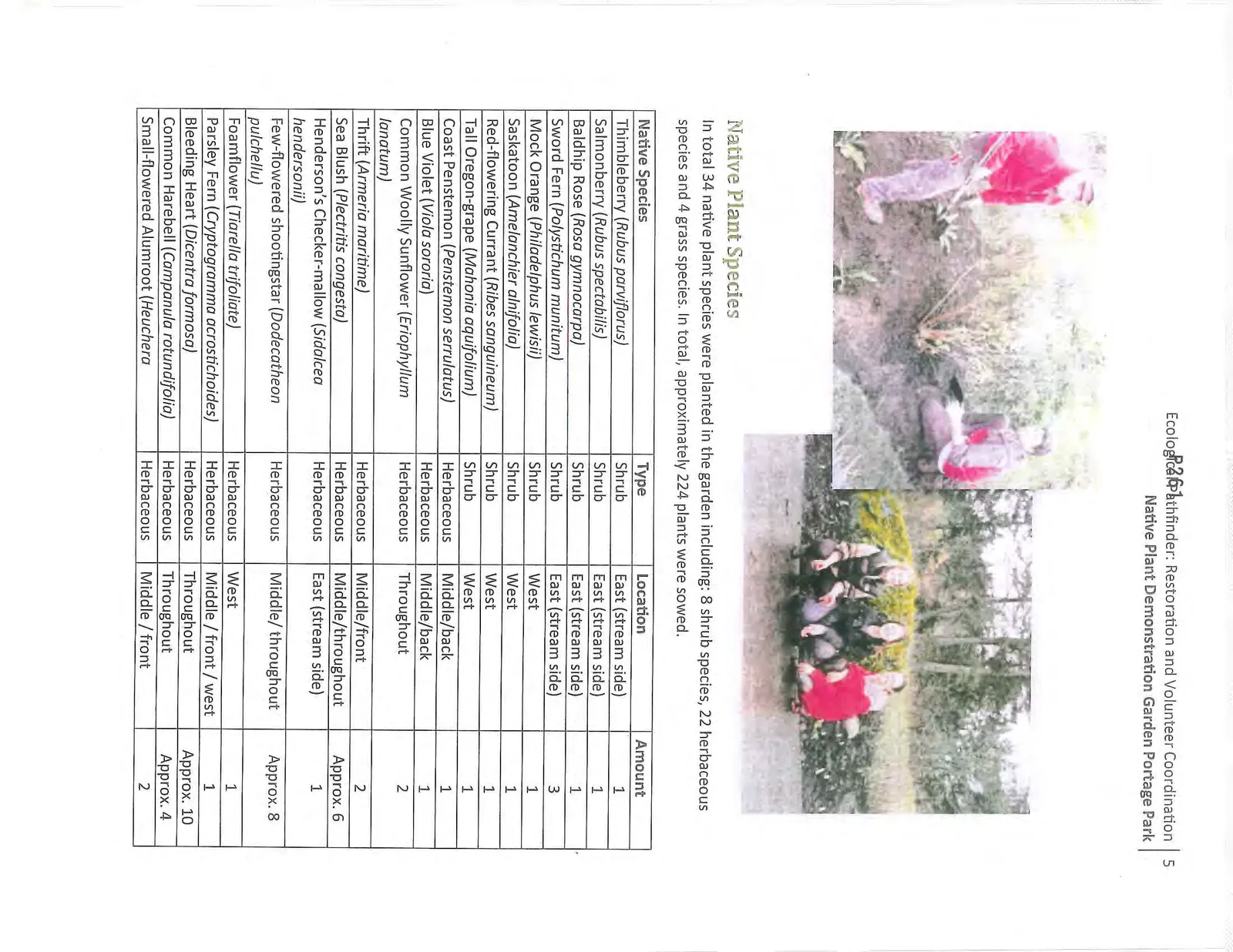
The site was prepared in late spring which included removing the turf grass, placing sheets of cardboard on the soil, and covering the cardboard with a thick layer of leaf mulch. This work was accomplished by the student group, along with a few View Royal volunteers. Initially, the garden bed had a sharp edge, and square shape, but was later (early fall), extended on both sides and the edges were smoothed.
Planting (November 2013)
The native plants were planted in November 2013. The larger shrubs were planted on the West and East sides, with the taller shrubs being placed on the far edges, and shrub height decreasing moving towards the outcrop, and main garden bed. The herbaceous species were placed strategically - their placement was based on expert advice by Louise Goulet, as well as on native plant garden resources through the Garry Oak Ecosystems Recovery Team (GOERT).
Proposed Budget
- Estimated plant / compost costs: $300 (30 plants x $10/plant)
- Coordinator: 20 hrs x $15/hr = $300 (this amount can be covered by the Restoration Plan funding)
- Refreshments: $150 (beverages and food for work parties)
- Estimated split rail fence cost: $10 / ft x 15 ft (plus HST and delivery) = $350
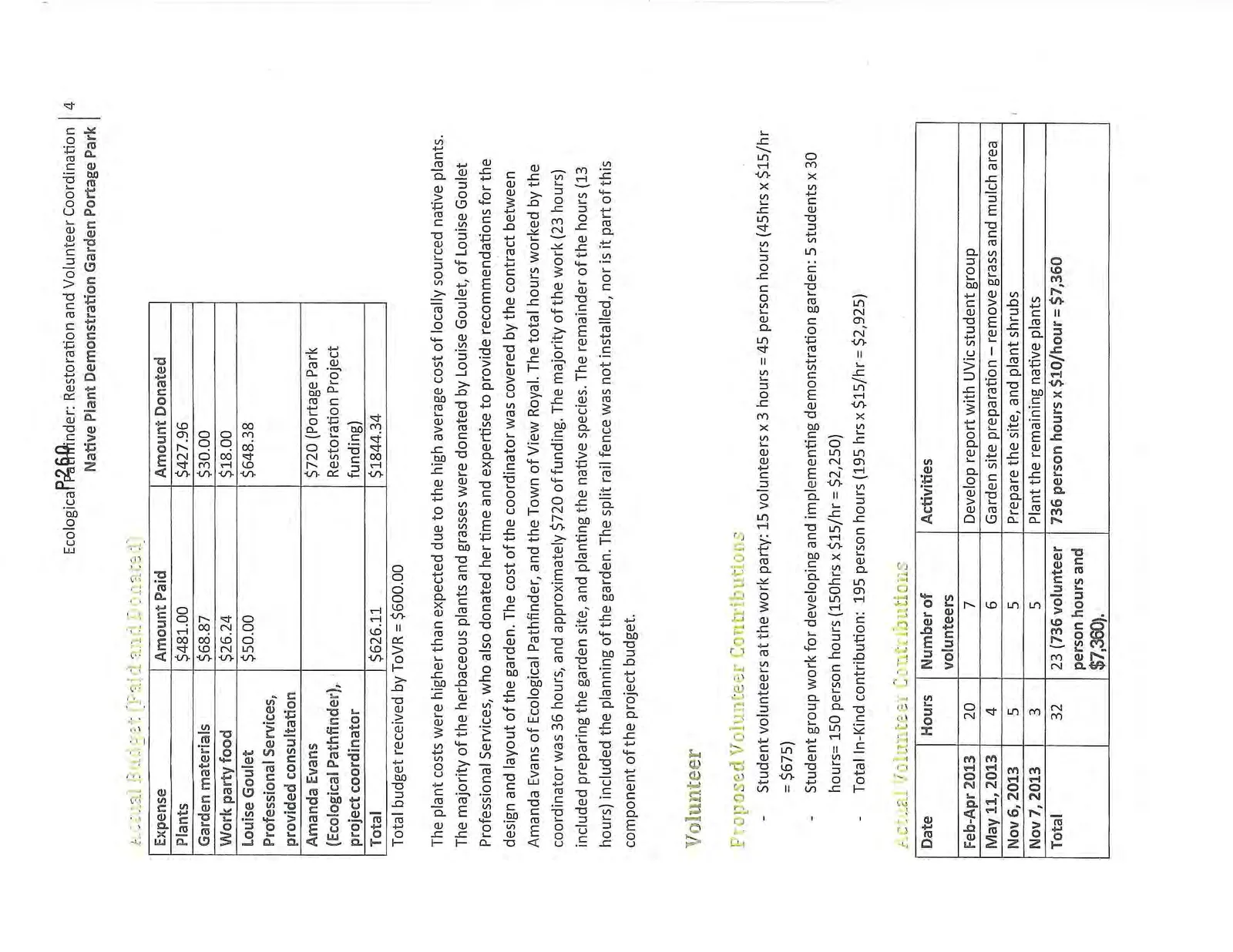
Actual Budget (Paid and Donated)
| Expense | Amount Paid | Amount Donated |
|---|---|---|
| Plants | $481.00 | $427.96 |
| Garden materials | $68.87 | $30.00 |
| Work party food | $26.24 | $18.00 |
| Louise Goulet Professional Services, provided consultation | $50.00 | $648.38 |
| Amanda Evans (Ecological Pathfinder), project coordinator | $720 (Portage Park Restoration Project funding) | |
| Total | $626.11 | $1844.34 |
Total budget received by ToVR = $600.00
The plant costs were higher than expected due to the high average cost of locally sourced native plants. The majority of the herbaceous plants and grasses were donated by Louise Goulet, of Louise Goulet Professional Services, who also donated her time and expertise to provide recommendations for the design and layout of the garden. The cost of the coordinator was covered by the contract between Amanda Evans of Ecological Pathfinder, and the Town of View Royal. The total hours worked by the coordinator was 36 hours, and approximately $720 of funding. The majority of the work (23 hours) included preparing the garden site, and planting the native species. The remainder of the hours (13 hours) included the planning of the garden. The split rail fence was not installed, nor is it part of this component of the project budget.
Volunteer
Proposed Volunteer Contributions
- Student volunteers at the work party: 15 volunteers x 3 hours = 45 person hours (45hrs x $15/hr = $675)
- Student group work for developing and implementing demonstration garden: 5 students x 30 hours= 150 person hours (150hrs x $15/hr = $2,250)
- Total In-Kind contribution: 195 person hours (195 hrs x $15/hr = $2,925)
Actual Volunteer Contributions
| Date | Hours | Number of volunteers | Activities |
|---|---|---|---|
| Feb-Apr 2013 | 20 | 7 | Develop report with UVic student group |
| May 11, 2013 | 4 | 6 | Garden site preparation – remove grass and mulch area |
| Nov 6, 2013 | 5 | 5 | Prepare the site, and plant shrubs |
| Nov 7, 2013 | 3 | 5 | Plant the remaining native plants |
| Total | 32 | 23 (736 volunteer person hours and $7,360). | 736 person hours x $10/hour = $7,360 |
Native Plant Species
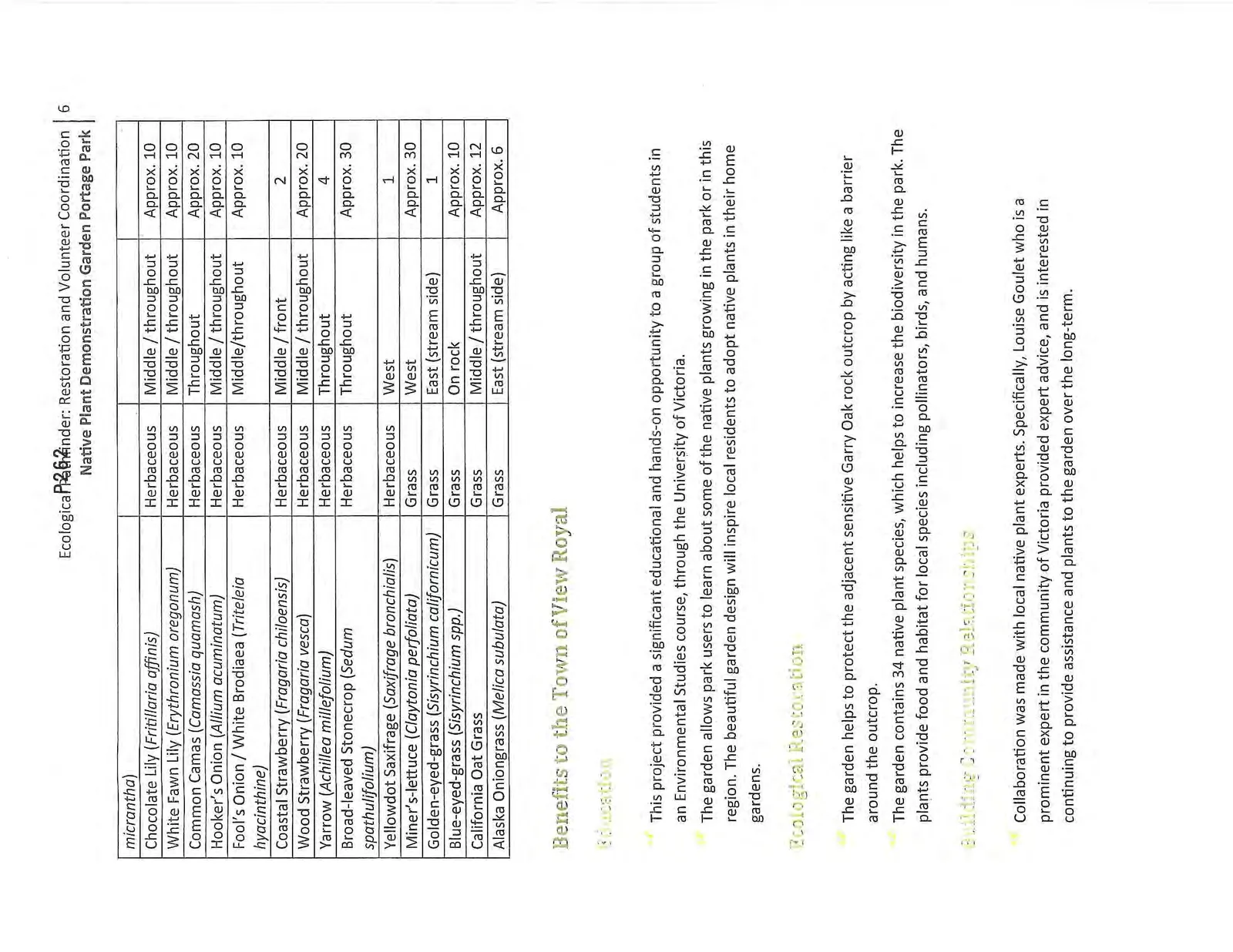
In total 34 native plant species were planted in the garden including: 8 shrub species, 22 herbaceous species and 4 grass species. In total, approximately 224 plants were sowed.
| Native Species | Type | Location | Amount |
|---|---|---|---|
| Thimbleberry (Rubus parviflorus) | Shrub | East (stream side) | 1 |
| Salmonberry (Rubus spectabilis) | Shrub | East (stream side) | 1 |
| Baldhip Rose (Rosa gymnocarpa) | Shrub | East (stream side) | 1 |
| Sword Fern (Polystichum munitum) | Shrub | East (stream side) | 3 |
| Mock Orange (Philadelphus lewisii) | Shrub | West | 1 |
| Saskatoon (Amelanchier alnifolia) | Shrub | West | 1 |
| Red-flowering Currant (Ribes sanguineum) | Shrub | West | 1 |
| Tall Oregon-grape (Mahonia aquifolium) | Shrub | West | 1 |
| Coast Penstemon (Penstemon serrulatus) | Herbaceous | Middle/back | 1 |
| Blue Violet (Viola sororia) | Herbaceous | Middle/back | 1 |
| Common Woolly Sunflower (Eriophyllum lanatum) | Herbaceous | Throughout | 2 |
| Thrift (Armeria maritime) | Herbaceous | Middle/front | 2 |
| Sea Blush (Plectritis congesta) | Herbaceous | Middle/throughout | Approx. 6 |
| Henderson's Checker-mallow (Sidalcea hendersonii) | Herbaceous | East (stream side) | 1 |
| Few-flowered shootingstar (Dodecatheon pulchellu) | Herbaceous | Middle/ throughout | Approx. 8 |
| Foamflower (Tiarella trifoliate) | Herbaceous | West | 1 |
| Parsley Fern (Cryptogramma acrostichoides) | Herbaceous | Middle / front / west | 1 |
| Bleeding Heart (Dicentra formosa) | Herbaceous | Throughout | Approx. 10 |
| Common Harebell (Campanula rotundifolia) | Herbaceous | Throughout | Approx. 4 |
| Small-flowered Alumroot (Heuchera micrantha) | Herbaceous | Middle / front | 2 |
| Chocolate Lily (Fritillaria affinis) | Herbaceous | Middle / throughout | Approx. 10 |
| White Fawn Lily (Erythronium oregonum) | Herbaceous | Middle / throughout | Approx. 10 |
| Common Camas (Camassia quamash) | Herbaceous | Throughout | Approx. 20 |
| Hooker’s Onion (Allium acuminatum) | Herbaceous | Middle / throughout | Approx. 10 |
| Fool’s Onion / White Brodiaea (Triteleia hyacinthine) | Herbaceous | Middle/throughout | Approx. 10 |
| Coastal Strawberry (Fragaria chiloensis) | Herbaceous | Middle / front | 2 |
| Wood Strawberry (Fragaria vesca) | Herbaceous | Middle / throughout | Approx. 20 |
| Yarrow (Achillea millefolium) | Herbaceous | Throughout | 4 |
| Broad-leaved Stonecrop (Sedum spathulifolium) | Herbaceous | Throughout | Approx. 30 |
| Yellowdot Saxifrage (Saxifrage bronchialis) | Herbaceous | West | 1 |
| Miner’s-lettuce (Claytonia perfoliata) | Grass | West | Approx. 30 |
| Golden-eyed-grass (Sisyrinchium californicum) | Grass | East (stream side) | 1 |
| Blue-eyed-grass (Sisyrinchium spp.) | Grass | On rock | Approx. 10 |
| California Oat Grass | Grass | Middle / throughout | Approx. 12 |
| Alaska Oniongrass (Melica subulata) | Grass | East (stream side) | Approx. 6 |
Benefits to the Town of View Royal
Education
- This project provided a significant educational and hands-on opportunity to a group of students in an Environmental Studies course, through the University of Victoria.
- The garden allows park users to learn about some of the native plants growing in the park or in this region. The beautiful garden design will inspire local residents to adopt native plants in their home gardens.
Ecological Restoration
- The garden helps to protect the adjacent sensitive Garry Oak rock outcrop by acting like a barrier around the outcrop.
- The garden contains 34 native plant species, which helps to increase the biodiversity in the park. The plants provide food and habitat for local species including pollinators, birds, and humans.
Building Community Relationships
- Collaboration was made with local native plant experts. Specifically, Louise Goulet who is a prominent expert in the community of Victoria provided expert advice, and is interested in continuing to provide assistance and plants to the garden over the long-term.
- This garden has the potential to be part of the yearly Victoria Native Plant Garden Tour, organized by the Habitat Acquisition Trust (HAT).
Management and Maintenance Recommendations
Weeding and Invasive Species Removal
Ongoing weeding of both non-native and native invasive plants should occur in and around the garden. This can take place during the monthly restoration work parties in Portage Park. Volunteers that live in the area and are interested in maintaining the garden (weeding, watering), may have the opportunity to do so on their own time.
Watering
The garden should be watered during the dry season of the garden’s first year. This should occur in May/June/July of 2014, and will depend on the duration of the spring rain. Watering should take place once per week.
Pruning and Mulching
Removing the seeds heads from Common Harebell will prolong flowering time through the fall.
Mulch and a thin layer of sea soil should be placed on the garden once per year in the late fall. Mulch helps to smother invasive plants, especially grasses. Mulch also helps protect the soil, and improves soil structure over time. A thin layer of sea soil placed on top of the mulch will help propagate native seeds, since the texture of mulch is not fine enough for native plant seeds to grow.
Monitoring
The garden should be monitored over the long-term to observe the response of the plants. Some plants may thrive, and some may die and will need to be replaced. Plants may be moved to other areas in the garden that may be more suitable. Any empty spots may be filled in with additional plants. Reports should be written to document garden observations which can be done twice per year, once in the spring and once in the fall. Monitoring will enable the garden to flourish and grow into a self-supporting and sustaining, beautiful garden.
Be Patient and Persistent!
Some plants take years to become established, and even longer to bloom. Removing and controlling weeds and invasive plants in the garden may also take time. (GOERT)
Future Project Ideas
Creation of a Garden Brochure
A garden brochure will educate visitors about the types of plants in the garden, the importance of native species and ecosystems, and can include additional resources for growing native species. This brochure can be developed through the Portage Park Restoration Project funding (2013/2014).
Interpretive Sign
A permanent sign can be developed to showcase the plant species found in the garden. The sign can highlight Portage Park in general, including traditional land use, information about Garry Oak ecosystems, and any other pertinent information. A “Grant-in-Aid” through the Town of View Royal is a potential funding source for this project.
Garden Extension
The native garden can be extended on the east (stream side), and west, since many of the plants growing beyond the garden on these sides are mainly non-native and invasive. Extending the garden will help reduce these invasive plants, and improve the ecological integrity and biodiversity in the park.
Proper fencing
It is recommended to install a permanent fencing around the garden. This can be a split rail fence.
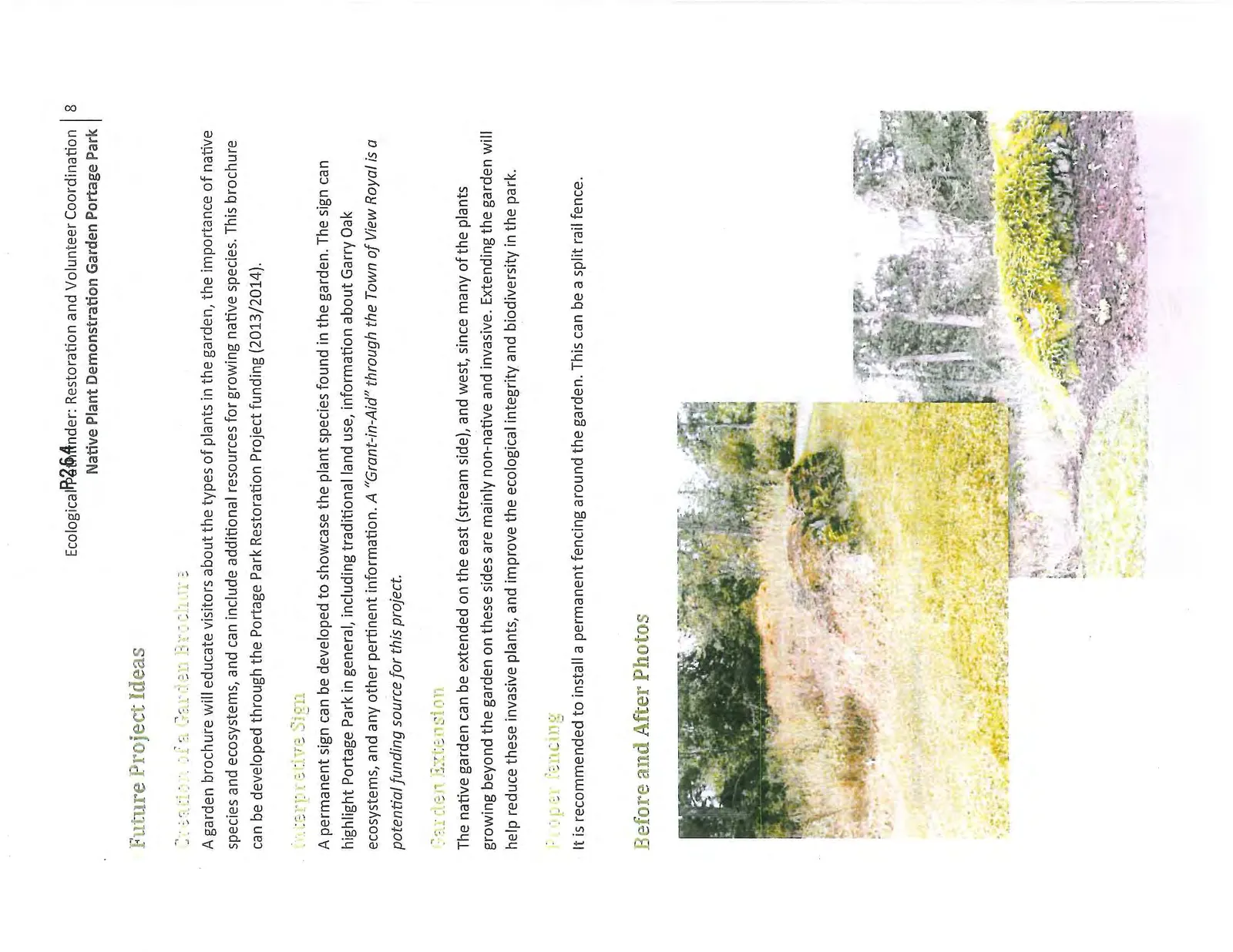
Before and After Photos
Document Images
(5)