CRD Review of Youth and Family Court Committee Service: Recommendations as a result of consultation
Letter from CRD Corporate Services detailing recommendations for the reorganization of the Victoria Youth and Family Court Committee into a delegated commission.
February 26, 2021
VIA E-MAIL
Victoria Youth and Family Court Committee
Attn: Members of the Committee
Dear Sirs/Mesdames:
Re: CRD Review of Youth and Family Court Committee Service: Recommendations as a result of consultation
Further to our consultation at Victoria Youth and Family Court Committee (the "Committee") meetings January 27, 2021 and February 3, 2021, we write to request the Committee’s membership, by resolution passed in open meeting properly assembled, confirm it is interested in continuing with the process as outlined in this letter.
On January 27, 2021, we canvassed the Committee’s history, problems faced by it and other family court committees, how grants can be made, and options for resolving structure and governance issues. On February 3, 2021, we went through each recommendation in the CRD report. Discussion occurred on public meeting and record keeping requirements, the role of the Provincial Ombudsperson, and on delegated versus advisory commissions. At this meeting, CRD was prepared to present a delegated commission model, but was informed January 26, 2021 by the Committee’s Chair that it was not ready for further consultation and would not be ready until after an orientation session in February had been held for new members.
Suggested Motion Language
We ask that you consider a motion, in open meeting assembled, showing a group intention to continue with this process. We suggest the following:
That the Victoria Youth and Family Court Committee recommend to the Capital Regional District Board:
- Consider creation of a delegated commission, rather than an advisory committee or commission, to continue the work of the Victoria Youth and Family Court Committee;
- Direct staff to continue to engage with the Committee to work to implement certain mandate, governance, and structure changes in accordance with the recommendations set out in the CRD’s letter of February 26, 2021.
Recommended Structure – Delegated Commission
A delegated commission will provide independence over administration and operation of the service, similar to how the Committee currently operates, but with a delegation of grant-making authority and a clear mandate set out in a bylaw. Similar commissions exist already at CRD: no new model would need to be created. This has the least burden in time, monetary cost, and personal financial risk to appointees. A draft commission bylaw has been prepared to implement certain recommendations set out in this letter. Please note that though it would be a delegated commission, the Committee name would not change: “commission” is a legal status.
An advisory commission is not recommended. It would cause unnecessary delays relating to grant-making, would require additional Board referrals, and increase use of Board and staff time. Committee issues are specialized, funding applications are received throughout the year (particularly from youth) and the Committee is ideally staffed with persons able to advise on community need, something it has done in the capital region since the 1960s.
A society is not recommended. The administrative burden and need for additional insurance and other materials (risk, privacy, work safety, human rights policies) would quickly deplete resources. Volunteers who provide assistance to the Committee and certain local government appointments undertaking Committee work between meetings are likely be ineligible for the Local Government Act indemnity and would not be covered by CRD’s insurance.
Recommendations
Recommendations are organized into “must” or “may” categories and additional considerations contained in the below table.
Mandatory Recommendations - Structure
The following are recommendations based on legislative requirements and best practices.
| Recommendation | Must / May | Reasoning |
|---|---|---|
| Set out mandate and delegation in a bylaw | Must | A commission bylaw sets out delegation for grant-making and a clear mandate to guide the Committee in its business. A proposed mandate, compared to prior mandates and legislation is Schedule “A”. The Committee should examine its mandate to ensure it is accurately reflecting both its historical purpose per the PCA and the broader work it does. Quorum is currently set to seven members, the same number as CRD appointments. This is appropriate based on attendance and is approximately 30% of membership. |
| Comply with Community Charter (Formalize meetings) | Must | As a body of a local government, meetings and any sessions where decisions are made must be in open. Does not apply to work by volunteers or sub-committees, provided they are not making final decisions for the Committee. |
| Public minutes and agendas unless in closed (Formalize meetings) | Must | Community Charter requires these to be published within a certain time, and to be publicly available or inspected on request. Publication could be met by online publication through CRD; prior minutes could be made available by CRD to meet requirements for public inspection. YCJA provides confidentiality provisions, if ever requested as a conference by the Court. |
| Maintain records consistent with the obligations of a public authority | Must | Required by Community Charter and FIPPA. Covered by CRD records and privacy policies, use of Corporate Officer and FOI Manager for FOI requests. Records should be stored at CRD. A CRD e-mail address should be provided. Meeting minutes should be publicly accessible and available. |
| Procedures bylaw compliance (Formalize meetings) | Must | To resolve the existing complaints faced by the Committee, it should ensure:
Decisions should be made in an open, properly constituted meeting. |
| Institute term limits | Must | Representatives should exit after a certain time to ensure fulsome representation by other members and others sought to fill their roles as part of a transition plan. Two year terms are proposed, with a maximum of three consecutive terms. After one year, a Committee member is eligible for re-appointment. Staggered terms are also recommended for community appointments (e.g. CRD appointments). For transition, existing committee members who are beyond their term limits should receive the balance of their term plus the option for one additional two years term. A further term of two years can be provided at appointing organization’s option with consent of Committee. Past long-time volunteers can be non-voting resource members or participate as volunteers, a practice formerly used by the Committee. |
| Consolidate finances in CRD | Must | There is no need to have separate bank account. Approved grants, honoraria, and reimbursements of expenses can be issued directly from CRD. Can be included in CRD financial checks and audit. |
| Follow existing policies rather than create its own | Must | As a body of the CRD, the Committee should follow CRD policies, such as those relating to expenses; records management; standards of conduct; respectful workplace; and the like. If necessary, specific policies or exceptions can be developed in accordance with CRD’s Policy Framework. |
| Re-arrange agenda items | Must | Agenda items should be re-arranged such that resource members speak at a dedicated time in the meeting (done). |
Non-Mandatory Recommendations – Governance
The following are non-mandatory governance recommendations. Implementing a few would likely resolve many of the conflicts and issues faced by the Committee relating to its work.
| Recommendation | Must / May | Reasoning |
|---|---|---|
| Reduce or restructure meetings | May | Consider (non-exhaustively, and based on needs):
|
| Set specific mandates for sub-committees with dates for deliverables (reduce or restructure meetings) | May | Sub-committee creation and appointments should be at the call of the Board, not at the call of the Chair, to ensure consistent direction. Consider reducing the number of sub-committees, depending on the projects and workloads is advisable. When creating such groups, set a mandate, time limit, and staff with volunteers (who do not need to be Committee members) – did this historically. Using time or mandate-limited sub-committees, will allow work to get done to be reported up to the Committee as a whole. Example:
|
| Look at membership composition (reduce numbers and appoint family-and youth-involved individuals) | May | The Committee may wish to consider:
|
| Grant intake procedure and grant agreement form | May | May set grant-intakes per year and reserve some amount for applications that come up between meetings. May wish to establish non-exhaustive criteria for grants. Can still review grants through sub-committee, with recommendations and summary to Committee for approval. Have a conflicts recusal procedure to avoid allegations of bias or impropriety (as with other CRD granting bodies). Before any funding is provided, a grant-agreement must be entered into to protect funds (simple, mandatory). |
| Maintain a volunteer registry | May | This is strongly recommended if the Committee intends to continue to perform work outside properly constituted meetings, such as Court Watch, facility visits, or assistance to individual youth and families. The Local Government Act indemnity only applies to elected officials when working within their role, not when doing hands-on volunteer work (say court watching) not typically the duty of a local government official; for individual appointments and volunteers, it only applies when under the local government’s direction: the Committee would need to specifically mandate tasks to its volunteers and sub-committees (if any) by resolution to ensure works are being properly supervised. It can do this by specific, mandated resolutions or by utilizing a volunteer coordinator, similar to how other delegated commissions operate. To qualify for insurance for their own injuries, volunteers must also register with CRD’s Risk and Insurance Department. Individuals working with vulnerable youth should have a recent valid criminal record check on file with CRD. This will satisfy an insurer should a claim arise relating to misconduct involving youth. |
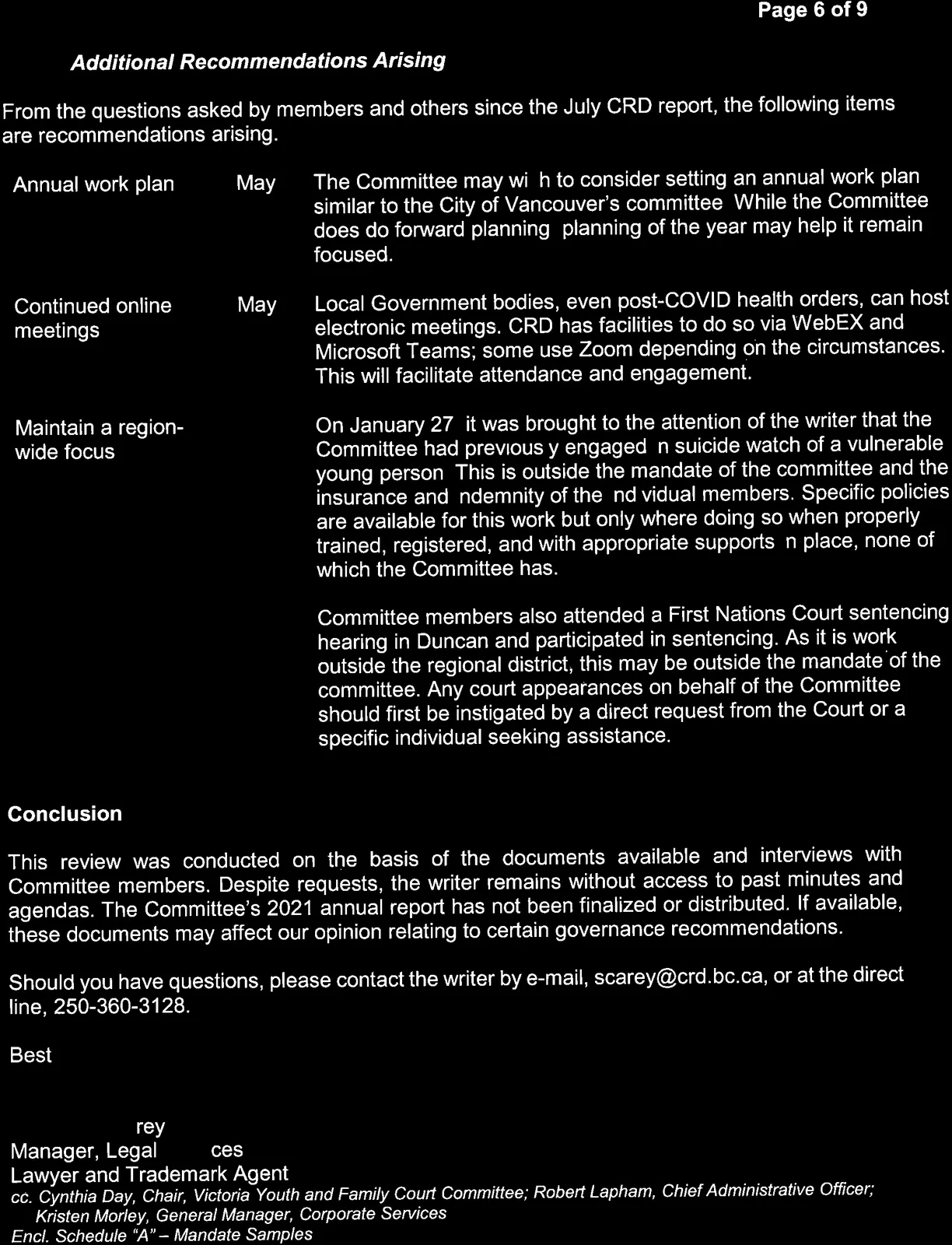
Additional Recommendations Arising
From the questions asked by members and others since the July CRD report, the following items are recommendations arising.
| Recommendation | Must / May | Reasoning |
|---|---|---|
| Annual work plan | May | The Committee may wish to consider setting an annual work plan, similar to the City of Vancouver's committee. While the Committee does do forward planning, planning of the year may help it remain focused. |
| Continued online meetings | May | Local Government bodies, even post-COVID health orders, can host electronic meetings. CRD has facilities to do so via WebEX and Microsoft Teams; some use Zoom depending on the circumstances. This will facilitate attendance and engagement. |
| Maintain a region-wide focus | Must | On January 27, it was brought to the attention of the writer that the Committee had previously engaged in suicide watch of a vulnerable young person. This is outside the mandate of the committee and the insurance and indemnity of the individual members. Specific policies are available for this work but only where doing so when properly trained, registered, and with appropriate supports in place, none of which the Committee has. Committee members also attended a First Nations Court sentencing hearing in Duncan and participated in sentencing. As it is work outside the regional district, this may be outside the mandate of the committee. Any court appearances on behalf of the Committee should first be instigated by a direct request from the Court or a specific individual seeking assistance. |
Conclusion
This review was conducted on the basis of the documents available and interviews with Committee members. Despite requests, the writer remains without access to past minutes and agendas. The Committee’s 2021 annual report has not been finalized or distributed. If available, these documents may affect our opinion relating to certain governance recommendations.
Should you have questions, please contact the writer by e-mail, scarey@crd.bc.ca, or at the direct line, 250-360-3128.
Best regards,
Steven N. Carey, B.Sc, J.D. Manager, Legal Services Lawyer and Trademark Agent
cc. Cynthia Day, Chair, Victoria Youth and Family Court Committee; Robert Lapham, Chief Administrative Officer; Kristen Morley, General Manager, Corporate Services Encl. Schedule "A" - Mandate Samples
Document Images
(2)