MEMORANDUM: Transportation Demand Management Review
A consultant report from Watt Consulting Group reviewing the transportation context and proposing strategies to reduce parking demand for the 82-unit multi-family building.
MEMORANDUM
To: Graeme Mann – GT Mann Contracting Ltd. From: Tim Shah, Senior Transportation Planner, RPP, MCIP Our File #: 3166.B01 Project: 161, 169 & 171 Island Highway Date: November 23, 2021 RE: Transportation Demand Management Review
1.0 INTRODUCTION
Watt Consulting Group was retained by GT Mann complete a transportation demand management (TDM) review of the proposed development at 161, 169, & 171 Island Highway. The purpose of this memo is to outline different TDM strategies that the applicant could pursue to [a] reduce the amount of vehicle parking required and [b] provide more sustainable transportation choices to future residents.
1.1 SITE CHARACTERISTICS & TRANSPORTATION CONTEXT
The following discussion summarizes the transportation and land use characteristics surrounding the subject site.
- Transit | The site is well served by transit. Within 200m east of the site (5-minute walk), there are two bus stops that are served by routes 14 (Victoria General / UVic), 25 (Maplewood / Admirals Walk, and 46 (Dockyard / Westhills). According to the Esquimalt-View Royal Local Area Transit Plan¹, the route 14 is a ‘Frequent Transit’ route, which provides frequent service from 7am to 7pm, 7 days a week with additional evening and Friday and Saturday late night service. The route 25 is a ‘Local Transit – High Demand’ route, which provides a “reasonable level of service” throughout the day. The route 46 is a ‘Local Transit – Coverage’ route, which provides a basic level of service to connect low density areas with nearby destinations and connections to other routes. Table 1 provides a summary of the weekday service levels for all three routes that serve the subject site. The table indicates that the route 14 has the highest ridership, largely due to its more frequent service. This route will continue to provide service along Old Island Highway and directly benefit residents of the future development at 161, 169 and 171 Island Highway.
TABLE 1. WEEKDAY SERVICE LEVELS OF TRANSIT ROUTES SERVING SUBJECT SITE²
| Route | Route Type | Daily Trips Operated | Avg Daily Boardings |
|---|---|---|---|
| 14 Vic General/Uvic | Frequent Transit | 160 | 6,441 |
| 25 Maplewood/ / Admirals Walk | Local Transit – High Demand | 35 | 926 |
| 46 Dockyard/Westhills | Local Transit – Coverage | 126 | 5,069 |
According to the Esquimalt-View Royal Local Area Transit Plan, route 46 is identified as one of the medium term service priorities. Specifically, the proposal is to introduce midday service and weekend service to the existing weekday peak-only service. This would fill the midday and weekend service gaps along Old Island Highway, among other benefits, and provide more service to the subject site.
Cycling | the subject site has access to a painted bike lane on Island Highway. The bike lane runs in both directions and connects with the Galloping Goose trail (to the west) at the intersection of Island Highway and Highway 1A. It also runs along Craigflower Road (to the east) to the Victoria West neighbourhood in the City of Victoria. The E&N Rail Trail is also within 100m (1-minute bike ride) from the subject site. The E&N Rail Trail is currently 13 kilometres in length with plans to expand to 17 kilometres. It connects to several key destinations in the region including downtown Victoria and also serves most areas in View Royal. Further, the trail connects to Admirals Walk where several commercial and retail amenities are available including a grocery store, pharmacies, restaurants, and financial institutions. Admirals Walk is about 1.1km (3-minute bike ride) from the subject site.
Walking | even though the subject site has a Walk Score of 25, which means most errands require a car, its Walk Score does not accurately reflect its walkability as several amenities can be reached within a 10 to 15-minute walk along Island Highway. Sidewalks are provided on both sides of Island Highway and there is also an existing pathway in Portage Park behind the subject site that connects with the E&N Rail Trail.
2.0 PROPOSED DEVELOPMENT
The proposal is to provide an 82-unit 5 story multi-family residential building. The current zoning is R-1B (Detached Residential—Medium Lot) and the proposal is to rezone to a CD (Comprehensive Development) designation. The development includes a mix of unit types comprising 65 one-bedrooms, 14 two-bedrooms, and 3 three-bedroom.
2.1 PROPOSED PARKING SUPPLY
2.1.1 VEHICLE PARKING
A total of 94 residential parking spaces are proposed, which includes 1 accessible parking space. In addition, nine (9) visitor spaces are proposed along with one (1) passenger / commercial loading space. Therefore, a total of 104 spaces are proposed.
2.1.2 BICYCLE PARKING
A total of 82 secure long-term bicycle parking spaces are proposed (1 per unit). In addition, 6 short-term visitor parking spaces will be included.
2.2 PARKING REQUIREMENT
Per the Town of View Royal’s Zoning Bylaw, the site would be subjected to the ‘Apartment’ requirement, which results in 92 vehicle parking spaces. The applicant is exceeding this by 12 spaces. The applicant is meeting the bicycle parking requirements per the Zoning Bylaw. The bylaw also requires that all Class 1 (long-term) bicycle parking spaces be energized, which the applicant is meeting.
3.0 EXPECTED PARKING DEMAND
3.1 RESIDENTIAL PARKING
A formal parking variance study was not completed as the applicant is exceeding the parking requirements in the Town’s Zoning Bylaw. However, as discussed in Section 4.0 (TDM Strategy), there are several TDM options that applicant could pursue to reduce the amount of residential parking needed for the site and provide more sustainable transportation choices for residents. For the purposes of this memo, the expected parking demand for residential parking is the total spaces provided, which is 94 parking spaces.
3.2 VISITOR PARKING
Even though visitor parking is not required per the Town’s Zoning Bylaw, it is anticipated that there will be demand for visitor parking at the subject site. WATT has completed hundreds of residential parking studies in Greater Victoria over the last 10 years, which have included observations of visitor parking. The results have consistently indicated that visitor parking demand is typically in the range of 0.05 to 0.12 spaces per unit in both urban municipalities (e.g., Esquimalt, Victoria, Oak Bay) and suburban communities (e.g., Saanich, View Royal, Colwood, Langford). The data indicate that visitor parking demand is not strongly linked to location.
Similar results have been reported in Metro Vancouver where a 2012 study found that visitor parking demand was less than 0.1 vehicles per unit across the region.³ Based on these past parking studies, it is recommended that the applicant provide a minimum of 0.1 spaces per unit, which results in 9 spaces. The applicant is providing 9 spaces, which meets the expected demand.
4.0 TRANSPORTATION DEMAND MANAGEMENT
Transportation demand management (TDM) is the application of strategies and policies to influence individual travel choice, most commonly to reduce single-occupant vehicle travel. TDM measures typically aim to encourage sustainable travel, enhance travel options, and decrease parking demand. Successful TDM initiatives can result in the reduction of parking demand, fewer vehicle trips, and associated benefits of decreased greenhouse gas (GHG) emissions, improved personal health and well-being, reduced traffic congestion, and lower infrastructure costs. The following are the recommended TDM measures that the applicant could pursue as part of the application to reduce the residential vehicle parking demand at the site.
4.1 PASSENGER & COMMERCIAL LOADING
4.1.1 OVERVIEW
Designated passenger loading zones are an effective way to efficiently facilitate passenger pickups and drop-offs along with accommodating commercial and food delivery services. While these loading zones are not a traditional TDM measure, they are an important way to manage the overall parking demand at the site. Further, due to the lack of on-street parking surrounding the site, it is critical to ensure that commercial and food delivery services have a designated off-street stall when visiting the site and not be forced to occupy a visitor parking space. Further, the provision of a passenger / commercial loading space would also accommodate future ride-hailing services (e.g., Uber, Lyft), if those services start operating in Greater Victoria.
4.1.2 RECOMMENDATION
It is recommended that the applicant designate one commercial / loading parking space.
4.2 CARSHARING
4.2.1 OVERVIEW
Carshare is a form of car rental where people can book vehicles for varying lengths of time. They are usually co-operative and users must sign up as a member to be able to use the vehicles and pay the associated costs. The Modo Car Cooperative (“Modo”) is the most popular carsharing service in Greater Victoria. As of 2021, there are currently no Modo vehicles in View Royal. The closest vehicle is in Esquimalt at the Lampson Street and Colville Road intersection.⁴ Even though the COVID-19 pandemic initially impacted Modo’s operations, they now have 108 vehicles compared to just 23 vehicles when it first started operated in Greater Victoria in 2015. This represents an increase of 370%.⁵
Part of the reason why carsharing is expanding locally and being supported by municipalities is because of its ability to reduce household vehicle ownership and parking demand. A 2018 study from Metro Vancouver analyzed 3,405 survey respondents from carsharing users in the region and found that carsharing users of Car2go and Modo reported reduced vehicle ownership after joining a carsharing service. The impact was larger for Modo users; households joining Modo reduced their ownership from an average of 0.68 to 0.36 vehicles. Further, Modo members were close to five times more likely to reduce car ownership compared to Car2go users.⁶
Other studies have specifically explored whether the placement and location of a carsharing vehicle can have a positive impact on utilization. One study reported that on-street carshare vehicles can contribute to the growth of carsharing in two ways: (1) the time savings and convenience of on-street spaces can attract new members to carsharing organizations and (2) the better visibility of carshare vehicles parked on the street can serve as advertising that can show the benefits of membership.⁷
4.2.2 RECOMMENDATION
Based on correspondence with Modo and the applicant, Modo has indicated that they will not be expanding their operations to View Royal at this time. However, it is recommended that the applicant work with the Town of View Royal to continue conversations with Modo to see whether expansion of their fleet is feasible in the near future. Municipal support for carsharing is an important consideration for carsharing operators like Modo in deciding whether to expand their business and provide service.
4.3 SHARED ELECTRIC BIKE PROGRAM
4.3.1 OVERVIEW
Electric bicycles (e-bikes) are bicycles with an electric motor of 500 watts or less, and functioning pedals that are limited to a top speed of 32 km/h without pedaling. Electric bicycles make cycling more attractive for a greater diversity of the population, particularly for seniors, women, and people with disabilities, as they increase the maximum length of bicycle trips, minimize the impact of hills and other terrain challenges, and allow people to bike with heavier cargo loads. Further, electric bicycles can help municipalities achieve their GHG emission reduction targets. With supportive cycling infrastructure in place, e-bikes have the potential to substitute for, or completely replace, a substantial number of trips taken by a gasoline powered car, which could address congestion issues within urban areas.⁸
Recent research on e-bikes has reported the following impacts on vehicle ownership:
- A 2020 scoping review examined 76 studies that have been published to date on electric bikes. It found that the proportion of car journeys substituted following acquisition of an e-bike ranged from 20% to 86%, with three studies reporting the substitution of short car journeys with the e-bike;⁹
- Another 2020 study found that people who purchased an e-bike increased their bicycle use from 2.1 to 9.2 km per day on average;¹⁰
- A 2019 study found that approximately 39 kilometres of driving per week is displaced by the average e-bike adopter along with 14 kilometres of travel by conventional bicycle¹¹; and
- A 2018 study presented results of a North American survey of electric bike owners. The study reported that 62% of e-bike trips replaced trips that otherwise would have been taken by car. Of these trips previously taken by car, 45.8% were commute trips to work or school, 44.7% were other utilitarian trips (entertainment, personal errands, visiting friends and family, or other), and 9.4% were recreation or exercise trips. The average length of these previous car trips was 15 kilometres.¹²
4.3.2 RECOMMENDATION
As discussed in Section 1.1, the site benefits from access to safe cycling infrastructure including a painted bike lane on Island Highway and a multi-use pathway (E&N Rail Trail). This will make it easier for future residents to use their bikes for utilitarian and recreational trips to access various destinations in the region. One way to make it even easier for residents to ride a bicycle is through a shared electric bike program.
Specifically, it is recommended that the applicant provide a shared e-bike program to provide a transportation option to residents who may not own a vehicle or for residents who own a vehicle but may not require it for all trip purposes. The shared e-bike program would include the following:
- The e-bikes would be owned and maintained by the building.
- The process to reserve an e-bike will most likely be on a first come first serve basis.
- Overall e-bike utilization should be carefully monitored in the first year. If demand is consistently high, consideration should be given to adding more e-bikes to the fleet after year 1.
A total of 5-7 bikes are recommended (about 8% of the total units) as part of the shared e-bike program.
A 10% reduction in resident parking demand is supported if the applicant commits to a shared e-bike program.
4.4 ELECTRIC BIKE PARKING
4.4.1 OVERVIEW
E-bikes can displace trips made by private vehicles and in some cases, substitute for private vehicles altogether. Equally important, though, is the provision of parking facilities to accommodate electric bike users. One of the top barriers facing prospective e-bike users is the fear that their bicycle might be stolen.¹³ That same research found that the prospective e-bike users would feel more comfortable if they could park their bicycle in a locked or supervised area.
The Capital Region Local Government Electric Vehicle + Electric Bike Infrastructure Planning Guide¹⁴ includes e-bike parking design guidelines to help address the concerns of current and prospective e-bike owners as well as to increase overall e-bike ownership in the Capital Region. To address security concerns, the guide recommends the following:
- Ensure all racks and mounting apparatuses are of a material and gauge that they cannot be physically altered / manipulated
- Ensure all racks and mounting apparatuses are securely fastened to the ground or wall
- Control access to shared bicycle rooms by way of a lock or keypad
- Ensure bicycle parking areas are adequately lit at all hours
More enhanced security features include self-contained bike lockers and video surveillance. The guide also recommends that 10% of the long-term spaces be provided as cargo racks to accommodate e-bikes. Cargo bikes are typically electric-assist (e-bikes) that are longer than regular bicycles because they are capable of carrying cargo and/or multiple passengers with the assistance of the battery. Cargo bikes can be a popular option for young families. They can be as long as 3.0m and as wide as 0.9m. A figure has been included below to illustrate the dimensions of different cargo and oversized bicycles.
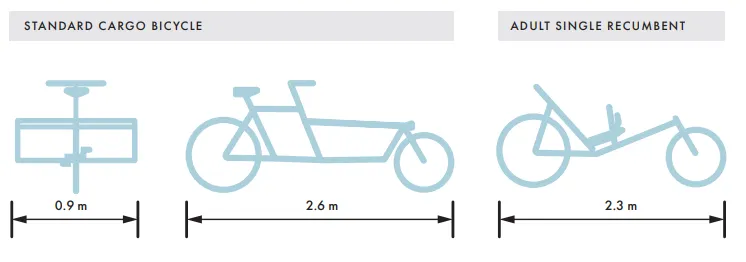
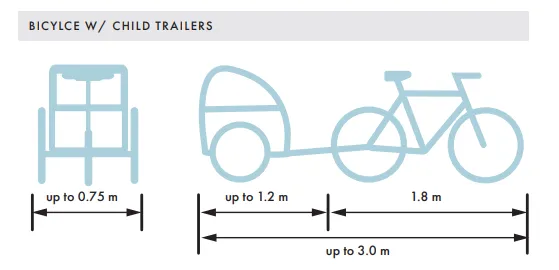
Typical dimensions for cargo and longer bicycles. Source: BC Active Transportation Design Guide
4.4.2 RECOMMENDATION
It is recommended that the applicant provide the following:
- Cargo Bike Parking | At least 10% of long-term bicycle parking spaces (9 spaces) should be designed for cargo bicycles (2.6m stall depth), which are harder to fit in a standard bike rack where the stall depth is 1.8 metres.
- Secured Location | All long-term bike parking spaces should be in a secure access-controlled location, which is especially important for e-bike users to minimize bike theft.
A 5% reduction in resident parking demand is supported if the applicant commits to the electric bike parking recommendations above.
4.5 TDM SUMMARY
A summary of the proposed TDM measures and parking reductions is provided in Table 2. A resident parking reduction of 15% is supported if both TDM measures are provided. This represents a reduction in the estimated resident parking demand by 14 spaces.
TABLE 2. SUMMARY OF ESTIMATED PARKING DEMAND WITH TDM
| TDM Measure | Provision | Parking Demand / Reduction |
|---|---|---|
| Baseline Resident Parking Demand | 94 spaces | |
| Total Resident Parking Demand Reduction | −15% (−14 spaces) | |
| Shared Electric Bike Program | 5-7 e-bikes | −10% |
| Electric Bicycle Parking | 10% cargo spaces, 100% secure | −5% |
| Estimated Resident Parking Demand with TDM | 80 spaces (94 – 14) | |
| Estimated Visitor Parking Demand | 9 spaces | |
| Total Site Parking Demand with TDM | 89 spaces | |
| Proposed Parking Supply | 104 spaces | |
| Difference | +15 |
5.0 CONCLUSION
The proposed development at 1161, 169 & 171 Island Highway includes an 82-unit 5 story multi-family residential building. A total 104 spaces are proposed, which is higher than what is required in the Town’s Zoning Bylaw. Even though the proposed supply exceeds the parking requirement, there are several TDM options that applicant could pursue to reduce the amount of residential parking needed for the site and provide more sustainable transportation choices for residents.
The applicant will need to ultimately decide which TDM option(s) are most feasible for the development. If TDM is pursued, then a reduction of 14 residential parking spaces would be supported.
Sincerely,
Watt Consulting Group
Tim Shah, RPP, MCIP Senior Transportation Planner
¹ BC Transit. (2021). Esquimalt-View Royal Local Area Transit Plan. Available online at: https://www.bctransit.com/documents/1529711822375 ² BC Transit. (2021). Esquimalt-View Royal Local Area Transit Plan. Available online at: https://www.bctransit.com/documents/1529711822375 ³ Metro Vancouver. (2012). The Metro Vancouver Apartment Parking Study. Available online at: http://www.metrovancouver.org/services/regional-planning/PlanningPublications/Apartment_Parking_Study_TechnicalReport.pdf ⁴ The locations of all Modo vehicles in Greater Victoria are available online at: https://modo.coop/car-map ⁵ Information obtained by Modo’s Business Development Manager on October 14, 2021. ⁶ Namazu, M & H Dowlatabadi. (2018). Vehicle ownership reduction: A comparison of one-way and two-way carsharing systems. Transport Policy, (64), 38-50. ⁷ Osgood, A. (2010). On-Street Parking Spaces for Shared Cars. Access Magazine, available online at: http://www.accessmagazine.org/wp-content/uploads/sites/7/2016/01/access-36sharedparking.pdf ⁸ WATT Consulting Group. (2018). Capital Region Local Government Electric Vehicle + Electric Bike Infrastructure Planning Guide. Available online at: https://www.crd.bc.ca/docs/default-source/climate-action-pdf/reports/infrastructure-planning-guide_capital-region-ev-ebike-infrastructure-project-nov-2018.pdf?sfvrsn=d767c5ca_2 ⁹ Bourne, J.E., Cooper, A.R., Kelly, P., Kinnear, F.J., England, C., Leary, S., and A. Page. (2020). The impact of e-cycling on travel behaviour: A scoping review. Journal of Transportation Health, 19. ¹⁰ Fyhri, A & H.B. Sundfor. (2020). Do people who buy e-bikes cycle more? Transportation Research Part D, 86, 1-7. ¹¹ Bagasse, A & E Borgesian. (2019). Electric Bicycles: Can they reduce driving and emissions in Canada. Plan Canada Fall 2019. ¹² MacArthur, J., Harpool, M., & D. Scheppke. (2018). A North American Survey of Electric Bicycle Owners. National Institute for Transportation and Communities, NITC-RR-1041. ¹³ WATT Consulting Group. (2018). Capital Region Local Government Electric Vehicle + Electric Bike Infrastructure Backgrounder. Available online at: https://www.crd.bc.ca/docs/default-source/climate-action-pdf/reports/electric-vehicle-and-e-bike-infrastructure-backgrounder-sept-2018.pdf?sfvrsn=a067c5ca_2 ¹⁴ WATT Consulting Group. (2018). Capital Region Local Government Electric Vehicle + Electric Bike Infrastructure Planning Guide. Available online at: https://www.crd.bc.ca/docs/default-source/climate-action-pdf/reports/infrastructure-planning-guide_capital-region-ev-ebike-infrastructure-project-nov-2018.pdf?sfvrsn=d767c5ca_2