Provincial Responses to 2024 Resolutions (EB3, NR42, NR54)
Details of the Provincial responses to resolutions regarding the Mental Health Act, Police Cost Sharing, and Rodent Glue Traps.
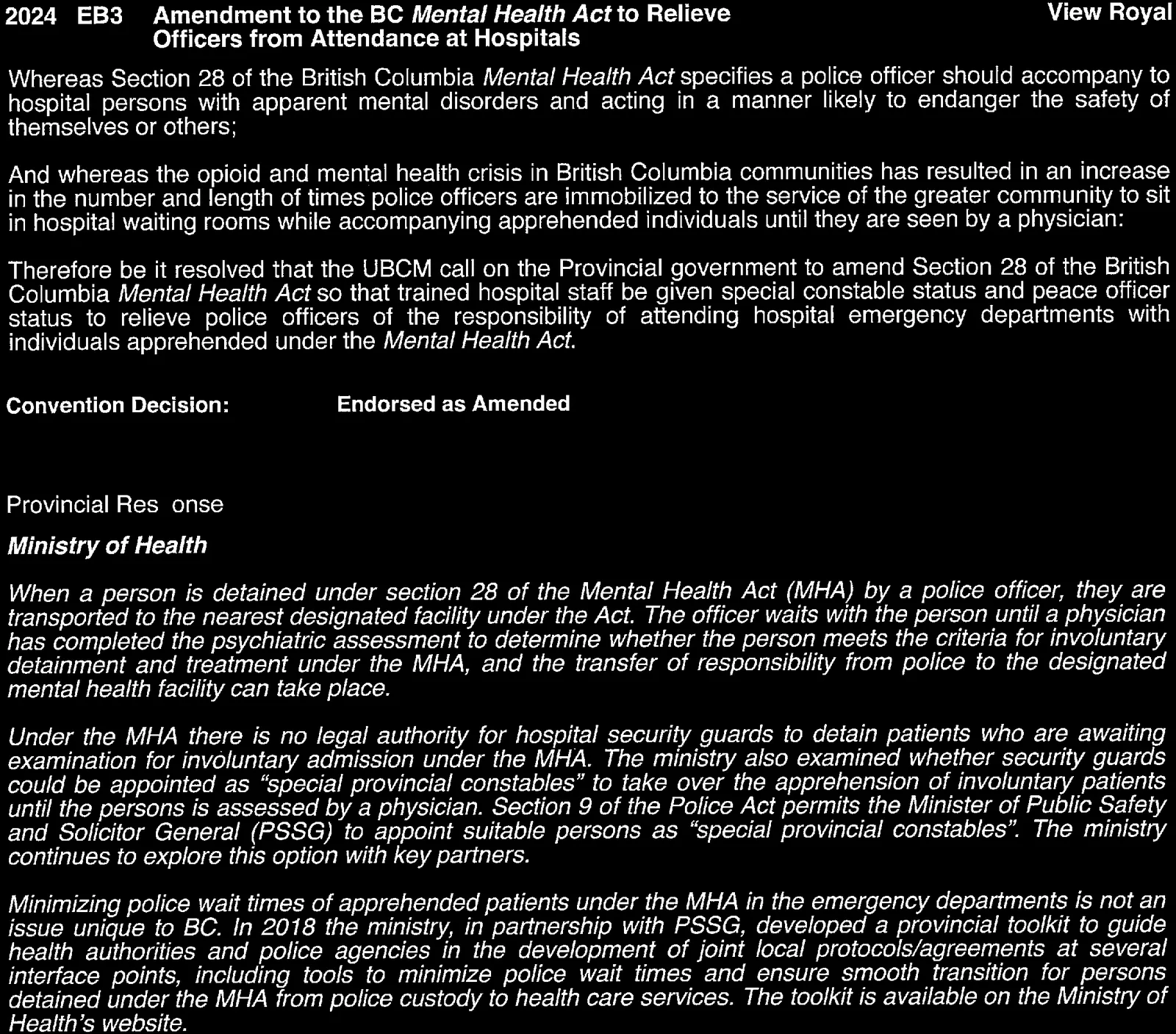
2024 EB3 Amendment to the BC Mental Health Act to Relieve Officers from Attendance at Hospitals
View Royal
Whereas Section 28 of the British Columbia Mental Health Act specifies a police officer should accompany to hospital persons with apparent mental disorders and acting in a manner likely to endanger the safety of themselves or others;
And whereas the opioid and mental health crisis in British Columbia communities has resulted in an increase in the number and length of times police officers are immobilized to the service of the greater community to sit in hospital waiting rooms while accompanying apprehended individuals until they are seen by a physician:
Therefore be it resolved that the UBCM call on the Provincial government to amend Section 28 of the British Columbia Mental Health Act so that trained hospital staff be given special constable status and peace officer status to relieve police officers of the responsibility of attending hospital emergency departments with individuals apprehended under the Mental Health Act.
Convention Decision: Endorsed as Amended
Provincial Response
Ministry of Health
When a person is detained under section 28 of the Mental Health Act (MHA) by a police officer, they are transported to the nearest designated facility under the Act. The officer waits with the person until a physician has completed the psychiatric assessment to determine whether the person meets the criteria for involuntary detainment and treatment under the MHA, and the transfer of responsibility from police to the designated mental health facility can take place.
Under the MHA there is no legal authority for hospital security guards to detain patients who are awaiting examination for involuntary admission under the MHA. The ministry also examined whether security guards could be appointed as “special provincial constables” to take over the apprehension of involuntary patients until the persons is assessed by a physician. Section 9 of the Police Act permits the Minister of Public Safety and Solicitor General (PSSG) to appoint suitable persons as “special provincial constables”. The ministry continues to explore this option with key partners.
Minimizing police wait times of apprehended patients under the MHA in the emergency departments is not an issue unique to BC. In 2018 the ministry, in partnership with PSSG, developed a provincial toolkit to guide health authorities and police agencies in the development of joint local protocols/agreements at several interface points, including tools to minimize police wait times and ensure smooth transition for persons detained under the MHA from police custody to health care services. The toolkit is available on the Ministry of Health’s website.
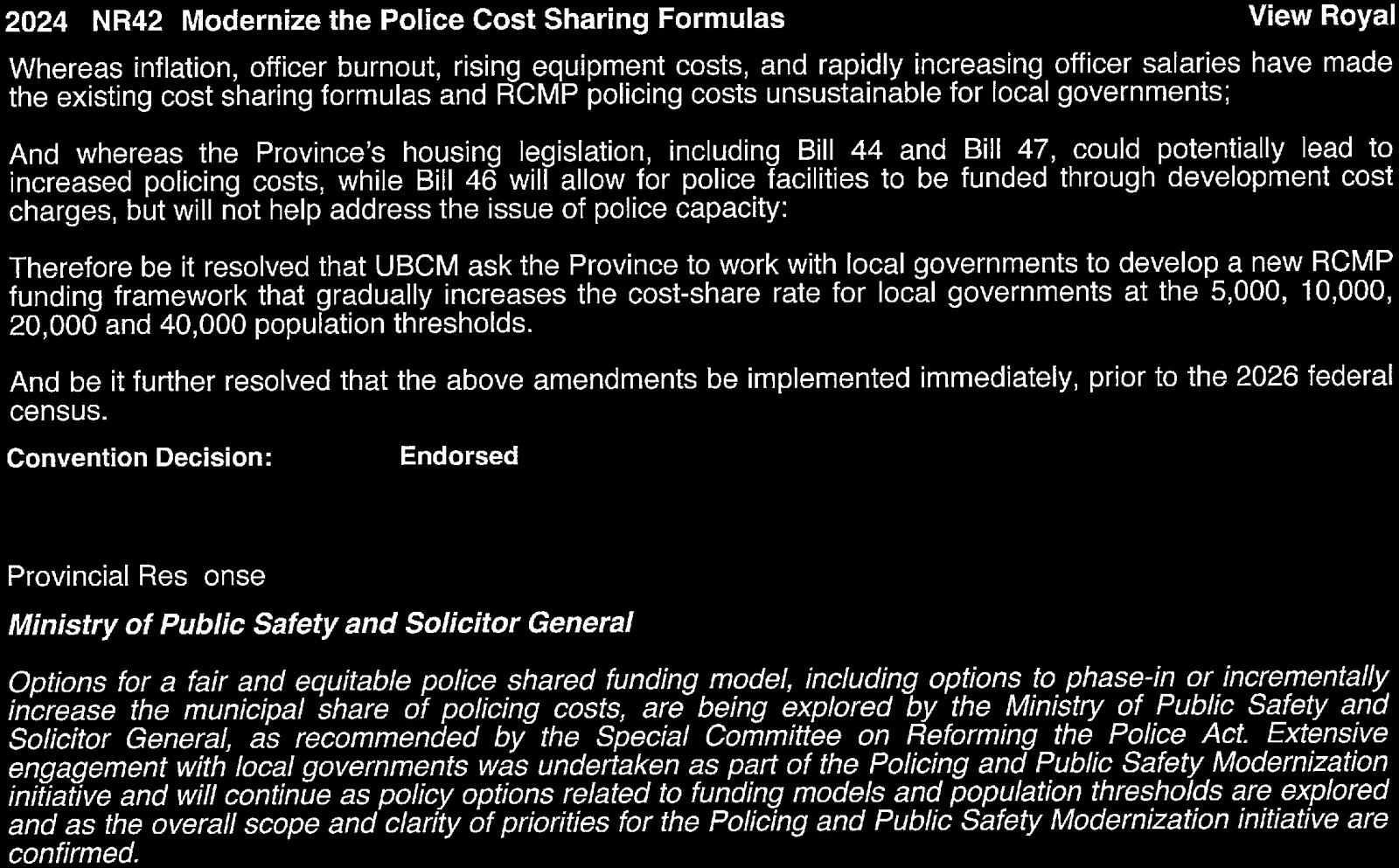
2024 NR42 Modernize the Police Cost Sharing Formulas
View Royal
Whereas inflation, officer burnout, rising equipment costs, and rapidly increasing officer salaries have made the existing cost sharing formulas and RCMP policing costs unsustainable for local governments;
And whereas the Province’s housing legislation, including Bill 44 and Bill 47, could potentially lead to increased policing costs, while Bill 46 will allow for police facilities to be funded through development cost charges, but will not help address the issue of police capacity:
Therefore be it resolved that UBCM ask the Province to work with local governments to develop a new RCMP funding framework that gradually increases the cost-share rate for local governments at the 5,000, 10,000, 20,000 and 40,000 population thresholds.
And be it further resolved that the above amendments be implemented immediately, prior to the 2026 federal census.
Convention Decision: Endorsed
Provincial Response
Ministry of Public Safety and Solicitor General
Options for a fair and equitable police shared funding model, including options to phase-in or incrementally increase the municipal share of policing costs, are being explored by the Ministry of Public Safety and Solicitor General, as recommended by the Special Committee on Reforming the Police Act. Extensive engagement with local governments was undertaken as part of the Policing and Public Safety Modernization initiative and will continue as policy options related to funding models and population thresholds are explored and as the overall scope and clarity of priorities for the Policing and Public Safety Modernization initiative are confirmed.
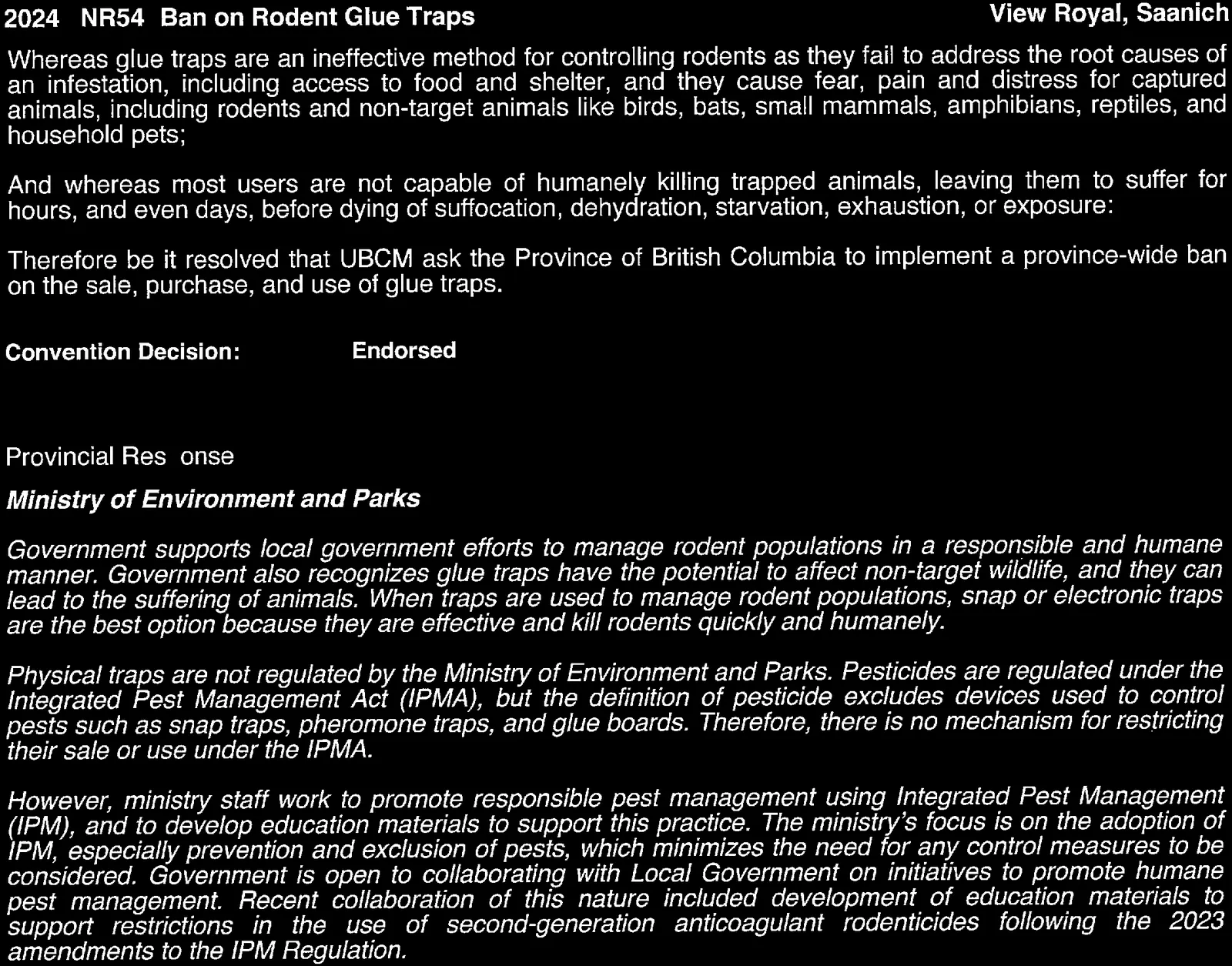
2024 NR54 Ban on Rodent Glue Traps
View Royal, Saanich
Whereas glue traps are an ineffective method for controlling rodents as they fail to address the root causes of an infestation, including access to food and shelter, and they cause fear, pain and distress for captured animals, including rodents and non-target animals like birds, bats, small mammals, amphibians, reptiles, and household pets;
And whereas most users are not capable of humanely killing trapped animals, leaving them to suffer for hours, and even days, before dying of suffocation, dehydration, starvation, exhaustion, or exposure:
Therefore be it resolved that UBCM ask the Province of British Columbia to implement a province-wide ban on the sale, purchase, and use of glue traps.
Convention Decision: Endorsed
Provincial Response
Ministry of Environment and Parks
Government supports local government efforts to manage rodent populations in a responsible and humane manner. Government also recognizes glue traps have the potential to affect non-target wildlife, and they can lead to the suffering of animals. When traps are used to manage rodent populations, snap or electronic traps are the best option because they are effective and kill rodents quickly and humanely.
Physical traps are not regulated by the Ministry of Environment and Parks. Pesticides are regulated under the Integrated Pest Management Act (IPMA), but the definition of pesticide excludes devices used to control pests such as snap traps, pheromone traps, and glue boards. Therefore, there is no mechanism for restricting their sale or use under the IPMA.
However, ministry staff work to promote responsible pest management using Integrated Pest Management (IPM), and to develop education materials to support this practice. The ministry’s focus is on the adoption of IPM, especially prevention and exclusion of pests, which minimizes the need for any control measures to be considered. Government is open to collaborating with Local Government on initiatives to promote humane pest management. Recent collaboration of this nature included development of education materials to support restrictions in the use of second-generation anticoagulant rodenticides following the 2023 amendments to the IPM Regulation.
Document Images
(6)