Letter from Cynthia Day re: Closure of the Victoria Youth Custody Services Centre
Formal letter opposing the closure of the local youth custody facility and highlighting service gaps.
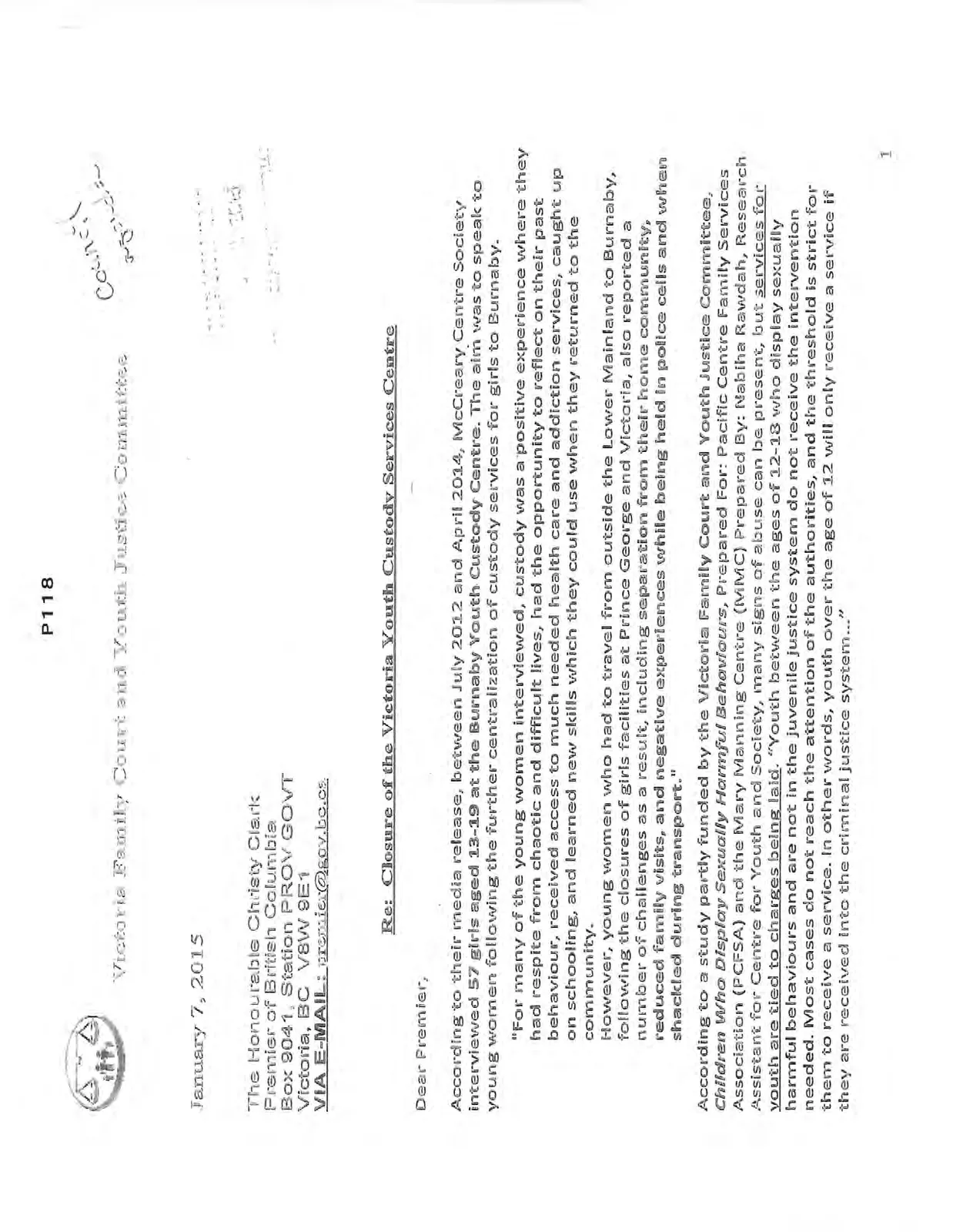
January 7, 2015
The Honourable Christy Clark Premier of British Columbia Box 9041, Station PROV GOVT Victoria, BC V8W 9E1 VIA E-MAIL: premier@gov.bc.ca
Re: Closure of the Victoria Youth Custody Services Centre
Dear Premier,
According to their media release, between July 2012 and April 2014, McCreary Centre Society interviewed 57 girls aged 13-19 at the Burnaby Youth Custody Centre. The aim was to speak to young women following the further centralization of custody services for girls to Burnaby.
"For many of the young women interviewed, custody was a positive experience where they had respite from chaotic and difficult lives, had the opportunity to reflect on their past behaviour, received access to much needed health care and addiction services, caught up on schooling, and learned new skills which they could use when they returned to the community.
However, young women who had to travel from outside the Lower Mainland to Burnaby, following the closures of girls facilities at Prince George and Victoria, also reported a number of challenges as a result, including separation from their home community, reduced family visits, and negative experiences while being held in police cells and when shackled during transport."
According to a study partly funded by the Victoria Family Court and Youth Justice Committee, Children Who Display Sexually Harmful Behaviours, Prepared For: Pacific Centre Family Services Association (PCFSA) and the Mary Manning Centre (MMC) Prepared By: Nabiha Rawdah, Research Assistant for Centre for Youth and Society, many signs of abuse can be present, but services for youth are tied to charges being laid. "Youth between the ages of 12-18 who display sexually harmful behaviours and are not in the juvenile justice system do not receive the intervention needed. Most cases do not reach the attention of the authorities, and the threshold is strict for them to receive a service. In other words, youth over the age of 12 will only receive a service if they are received into the criminal justice system..."
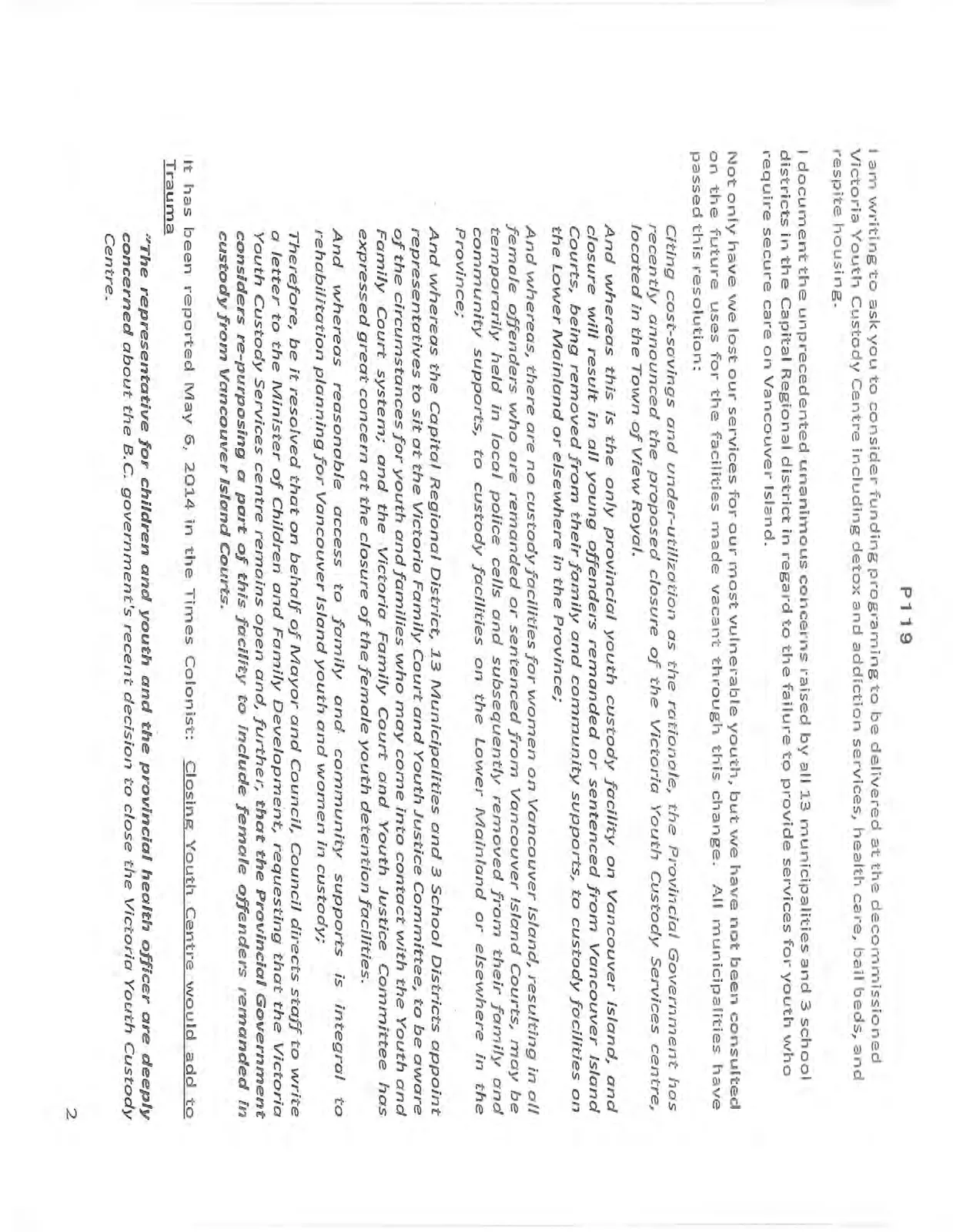
I am writing to ask you to consider funding programing to be delivered at the decommissioned Victoria Youth Custody Centre including detox and addiction services, health care, bail beds, and respite housing.
I document the unprecedented unanimous concerns raised by all 13 municipalities and 3 school districts in the Capital Regional district in regard to the failure to provide services for youth who require secure care on Vancouver Island.
Not only have we lost our services for our most vulnerable youth, but we have not been consulted on the future uses for the facilities made vacant through this change. All municipalities have passed this resolution:
Citing cost-savings and under-utilization as the rationale, the Provincial Government has recently announced the proposed closure of the Victoria Youth Custody Services centre, located in the Town of View Royal.
And whereas this is the only provincial youth custody facility on Vancouver Island, and closure will result in all young offenders remanded or sentenced from Vancouver Island Courts, being removed from their family and community supports, to custody facilities on the Lower Mainland or elsewhere in the Province;
And whereas, there are no custody facilities for women on Vancouver Island, resulting in all female offenders who are remanded or sentenced from Vancouver Island Courts, may be temporarily held in local police cells and subsequently removed from their family and community supports, to custody facilities on the Lower Mainland or elsewhere in the Province;
And whereas the Capital Regional District, 13 Municipalities and 3 School Districts appoint representatives to sit at the Victoria Family Court and Youth Justice Committee, to be aware of the circumstances for youth and families who may come into contact with the Youth and Family Court system; and the Victoria Family Court and Youth Justice Committee has expressed great concern at the closure of the female youth detention facilities.
And whereas reasonable access to family and community supports is integral to rehabilitation planning for Vancouver Island youth and women in custody;
Therefore, be it resolved that on behalf of Mayor and Council, Council directs staff to write a letter to the Minister of Children and Family Development, requesting that the Victoria Youth Custody Services centre remains open and, further, that the Provincial Government considers re-purposing a part of this facility to include female offenders remanded in custody from Vancouver Island Courts.
It has been reported May 6, 2014 in the Times Colonist: Closing Youth Centre would add to Trauma
"The representative for children and youth and the provincial health officer are deeply concerned about the B.C. government's recent decision to close the Victoria Youth Custody Centre.
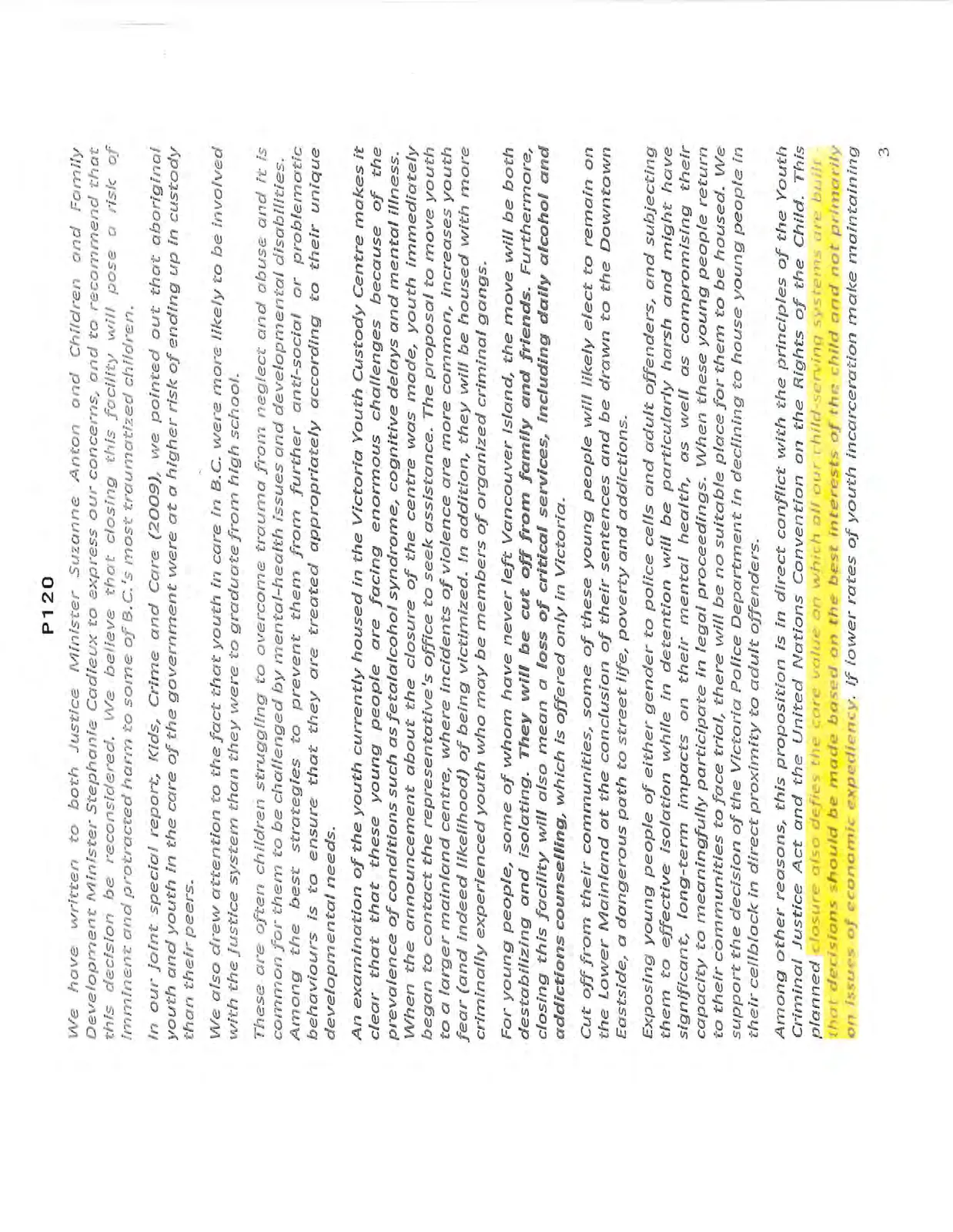
We have written to both Justice Minister Suzanne Anton and Children and Family Development Minister Stephanie Cadieux to express our concerns, and to recommend that this decision be reconsidered. We believe that closing this facility will pose a risk of imminent and protracted harm to some of B.C.'s most traumatized children.
In our joint special report, Kids, Crime and Care (2009), we pointed out that aboriginal youth and youth in the care of the government were at a higher risk of ending up in custody than their peers.
We also drew attention to the fact that youth in care in B.C. were more likely to be involved with the justice system than they were to graduate from high school.
These are often children struggling to overcome trauma from neglect and abuse and it is common for them to be challenged by mental-health issues and developmental disabilities. Among the best strategies to prevent them from further anti-social or problematic behaviours is to ensure that they are treated appropriately according to their unique developmental needs.
An examination of the youth currently housed in the Victoria Youth Custody Centre makes it clear that that these young people are facing enormous challenges because of the prevalence of conditions such as fetalalcohol syndrome, cognitive delays and mental illness. When the announcement about the closure of the centre was made, youth immediately began to contact the representative's office to seek assistance. The proposal to move youth to a larger mainland centre, where incidents of violence are more common, increases youth fear (and indeed likelihood) of being victimized. In addition, they will be housed with more criminally experienced youth who may be members of organized criminal gangs.
For young people, some of whom have never left Vancouver Island, the move will be both destabilizing and isolating. They will be cut off from family and friends. Furthermore, closing this facility will also mean a loss of critical services, including daily alcohol and addictions counselling, which is offered only in Victoria.
Cut off from their communities, some of these young people will likely elect to remain on the Lower Mainland at the conclusion of their sentences and be drawn to the Downtown Eastside, a dangerous path to street life, poverty and addictions.
Exposing young people of either gender to police cells and adult offenders, and subjecting them to effective isolation while in detention will be particularly harsh and might have significant, long-term impacts on their mental health, as well as compromising their capacity to meaningfully participate in legal proceedings. When these young people return to their communities to face trial, there will be no suitable place for them to be housed. We support the decision of the Victoria Police Department in declining to house young people in their cellblock in direct proximity to adult offenders.
Among other reasons, this proposition is in direct conflict with the principles of the Youth Criminal Justice Act and the United Nations Convention on the Rights of the Child. This planned closure also defies the core value on which all our child-serving systems are built - that decisions should be made based on the best interests of the child and not primarily on issues of economic expediency. If lower rates of youth incarceration make maintaining the Victoria Youth Custody Centre solely for that purpose uneconomic, then this represents a unique opportunity to repurpose the facility to address any number of well-identified needs in our communities that could support children and youth struggling with addictions and mental-health issues.
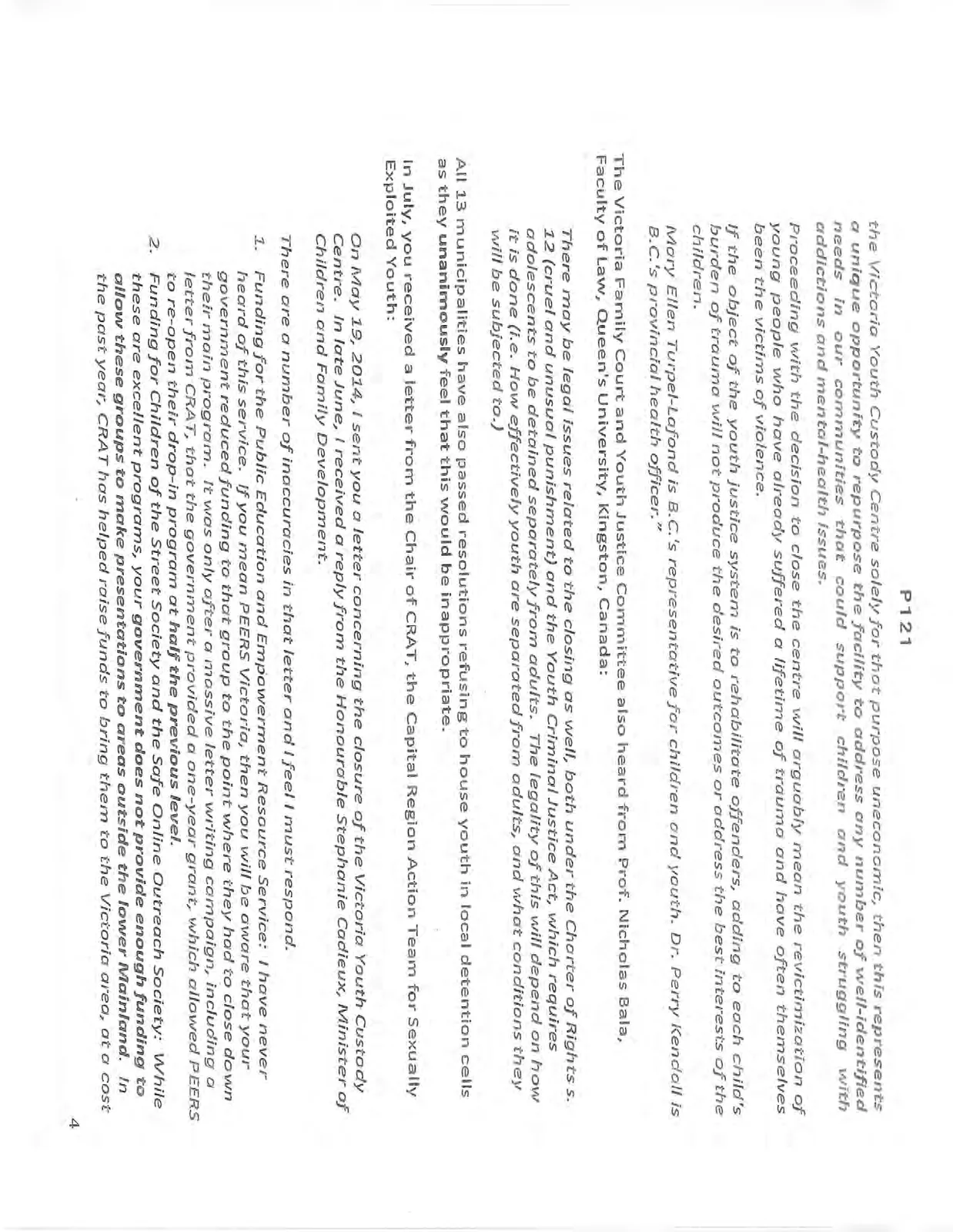
Proceeding with the decision to close the centre will arguably mean the revictimization of young people who have already suffered a lifetime of trauma and have often themselves been the victims of violence.
If the object of the youth justice system is to rehabilitate offenders, adding to each child's burden of trauma will not produce the desired outcomes or address the best interests of the children.
Mary Ellen Turpel-Lafond is B.C.'s representative for children and youth. Dr. Perry Kendall is B.C.'s provincial health officer."
The Victoria Family Court and Youth Justice Committee also heard from Prof. Nicholas Bala, Faculty of Law, Queen's University, Kingston, Canada:
There may be legal issues related to the closing as well, both under the Charter of Rights s. 12 (cruel and unusual punishment) and the Youth Criminal Justice Act, which requires adolescents to be detained separately from adults. The legality of this will depend on how it is done (i.e. How effectively youth are separated from adults, and what conditions they will be subjected to.)
All 13 municipalities have also passed resolutions refusing to house youth in local detention cells as they unanimously feel that this would be inappropriate.
In July, you received a letter from the Chair of CRAT, the Capital Region Action Team for Sexually Exploited Youth:
On May 19, 2014, I sent you a letter concerning the closure of the Victoria Youth Custody Centre. In late June, I received a reply from the Honourable Stephanie Cadieux, Minister of Children and Family Development.
There are a number of inaccuracies in that letter and I feel I must respond.
- Funding for the Public Education and Empowerment Resource Service: I have never heard of this service. If you mean PEERS Victoria, then you will be aware that your government reduced funding to that group to the point where they had to close down their main program. It was only after a massive letter writing campaign, including a letter from CRAT, that the government provided a one-year grant, which allowed PEERS to re-open their drop-in program at half the previous level.
- Funding for Children of the Street Society and the Safe Online Outreach Society: While these are excellent programs, your government does not provide enough funding to allow these groups to make presentations to areas outside the lower Mainland. In the past year, CRAT has helped raise funds to bring them to the Victoria area, at a cost of close to $5,000.
- Gaps in Service: one of our roles is to identify gaps in service. The main reason for gaps in service to sexually exploited youth is cutbacks by the Provincial government, such as SCIT, CAFCA, and several other youth outreach services run by a number of non-profit organizations.
I am concerned that if this is the quality of research and information given to policy makers, that there is a real danger of decisions being made which are not evidence-based and which may not be in the public interest.
The Minister goes on to state the closure of the Youth Custody Centre was an operational decision. While the government is free to make operational decisions, there was no community consultation. The Victoria Family Court and Youth Justice Committee is a statutory group which, among other things, advises your government on issues affecting youth who come into contact with the Criminal Justice System. The decision to close the Victoria Youth Custody Centre was made without any input from them. Your government has a Blue Panel Committee touring the Province asking for community feedback on aspects of the Criminal Justice System. Surely, their final report, which has not been completed, should have been considered before the decision was made to close the Youth Custody Centre. The Select Standing Committee on Children and Youth has not completed its findings. The issue that I raised about the UN Convention on the Rights of the Child, requiring youth to be consulted about issues that affect them has not been addressed by the Minister.
Bill McElroy, Chair Capital Region Action Team for Sexually Exploited Youth
On December 17, 2014 CFAX reported that the Royal BC Museum was no longer pursuing the notion of taking over the building for the storage of artifacts. There has been considerable debate and concern for the wellbeing of Island children. It is not too late to make a change for the better, to consult with the Victoria Family Court and Youth Justice Committee, and live up to the promise of legislation. The committee would be pleased to assist you in developing a plan for a cost effective use of the Victoria Youth Detention Centre.
Sincerely,
Councillor Cynthia Day Chair, Victoria Family Court and Youth Justice Committee
Cc: 14 BC Capital Regional and Municipal Governments and 3 CRD School Boards Dr. Perry Kendall, Provincial Health Officer Mary Ellen Turpel-Lafond, BC's Representative for Children and Youth Maurine Karagianis, MLA Randall Garrison, MP
Document Images
(5)