DRAFT TERMS OF REFERENCE for BCUC Review of Site C
Proposed framework for a utility commission inquiry into the economic effects of the dam project.
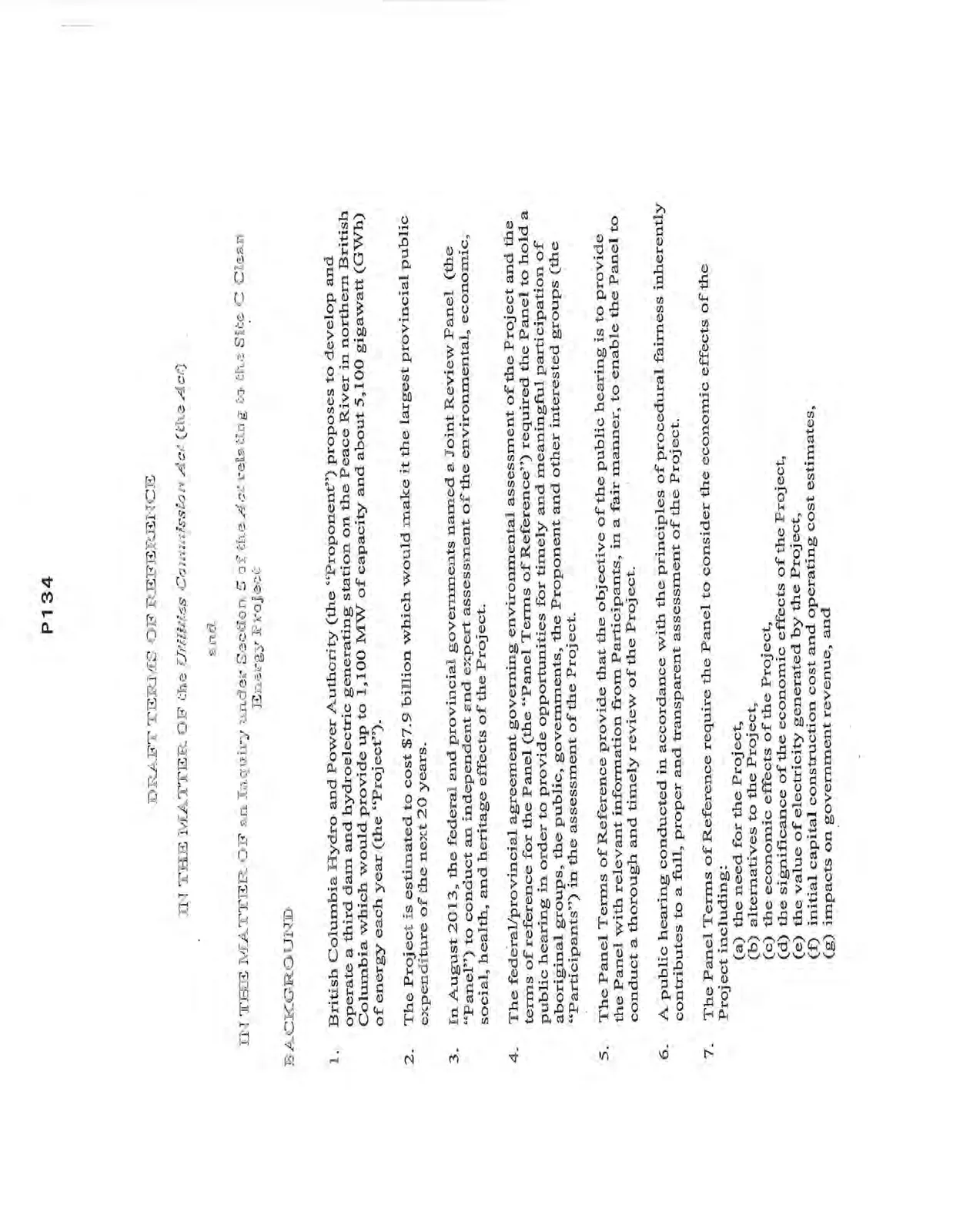
DRAFT TERMS OF REFERENCE
IN THE MATTER OF the Utilities Commission Act (the Act)
and
IN THE MATTER OF an Inquiry under Section 5 of the Act relating to the Site C Clean Energy Project
BACKGROUND
British Columbia Hydro and Power Authority (the “Proponent”) proposes to develop and operate a third dam and hydroelectric generating station on the Peace River in northern British Columbia which would provide up to 1,100 MW of capacity and about 5,100 gigawatt (GWh) of energy each year (the “Project”).
The Project is estimated to cost $7.9 billion which would make it the largest provincial public expenditure of the next 20 years.
In August 2013, the federal and provincial governments named a Joint Review Panel (the “Panel”) to conduct an independent and expert assessment of the environmental, economic, social, health, and heritage effects of the Project.
The federal/provincial agreement governing environmental assessment of the Project and the terms of reference for the Panel (the “Panel Terms of Reference”) required the Panel to hold a public hearing in order to provide opportunities for timely and meaningful participation of aboriginal groups, the public, governments, the Proponent and other interested groups (the “Participants”) in the assessment of the Project.
The Panel Terms of Reference provide that the objective of the public hearing is to provide the Panel with relevant information from Participants, in a fair manner, to enable the Panel to conduct a thorough and timely review of the Project.
A public hearing conducted in accordance with the principles of procedural fairness inherently contributes to a full, proper and transparent assessment of the Project.
The Panel Terms of Reference require the Panel to consider the economic effects of the Project including: (a) the need for the Project, (b) alternatives to the Project, (c) the economic effects of the Project, (d) the significance of the economic effects of the Project, (e) the value of electricity generated by the Project, (f) initial capital construction cost and operating cost estimates, (g) impacts on government revenue, and (h) impacts on gross domestic product.
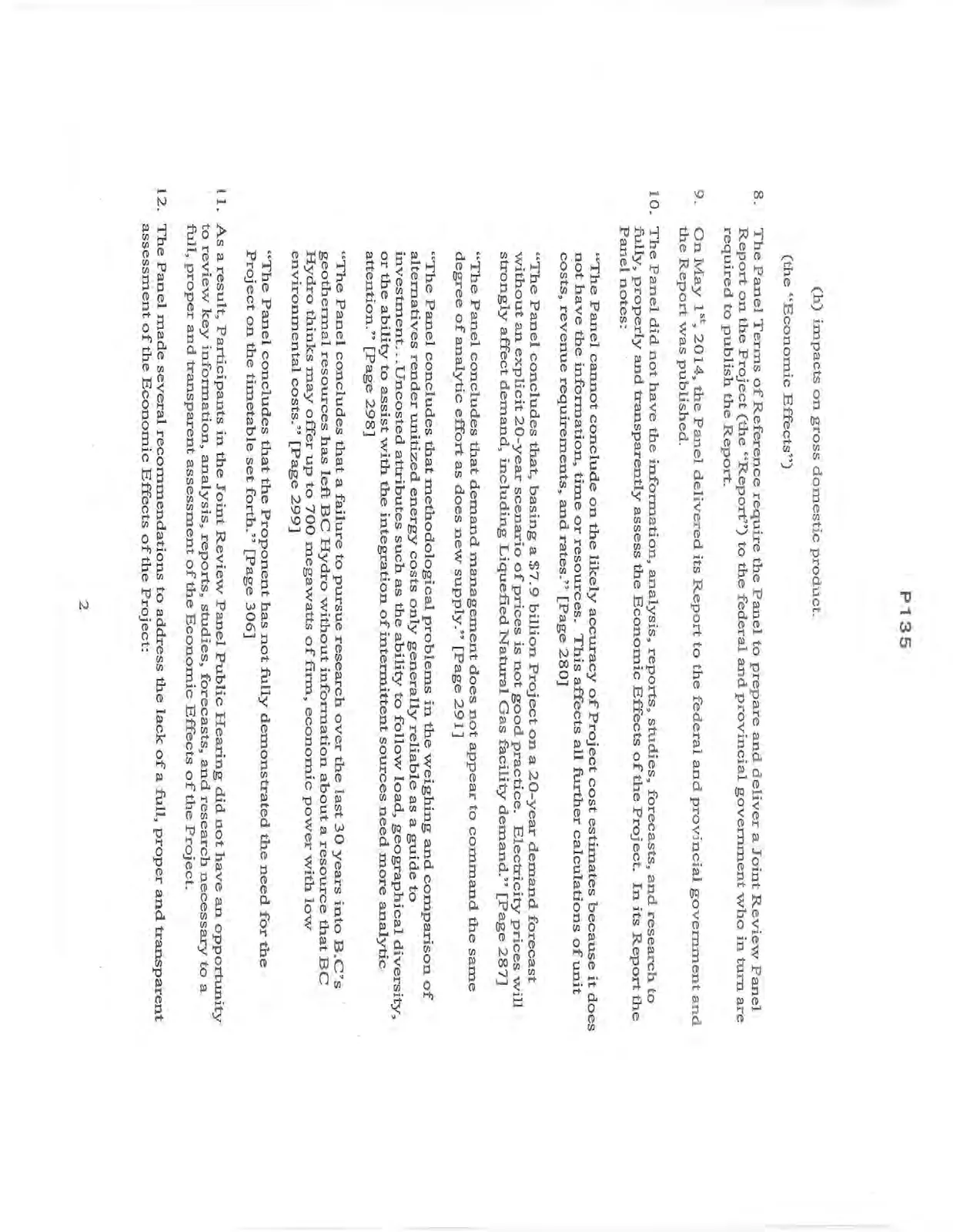
(the “Economic Effects”)
The Panel Terms of Reference require the Panel to prepare and deliver a Joint Review Panel Report on the Project (the “Report”) to the federal and provincial government who in turn are required to publish the Report.
On May 1st, 2014, the Panel delivered its Report to the federal and provincial government and the Report was published.
The Panel did not have the information, analysis, reports, studies, forecasts, and research to fully, properly and transparently assess the Economic Effects of the Project. In its Report the Panel notes:
“The Panel cannot conclude on the likely accuracy of Project cost estimates because it does not have the information, time or resources. This affects all further calculations of unit costs, revenue requirements, and rates.” [Page 280]
“The Panel concludes that, basing a $7.9 billion Project on a 20-year demand forecast without an explicit 20-year scenario of prices is not good practice. Electricity prices will strongly affect demand, including Liquefied Natural Gas facility demand.” [Page 287]
“The Panel concludes that demand management does not appear to command the same degree of analytic effort as does new supply.” [Page 291]
“The Panel concludes that methodological problems in the weighing and comparison of alternatives render unitized energy costs only generally reliable as a guide to investment… Uncosted attributes such as the ability to follow load, geographical diversity, or the ability to assist with the integration of intermittent sources need more analytic attention.” [Page 298]
“The Panel concludes that a failure to pursue research over the last 30 years into B.C.’s geothermal resources has left BC Hydro without information about a resource that BC Hydro thinks may offer up to 700 megawatts of firm, economic power with low environmental costs.” [Page 299]
“The Panel concludes that the Proponent has not fully demonstrated the need for the Project on the timetable set forth.” [Page 306]
As a result, Participants in the Joint Review Panel Public Hearing did not have an opportunity to review key information, analysis, reports, studies, forecasts, and research necessary to a full, proper and transparent assessment of the Economic Effects of the Project.
The Panel made several recommendations to address the lack of a full, proper and transparent assessment of the Economic Effects of the Project:
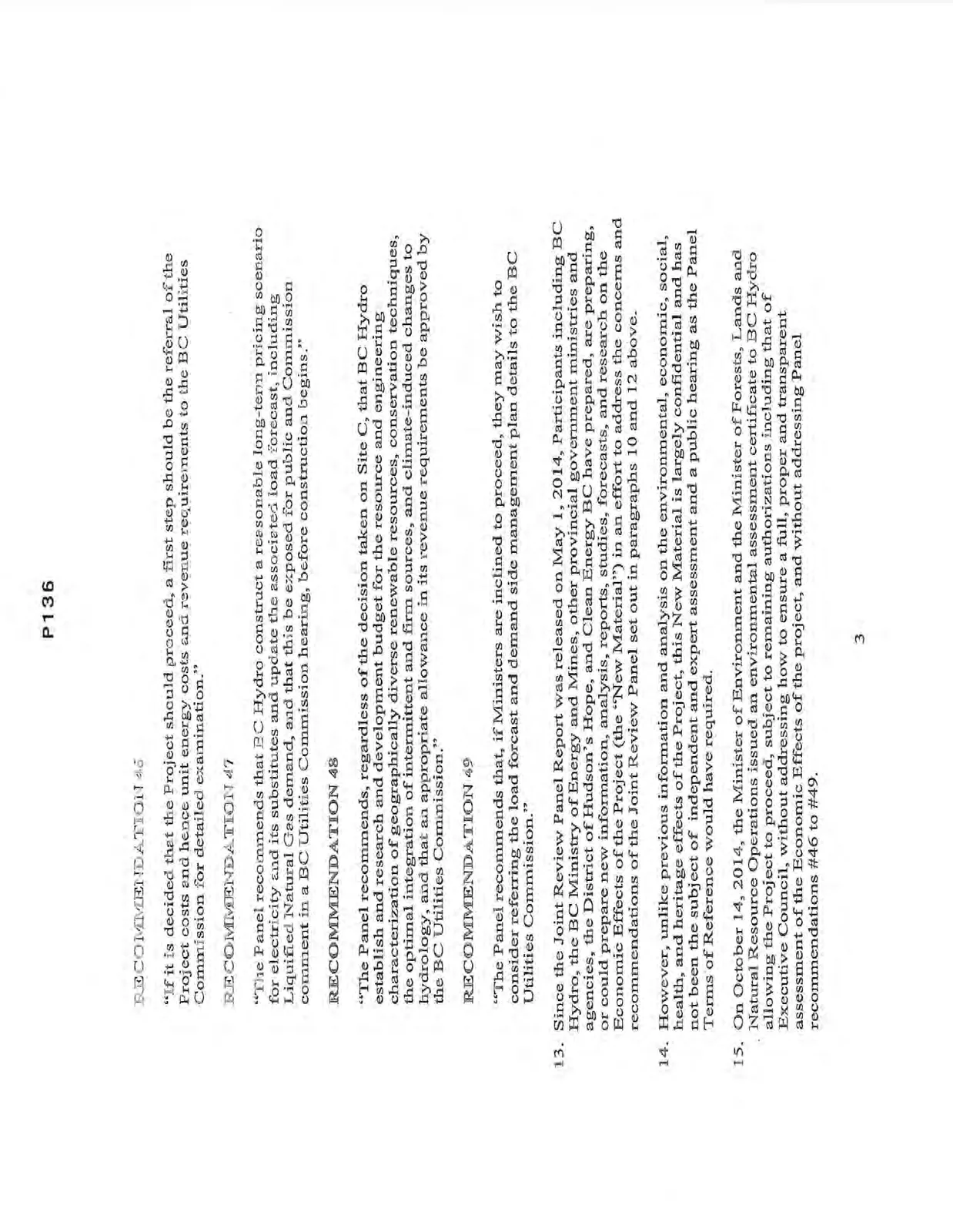
RECOMMENDATION 46 “If it is decided that the Project should proceed, a first step should be the referral of the Project costs and hence unit energy costs and revenue requirements to the BC Utilities Commission for detailed examination.”
RECOMMENDATION 47 “The Panel recommends that BC Hydro construct a reasonable long-term pricing scenario for electricity and its substitutes and update the associated load forecast, including Liquified Natural Gas demand, and that this be exposed for public and Commission comment in a BC Utilities Commission hearing, before construction begins.”
RECOMMENDATION 48 “The Panel recommends, regardless of the decision taken on Site C, that BC Hydro establish and research and development budget for the resource and engineering characterization of geographically diverse renewable resources, conservation techniques, the optimal integration of intermittent and firm sources, and climate-induced changes to hydrology, and that an appropriate allowance in its revenue requirements be approved by the BC Utilities Commission.”
RECOMMENDATION 49 “The Panel recommends that, if Ministers are inclined to proceed, they may wish to consider referring the load forcast and demand side management plan details to the BC Utilities Commission.”
Since the Joint Review Panel Report was released on May 1, 2014, Participants including BC Hydro, the BC Ministry of Energy and Mines, other provincial government ministries and agencies, the District of Hudson’s Hope, and Clean Energy BC have prepared, are preparing, or could prepare new information, analysis, reports, studies, forecasts, and research on the Economic Effects of the Project (the “New Material”) in an effort to address the concerns and recommendations of the Joint Review Panel set out in paragraphs 10 and 12 above.
However, unlike previous information and analysis on the environmental, economic, social, health, and heritage effects of the Project, this New Material is largely confidential and has not been the subject of independent and expert assessment and a public hearing as the Panel Terms of Reference would have required.
On October 14, 2014, the Minister of Environment and the Minister of Forests, Lands and Natural Resource Operations issued an environmental assessment certificate to BC Hydro allowing the Project to proceed, subject to remaining authorizations including that of Executive Council, without addressing how to ensure a full, proper and transparent assessment of the Economic Effects of the project, and without addressing Panel recommendations #46 to #49.
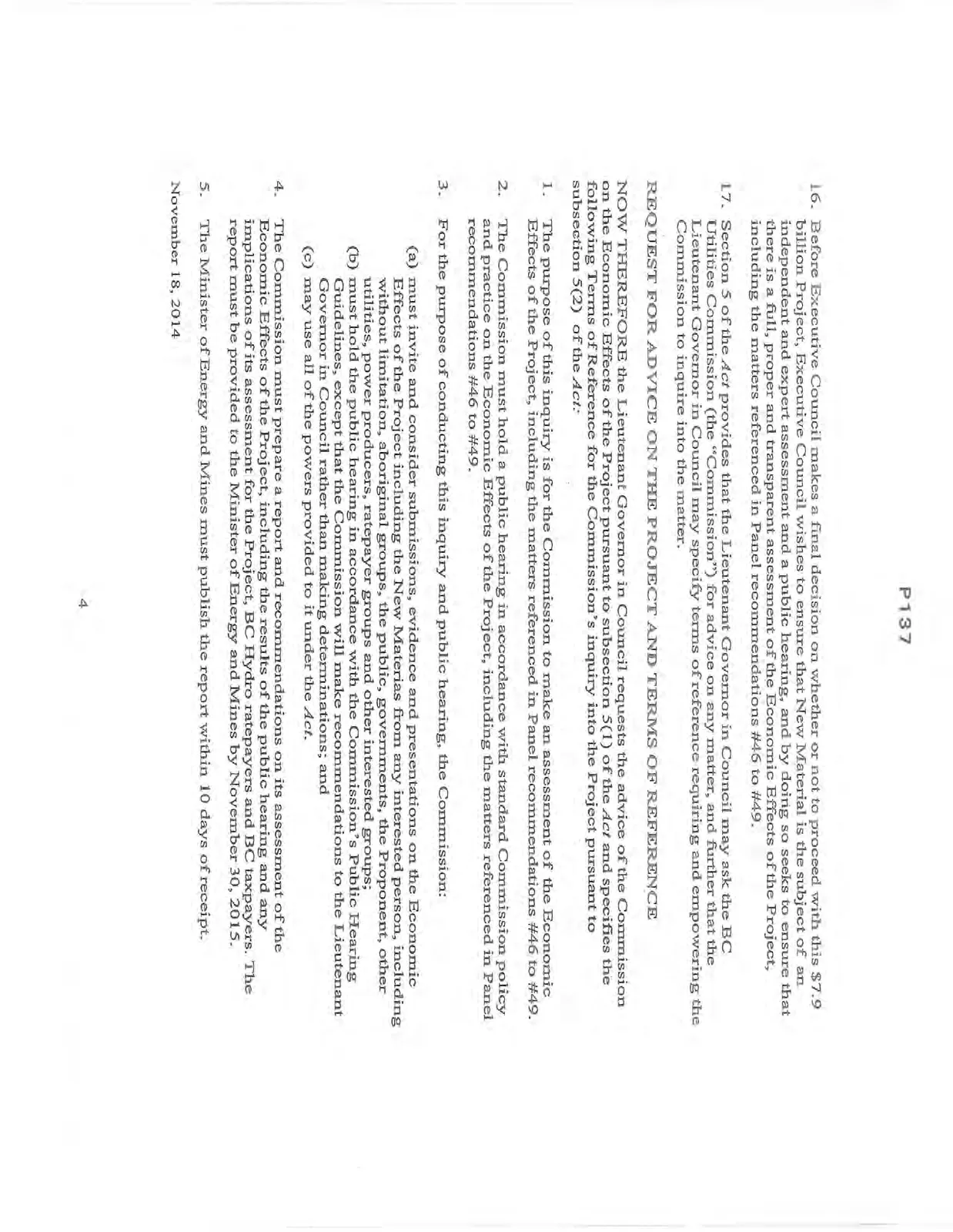
Before Executive Council makes a final decision on whether or not to proceed with this $7.9 billion Project, Executive Council wishes to ensure that New Material is the subject of an independent and expert assessment and a public hearing, and by doing so seeks to ensure that there is a full, proper and transparent assessment of the Economic Effects of the Project, including the matters referenced in Panel recommendations #46 to #49.
- Section 5 of the Act provides that the Lieutenant Governor in Council may ask the BC Utilities Commission (the “Commission”) for advice on any matter, and further that the Lieutenant Governor in Council may specify terms of reference requiring and empowering the Commission to inquire into the matter.
REQUEST FOR ADVICE ON THE PROJECT AND TERMS OF REFERENCE
NOW THEREFORE the Lieutenant Governor in Council requests the advice of the Commission on the Economic Effects of the Project pursuant to subsection 5(1) of the Act and specifies the following Terms of Reference for the Commission’s inquiry into the Project pursuant to subsection 5(2) of the Act:
The purpose of this inquiry is for the Commission to make an assessment of the Economic Effects of the Project, including the matters referenced in Panel recommendations #46 to #49.
The Commission must hold a public hearing in accordance with standard Commission policy and practice on the Economic Effects of the Project, including the matters referenced in Panel recommendations #46 to #49.
For the purpose of conducting this inquiry and public hearing, the Commission: (a) must invite and consider submissions, evidence and presentations on the Economic Effects of the Project including the New Material from any interested person, including without limitation, aboriginal groups, the public, governments, the Proponent, other utilities, power producers, ratepayer groups and other interested groups; (b) must hold the public hearing in accordance with the Commission’s Public Hearing Guidelines, except that the Commission will make recommendations to the Lieutenant Governor in Council rather than making determinations; and (c) may use all of the powers provided to it under the Act.
The Commission must prepare a report and recommendations on its assessment of the Economic Effects of the Project, including the results of the public hearing and any implications of its assessment for the Project, BC Hydro ratepayers and BC taxpayers. The report must be provided to the Minister of Energy and Mines by November 30, 2015.
The Minister of Energy and Mines must publish the report within 10 days of receipt.
November 18, 2014
Document Images
(4)