Presentation: Transportation Governance Engagement Workbook
CRD presentation regarding regional transportation goals, current governance features, and proposed levels of change.
Transportation Governance Engagement Workbook

Agenda
- Project rationale
- Transportation in the region
- Workbook input
- Next steps
- Discussion

Project rationale

Background: Why are we here?
- Transportation is a priority.
- Change is needed to achieve the ambitious goals set by the CRD.
- We need to hear from you about how much change you want to see.

Regional Transportation Goals
- Ease congestion
- Support higher rates of walking, cycling and transit use
- Reduce emissions

What does the CRD currently offer?
- Policy, planning and data
- Regional trails
- Coordination
- Governance
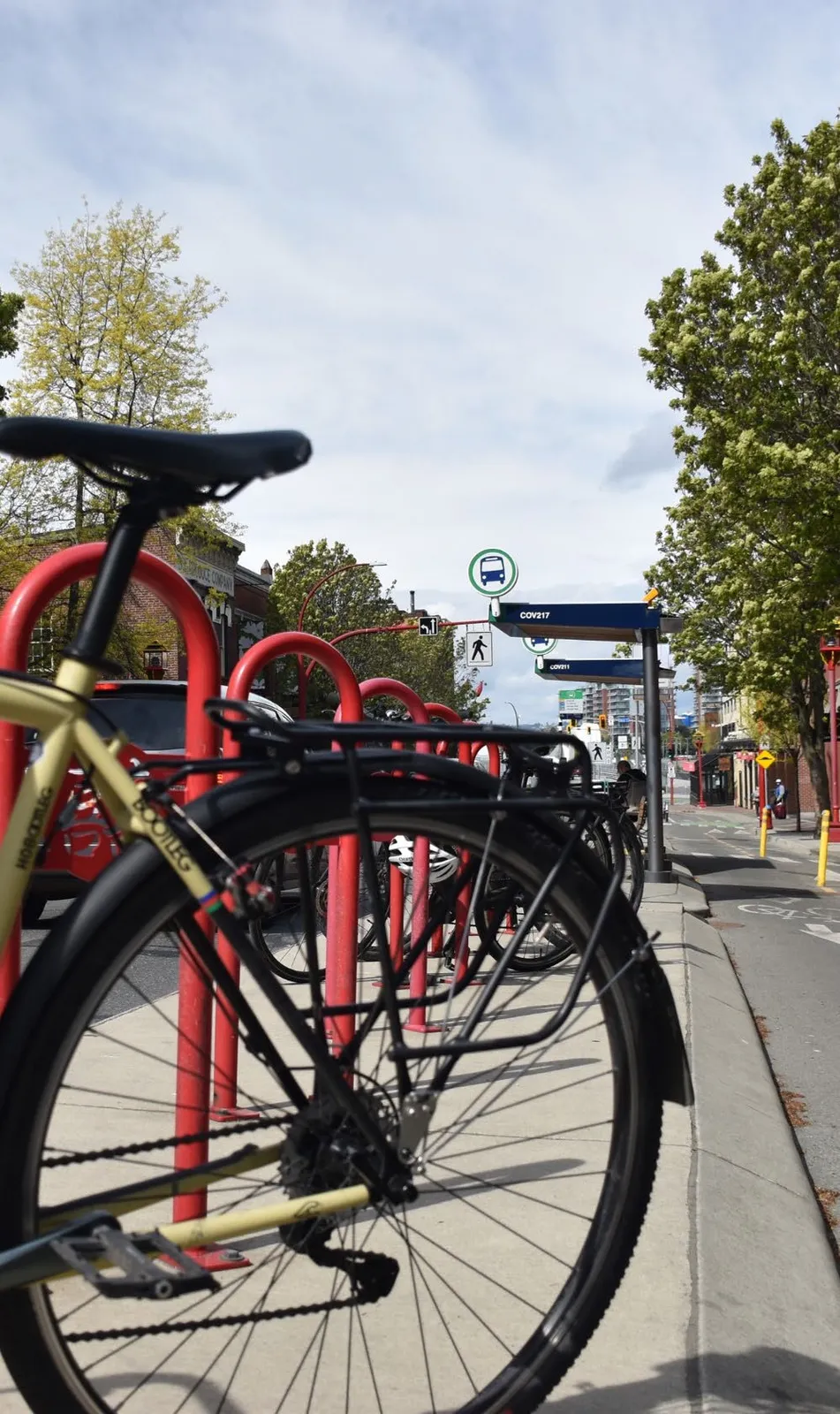
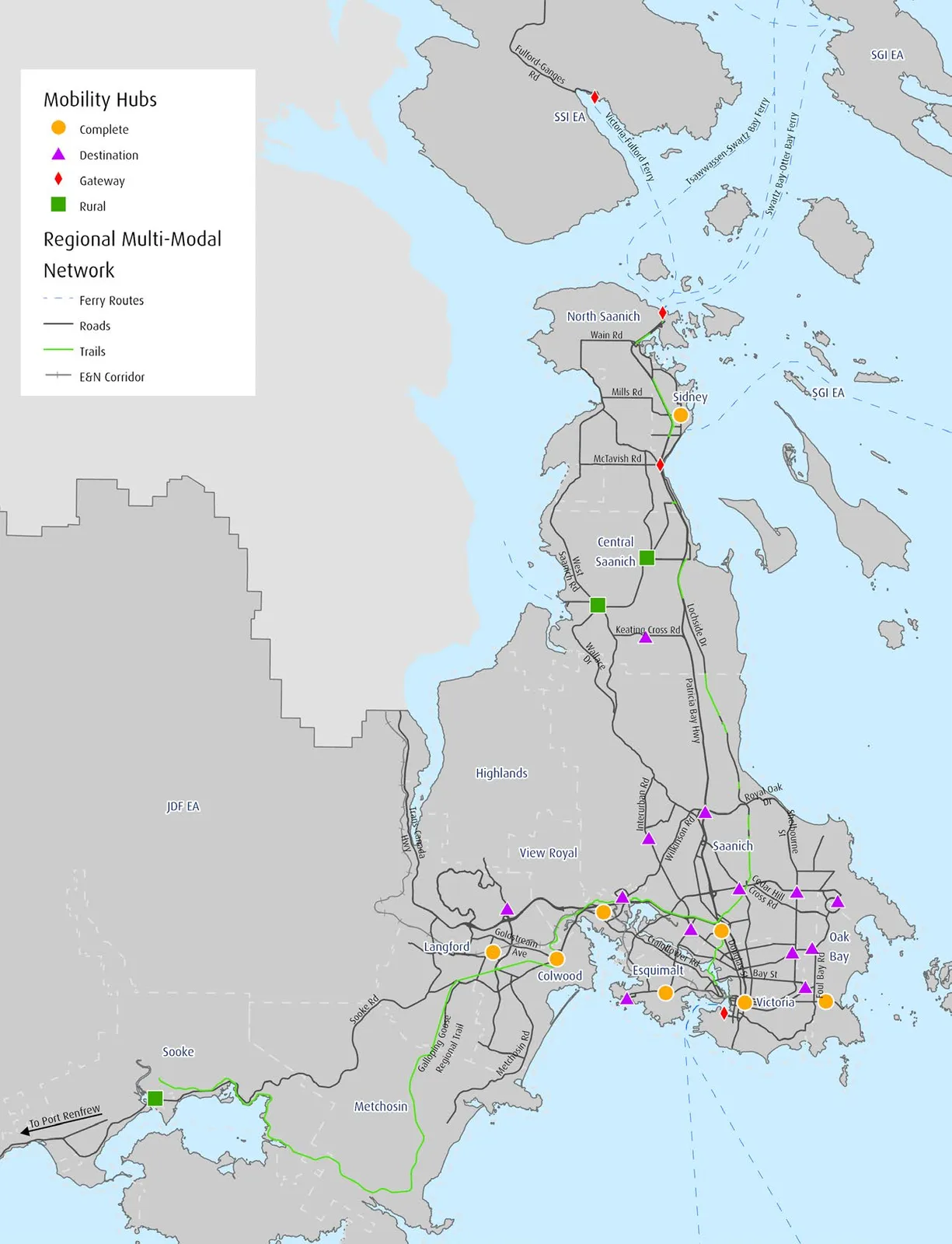
Transportation in the region
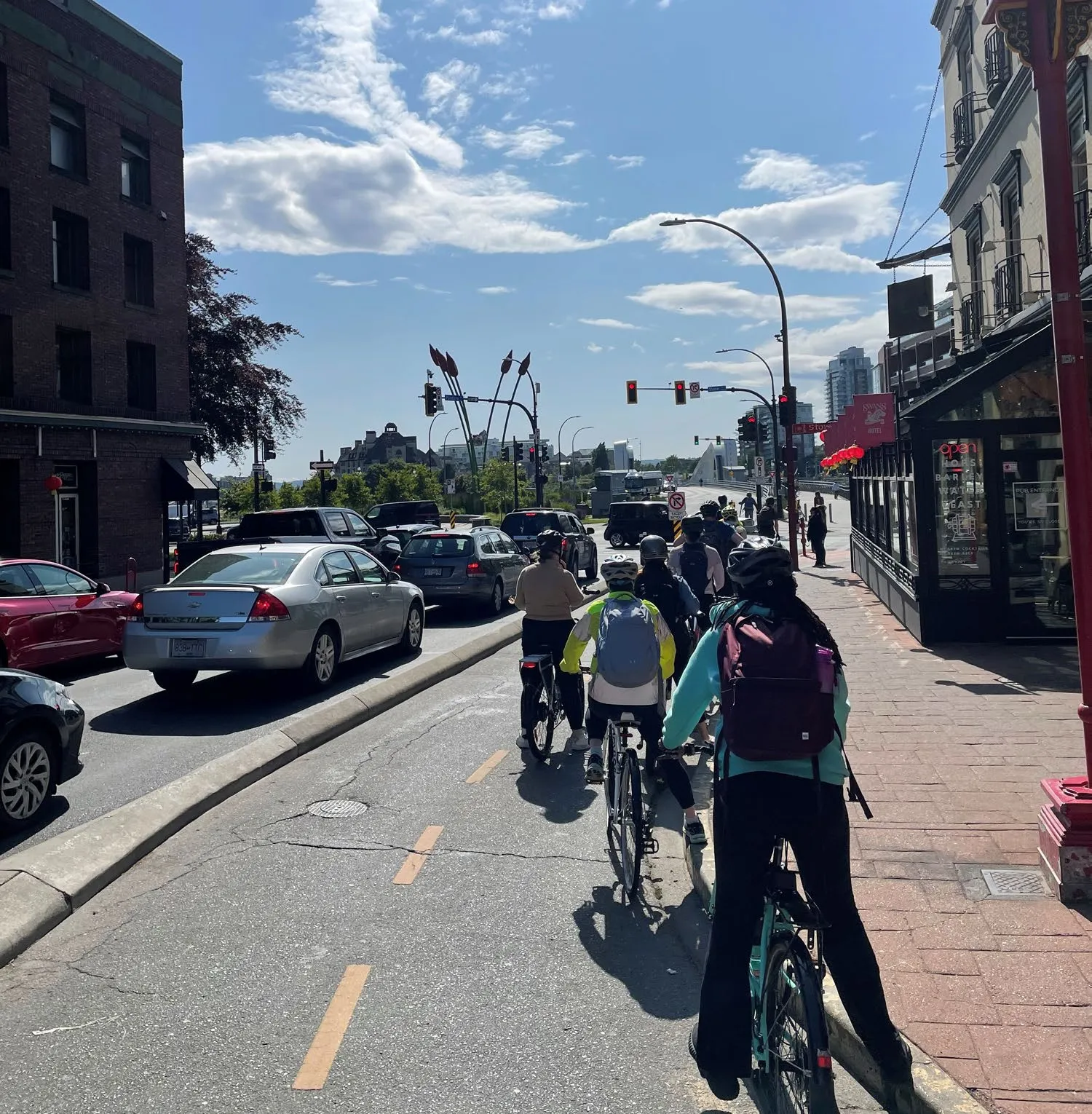
Transportation governance in the capital region

| Feature | CRD | Municipalities | BC Transit | MOTI |
|---|---|---|---|---|
| Governance features | • CRD Transportation Committee / Board – same decision-makers as municipalities and VRTC • Advisory: Working Group and Traffic Safety Commission • Focus on data and planning alignment |
• 13 local government councils • Representation at CRD and VRTC • Compete for limited funding • Focus on policy and service delivery |
• VRTC – same decision-makers as municipalities and regional Board • Compete for limited funding • Impacted by others’ decisions |
• Controls funding and legislation • Shifting priorities to climate action and complete communities • Responds to focused advocacy |
| Regional and Multi-Use Trails | Primary | Direct service delivery impact | Consulted agency | Leases ROW |
| Regional and Local Roads | Planning / policy impact | Primary | Direct service delivery impact | Legislation / funding |
| Land Use – Corridors & Nodes | Planning / policy impact | Primary | Direct service delivery impact | Legislation |
| Regional Transit Network | Planning / policy impact | Direct service delivery impact | Primary | Legislation / funding |
| Provincial Highways | Planning / policy impact | Direct service delivery impact | Direct service delivery impact | Primary |
Regional Transportation Plan

Outcomes
- Regional Multi-modal Network (RMN)
- Outcome statements
Actions
- Plans / policy
- Infrastructure, service delivery & programming
- Land use
- Behaviour change
Regional Transportation Priorities
| Advocate | Act | Pivot |
|---|---|---|
| Improve service delivery | Deliver services, coordinate and aim for consistency | Plan for long-term needs |
| • Transit (RapidBus) • Transit (general) • Transit (non-bus mass transit) • Highway safety & multi-modal improvements • SSI / SGI connectivity |
• Active transportation • Transportation Demand Management (TDM) • Safety policy • Strengthen land use • Parking & access upgrades |
• Governance • Rail link & Westshore passenger ferry |
Sub-Regional Trip Patterns
Internal and External 2022 Origin Destination Household Travel Survey
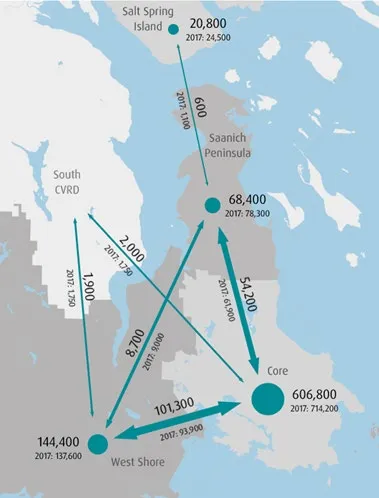
Sub-Regional Daily Trips (Internal):
- Core: 606,800 (2017: 714,200)
- West Shore: 144,400 (2017: 137,600)
- Saanich Peninsula: 68,400 (2017: 78,300)
- Salt Spring Island: 20,800 (2017: 24,500)
Inter-Regional Trips:
- Core ↔ West Shore: 101,300 (2017: 93,900)
- Core ↔ Saanich Peninsula: 54,200 (2017: 61,900)
- West Shore → Saanich Peninsula: 8,700 (2017: 9,000)
- West Shore → South CVRD: 1,900 (2017: 1,750)
- Saanich Peninsula → South CVRD: 2,000 (2017: 1,750)
- Saanich Peninsula → SSI: 600 (2017: 1,100)
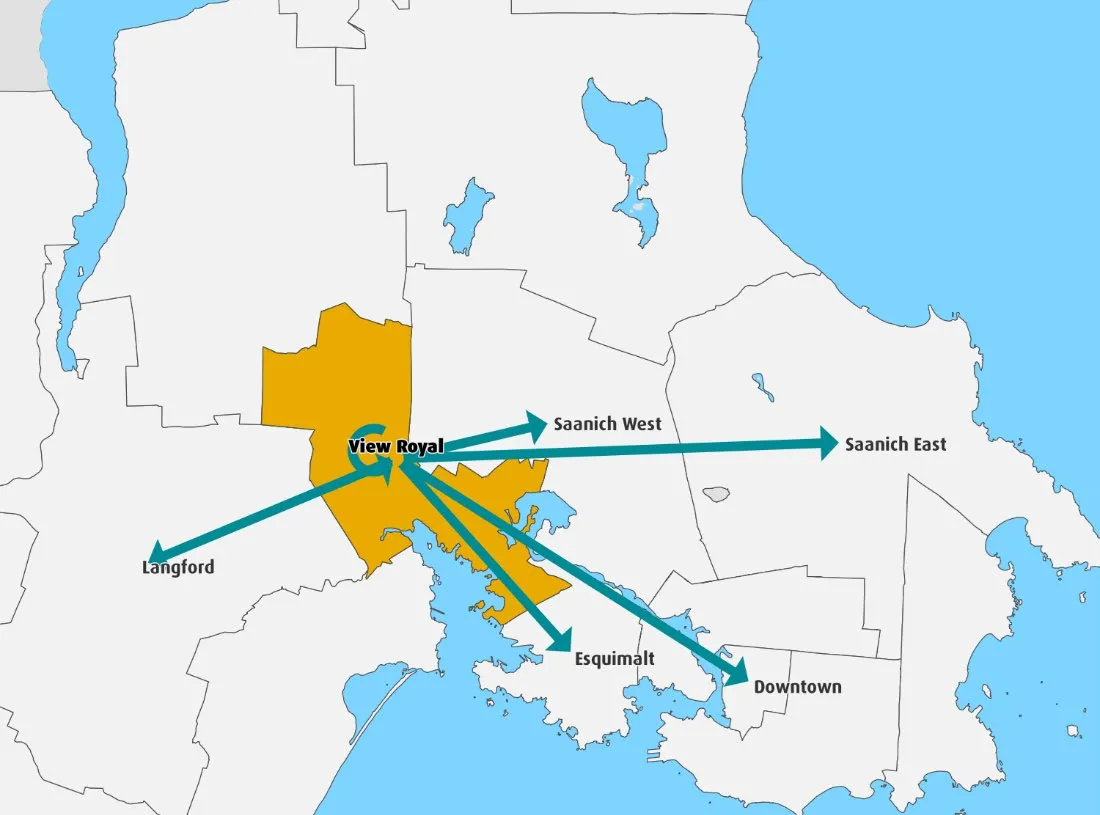
Top Five Destinations of AM Peak Trips from View Royal
2022 Origin Destination Household Travel Survey
Destinations: Langford, Saanich West, Saanich East, Esquimalt, Downtown.
Delivering on resident expectations
- Live and work across local government boundaries
- Move easily across the region
- Expect quality service regardless of who delivers the service
Workbook Input
How far do we want to go?
- Level 1: New CRD Service - CRD brings its transportation functions into one department to enable service-level changes.
- Level 2: Expand CRD Authority - CRD gets new funding and service authorities to change travel behaviour and build out the multi-modal network.
- Level 3: New authority - One organization makes decisions about service levels and investment in the network.
Scope of change:
- Scope of change the CRD could deliver, based on authorities permitted by legislation: Includes Level 1 and Level 2.
- Scope of change that requires new legislative authorities: Includes Level 3.
Who is being engaged?
- 13 municipalities
- Three electoral areas
- Agency partners (e.g., BC Transit, Victoria Regional Transit Commission, BC Ferries, Airport Authority, Island Corridor Foundation, Province)
- First Nations are invited to participate

Engagement Scope

In Scope
- Test support for matters where greater regional focus is needed to advance transportation priorities
- Identify decision-making preferences related funding, planning, policy and service delivery
- Explore opportunities and constraints related to governance change
Out of Scope
- Updating the Regional Transportation Plan
- Making changes to the regional multi-modal network
- Identifying transportation issues and priorities
- Amending authorities set out in legislation
Engagement Workbook
- Introduction and background
- Questionnaire
- Glossary

Examples
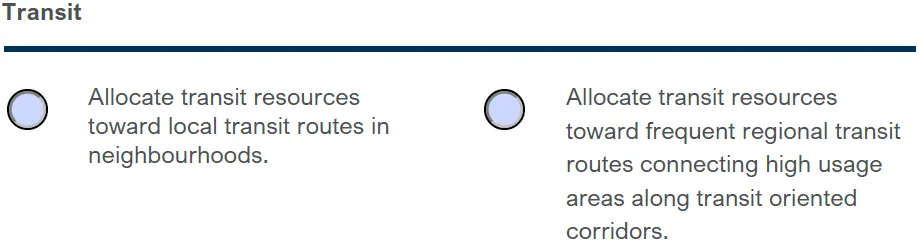
Considering trade-offs Question 1. A – I Transit
- Allocate transit resources toward local transit routes in neighbourhoods.
- Allocate transit resources toward frequent regional transit routes connecting high usage areas along transit oriented corridors.
Understanding expectations Question 2. A – D
- A new governance structure should strike a balance between regional and local priorities. (Agree - Neither agree nor disagree - Disagree)

Examples
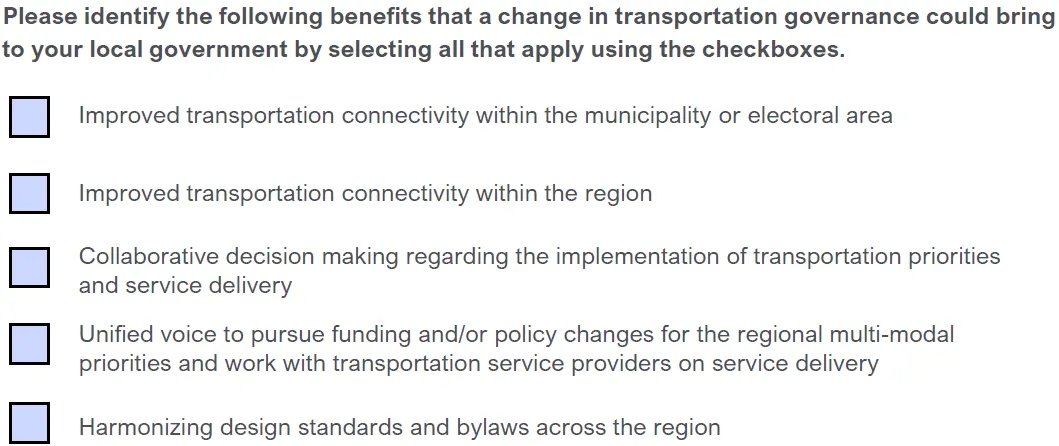
Identifying opportunities Questions 3-4 (select) Please identify the following benefits that a change in transportation governance could bring to your local government by selecting all that apply using the checkboxes.
- Improved transportation connectivity within the municipality or electoral area
- Improved transportation connectivity within the region
- Collaborative decision making regarding the implementation of transportation priorities and service delivery
- Unified voice to pursue funding and/or policy changes for the regional multi-modal priorities and work with transportation service providers on service delivery
- Harmonizing design standards and bylaws across the region

Examples
Identifying opportunities Questions 5-6 (rank) Please rank which factors should be the highest priority when building out the Regional Multi-modal Network from 1-4, with one being the most important. Enter the ranked number in each text box accordingly. When ranking, consider areas with the highest potential for meeting regional objectives.
- Connecting residential areas and employment centers
- Improving access to essential amenities (i.e., schools, healthcare facilities, shopping, recreational facilities and parks)
- Enhancing connectivity between neighboring municipalities
- Connecting to BC Ferries and Victoria International Airport (YYJ)
Examples
4. Open-ended Question 7 Are there any additional comments or suggestions you would like to provide regarding the understanding of and support for a change in transportation governance in our region? Please provide comments or suggestions, if applicable.
Next steps
Engagement timeline
- Spring 2023:
- Present jurisdictional scan and governance concepts.
- Seek direction to engage on scope and scale of change.
- Summer 2023:
- Broadly engage local governments, BC Transit, Ministry of Transportation and Infrastructure (MOTI), BC Ferries and the airport authority and analyze level of consensus of possible change.
- Fall 2023:
- Report back on level of consensus.
- Decide on governance change achievable over this Board term.
Long-term timeline
- Summer 2023: Engagement & Analysis
- Fall 2023: Reporting
- Fall 2023: Analysis and Options Development
- 2024: Service establishment - Undertake service approval and enact a service establishment bylaw
- 2025-ongoing: Implementation & delivery - Implement required internal changes to increase service levels, prove feasibility
- 2025-2026: Business case for an authority - Pending support, begin a business case for a new authority
- 2026-on: Delivery - Advocate for legislative change and implement new authority
* The long-term timeline is subject to level of consensus and approvals outside of regional district and local government control.
What is success?
By the end of the Board term, the region has taken a concrete first step toward changing authorities.
Comparing different authorities
| Feature | CRD | TransLink | Auckland Transport | Halifax Regional Municipality (HRM) |
|---|---|---|---|---|
| Governance features | • No mechanism to collectively address impact of decisions • Compete for funding • Focus on planning alignment |
• Funding incentivizes collective decisions on regional network • Limited funding source • Complex decision-making |
• Single local government • Local and Federal government control of funding • Does not set mobility outcomes; deliver on local government goals |
• Single local government • Significant control over mobility outcomes • Product of amalgamation |
| Regional and Multi-Use Trails | CRD | TransLink / Metro Vancouver | Auckland Transport | HRM |
| Regional and Local Roads | Local Governments | TransLink / Local Governments | Auckland Transport | HRM / Province |
| Regional Transit Network | BC Transit | TransLink / Local Governments | Auckland Transport | HRM |
| Land Use – Corridors & Nodes | Local Governments | Local Governments / Metro Vancouver | Local Government | HRM |
| Provincial Highways | Province | Province | Federal Government | Province |
What can we learn?
- Need strong business case for change
- Takes time to become fully operational – deliver in increments
- Build from a solid base – get the tools needed to control mobility
Discussion