COUNCIL REPORT - RECREATIONAL CANNABIS REGULATION
Staff report recommending the removal of prohibitions on home growing of recreational cannabis and using rezoning and business license fees for retail approvals.
TOWN OF VIEW ROYAL COUNCIL REPORT
TO: Council DATE: October 31, 2019 FROM: J. Davison, MCIP RPP, Community Planner MEETING DATE: November 5, 2019
RECREATIONAL CANNABIS REGULATION
RECOMMENDATION:
THAT the prohibition on home growing of recreational cannabis be removed;
AND THAT rezoning and business license fees be the tool used for approving recreational cannabis retail uses in the Town, including the development of guidelines that describe the zoning process and establish expectations for applicants;
AND FURTHER THAT a business license fee for recreational cannabis retail business licenses be established that covers costs associated with related education and enforcement.
CHIEF ADMINISTRATIVE OFFICER’S COMMENTS:
I concur with the recommendation.
DIRECTOR OF DEVELOPMENT SERVICES’ COMMENTS:
I concur with the recommendation.
PURPOSE OF REPORT:
This report was discussed and received at the October 8, 2019 Committee of the Whole meeting. At this time, it is before Council to seek a recommendation for an approach to take moving forward as the Town is in receipt of a rezoning application and there have been multiple inquiries about this topic.
BACKGROUND:
Currently the production, distribution, sale and home growing of recreational cannabis is prohibited by the Town of View Royal within Zoning Bylaw No. 900, 2014. The reason for putting those regulations in place was to ensure the uses remained prohibited through the (at the time) uncertain process of federal legalization of recreational cannabis. Council at the time agreed to proceed cautiously with a thorough public engagement process and a comprehensive review of the potential approaches for permitting these uses within the Town.
This report is the latest in a series of reports regarding recreational cannabis regulation in the Town of View Royal. The most recent report focused on the City of Langford’s approach to approving and regulating recreational cannabis retail sales. That report is attached to this report. The legality of Langford’s RFP/Temporary Use Permit process has been in question, and the ultimate amount that Langford has received has not yet been made public. There has been a rumoured number from a few sources that Langford has received hundreds of thousands of dollars in funds from the RFP process, but as far as staff have heard this is merely a ‘guesstimate’ based on Mayor Young’s statement to the Times Colonist in March of 2019:
“But I will tell you I have enough for two officers and some money for education every year, so there’s no cost to the taxpayers.”
Young said the money will be used to pay for one police officer and one bylaw officer to handle any associated issues and help educate the public. “We’re happy, I can tell you, with the applications that came forward. It actually took the risk and it took the costs from the taxpayer and put it on the business owner to help the city manage the new costs that may arise from this.”
The lack of any hard numbers has made it difficult for staff to analyze the suitability of the approach for the Town.
The public engagement process did not attract much interest or attention from the public, and Council decided to abandon it early this year. While it was hoped that a specific application would have generated more public interest, the current application at Admirals Walk has rezoning signs posted on three sides of the property and yet inquiry has been virtually non-existent. Thus far it seems that the public is simply not very concerned with these stores or cannabis issues in general, other than a few comments about odour and objections to the Town prohibiting home growing.
ISSUES AND ANALYSIS:
There are two questions yet to be answered by Council:
- Permitting the uses: Does the Town want to permit any of the production, distribution, sales and/or home growing of recreational cannabis? Currently the most pressing uses are sales and home growing.
- Regulatory approaches: How and where will the Town permit these uses?
Permitting the Uses
Throughout this process staff has heard issues raised by Council regarding permitting cannabis uses within the Town. These issues can broadly be categorized as either public health-related, or enforcement-related, and represent the two issues which are perceived as burdens on the Town’s resources.
Public Health Issues
Impact to health (particularly to youth) is a concern, and it cannot reasonably be said that recreational cannabis consumption has a net health benefit. The reality is that illegal cannabis use in Canada has been so prevalent that the goal for legalization in Canada has been rooted in harm reduction. It is felt that legalization will reduce organized crime activities, will legitimize public health education around cannabis use beyond statements around abstinence, will provide a well-regulated and consistent product, and will generate public revenue in such forms as permit fees, licensing fees and taxes to offset the societal costs associated with cannabis consumption.
Permitting some or all uses in the Town would be furthering this effort. Prohibiting uses does not remove cannabis from the municipality; rather, it brings its use into the open and permits public health agencies and law enforcement to pursue more nuanced and realistic public education initiatives and drug enforcement strategies. Continuing a prohibitive stance leaves the municipality moving against societal trends recognized by federal and provincial legislation and by public health professionals. Prohibition is not a sustainable approach to regulating cannabis in the current legislative and societal environment. Approving these uses, in staff’s opinion, is not a pro-cannabis approach but rather a harm reduction approach.
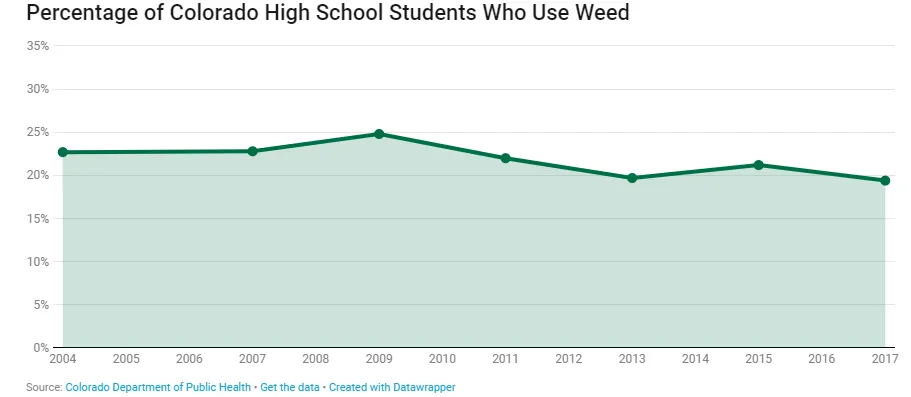
Evidence that legalizing cannabis does not lead to increased youth consumption has been borne out in Colorado and Washington State, which have had legalized cannabis for years – Washington legalized in 2012 and Colorado in 2014. Many jurisdictions have looked to these states’ experiences to inform their own policies and regulations.
According to the chart below, use by high school students in Colorado after legalization has been lower than any year between 2004 and 2012.
Attached to this report is a Canadian Centre on Substance Abuse and Addiction (CCSAA) paper on the Washington and Colorado experiences. The main public health conclusions applicable to municipalities centre on:
- the need to avoid overt commercialization and marketing to youth;
- to communicate and collaborate with other stakeholders;
- to invest in prevention, education and treatment rather than an enforcement-based approach especially at the early stages of implementation;
- to invest proactively in a public health approach
One dominant rationale for cannabis legalization is the increased opportunity for a public health approach that includes prevention, education and treatment, in contrast with an enforcement approach focused on legal sanctions. A portion of sales revenue in both Colorado and Washington has been designated to support prevention and education initiatives. However, revenue-based funding by nature means a delay between the initiation of sales and the availability of funding, which results in limited resources prior to and early in the implementation stage — the period during which these initiatives are most needed. In addition, taxation revenue in Washington that was initially earmarked for cannabis-related prevention, education, treatment, regulation and research has been reallocated to the general revenue stream, which reduces the funding available for public health.
A public health approach is comprehensive, and stakeholders highlighted the need to build capacity across all system components that would be impacted by cannabis legalization. Stakeholders in Colorado in particular remarked on the importance of ensuring that resources are in place to address potential impacts on the health sector from emergency hospital admissions, poison control incidents and demand for treatment.
Stakeholders cautioned that lobbying by the cannabis industry could influence political decision making in favour of retail profit over public health. These concerns were more prominent in Colorado, where an established and coordinated industry presence has been part of the collaborative development process.
It is expected that a municipal public health initiative will complement provincial and federal efforts.
Enforcement Issues
The question around enforcement has been: How much of an additional burden will be placed on the Town’s enforcement personnel (including the RCMP) by permitting these uses? This is not an easily answered question and may not be adequately answered without some experience and data in the Canadian context. The same CCSAA paper made the following conclusion on enforcement:
Ensure consistent enforcement of regulations by investing in training and tools for those responsible for enforcement, particularly to prevent and address impaired driving and diversion to youth, and to control the black market
Stakeholders agreed there remains a strong role for enforcement under legalization, especially in areas such as driving while impaired, use in public, distribution to youth, and black-market production and diversion. Enforcement stakeholders in Colorado, for example, remarked that they had observed an increase in the black market because of the increased ease of production and the profits associated with exporting to neighbouring states.
Investing in education, training, analysis and investigative capacity is important to ensure consistent and effective enforcement of the regulations. Colorado stakeholders noted that adequate resources had not been invested to ensure access to the training required for effective and consistent enforcement. Several Washington stakeholders felt that frontline officers did not view enforcement of the regulations as a priority, which led to the normalizing of transgressions such as use in public. Colorado stakeholders pointed out the lack of labs for sample analysis as a significant obstacle, whereas Washington stakeholders emphasized that the availability of testing labs and the scaling up of impaired driving detection capacity before legalization had been especially beneficial.
It is clear from these experiences that generating funds from applications for cannabis retail store uses for the purpose of education and enforcement is likely beneficial and justified and provides a net public benefit over a prohibition and enforcement-based approach (where the uses in View Royal remain illegal). Overspending on education and law enforcement at the applicants’ expense during the early part of implementation is a low-risk and high-benefit approach for the Town.
Regulatory Approaches
Much of the discussion around the regulatory approach to cannabis retail has been whether to take the Langford approach of issuing Requests for Proposals (RFPs) and award a set number of contracts for stores, approved under Temporary Use Permit (TUPs) which are valid for three years and an option to renew for another three years, or whether to rezone properties. Langford’s rationale for choosing their approach was covered in the attached report to COW from June 2019, but a more detailed analysis of the legal and financial approaches of the RFP process vs a more traditional rezoning with a business license cost-recovery approach is necessary. As a municipality is statutorily required to be cost-neutral, care must be taken to justify funds taken in to offset the impact of the use.
The RFP process is a legal approach but is considered ‘pushing the envelope’ as far as justification for cost-recovery and ‘selling zoning’. A municipality considering this approach would have to make preparation should contracts be voided by legal challenge.
Financial Details
The City of Vancouver charges ~$33,000 per year for a cannabis retail license, significantly more than the City of Victoria at $5,000 per year. Given that the City of Vancouver has the most experience in British Columbia, one could assume that there is good reason for that figure.
Regarding the RFP process vs the Business Licensing approach to cost-recovery, there are some considerations.
Risks for the Town regarding the RFP process:
- It is less certain in the potential funds received.
- Legal contracts and potential legal challenge represent costs for the Town which must be recovered from funds received by successful proponents.
- The Town must transition to a rezoning and business licensing model after the TUP expires.
- The RFP/TUP process is less business-friendly and less transparent than a rezoning and business license model. Transparency is primarily a public engagement consideration in terms of the assumption by the public that these Temporary Use Permits are a foregone conclusion in the RFP process, rather than a property-considered change in land use underpinned by a Public Hearing and informed public input.
Benefits to the Town regarding the RFP process:
- The Town is not driving the funding process, and as such the justification for receiving the funds is shared with the proponent.
- The RFP process frontends the financial contribution and allows the Town to receive funds when the Canadian Centre on Substance Abuse and Addiction says it is the most important to be proactive – at the beginning of the process.
- Does not permanently commit the Town to this use, should it prove to be undesirable or unsustainable; financially or otherwise.
- The edible market represents an unknown element. The three-year TUP will be enough time for edibles to be legalized (October 2019 federally).
How Many Stores in View Royal?
As mentioned in the previous report to COW, the City of Langford has some locational considerations:
- 500 metres of any other location where the retail sale of Cannabis Products for nonmedicinal use has been authorized (with the exception of Goldstream Avenue, where two locations may be considered);
- 300 metres of any school;
- 300 metres of any group daycare;
- 150 metres of Centennial Park, Veterans Memorial Park, City Centre Park, Westhills YMCA, any regional or Provincial park, or Langford, Glen or Florence Lakes; and,
- 50 metres of any land zoned R1 (One-family Residential) or R2 (One- and Two-Family Residential), except within the designated City Centre.
These are much different from the City of Victoria’s only requirement that stores be spaced at least 400m from each other.
If the Town used Langford’s approach to buffering uses, the prohibited areas would be as represented in the figure below, where green represents major or regional parks, light blue is schools, dark blue is commercial daycare, and yellow is R-1, R-1A, R-1B, R-1C and R-2 zoning.
As one can see, the only remaining spaces within existing commercial zones are the lands along Island Highway north of the Casino and the commercial space opposite the Victoria General Hospital. Potentially in the future, the Town Centre at Fort Victoria could support a third, but this would require a major shift in land use in that location.
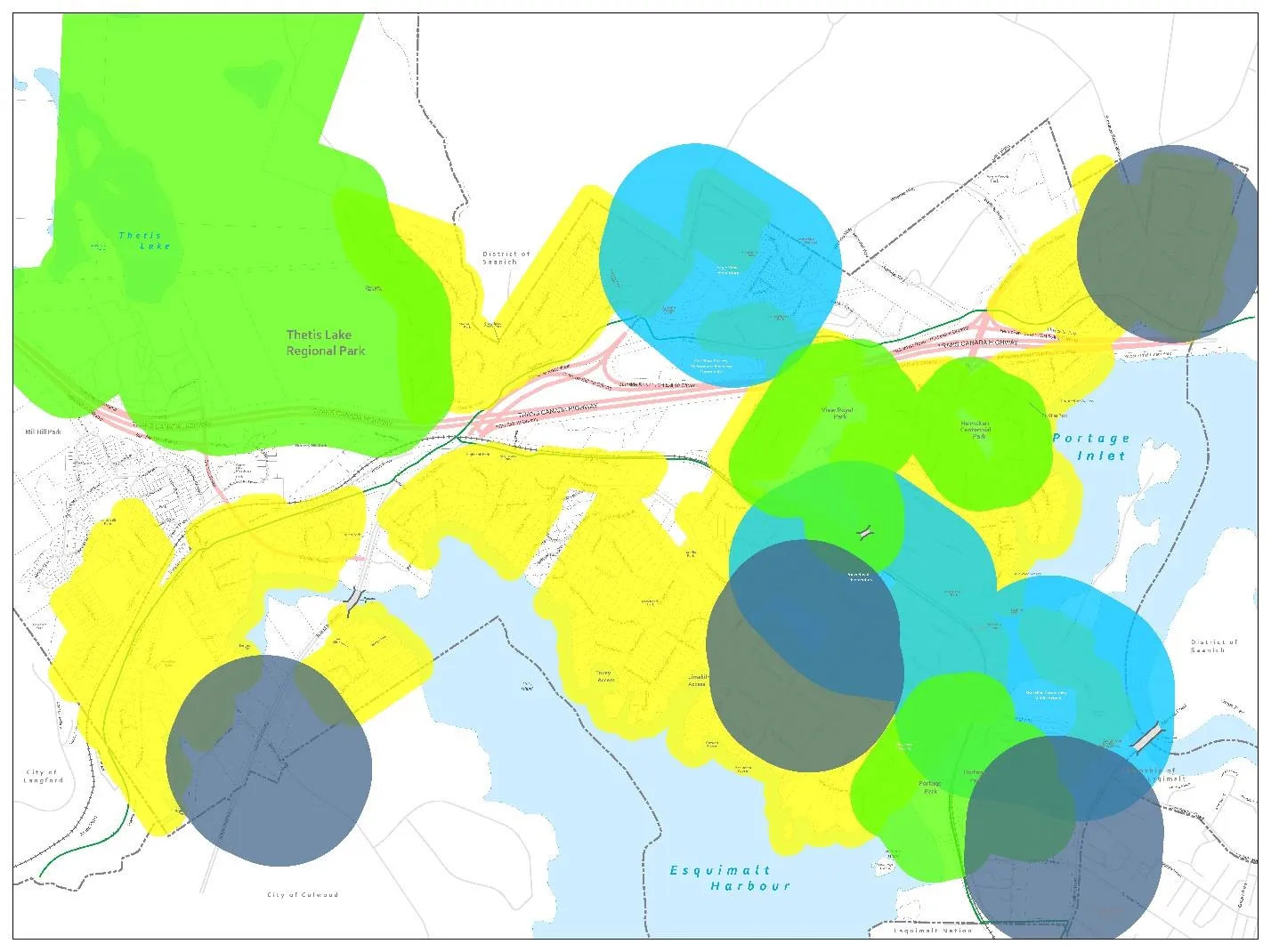
Based on the above coverage, it appears that park buffers have little impact on the commercial areas, except for the pedestrian arms of Portage Park extending to the east. Most children using Portage Park are using the playground and that is significantly separated from the Admirals Rd commercial areas. Detached residential also seems to have a very limited impact.
Including daycares in the buffer removes the Admirals Walk and surrounding commercial areas from cannabis retail stores, as well as removing a good portion of the commercial area near the Island Highway/Wilfert area, as well as Eagle Creek Village. Given that cannabis retail can and would probably act to instead displace much-needed daycares in the future, it does not make sense to buffer these uses. Staff is of the opinion that the downside of losing daycare space is a much more negative impact to the community than any possible presence of cannabis retail.
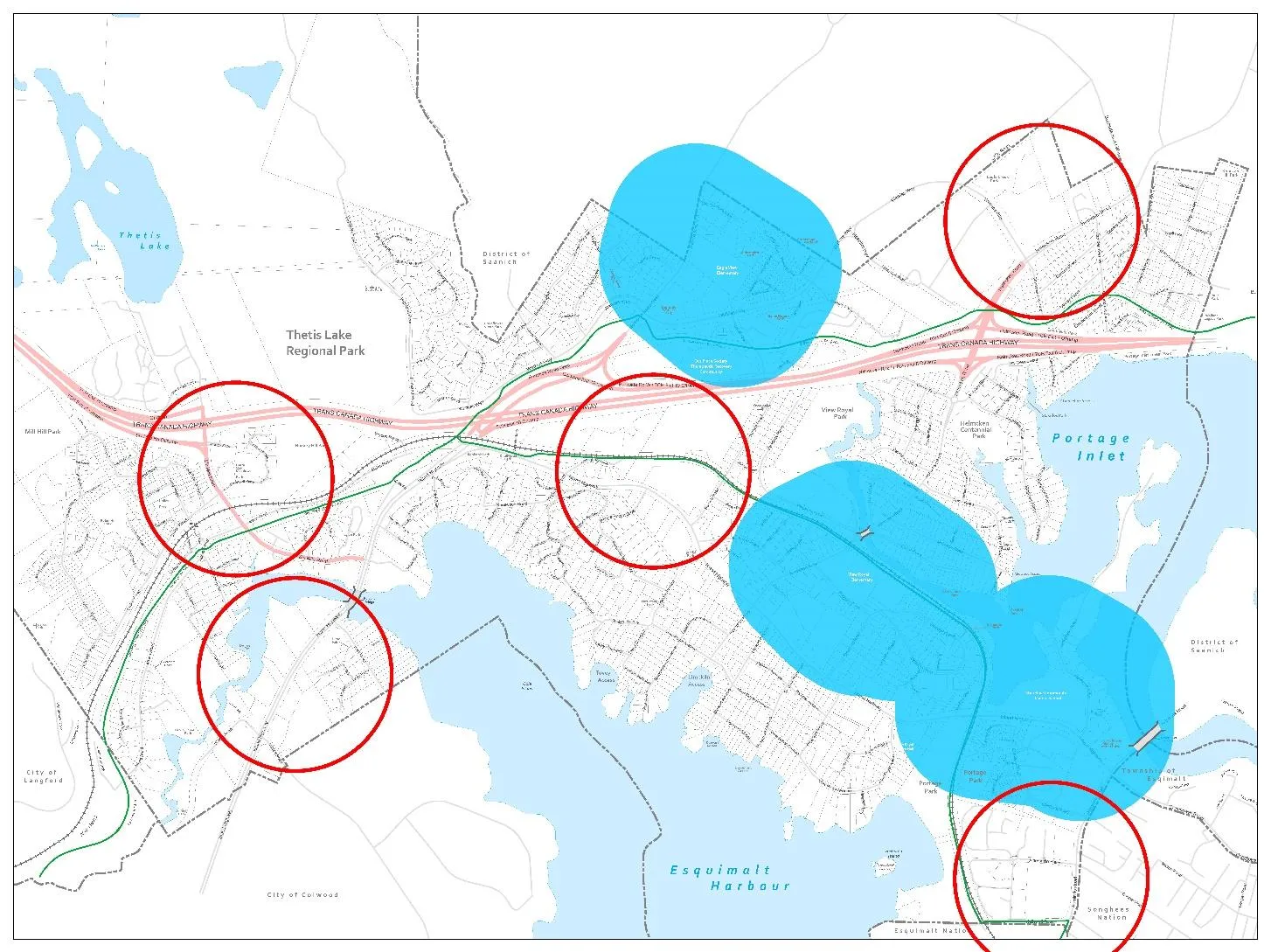
Buffering only schools seems like the best and most realistic compromise, given View Royal’s geography. If this is done, realistically the Town can expect to have up to five cannabis retail locations in the future – one near the Island Highway/Wilfert intersection, one potentially at Eagle Creek or nearby, and one at Admirals Walk (for which the Town currently has an application), one at Lakeside Village, and one potentially at the future Town Centre at the current Fort Victoria.
Note that in the diagram below, the school and store buffers can overlap (but not reach the school property itself) but the red store buffers cannot overlap.
DISCUSSION:
Staff’s position throughout this process has been that recreational cannabis will be integrated into Canadian society quickly, and continuing a prohibitive stance is neither sustainable, nor recommended by public health professionals. Permitting recreational cannabis uses would be considered a proactive public health initiative.
The questions for Council remain:
Does Council wish to permit some of these uses? The most pressing issues are home growing and retail sales. Staff have recommended in previous reports that Council not prohibit home growing; it represents an unnecessary and overly burdensome enforcement issue and should really be handled by the RCMP. Staff is recommending that Council move to approve recreational cannabis retail uses and remove the prohibition for home growing.
Does Council wish to take the RFP/TUP process, or does it wish to pursue the rezoning and business licensing approach? Staff’s main concerns with the RFP/TUP process is that it was legal, and that it was not an exploitative practise designed to extract more funds from applicants than could reasonably be expected for cost-neutrality. There is risk that this process could not stand up to legal challenge, though small, and it represents a departure from the Town’s typical process. On the other hand, the RFP process could frontend the costs for covering the Town’s enforcement and education initiatives and will provide a safeguard for monitoring the potentially much larger market of edibles sales.
Staff is recommending the approach of a rezoning and business license fee. It is the standard approach that the Town has taken and represents less risk for the Town and less risk for applicants looking to establish a long-term retail location in the Town. It does not require legal contracts. Despite the opportunity to review the appropriateness of these stores with the TUP process, the reality is that recreational cannabis is already a mature societal presence and these stores and uses will be a reality in our society. From the perspective of transparency of process, our community has some familiarity with the rezoning process and the steps that are followed. Introducing a different process carries the risk of eroding public confidence in the transparency of decision making in the Town. Staff is of the opinion that it is important to fund education and enforcement, and these costs can be recouped through a yearly business license fee. Staff does believe that a significant business license fee is justified, and that a fee somewhere between the Vancouver ($33,000) and Victoria ($5,000) yearly might be a good starting point for discussion based on the information presented in this report. Reductions could be considered in the future should it be necessary.
There is also the pressing issue of the current application. Moving to a rezoning and business licensing process would enable the current application at Admirals Walk to move forward.
RECOMMENDED APPROACH:
Staff is recommending that Council:
- Remove the prohibition on home growing of recreational cannabis
- Take the approach of using rezoning and business license fees as the tool for approving recreational cannabis uses in the Town. This would include the development of guidelines for this use that would inform the zoning process and establish expectations for applicants.
- Set a business license fee for a recreational cannabis retail business license to cover costs associated with education and enforcement.
ALTERNATE APPROACH:
If Council determines that an RFP and TUP approach is preferable, an appropriate resolution would be:
That Council direct staff to draft an RFP for temporary use permits for cannabis retail use and prepare a draft contract for the Town to use when engaging proponents.
RECOMMENDATION:
THAT the prohibition on home growing of recreational cannabis be removed;
AND THAT rezoning and business license fees be the tool used for approving recreational cannabis retail uses in the Town, including the development of guidelines that describe the zoning process and establish expectations for applicants;
AND FURTHER THAT a business license fee for recreational cannabis retail business licenses be established that covers costs associated with related education and enforcement.
SUBMITTED BY: J. Davison MCIP RPP, Community Planner
REVIEWED BY: L. Chase MCIP RPP, Director of Development Services
ATTACHMENTS
- Canadian Centre for Substance Abuse and Addiction – Cannabis Regulation: Lessons Learned in Colorado and Washington State – November 2015
- Town of View Royal Report to Committee of the Whole – Analysis of City of Langford Approach to Recreational Cannabis Retail Sale – June 11, 2019
Document Images
(3)