Correspondence from VRBA Re: Energy Efficiency Improvements to the National Building Code
Correspondence from the Victoria Residential Builders' Association and the federal Minister of Natural Resources regarding BC Step Code and national code harmonization.
Community Builders… Building Communities
March 29, 2018
Dear Mayor and Council,
RE: Update on BC Step Code
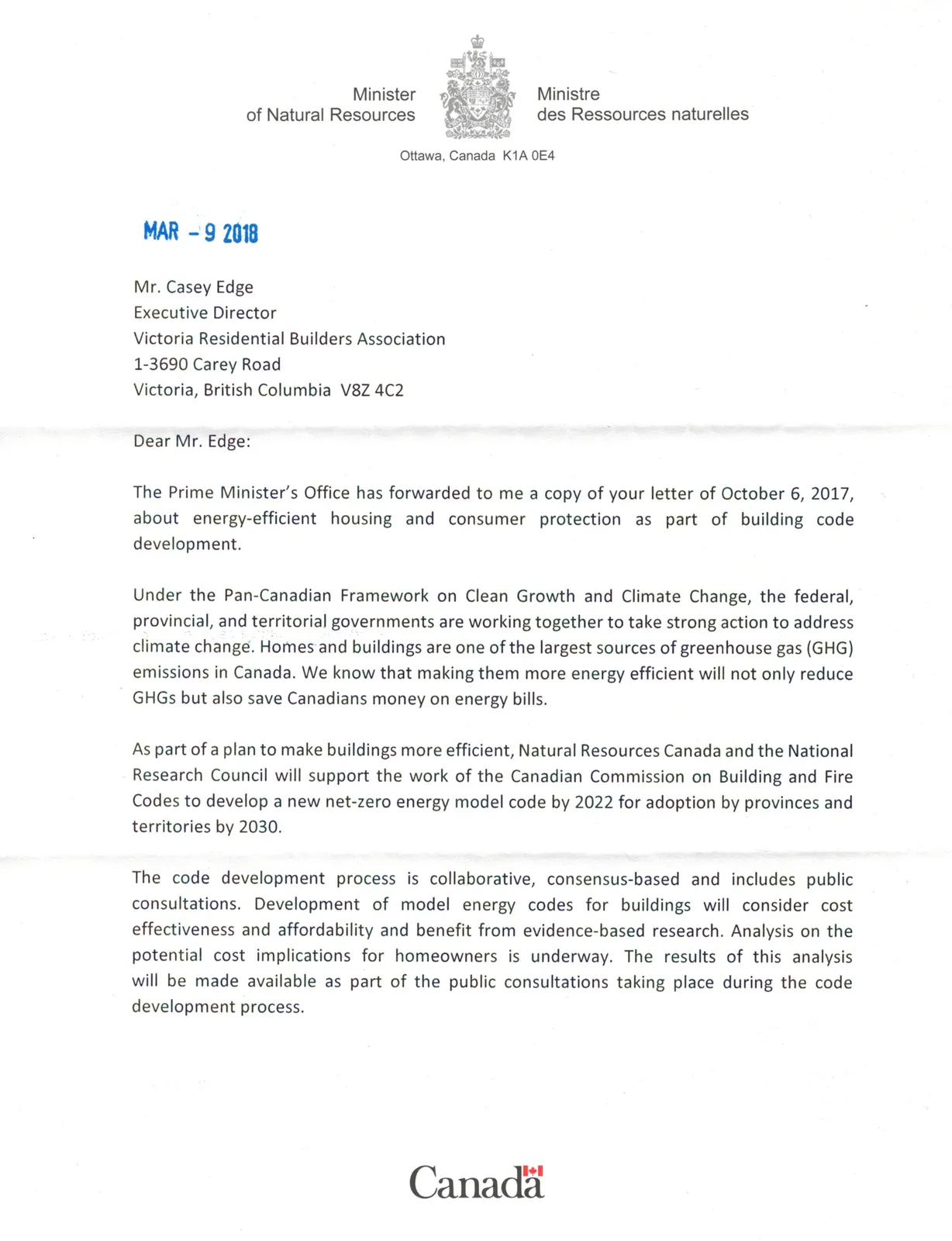
Attached is a letter to VRBA from the Honourable Jim Carr, Minister of Natural Resources for Canada describing the plan and timeline for energy efficiency improvements to the National Building Code.
Carr says, “As part of a plan to make buildings more efficient, Natural Resources Canada and the National Research Council will support the work of the Canadian Commission on Building and Fire Codes to develop a new net-zero energy model code by 2022 for adoption by provinces and territories by 2030.”
Carr does not say he supports BC’s Step Code.
He says, “The (national) code development process is collaborative, consensus-based and includes public consultations. Development of model energy codes for buildings will consider cost effectiveness and affordability and benefit from evidence-based research. Analysis on the potential cost implications for homeowners is underway. The results of this analysis will be made available as part of the public consultations taking place during the code development process.”
In other words, cost implications for homeowners will be available during a public consultation, which was not done for BC’s Step Code. The national affordability consultation is expected to be launched in Fall 2019. In BC, the minister signed the Step Code regulation prior to the cost/benefit analysis, which is not normally part of responsible code development. BC’s cost/benefit differs significantly from our builders’ cost estimates.
VRBA provides input into National Code initiatives and recently discussed the Step Code process with national officials. They report that in addition to performance testing, their plan will include a prescriptive option not available in BC’s Step Code. This is important to avoid bottlenecks and rising costs that may arise from insufficient testing capacity. Clearly the National Code’s goal is also Net Zero by 2030. However unlike BC, they are being diligent to address affordability, builder education support, attention to materials and practices, and potential unintended consequences.
There is a signed agreement to harmonize BC’s code with the National Code, which is violated by BC’s Step Code. The BC govt leaped ahead under the pretext tighter homes are required now. By deviating from the national code process, BC irresponsibly fast-tracks energy efficiency, puts homeowners at risk and adds significant cost for negligible benefit. Most energy loss is from older homes, not new homes. Also, municipalities are responsible for establishing and enforcing the province’s Step Code Tiers - a big responsibility. The Municipal Insurance Association says “Building bylaws are one of local governments’ greatest exposures to liability risks.” Your municipality voluntarily invokes the Step Code, not the province.
Our recommendation is municipalities should disregard BC’s Step Code and instead wait for the National Building Code’s diligence, affordability study and public consultation. When the National Code responsibly increases energy efficiency, the BC building code will follow as part of the mandatory provincial code.
Feel free to contact me for any additional information.
Yours sincerely,
Casey Edge Executive Director
MAR - 9 2018
Mr. Casey Edge Executive Director Victoria Residential Builders Association 1-3690 Carey Road Victoria, British Columbia V8Z 4C2
Dear Mr. Edge:
The Prime Minister’s Office has forwarded to me a copy of your letter of October 6, 2017, about energy-efficient housing and consumer protection as part of building code development.
Under the Pan-Canadian Framework on Clean Growth and Climate Change, the federal, provincial, and territorial governments are working together to take strong action to address climate change. Homes and buildings are one of the largest sources of greenhouse gas (GHG) emissions in Canada. We know that making them more energy efficient will not only reduce GHGs but also save Canadians money on energy bills.
As part of a plan to make buildings more efficient, Natural Resources Canada and the National Research Council will support the work of the Canadian Commission on Building and Fire Codes to develop a new net-zero energy model code by 2022 for adoption by provinces and territories by 2030.
The code development process is collaborative, consensus-based and includes public consultations. Development of model energy codes for buildings will consider cost effectiveness and affordability and benefit from evidence-based research. Analysis on the potential cost implications for homeowners is underway. The results of this analysis will be made available as part of the public consultations taking place during the code development process.
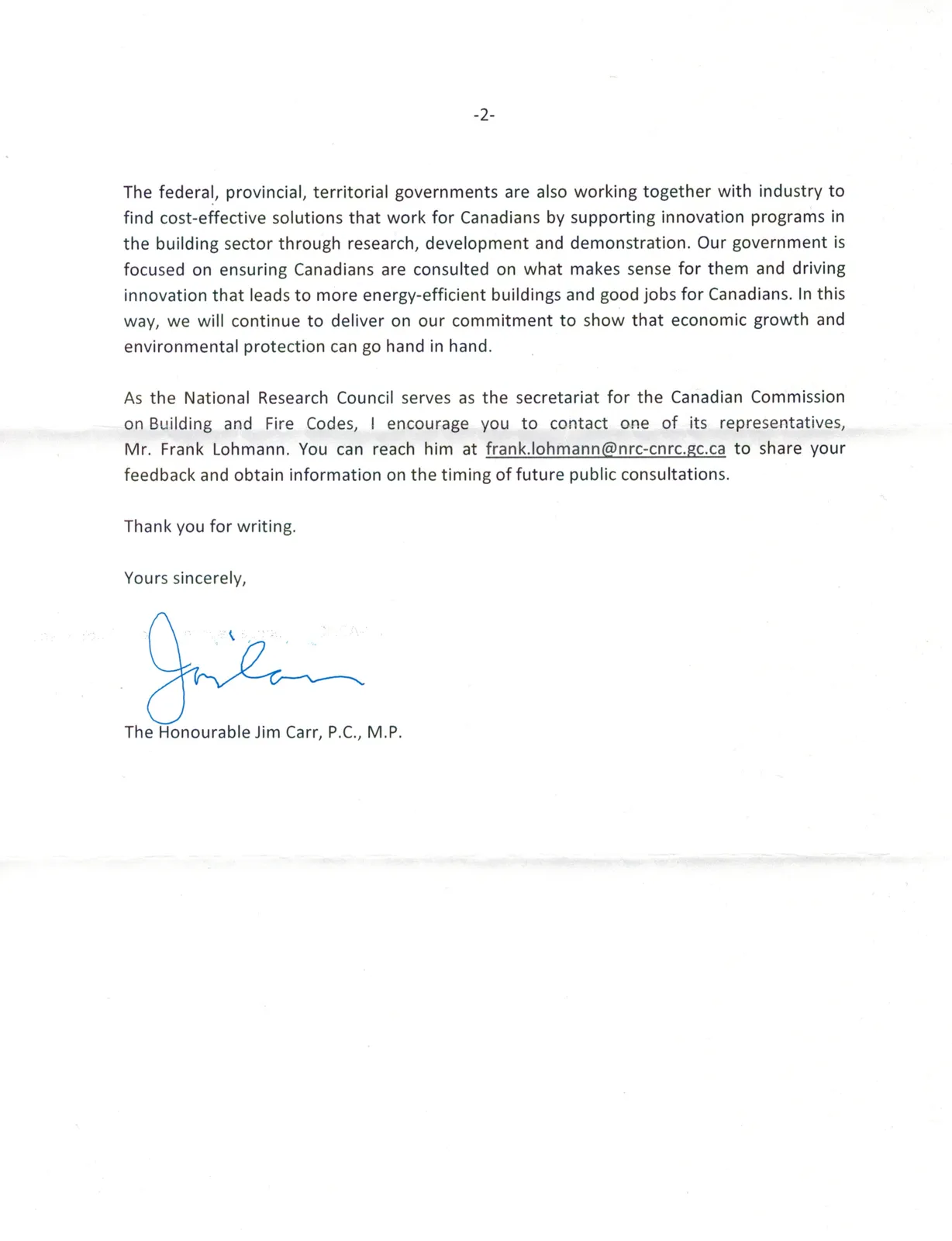
The federal, provincial, territorial governments are also working together with industry to find cost-effective solutions that work for Canadians by supporting innovation programs in the building sector through research, development and demonstration. Our government is focused on ensuring Canadians are consulted on what makes sense for them and driving innovation that leads to more energy-efficient buildings and good jobs for Canadians. In this way, we will continue to deliver on our commitment to show that economic growth and environmental protection can go hand in hand.
As the National Research Council serves as the secretariat for the Canadian Commission on Building and Fire Codes, I encourage you to contact one of its representatives, Mr. Frank Lohmann. You can reach him at frank.lohmann@nrc-cnrc.gc.ca to share your feedback and obtain information on the timing of future public consultations.
Thank you for writing.
Yours sincerely,
The Honourable Jim Carr, P.C., M.P.
Document Images
(4)