Introduction of Draft Soil Deposit/Removal Bylaw Report
Proposed new bylaw to regulate large-scale soil movement and clarify the permit process while exempting minor residential landscaping.
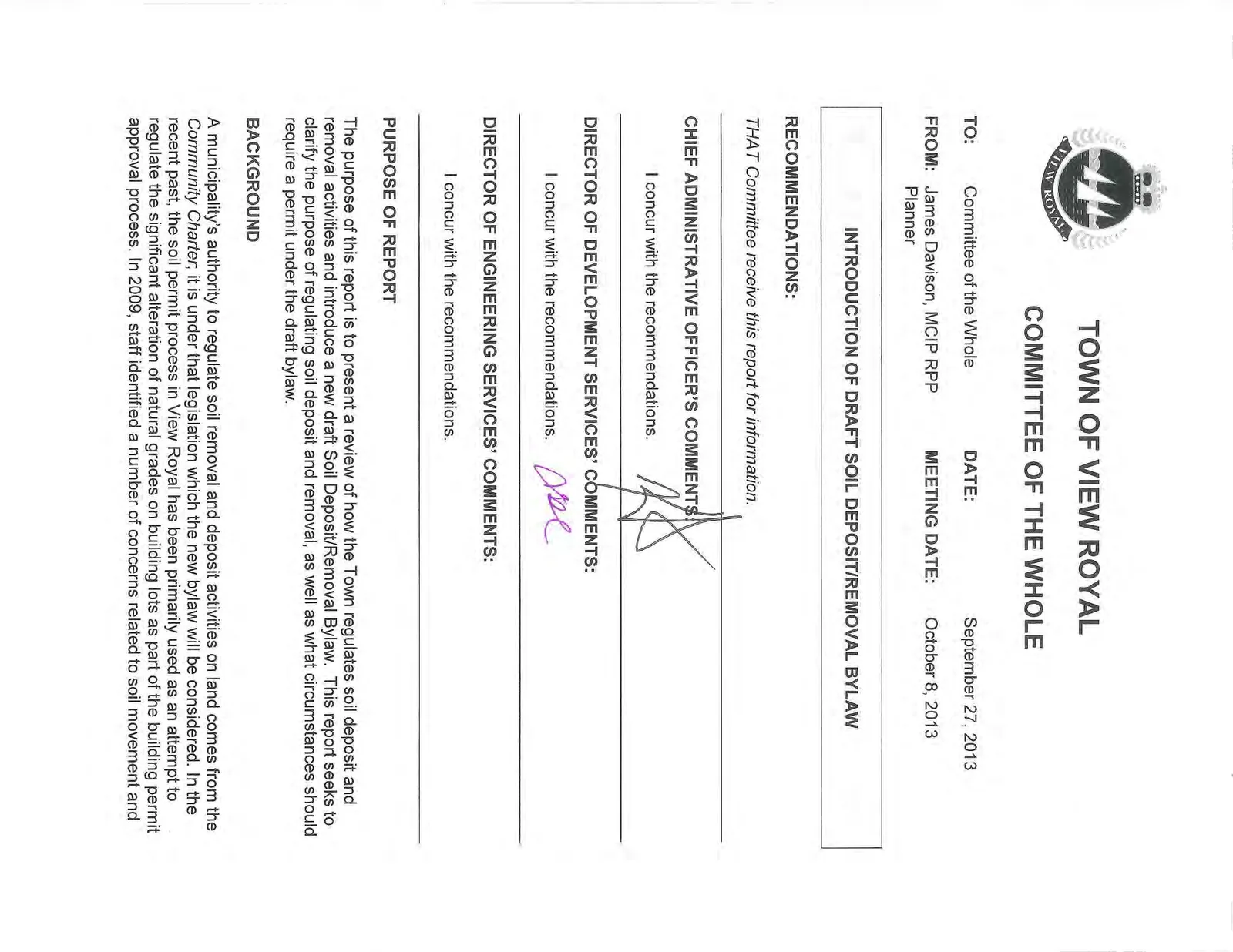
TOWN OF VIEW ROYAL COMMITTEE OF THE WHOLE
TO: Committee of the Whole DATE: September 27, 2013 FROM: James Davison, MCIP RPP, Planner MEETING DATE: October 8, 2013
INTRODUCTION OF DRAFT SOIL DEPOSIT/REMOVAL BYLAW
RECOMMENDATIONS:
THAT Committee receive this report for information.
CHIEF ADMINISTRATIVE OFFICER'S COMMENTS: I concur with the recommendations.
DIRECTOR OF DEVELOPMENT SERVICES' COMMENTS: I concur with the recommendations.
DIRECTOR OF ENGINEERING SERVICES' COMMENTS: I concur with the recommendations.
PURPOSE OF REPORT
The purpose of this report is to present a review of how the Town regulates soil deposit and removal activities and introduce a new draft Soil Deposit/Removal Bylaw. This report seeks to clarify the purpose of regulating soil deposit and removal, as well as what circumstances should require a permit under the draft bylaw.
BACKGROUND
A municipality's authority to regulate soil removal and deposit activities on land comes from the Community Charter; it is under that legislation which the new bylaw will be considered. In the recent past, the soil permit process in View Royal has been primarily used as an attempt to regulate the significant alteration of natural grades on building lots as part of the building permit approval process. In 2009, staff identified a number of concerns related to soil movement and the alteration of grade, natural landscape and building height which takes place at the building permit stage. These included the use of retaining walls to substantially alter lot profiles and resultant increases in the height of single family dwelling buildings and fences. These were not being effectively addressed by the soil permit process.
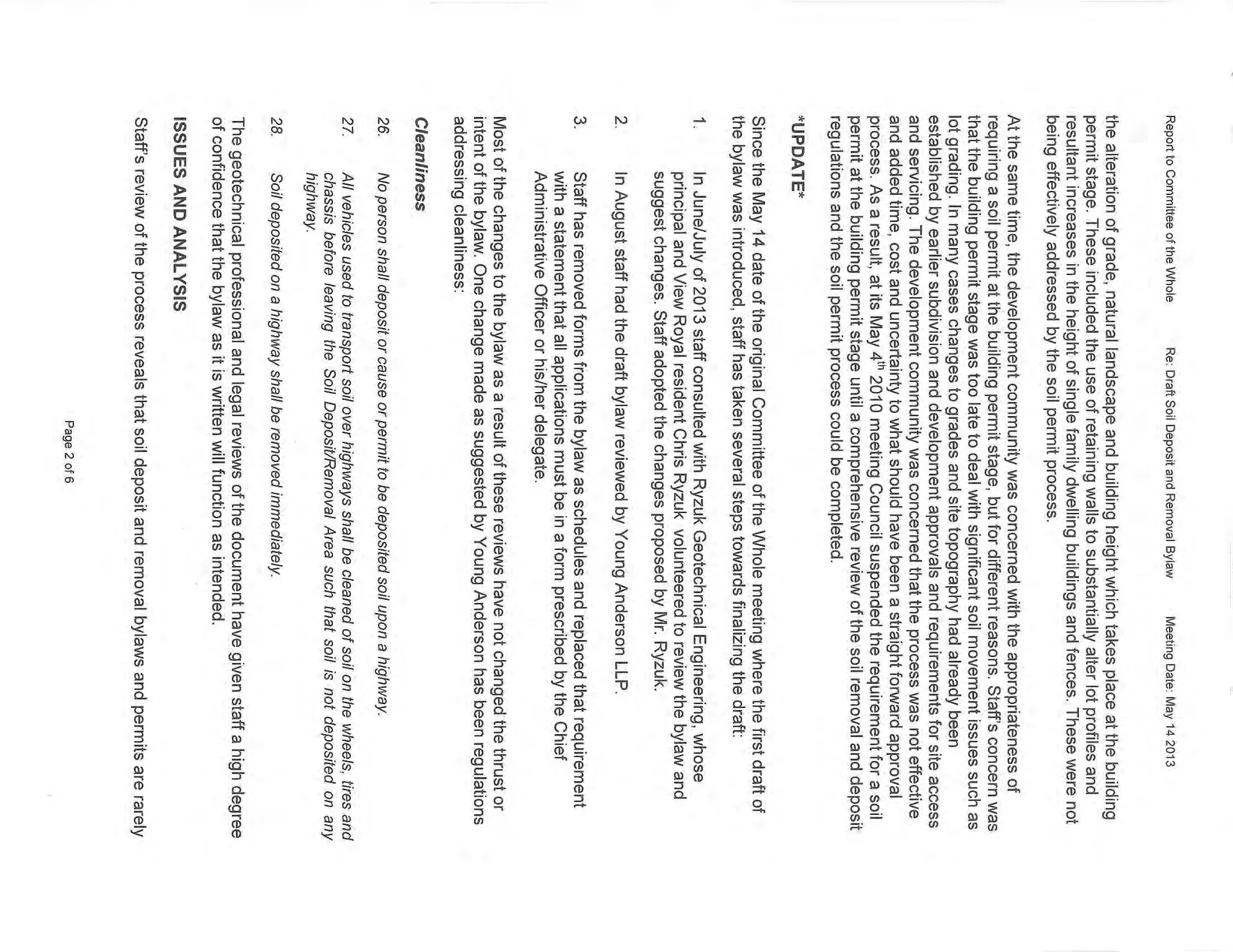
At the same time, the development community was concerned with the appropriateness of requiring a soil permit at the building permit stage, but for different reasons. Staff's concern was that the building permit stage was too late to deal with significant soil movement issues such as lot grading. In many cases changes to grades and site topography had already been established by earlier subdivision and development approvals and requirements for site access and servicing. The development community was concerned that the process was not effective and added time, cost and uncertainty to what should have been a straight forward approval process. As a result, at its May 4th 2010 meeting Council suspended the requirement for a soil permit at the building permit stage until a comprehensive review of the soil removal and deposit regulations and the soil permit process could be completed.
UPDATE
Since the May 14 date of the original Committee of the Whole meeting where the first draft of the bylaw was introduced, staff has taken several steps towards finalizing the draft:
- In June/July of 2013 staff consulted with Ryzuk Geotechnical Engineering, whose principal and View Royal resident Chris Ryzuk volunteered to review the bylaw and suggest changes. Staff adopted the changes proposed by Mr. Ryzuk.
- In August staff had the draft bylaw reviewed by Young Anderson LLP.
- Staff has removed forms from the bylaw as schedules and replaced that requirement with a statement that all applications must be in a form prescribed by the Chief Administrative Officer or his/her delegate.
Most of the changes to the bylaw as a result of these reviews have not changed the thrust or intent of the bylaw. One change made as suggested by Young Anderson has been regulations addressing cleanliness:
Cleanliness
- No person shall deposit or cause or permit to be deposited soil upon a highway.
- All vehicles used to transport soil over highways shall be cleaned of soil on the wheels, tires and chassis before leaving the Soil Deposit/Removal Area such that soil is not deposited on any highway.
- Soil deposited on a highway shall be removed immediately.
The geotechnical professional and legal reviews of the document have given staff a high degree of confidence that the bylaw as it is written will function as intended.
ISSUES AND ANALYSIS
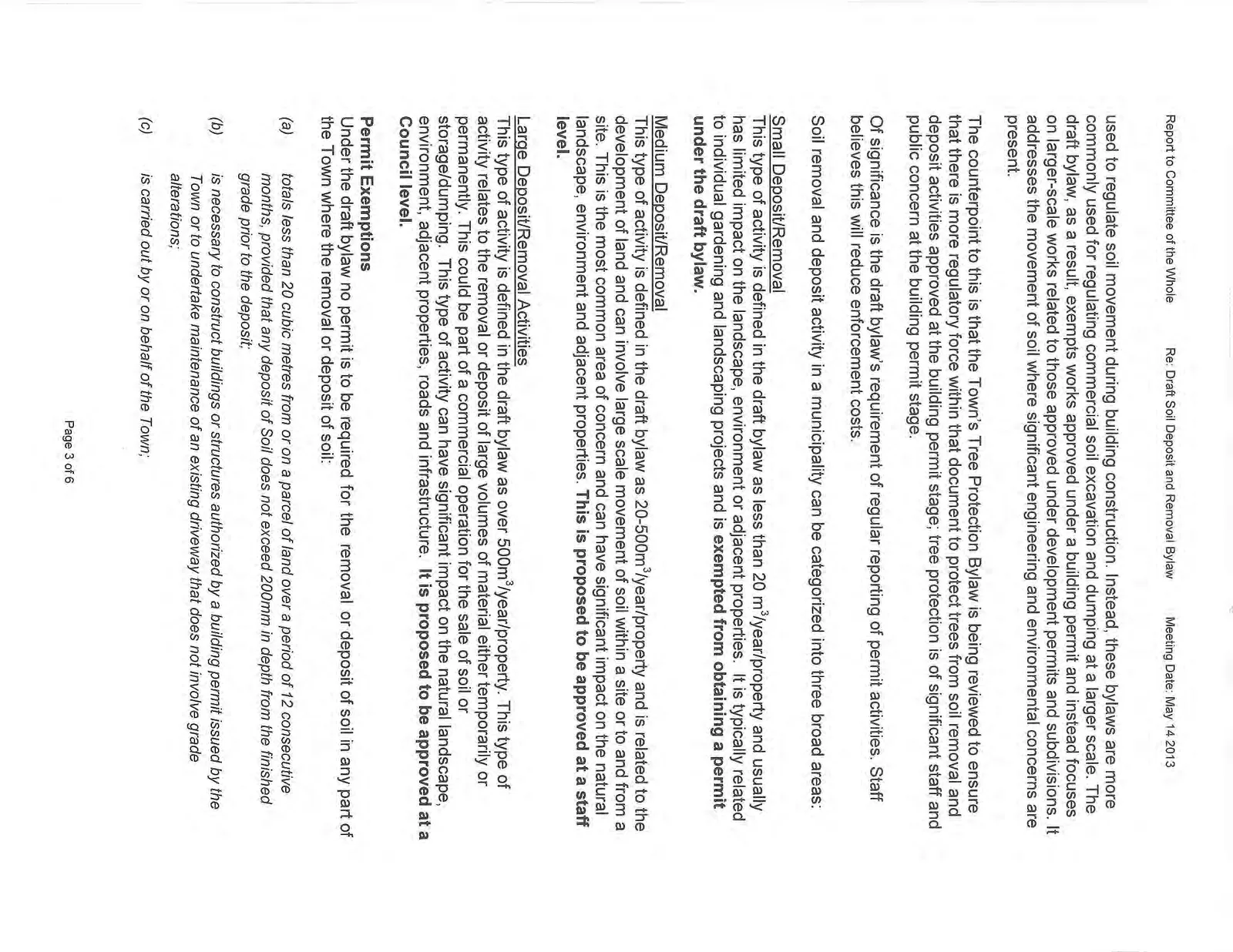
Staff's review of the process reveals that soil deposit and removal bylaws and permits are rarely used to regulate soil movement during building construction. Instead, these bylaws are more commonly used for regulating commercial soil excavation and dumping at a larger scale. The draft bylaw, as a result, exempts works approved under a building permit and instead focuses on larger-scale works related to those approved under development permits and subdivisions. It addresses the movement of soil where significant engineering and environmental concerns are present.
The counterpoint to this is that the Town's Tree Protection Bylaw is being reviewed to ensure that there is more regulatory force within that document to protect trees from soil removal and deposit activities approved at the building permit stage; tree protection is of significant staff and public concern at the building permit stage.
Of significance is the draft bylaw's requirement of regular reporting of permit activities. Staff believes this will reduce enforcement costs.
Soil removal and deposit activity in a municipality can be categorized into three broad areas:
Small Deposit/Removal
This type of activity is defined in the draft bylaw as less than 20 m³/year/property and usually has limited impact on the landscape, environment or adjacent properties. It is typically related to individual gardening and landscaping projects and is exempted from obtaining a permit under the draft bylaw.
Medium Deposit/Removal
This type of activity is defined in the draft bylaw as 20-500 m³/year/property and is related to the development of land and can involve large scale movement of soil within a site or to and from a site. This is the most common area of concern and can have significant impact on the natural landscape, environment and adjacent properties. This is proposed to be approved at a staff level.
Large Deposit/Removal Activities
This type of activity is defined in the draft bylaw as over 500 m³/year/property. This type of activity relates to the removal or deposit of large volumes of material either temporarily or permanently. This could be part of a commercial operation for the sale of soil or storage/dumping. This type of activity can have significant impact on the natural landscape, environment, adjacent properties, roads and infrastructure. It is proposed to be approved at a Council level.
Permit Exemptions
Under the draft bylaw no permit is to be required for the removal or deposit of soil in any part of the Town where the removal or deposit of soil:
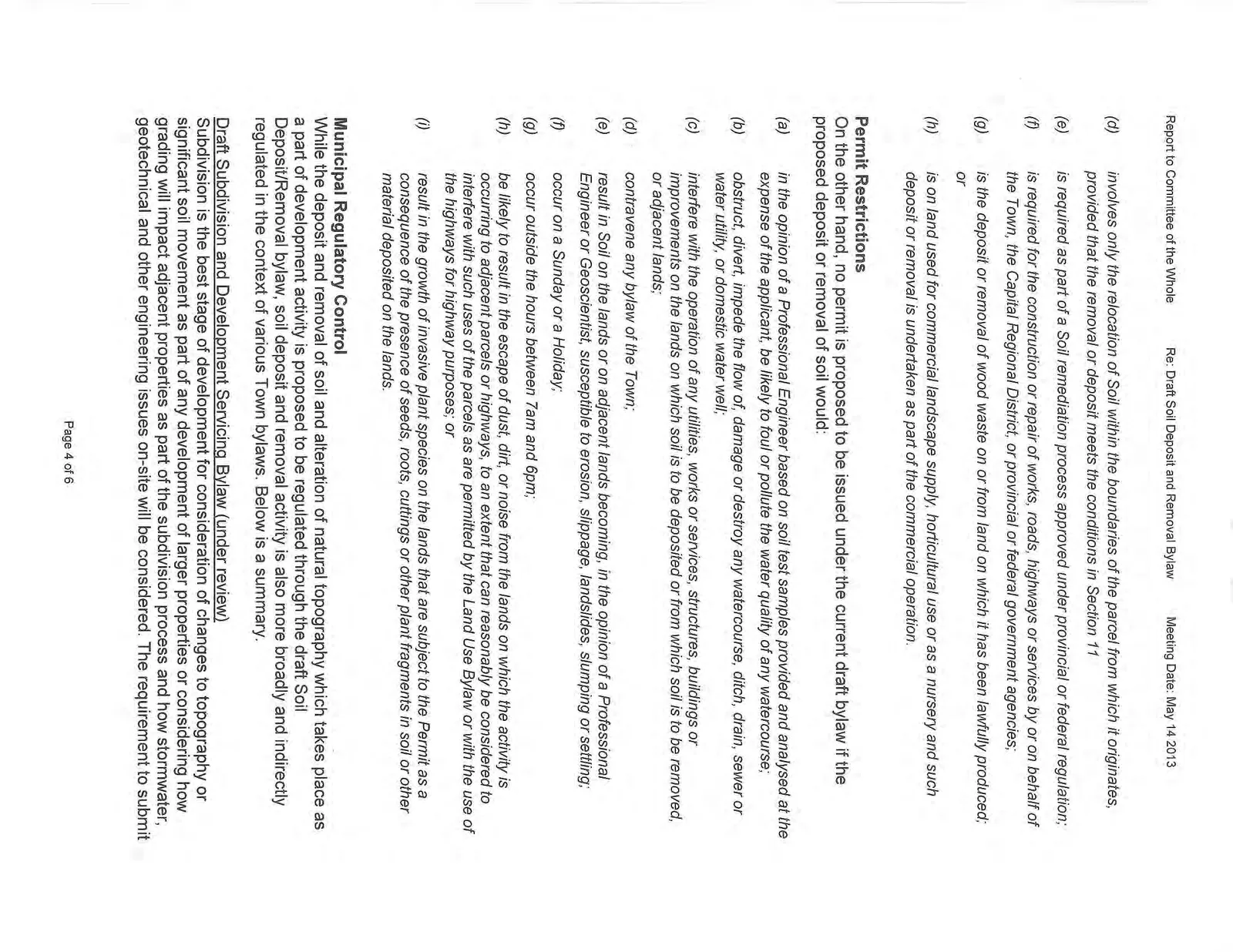
(a) totals less than 20 cubic metres from or on a parcel of land over a period of 12 consecutive months, provided that any deposit of Soil does not exceed 200mm in depth from the finished grade prior to the deposit; (b) is necessary to construct buildings or structures authorized by a building permit issued by the Town or to undertake maintenance of an existing driveway that does not involve grade alterations; (c) is carried out by or on behalf of the Town; (d) involves only the relocation of Soil within the boundaries of the parcel from which it originates, provided that the removal or deposit meets the conditions in Section 11 (e) is required as part of a Soil remediation process approved under provincial or federal regulation; (f) is required for the construction or repair of works, roads, highways or services by or on behalf of the Town, the Capital Regional District, or provincial or federal government agencies; (g) is the deposit or removal of wood waste on or from land on which it has been lawfully produced; or (h) is on land used for commercial landscape supply, horticultural use or as a nursery and such deposit or removal is undertaken as part of the commercial operation.
Permit Restrictions
On the other hand, no permit is proposed to be issued under the current draft bylaw if the proposed deposit or removal of soil would:
(a) in the opinion of a Professional Engineer based on soil test samples provided and analysed at the expense of the applicant, be likely to foul or pollute the water quality of any watercourse; (b) obstruct, divert, impede the flow of, damage or destroy any watercourse, ditch, drain, sewer or water utility, or domestic water well; (c) interfere with the operation of any utilities, works or services, structures, buildings or improvements on the lands on which soil is to be deposited or from which soil is to be removed, or adjacent lands; (d) contravene any bylaw of the Town; (e) result in Soil on the lands or on adjacent lands becoming, in the opinion of a Professional Engineer or Geoscientist, susceptible to erosion, slippage, landslides, slumping or settling; (f) occur on a Sunday or a Holiday; (g) occur outside the hours between 7am and 6pm; (h) be likely to result in the escape of dust, dirt, or noise from the lands on which the activity is occurring to adjacent parcels or highways, to an extent that can reasonably be considered to interfere with such uses of the parcels as are permitted by the Land Use Bylaw or with the use of the highways for highway purposes; or (i) result in the growth of invasive plant species on the lands that are subject to the Permit as a consequence of the presence of seeds, roots, cuttings or other plant fragments in soil or other material deposited on the lands.
Municipal Regulatory Control
While the deposit and removal of soil and alteration of natural topography which takes place as a part of development activity is proposed to be regulated through the draft Soil Deposit/Removal bylaw, soil deposit and removal activity is also more broadly and indirectly regulated in the context of various Town bylaws. Below is a summary.
Draft Subdivision and Development Servicing Bylaw (under review)
Subdivision is the best stage of development for consideration of changes to topography or significant soil movement as part of any development of larger properties or considering how grading will impact adjacent properties as part of the subdivision process and how stormwater, geotechnical and other engineering issues on-site will be considered. The requirement to submit grading plans at the subdivision stage is also being reviewed but will likely be added.
Official Community Plan
The OCP addresses soil deposit and removal activities primarily with respect to Development Permit Area requirements as they pertain to form and character, and environmental protection. The issuance of a permit to deposit or remove soil would be considered in the context of whether the activity contravenes any of the Development Permit Guidelines in the Official Community Plan.
Land Use Bylaw (draft Zoning Bylaw under review)
The Land Use Bylaw is also under review, and will be referred to as the Zoning Bylaw. The definitions and general regulations under the existing land use bylaw (and in the future zoning bylaw) have addressed the issue of depositing soil on a site to alter grading and building height calculations. Additionally, under the zoning bylaw's general regulations retaining walls will be defined with maximum height and (likely) separation requirements. Regulating retaining walls will control the amount of soil that could be deposited on sloping properties and will be used in concert with the draft soil deposit/removal bylaw to ensure that extensive and/or undesirable terraforming on sites is minimized and regulated effectively.
Building Bylaw
The Building Bylaw requires the identification of various grading issues, including existing and finished ground levels, gradients of parking and driveway access, drainage, and supervision of the design and construction of retaining structures greater than 1.5m tall. Collectively the building bylaw exerts significant control over site grading issues such that staff feels comfortable with exempting works approved under building permit from requiring a permit for soil deposit or removal.
Tree Protection Bylaw (under review)
Tree protection bylaws can limit the cutting or filling of land which would directly affect the health and stability of protected trees. The current Tree protection Bylaw is being reviewed to ensure that protected trees are not affected by soil movement on a site. The Tree Protection Bylaw will require extra regulatory force and be accompanied by vigilant awareness enforcement by staff to ensure that the building permit exemption under the draft soil deposit/removal requirements to protect trees potentially affected by works approved under building permits.
Provincial Regulatory Control
Deposit or removal of contaminated soil is regulated at a provincial level whereby a property owner must provide a site profile to the local municipality if they apply or seek approval to remove soil from property that the person knows (or reasonably should know) is or was used for industrial or commercial activity.
CONCLUSIONS
The draft Soil Deposit/Removal Bylaw is attached to this report for consideration. Staff believes that it gives the Town effective tools to deal with large scale soil movement activity. It exempts small/domestic soil movement, and works in conjunction with existing regulation to deal with the issues in an integrated manner across the full scope of the Town’s regulatory power. Concerns over engineering issues and environmental impact will be better addressed in a more efficient and effective manner. The draft bylaw offers staff and Council the opportunity to address concerns over possible disturbance to drainage patterns, riparian areas and marine shorelines and potential impacts on municipal infrastructure and adjacent properties. It also allows staff and Council to effectively consider activities with Official Community Plan guidelines and policy in mind.
RECOMMENDATION
THAT Committee receive this report for information.
SUBMITTED BY: J. Davison MCIP RPP, Planner
REVIEWED BY: L. Chase MCIP RPP, Director of Development Services
ATTACHMENTS
- DRAFT Soil Deposit and Removal Bylaw
- DRAFT Application Forms
Document Images
(6)