VOLUNTEER VIEW ROYAL - Policy Paper
A detailed proposal and strategic plan for establishing a centralized volunteer coordination body named 'Volunteer VR'.
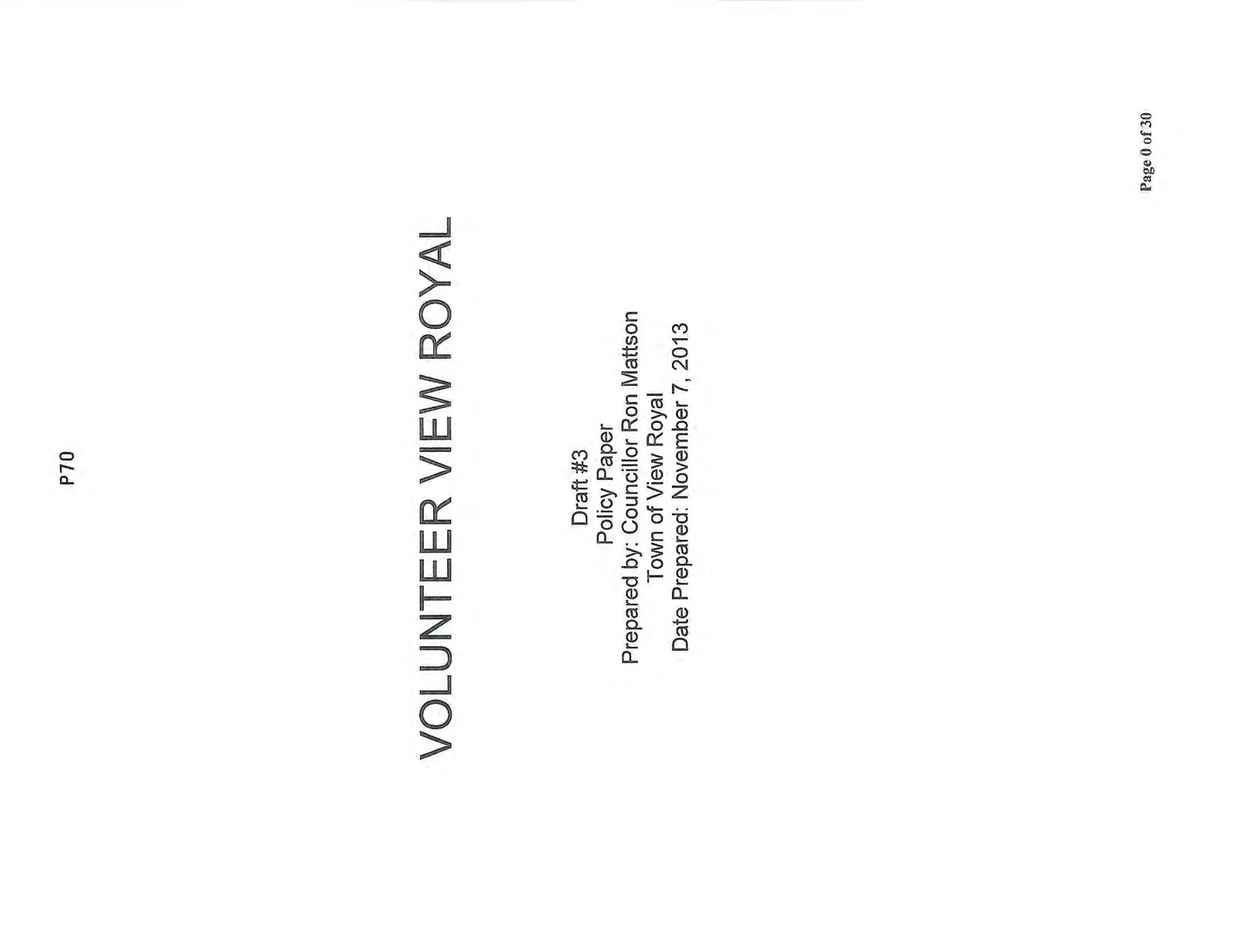
VOLUNTEER VIEW ROYAL
Draft #3 Policy Paper Prepared by: Councillor Ron Mattson Town of View Royal Date Prepared: November 7, 2013
TABLE OF CONTENTS
| # | Topic | Page |
|---|---|---|
| I | Introduction – Volunteerism and Volunteer View Royal | 2 |
| II | Background – Why Does View Royal need a Volunteer Centre | 5 |
| III | Structure | 7 |
| IV | Services | 8 |
| V | Communications | 10 |
| VI | Staffing Requirements | 10 |
| VII | Financial consideration | 11 |
| VIII | Conclusions | 12 |
| Appendix 1 Mission, Guiding Principles and Goals of Volunteer VR | 13 | |
| Appendix 2 Who Benefits From Volunteerism | 15 | |
| Appendix 3 The Voluntary Sector And Volunteerism (The Industry) | 18 | |
| Appendix 4 Volunteer View Royal Communications Strategy | 23 | |
| Appendix 5 Volunteer Opportunities for VR Residents | 26 | |
| Appendix 6 Volunteer VR Services | 27 | |
| RECOMMENDATIONS | 29 |
I) INTRODUCTION
Volunteerism
BC is driven by volunteers--Each year, just under half of the population volunteers their time, energy and skills. Their expertise, passion and dedication are essential in helping thousands of organizations achieve their mission and build stronger communities. The many contributions encompass the entire range of tasks that organizations require including serving on boards and committees, canvassing for funds, providing counselling services or making friendly visits to seniors, delivering food, helping build facilities, serving as volunteer drivers, helping to protect the environment and wildlife, advocating for social causes, coaching children and youth, and the list goes on.
Volunteers are everyday heroes that make communities a great place to live, work, invest and raise families. Harnessing and supporting this incredible power of citizenship is a complicated task.
The Town of VR has a long and proud history of volunteerism; most notably the VR Volunteer Fire and Emergency Support Services (ESS). However, there are many others who have played an important role in our community, the View Royal Fast Ball Association, VR Reading Centre and VR Town Committee members to name but a few.
Volunteerism supports goals outlined in the Town's OCP, to:
- Promote a strong sense of community in all areas and neighbourhoods of the Town, and create an enhanced sense of place and identity.
- Ensure that community services and amenities can be provided within the financial means of the municipality, and strengthen partnerships with regional service providers to increase local opportunities.
Volunteerism can also be an important component of the Town successfully achieving its goal of sustainability though the creation of a healthy community today and lasting legacy for future generations. A significant element of its success will come from a healthy and effective volunteer sector. The Town is challenged with meeting the needs of the community while remaining fiscally responsible. One of the key strategies to community development is the leveraging of citizens—your local resource—who are interested and committed to growing and enhancing their community through volunteerism. Not-for-profit and voluntary organizations can assist in this process as they are vehicles for citizen engagement in their community and providing benefits to the public. However, many are struggling to provide the public with all the benefits they have the potential to offer.
The Town does support Volunteer Victoria (VV) with a minor financial contribution. VV currently works with 16,500 volunteers and 350 community agencies to provide mentorship, advising, training, and volunteer management services to help youth, adults, and organizations reduce barriers, gain momentum, and make positive change. Volunteer Victoria also provides volunteer management training to organization – where participants will learn to plan a successful volunteer program; recruit and screen potential volunteers; orient, train, supervise and recognize volunteers effectively within their program; and evaluate and market their program effectively. The Town has an opportunity to leverage its relationship with Volunteer Victoria to provide additional volunteer services to the Town.
The overall intent of this proposal is to demonstrate the need for the Town of VR to be a catalyst in the establishment of volunteer management group as part of its operations. The Town of VR must take the initiative to engage its citizens for the overall good of the community.
It is expected that the need for volunteers will continue to grow in concert with the need to engage volunteers in the community to support this increased demand, creating an even larger socio-economic impact to the community.
Volunteer View Royal (VR)
The name proposed for the group to be established to manage the Towns volunteer services is Volunteer View Royal (VR). Volunteer VR would be established to assist and maintain a vibrant, effective volunteer community that will motivate, educate, support and protect the most valued asset—it's volunteers. Working with Volunteer Victoria and other volunteer centres across the CRD, Volunteer VR can leverage the knowledge to provide tools, initiatives and resources that help community organizations engage volunteers, build internal leadership and achieve their missions. By connecting people, organizations and ideas, Volunteer VR can assist to strengthen our community.
Volunteer VR would foster and develop volunteerism in the Town of VR by raising awareness of the power of service, promoting and supporting volunteerism in an effort to connect all people to meaningful volunteer opportunities. Currently there are not-for-profit organizations operating in VR (CRD) that are committed to fostering individual and community development.
Volunteer Centres are the link between those that want to volunteer and organizations that need volunteers to meet the needs of the community. More often than not, needs continue to go unmet as people are not aware of volunteer opportunities nor do organizations needing volunteers have the resources/skills to manage volunteers. Volunteer VR, working in conjunction with Volunteer Victoria, would be the conduit in bringing organizations together and coordinating volunteer efforts. This function would enable the opportunity to not only build strong linkages, but as well, leverage resources that would develop the potential of the community.
There is recognition that the Town does not have funding available to do everything itself. There is a further recognition that there is no need for VR to reinvent the wheel; we should be learning from and taking advantage of other volunteer organizations in the CRD and services provided through the provincial government and the non-profit sector (e.g., BC Healthy communities).
Developing a well organized and effective volunteer sector in VR will be a journey. Volunteer Victoria recommended that the Town start on this journey though baby steps by simplifying its mandate. Over time, by working with other existing volunteer organizations both in and out of the CRD, the Town will be able to develop a more comprehensive volunteer management program within the Town’s organizational structure.
It is proposed that Volunteer VR be established as a function of the Town of VR. During its infancy Volunteer VR would act similarly to an advisory committee in that it would:
- Develop formal mission, goals and objectives – utilizing those drafted in Appendix 1: Proposed Mission, Guiding Principles and Goals of Volunteer VR
- Develop an operational structure that fits within the overall structure of the Town.
- Look for opportunities to achieve immediate success from the initiative (see Appendix 5 for a list of volunteer activities previously presented to Council).
- Create a Volunteer Centre though which to provide volunteer services in View Royal.
The Town would instruction Volunteer VR to develop recommendations respecting a Volunteer Centre that adhere to the following broad principles:
- Develop links to existing services / resources wherever possible – for example, partner with Volunteer Victoria
- Do not duplicate services
- Simplify administration – e.g., use Volunteer Victoria expertise wherever possible (e.g., interviewing volunteers)
- Start small and work into more complex initiatives (initially focus on low hanging fruit before expanding into a full-time volunteer co-ordinator for town)
- Build on successful current and past initiatives in the town (e.g., broom pull, park/creek clean up, VR cleanup day)
- Garner support of VR Town staff as well as Council
- Acknowledge and take advantage of trends in volunteerism
- 1 day projects
- family volunteer opportunities
- corporate team building
- donors changing to volunteers (easier to get time than $)
II) BACKGROUND
What is a Volunteer Centre?
Volunteer centres are created to reflect the needs of the community they serve. Volunteer centres exist primarily to foster and develop volunteerism in the community as a whole and provide a variety of services to volunteers and not-for-profit agencies alike while maintaining the versatility to grow and change with the needs of the community.
Why Does VR Need a Volunteer Centre?
It is widely known that well equipped, trained and supported volunteers make strong, vibrant communities. In fire departments, hospitals and schools, in nursing homes and homeless shelters, in political campaigns and environment crusades, volunteers contribute to the vitality of a healthy Town. Increasingly, these volunteers make the difference for many in our community between just getting by and fully enjoying life. A vibrant Town can be measured by the level to which it supports its volunteers and not-for-profit organizations.
While volunteerism is currently occurring in VR, no statistics are available to determine its health and there is no central organizing entity to coordinate, support, educate, promote, advocate for, recognize or protect its participants or organizers. This situation contributes to under utilization of resources, lack of synergy, and unnecessary risk.
There is no current centralized coordination of volunteers in the Town. To facilitate volunteerism in VR, there is a strong need for one and would support the establishment of a volunteer centre
The Town of VR has established a Strategic Plan which supports the inclusion and engagement of our community. Many of the strategic goals will require the commitment of volunteers to implement and achieve success.
There is a need and an opportunity to improve the understanding and importance of volunteerism in building social capital and improving the quality of life in our community
The contributions of volunteers must be celebrated and recognized. Volunteer VR will play a key role in coordinating and celebrating volunteers on a community-wide basis.
The nature of volunteerism is changing as BC and all of North America, undergoes demographic shifts with an increase in aging population. This shift is creating new types of volunteers who are more skilled or wish to volunteer their time in a more self-directed and specific way. Retired professionals, stay-at-home mothers, high school students and new immigrants are all potential volunteers that must be strategically engage and involved. Local organizations are currently struggling to meet the needs of today, let alone plan for a more coordinated and sophisticated approach to volunteer management to achieve maximum success in our community.
The centre will help people to think about how they want to volunteer their time and how they become active in their community. Research shows, that only a small proportion of people expressing an interest actually go on to volunteer. Volunteer VR is the missing link. The centre can provide the match between the volunteer and those locally requiring assistance through an effective volunteer management program.
Networks are part of relationship building. Volunteer VR will help, expand and leverage networks in our community to help strengthen the voice of volunteerism
Corporations are increasingly seeking opportunities to —give back to the community and corporate volunteerism is a growing trend. With a growing and diversified workforce with a range of talents, skills and abilities, corporations are looking to support their community through their available resources and not just financially.
For information on who benefits from Volunteerism, see Appendix 2
III) STRUCTURE
Organizational Structure
It is proposed that Volunteer VR will be established as a function of the Town of VR. Further, during its infancy Volunteer VR would act similarly to an advisory committee by providing recommendations to Council on its direction (i.e. mission, guiding principles and goals) and volunteer strategies (e.g see Appendix 5). Over the longer term, the Volunteer VR would develop a more autonomous relationship with Town while remaining a function of the Town.
It is important to note that Volunteer VR will not be looking to duplicate the efforts of other volunteer organizations operating in the CRD; a critical component of its mandate would be to develop relationships with existing volunteer service providers.
As with other advisory committees Volunteer VR will have a Council and a staff liaison. It is anticipated that Volunteer VR would be situated under the Town’s Corporate Administration.
Volunteer VR will operate as a function of the municipality, the volunteer centre will follow all policies, procedures and processes established by the Town of VR.
If Council approves this proposal, the Town would seek volunteers from the community to sit on Volunteer View Royal.
Location
As this would be a new centre geared to reaching the general public, it must be highly visible, accessible and central. In order to keep overhead costs at a minimum and maximize current resources it is recommended that Volunteer VR acquire space in an existing community resource and share equipment, meeting space and technology networks. This option would allow Volunteer VR to create a visible presence that is accessible to all members of the community while mitigating operational costs. Once Volunteer VR is ready to establish a volunteer centre, it could, for example, approach the VR Reading Centre for space and for the use of its equipment Given the Town’s contribution to the VR Reading Centre and the limited hours of operation of the Reading Centre, there is a real opportunity to not only share space but for Reading Centre volunteer to participate by helping to provide services developed by Volunteer VR. There are other options such as being located in the new fire hall. The Town would seek input for Volunteer VR on where the Centre should be located. Initially, Volunteer View Royal would, as do other advisory committees, meet in the Town’s meeting rooms.
IV) SERVICES
Client Groups
Volunteer VR will serve three distinct client groups through the volunteer services program; potential/current volunteers, not-for-profit organizations needing volunteers and the business community looking to contribute to their community.
a. Community Not-for-Profit and/or Charitable Organizations—these organizations/agencies receive the following benefits:
- Assist with volunteer coordination already underway or in consideration by Council (i.e. Community Events, Proclamations recognizing the value of volunteers and/or volunteers interested in volunteering for Town advisory committees)
- Opportunities to advertise volunteer openings through the volunteer database and through the office
- Access to our resource materials, both print and online sources
- Opportunities to participate in Volunteer recognition programs/events
- Access to customized training and consultation services (provided through the Town or its affiliated agencies – e.g., Volunteer Victoria or Juan de Fuca Rec Centre)
- Support through promotion and advocacy of volunteerism
- Partner with Volunteer VR to offer a comprehensive, up to date and responsive information and referral system for the community
- Access to community meeting space (either in the Town Hall or other community spaces)
- Access to database of potential volunteers
b. Members of the General Public—services to current and prospective volunteers will include:
- Supporting citizens to become productive and engaged members of the community
- Access information on current volunteer openings within VR by accessing an online database or by visiting Volunteer VR or visiting any display at local events
- Referral to community organizations/agencies
- Attend workshops and events delivered through Volunteer VR or Volunteer Victoria or other agencies.
- Assist citizens to gain experience through volunteering, thereby increasing their chances of employment and increasing their health and well-being
- Impacting the community-at-large through a more effective and inclusive engagement of all its citizens
c. Business Community—centralized coordinated efforts will allow for the business community to give back to their community through employee volunteer initiatives that are easy to source and contribute to with varying levels of commitment
Volunteer VR would offer information to volunteers on current volunteer openings in the community. It is their responsibility to contact the organization needing volunteers to seek further opportunities. It is the responsibility of the organization in need of volunteers to conduct any screening of volunteers, the suitability, performance and any background checks/reports of potential volunteers. For additional information on the types of services that could be offered see Appendix 6 – Volunteer VR Services
V) COMMUNICATIONS
Communications Objectives
- To engage the local citizens, organizations and the corporate sector about the benefits and opportunities that volunteerism can bring to the community and to them as individuals through a variety of channels.
- To ensure that a comprehensive communication strategy is in place for the organization including the role and function of staff and community stakeholders.
- To generate media coverage and create awareness of the launch of the organization and on-going developments of the committee.
Key Messages
Key messages will need to be created that can be consistently and clearly stated through a variety of communication channels both verbally and in writing. They need to factor in the order of business and scope of the organization; how volunteers are managed;
The key messages should address:
- Values for Volunteer Involvement
- Guiding principles for Volunteer Involvement
- Organizational Standards for Volunteer Involvement
Overall Strategies
The primary objectives of the overall communications strategy should focus on three audiences: the local community; staff of the organization; and media partners.
See Appendix 4 for a draft of the Volunteer View Royal communications strategy
VI) STAFFING REQUIREMENTS
Volunteer VR will not require full-time staff members; instead it is proposed that Volunteer VR leverages volunteers to assist with client services. The centre will start with a part-time volunteer Centre Coordinator and, if there is an available resource, an Assistant. Based on the success of Centre and needs of the community, these volunteer position may morph into paid positions (e.g., an annual honorarium).
The Coordinator of Volunteer VR would play a key leadership role internally and externally in the community to develop and manage a sustainable and progressive organization that is focused on excellence in voluntary sector management and relations. The role of the Assistant will be to support the Coordinator in the effective and efficient delivery of the above functions, provide customer service to all clients of the centre, and to provide office administrative functions and support as required (initially, the Town’s resources could be utilized until the required resources are available).
While internal ToVR staffing resources will, at the outset, be required to assist with the development of Centre and its services, it is anticipated that Council will instruct Volunteer VR to look for opportunities to limit the input of Town staff in the day to day operations of the Centre.
VII) FINANCIAL CONSIDERATIONS
A detailed budget has been not been established for Volunteer VR or the Centre. Volunteer VR would be charged with developing a strategic plan and costing the various steps required to implement the plan.
The proposal is requesting the Town allocate the funding donated for a VR volunteer bureau to Volunteer VR. This initial funding would be used to facilitate service delivery and not to pay for services provided by the Town. It would be part of Volunteer VR to seek and increase outside sponsorship and other sources of funding in order to expand it ability to provide volunteer services.
It is anticipated that the finance department would provide expertise in the establishment of all budgetary measures and that both the legal department and human resources would assist with agreements, procedures and policies.
VIII) CONCLUSION
VR is currently without the benefit of a volunteer centre. While volunteerism is occurring in VR, no statistics are available to determine its health and there is no central organizing entity to coordinate, support, educate, promote, advocate for, recognize or protect its participants
The Town of VR has been presented with an opportunity for a minimal investment to be the catalyst in generating volunteer investment to make our community a great place to live, work, invest and raise families. Many larger BC municipalities are taking a more proactive approach to volunteer management by providing the necessary resources to their respective communities. The Town of VR must take the initiative to provide a more coordinated and centralized approach to volunteer management to engage its citizens for the overall good of the community.
APPENDIX 1: PROPOSED MISSION, GUIDING PRINCIPLES AND GOALS OF VOLUNTEER VR
Mission of Volunteer VR
The underlying purpose of Volunteer VR is to promote and support volunteerism in an effort to connect all people to meaningful volunteer opportunities that reflect the needs of our community. Volunteer VR believes that every member of the community has both an opportunity and the ability to build the community in which they wish to live, work and play in a way that is meaningful to them.
The mission of Volunteer VR is the pursuit and achievement of the following principles established by Volunteer Canada:
- Promote Volunteerism Volunteer VR will raise awareness of the power of service, encourage people to volunteer, provide information about volunteerism and recognize the valuable contributions of volunteers. Volunteer VR will be a voice for volunteers and volunteerism in the community.
- Build Capacity Volunteer VR will support voluntary sector organizations, and other groups and individuals that work with volunteers to recruit, manage, and retain volunteers through the provision of education and training opportunities, one-to-one consultations and providing support to organizations (our members) that work with volunteers.
- Provide Leadership relating to Volunteerism Volunteer VR will serve as the conduit for the community and a catalyst for action by working through local partnerships and collaborating with various groups and organizations, government, schools and community leaders to identify needs and mobilize volunteer response and advise volunteers of the community needs.
- Connecting People with Opportunities to Serve Volunteer VR will provide people with easy access to a wide variety of opportunities to connect to their community through a volunteer referral service and work with local organization members to recognize the contribution of volunteers in meeting the needs of the community.
Guiding Principles of Volunteer VR
- Volunteers are the backbone of the voluntary sector. Their contributions are essential to maintaining a vibrant community
- Volunteer VR will establish a strong network of support with local organizations and individuals to identify the needs of the community and engage the necessary resources to meet those needs through an effective referral service
- Volunteer VR will be inclusive and provide accessibility to all within our diverse community.
- Every volunteer has a unique gift that they can use to help others and improve our community.
- Strong volunteer communities require education, advocacy, coordination, promotion and a vibrant public profile
- Volunteer VR supports and endorses the Canadian Code for Volunteer Involvement
Goals of Volunteer VR
- To create synergy amongst stakeholders; those looking to volunteer and those needing volunteers
- To develop comprehensive and consistent volunteer management policies supported by Volunteer VR
- To have communication processes that give potential and existing volunteers the information they need, when they need it, in a form that is easy utilized.
- To develop a community consultation process for Volunteer VR that ensures the strategy reflects current issues and organizational goals support the strategy
- To have strong sustainable volunteers that are well trained and understand the guidelines, roles and responsibilities outlined in the volunteer recruitment process of Volunteer VR
- To have all volunteers confident in their ability to perform their specified roles. This would be supported with a training plan that clearly identifies priority training areas for volunteers
- To develop and maintain exceptional Volunteer Service resources both in print and online
- To deliver timely and relevant programs that is consistently updated to deliver value to both volunteers and member organizations.
- To develop in partnership with member agencies, a series of performance indicators, benchmarks and management tracking tools to allow for the utilization and maximization of resources.
- To ensure longevity and security of Volunteer VR funding.
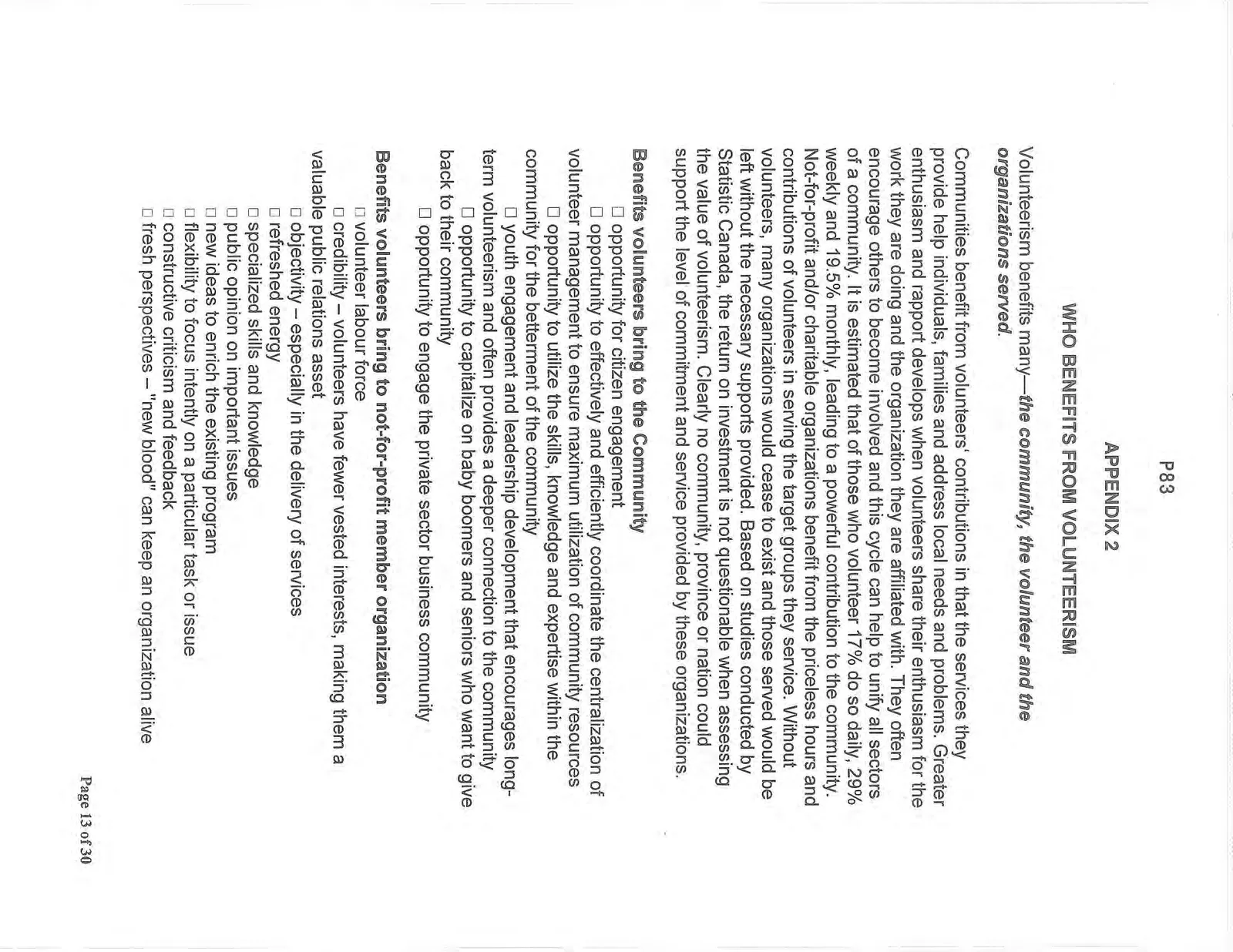
APPENDIX 2: WHO BENEFITS FROM VOLUNTEERISM
Volunteerism benefits many—the community, the volunteer and the organizations served.
Communities benefit from volunteers' contributions in that the services they provide help individuals, families and address local needs and problems. Greater enthusiasm and rapport develops when volunteers share their enthusiasm for the work they are doing and the organization they are affiliated with. They often encourage others to become involved and this cycle can help to unify all sectors of a community. It is estimated that of those who volunteer 17% do so daily, 29% weekly and 19.5% monthly, leading to a powerful contribution to the community. Not-for-profit and/or charitable organizations benefit from the priceless hours and contributions of volunteers in serving the target groups they service. Without contributions of volunteers in serving the target groups they service. Without Statistics Canada, the return on investment is not questionable when assessing the value of volunteerism. Clearly no community, province or nation could support the level of commitment and service provided by these organizations.
Benefits volunteers bring to the Community
- opportunity for citizen engagement
- opportunity to effectively and efficiently coordinate the centralization of volunteer management to ensure maximum utilization of community resources
- opportunity to utilize the skills, knowledge and expertise within the community for the betterment of the community
- youth engagement and leadership development that encourages long-term volunteerism and often provides a deeper connection to the community
- opportunity to capitalize on baby boomers and seniors who want to give back to their community
- opportunity to engage the private sector business community
Benefits volunteers bring to not-for-profit member organization
- volunteer labour force
- credibility – volunteers have fewer vested interests, making them a valuable public relations asset
- objectivity – especially in the delivery of services
- refreshed energy
- specialized skills and knowledge
- public opinion on important issues
- new ideas to enrich the existing program
- flexibility to focus intently on a particular task or issue
- constructive criticism and feedback
- fresh perspectives – "new blood" can keep an organization alive
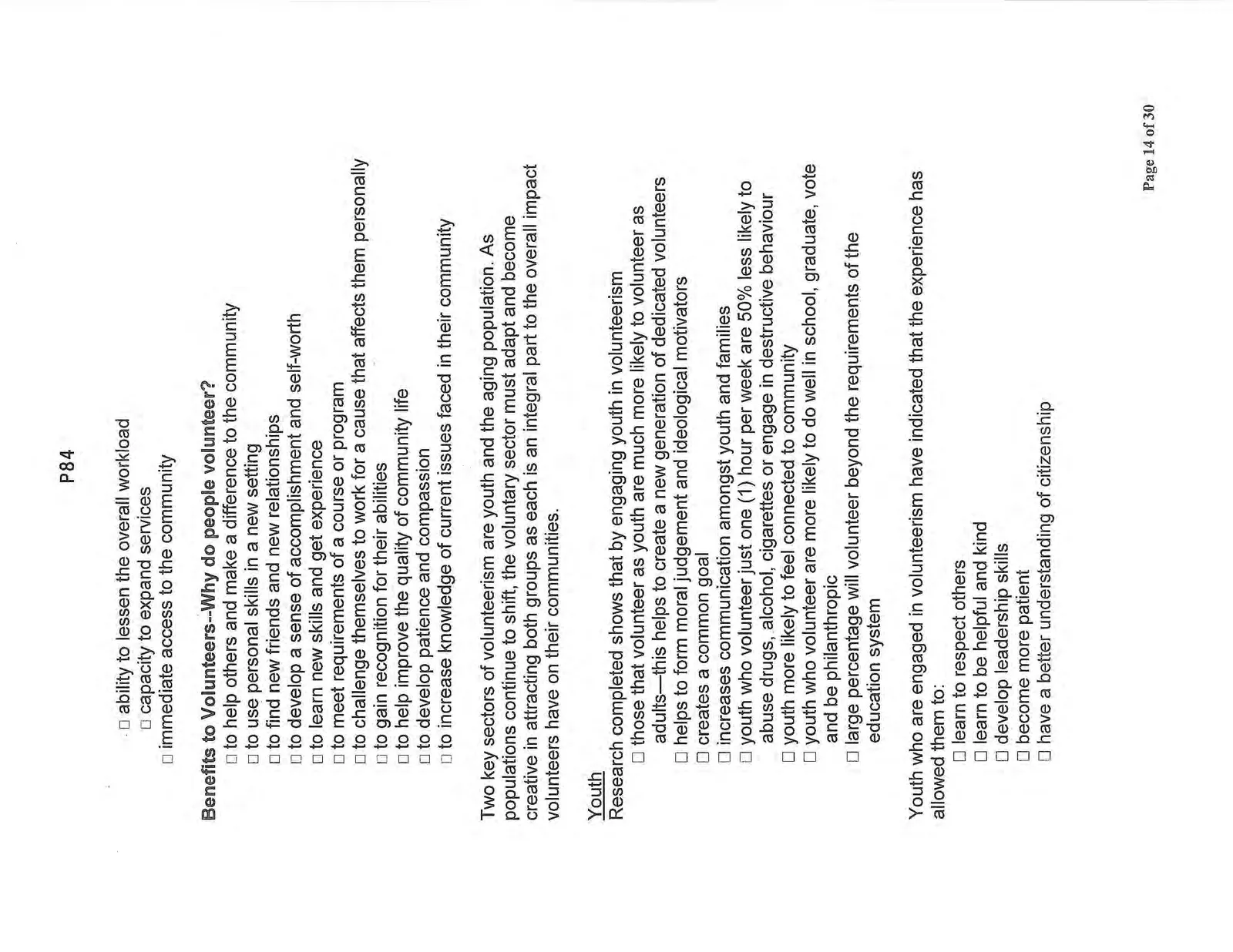
- ability to lessen the overall workload
- capacity to expand services
- immediate access to the community
Benefits to Volunteers--Why do people volunteer?
- to help others and make a difference to the community
- to use personal skills in a new setting
- to find new friends and new relationships
- to develop a sense of accomplishment and self-worth
- to learn new skills and get experience
- to meet requirements of a course or program
- to challenge themselves to work for a cause that affects them personally
- to gain recognition for their abilities
- to help improve the quality of community life
- to develop patience and compassion
- to increase knowledge of current issues faced in their community
Two key sectors of volunteerism are youth and the aging population. As populations continue to shift, the voluntary sector must adapt and become creative in attracting both groups as each is an integral part to the overall impact volunteers have on their communities.
Youth
Research completed shows that by engaging youth in volunteerism
- those that volunteer as youth are much more likely to volunteer as adults—this helps to create a new generation of dedicated volunteers
- helps to form moral judgement and ideological motivators
- creates a common goal
- increases communication amongst youth and families
- youth who volunteer just one (1) hour per week are 50% less likely to abuse drugs, alcohol, cigarettes or engage in destructive behaviour
- youth more likely to feel connected to community
- youth who volunteer are more likely to do well in school, graduate, vote and be philanthropic
- large percentage will volunteer beyond the requirements of the education system
Youth who are engaged in volunteerism have indicated that the experience has allowed them to:
- learn to respect others
- learn to be helpful and kind
- develop leadership skills
- become more patient
- have a better understanding of citizenship
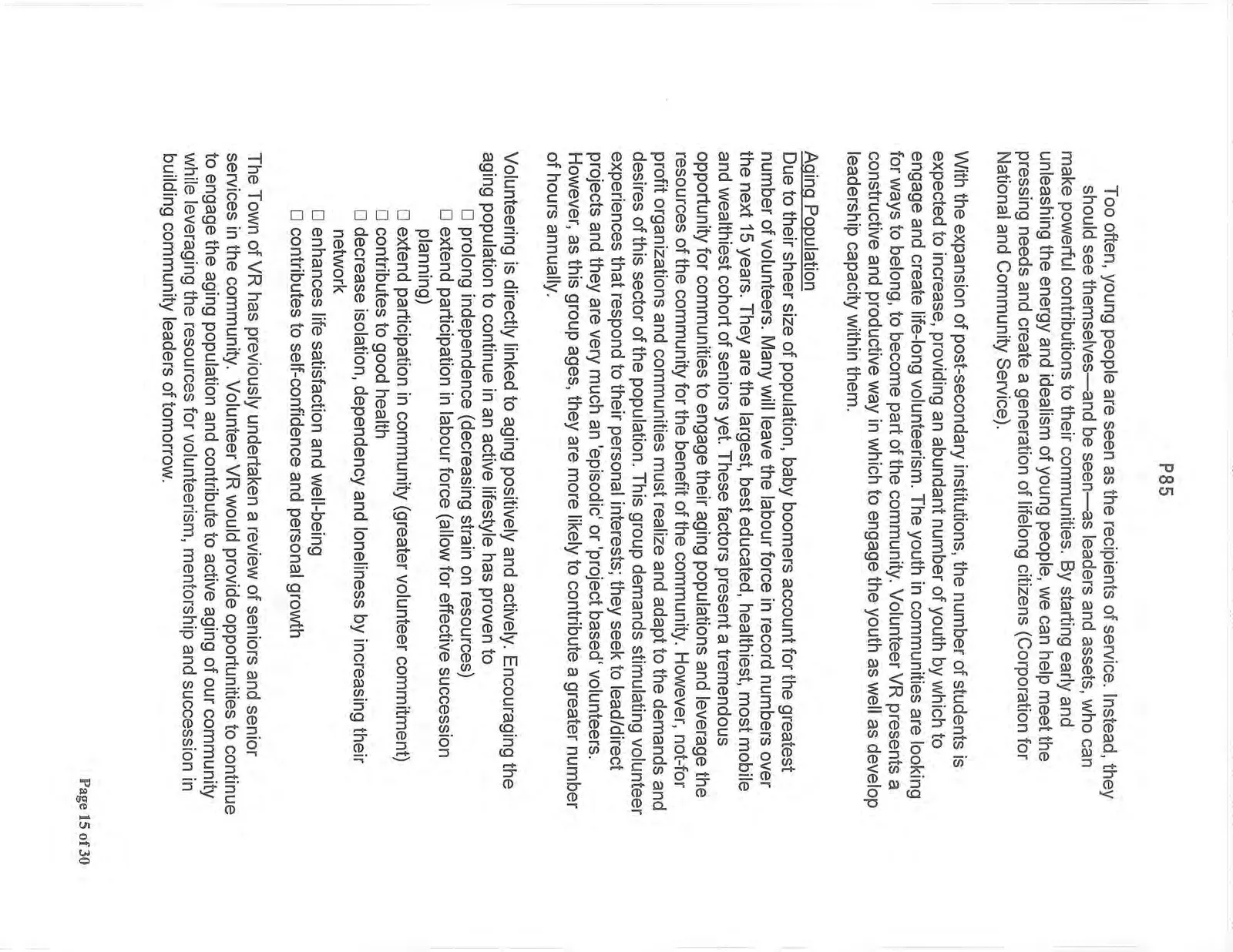
Too often, young people are seen as the recipients of service. Instead, they should see themselves—and be seen—as leaders and assets, who can make powerful contributions to their communities. By starting early and unleashing the energy and idealism of young people, we can help meet the pressing needs and create a generation of lifelong citizens (Corporation for National and Community Service).
With the expansion of post-secondary institutions, the number of students is expected to increase, providing an abundant number of youth by which to engage and create life-long volunteerism. The youth in communities are looking for ways to belong, to become part of the community. Volunteer VR presents a constructive and productive way in which to engage the youth as well as develop leadership capacity within them.
Aging Population
Due to their sheer size of population, baby boomers account for the greatest number of volunteers. Many will leave the labour force in record numbers over the next 15 years. They are the largest, best educated, healthiest, most mobile and wealthiest cohort of seniors yet. These factors present a tremendous opportunity for communities to engage their aging populations and leverage the resources of the community for the benefit of the community. However, not-for profit organizations and communities must realize and adapt to the demands and desires of this sector of the population. This group demands stimulating volunteer experiences that respond to their personal interests; they seek to lead/direct projects and they are very much an 'episodic' or 'project based' volunteers. However, as this group ages, they are more likely to contribute a greater number of hours annually.
Volunteering is directly linked to aging positively and actively. Encouraging the aging population to continue in an active lifestyle has proven to
- prolong independence (decreasing strain on resources)
- extend participation in labour force (allow for effective succession planning)
- extend participation in community (greater volunteer commitment)
- contributes to good health
- decrease isolation, dependency and loneliness by increasing their network
- enhances life satisfaction and well-being
- contributes to self-confidence and personal growth
The Town of VR has previously undertaken a review of seniors and senior services in the community. Volunteer VR would provide opportunities to continue to engage the aging population and contribute to active aging of our community while leveraging the resources for volunteerism, mentorship and succession in building community leaders of tomorrow.
APPENDIX 3: THE VOLUNTARY SECTOR AND VOLUNTEERISM (THE INDUSTRY)
Volunteers are the most important resource community organizations have. The ability of people to work willingly together for the betterment of their community and themselves is a valuable resource.
The image of the volunteer has changed over time. Gone is the stereotype of the middle-aged housewife with time on her hands. Now volunteers come from all walks of life: They may be a teenager learning to manage responsibility by caring for wounded wildlife, an executive sharing management skills with a community group or a retiree enjoying a new friendship as a volunteer reader at the community library.
Ideally, volunteers find the donation of their time and energy a meaningful experience for themselves as well as for the organization. A true win-win situation.

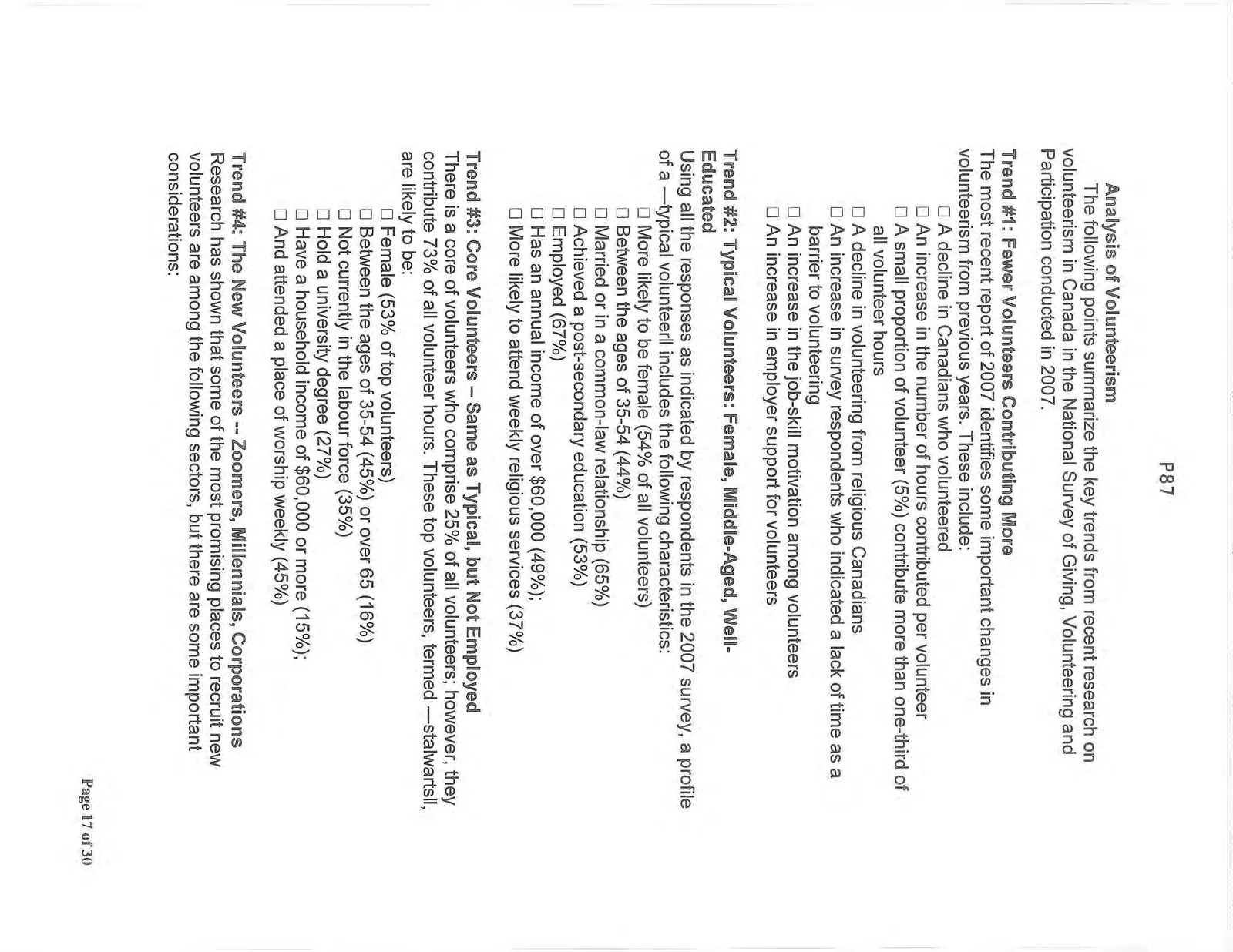
Analysis of Volunteerism
The following points summarize the key trends from recent research on volunteerism in Canada in the National Survey of Giving, Volunteering and Participation conducted in 2007.
Trend #1: Fewer Volunteers Contributing More The most recent report of 2007 identifies some important changes in volunteerism from previous years. These include:
- A decline in Canadians who volunteered
- An increase in the number of hours contributed per volunteer
- A small proportion of volunteer (5%) contribute more than one-third of all volunteer hours
- A decline in volunteering from religious Canadians
- An increase in survey respondents who indicated a lack of time as a barrier to volunteering
- An increase in the job-skill motivation among volunteers
- An increase in employer support for volunteers
Trend #2: Typical Volunteers: Female, Middle-Aged, Well-Educated Using all the responses as indicated by respondents in the 2007 survey, a profile of a —typical volunteerll includes the following characteristics:
- More likely to be female (54% of all volunteers)
- Between the ages of 35-54 (44%)
- Married or in a common-law relationship (65%)
- Achieved a post-secondary education (53%)
- Employed (67%)
- Has an annual income of over $60,000 (49%);
- More likely to attend weekly religious services (37%)
Trend #3: Core Volunteers – Same as Typical, but Not Employed There is a core of volunteers who comprise 25% of all volunteers; however, they contribute 73% of all volunteer hours. These top volunteers, termed —stalwartsll, are likely to be:
- Female (53% of top volunteers)
- Between the ages of 35-54 (45%) or over 65 (16%)
- Not currently in the labour force (35%)
- Hold a university degree (27%)
- Have a household income of $60,000 or more (15%);
- And attended a place of worship weekly (45%)
Trend #4: The New Volunteers -- Zoomers, Millennials, Corporations Research has shown that some of the most promising places to recruit new volunteers are among the following sectors, but there are some important considerations:
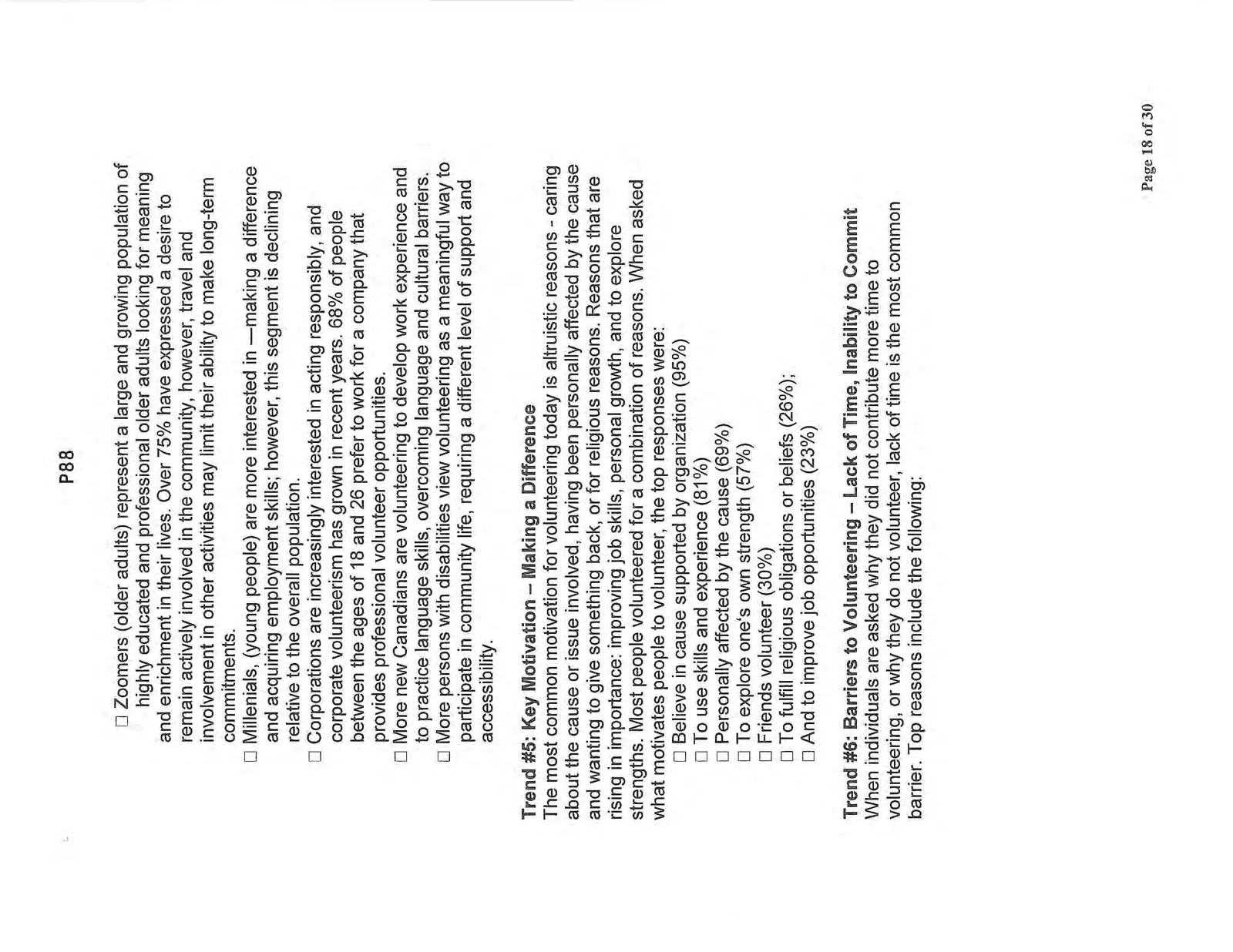
- Zoomers (older adults) represent a large and growing population of highly educated and professional older adults looking for meaning and enrichment in their lives. Over 75% have expressed a desire to remain actively involved in the community, however, travel and involvement in other activities may limit their ability to make long-term commitments.
- Millenials, (young people) are more interested in —making a difference and acquiring employment skills; however, this segment is declining relative to the overall population.
- Corporations are increasingly interested in acting responsibly, and corporate volunteerism has grown in recent years. 68% of people between the ages of 18 and 26 prefer to work for a company that provides professional volunteer opportunities.
- More new Canadians are volunteering to develop work experience and to practice language skills, overcoming language and cultural barriers.
- More persons with disabilities view volunteering as a meaningful way to participate in community life, requiring a different level of support and accessibility.
Trend #5: Key Motivation – Making a Difference The most common motivation for volunteering today is altruistic reasons - caring about the cause or issue involved, having been personally affected by the cause and wanting to give something back, or for religious reasons. Reasons that are rising in importance: improving job skills, personal growth, and to explore strengths. Most people volunteered for a combination of reasons. When asked what motivates people to volunteer, the top responses were:
- Believe in cause supported by organization (95%)
- To use skills and experience (81%)
- Personally affected by the cause (69%)
- To explore one’s own strength (57%)
- Friends volunteer (30%)
- To fulfill religious obligations or beliefs (26%);
- And to improve job opportunities (23%)
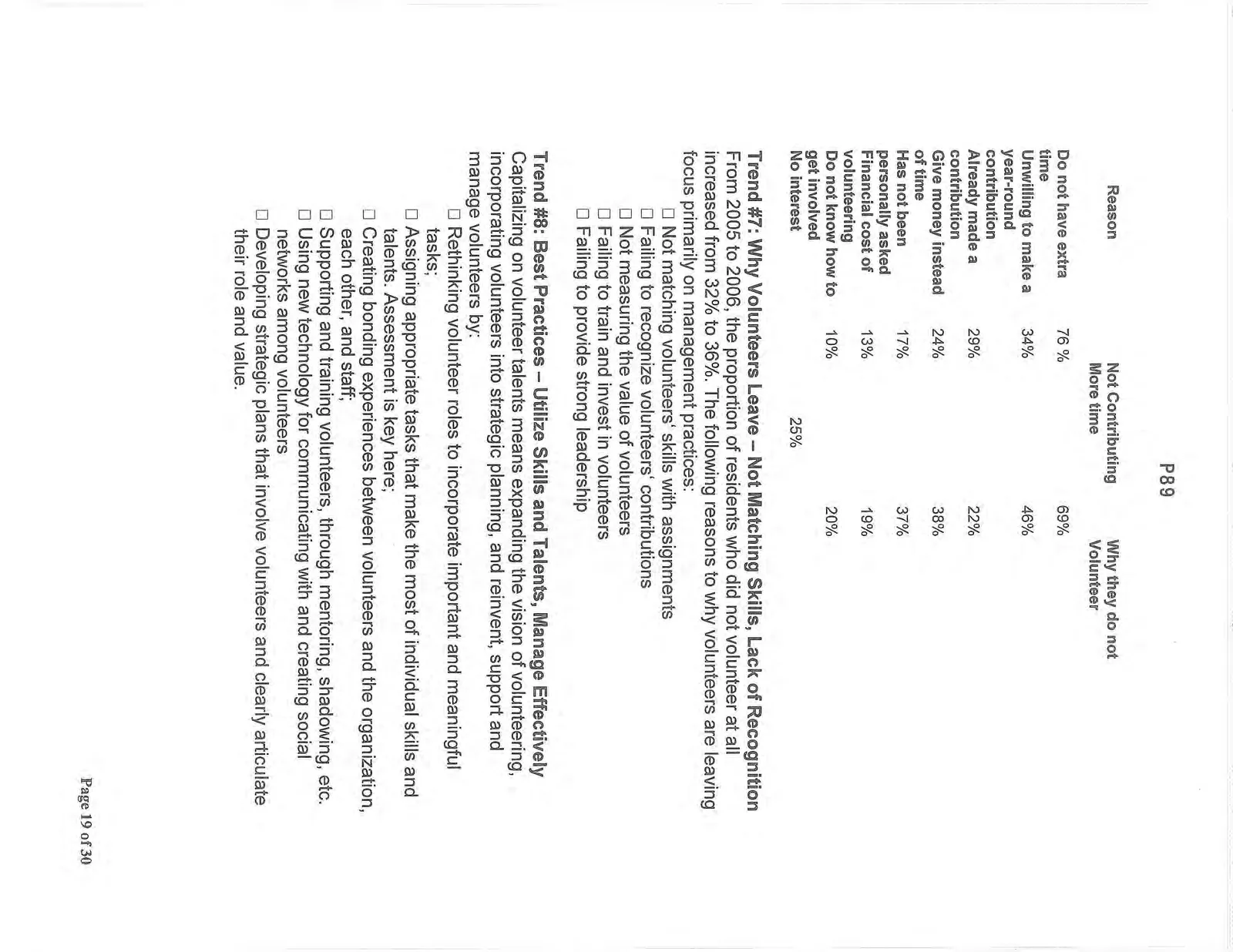
Trend #6: Barriers to Volunteering – Lack of Time, Inability to Commit When individuals are asked why they did not contribute more time to volunteering, or why they do not volunteer, lack of time is the most common barrier. Top reasons include the following:
| Reason | Not Contributing More time | Why they do not Volunteer |
|---|---|---|
| Do not have extra time | 76% | 69% |
| Unwilling to make a year-round contribution | 34% | 46% |
| Already made a contribution | 29% | 22% |
| Give money instead of time | 24% | 38% |
| Has not been personally asked | 17% | 37% |
| Financial cost of volunteering | 13% | 19% |
| Do not know how to get involved | 10% | 20% |
| No interest | 25% |
Trend #7: Why Volunteers Leave – Not Matching Skills, Lack of Recognition From 2005 to 2006, the proportion of residents who did not volunteer at all increased from 32% to 36%. The following reasons to why volunteers are leaving focus primarily on management practices:
- Not matching volunteers' skills with assignments
- Failing to recognize volunteers‘ contributions
- Not measuring the value of volunteers
- Failing to train and invest in volunteers
- Failing to provide strong leadership
Trend #8: Best Practices – Utilize Skills and Talents, Manage Effectively Capitalizing on volunteer talents means expanding the vision of volunteering, incorporating volunteers into strategic planning, and reinvent, support and manage volunteers by:
- Rethinking volunteer roles to incorporate important and meaningful tasks;
- Assigning appropriate tasks that make the most of individual skills and talents. Assessment is key here;
- Creating bonding experiences between volunteers and the organization, each other, and staff;
- Supporting and training volunteers, through mentoring, shadowing, etc.
- Using new technology for communicating with and creating social networks among volunteers
- Developing strategic plans that involve volunteers and clearly articulate their role and value.

APPENDIX 4: DRAFT VOLUNTEER VIEW ROYAL COMMUNICATIONS STRATEGY
Overall Strategies
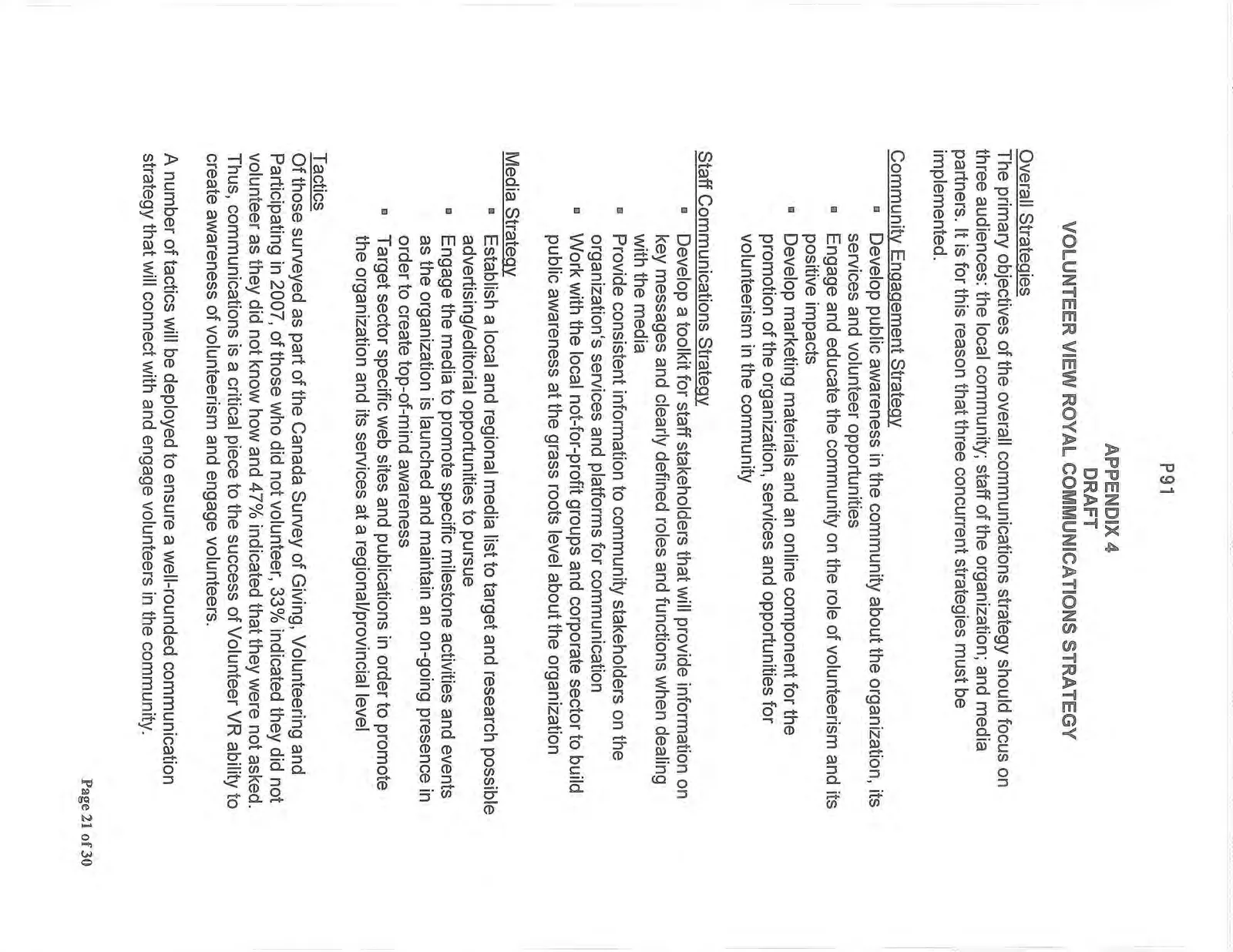
The primary objectives of the overall communications strategy should focus on three audiences: the local community; staff of the organization; and media partners. It is for this reason that three concurrent strategies must be implemented.
Community Engagement Strategy
- Develop public awareness in the community about the organization, its services and volunteer opportunities
- Engage and educate the community on the role of volunteerism and its positive impacts
- Develop marketing materials and an online component for the promotion of the organization, services and opportunities for volunteerism in the community
Staff Communications Strategy
- Develop a toolkit for staff stakeholders that will provide information on key messages and clearly defined roles and functions when dealing with the media
- Provide consistent information to community stakeholders on the organization’s services and platforms for communication
- Work with the local not-for-profit groups and corporate sector to build public awareness at the grass roots level about the organization
Media Strategy
- Establish a local and regional media list to target and research possible advertising/editorial opportunities to pursue
- Engage the media to promote specific milestone activities and events as the organization is launched and maintain an on-going presence in order to create top-of-mind awareness
- Target sector specific web sites and publications in order to promote the organization and its services at a regional/provincial level
Tactics
Of those surveyed as part of the Canada Survey of Giving, Volunteering and Participating in 2007, of those who did not volunteer, 33% indicated they did not volunteer as they did not know how and 47% indicated that they were not asked. Thus, communications is a critical piece to the success of Volunteer VR ability to create awareness of volunteerism and engage volunteers.
A number of tactics will be deployed to ensure a well-rounded communication strategy that will connect with and engage volunteers in the community.
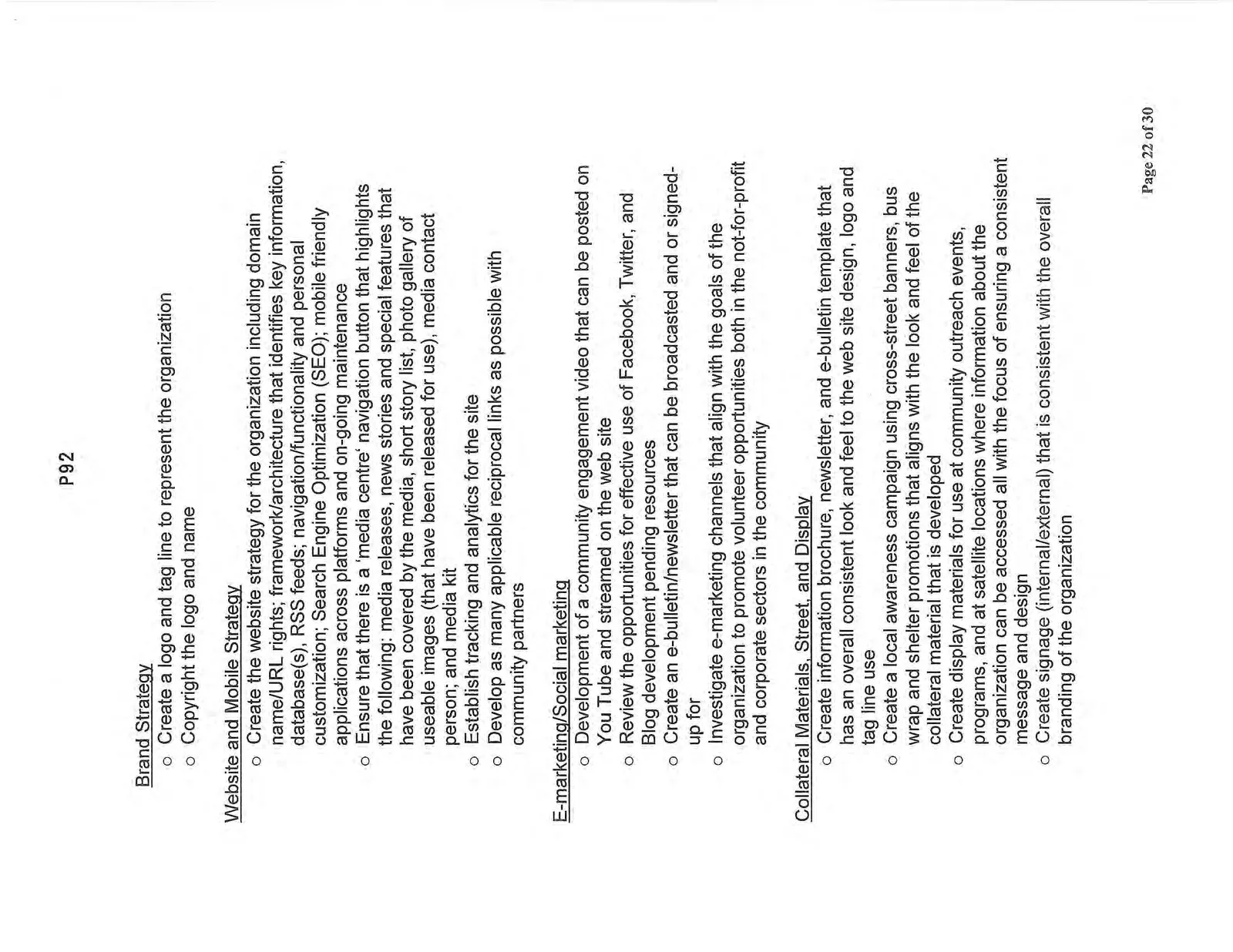
Brand Strategy
- Create a logo and tag line to represent the organization
- Copyright the logo and name
Website and Mobile Strategy
- Create the website strategy for the organization including domain name/URL rights; framework/architecture that identifies key information, database(s), RSS feeds; navigation/functionality and personal customization; Search Engine Optimization (SEO); mobile friendly applications across platforms and on-going maintenance
- Ensure that there is a 'media centre‘ navigation button that highlights the following: media releases, news stories and special features that have been covered by the media, short story list, photo gallery of useable images (that have been released for use), media contact person; and media kit
- Establish tracking and analytics for the site
- Develop as many applicable reciprocal links as possible with community partners
E-marketing/Social marketing
- Development of a community engagement video that can be posted on You Tube and streamed on the web site
- Review the opportunities for effective use of Facebook, Twitter, and Blog development pending resources
- Create an e-bulletin/newsletter that can be broadcasted and or signed-up for
- Investigate e-marketing channels that align with the goals of the organization to promote volunteer opportunities both in the not-for-profit and corporate sectors in the community
Collateral Materials, Street, and Display
- Create information brochure, newsletter, and e-bulletin template that has an overall consistent look and feel to the web site design, logo and tag line use
- Create a local awareness campaign using cross-street banners, bus wrap and shelter promotions that aligns with the look and feel of the collateral material that is developed
- Create display materials for use at community outreach events, programs, and at satellite locations where information about the organization can be accessed all with the focus of ensuring a consistent message and design
- Create signage (internal/external) that is consistent with the overall branding of the organization
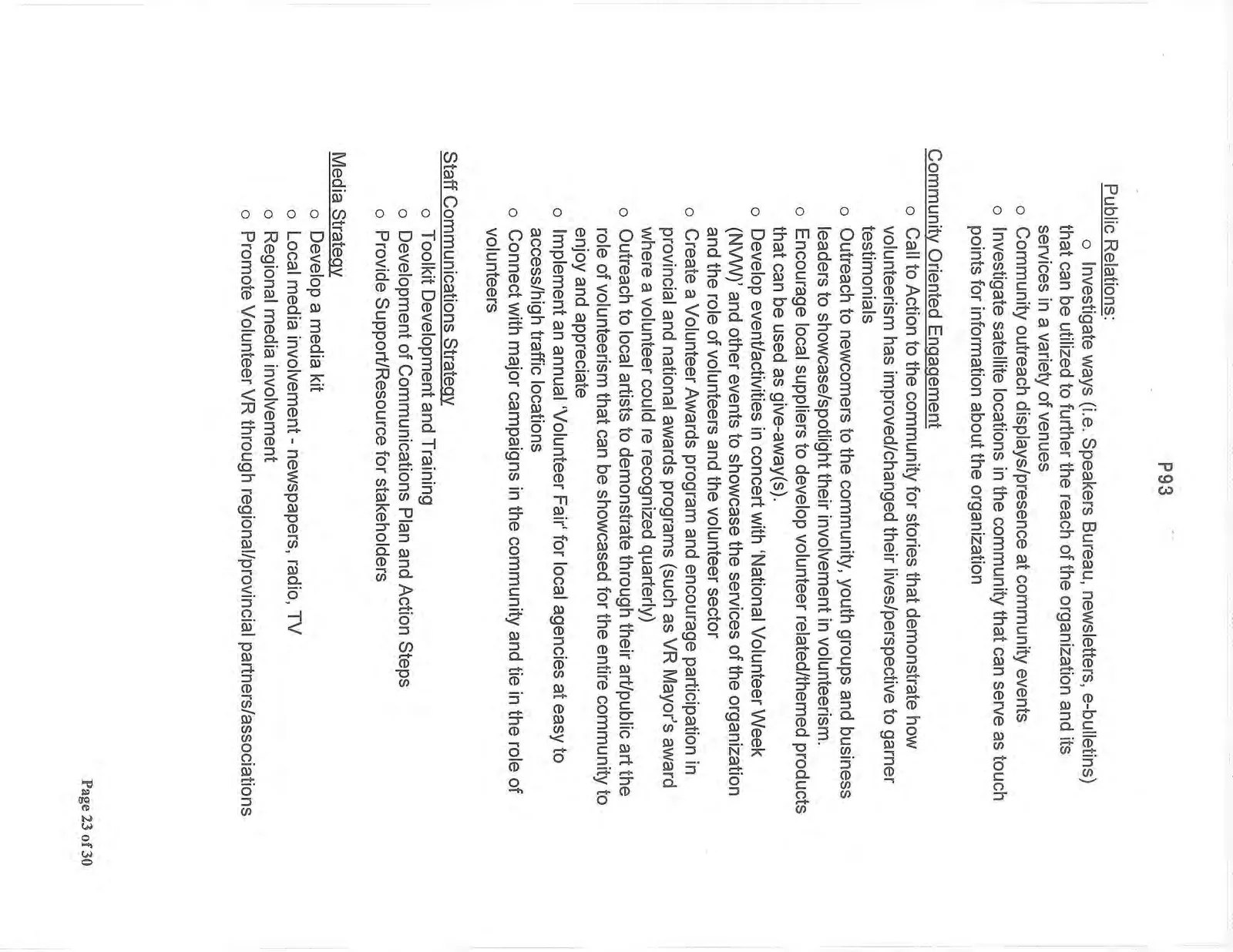
Public Relations:
- Investigate ways (i.e. Speakers Bureau, newsletters, e-bulletins) that can be utilized to further the reach of the organization and its services in a variety of venues
- Community outreach displays/presence at community events
- Investigate satellite locations in the community that can serve as touch points for information about the organization
Community Oriented Engagement
- Call to Action to the community for stories that demonstrate how volunteerism has improved/changed their lives/perspective to garner testimonials
- Outreach to newcomers to the community, youth groups and business leaders to showcase/spotlight their involvement in volunteerism.
- Encourage local suppliers to develop volunteer related/themed products that can be used as give-away(s).
- Develop event/activities in concert with 'National Volunteer Week (NVW)' and other events to showcase the services of the organization and the role of volunteers and the volunteer sector
- Create a Volunteer Awards program and encourage participation in provincial and national awards programs (such as VR Mayor’s award where a volunteer could re recognized quarterly)
- Outreach to local artists to demonstrate through their art/public art the role of volunteerism that can be showcased for the entire community to enjoy and appreciate
- Implement an annual 'Volunteer Fair‘ for local agencies at easy to access/high traffic locations
- Connect with major campaigns in the community and tie in the role of volunteers
Staff Communications Strategy
- Toolkit Development and Training
- Development of Communications Plan and Action Steps
- Provide Support/Resource for stakeholders
Media Strategy
- Develop a media kit
- Local media involvement - newspapers, radio, TV
- Regional media involvement
- Promote Volunteer VR through regional/provincial partners/associations
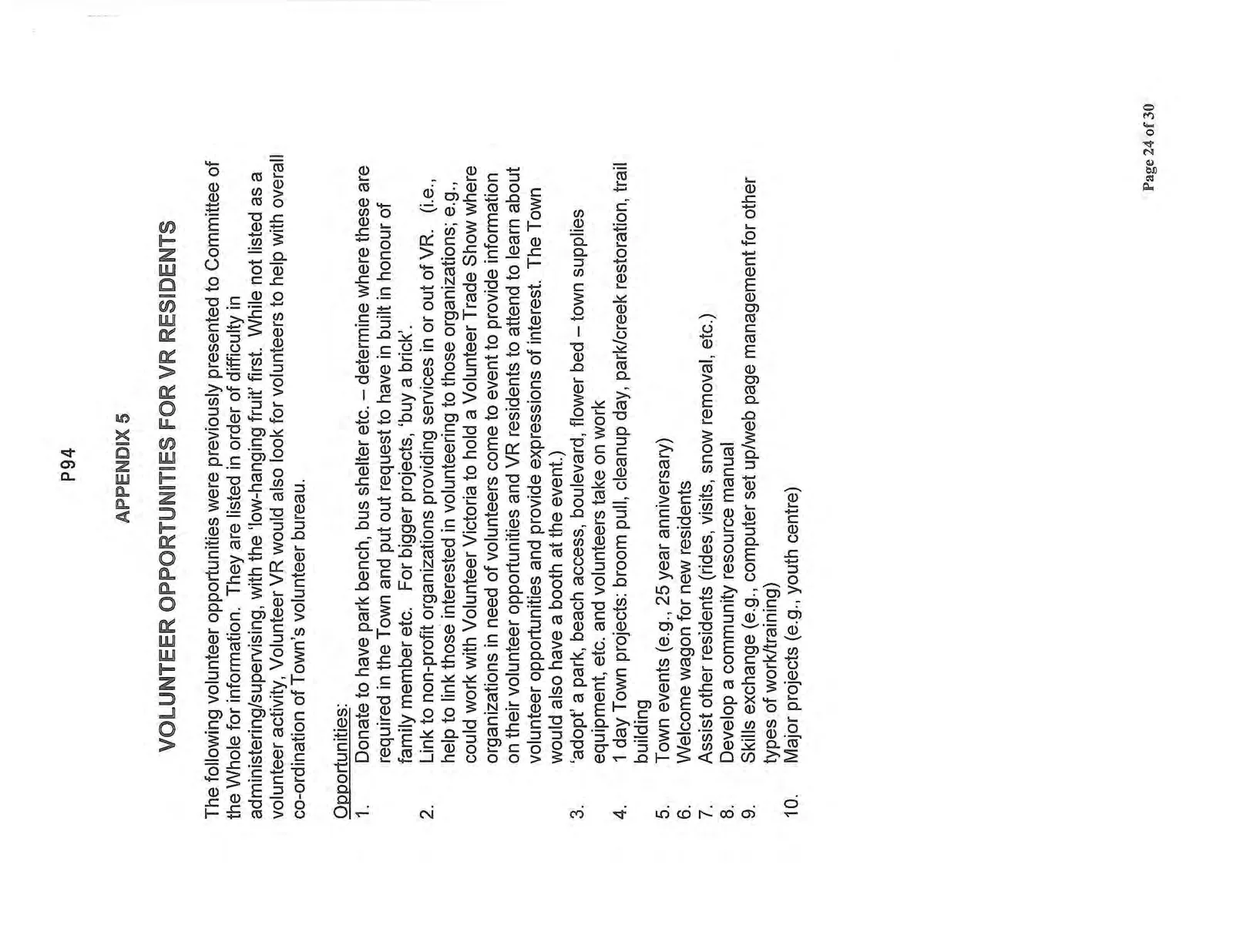
APPENDIX 5: VOLUNTEER OPPORTUNITIES FOR VR RESIDENTS
The following volunteer opportunities were previously presented to Committee of the Whole for information. They are listed in order of difficulty in administering/supervising, with the 'low-hanging fruit‘ first. While not listed as a volunteer activity, Volunteer VR would also look for volunteers to help with overall co-ordination of Town’s volunteer bureau.
Opportunities:
- Donate to have park bench, bus shelter etc. – determine where these are required in the Town and put out request to have in built in honour of family member etc. For bigger projects, 'buy a brick‘.
- Link to non-profit organizations providing services in or out of VR. (i.e., help to link those interested in volunteering to those organizations; e.g., could work with Volunteer Victoria to hold a Volunteer Trade Show where organizations in need of volunteers come to event to provide information on their volunteer opportunities and VR residents to attend to learn about volunteer opportunities and provide expressions of interest. The Town would also have a booth at the event.)
- 'adopt‘ a park, beach access, boulevard, flower bed – town supplies equipment, etc. and volunteers take on work
- 1 day Town projects: broom pull, cleanup day, park/creek restoration, trail building
- Town events (e.g., 25 year anniversary)
- Welcome wagon for new residents
- Assist other residents (rides, visits, snow removal, etc.)
- Develop a community resource manual
- Skills exchange (e.g., computer set up/web page management for other types of work/training)
- Major projects (e.g., youth centre)
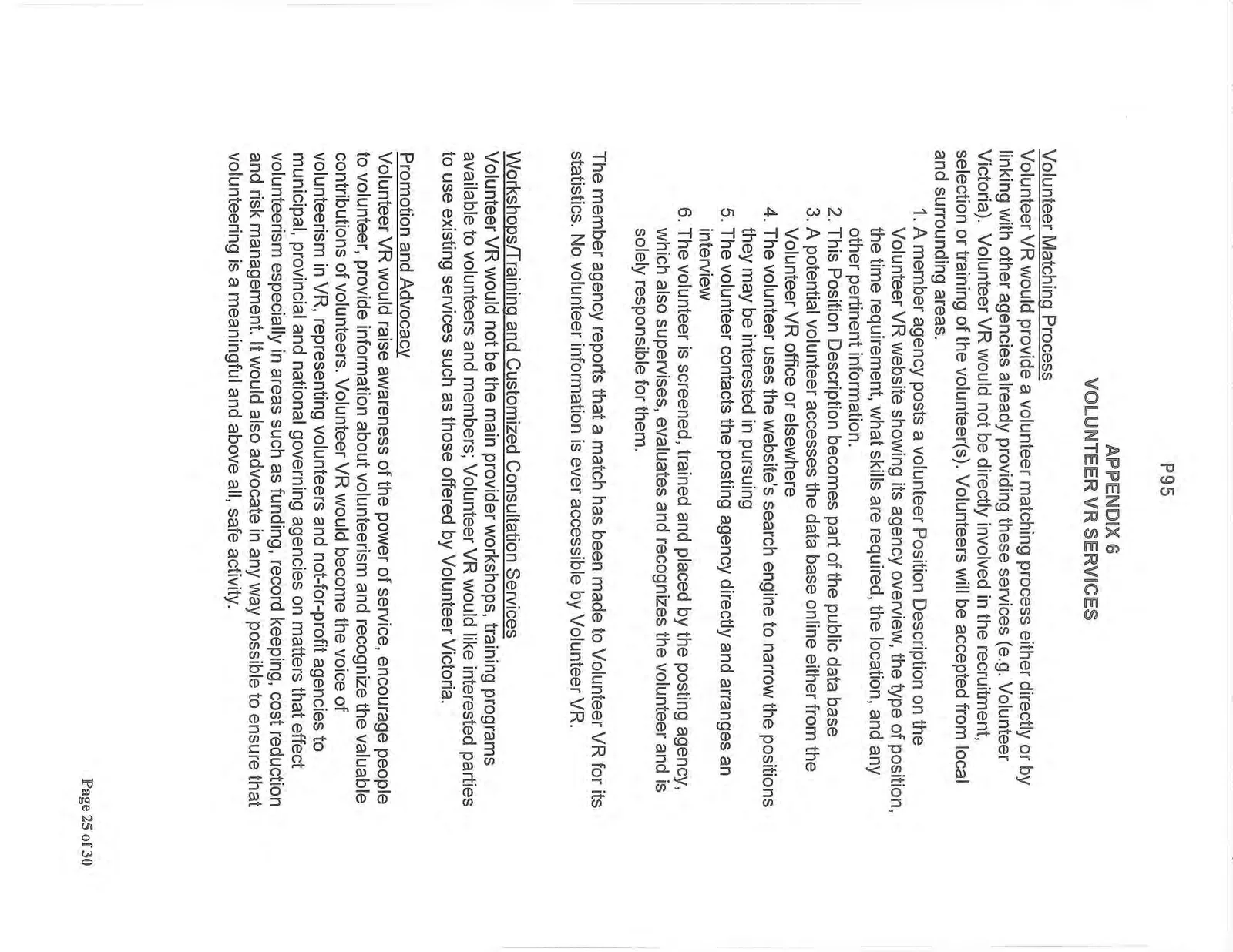
APPENDIX 6: VOLUNTEER VR SERVICES
Volunteer Matching Process
Volunteer VR would provide a volunteer matching process either directly or by linking with other agencies already providing these services (e.g. Volunteer Victoria). Volunteer VR would not be directly involved in the recruitment, selection or training of the volunteer(s). Volunteers will be accepted from local and surrounding areas.
- A member agency posts a volunteer Position Description on the Volunteer VR website showing its agency overview, the type of position, the time requirement, what skills are required, the location, and any other pertinent information.
- This Position Description becomes part of the public data base
- A potential volunteer accesses the data base online either from the Volunteer VR office or elsewhere
- The volunteer uses the website's search engine to narrow the positions they may be interested in pursuing
- The volunteer contacts the posting agency directly and arranges an interview
- The volunteer is screened, trained and placed by the posting agency, which also supervises, evaluates and recognizes the volunteer and is solely responsible for them.
The member agency reports that a match has been made to Volunteer VR for its statistics. No volunteer information is ever accessible by Volunteer VR.
Workshops/Training and Customized Consultation Services
Volunteer VR would not be the main provider workshops, training programs available to volunteers and members; Volunteer VR would like interested parties to use existing services such as those offered by Volunteer Victoria.
Promotion and Advocacy
Volunteer VR would raise awareness of the power of service, encourage people to volunteer, provide information about volunteerism and recognize the valuable contributions of volunteers. Volunteer VR would become the voice of volunteerism in VR, representing volunteers and not-for-profit agencies to municipal, provincial and national governing agencies on matters that effect volunteerism especially in areas such as funding, record keeping, cost reduction and risk management. It would also advocate in any way possible to ensure that volunteering is a meaningful and above all, safe activity.
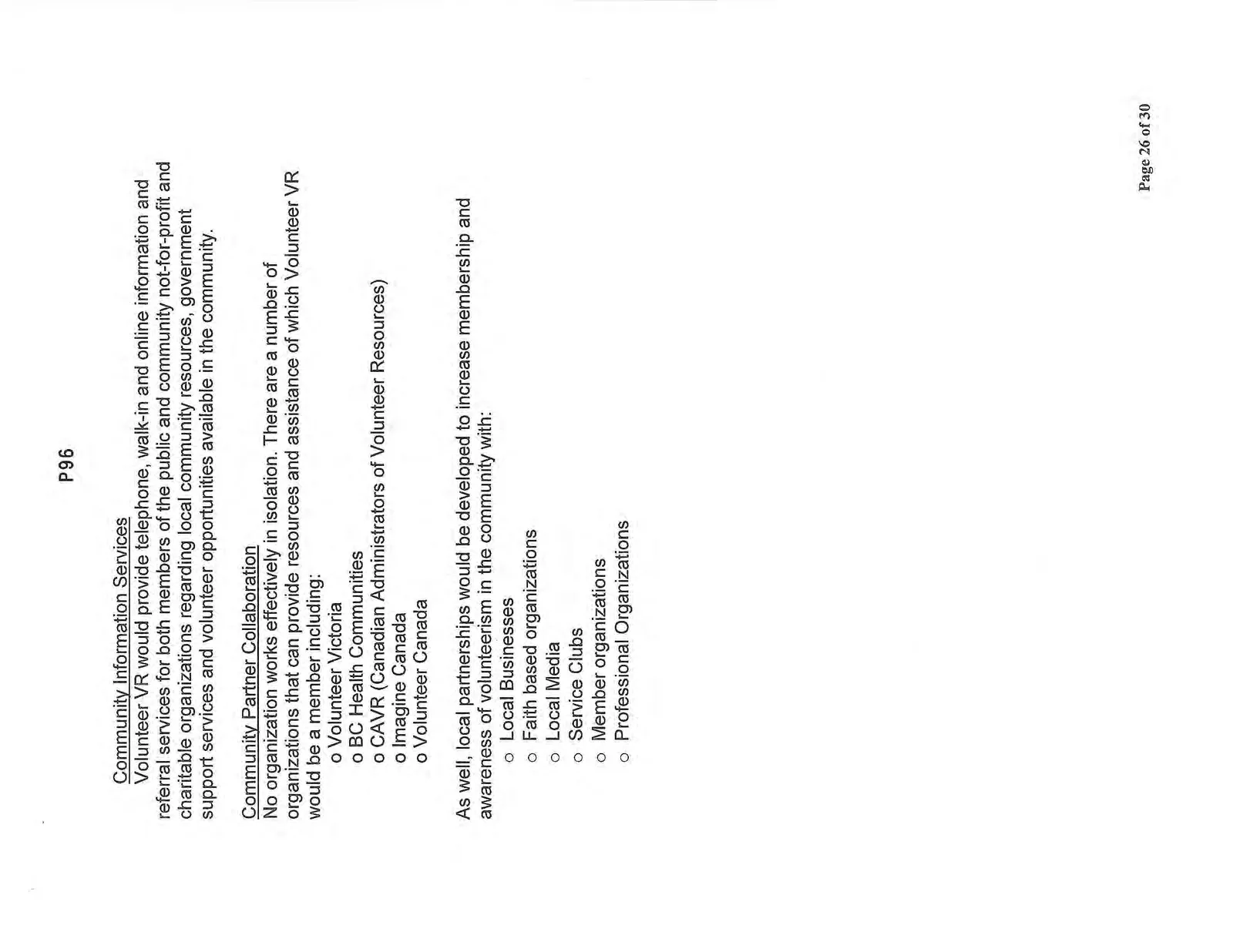
Community Information Services
Volunteer VR would provide telephone, walk-in and online information and referral services for both members of the public and community not-for-profit and charitable organizations regarding local community resources, government support services and volunteer opportunities available in the community.
Community Partner Collaboration
No organization works effectively in isolation. There are a number of organizations that can provide resources and assistance of which Volunteer VR would be a member including:
- Volunteer Victoria
- BC Health Communities
- CAVR (Canadian Administrators of Volunteer Resources)
- Imagine Canada
- Volunteer Canada
As well, local partnerships would be developed to increase membership and awareness of volunteerism in the community with:
- Local Businesses
- Faith based organizations
- Local Media
- Service Clubs
- Member organizations
- Professional Organizations
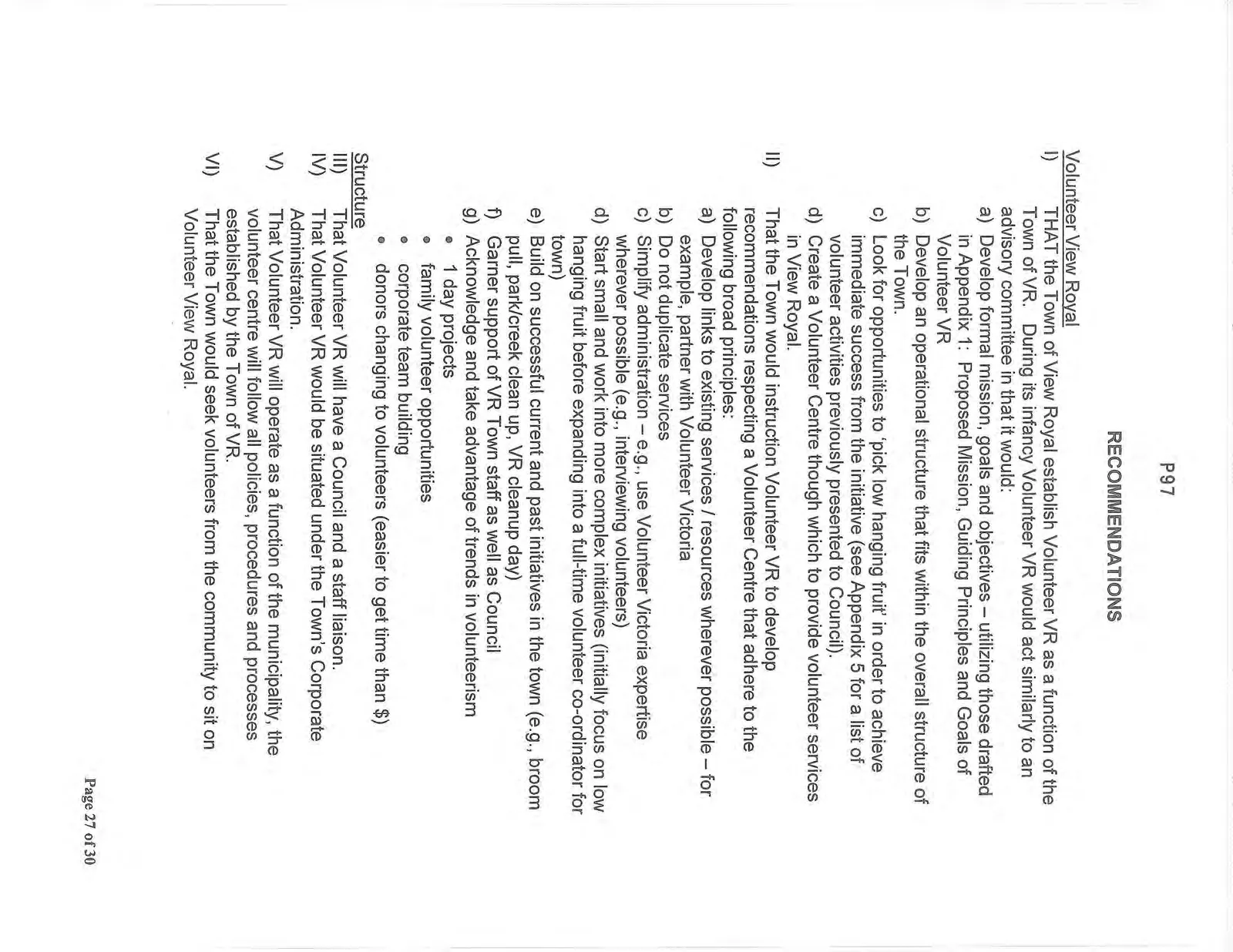
RECOMMENDATIONS
Volunteer View Royal
I) THAT the Town of View Royal establish Volunteer VR as a function of the Town of VR. During its infancy Volunteer VR would act similarly to an advisory committee in that it would: a) Develop formal mission, goals and objectives – utilizing those drafted in Appendix 1: Proposed Mission, Guiding Principles and Goals of Volunteer VR b) Develop an operational structure that fits within the overall structure of the Town. c) Look for opportunities to 'pick low hanging fruit‘ in order to achieve immediate success from the initiative (see Appendix 5 for a list of volunteer activities previously presented to Council). d) Create a Volunteer Centre though which to provide volunteer services in View Royal.
II) That the Town would instruction Volunteer VR to develop recommendations respecting a Volunteer Centre that adhere to the following broad principles: a) Develop links to existing services / resources wherever possible – for example, partner with Volunteer Victoria b) Do not duplicate services c) Simplify administration – e.g., use Volunteer Victoria expertise wherever possible (e.g., interviewing volunteers) d) Start small and work into more complex initiatives (initially focus on low hanging fruit before expanding into a full-time volunteer co-ordinator for town) e) Build on successful current and past initiatives in the town (e.g., broom pull, park/creek clean up, VR cleanup day) f) Garner support of VR Town staff as well as Council g) Acknowledge and take advantage of trends in volunteerism
- 1 day projects
- family volunteer opportunities
- corporate team building
- donors changing to volunteers (easier to get time than $)
Structure
III) That Volunteer VR will have a Council and a staff liaison. IV) That Volunteer VR would be situated under the Town’s Corporate Administration. V) That Volunteer VR will operate as a function of the municipality, the volunteer centre will follow all policies, procedures and processes established by the Town of VR. VI) That the Town would seek volunteers from the community to sit on Volunteer View Royal.
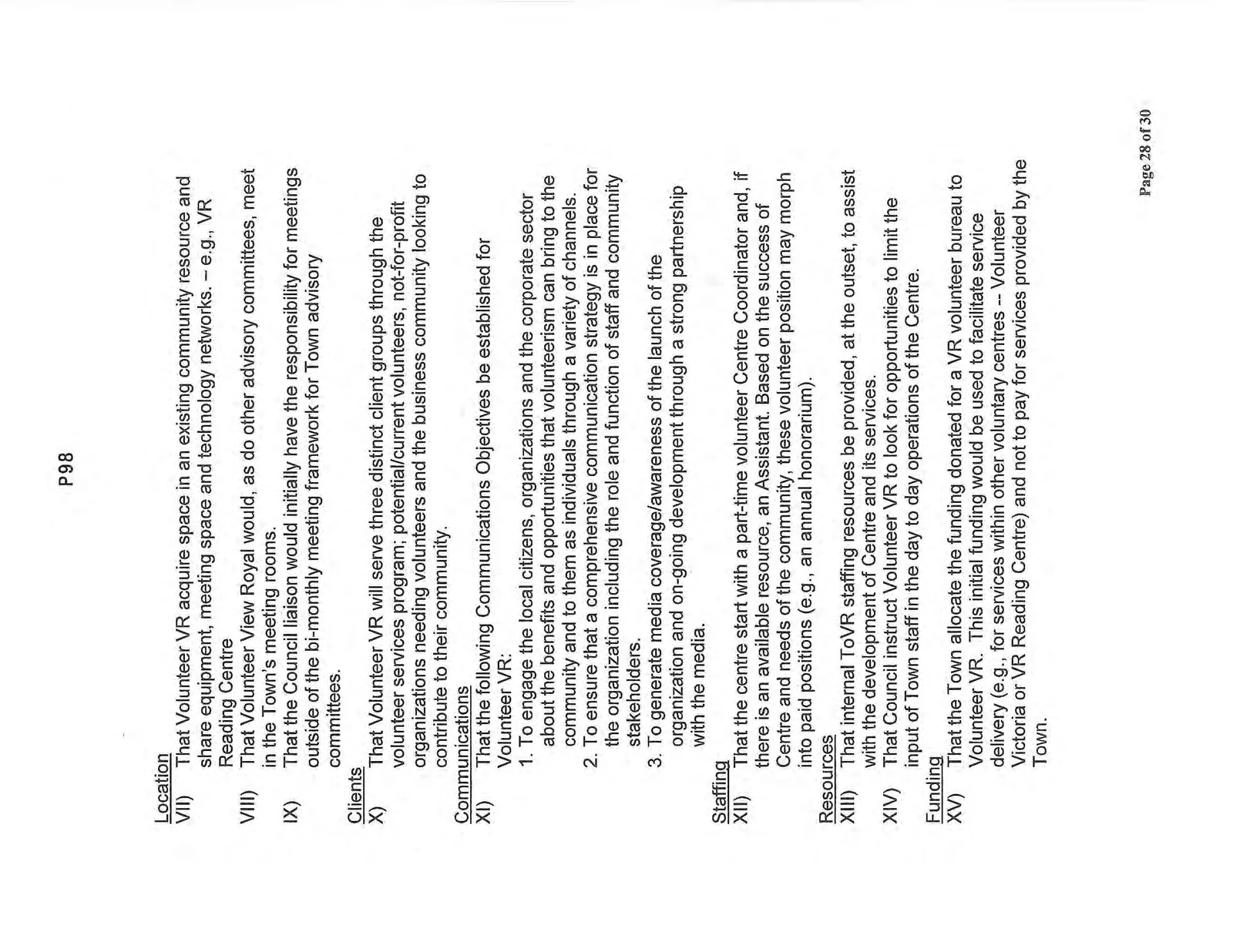
Location
VII) That Volunteer VR acquire space in an existing community resource and share equipment, meeting space and technology networks. – e.g., VR Reading Centre VIII) That Volunteer View Royal would, as do other advisory committees, meet in the Town’s meeting rooms. IX) That the Council liaison would initially have the responsibility for meetings outside of the bi-monthly meeting framework for Town advisory committees.
Clients
X) That Volunteer VR will serve three distinct client groups through the volunteer services program; potential/current volunteers, not-for-profit organizations needing volunteers and the business community looking to contribute to their community.
Communications
XI) That the following Communications Objectives be established for Volunteer VR:
- To engage the local citizens, organizations and the corporate sector about the benefits and opportunities that volunteerism can bring to the community and to them as individuals through a variety of channels.
- To ensure that a comprehensive communication strategy is in place for the organization including the role and function of staff and community stakeholders.
- To generate media coverage/awareness of the launch of the organization and on-going development through a strong partnership with the media.
Staffing
XII) That the centre start with a part-time volunteer Centre Coordinator and, if there is an available resource, an Assistant. Based on the success of Centre and needs of the community, these volunteer position may morph into paid positions (e.g., an annual honorarium).
Resources
XIII) That internal ToVR staffing resources be provided, at the outset, to assist with the development of Centre and its services. XIV) That Council instruct Volunteer VR to look for opportunities to limit the input of Town staff in the day to day operations of the Centre.
Funding
XV) That the Town allocate the funding donated for a VR volunteer bureau to Volunteer VR. This initial funding would be used to facilitate service delivery (e.g., for services within other voluntary centres -- Volunteer Victoria or VR Reading Centre) and not to pay for services provided by the Town. XVI) That Volunteer VR seek and increase outside sponsorship and other sources of funding in order to expand it ability to provide volunteer services. XVII) That Volunteer VR attempt to quantify the value to the Town of the services it provided (through volunteers) and seek a contribution through the Town’s annual Grants process.
Document Images
(28)