Records Management Policy
Administrative policy outlining accountability, responsibilities, and procedures for records creation, disposal, and retention.
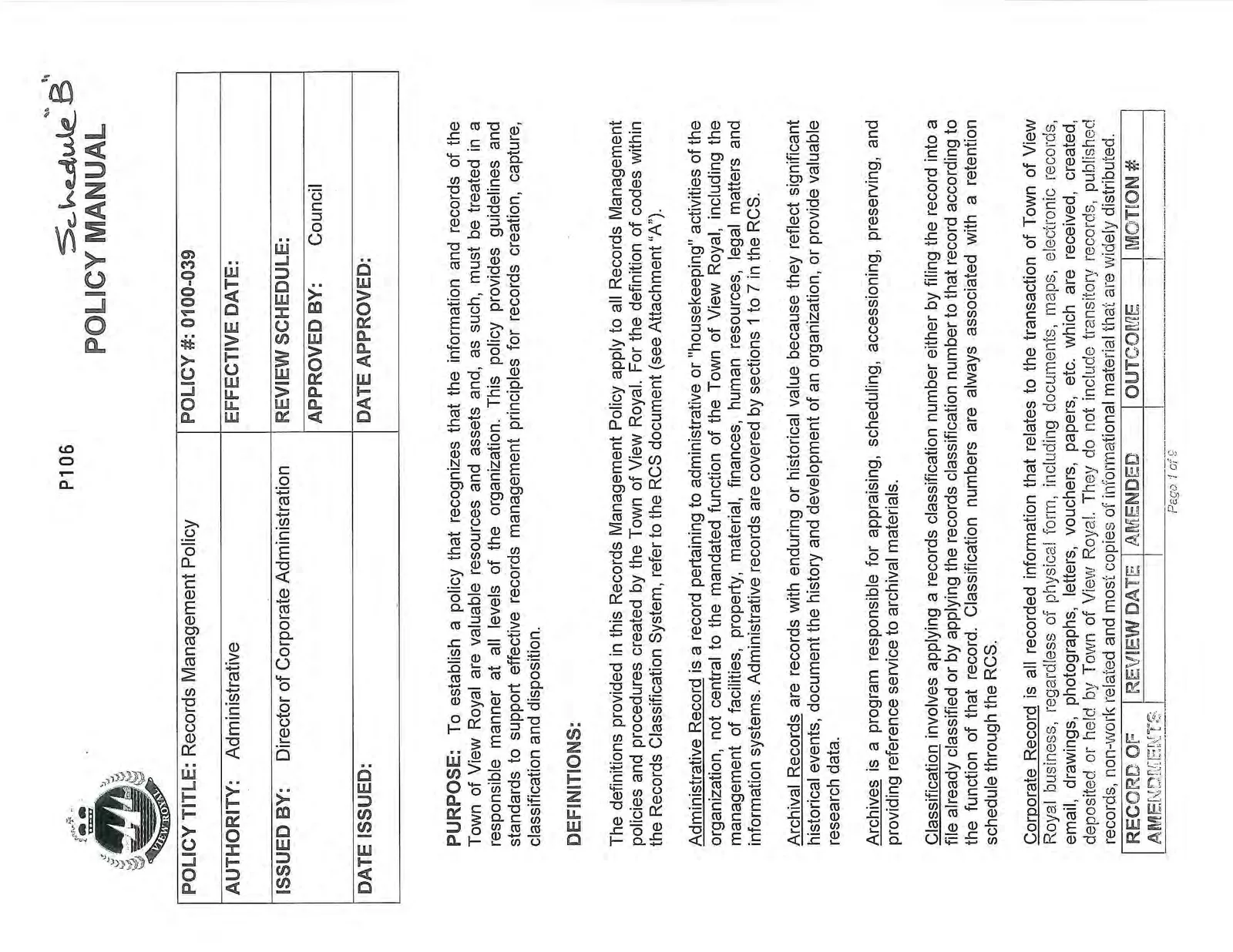
| POLICY TITLE: Records Management Policy | POLICY #: 0100-039 |
| AUTHORITY: Administrative | EFFECTIVE DATE: |
| ISSUED BY: Director of Corporate Administration | REVIEW SCHEDULE: |
| APPROVED BY: Council | |
| DATE ISSUED: | DATE APPROVED: |
PURPOSE:
To establish a policy that recognizes that the information and records of the Town of View Royal are valuable resources and assets and, as such, must be treated in a responsible manner at all levels of the organization. This policy provides guidelines and standards to support effective records management principles for records creation, capture, classification and disposition.
DEFINITIONS:
The definitions provided in this Records Management Policy apply to all Records Management policies and procedures created by the Town of View Royal. For the definition of codes within the Records Classification System, refer to the RCS document (see Attachment "A").
Administrative Record is a record pertaining to administrative or "housekeeping" activities of the organization, not central to the mandated function of the Town of View Royal, including the management of facilities, property, material, finances, human resources, legal matters and information systems. Administrative records are covered by sections 1 to 7 in the RCS.
Archival Records are records with enduring or historical value because they reflect significant historical events, document the history and development of an organization, or provide valuable research data.
Archives is a program responsible for appraising, scheduling, accessioning, preserving, and providing reference service to archival materials.
Classification involves applying a records classification number either by filing the record into a file already classified or by applying the records classification number to that record according to the function of that record. Classification numbers are always associated with a retention schedule through the RCS.
Corporate Record is all recorded information that relates to the transaction of Town of View Royal business, regardless of physical form, including documents, maps, electronic records, email, drawings, photographs, letters, vouchers, papers, etc. which are received, created, deposited or held by Town of View Royal. They do not include transitory records, published records, non-work related and most copies of informational material that are widely distributed.
| RECORD OF AMENDMENTS | REVIEW DATE | AMENDED | OUTCOME | MOTION # |
|---|---|---|---|---|
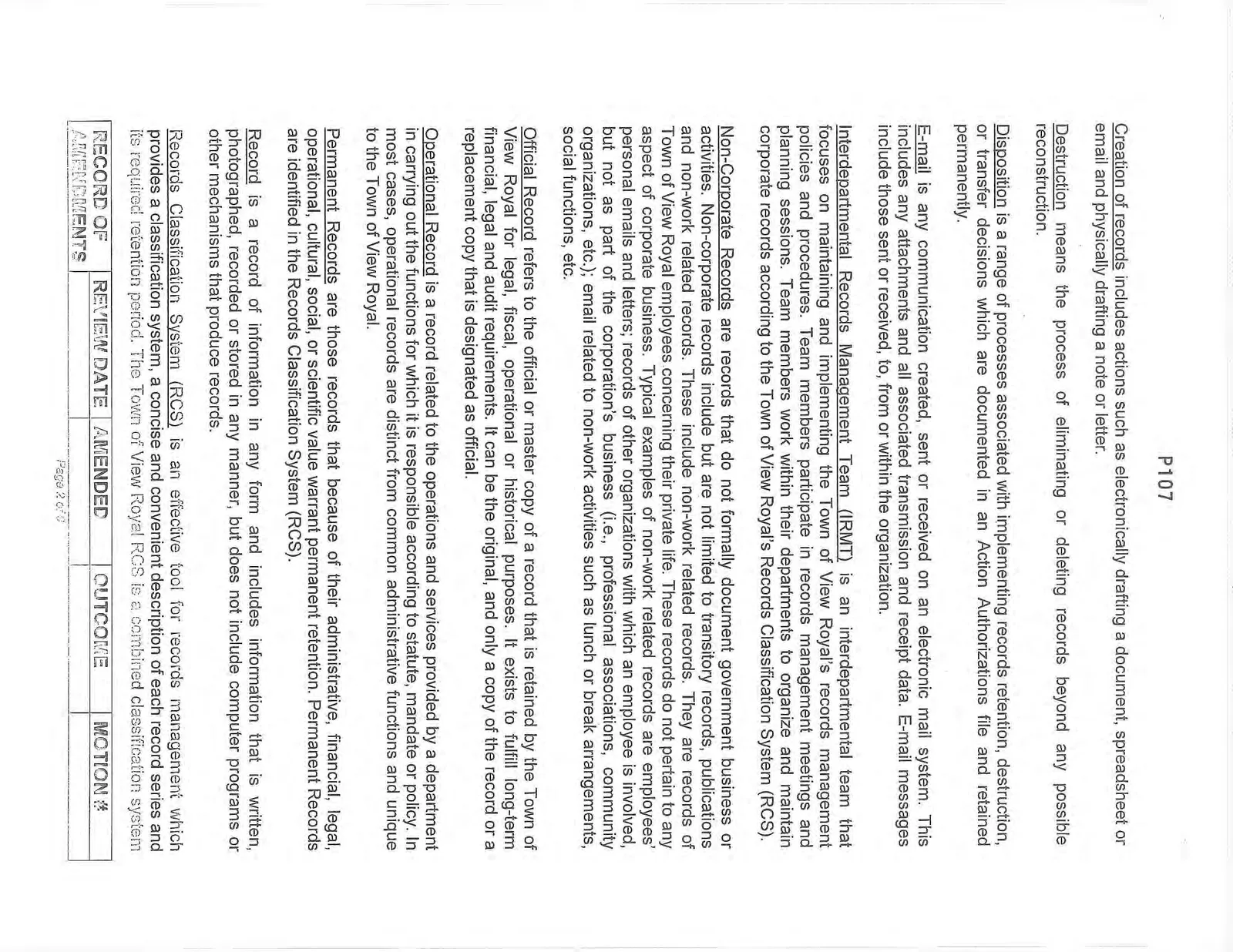
Creation of records includes actions such as electronically drafting a document, spreadsheet or email and physically drafting a note or letter.
Destruction means the process of eliminating or deleting records beyond any possible reconstruction.
Disposition is a range of processes associated with implementing records retention, destruction, or transfer decisions which are documented in an Action Authorizations file and retained permanently.
E-mail is any communication created, sent or received on an electronic mail system. This includes any attachments and all associated transmission and receipt data. E-mail messages include those sent or received, to, from or within the organization.
Interdepartmental Records Management Team (IRMT) is an interdepartmental team that focuses on maintaining and implementing the Town of View Royal's records management policies and procedures. Team members participate in records management meetings and planning sessions. Team members work within their departments to organize and maintain corporate records according to the Town of View Royal's Records Classification System (RCS).
Non-Corporate Records are records that do not formally document government business or activities. Non-corporate records include but are not limited to transitory records, publications and non-work related records. These include non-work related records. They are records of Town of View Royal employees concerning their private life. These records do not pertain to any aspect of corporate business. Typical examples of non-work related records are employees' personal emails and letters; records of other organizations with which an employee is involved, but not as part of the corporation's business (i.e., professional associations, community organizations, etc.); email related to non-work activities such as lunch or break arrangements, social functions, etc.
Official Record refers to the official or master copy of a record that is retained by the Town of View Royal for legal, fiscal, operational or historical purposes. It exists to fulfill long-term financial, legal and audit requirements. It can be the original, and only a copy of the record or a replacement copy that is designated as official.
Operational Record is a record related to the operations and services provided by a department in carrying out the functions for which it is responsible according to statute, mandate or policy. In most cases, operational records are distinct from common administrative functions and unique to the Town of View Royal.
Permanent Records are those records that because of their administrative, financial, legal, operational, cultural, social, or scientific value warrant permanent retention. Permanent Records are identified in the Records Classification System (RCS).
Record is a record of information in any form and includes information that is written, photographed, recorded or stored in any manner, but does not include computer programs or other mechanisms that produce records.
Records Classification System (RCS) is an effective tool for records management which provides a classification system, a concise and convenient description of each record series and its required retention period. The Town of View Royal RCS is a combined classification system
| RECORD OF AMENDMENTS | REVIEW DATE | AMENDED | OUTCOME | MOTION # |
|---|---|---|---|---|
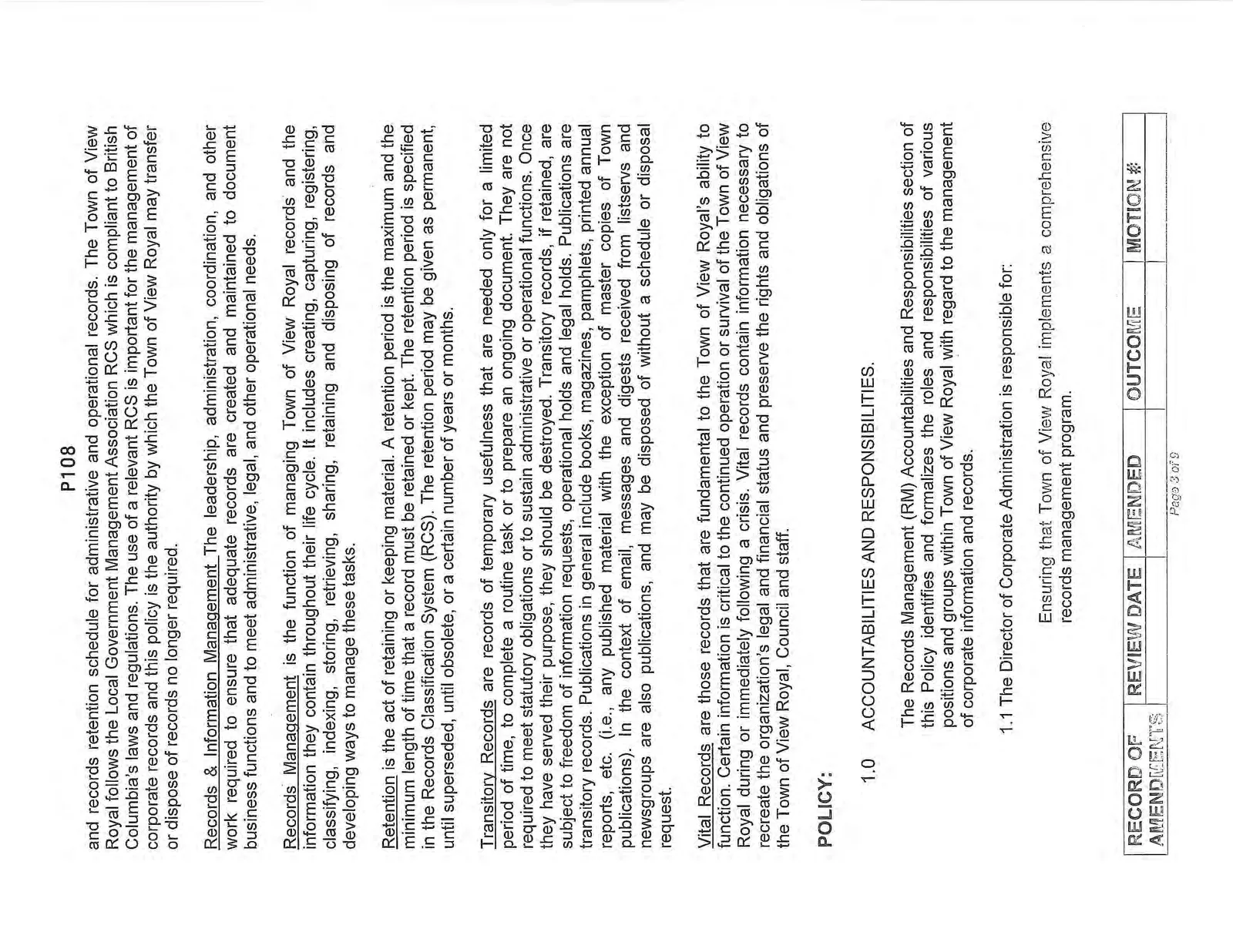
and records retention schedule for administrative and operational records. The Town of View Royal follows the Local Government Management Association RCS which is compliant to British Columbia's laws and regulations. The use of a relevant RCS is important for the management of corporate records and this policy is the authority by which the Town of View Royal may transfer or dispose of records no longer required.
Records & Information Management The leadership, administration, coordination, and other work required to ensure that adequate records are created and maintained to document business functions and to meet administrative, legal, and other operational needs.
Records Management is the function of managing Town of View Royal records and the information they contain throughout their life cycle. It includes creating, capturing, registering, classifying, indexing, storing, retrieving, sharing, retaining and disposing of records and developing ways to manage these tasks.
Retention is the act of retaining or keeping material. A retention period is the maximum and the minimum length of time that a record must be retained or kept. The retention period is specified in the Records Classification System (RCS). The retention period may be given as permanent, until superseded, until obsolete, or a certain number of years or months.
Transitory Records are records of temporary usefulness that are needed only for a limited period of time, to complete a routine task or to prepare an ongoing document. They are not required to meet statutory obligations or to sustain administrative or operational functions. Once they have served their purpose, they should be destroyed. Transitory records, if retained, are subject to freedom of information requests, operational holds and legal holds. Publications in general include books, magazines, pamphlets, printed annual reports, etc. (i.e., any published material with the exception of master copies of Town publications). In the context of email, messages and digests received from listservs and newsgroups are also publications, and may be disposed of without a schedule or disposal request.
Vital Records are those records that are fundamental to the Town of View Royal's ability to function. Certain information is critical to the continued operation or survival of the Town of View Royal during or immediately following a crisis. Vital records contain information necessary to recreate the organization's legal and financial status and preserve the rights and obligations of the Town of View Royal, Council and staff.
POLICY:
1.0 ACCOUNTABILITIES AND RESPONSIBILITIES.
The Records Management (RM) Accountabilities and Responsibilities section of this Policy identifies and formalizes the roles and responsibilities of various positions and groups within Town of View Royal with regard to the management of corporate information and records.
1.1 The Director of Corporate Administration is responsible for:
Ensuring that Town of View Royal implements a comprehensive records management program.
| RECORD OF AMENDMENTS | REVIEW DATE | AMENDED | OUTCOME | MOTION # |
|---|---|---|---|---|
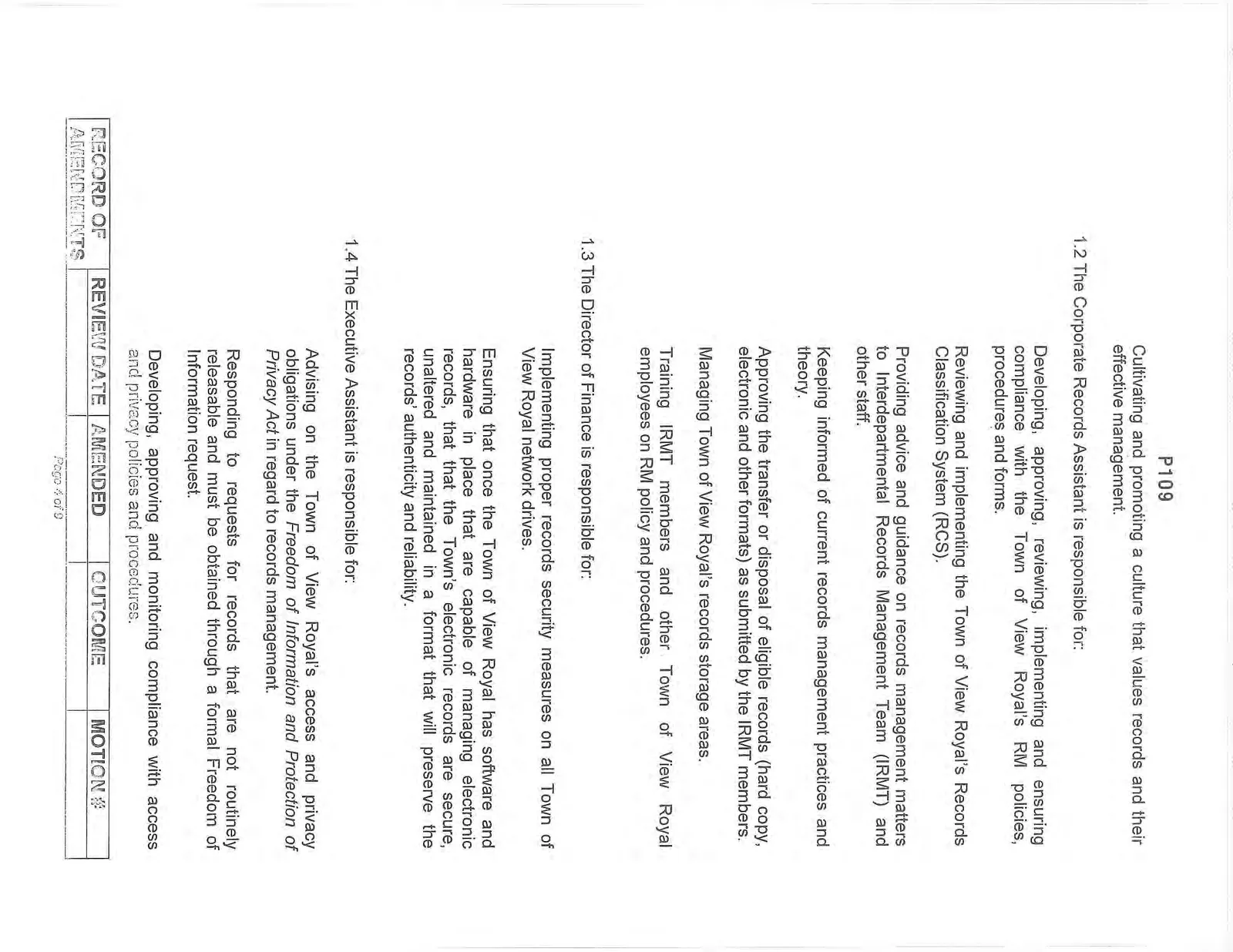
Cultivating and promoting a culture that values records and their effective management.
1.2 The Corporate Records Assistant is responsible for:
- Developing, approving, reviewing, implementing and ensuring compliance with the Town of View Royal's RM policies, procedures and forms.
- Reviewing and implementing the Town of View Royal's Records Classification System (RCS).
- Providing advice and guidance on records management matters to Interdepartmental Records Management Team (IRMT) and other staff.
- Keeping informed of current records management practices and theory.
- Approving the transfer or disposal of eligible records (hard copy, electronic and other formats) as submitted by the IRMT members.
- Managing Town of View Royal's records storage areas.
- Training IRMT members and other Town of View Royal employees on RM policy and procedures.
1.3 The Director of Finance is responsible for:
- Implementing proper records security measures on all Town of View Royal network drives.
- Ensuring that once the Town of View Royal has software and hardware in place that are capable of managing electronic records, that that the Town's electronic records are secure, unaltered and maintained in a format that will preserve the records' authenticity and reliability.
1.4 The Executive Assistant is responsible for:
- Advising on the Town of View Royal's access and privacy obligations under the Freedom of Information and Protection of Privacy Act in regard to records management.
- Responding to requests for records that are not routinely releasable and must be obtained through a formal Freedom of Information request.
- Developing, approving and monitoring compliance with access and privacy policies and procedures.
| RECORD OF AMENDMENTS | REVIEW DATE | AMENDED | OUTCOME | MOTION # |
|---|---|---|---|---|
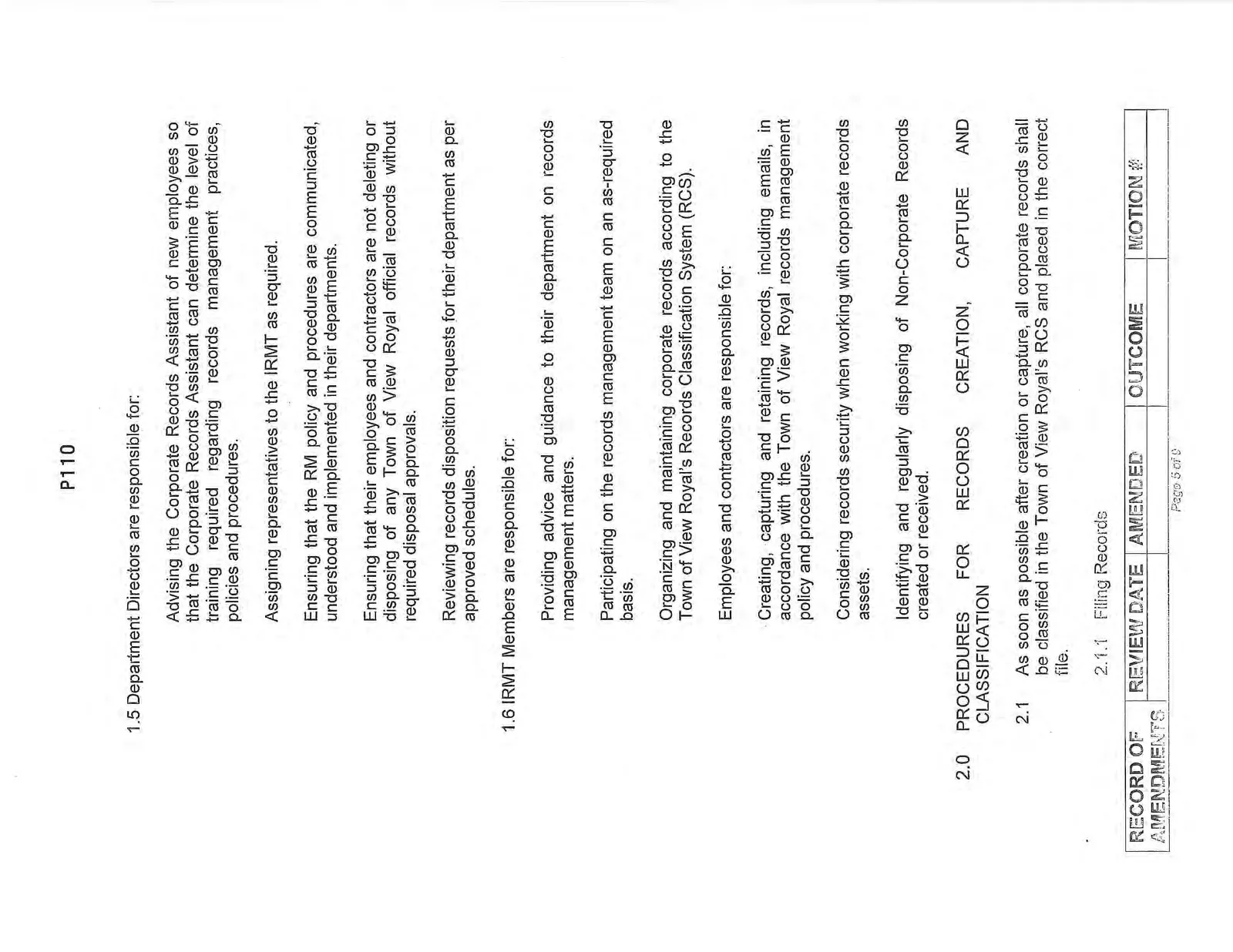
1.5 Department Directors are responsible for:
- Advising the Corporate Records Assistant of new employees so that the Corporate Records Assistant can determine the level of training required regarding records management practices, policies and procedures.
- Assigning representatives to the IRMT as required.
- Ensuring that the RM policy and procedures are communicated, understood and implemented in their departments.
- Ensuring that their employees and contractors are not deleting or disposing of any Town of View Royal official records without required disposal approvals.
- Reviewing records disposition requests for their department as per approved schedules.
1.6 IRMT Members are responsible for:
- Providing advice and guidance to their department on records management matters.
- Participating on the records management team on an as-required basis.
- Organizing and maintaining corporate records according to the Town of View Royal's Records Classification System (RCS).
Employees and contractors are responsible for:
- Creating, capturing and retaining records, including emails, in accordance with the Town of View Royal records management policy and procedures.
- Considering records security when working with corporate records assets.
- Identifying and regularly disposing of Non-Corporate Records created or received.
2.0 PROCEDURES FOR RECORDS CREATION, CAPTURE AND CLASSIFICATION
2.1 As soon as possible after creation or capture, all corporate records shall be classified in the Town of View Royal's RCS and placed in the correct file.
2.1.1 Filing Records
| RECORD OF AMENDMENTS | REVIEW DATE | AMENDED | OUTCOME | MOTION # |
|---|---|---|---|---|
For instructions on how to file records, see the Town of View Royal's "Records Management Guidelines for Filing Records".
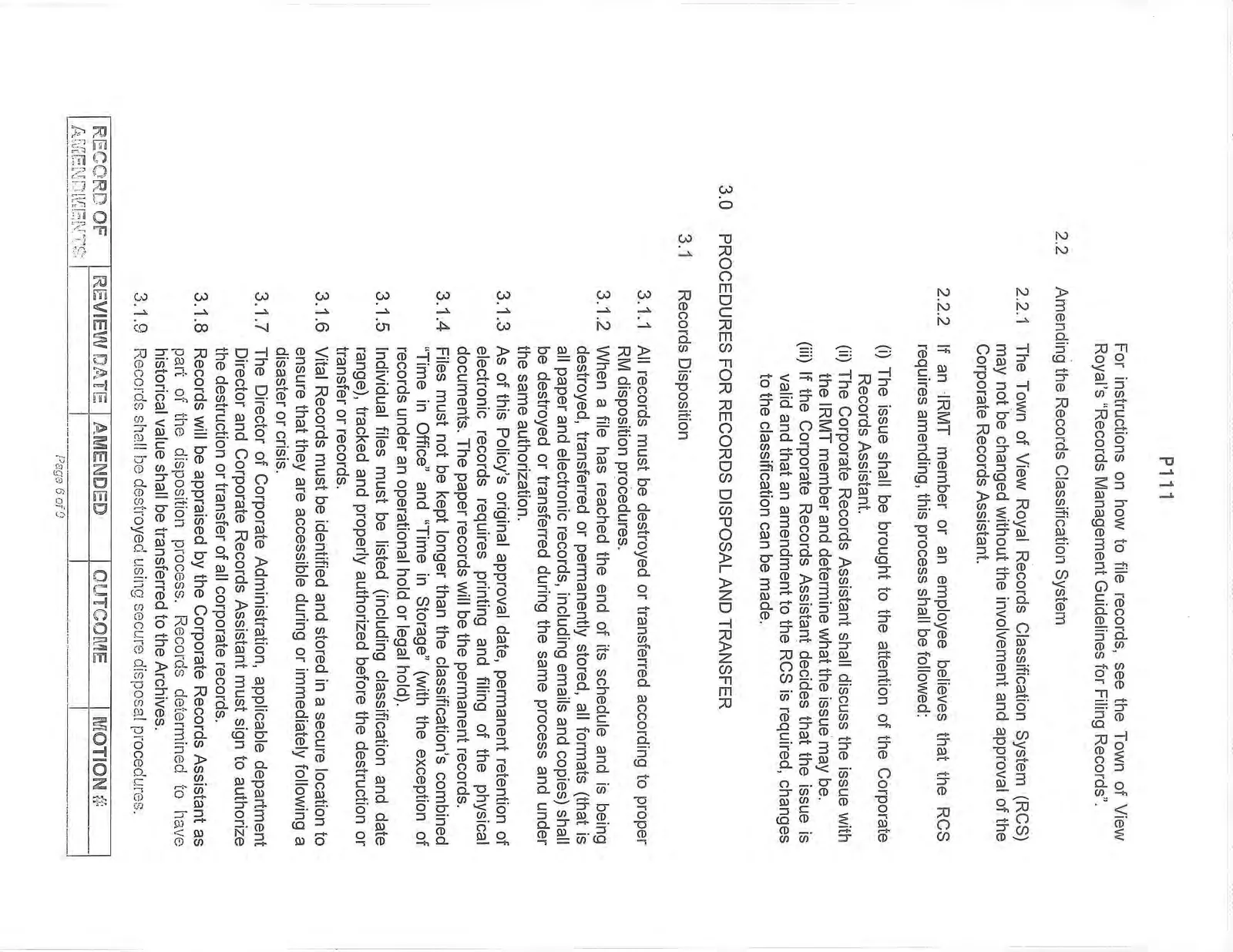
2.2 Amending the Records Classification System
2.2.1 The Town of View Royal Records Classification System (RCS) may not be changed without the involvement and approval of the Corporate Records Assistant.
2.2.2 If an IRMT member or an employee believes that the RCS requires amending, this process shall be followed:
(i) The issue shall be brought to the attention of the Corporate Records Assistant. (ii) The Corporate Records Assistant shall discuss the issue with the IRMT member and determine what the issue may be. (iii) If the Corporate Records Assistant decides that the issue is valid and that an amendment to the RCS is required, changes to the classification can be made.
3.0 PROCEDURES FOR RECORDS DISPOSAL AND TRANSFER
3.1 Records Disposition
3.1.1 All records must be destroyed or transferred according to proper RM disposition procedures. 3.1.2 When a file has reached the end of its schedule and is being destroyed, transferred or permanently stored, all formats (that is all paper and electronic records, including emails and copies) shall be destroyed or transferred during the same process and under the same authorization. 3.1.3 As of this Policy's original approval date, permanent retention of electronic records requires printing and filing of the physical documents. The paper records will be the permanent records. 3.1.4 Files must not be kept longer than the classification's combined "Time in Office" and "Time in Storage" (with the exception of records under an operational hold or legal hold). 3.1.5 Individual files must be listed (including classification and date range), tracked and properly authorized before the destruction or transfer or records. 3.1.6 Vital Records must be identified and stored in a secure location to ensure that they are accessible during or immediately following a disaster or crisis. 3.1.7 The Director of Corporate Administration, applicable department Director and Corporate Records Assistant must sign to authorize the destruction or transfer of all corporate records. 3.1.8 Records will be appraised by the Corporate Records Assistant as part of the disposition process. Records determined to have historical value shall be transferred to the Archives. 3.1.9 Records shall be destroyed using secure disposal procedures.
| RECORD OF AMENDMENTS | REVIEW DATE | AMENDED | OUTCOME | MOTION # |
|---|---|---|---|---|
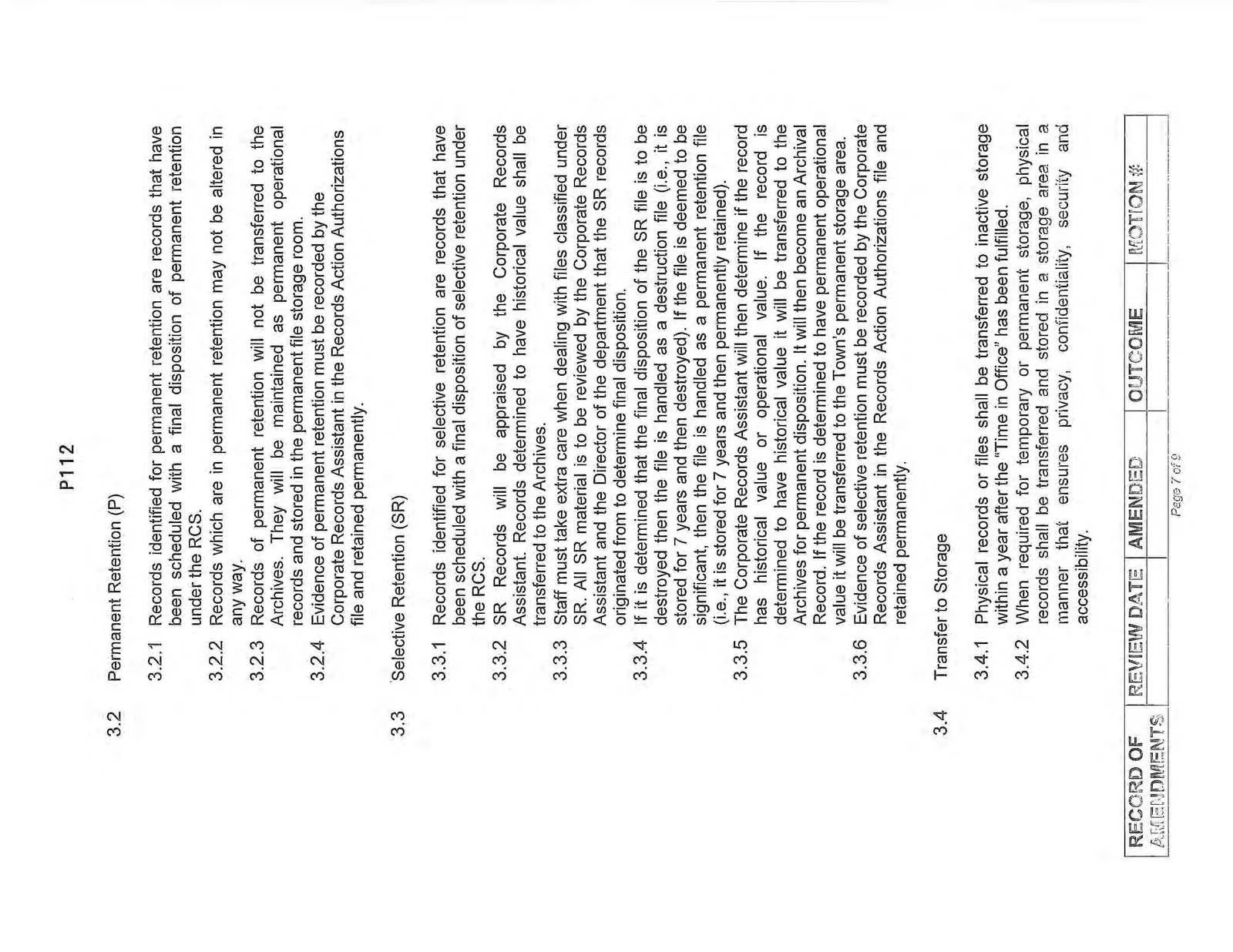
3.2 Permanent Retention (P)
3.2.1 Records identified for permanent retention are records that have been scheduled with a final disposition of permanent retention under the RCS. 3.2.2 Records which are in permanent retention may not be altered in any way. 3.2.3 Records of permanent retention will not be transferred to the Archives. They will be maintained as permanent operational records and stored in the permanent file storage room. 3.2.4 Evidence of permanent retention must be recorded by the Corporate Records Assistant in the Records Action Authorizations file and retained permanently.
3.3 Selective Retention (SR)
3.3.1 Records identified for selective retention are records that have been scheduled with a final disposition of selective retention under the RCS. 3.3.2 SR Records will be appraised by the Corporate Records Assistant. Records determined to have historical value shall be transferred to the Archives. 3.3.3 Staff must take extra care when dealing with files classified under SR. All SR material is to be reviewed by the Corporate Records Assistant and the Director of the department that the SR records originated from to determine final disposition. 3.3.4 If it is determined that the final disposition of the SR file is to be destroyed then the file is handled as a destruction file (i.e., it is stored for 7 years and then destroyed). If the file is deemed to be significant, then the file is handled as a permanent retention file (i.e., it is stored for 7 years and then permanently retained). 3.3.5 The Corporate Records Assistant will then determine if the record has historical value or operational value. If the record is determined to have historical value it will be transferred to the Archives for permanent disposition. It will then become an Archival Record. If the record is determined to have permanent operational value it will be transferred to the Town's permanent storage area. 3.3.6 Evidence of selective retention must be recorded by the Corporate Records Assistant in the Records Action Authorizations file and retained permanently.
3.4 Transfer to Storage
3.4.1 Physical records or files shall be transferred to inactive storage within a year after the "Time in Office" has been fulfilled. 3.4.2 When required for temporary or permanent storage, physical records shall be transferred and stored in a storage area in a manner that ensures privacy, confidentiality, security and accessibility.
| RECORD OF AMENDMENTS | REVIEW DATE | AMENDED | OUTCOME | MOTION # |
|---|---|---|---|---|
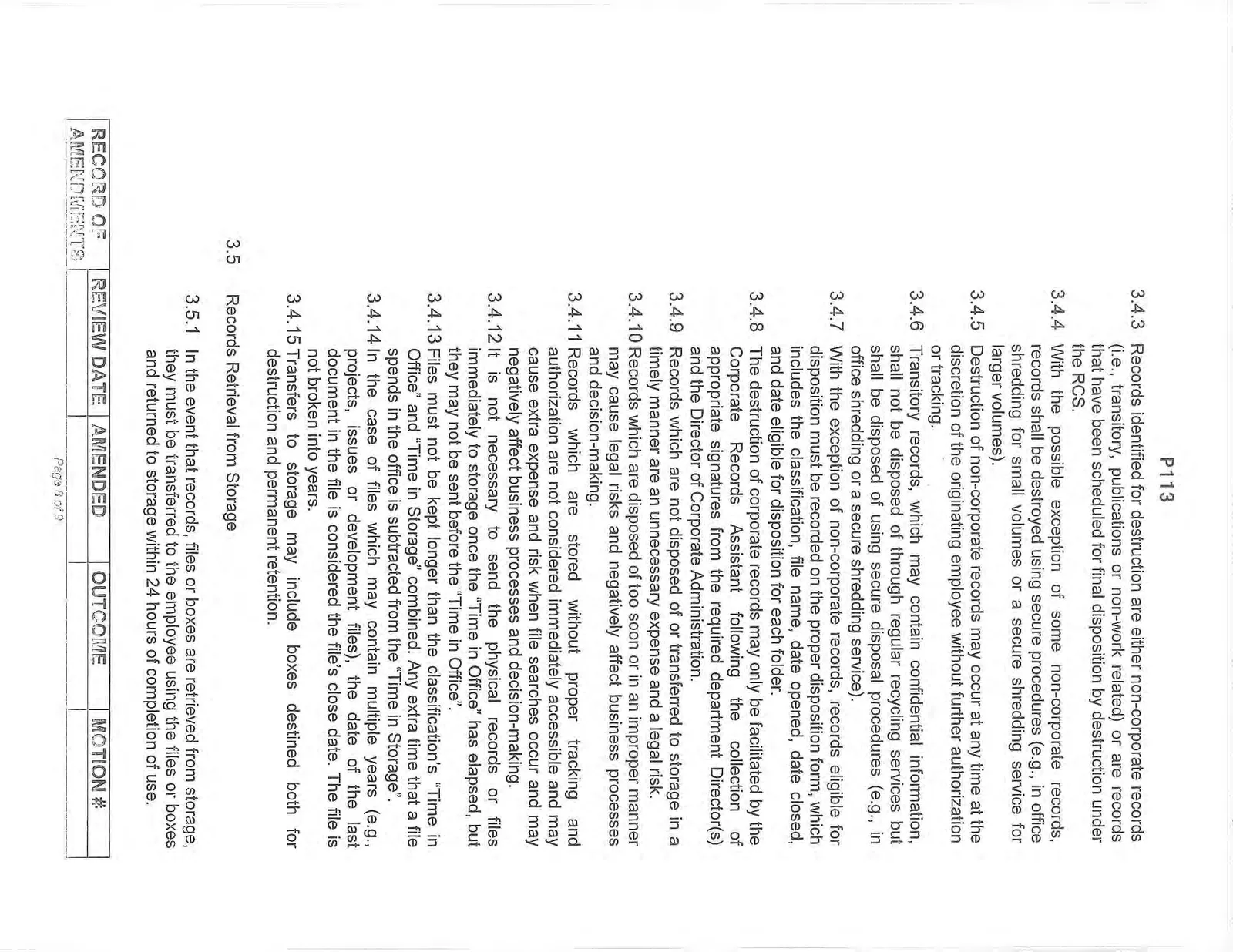
3.4.3 Records identified for destruction are either non-corporate records (i.e., transitory, publications or non-work related) or are records that have been scheduled for final disposition by destruction under the RCS. 3.4.4 With the possible exception of some non-corporate records, records shall be destroyed using secure procedures (e.g., in office shredding for small volumes or a secure shredding service for larger volumes). 3.4.5 Destruction of non-corporate records may occur at any time at the discretion of the originating employee without further authorization or tracking. 3.4.6 Transitory records, which may contain confidential information, shall not be disposed of through regular recycling services but shall be disposed of using secure disposal procedures (e.g., in office shredding or a secure shredding service). 3.4.7 With the exception of non-corporate records, records eligible for disposition must be recorded on the proper disposition form, which includes the classification, file name, date opened, date closed, and date eligible for disposition for each folder. 3.4.8 The destruction of corporate records may only be facilitated by the Corporate Records Assistant following the collection of appropriate signatures from the required department Director(s) and the Director of Corporate Administration. 3.4.9 Records which are not disposed of or transferred to storage in a timely manner are an unnecessary expense and a legal risk. 3.4.10 Records which are disposed of too soon or in an improper manner may cause legal risks and negatively affect business processes and decision-making. 3.4.11 Records which are stored without proper tracking and authorization are not considered immediately accessible and may cause extra expense and risk when file searches occur and may negatively affect business processes and decision-making. 3.4.12 It is not necessary to send the physical records or files immediately to storage once the "Time in Office" has elapsed, but they may not be sent before the "Time in Office". 3.4.13 Files must not be kept longer than the classification's "Time in Office" and "Time in Storage" combined. Any extra time that a file spends in the office is subtracted from the "Time in Storage". 3.4.14 In the case of files which may contain multiple years (e.g., projects, issues or development files), the date of the last document in the file is considered the file's close date. The file is not broken into years. 3.4.15 Transfers to storage may include boxes destined both for destruction and permanent retention.
3.5 Records Retrieval from Storage
3.5.1 In the event that records, files or boxes are retrieved from storage, they must be transferred to the employee using the files or boxes and returned to storage within 24 hours of completion of use.
| RECORD OF AMENDMENTS | REVIEW DATE | AMENDED | OUTCOME | MOTION # |
|---|---|---|---|---|
ATTACHMENTS:
The Town of View Royal Records Classification System (RCS)
DISTRIBUTION:
| RECORD OF AMENDMENTS | REVIEW DATE | AMENDED | OUTCOME | MOTION # |
|---|---|---|---|---|
Document Images
(9)