VFCYJ Chair's Report
Report from the Chair summarizing the year's advocacy work on human trafficking, youth housing, and mental health.
Chair's Report
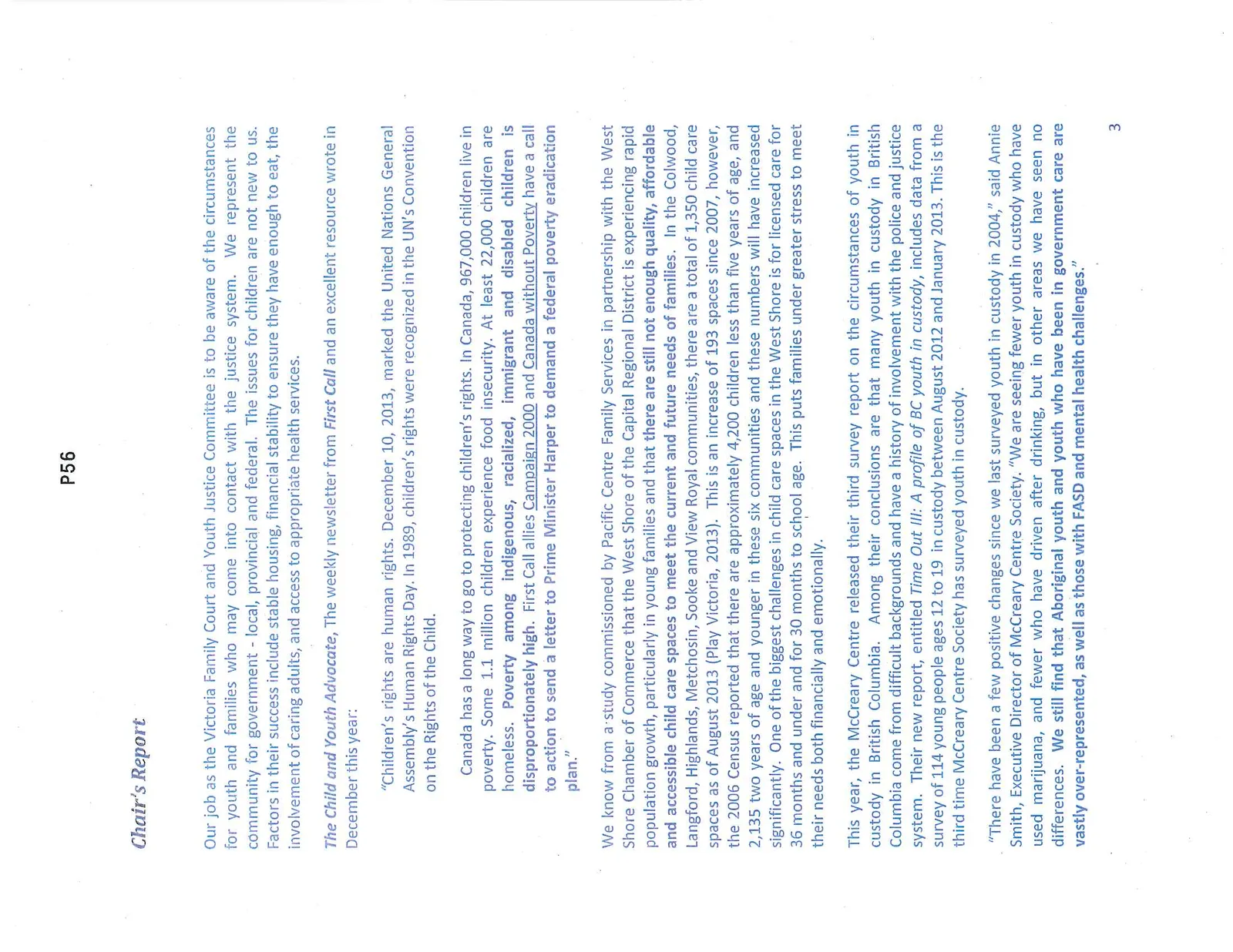
Our job as the Victoria Family Court and Youth Justice Committee is to be aware of the circumstances for youth and families who may come into contact with the justice system. We represent the community for government - local, provincial and federal. The issues for children are not new to us. Factors in their success include stable housing, financial stability to ensure they have enough to eat, the involvement of caring adults, and access to appropriate health services.
The Child and Youth Advocate, The weekly newsletter from First Call and an excellent resource wrote in December this year:
“Children’s rights are human rights. December 10, 2013, marked the United Nations General Assembly’s Human Rights Day. In 1989, children’s rights were recognized in the UN’s Convention on the Rights of the Child.
Canada has a long way to go to protecting children’s rights. In Canada, 967,000 children live in poverty. Some 1.1 million children experience food insecurity. At least 22,000 children are homeless. Poverty among indigenous, racialized, immigrant and disabled children is disproportionately high. First Call allies Campaign 2000 and Canada without Poverty have a call to action to send a letter to Prime Minister Harper to demand a federal poverty eradication plan.”
We know from a study commissioned by Pacific Centre Family Services in partnership with the West Shore Chamber of Commerce that the West Shore of the Capital Regional District is experiencing rapid population growth, particularly in young families and that there are still not enough quality, affordable and accessible child care spaces to meet the current and future needs of families. In the Colwood, Langford, Highlands, Metchosin, Sooke and View Royal communities, there are a total of 1,350 child care spaces as of August 2013 (Play Victoria, 2013). This is an increase of 193 spaces since 2007, however, the 2006 Census reported that there are approximately 4,200 children less than five years of age, and 2,135 two years of age and younger in these six communities and these numbers will have increased significantly. One of the biggest challenges in child care spaces in the West Shore is for licensed care for 36 months and under and for 30 months to school age. This puts families under greater stress to meet their needs both financially and emotionally.
This year, the McCreary Centre released their third survey report on the circumstances of youth in custody in British Columbia. Among their conclusions are that many youth in custody in British Columbia come from difficult backgrounds and have a history of involvement with the police and justice system. Their new report, entitled Time Out III: A profile of BC youth in custody, includes data from a survey of 114 young people ages 12 to 19 in custody between August 2012 and January 2013. This is the third time McCreary Centre Society has surveyed youth in custody.
“There have been a few positive changes since we last surveyed youth in custody in 2004,” said Annie Smith, Executive Director of McCreary Centre Society. “We are seeing fewer youth in custody who have used marijuana, and fewer who have driven after drinking, but in other areas we have seen no differences. We still find that Aboriginal youth and youth who have been in government care are vastly over-represented, as well as those with FASD and mental health challenges.”
Victoria Family Court and Youth Justice Committee
The Victoria Family Court and Youth Justice Committee heard from CASA and their Student volunteer who attended court to observe our justice system in action with youth and families. They found that there was little time for parents or children to understand what was happening. Court time, a precious resource, continues to be wasted with numerous continuances and failures to appear, placing greater pressure on these costly resources to produce results. At times they reported it seemed like a big machine, where children and parents had little chance to affect its operations. Out of the 180 cases observed at Family Court, only 56 had parents present (30% of total cases) and only 4 cases had children present. The large proportions of aboriginal youth were noted, as were transportation problems that may explain some of the lack of parent participation. The fact that there is a criminal native court worker but no worker for family matters is problematic.
We heard from the Aboriginal Criminal Court Worker, who serves our communities from Port Renfrew to Duncan, relying on contacts at court and within the aboriginal community to alert him to cases that might benefit from his assistance.
First Call also reported that: ‘On December 16th, the BC Supreme Court ruled that the provincial government’s decision to end a mother-baby program at the Alouette Correctional Centre for Women in Maple Ridge was unconstitutional. The decision is “a victory for highly vulnerable women and their children,” said Kasari Govender, executive director of West Coast Women’s Legal Education and Action Fund, a First Call coalition partner.’
In 2012 the Victoria Family Court and Youth Justice Committee expressed great concern that the Ministry of Children and Family Development Youth Justice shut down the Girls Units in the Victoria Youth Custody Centre and sent all girls in custody in BC to the Burnaby Youth Custody Centre where contact with family would be limited if not prevented entirely.
First Call reports that MCFD Youth Justice has now developed the Visitation Financial Support Program to assist girls in custody with family visits. The funding will cover travel costs such as hotel, transportation and meals for out-of-town family. Families that may have girls in custody at Burnaby Youth Custody are encouraged to apply by calling the case management department at Burnaby Youth Custody Services at 778-452-2050. If the families are denied, please make note of this and encourage the families to:
- Request, in writing, the reason as to why they are being denied
- Request, in writing, the policy/practice standard the decision was/is based on
- Request, in writing, a copy of the Complaints Dispute Resolution and contact person for CDR for this specific area
- Request the name and title of the MCFD Youth Justice staff making the decision
Thanks to our friends at the Northern First Nations Child and Family Service Council for bringing this resource to our attention.
Victoria Family Court and Youth Justice Committee
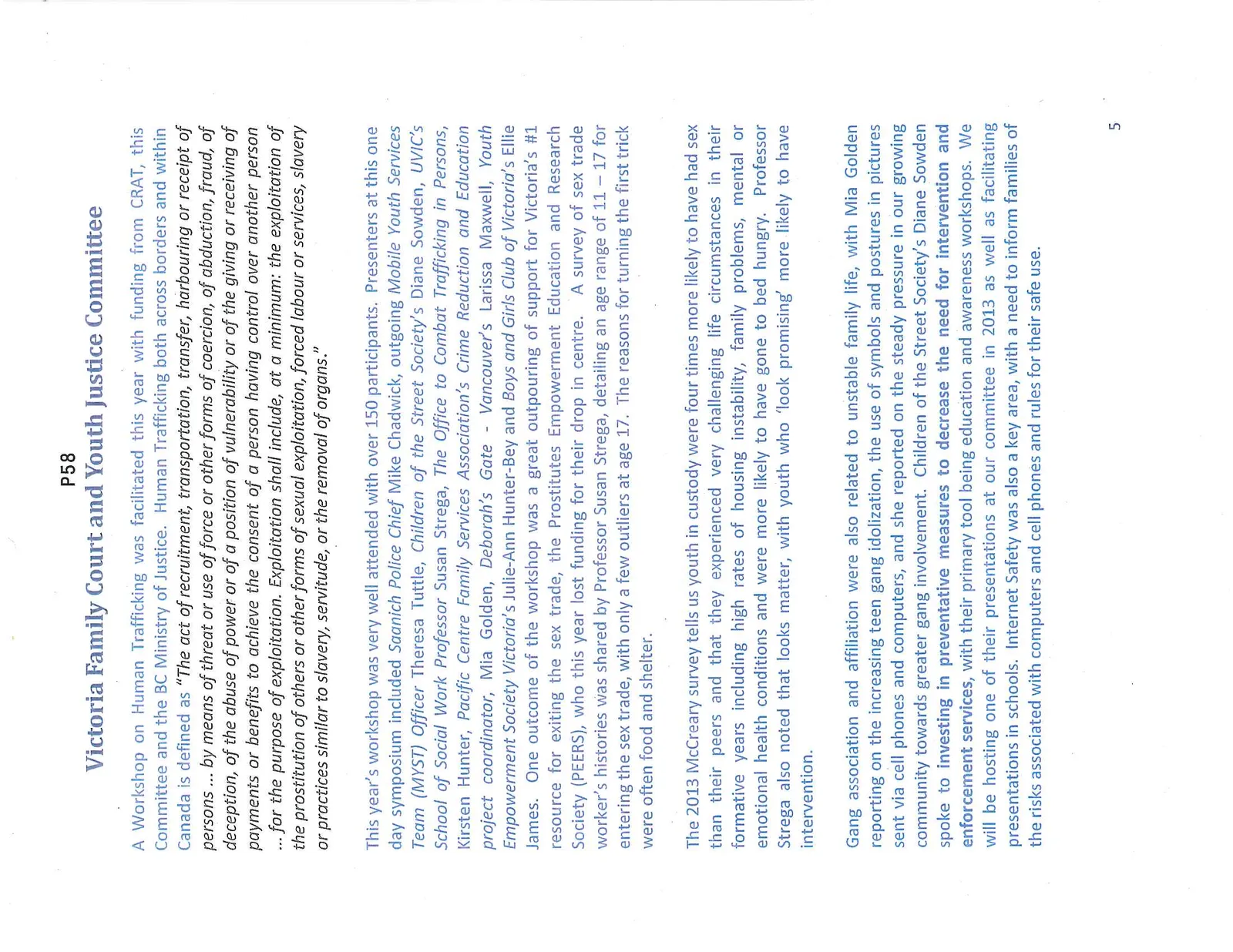
A Workshop on Human Trafficking was facilitated this year with funding from CRAT, this Committee and the BC Ministry of Justice. Human Trafficking both across borders and within Canada is defined as “The act of recruitment, transportation, transfer, harbouring or receipt of persons ... by means of threat or use of force or other forms of coercion, of abduction, fraud, of deception, of the abuse of power or of a position of vulnerability or of the giving or receiving of payments or benefits to achieve the consent of a person having control over another person ... for the purpose of exploitation. Exploitation shall include, at a minimum: the exploitation of the prostitution of others or other forms of sexual exploitation, forced labour or services, slavery or practices similar to slavery, servitude, or the removal of organs.”
This year’s workshop was very well attended with over 150 participants. Presenters at this one day symposium included Saanich Police Chief Mike Chadwick, outgoing Mobile Youth Services Team (MYST) Officer Theresa Tuttle, Children of the Street Society’s Diane Sowden, UVIC’s School of Social Work Professor Susan Strega, The Office to Combat Trafficking in Persons, Kirsten Hunter, Pacific Centre Family Services Association’s Crime Reduction and Education project coordinator, Mia Golden, Deborah’s Gate - Vancouver’s Larissa Maxwell, Youth Empowerment Society Victoria’s Julie-Ann Hunter-Bey and Boys and Girls Club of Victoria’s Ellie James. One outcome of the workshop was a great outpouring of support for Victoria’s #1 resource for exiting the sex trade, the Prostitutes Empowerment Education and Research Society (PEERS), who this year lost funding for their drop in centre. A survey of sex trade worker’s histories was shared by Professor Susan Strega, detailing an age range of 11 – 17 for entering the sex trade, with only a few outliers at age 17. The reasons for turning the first trick were often food and shelter.
The 2013 McCreary survey tells us youth in custody were four times more likely to have had sex than their peers and that they experienced very challenging life circumstances in their formative years including high rates of housing instability, family problems, mental or emotional health conditions and were more likely to have gone to bed hungry. Professor Strega also noted that looks matter, with youth who ‘look promising’ more likely to have intervention.
Gang association and affiliation were also related to unstable family life, with Mia Golden reporting on the increasing teen gang idolization, the use of symbols and postures in pictures sent via cell phones and computers, and she reported on the steady pressure in our growing community towards greater gang involvement. Children of the Street Society’s Diane Sowden spoke to investing in preventative measures to decrease the need for intervention and enforcement services, with their primary tool being education and awareness workshops. We will be hosting one of their presentations at our committee in 2013 as well as facilitating presentations in schools. Internet Safety was also a key area, with a need to inform families of the risks associated with computers and cell phones and rules for their safe use.
Victoria Family Court and Youth Justice Committee
This year I wrote to the Premier on behalf of the Family Court and Youth Justice Committee advocating for funding of PEERS drop in centre, our best resource to help youth exit the sex trace and a model which was followed to create similar programs in other jurisdictions and funded by the province for Vancouver.
Mary Ellen Turpel Lafonde, BC’s Children’s Advocate released “When Talk Trumped Service: A Decade of Lost Opportunity for Aboriginal Children and Youth in B.C.” in November. An admittedly difficult and controversial report that criticized MCFD and First Nations saying that attempts to create new systems were overly costly and that “paying for these initiatives increasingly came out of direct service lines of MCFD operations so that all children and youth, including Aboriginal children and youth, who receive actual services paid the price and continue to do so”.
We have also seen from this year’s Vital Signs Report produced by the Victoria Foundation, that our youth are concerned about employment and training, with unemployment rates for youth 15 – 24 at 10.9%, below the national 14.3% and provincial 13.2%. In regard to their finances, 35.3% of youth reported moderate stress and 22.1% had high stress about finances, together representing more than half of youth surveyed having moderate to high concern about finances.
Youth Housing and Homelessness received a C+ in the Vital Signs 2013 Report, noting there are 26 subsidized long term transitional housing units in Greater Victoria for youth at risk of becoming homeless.
This has been a focus for advocacy for additional units particularly in the West Shore region, with youth joining CRAT’s Youth Housing Task Force in advocating for more youth housing. Threshold Youth Housing Society has completed a 5 year strategic plan, which will see them providing 50 beds for youth by 2018, and they have indicated that their next priority area for youth housing will be the West Shore. It remains a concern of the committee that there are insufficient resources for youth who may find themselves kicked out of their family home, leaving them vulnerable - couch surfing or living on the street.
A key area of interest for this committee remains Youth Mental Health. You will find several articles that were published in the local newspapers this year on this important area included as my report for 2013. While we wait for the province to consider itself financially stable enough to invest in this important intervention area, we have continued to gather evidence of the need for service. We have set aside $10,000 to assist in a pilot project and hope that we will be able to partner with other agencies in its development and an evaluation of one model’s effectiveness in order to inform the provision of services province wide. It is our hope that we can develop a model for service delivery in a school setting as envisioned by Dr. Basil Boulton, pediatrician and past chair of this task force.
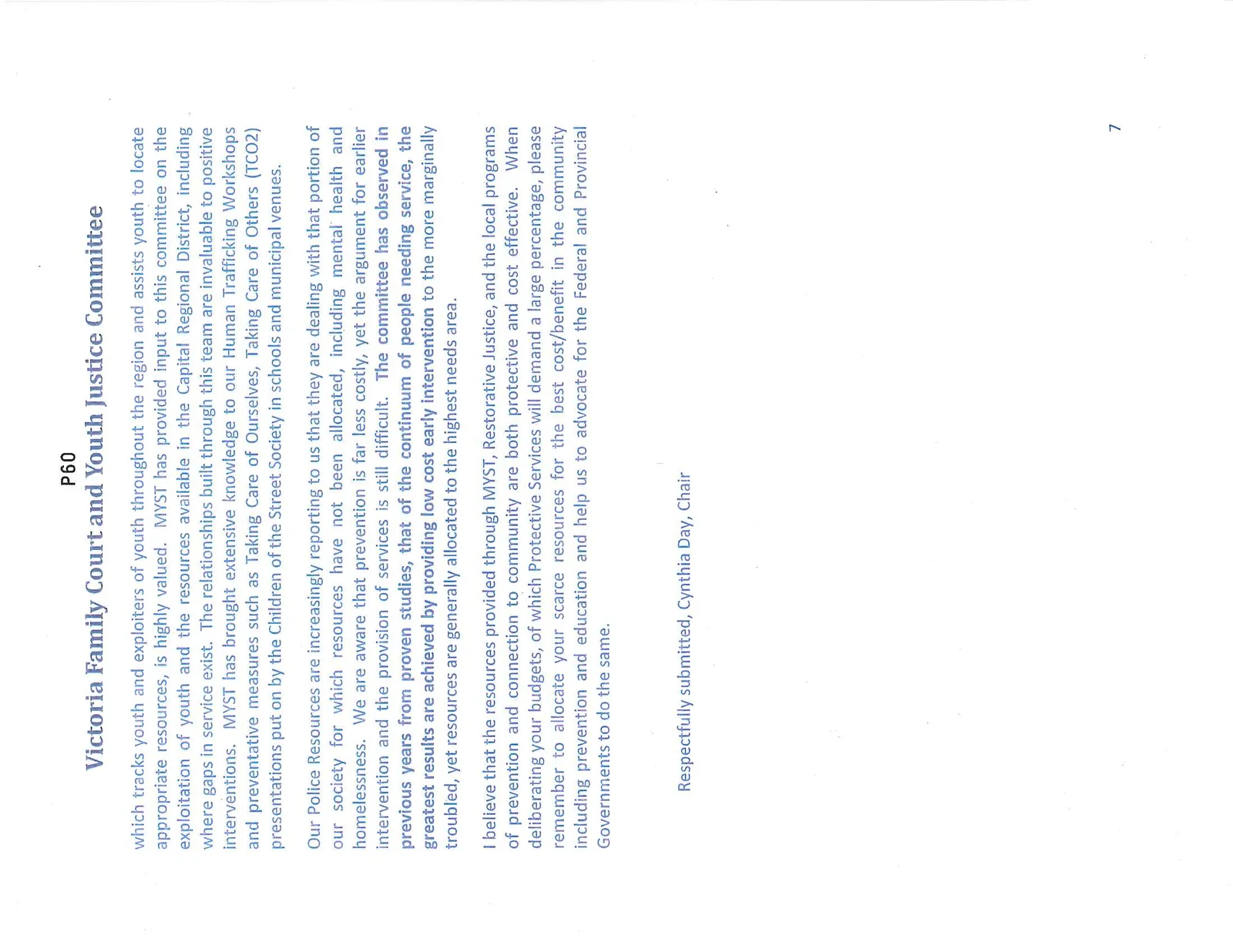
We also heard of the possible reorganization of the Mobile Youth Services Team this year. The committee has expressed support for more resources in this area. This regional police service, which tracks youth and exploiters of youth throughout the region and assists youth to locate appropriate resources, is highly valued. MYST has provided input to this committee on the exploitation of youth and the resources available in the Capital Regional District, including where gaps in service exist. The relationships built through this team are invaluable to positive interventions. MYST has brought extensive knowledge to our Human Trafficking Workshops and preventative measures such as Taking Care of Ourselves, Taking Care of Others (TCO2) presentations put on by the Children of the Street Society in schools and municipal venues.
Our Police Resources are increasingly reporting to us that they are dealing with that portion of our society for which resources have not been allocated, including mental health and homelessness. We are aware that prevention is far less costly, yet the argument for earlier intervention and the provision of services is still difficult. The committee has observed in previous years from proven studies, that of the continuum of people needing service, the greatest results are achieved by providing low cost early intervention to the more marginally troubled, yet resources are generally allocated to the highest needs area.
I believe that the resources provided through MYST, Restorative Justice, and the local programs of prevention and connection to community are both protective and cost effective. When deliberating your budgets, of which Protective Services will demand a large percentage, please remember to allocate your scarce resources for the best cost/benefit in the community including prevention and education and help us to advocate for the Federal and Provincial Governments to do the same.
Respectfully submitted, Cynthia Day, Chair
Document Images
(5)