Appendix: Youth Mental Health News Articles
Media coverage regarding mental health issues affecting local teenagers.
Mental health issues real for today's youth
By KYLE WELLS May 14, 2013 · Updated 2:43 PM 0 Comments
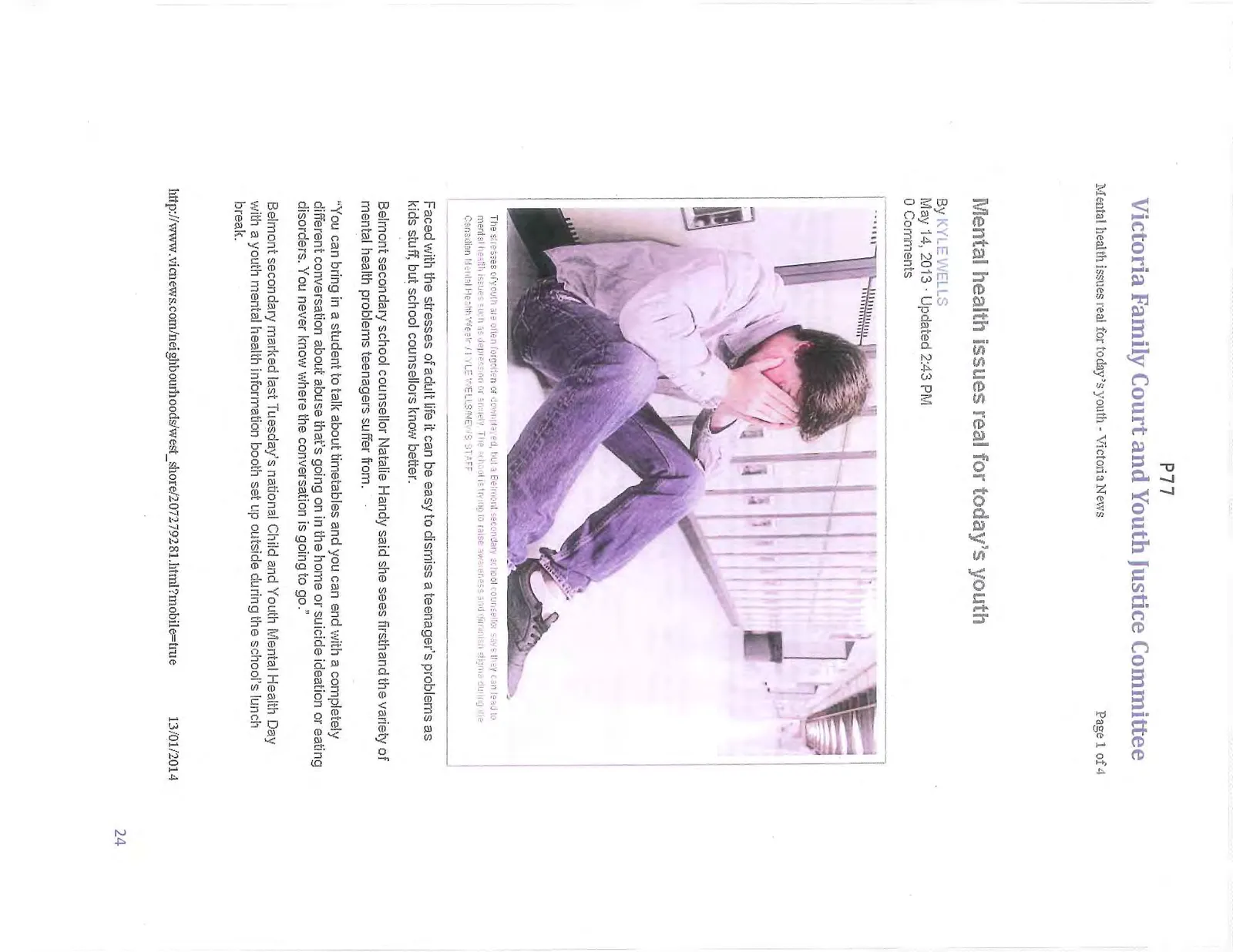
The stresses of youth are often forgotten or downplayed, but a Belmont secondary school counsellor says they can lead to mental health issues such as depression or anxiety. The school is trying to raise awareness and diminish stigma during the Canadian Mental Health Week. KYLE WELLS/NEWS STAFF
Faced with the stresses of adult life it can be easy to dismiss a teenager's problems as kids stuff, but school counsellors know better.
Belmont secondary school counsellor Natalie Handy said she sees firsthand the variety of mental health problems teenagers suffer from.
"You can bring in a student to talk about timetables and you can end with a completely different conversation about abuse that's going on in the home or suicide ideation or eating disorders. You never know where the conversation is going to go."
Belmont secondary marked last Tuesday's national Child and Youth Mental Health Day with a youth mental health information booth set up outside during the school's lunch break.
The lure of free treats and swag brought students over, but once hooked the counsellors were ready with pamphlets and information on resources available to youth who feel as though they might need some help.
The giveaways for students were donated by a number of local businesses.
"We're very aware and clear with kids that we don't want them taking this information away to self-diagnose," Handy said. "But we do want them to have the information to access a lot of resources ... to follow up with us or a family doctor."
The booth proved popular, with a few hundred students showing up to grab a treat and information.
Handy believes we, as a society, don't recognize or talk about how a big a problem mental health issues are for today's youth. Adults don't realize just how much stress young people can be under, said Handy, whether it's related to academics, relationships, home life, peer pressures, societal pressures or all of the above.
The popularization of social media and the frenetic immediacy of modern culture is also taking away from a teen's time to reflect, to process information, which can add to the stress.
"There needs to be time to reflect, there needs to be time to pause and understand what's going on, because it's all happening so fast," Handy said. "You see a lot of anxiety, lots of depression in our youth."
Larger mental health issues, such as schizophrenia and bi-polar disorder, also often first arise during the teenage years. Early detection is key, so the more students know, and the less stigma that surrounds admitting to mental health problems, the higher the likelihood a student will seek help.
"I think as a group we just need to find more ways to reach out to kids and their families."
Help is a call away
n Teens who feel they may need help with anxiety, depression or any other mental health issues are advised to see a school counsellor or family doctor, but initial information can be easily found at the Kids Help Phone (1-800-668-6868) or online at keltymentalhealth.ca or youth.anxietybc.com
"Talk to somebody, pick up the phone and call a help line, or come and talk (to a counsellor). It's about taking that first step, and I know how difficult it is, but it's so important," Handy said.
MICHELLE FORTIN: Mental illness, an ignored problem
By Victoria News Published: June 20, 2013 01:00 PM Updated: June 20, 2013 02:02 PM
Most parents worry when their children begin driving. They warn teens about the risks.
In 2011, despite that care and concern, 291 British Columbians died in car crashes.
That same year, 526 people took their own lives - 80 per cent more than those killed in car crashes.
Road crashes don't come close to taking the toll of mental illness and problem substance use. Why don't we, as a society, urge parents to have serious talks with their children about those risks? Stigma, in part.
No one tells cancer patients to buck up and wish their infirmities away. But people with mental illness routinely face prejudice and a dismissive attitude.
People who have an obvious illness tend to get help. At the least, emergency rooms provide urgent care. Those with a mental illness and substance abuse issues face a tougher reality.
Joshua Beharry wrote about his experiences in a Vancouver newspaper last month. In 2009, at 22, he went to a hospital emergency ward because months of depression had left him increasingly suicidal.
"I spoke to an emergency room doctor and a psychiatric nurse," he wrote. "They asked if I had a plan to kill myself."
"I didn't have a plan so I went home," Beharry recalled.
And a month later, he tried to kill himself. ER staff aren't at fault. They send people away because there are no treatment spaces.
The community social services sector plays a huge role in addressing mental illness and substance abuse.
But every day, we turn people away, or place them on long wait lists. Budget freezes and cuts and a lack of integrated responses have created a crisis.
The cost for it all is enormous. A 2010 study estimated the cost to the economy due to lost work days was $50 billion a year. Add the damage to families, the costs of homelessness and health care and the total rises sharply.
Former senator Michael Kirby, the first chairman of the Mental Health Commission of Canada, noted mental health and substance use represent about 35 per cent of the disease burden in Canada, yet receive about five per cent of the resources.
Mary Ellen Turpel-Lafond, B.C.'s Representative for Children and Youth, noted this year that lack of political leadership has left this province with a fragmented, inadequate system of supports for youth facing mental illness.
A new government has the chance to address these problems, and provide adequate resources and a collaboration strategy linking health and social services sectors.
We should make sure mental health and problem substance use services step out of the shadows.
Michelle Fortin is chairwoman of the B.C. Addiction Specialists and Allied Professionals.
Document Images
(2)