Attachment 9-10: Proposed Play Area and Material Site Plans
Detailed landscape and playground design plans for the outdoor play portion of the daycare facility.
Proposed Materials
Synthetic Turf
Shaping of the area, ensuring drainage, layering and tamping of the various sand and gravel bases, custom undulations for golf greens, turf selection and layout and finally power brushing in our special top dressing sand.
- We use slit mono filament turf
- Most of our turf is non-in filled and doesn't require the traditional infill of sand and rubber crumb.
- Better quality, sports turf can be in filled if the specs require it.
Designed and built using strategies aimed at improving performance across all the metrics that matter most: energy savings, water efficiency², CO2 emissions reduction, improved environmental quality, and stewardship of resources and sensitivity to their impacts.
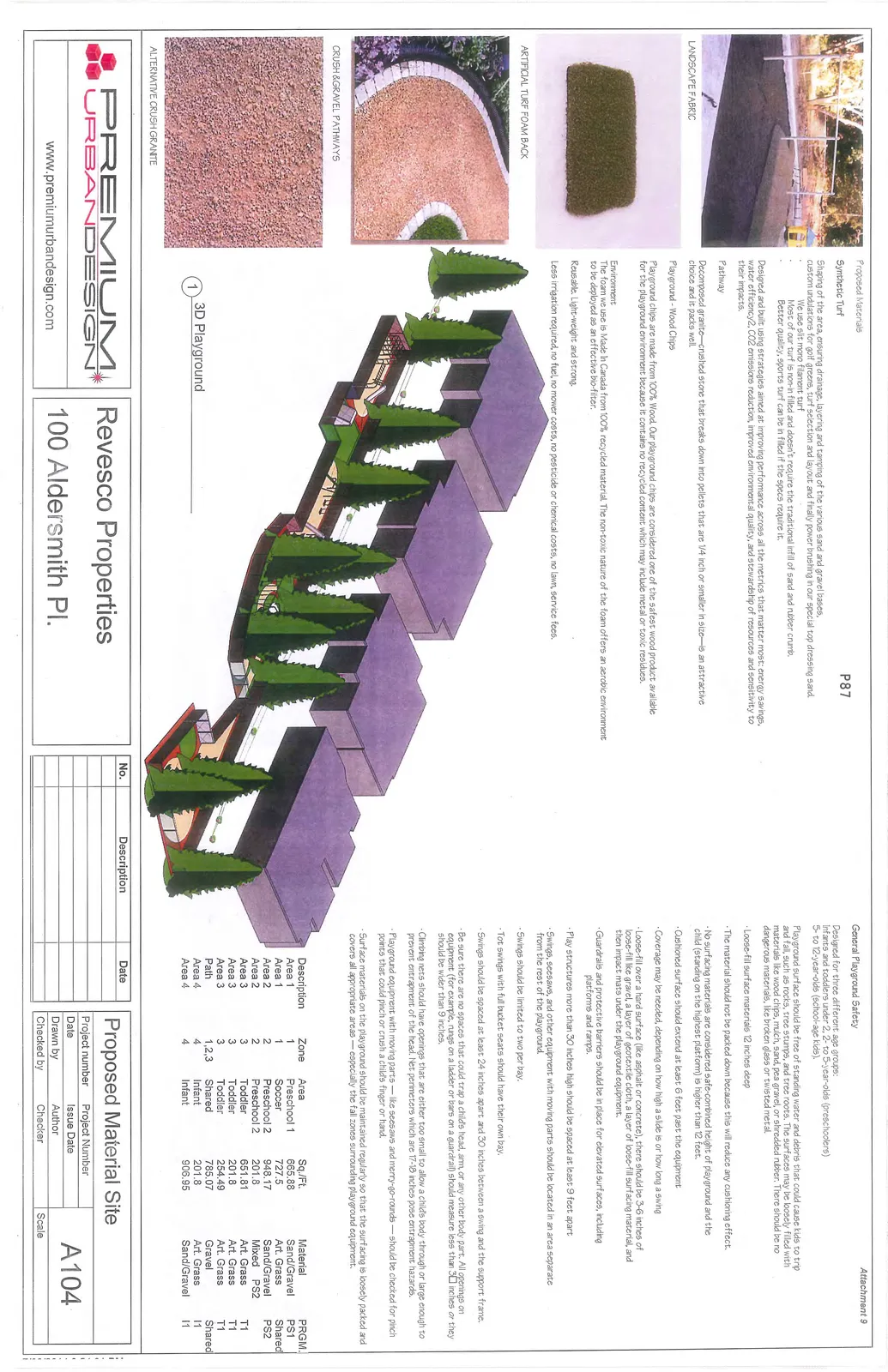
Pathway
Decomposed granite—crushed stone that breaks down into pellets that are 1/4 inch or smaller in size—is an attractive choice and it packs well.
Playground - Wood Chips
Playground chips are made from 100% Wood. Our playground chips are considered one of the safest wood product available for the playground environment because it contains no recycled content which may include metal or toxic residues.
Environment
The foam we use is Made In Canada from 100% recycled material. The non-toxic nature of the foam offers an aerobic environment to be deployed as an effective bio-filter.
Reusable. Light-weight and strong. Less irrigation required, no fuel, no mower costs, no pesticide or chemical costs, no lawn, service fees.
General Playground Safety
Designed for three different age groups: Infants and toddlers under 2; 2- to 5-year-olds (preschoolers) 5- to 12-year-olds (school-age kids).
Playground surface should be free of standing water and debris that could cause kids to trip and fall, such as rocks, tree stumps, and tree roots. The surfaces may be loosely filled with materials like wood chips, mulch, sand, pea gravel, or shredded rubber. There should be no dangerous materials, like broken glass or twisted metal.
- Loose-fill surface materials 12 inches deep
- The material should not be packed down because this will reduce any cushioning effect.
- No surfacing materials are considered safe-combined height of playground and the child (standing on the highest platform) is higher than 12 feet.
- Cushioned surface should extend at least 6 feet past the equipment
- Coverage may be needed, depending on how high a slide is or how long a swing
- Loose-fill over a hard surface (like asphalt or concrete), there should be 3-6 inches of loose-fill like gravel, a layer of geotextile cloth, a layer of loose-fill surfacing material, and then impact mats under the playground equipment.
- Guardrails and protective barriers should be in place for elevated surfaces, including platforms and ramps.
- Play structures more than 30 inches high should be spaced at least 9 feet apart
- Swings, seesaws, and other equipment with moving parts should be located in an area separate from the rest of the playground.
- Swings should be limited to two per bay.
- Tot swings with full bucket seats should have their own bay.
- Swings should be spaced at least 24 inches apart and 30 inches between a swing and the support frame.
- Be sure there are no spaces that could trap a child's head, arm, or any other body part. All openings on equipment (for example, rungs on a ladder or bars on a guardrail) should measure less than 3.5 inches or they should be wider than 9 inches.
- Climbing nets should have openings that are either too small to allow a child's body through or large enough to prevent entrapment of the head. Net perimeters which are 17-18 inches pose entrapment hazards.
- Playground equipment with moving parts — like seesaws and merry-go-rounds — should be checked for pinch points that could pinch or crush a child's finger or hand.
- Surface materials on the playground should be maintained regularly so that the surfacing is loosely packed and covers all appropriate areas — especially the fall zones surrounding playground equipment.
| Description | Zone | Area | Sq./Ft. | Material | PRGM. |
|---|---|---|---|---|---|
| Area 1 | 1 | Preschool 1 | 665.88 | Sand/Gravel | PS1 |
| Area 1 | 1 | Soccer | 727.5 | Art. Grass | Shared |
| Area 2 | 2 | Preschool 2 | 948.17 | Sand/Gravel | PS2 |
| Area 2 | 2 | Preschool 2 | 201.8 | Mixed PS2 | |
| Area 3 | 3 | Toddler | 651.81 | Art. Grass | T1 |
| Area 3 | 3 | Toddler | 201.8 | Art. Grass | T1 |
| Area 3 | 3 | Toddler | 254.49 | Art. Grass | T1 |
| Path | 1,2,3 | Shared | 785.07 | Gravel | Shared |
| Area 4 | 4 | Infant | 201.8 | Art. Grass | I1 |
| Area 4 | 4 | Infant | 908.95 | Sand/Gravel | I1 |
Revesco Properties 100 Aldersmith Pl. Proposed Material Site
Functional Zone Objectives
- Provide Surface Drainage
- Prevent pavement break-up
- Provides better visibility and maintenance
- Blends and Screen adjacent Surroundings
- Clean and removes any dangers trees
- Management of vegetation and trees
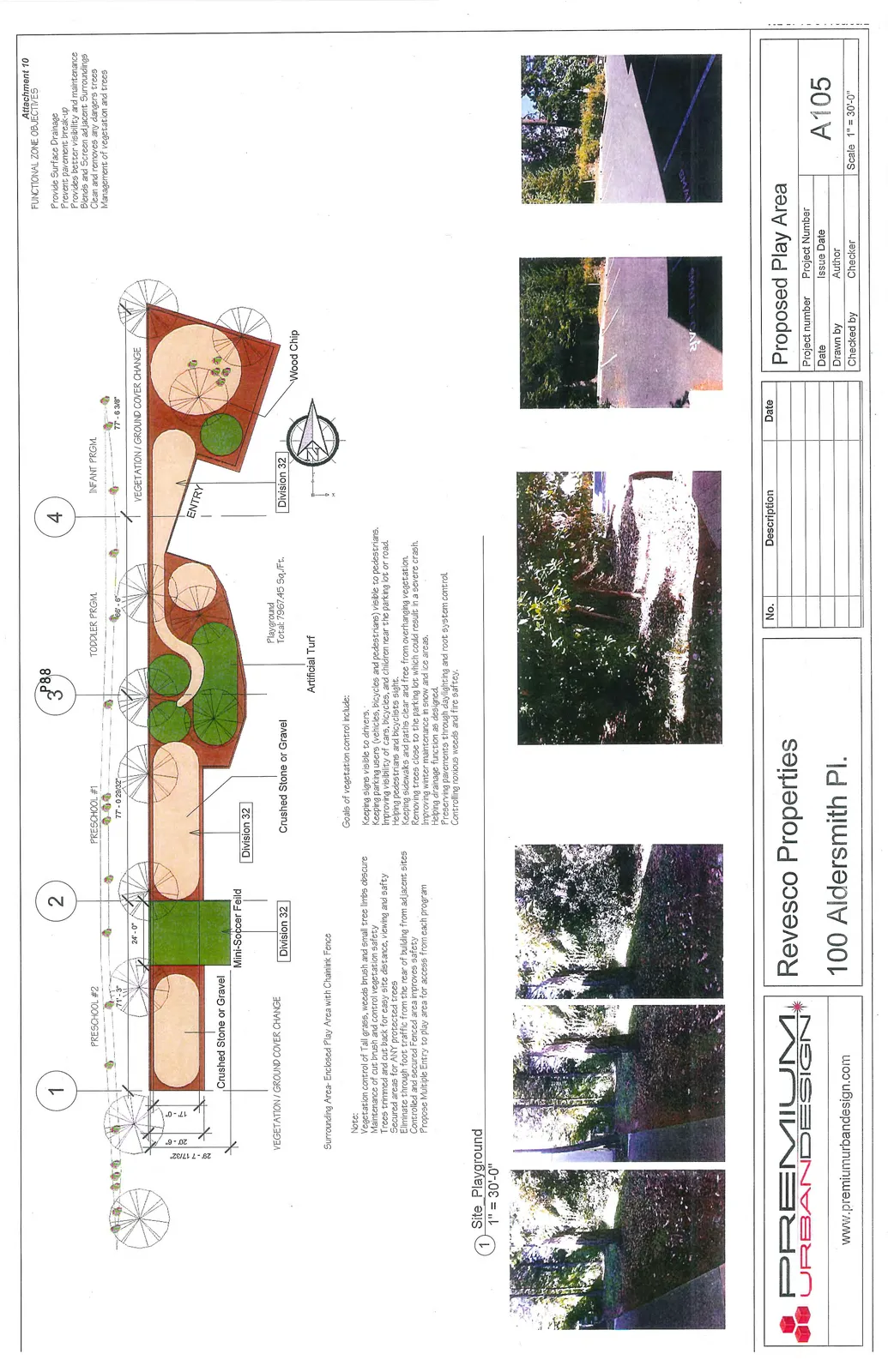
Surrounding Area - Enclosed Play Area with Chainlink Fence
Note:
- Vegetation control of Tall grass, weeds brush and small tree limbs obscure
- Maintenance of cut brush and control vegetation safety
- Trees trimmed and cut back for easy site distance, viewing and safty
- Secured areas for ANY protected trees
- Eliminate through foot traffic from the rear of building from adjacent sites
- Controlled and secured Fenced area improves safety
- Propose Multiple Entry to play area for access from each program
Goals of vegetation control include:
- Keeping signs visible to drivers.
- Keeping parking users (vehicles, bicycles and pedestrians) visible to pedestrians.
- Improving visibility of cars, bicycles, and children near the parking lot or road.
- Helping pedestrians and bicyclists sight.
- Keeping sidewalks and paths clear and free from overhanging vegetation.
- Removing trees close to the parking lot which could result in a severe crash.
- Improving winter maintenance in snow and ice areas.
- Helping drainage function as designed.
- Preserving pavements through daylighting and root system control.
- Controlling noxious weeds and fire saftey.
Revesco Properties 100 Aldersmith Pl. Proposed Play Area