TOWN OF VIEW ROYAL FINANCE & ADMINISTRATION REPORT: ADVISORY COMMITTEE STRUCTURE REVIEW & REVITALIZATION
Report proposing changes to the advisory committee structure to shift focus toward a task-oriented approach and improve efficiency.
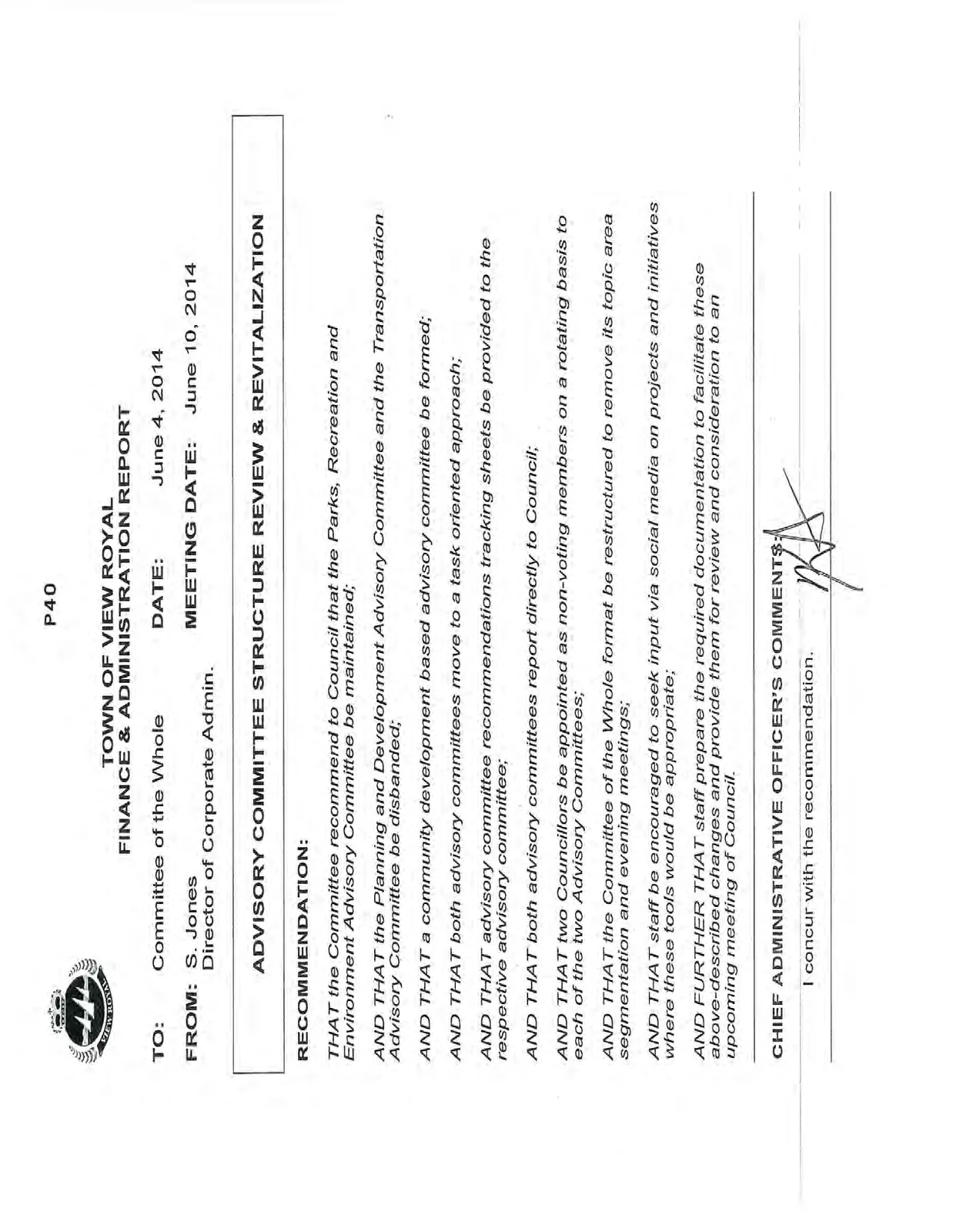
TOWN OF VIEW ROYAL FINANCE & ADMINISTRATION REPORT
TO: Committee of the Whole DATE: June 4, 2014 FROM: S. Jones, Director of Corporate Admin. MEETING DATE: June 10, 2014
ADVISORY COMMITTEE STRUCTURE REVIEW & REVITALIZATION
RECOMMENDATION:
THAT the Committee recommend to Council that the Parks, Recreation and Environment Advisory Committee be maintained;
AND THAT the Planning and Development Advisory Committee and the Transportation Advisory Committee be disbanded;
AND THAT a community development based advisory committee be formed;
AND THAT both advisory committees move to a task oriented approach;
AND THAT advisory committee recommendations tracking sheets be provided to the respective advisory committee;
AND THAT both advisory committees report directly to Council;
AND THAT two Councillors be appointed as non-voting members on a rotating basis to each of the two Advisory Committees;
AND THAT the Committee of the Whole format be restructured to remove its topic area segmentation and evening meetings;
AND THAT staff be encouraged to seek input via social media on projects and initiatives where these tools would be appropriate;
AND FURTHER THAT staff prepare the required documentation to facilitate these above-described changes and provide them for review and consideration to an upcoming meeting of Council.
CHIEF ADMINISTRATIVE OFFICER’S COMMENTS:
I concur with the recommendation.
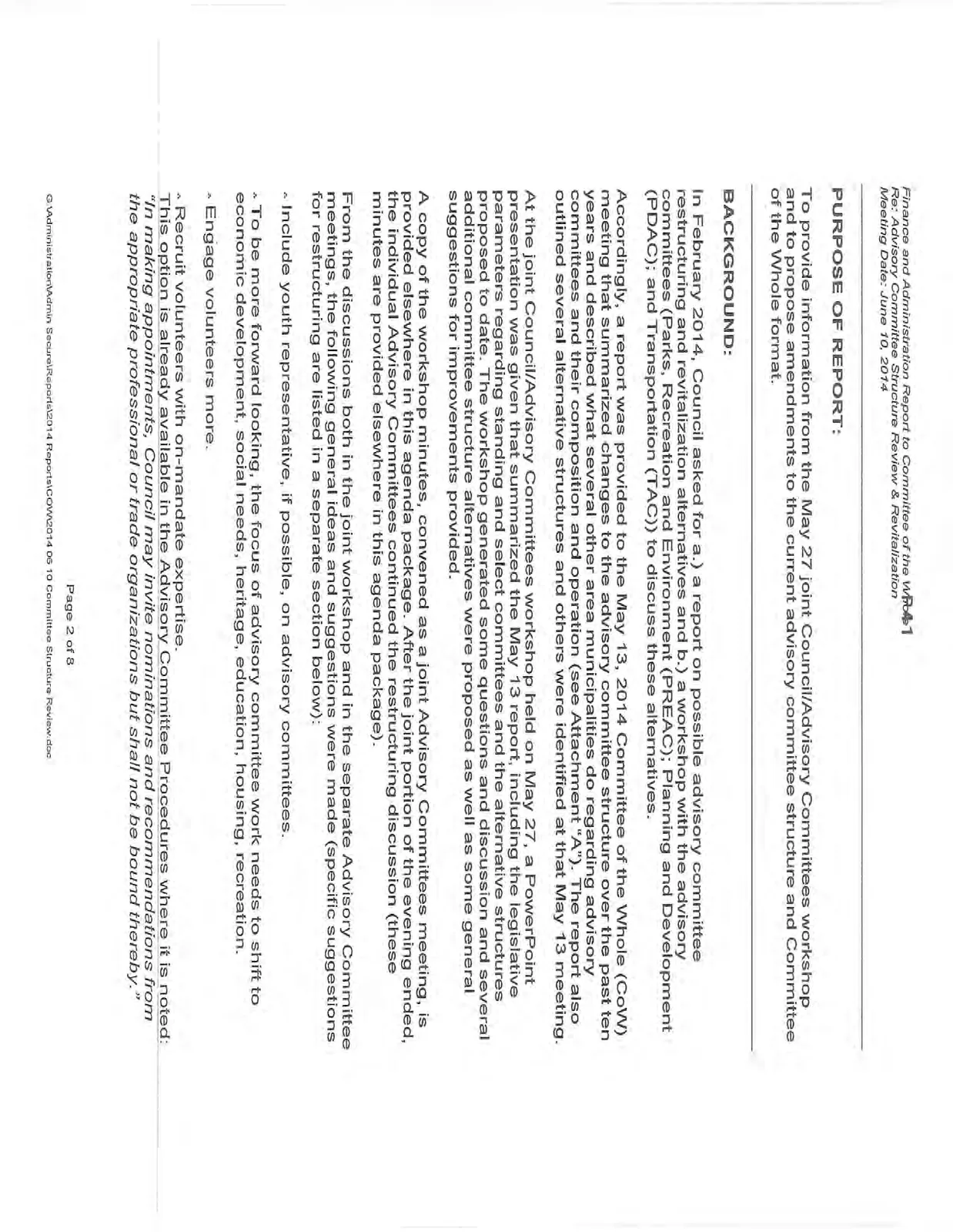
PURPOSE OF REPORT:
To provide information from the May 27 joint Council/Advisory Committees workshop and to propose amendments to the current advisory committee structure and Committee of the Whole format.
BACKGROUND:
In February 2014, Council asked for a.) a report on possible advisory committee restructuring and revitalization alternatives and b.) a workshop with the advisory committees (Parks, Recreation and Environment (PREAC); Planning and Development (PDAC); and Transportation (TAC)) to discuss these alternatives.
Accordingly, a report was provided to the May 13, 2014 Committee of the Whole (CoW) meeting that summarized changes to the advisory committee structure over the past ten years and described what several other area municipalities do regarding advisory committees and their composition and operation (see Attachment "A"). The report also outlined several alternative structures and others were identified at that May 13 meeting.
At the joint Council/Advisory Committees workshop held on May 27, a PowerPoint presentation was given that summarized the May 13 report, including the legislative parameters regarding standing and select committees and the alternative structures proposed to date. The workshop generated some questions and discussion and several additional committee structure alternatives were proposed as well as some general suggestions for improvements provided.
A copy of the workshop minutes, convened as a joint Advisory Committees meeting, is provided elsewhere in this agenda package. After the joint portion of the evening ended, the individual Advisory Committees continued the restructuring discussion (these minutes are provided elsewhere in this agenda package).
From the discussions both in the joint workshop and in the separate Advisory Committee meetings, the following general ideas and suggestions were made (specific suggestions for restructuring are listed in a separate section below):
- Include youth representative, if possible, on advisory committees.
- To be more forward looking, the focus of advisory committee work needs to shift to economic development, social needs, heritage, education, housing, recreation.
- Engage volunteers more.
- Recruit volunteers with on-mandate expertise. This option is already available in the Advisory Committee Procedures where it is noted: "In making appointments, Council may invite nominations and recommendations from the appropriate professional or trade organizations but shall not be bound thereby."
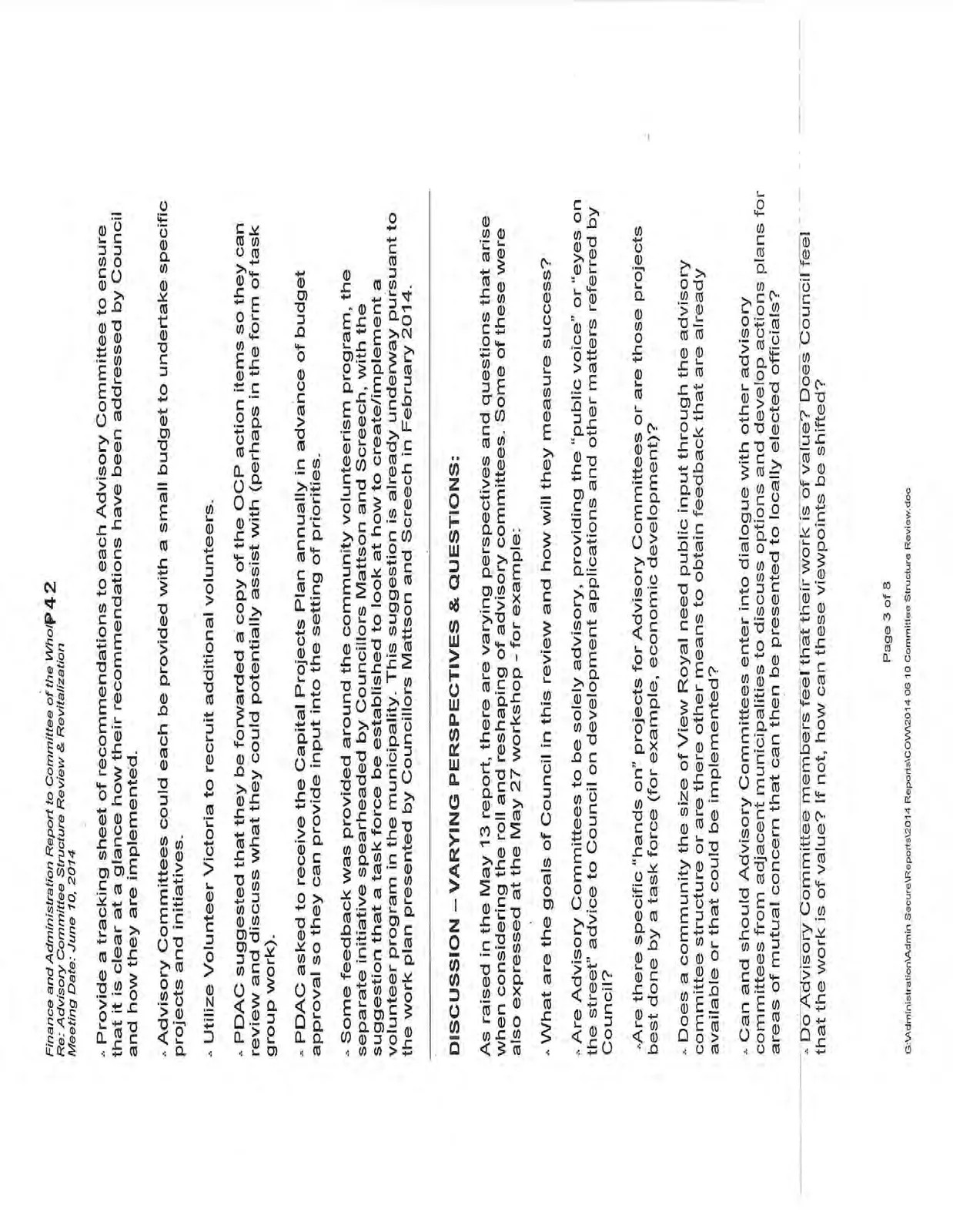
- Provide a tracking sheet of recommendations to each Advisory Committee to ensure that it is clear at a glance how their recommendations have been addressed by Council and how they are implemented.
- Advisory Committees could each be provided with a small budget to undertake specific projects and initiatives.
- Utilize Volunteer Victoria to recruit additional volunteers.
- PDAC suggested that they be forwarded a copy of the OCP action items so they can review and discuss what they could potentially assist with (perhaps in the form of task group work).
- PDAC asked to receive the Capital Projects Plan annually in advance of budget approval so they can provide input into the setting of priorities.
- Some feedback was provided around the community volunteerism program, the separate initiative spearheaded by Councillors Mattson and Screech, with the suggestion that a task force be established to look at how to create/implement a volunteer program in the municipality. This suggestion is already underway pursuant to the work plan presented by Councillors Mattson and Screech in February 2014.
DISCUSSION – VARYING PERSPECTIVES & QUESTIONS:
As raised in the May 13 report, there are varying perspectives and questions that arise when considering the roll and reshaping of advisory committees. Some of these were also expressed at the May 27 workshop - for example:
- What are the goals of Council in this review and how will they measure success?
- Are Advisory Committees to be solely advisory, providing the "public voice" or "eyes on the street" advice to Council on development applications and other matters referred by Council?
- Are there specific "hands on" projects for Advisory Committees or are those projects best done by a task force (for example, economic development)?
- Does a community the size of View Royal need public input through the advisory committee structure or are there other means to obtain feedback that are already available or that could be implemented?
- Can and should Advisory Committees enter into dialogue with other advisory committees from adjacent municipalities to discuss options and develop actions plans for areas of mutual concern that can then be presented to locally elected officials?
- Do Advisory Committee members feel that their work is of value? Does Council feel that the work is of value? If not, how can these viewpoints be shifted?
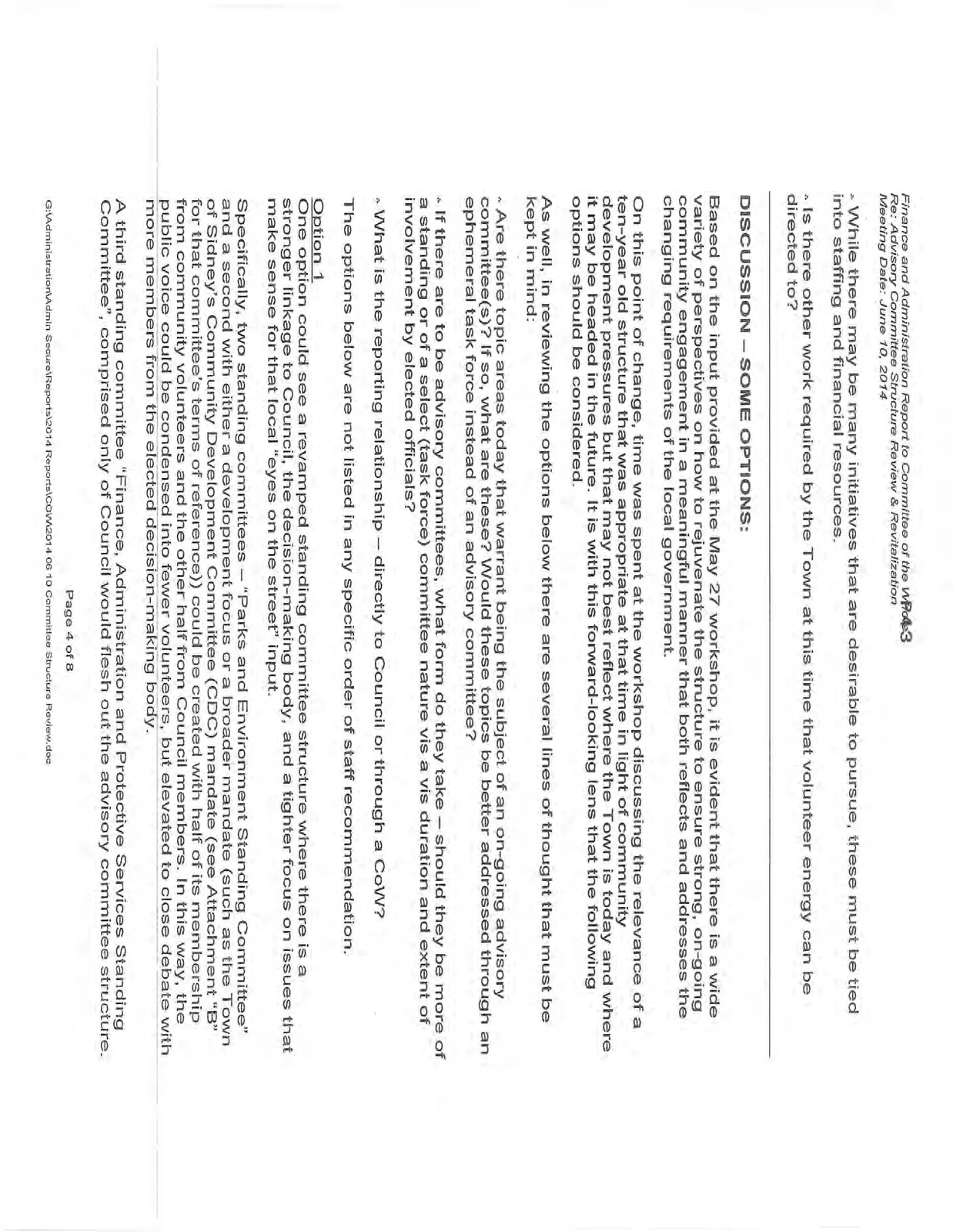
- While there may be many initiatives that are desirable to pursue, these must be tied into staffing and financial resources.
- Is there other work required by the Town at this time that volunteer energy can be directed to?
DISCUSSION – SOME OPTIONS:
Based on the input provided at the May 27 workshop, it is evident that there is a wide variety of perspectives on how to rejuvenate the structure to ensure strong, on-going community engagement in a meaningful manner that both reflects and addresses the changing requirements of the local government.
On this point of change, time was spent at the workshop discussing the relevance of a ten-year old structure that was appropriate at that time in light of community development pressures but that may not best reflect where the Town is today and where it may be headed in the future. It is with this forward-looking lens that the following options should be considered.
As well, in reviewing the options below there are several lines of thought that must be kept in mind:
- Are there topic areas today that warrant being the subject of an on-going advisory committee(s)? If so, what are these? Would these topics be better addressed through an ephemeral task force instead of an advisory committee?
- If there are to be advisory committees, what form do they take – should they be more of a standing or of a select (task force) committee nature vis a vis duration and extent of involvement by elected officials?
- What is the reporting relationship – directly to Council or through a CoW?
The options below are not listed in any specific order of staff recommendation.
Option 1
One option could see a revamped standing committee structure where there is a stronger linkage to Council, the decision-making body, and a tighter focus on issues that make sense for that local "eyes on the street" input.
Specifically, two standing committees – "Parks and Environment Standing Committee" and a second with either a development focus or a broader mandate (such as the Town of Sidney's Community Development Committee (CDC) mandate (see Attachment "B" for that committee's terms of reference)) could be created with half of its membership from community volunteers and the other half from Council members. In this way, the public voice could be condensed into fewer volunteers, but elevated to close debate with more members from the elected decision-making body.
A third standing committee "Finance, Administration and Protective Services Standing Committee", comprised only of Council would flesh out the advisory committee structure.
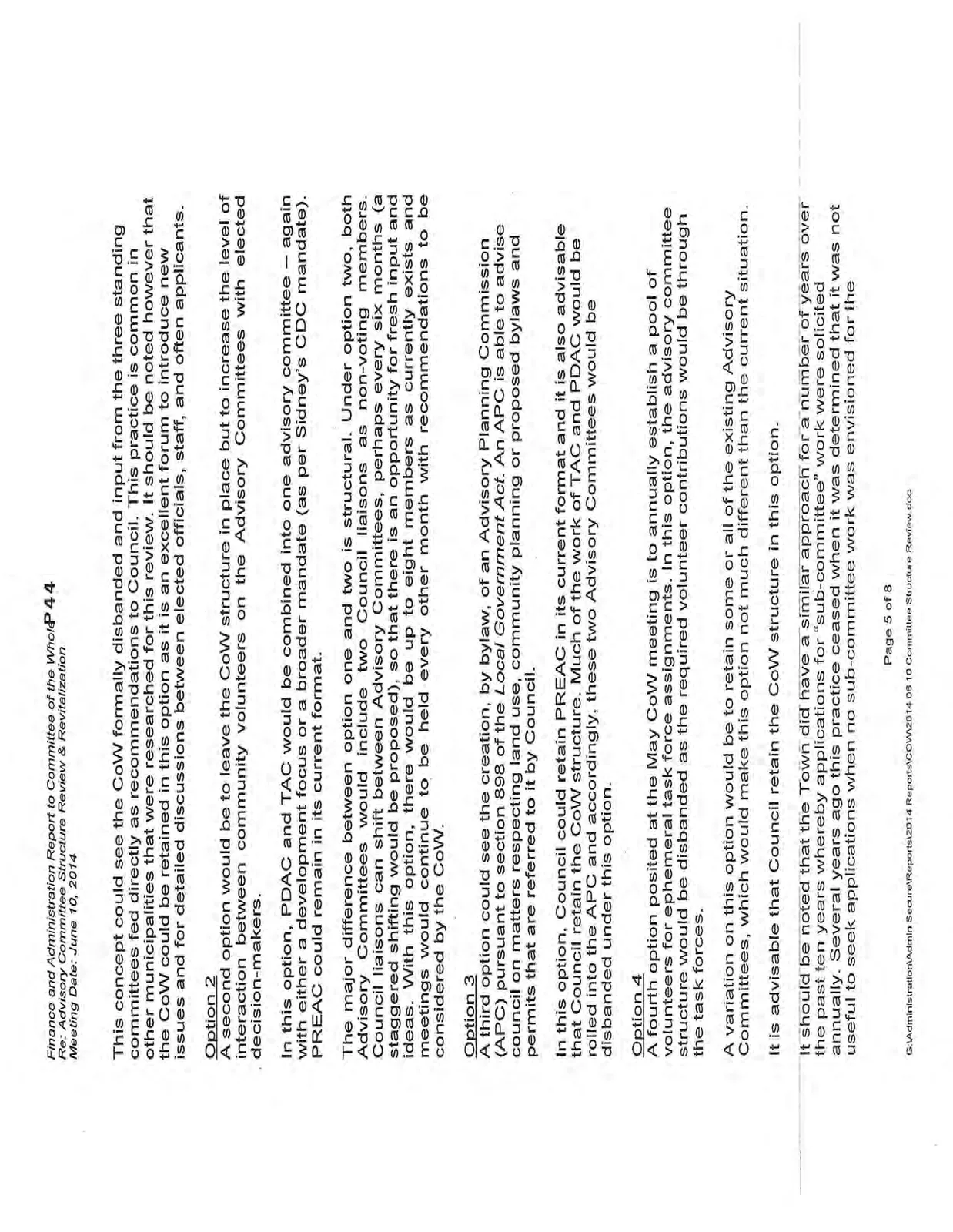
This concept could see the CoW formally disbanded and input from the three standing committees fed directly as recommendations to Council. This practice is common in other municipalities that were researched for this review. It should be noted however that the CoW could be retained in this option as it is an excellent forum to introduce new issues and for detailed discussions between elected officials, staff, and often applicants.
Option 2
A second option would be to leave the CoW structure in place but to increase the level of interaction between community volunteers on the Advisory Committees with elected decision-makers.
In this option, PDAC and TAC would be combined into one advisory committee – again with either a development focus or a broader mandate (as per Sidney's CDC mandate). PREAC could remain in its current format.
The major difference between option one and two is structural. Under option two, both Advisory Committees would include two Council liaisons as non-voting members. Council liaisons can shift between Advisory Committees, perhaps every six months (a staggered shifting would be proposed), so that there is an opportunity for fresh input and ideas. With this option, there would be up to eight members as currently exists and meetings would continue to be held every other month with recommendations to be considered by the CoW.
Option 3
A third option could see the creation, by bylaw, of an Advisory Planning Commission (APC) pursuant to section 898 of the Local Government Act. An APC is able to advise council on matters respecting land use, community planning or proposed bylaws and permits that are referred to it by Council.
In this option, Council could retain PREAC in its current format and it is also advisable that Council retain the CoW structure. Much of the work of TAC and PDAC would be rolled into the APC and accordingly, these two Advisory Committees would be disbanded under this option.
Option 4
A fourth option posited at the May CoW meeting is to annually establish a pool of volunteers for ephemeral task force assignments. In this option, the advisory committee structure would be disbanded as the required volunteer contributions would be through the task forces.
A variation on this option would be to retain some or all of the existing Advisory Committees, which would make this option not much different than the current situation.
It is advisable that Council retain the CoW structure in this option.
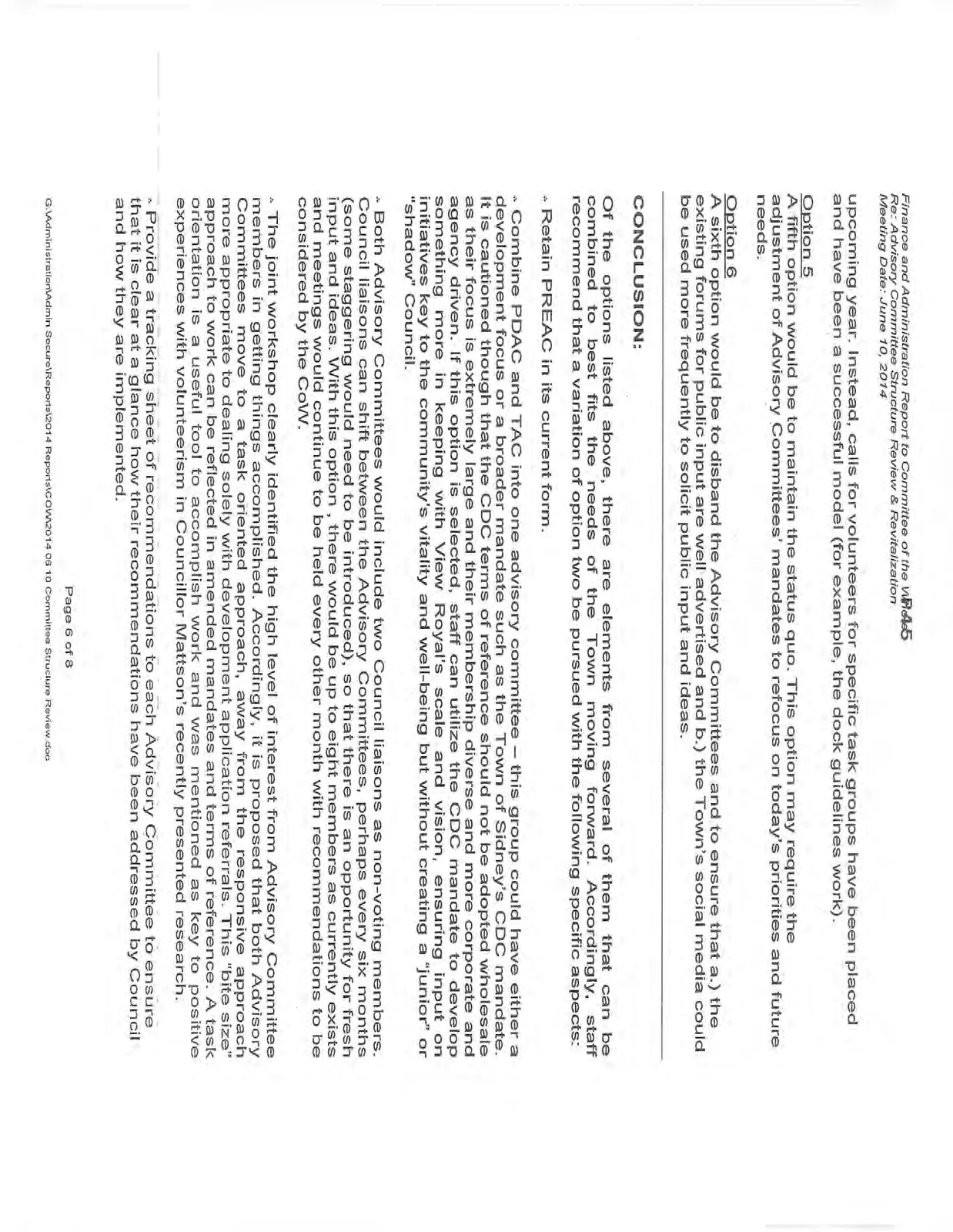
It should be noted that the Town did have a similar approach for a number of years over the past ten years whereby applications for "sub-committee" work were solicited annually. Several years ago this practice ceased when it was determined that it was not useful to seek applications when no sub-committee work was envisioned for the upcoming year. Instead, calls for volunteers for specific task groups have been placed and have been a successful model (for example, the dock guidelines work).
Option 5
A fifth option would be to maintain the status quo. This option may require the adjustment of Advisory Committees' mandates to refocus on today's priorities and future needs.
Option 6
A sixth option would be to disband the Advisory Committees and to ensure that a.) the existing forums for public input are well advertised and b.) the Town's social media could be used more frequently to solicit public input and ideas.
CONCLUSION:
Of the options listed above, there are elements from several of them that can be combined to best fits the needs of the Town moving forward. Accordingly, staff recommend that a variation of option two be pursued with the following specific aspects:
- Retain PREAC in its current form.
- Combine PDAC and TAC into one advisory committee – this group could have either a development focus or a broader mandate such as the Town of Sidney's CDC mandate. It is cautioned though that the CDC terms of reference should not be adopted wholesale as their focus is extremely large and their membership diverse and more corporate and agency driven. If this option is selected, staff can utilize the CDC mandate to develop something more in keeping with View Royal's scale and vision, ensuring input on initiatives key to the community's vitality and well-being but without creating a "junior" or "shadow" Council.
- Both Advisory Committees would include two Council liaisons as non-voting members. Council liaisons can shift between Advisory Committees, perhaps every six months (some staggering would need to be introduced), so that there is an opportunity for fresh input and ideas. With this option, there would be up to eight members as currently exists and meetings would continue to be held every other month with recommendations to be considered by the CoW.
- The joint workshop clearly identified the high level of interest from Advisory Committee members in getting things accomplished. Accordingly, it is proposed that both Advisory Committees move to a task oriented approach, away from the responsive approach more appropriate to dealing solely with development application referrals. This "bite size" approach to work can be reflected in amended mandates and terms of reference. A task orientation is a useful tool to accomplish work and was mentioned as key to positive experiences with volunteerism in Councillor Mattson's recently presented research.
- Provide a tracking sheet of recommendations to each Advisory Committee to ensure that it is clear at a glance how their recommendations have been addressed by Council and how they are implemented.
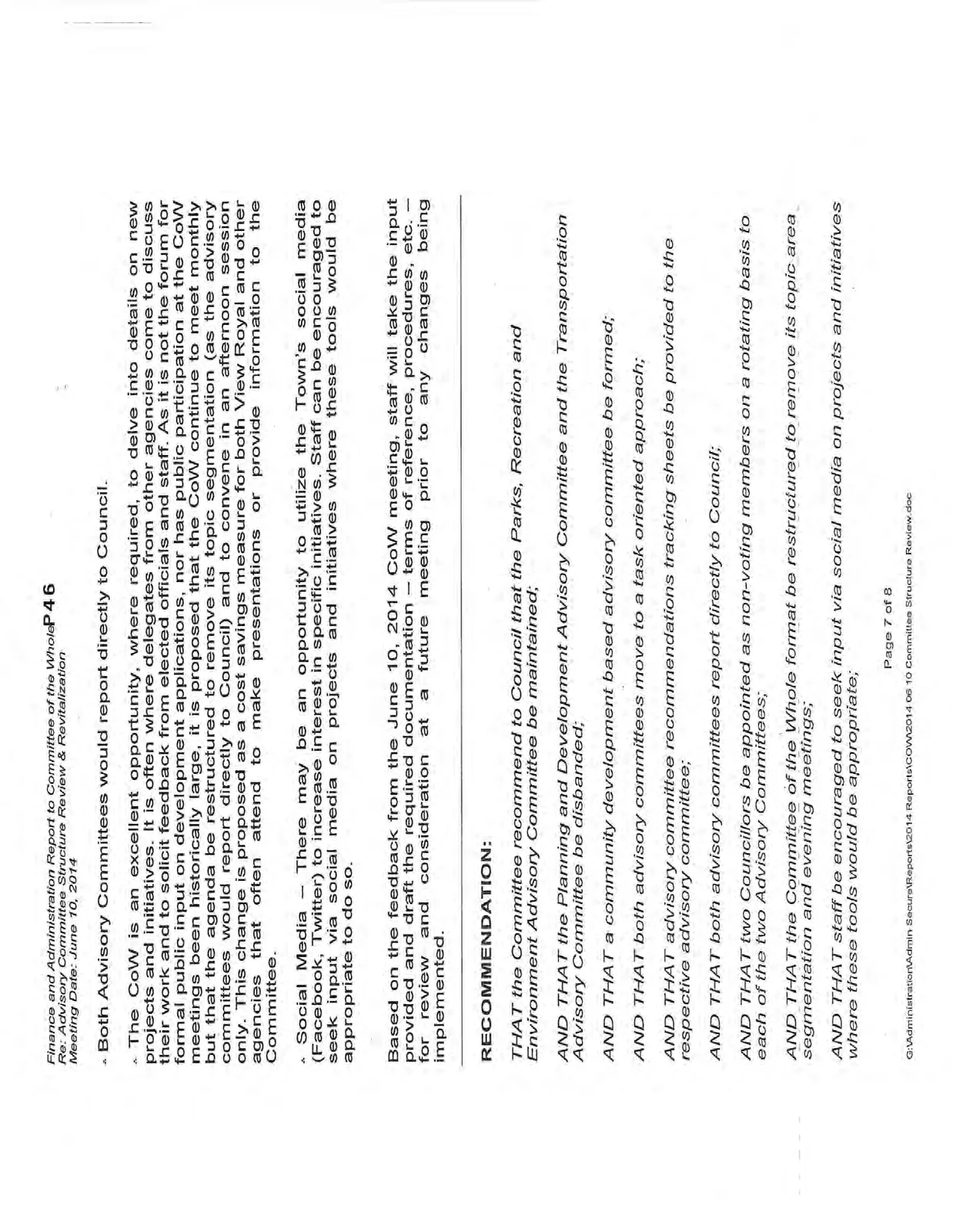
- Both Advisory Committees would report directly to Council.
- The CoW is an excellent opportunity, where required, to delve into details on new projects and initiatives. It is often where delegates from other agencies come to discuss their work and to solicit feedback from elected officials and staff. As it is not the forum for formal public input on development applications, nor has public participation at the CoW meetings been historically large, it is proposed that the CoW continue monthly but that the agenda be restructured to remove its topic segmentation (as the advisory committees would report directly to Council) and to convene in an afternoon session only. This change is proposed as a cost savings measure for both View Royal and other agencies that often attend to make presentations or provide information to the Committee.
- Social Media – There may be an opportunity to utilize the Town's social media (Facebook, Twitter) to increase interest in specific initiatives. Staff can be encouraged to seek input via social media on projects and initiatives where these tools would be appropriate to do so.
Based on the feedback from the June 10, 2014 CoW meeting, staff will take the input provided and draft the required documentation – terms of reference, procedures, etc. – for review and consideration at a future meeting prior to any changes being implemented.
RECOMMENDATION:
THAT the Committee recommend to Council that the Parks, Recreation and Environment Advisory Committee be maintained;
AND THAT the Planning and Development Advisory Committee and the Transportation Advisory Committee be disbanded;
AND THAT a community development based advisory committee be formed;
AND THAT both advisory committees move to a task oriented approach;
AND THAT advisory committee recommendations tracking sheets be provided to the respective advisory committee;
AND THAT both advisory committees report directly to Council;
AND THAT two Councillors be appointed as non-voting members on a rotating basis to each of the two Advisory Committees;
AND THAT the Committee of the Whole format be restructured to remove its topic area segmentation and evening meetings;
AND THAT staff be encouraged to seek input via social media on projects and initiatives where these tools would be appropriate;
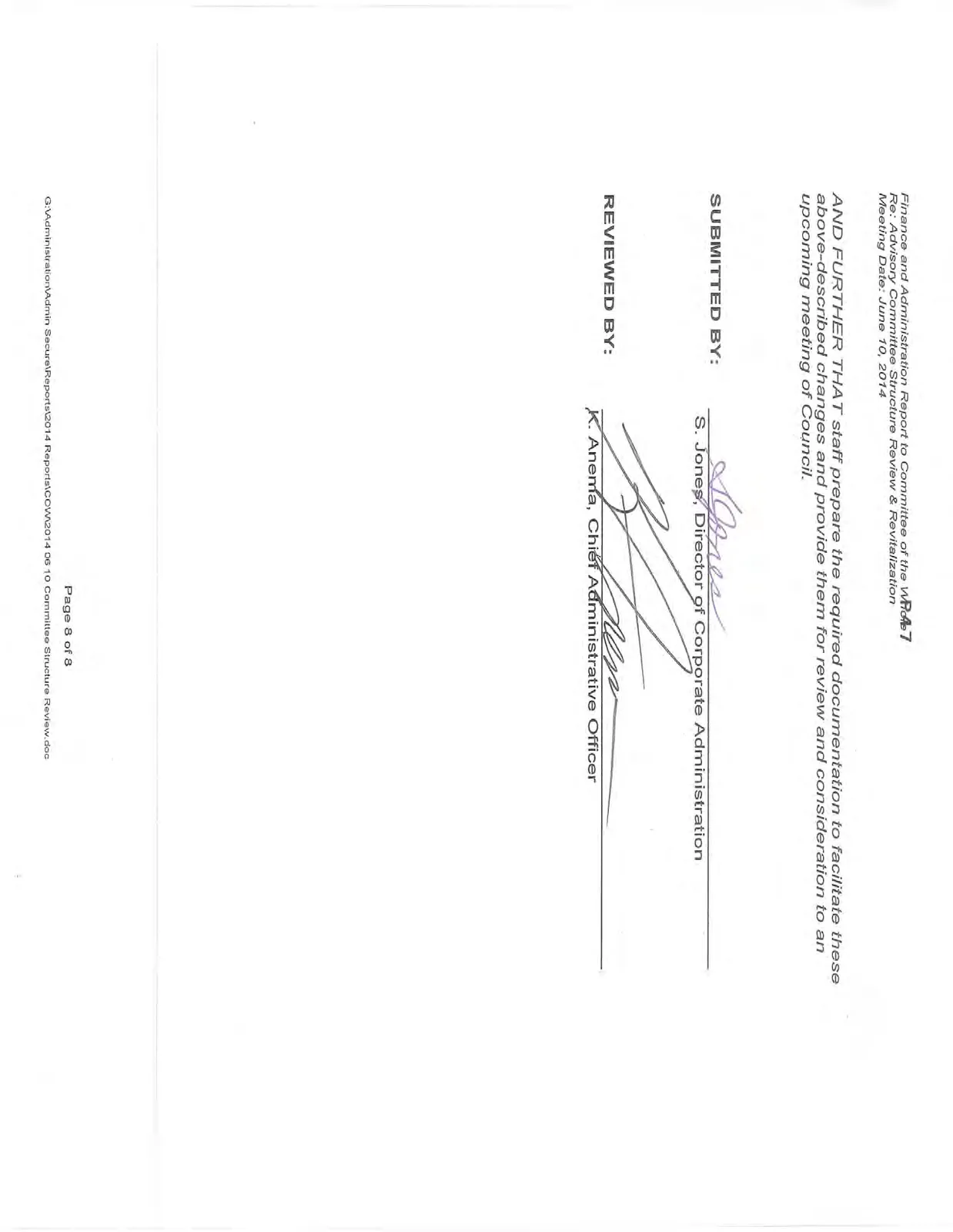
AND FURTHER THAT staff prepare the required documentation to facilitate these above-described changes and provide them for review and consideration to an upcoming meeting of Council.
SUBMITTED BY: S. Jones, Director of Corporate Administration
REVIEWED BY: K. Anema, Chief Administrative Officer
Document Images
(8)