Develop with Care 2012 Fact Sheet #4 - Public Works
Provincial environmental guidelines for public works to minimize impacts on the natural environment during maintenance and development.
Develop with Care 2012
FACT SHEET #4 Public Works
Environmental Guidelines for Urban and Rural Land Development in British Columbia
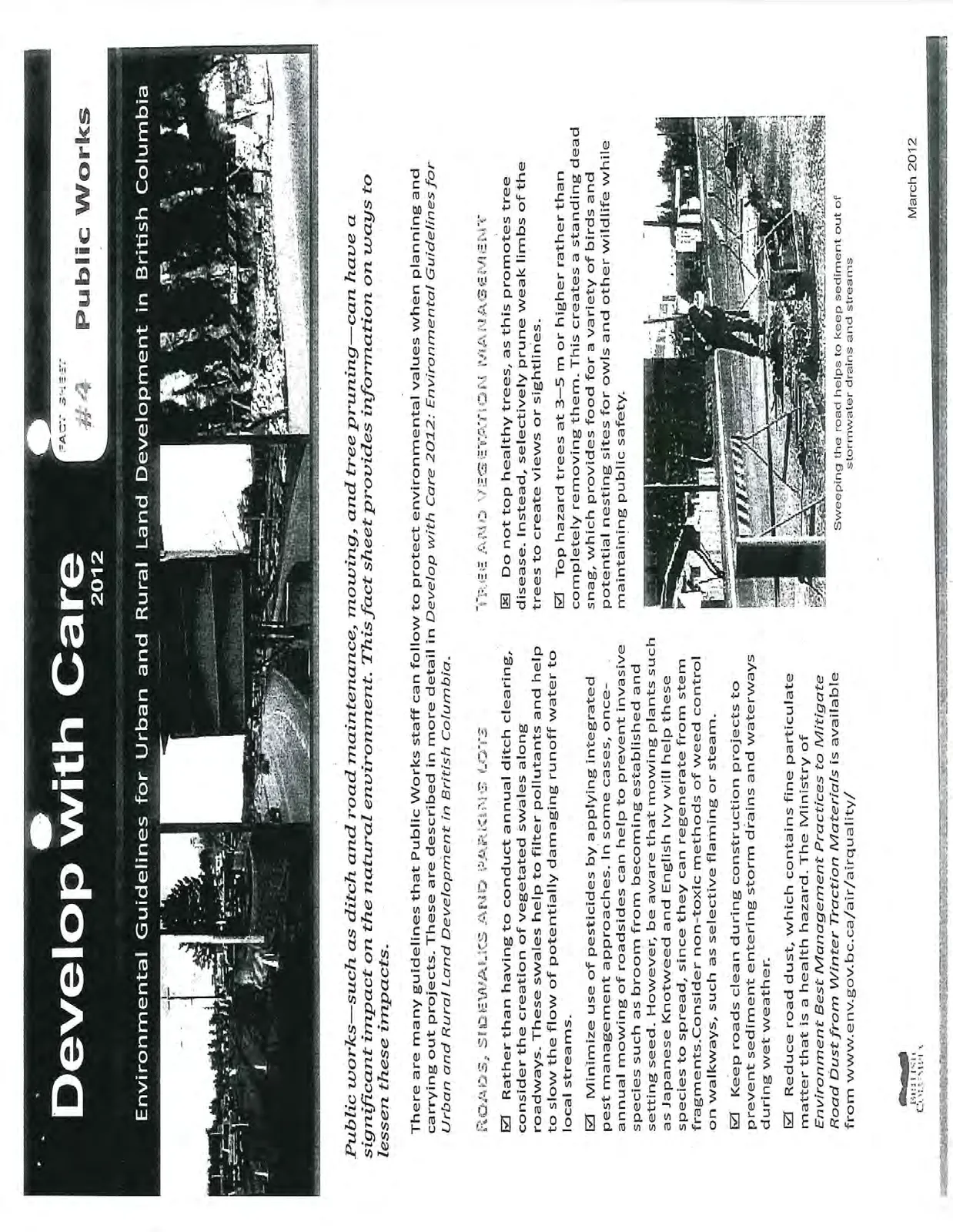
Public works—such as ditch and road maintenance, mowing, and tree pruning—can have a significant impact on the natural environment. This fact sheet provides information on ways to lessen these impacts.
There are many guidelines that Public Works staff can follow to protect environmental values when planning and carrying out projects. These are described in more detail in Develop with Care 2012: Environmental Guidelines for Urban and Rural Land Development in British Columbia.
ROADS, SIDEWALKS AND PARKING LOTS
- Rather than having to conduct annual ditch clearing, consider the creation of vegetated swales along roadways. These swales help to filter pollutants and help to slow the flow of potentially damaging runoff water to local streams.
- Minimize use of pesticides by applying integrated pest management approaches. In some cases, once-annual mowing of roadsides can help to prevent invasive species such as broom from becoming established and setting seed. However, be aware that mowing plants such as Japanese Knotweed and English Ivy will help these species to spread, since they can regenerate from stem fragments. Consider non-toxic methods of weed control on walkways, such as selective flaming or steam.
- Keep roads clean during construction projects to prevent sediment entering storm drains and waterways during wet weather.
- Reduce road dust, which contains fine particulate matter that is a health hazard. The Ministry of Environment Best Management Practices to Mitigate Road Dust from Winter Traction Materials is available from www.env.gov.bc.ca/air/airquality/
TREE AND VEGETATION MANAGEMENT
- Do not top healthy trees, as this promotes tree disease. Instead, selectively prune weak limbs of the trees to create views or sightlines.
- Top hazard trees at 3–5 m or higher rather than completely removing them. This creates a standing dead snag, which provides food for a variety of birds and potential nesting sites for owls and other wildlife while maintaining public safety.
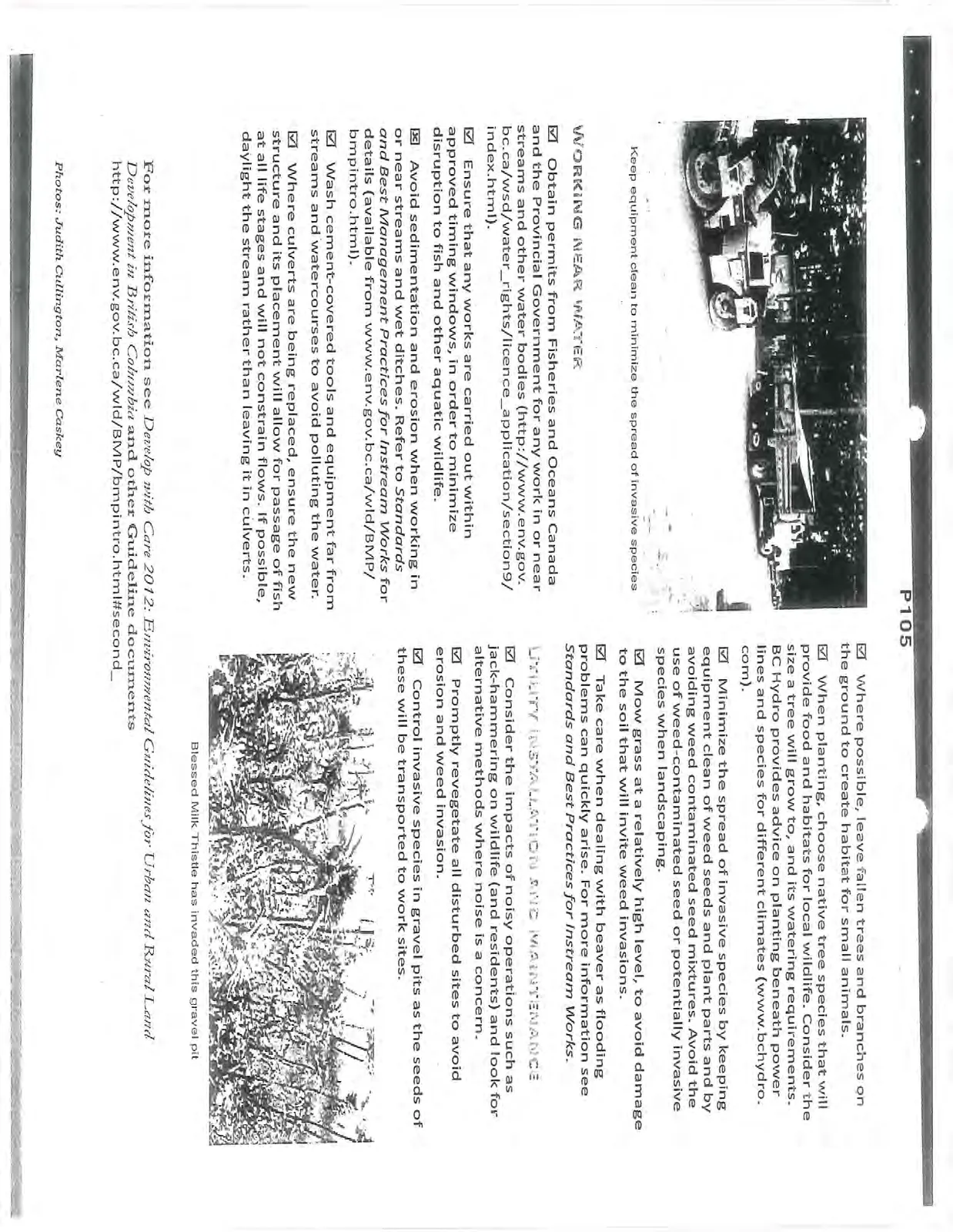
Sweeping the road helps to keep sediment out of stormwater drains and streams
Keep equipment clean to minimize the spread of invasive species
- Where possible, leave fallen trees and branches on the ground to create habitat for small animals.
- When planting, choose native tree species that will provide food and habitats for local wildlife. Consider the size a tree will grow to, and its watering requirements. BC Hydro provides advice on planting beneath power lines and species for different climates (www.bchydro.com).
- Minimize the spread of invasive species by keeping equipment clean of weed seeds and plant parts and by avoiding weed contaminated seed mixtures. Avoid the use of weed-contaminated seed or potentially invasive species when landscaping.
- Mow grass at a relatively high level, to avoid damage to the soil that will invite weed invasions.
- Take care when dealing with beaver as flooding problems can quickly arise. For more information see Standards and Best Practices for Instream Works.
WORKING NEAR WATER
- Obtain permits from Fisheries and Oceans Canada and the Provincial Government for any work in or near streams and other water bodies (http://www.env.gov.bc.ca/wsd/water_rights/licence_application/section9/index.html).
- Ensure that any works are carried out within approved timing windows, in order to minimize disruption to fish and other aquatic wildlife.
- Avoid sedimentation and erosion when working in or near streams and wet ditches. Refer to Standards and Best Management Practices for Instream Works for details (available from www.env.gov.bc.ca/wld/BMP/bmpintro.html).
- Wash cement-covered tools and equipment far from streams and watercourses to avoid polluting the water.
- Where culverts are being replaced, ensure the new structure and its placement will allow for passage of fish at all life stages and will not constrain flows. If possible, daylight the stream rather than leaving it in culverts.
UTILITY INSTALLATION AND MAINTENANCE
- Consider the impacts of noisy operations such as jack-hammering on wildlife (and residents) and look for alternative methods where noise is a concern.
- Promptly revegetate all disturbed sites to avoid erosion and weed invasion.
- Control invasive species in gravel pits as the seeds of these will be transported to work sites.
Blessed Milk Thistle has invaded this gravel pit
For more information see Develop with Care 2012: Environmental Guidelines for Urban and Rural Land Development in British Columbia and other Guideline documents http://www.env.gov.bc.ca/wld/BMP/bmpintro.html#second_
Photos: Judith Cullington, Marlene Caskey
March 2012