Attachment 7 - 237 Anya Lane Tree Damage Assessment Report (Michael Gye & Heidi Krogstad Urban Forestry Ltd.)
Detailed arborist assessment of five trees adjacent to the driveway and retaining wall, concluding that fill will have significant impacts on their lifespan.
April 29, 2014
Town of View Royal 45 View Royal Avenue, Victoria, BC, V9B 1A6
Dear Mr. Calla.
Re: 237 Anya Lane Tree Damage Assessment Report
Assignment
To assess the impact of the driveway fill on the adjacent trees shown in the photograph below and give an opinion in a written report.
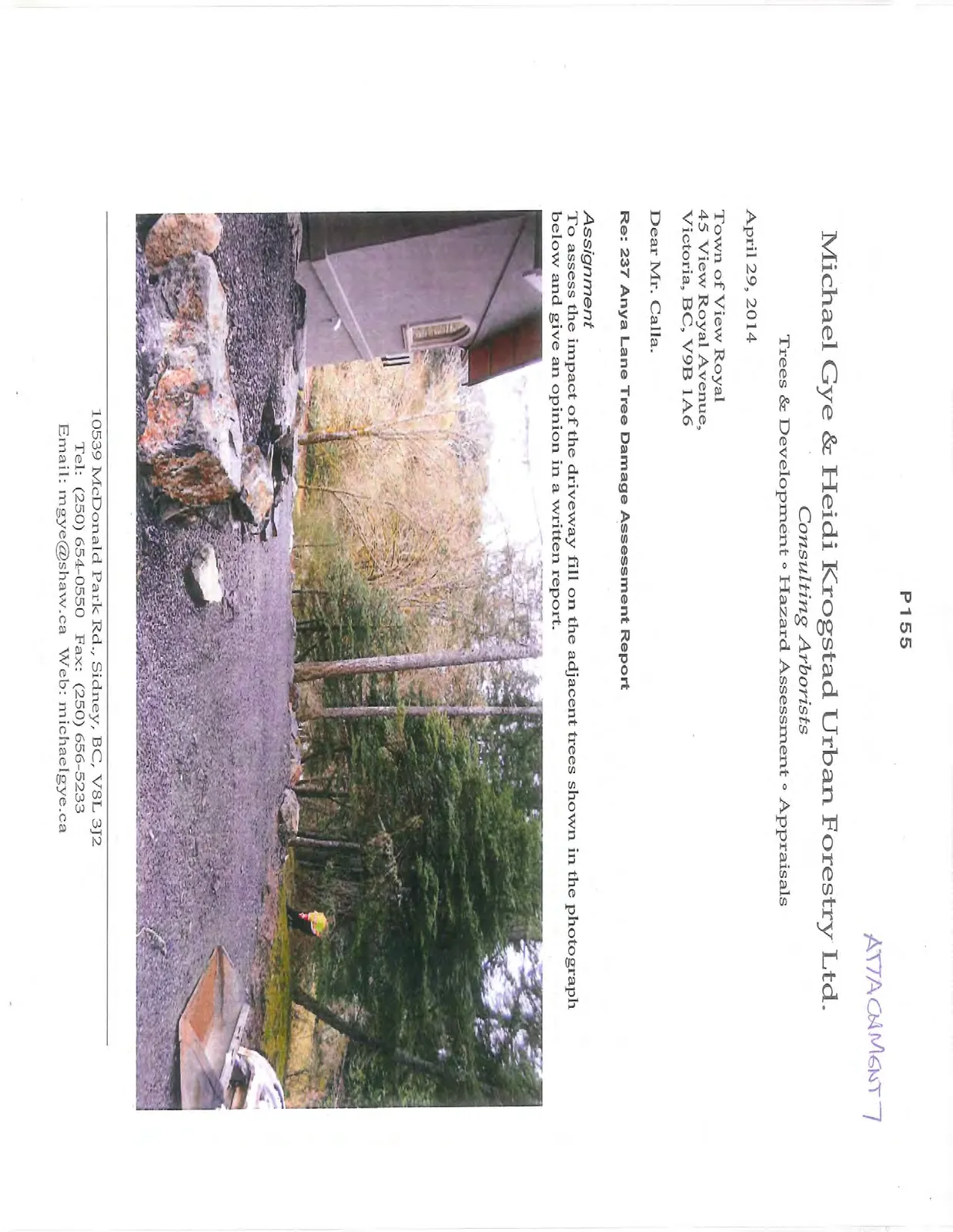
Background
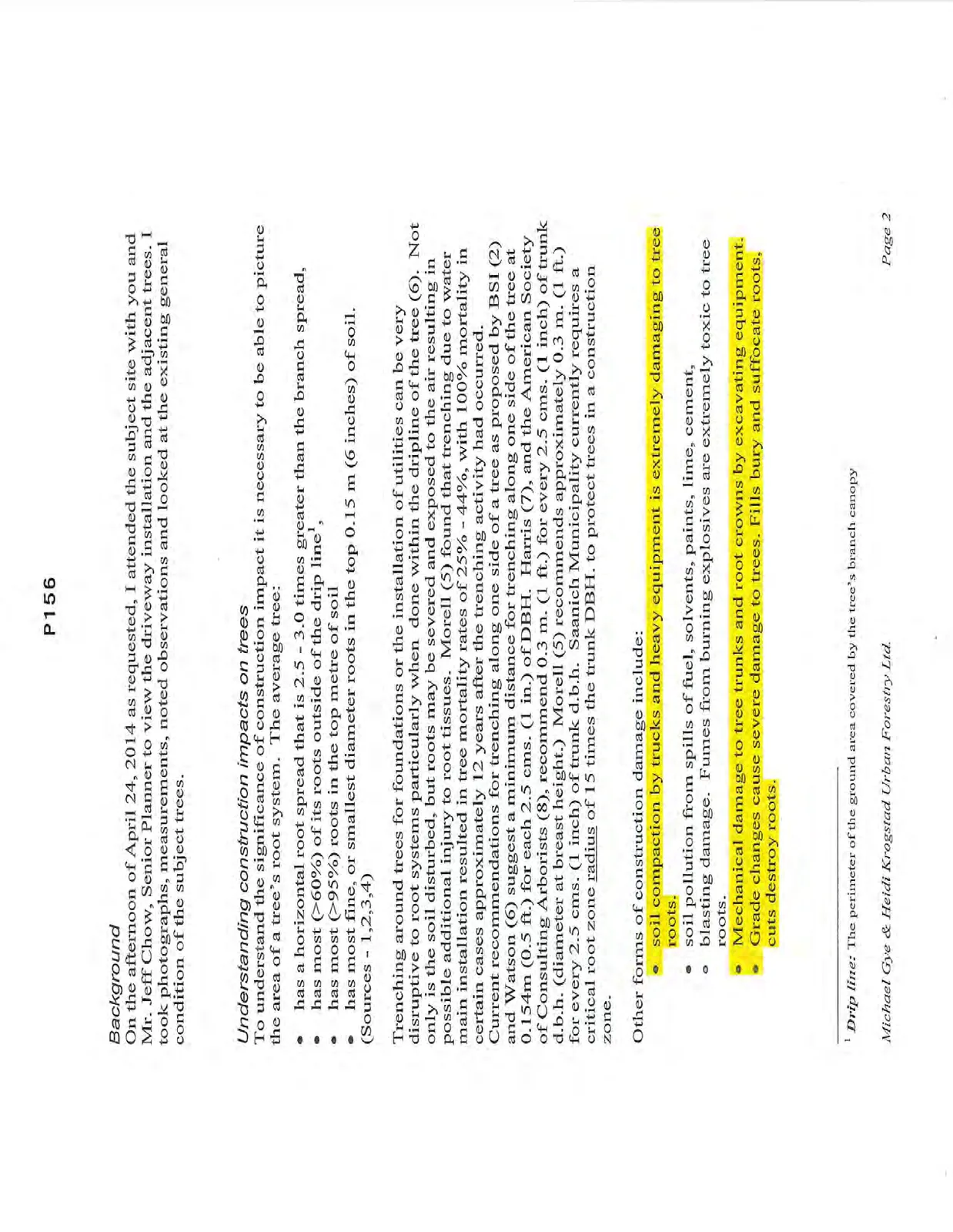
On the afternoon of April 24, 2014 as requested, I attended the subject site with you and Mr. Jeff Chow, Senior Planner to view the driveway installation and the adjacent trees. I took photographs, measurements, noted observations and looked at the existing general condition of the subject trees.
Understanding construction impacts on trees
To understand the significance of construction impact it is necessary to be able to picture the area of a tree’s root system. The average tree:
- has a horizontal root spread that is 2.5 - 3.0 times greater than the branch spread,
- has most (>60%) of its roots outside of the drip line¹,
- has most (>95%) roots in the top metre of soil
- has most fine, or smallest diameter roots in the top 0.15 m (6 inches) of soil. (Sources - 1,2,3,4)
Trenching around trees for foundations or the installation of utilities can be very disruptive to root systems particularly when done within the dripline of the tree (6). Not only is the soil disturbed, but roots may be severed and exposed to the air resulting in possible additional injury to root tissues. Morell (5) found that trenching due to water main installation resulted in tree mortality rates of 25% - 44%, with 100% mortality in certain cases approximately 12 years after the trenching activity had occurred. Current recommendations for trenching along one side of a tree as proposed by BSI (2) and Watson (6) suggest a minimum distance for trenching along one side of the tree at 0.154m (0.5 ft.) for each 2.5 cms. (1 in.) of DBH. Harris (7), and the American Society of Consulting Arborists (8), recommend 0.3 m. (1 ft.) for every 2.5 cms. (1 inch) of trunk d.b.h. (diameter at breast height.) Morell (5) recommends approximately 0.3 m. (1 ft.) for every 2.5 cms. (1 inch) of trunk d.b.h. Saanich Municipality currently requires a critical root zone radius of 15 times the trunk DBH. to protect trees in a construction zone.
Other forms of construction damage include:
- soil compaction by trucks and heavy equipment is extremely damaging to tree roots.
- soil pollution from spills of fuel, solvents, paints, lime, cement,
- blasting damage. Fumes from burning explosives are extremely toxic to tree roots.
- Mechanical damage to tree trunks and root crowns by excavating equipment.
- Grade changes cause severe damage to trees. Fills bury and suffocate roots, cuts destroy roots.
¹ Drip line: The perimeter of the ground area covered by the tree’s branch canopy
Observations
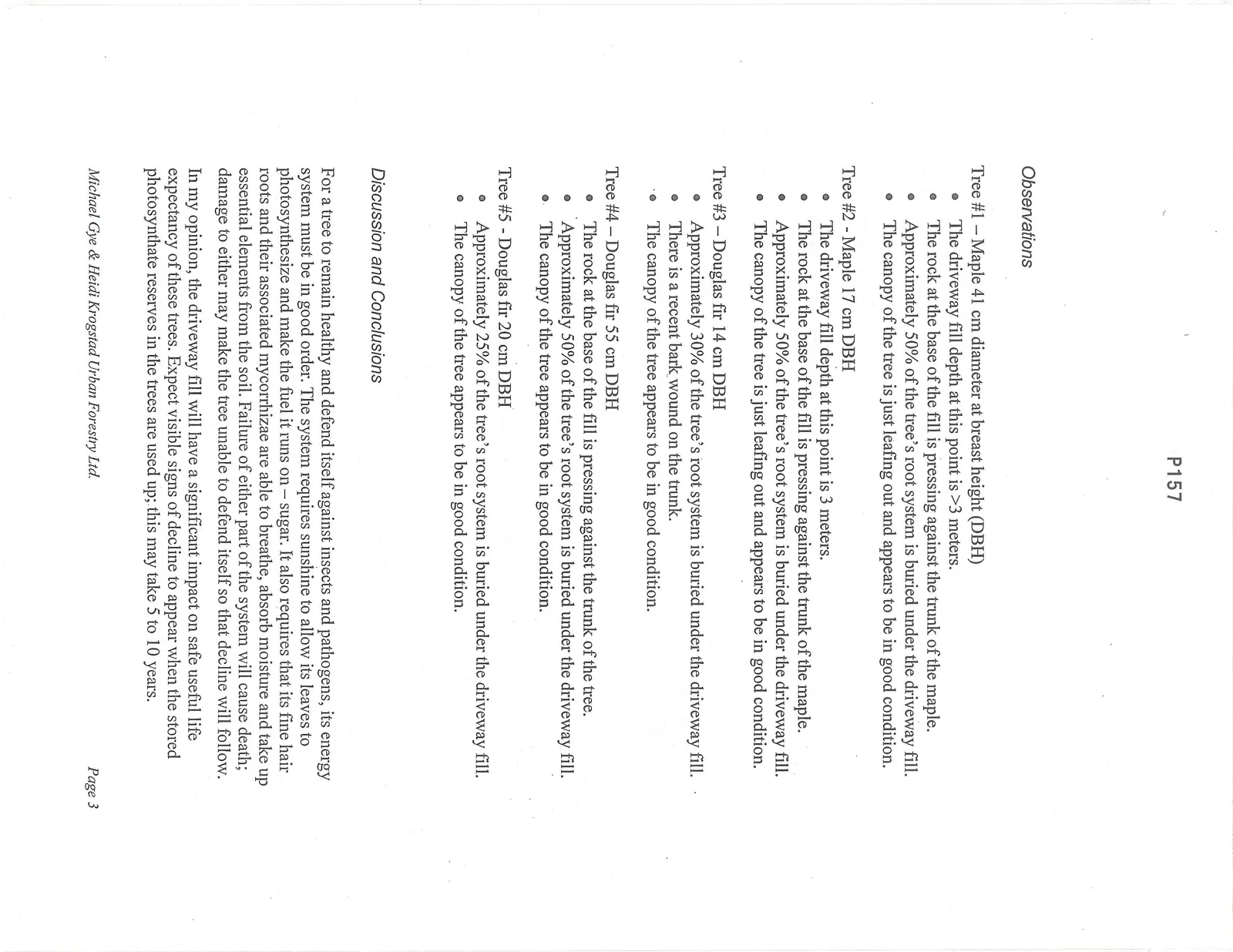
Tree #1 - Maple 41 cm diameter at breast height (DBH)
- The driveway fill depth at this point is >3 meters.
- The rock at the base of the fill is pressing against the trunk of the maple.
- Approximately 50% of the tree's root system is buried under the driveway fill.
- The canopy of the tree is just leafing out and appears to be in good condition.
Tree #2 - Maple 17 cm DBH
- The driveway fill depth at this point is 3 meters.
- The rock at the base of the fill is pressing against the trunk of the maple.
- Approximately 50% of the tree's root system is buried under the driveway fill.
- The canopy of the tree is just leafing out and appears to be in good condition.
Tree #3 - Douglas fir 14 cm DBH
- Approximately 30% of the tree's root system is buried under the driveway fill.
- There is a recent bark wound on the trunk.
- The canopy of the tree appears to be in good condition.
Tree #4 - Douglas fir 55 cm DBH
- The rock at the base of the fill is pressing against the trunk of the tree.
- Approximately 50% of the tree's root system is buried under the driveway fill.
- The canopy of the tree appears to be in good condition.
Tree #5 - Douglas fir 20 cm DBH
- Approximately 25% of the tree's root system is buried under the driveway fill.
- The canopy of the tree appears to be in good condition.
Discussion and Conclusions
For a tree to remain healthy and defend itself against insects and pathogens, its energy system must be in good order. The system requires sunshine to allow its leaves to photosynthesize and make the fuel it runs on — sugar. It also requires that its fine hair roots and their associated mycorrhizae are able to breathe, absorb moisture and take up essential elements from the soil. Failure of either part of the system will cause death; damage to either may make the tree unable to defend itself so that decline will follow.
In my opinion, the driveway fill will have a significant impact on safe useful life expectancy of these trees. Expect visible signs of decline to appear when the stored photosynthate reserves in the trees are used up; this may take 5 to 10 years.
In my opinion, mitigation by removing the driveway fill to restore the original grade is not advisable, as even more root damage would result.
Please call me with any questions, or if you need further information. Thank you for consulting with me.
Yours truly,
Michael Gye, Consulting Arborist. ISA Certified Arborist #PN0145A ISA Certified Tree Risk Assessor #24
For Michael Gye & Heidi Krogstad Urban Forestry Ltd.
LITERATURE CITED:
(1) Gilman, E.F.1988. Tree root spread in relation to branch drip line and harvestable root ball. HortScience 23:351-353 (2) Gilman E.F. 1990. Tree root growth and development. 1. Form, depth, spread and periodicity. J. of Environ. Hort. 8:215-220 (3) Perry T.O. 1982 The ecology of tree roots and the practical significance thereof. J. Arboric.8:197-211 (4) Watson G.B. and E.B. Himelick. 1982b. Root distribution of nursery trees and its relationship to transplanting success. J. Arboric. 8:225-228. (5) Morell J.D. 1984. Parkway tree augering specifications. J. Arboric. 10(5): 129-132 (6) Watson G. 1990. Preventing construction damage to trees. The Morton Arboretum information leaflet #36. Lisle, Illinois. 1 pp. (7) Harris R.W. 1992. Arboriculture: Care of Trees, Shrubs and Vines in the Landscape. Prentice Hall Inc. 674 pp. (8) American Society of Consulting Arborists. 1989. Protecting Trees during Construction: Answers to frequently asked questions for builders and property owners. Wheatbridge, Colorado. 1 pp.
Arborist's Disclosure Statement
Arborists are tree specialists who use their education, knowledge, training and experience to examine trees, recommend measures to enhance the beauty and health of trees, and attempt to reduce the risk of living near trees. Clients may choose to accept or disregard the recommendations of the arborist, or to seek additional advice.
Arborist cannot detect every condition that could possibly lead to the structural failure of a tree. Trees are living organisms that fail in ways we do not fully understand. Conditions are often hidden within trees and below ground. Arborists cannot guarantee that a tree will be healthy or safe under all circumstances, or for a specified period of time. Likewise, remedial treatments, like any medicine, cannot be guaranteed.
Treatment, pruning and removal of trees may involve considerations beyond the scope of the arborist's services such as property boundaries, property ownership, site lines, disputes between neighbours, and other issues. Arborists cannot take such considerations into account unless complete and accurate information is disclosed to the arborist. An arborist should then be expected to reasonably rely upon the completeness and accuracy of the information provided.
Trees can be managed, but they cannot be controlled. To live near trees is to accept some degree of risk. The only way to eliminate all risk associated with trees, is to eliminate all trees.
Assumptions and Limiting Conditions
- Any legal description provided to the consultant is assumed to be correct. Any titles and ownerships to any property are assumed to be good and marketable. No responsibility is assumed for matters legal in character, nor is any opinion rendered as to the quality of any title. Any and all existing liens and encumbrances have been disregarded, and any and all property is appraised/evaluated as though free and clear, under responsible ownership, and competent management.
- It is assumed that any property is not in violation of any applicable codes, ordinances, statutes, or other governmental regulations.
- Care has been taken to obtain all information from reliable sources. All data has been verified insofar as possible; however, the consultant can neither guarantee nor be responsible for the accuracy of information provided by others.
- The consultant shall not be required to give testimony or attend court by reason of this report unless subsequent contractual arrangements are made.
- Loss or alteration of any part of this report invalidates the entire report.
- Possession of this report or a copy thereof does not imply right of publication or use for any purpose by any other than the person to whom it is addressed, without the prior expressed written consent of the consultant.
- Neither all nor any part of the contents of this report, nor copy thereof, shall be used for any purpose by anyone but the person to whom it is addressed, without the prior written consent of the consultant; nor shall it be conveyed by anyone, including the client, to the public through advertising, public relations, news, sales or other media, without the prior written or verbal consent of the consultant: particularly as to value conclusions, identity of the consultant, or any reference to any professional society or institute, or to any initialled designation conferred upon the consultant stated in his qualifications.
- This report and any values expressed herein represent the opinion of the consultant and the consultant's fee is in no way contingent upon the reporting of a specified value, a stipulated result, the occurrence of a subsequent event, nor upon any finding to be reported.
- Sketches, diagrams, graphs, and photographs in this report, being intended as visual aids, are not necessarily to scale and should not be construed as engineering or architectural reports or surveys.
- Unless expressed otherwise: 1) information contained in this report covers only those items that were examined and reflect the condition of those items at the time of inspection; and 2) the inspection is limited to visual examination of accessible components without dissection, excavation, or probing unless otherwise noted. There is no warranty or guarantee, expressed or implied, that problems or deficiencies of the plants or property in question may not arise in the future.
Document Images
(4)