Appendix: IT Strategic Plan and Roadmap Prepared by MYRA Systems Corp.
Comprehensive 5-year roadmap for municipal technology investment, infrastructure stabilization, and governance improvements.
IT STRATEGIC PLAN AND ROADMAP
PREPARED BY: MYRA SYSTEMS CORP.
| Role | Name |
|---|---|
| Authors | Leslie Kilpatrick, Damon Hughes |
| Contributors | Steve Harris, Clint McGuire, Crispin Murphy, Caius St. George |
| Creation Date | December 9, 2014 |
| Last Updated Date | February 3, 2015 |
| Version Number | 1.2 |
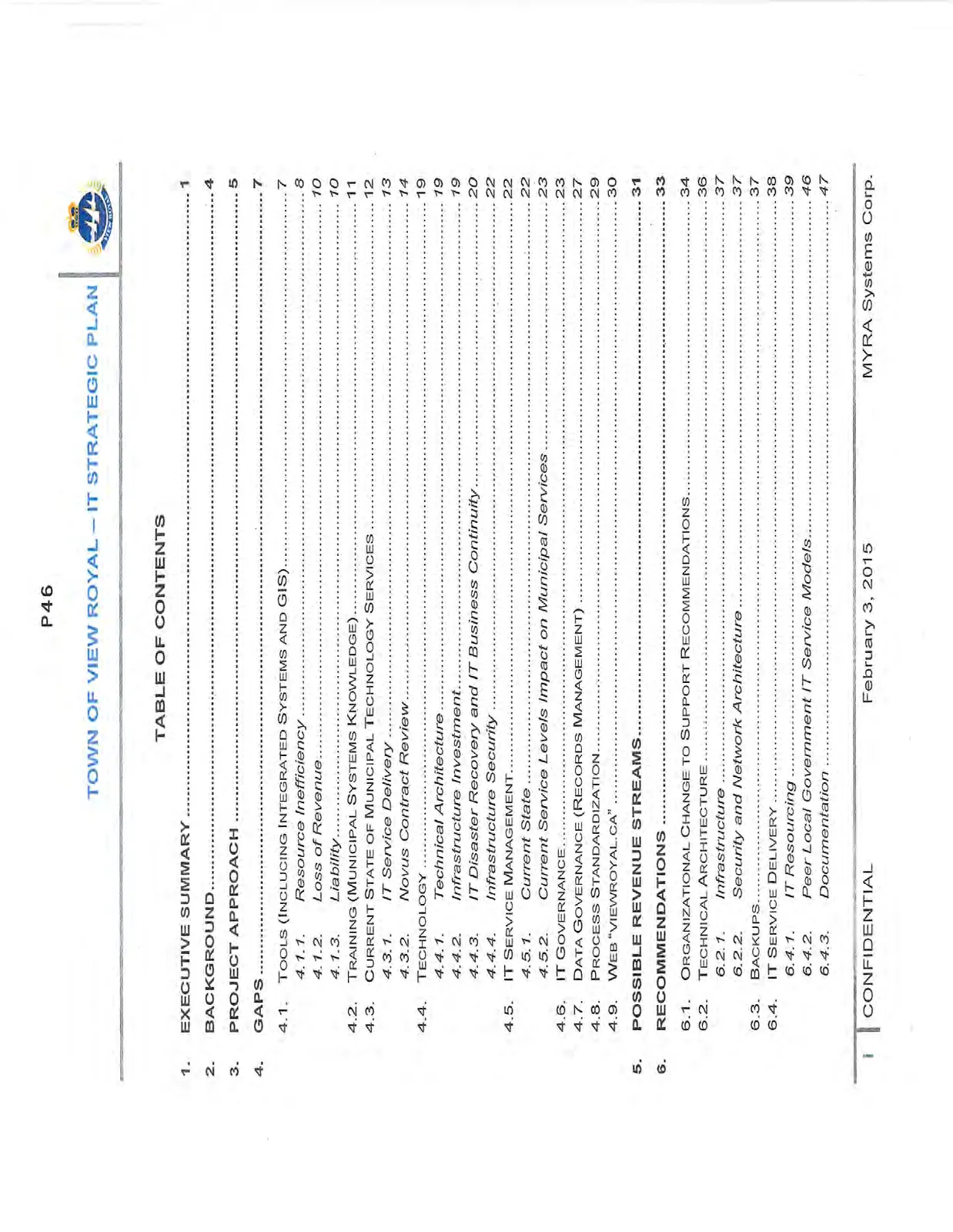
TABLE OF CONTENTS
- EXECUTIVE SUMMARY - 1
- BACKGROUND - 4
- PROJECT APPROACH - 5
- GAPS - 7 4.1. TOOLS (INCLUDING INTEGRATED SYSTEMS AND GIS) - 7 4.1.1. Resource Inefficiency - 8 4.1.2. Loss of Revenue - 10 4.1.3. Liability - 10 4.2. TRAINING (MUNICIPAL SYSTEMS KNOWLEDGE) - 11 4.3. CURRENT STATE OF MUNICIPAL TECHNOLOGY SERVICES - 12 4.3.1. IT Service Delivery - 13 4.3.2. Novus Contract Review - 14 4.4. TECHNOLOGY - 19 4.4.1. Technical Architecture - 19 4.4.2. Infrastructure Investment - 19 4.4.3. IT Disaster Recovery and IT Business Continuity - 20 4.4.4. Infrastructure Security - 22 4.5. IT SERVICE MANAGEMENT - 22 4.5.1. Current State - 22 4.5.2. Current Service Levels Impact on Municipal Services - 23 4.6. IT GOVERNANCE - 23 4.7. DATA GOVERNANCE (RECORDS MANAGEMENT) - 27 4.8. PROCESS STANDARDIZATION - 29 4.9. WEB "VIEWROYAL.CA" - 30
- POSSIBLE REVENUE STREAMS - 31
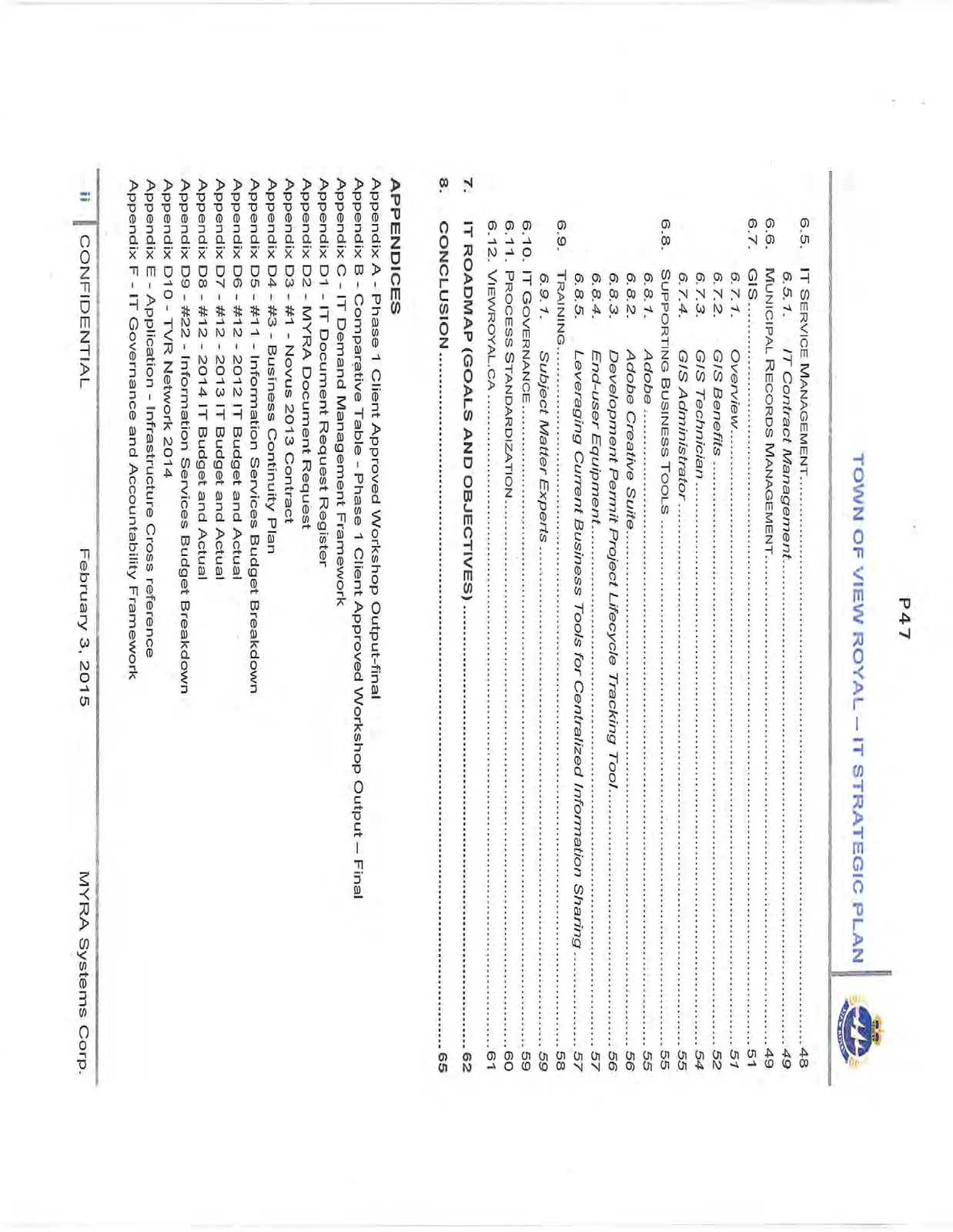
- RECOMMENDATIONS - 33 6.1. ORGANIZATIONAL CHANGE TO SUPPORT RECOMMENDATIONS - 34 6.2. TECHNICAL ARCHITECTURE - 36 6.2.1. Infrastructure - 37 6.2.2. Security and Network Architecture - 37 6.3. BACKUPS - 37 6.4. IT SERVICE DELIVERY - 38 6.4.1. IT Resourcing - 39 6.4.2. Peer Local Government IT Service Models - 46 6.4.3. Documentation - 47 6.5. IT SERVICE MANAGEMENT - 48 6.5.1. IT Contract Management - 49 6.6. MUNICIPAL RECORDS MANAGEMENT - 49 6.7. GIS - 51 6.7.1. Overview - 51 6.7.2. GIS Benefits - 52 6.7.3. GIS Technician - 54 6.7.4. GIS Administrator - 55 6.8. SUPPORTING BUSINESS TOOLS - 55 6.8.1. Adobe - 55 6.8.2. Adobe Creative Suite - 56 6.8.3. Development Permit Project Lifecycle Tracking Tool - 56 6.8.4. End-user Equipment - 57 6.8.5. Leveraging Current Business Tools for Centralized Information Sharing - 57 6.9. TRAINING - 58 6.9.1. Subject Matter Experts - 59 6.10. IT GOVERNANCE - 59 6.11. PROCESS STANDARDIZATION - 60 6.12. VIEWROYAL.CA - 61
- IT ROADMAP (GOALS AND OBJECTIVES) - 62
- CONCLUSION - 65
APPENDICES
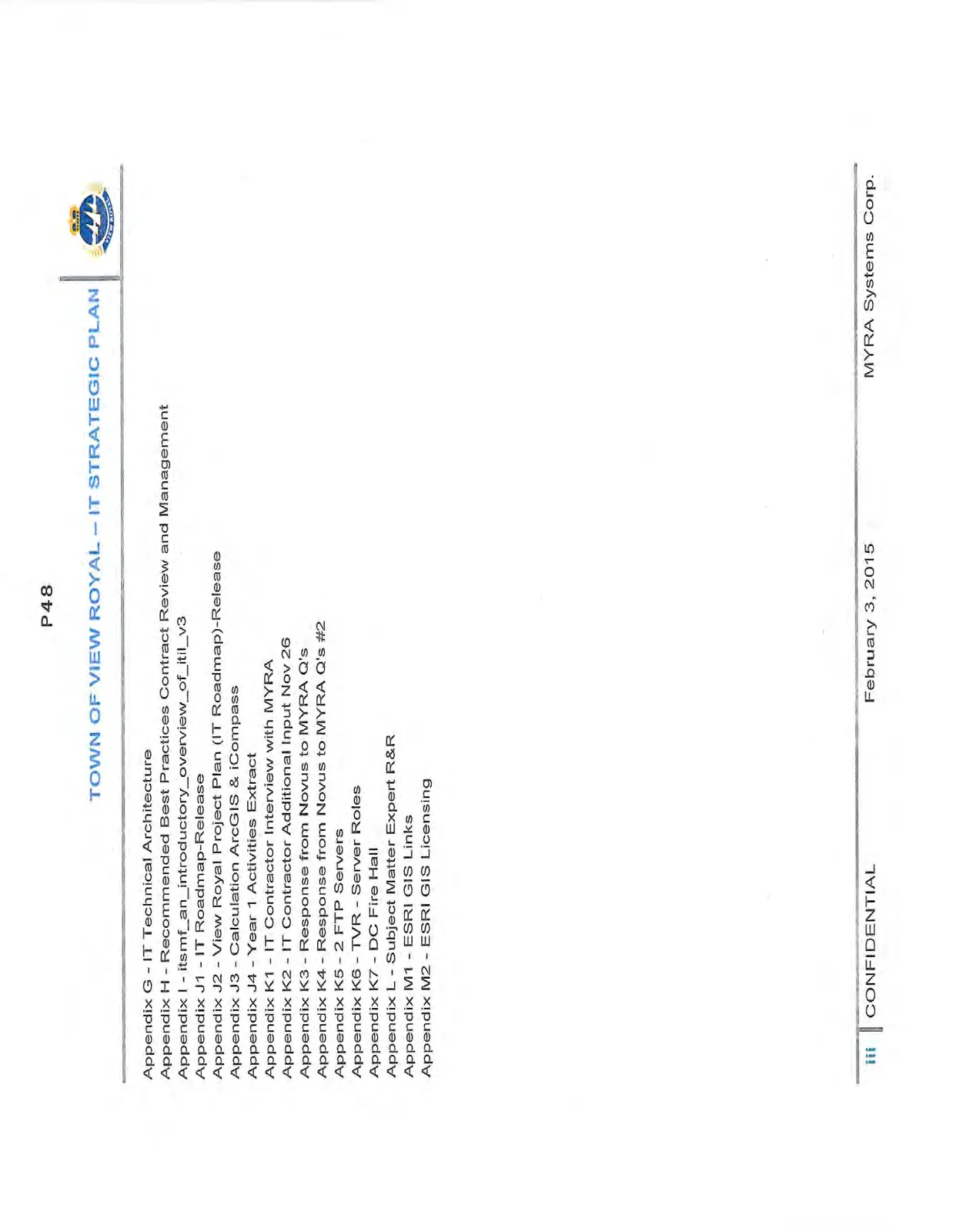
Appendix A - Phase 1 Client Approved Workshop Output-final Appendix B - Comparative Table - Phase 1 Client Approved Workshop Output – Final Appendix C - IT Demand Management Framework Appendix D1 - IT Document Request Register Appendix D2 - MYRA Document Request Appendix D3 - #1 - Novus 2013 Contract Appendix D4 - #3 - Business Continuity Plan Appendix D5 - #11 - Information Services Budget Breakdown Appendix D6 - #12 - 2012 IT Budget and Actual Appendix D7 - #12 - 2013 IT Budget and Actual Appendix D8 - #12 - 2014 IT Budget and Actual Appendix D9 - #22 - Information Services Budget Breakdown Appendix D10 - TVR Network 2014 Appendix E - Application - Infrastructure Cross reference Appendix F - IT Governance and Accountability Framework Appendix G - IT Technical Architecture Appendix H - Recommended Best Practices Contract Review and Management Appendix I - itsmf_an_introductory_overview_of_itil_v3 Appendix J1 - IT Roadmap-Release Appendix J2 - View Royal Project Plan (IT Roadmap)-Release Appendix J3 - Calculation ArcGIS & iCompass Appendix J4 - Year 1 Activities Extract Appendix K1 - IT Contractor Interview with MYRA Appendix K2 - IT Contractor Additional Input Nov 26 Appendix K3 - Response from Novus to MYRA Q's Appendix K4 - Response from Novus to MYRA Q's #2 Appendix K5 - 2 FTP Servers Appendix K6 - TVR - Server Roles Appendix K7 - DC Fire Hall Appendix L - Subject Matter Expert R&R Appendix M1 - ESRI GIS Links Appendix M2 - ESRI GIS Licensing
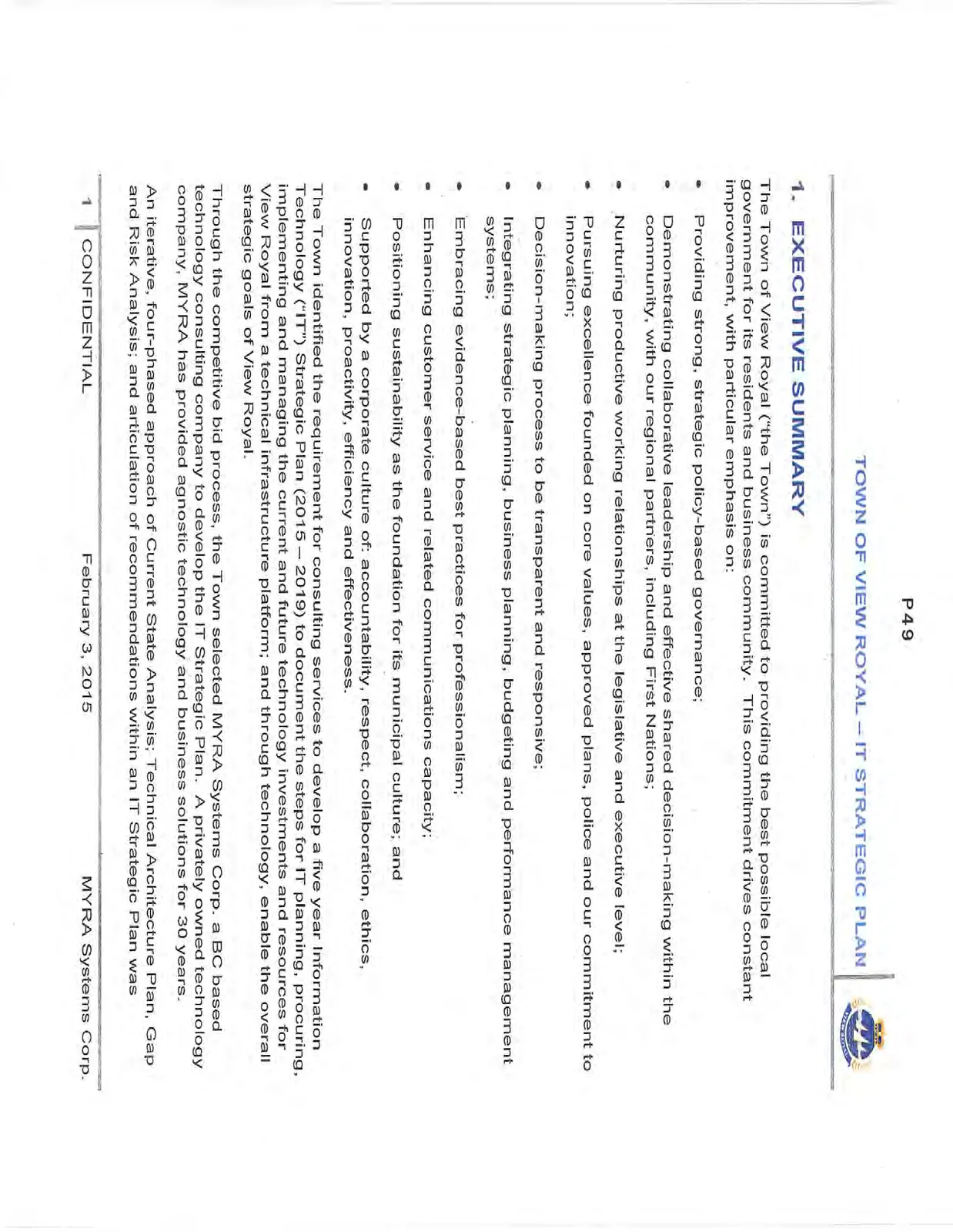
1. EXECUTIVE SUMMARY
The Town of View Royal (“the Town”) is committed to providing the best possible local government for its residents and business community. This commitment drives constant improvement, with particular emphasis on:
- Providing strong, strategic policy-based governance;
- Demonstrating collaborative leadership and effective shared decision-making within the community, with our regional partners, including First Nations;
- Nurturing productive working relationships at the legislative and executive level;
- Pursuing excellence founded on core values, approved plans, police and our commitment to innovation;
- Decision-making process to be transparent and responsive;
- Integrating strategic planning, business planning, budgeting and performance management systems;
- Embracing evidence-based best practices for professionalism;
- Enhancing customer service and related communications capacity;
- Positioning sustainability as the foundation for its municipal culture; and
- Supported by a corporate culture of: accountability, respect, collaboration, ethics, innovation, proactivity, efficiency and effectiveness.
The Town identified the requirement for consulting services to develop a five year Information Technology (“IT”) Strategic Plan (2015 – 2019) to document the steps for IT planning, procuring, implementing and managing the current and future technology investments and resources for View Royal from a technical infrastructure platform; and through technology, enable the overall strategic goals of View Royal.
Through the competitive bid process, the Town selected MYRA Systems Corp. a BC based technology consulting company to develop the IT Strategic Plan. A privately owned technology company, MYRA has provided agnostic technology and business solutions for 30 years.
An iterative, four-phased approach of Current State Analysis; Technical Architecture Plan, Gap and Risk Analysis; and articulation of recommendations within an IT Strategic Plan was undertaken. Supporting the IT Strategic Plan is an IT Roadmap of supporting goals, initiatives and projects. The Town’s five-year IT Roadmap details an iterative approach to simplifying and standardizing its technical infrastructure platform. Augmenting this technical transition are industry standard processes supporting the alignment of IT Services delivery and management with the Town’s overall strategic objectives of: delivering business value; and supporting the Town’s services.
- Gap themes identified during the Current State Analysis Phase were:
- Inadequate tools and lack of access to readily available data through integrated systems;
- Insufficient training and knowledge of municipal business systems;
- Unreliable end-user desktop and supporting IT infrastructure;
- The absence of industry standards-based IT service delivery, management and processes; and
- Knowledge of overall IT governance.
The Technical Architecture Review identified opportunities for:
- IT Systems stabilization, standardization, and best practices;
- IT infrastructure simplification; and
- IT Disaster Recovery and IT Business Continuity.
These gaps are typical in environments where IT services are systemically underfunded, and there is limited understanding in the value of stable, efficient and flexible technology services capable of supporting the needs of the business and its customers.
The recommendations arising from the IT Strategic Plan and comprehensive five year IT Roadmap articulate the projects, initiatives, timelines and expected resources to achieve and deliver measureable benefits with the expected outcome of a stable, reliable, effective, efficient, flexible and secure information technology environment. The projects and initiatives will enable these expected outcomes and support the recommendations for:
- Maturation of IT infrastructure, services and management through development of IT governance; information technology stabilization, standardization, simplification and automation;
- Delivery of IT services based on IT industry standards and best-practices and enabled by a widely skilled, professional, mature IT services team;
- Integrated technology systems providing a “single source of truth”;
- Stable, reliable, and effective Municipal Records management;
- Increased knowledge and skills in the Town’s municipal business applications through targeted internal training and skills development opportunities, and formalization of internal Subject Matter expertise; and
- Understanding the benefits of organizational Change Management as an important business tool and the needs for both the Town and its IT service delivery partner to integrate organizational Change and Communications framework into its projects and initiatives.
The Town’s staff resources actively participated in the IT Strategic Plan discovery sessions and workshops. Participants were well-prepared for all workshops, having undertaken their preparatory work of capturing ideas and pain-points in advance, ensuring the sessions were productive. Staff and leadership were responsive in the weeks following the on-site sessions providing clarification, additional information, and facilitating introductions and information exchange with various software and systems vendors.
The Town’s staff resources are aware of the impact of the current state of technology systems and services. The awareness extends to their need for greater understanding and increased skillset with the Town’s municipal business systems to improve their ability to deliver effective and efficient customer service. Recognition of the collective “can do” attitude and commitment by the staff to the Town’s customers is commendable. This “can do” attitude, effort and commitment is best redirected to “providing the best possible local government for its residents and business community” driven by “constant improvement” through efficient and effective value added services. To realize the benefits from value added customer service delivery requires a stable, reliable, flexible technology infrastructure environment enabled through mature IT service delivery and management; and staff knowledgeable in its municipal business systems with access to integrated, secure and reliable data.
The 2015 – 2019 IT Strategic Plan, IT Roadmap and recommended Best Practice appendices provide the Town with a comprehensive package that enables the Town to make well-informed decisions regarding the funding, execution and management of their IT services for the next five years.
6. RECOMMENDATIONS
The mission of Information Technology (“IT”) services at the Town of View Royal is to provide citizens, the business community, and Town employees with timely, convenient access to appropriate information and services through the use of technology.
Five prioritized IT Strategic goals are recommended as identified as key contributors to delivering simple, effective and flexible technology services to the Town:
- Environmentally Sustainable, Secure, Stable Technology infrastructure;
- Professional Frameworks and Standards to Deliver Service and Business Value;
- Accessible, Integrated Corporate and Business Area Information;
- Continuous Learning and Improvement; and
- IT Leadership and Mission Effectiveness through IT Governance and Accountability.
There are six fundamental principles to guide and support IT services at the Town of View Royal.
Effectively communicate information technology plans, projects and achievements to staff and customers.
Engage key organizational representatives from all departments in an IT governance partnership; prioritizing technology enabled projects to support municipal goals and objectives from an enterprise perspective.
Capture data once to eliminate potential for error, duplication of effort and to mitigate cost. Share data whenever possible through use of common data to the fullest extent supported by effective data governance through data policies for data sharing, access, standardization, quality and consistent data naming conventions.
Information technology will be best managed as an investment with annual allocation of funds sufficient to cover deprecated systems (applications and hardware infrastructure) before lifecycle end of 5 years; and address project and infrastructure requirements through multi-year planning and funding strategies.
Evaluate business processes for redesign (continuous improvement) opportunities prior to automation. Integrate existing technologies to exploit functional commonalities across departmental boundaries and leverage new technologies to realize new business methods.
Incrementally build knowledge through continuous learning to mature business application skills; and build sustainability through leveraging subject matter experts and importance allocated to a knowledge succession plan.
6.1. ORGANIZATIONAL CHANGE TO SUPPORT RECOMMENDATIONS
The Town’s staff resources are a committed group with a “can do” attitude demonstrated by their commitment to meet deadlines and service requirements in an inefficient environment reliant on multiple types, sources and locations of information. Within the “can do” environment is a prevailing sense of acceptance of the current status quo and a low expectation of experiencing actual improvements as an outcome of this IT Strategic Plan and Roadmap engagement. During the initial workshop sessions some participants articulated the expectation of improvements solely on the internal hire of an IT resource. Within the context of these discussions the MYRA Consultant introduced the requirement for process-driven approach to the delivery of IT services, and that improvement was not achieved through an internal IT resource.
Management of end-user (and Council) expectations is a critical component of successful IT service delivery. There will be resistance to formalizing processes and early demonstration of beneficial outcomes will be needed. A communications plan supporting IT changes will be required and a capability in strong organizational change and communications management will increase the probability of successful realization of beneficial outcomes.
Change is about the transition from current to future state, and requires transformation of each involved individual in varying degrees. Effective change is not doing new processes, tasks or activities the old way; it is about adapting behaviours, skills, knowledge and capacity. Organizational change is accomplished individually. For the organization to realize successful change all individuals (participants) must change.
The risk, and a significant one, is that each and every user at every level of the organization will have to change in order for IT to incrementally improve service delivery. Achieving satisfaction with IT service delivery does not rest solely on the shoulders of IT. Exceptional IT service is a bi-directional responsibility between the IT service team and the business (end-users) developing consensus on the components and response time expectations of Service Response Levels; consensus on introducing business enabling opportunities; and the impact and probability of risk associated with each. Exceptional IT Service is not about asking and receiving, it is about a partnership of discussing what the business opportunity or challenge is, opportunities to benefit the external community, and within IT’s service spectrum of internal and external capacity, what is the most appropriate solution. It is NOT about users learning IT, it IS about having frequent dialogue between users and IT resources to understand the business requirements from both an internal and external perspective, and identifying how or where the Town can leverage this knowledge.
Users will have to understand that in the early stages of building a stable IT environment they may still experience service interruptions as the Town’s system goes through stabilization and any new IT team becomes familiar with the environment. Targeted, effective communications supporting each change will be required outlining the expected benefit to the business with ongoing progress reports demonstrating how the short-term adjustments are contributing to achieving effective IT service, and enabling business. Effective changes are introduced, justified, promoted, measured and success celebrated, and where barriers or impediments have been presented, be open and transparent about those as well. Exceptional service delivery includes open and transparent communications.
The Town requires a new methodology to delivering IT services. The current end-user definition of improved IT service and system is “right here, right now” and reactive one-on-one fixes. That is not to say there won’t be urgent and immediate IT service requirements, however the reactive will mature to proactive with the goal of service reliability that does not require end-user “right here, right now”. A component of Service Response Level identification is to understand “business” critical or highly important situations that require immediate response that traditionally do not fall within the standard IT “critical” criteria (e.g. network outage at the Fire Hall supersedes unresponsive Vadim).
Reinforcement of change is the biggest hurdle as it is cultural and not technical; and often the results from the change are not immediately visible. Department Directors and the CAO will need to be monitoring end-user acceptance, and where deemed appropriate, may need to work with IT to tweak services offered within the Service Response Levels to ensure services are delivered to best enable business; and deliver exceptional IT service within available capacity.
The recipe for successfully stabilizing, simplifying and standardizing IT services, enabling IT to transform into a business enabler will start at the top with visible and active support of the IT transition roadmap, understanding there will be barriers to overcome and behavioural modifications to “help IT enable the business”. For the management layers it will mean actioning the change, and supporting your direct reports through their own transition. However, the benefit to management is that developing competencies in managing change is a business competency with on-going value.
With IT demonstrating incremental service successes communicated in a clear and easily understood manner, IT will evolve into being capable of demonstrating value to the Town as a business partner.
6.2. TECHNICAL ARCHITECTURE
The benefit of a defined technical architecture is the documented alignment of technology and the Town’s strategic goals. The objectives of a defined Technical Architecture are to: standardize and simplify supporting infrastructure; stabilize and right-size business applications; define service levels; manage service demand; define processes, policies, and procedures; and define the appropriate level of IT governance achieving the Town’s requirements while providing sufficient flexibility to adjust to internal and external influences.
The complete Town of View Royal Technical Architecture is attached as Appendix G.
There are four standard Technical Architecture principles: simplify, automate, align and standardize. To address the Town’s current instability of its infrastructure and absence of IT service processes, there is a preceding dependency requirement of stabilization. The proposed IT Roadmap of projects and initiatives has been grouped into four incremental Phases that integrate the five requirements at all levels as follows:
- Baseline Stabilization and Remediation;
- Implement Standards and Best Practices;
- Disaster Recovery Planning; and
- Disaster Recovery Implementation
The Town’s historical approach to IT of “cheap and proud of it” needs to mature in order to mitigate the known risks and the considerable unquantifiable cost of non-value added staff resource effort in the absence of stable systems and available tools. The recommendations and supporting projects and initiatives are not a request for a blank cheque to create a “Cadillac” infrastructure. The recommended projects and initiatives are prudent and practical, based on MYRA’s 30 years of delivering technical services to small, medium and enterprise public and private sector clients. Recommendations are to “best benefit” of the Town with “best benefit” defined as balancing stable, flexible, efficient business-enabling technology services with prudent IT investment respecting financial capacity.
Recommendation
The Town transition from “cheap and proud of it” approach to IT investment and associated service delivery to Technology-based fiscal prudence achieved through the leveraging of efficient technology infrastructure and business applications enabling the Town’s human resources to deliver value-added services to its customers.
Reference IT Roadmap Objectives: 1.2.1; 2.1.1; 2.2.1; 2.2.2; 2.2.3; 2.2.4; 2.2.5; 2.2.6; and Sections 5; 6 and 7.
6.2.1. Infrastructure
The Town’s present virtualization approach is not flexible or efficient. The current Microsoft Hyper-V virtualization technology is insufficient to support standardization and portability of technologies; and current approach of server-based Directly Attached Storage (“DAS”) is incapable of meeting the requirements of: simplicity, stable, standardized, flexible and/or scalable Disaster Recovery and Business Continuity services.
Reference: Page 14: “Virtualization; and Storage” Appendix G Technical Architecture.
Recommendation
The Town implement VMware virtualization and shared storage to provide options for hardware maintenance and patching testing; Business Continuity through redundant and readily available near or on-line infrastructure and business systems.
Reference IT Roadmap Objectives: 2.2.2; 2.2.4; 2.2.6
6.2.2. Security and Network Architecture
To mitigate the risk of hacking and other forms of unauthorized access that could be achieved due to the Town’s present simple network design, the Town would be best served through an early focus on having a security architecture drafted and implemented based on best practices.
Reference Page 16 & 17: “Communications Infrastructure; and Privacy and Security Architecture” Appendix G Technical Architecture.
Recommendation
Design and implement a best practices security architecture that supports the town business requirements including accessibility of applications to appropriate users while protecting the town data from attacks and risk of data loss.
Reference IT Roadmap Objectives: 2.1.3; 2.2.6
6.3. BACKUPS
Data and system configuration backups provide the most basic of Disaster Recovery services; and become more effective as a rudimentary Disaster Recovery approach when supported by solid systems, build and configuration documentation.
Backups are a component of enabling the Town a method of achieving a “Recovery Point Objective”. The Town requires an effective Backup methodology for its data (at a minimum) and systems.
Recommendation
The Town should undertake a backup inventory to document all current technology assets included (data, databases, system configurations, etc.) and the backup approach (full, incremental, differential) and lifecycle of backup (daily, weekly); and the step-by-step method to restore.
The Town should run a test of backups between sites (Town Hall and Fire Hall) to test data load transmission, data transmission time, and determine best approach to backups between sites using VPN (Virtual Private Network) technology.
Reference IT Roadmap Objectives: 1.1.1; 1.1.2; 1.1.4
6.4. IT SERVICE DELIVERY
To effectively manage IT service demand and provide stable and available business technology services, the end-to-end delivery of IT infrastructure platforms is best arranged in a service-based architecture with the technical support integrating open processes and standards. These processes and standards are referred to as ITIL. ITIL is a best practice framework intentionally drawn from both the public and private sectors. ITIL describes how IT resources should be organized to deliver business value, documenting the processes, functions and roles of IT Service Management (ITSM). At a high level, ITIL services are split into two groups: IT Service Delivery and IT Service Management. The following IT Service Delivery components are best managed when delivered to ITIL processes:
- Change Management
- Incident Management
- Release Management
- Risk Management
- SLA (Service Level Agreement) based services
- Security Audits and Assessments
- Decision and Business Case Support
- Application Integration Services
- Management and Reporting Services
- System and Process Documentation
- Line of Business Application Support
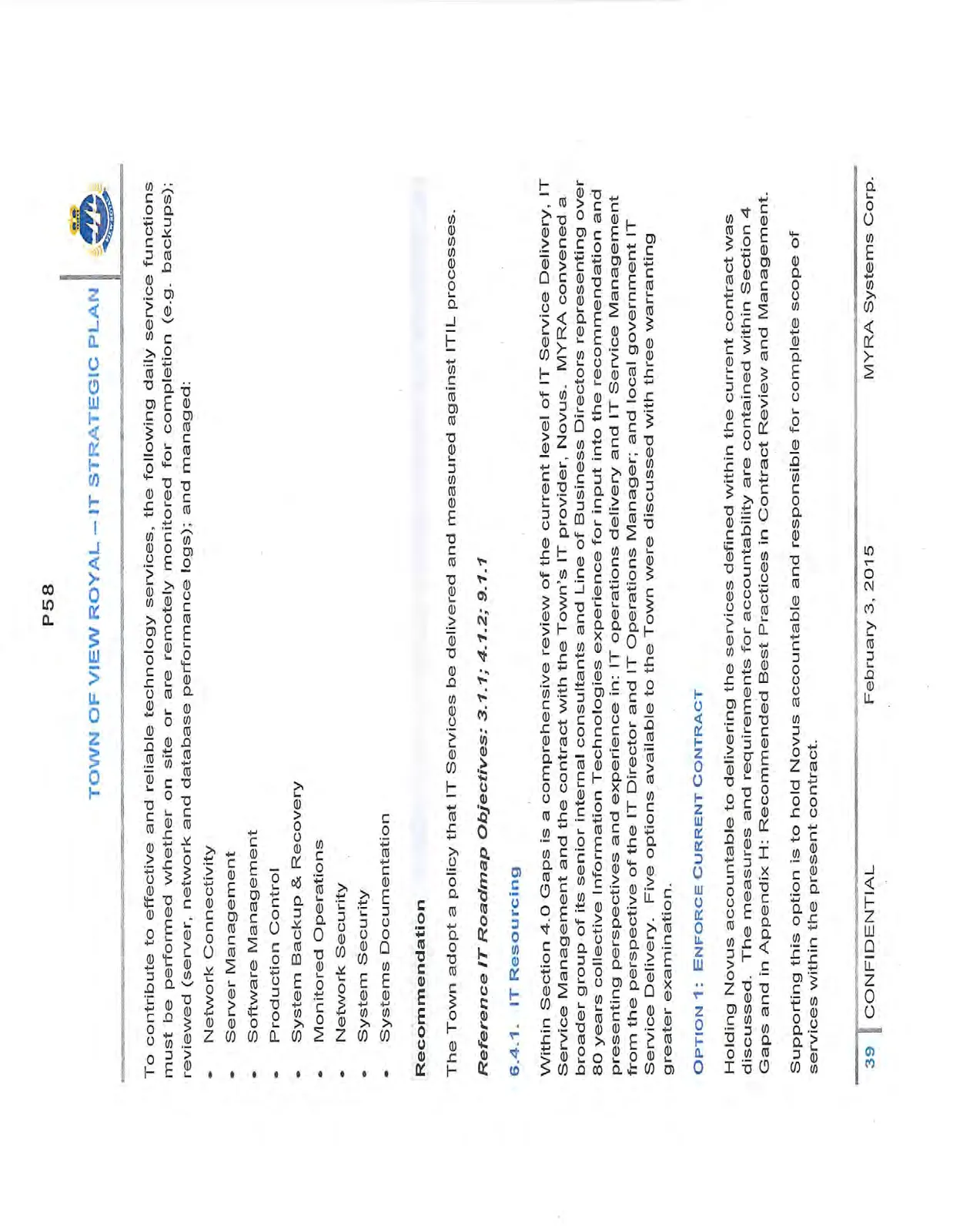
To contribute to effective and reliable technology services, the following daily service functions must be performed whether on site or are remotely monitored for completion (e.g. backups); reviewed (server, network and database performance logs); and managed:
- Network Connectivity
- Server Management
- Software Management
- Production Control
- System Backup & Recovery
- Monitored Operations
- Network Security
- System Security
- Systems Documentation
Recommendation
The Town adopt a policy that IT Services be delivered and measured against ITIL processes.
Reference IT Roadmap Objectives: 3.1.1; 4.1.2; 9.1.1
6.4.1. IT Resourcing
Within Section 4.0 Gaps is a comprehensive review of the current level of IT Service Delivery, IT Service Management and the contract with the Town’s IT provider, Novus. MYRA convened a broader group of its senior internal consultants and Line of Business Directors representing over 80 years collective Information Technologies experience for input into the recommendation and presenting perspectives and experience in: IT operations delivery and IT Service Management from the perspective of the IT Director and IT Operations Manager; and local government IT Service Delivery. Five options available to the Town were discussed with three warranting greater examination.
OPTION 1: ENFORCE CURRENT CONTRACT
Holding Novus accountable to delivering the services defined within the current contract was discussed. The measures and requirements for accountability are contained within Section 4 Gaps and in Appendix H: Recommended Best Practices in Contract Review and Management.
Supporting this option is to hold Novus accountable and responsible for complete scope of services within the present contract.
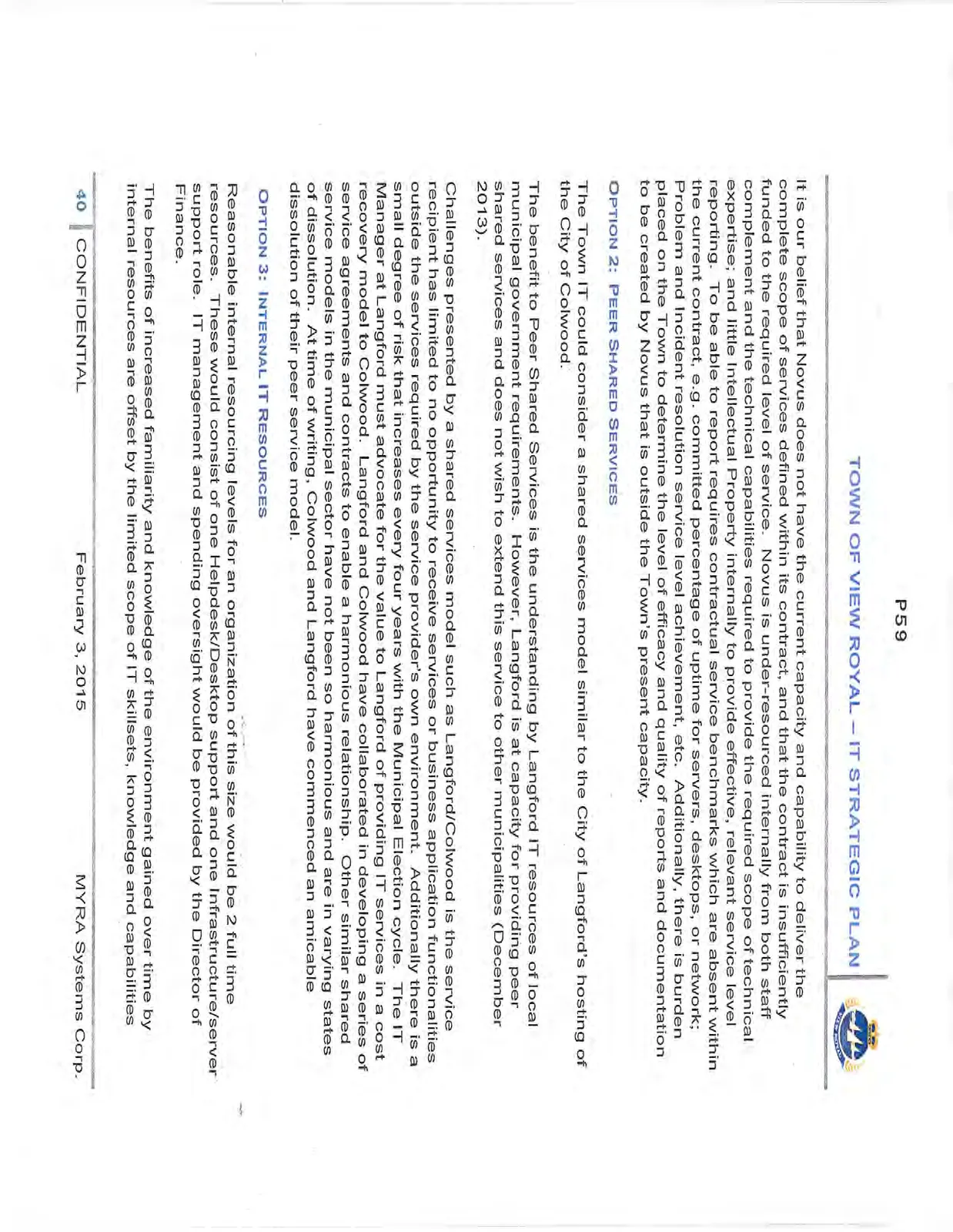
It is our belief that Novus does not have the current capacity and capability to deliver the complete scope of services defined within its contract, and that the contract is insufficiently funded to the required level of service. Novus is under-resourced internally from both staff complement and the technical capabilities required to provide the required scope of technical expertise; and little Intellectual Property internally to provide effective, relevant service level reporting. To be able to report requires contractual service benchmarks which are absent within the current contract, e.g. committed percentage of uptime for servers, desktops, or network; Problem and Incident resolution service level achievement, etc. Additionally, there is burden placed on the Town to determine the level of efficacy and quality of reports and documentation to be created by Novus that is outside the Town’s present capacity.
OPTION 2: PEER SHARED SERVICES
The Town IT could consider a shared services model similar to the City of Langford’s hosting of the City of Colwood.
The benefit to Peer Shared Services is the understanding by Langford IT resources of local municipal government requirements. However, Langford is at capacity for providing peer shared services and does not wish to extend this service to other municipalities (December 2013).
Challenges presented by a shared services model such as Langford/Colwood is the service recipient has limited to no opportunity to receive services or business application functionalities outside the services required by the service provider’s own environment. Additionally there is a small degree of risk that increases every four years with the Municipal Election cycle. The IT Manager at Langford must advocate for the value to Langford of providing IT services in a cost recovery model to Colwood. Langford and Colwood have collaborated in developing a series of service agreements and contracts to enable a harmonious relationship. Other similar shared service models in the municipal sector have not been so harmonious and are in varying states of dissolution. At time of writing, Colwood and Langford have commenced an amicable dissolution of their peer service model.
OPTION 3: INTERNAL IT RESOURCES
Reasonable internal resourcing levels for an organization of this size would be 2 full time resources. These would consist of one Helpdesk/Desktop support and one Infrastructure/server support role. IT management and spending oversight would be provided by the Director of Finance.
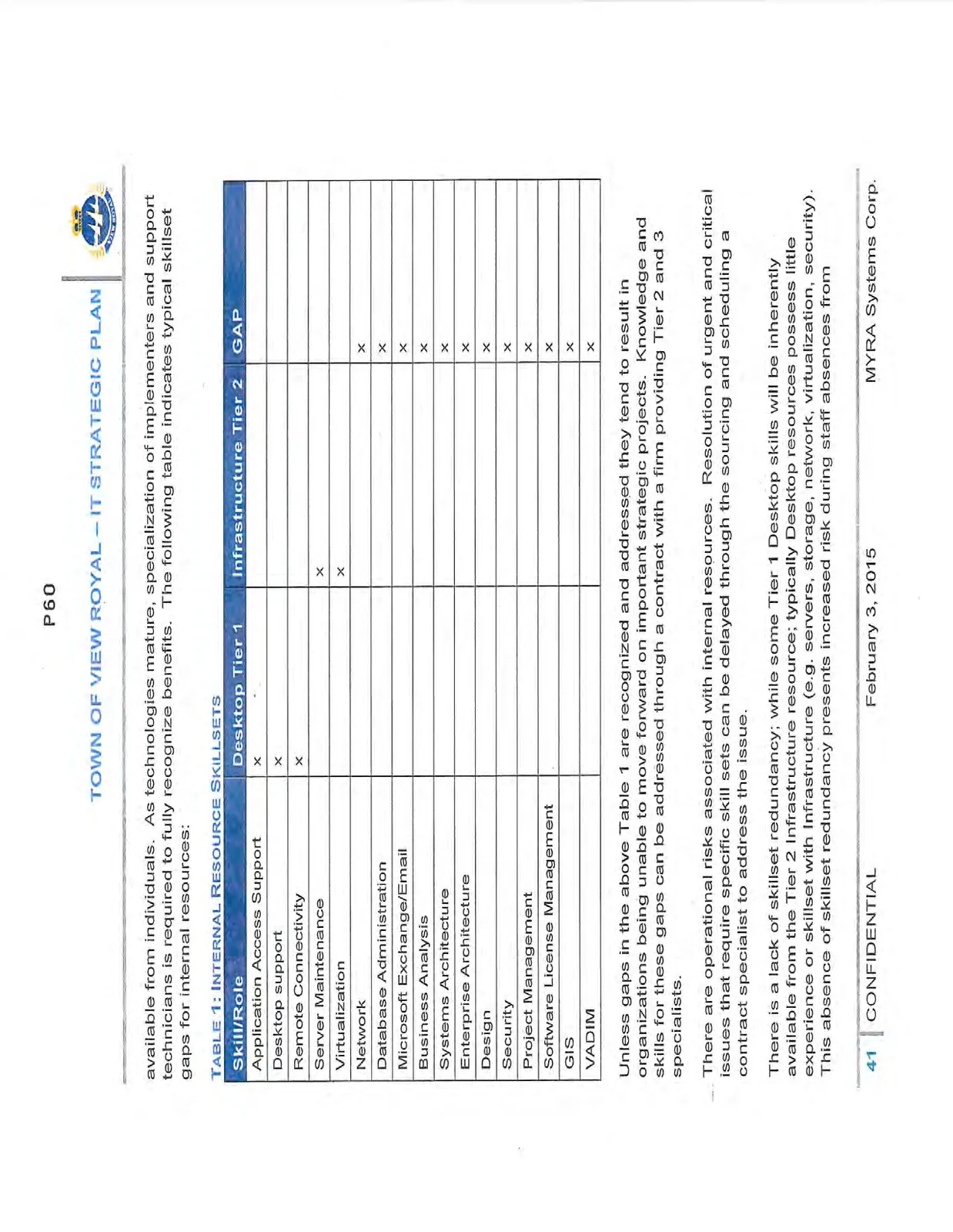
The benefits of increased familiarity and knowledge of the environment gained over time by internal resources are offset by the limited scope of IT skillsets, knowledge and capabilities available from individuals. As technologies mature, specialization of implementers and support technicians is required to fully recognize benefits. The following table indicates typical skillset gaps for internal resources:
TABLE 1: INTERNAL RESOURCE SKILLSETS
| Skill/Role | Desktop Tier 1 | Infrastructure Tier 2 | GAP |
|---|---|---|---|
| Application Access Support | x | ||
| Desktop support | x | ||
| Remote Connectivity | x | ||
| Server Maintenance | x | ||
| Virtualization | x | ||
| Network | x | ||
| Database Administration | x | ||
| Microsoft Exchange/Email | x | ||
| Business Analysis | x | ||
| Systems Architecture | x | ||
| Enterprise Architecture | x | ||
| Design | x | ||
| Security | x | ||
| Project Management | x | ||
| Software License Management | x | ||
| GIS | x | ||
| VADIM | x |
Unless gaps in the above Table 1 are recognized and addressed they tend to result in organizations being unable to move forward on important strategic projects. Knowledge and skills for these gaps can be addressed through a contract with a firm providing Tier 2 and 3 specialists.
There are operational risks associated with internal resources. Resolution of urgent and critical issues that require specific skill sets can be delayed through the sourcing and scheduling a contract specialist to address the issue.
There is a lack of skillset redundancy; while some Tier 1 Desktop skills will be inherently available from the Tier 2 Infrastructure resource; typically Desktop resources possess little experience or skillset with Infrastructure (e.g. servers, storage, network, virtualization, security). This absence of skillset redundancy presents increased risk during staff absences from vacation; illness and attrition. Attrition itself presents knowledge transfer gaps when there is an absence of crossover time within staff transition.
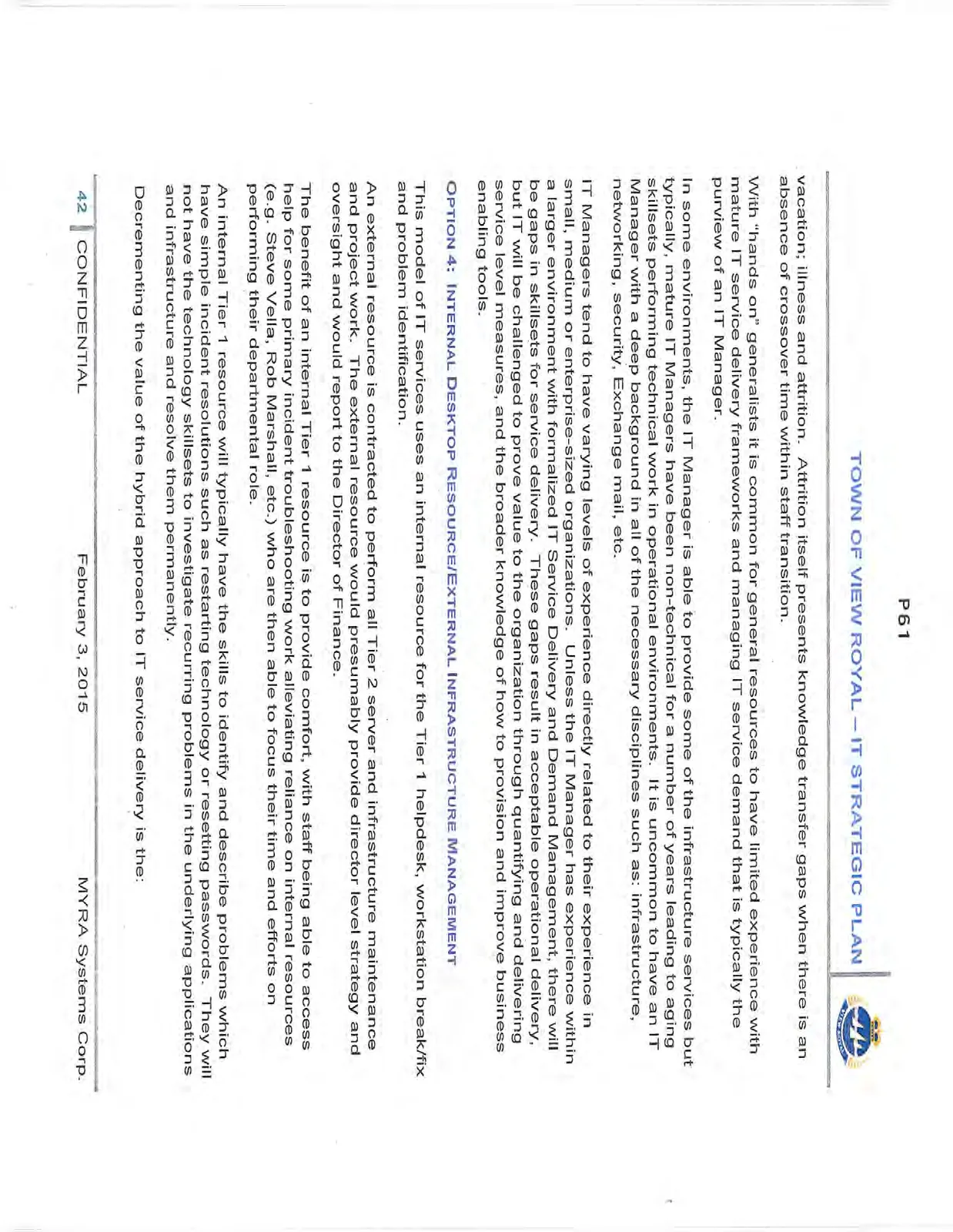
With “hands on” generalists it is common for general resources to have limited experience with mature IT service delivery frameworks and managing IT service demand that is typically the purview of an IT Manager.
In some environments, the IT Manager is able to provide some of the infrastructure services but typically, mature IT Managers have been non-technical for a number of years leading to aging skillsets performing technical work in operational environments. It is uncommon to have an IT Manager with a deep background in all of the necessary disciplines such as: infrastructure, networking, security, Exchange mail, etc.
IT Managers tend to have varying levels of experience directly related to their experience in small, medium or enterprise-sized organizations. Unless the IT Manager has experience within a larger environment with formalized IT Service Delivery and Demand Management, there will be gaps in skillsets for service delivery. These gaps result in acceptable operational delivery, but IT will be challenged to prove value to the organization through quantifying and delivering service level measures, and the broader knowledge of how to provision and improve business enabling tools.
OPTION 4: INTERNAL DESKTOP RESOURCE/EXTERNAL INFRASTRUCTURE MANAGEMENT
This model of IT services uses an internal resource for the Tier 1 helpdesk, workstation break/fix and problem identification.
An external resource is contracted to perform all Tier 2 server and infrastructure maintenance and project work. The external resource would presumably provide director level strategy and oversight and would report to the Director of Finance.
The benefit of an internal Tier 1 resource is to provide comfort, with staff being able to access help for some primary incident troubleshooting work alleviating reliance on internal resources (e.g. Steve Vella, Rob Marshall, etc.) who are then able to focus their time and efforts on performing their departmental role.
An internal Tier 1 resource will typically have the skills to identify and describe problems which have simple incident resolutions such as restarting technology or resetting passwords. They will not have the technology skillsets to investigate recurring problems in the underlying applications and infrastructure and resolve them permanently.
Decrementing the value of the hybrid approach to IT service delivery is the:
- Need for management and oversight of the internal resource enabled by an understanding of IT service delivery frameworks (e.g. ITIL); technical nomenclature; and management of IT service demand; and
- Desktop resource backfill (augmentation) for illness, vacations and training. The requirement for Desktop augmentation could be provided as a component of the external IT service delivery contract as an added service cost.
Several of the Town’s staff presently perform this Tier 1 role as stated above. Any issues that cannot be resolved by staff are being recorded for the next on-site visit from Novus.
The funding for a Tier 1 onsite helpdesk and workstation break/fix technician is better allocated to an external resource that has correct training and maturity to leverage the systems, technology and desktop automation to provide better support for the staff.
To summarize, the funds are better spent on having the users report their own issues and having a more skilled and knowledgeable resource undertake solving the problems permanently.
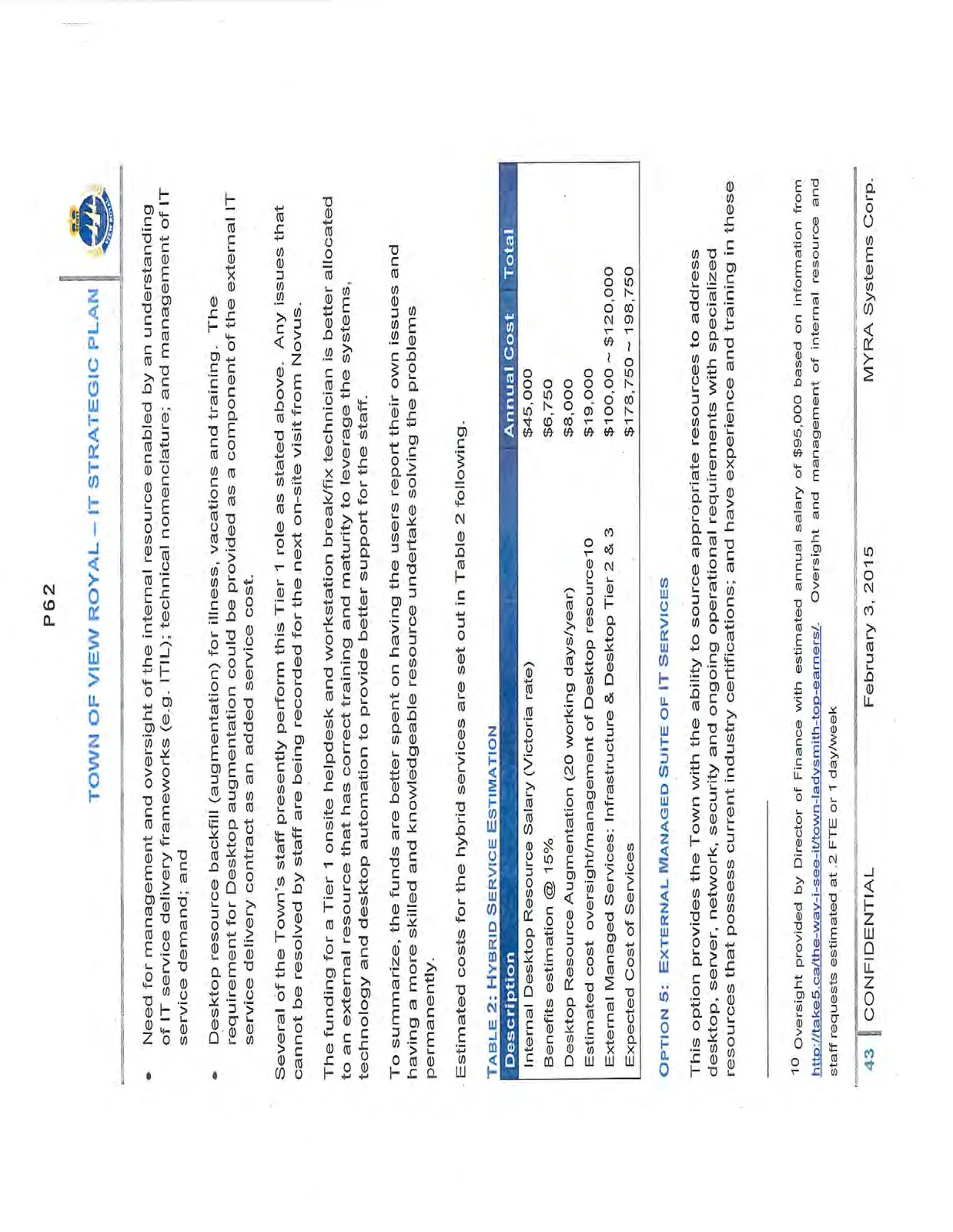
Estimated costs for the hybrid services are set out in Table 2 following.
TABLE 2: HYBRID SERVICE ESTIMATION
| Description | Annual Cost | Total |
|---|---|---|
| Internal Desktop Resource Salary (Victoria rate) | $45,000 | |
| Benefits estimation @ 15% | $6,750 | |
| Desktop Resource Augmentation (20 working days/year) | $8,000 | |
| Estimated cost oversight/management of Desktop resource¹⁰ | $19,000 | |
| External Managed Services: Infrastructure & Desktop Tier 2 & 3 | $100,00 - $120,000 | |
| Expected Cost of Services | $178,750 ~ 198,750 |
¹⁰ Oversight provided by Director of Finance with estimated annual salary of $95,000 based on information from http://take5.ca/the-way-i-see-it/town-ladysmith-top-earners/. Oversight and management of internal resource and staff requests estimated at .2 FTE or 1 day/week
OPTION 5: EXTERNAL MANAGED SUITE OF IT SERVICES
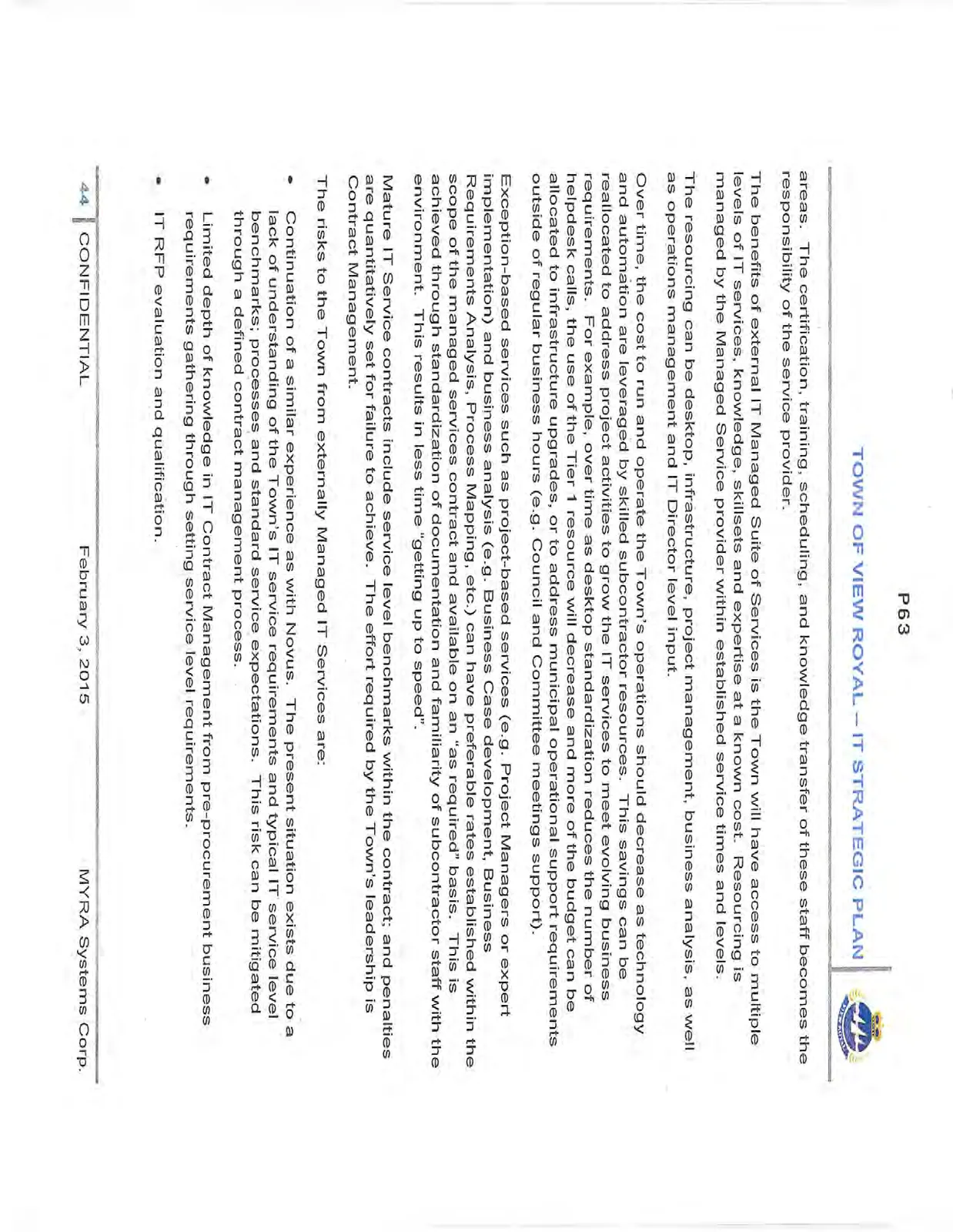
This option provides the Town with the ability to source appropriate resources to address desktop, server, network, security and ongoing operational requirements with specialized resources that possess current industry certifications; and have experience and training in these areas. The certification, training, scheduling, and knowledge transfer of these staff becomes the responsibility of the service provider.
The benefits of external IT Managed Suite of Services is the Town will have access to multiple levels of IT services, knowledge, skillsets and expertise at a known cost. Resourcing is managed by the Managed Service provider within established service times and levels.
The resourcing can be desktop, infrastructure, project management, business analysis, as well as operations management and IT Director level input.
Over time, the cost to run and operate the Town’s operations should decrease as technology and automation are leveraged by skilled subcontractor resources. This savings can be reallocated to address project activities to grow the IT services to meet evolving business requirements. For example, over time as desktop standardization reduces the number of helpdesk calls, the use of the Tier 1 resource will decrease and more of the budget can be allocated to infrastructure upgrades, or to address municipal operational support requirements outside of regular business hours (e.g. Council and Committee meetings support).
Exception-based services such as project-based services (e.g. Project Managers or expert implementation) and business analysis (e.g. Business Case development, Business Requirements Analysis, Process Mapping, etc.) can have preferable rates established within the scope of the managed services contract and available on an “as required” basis. This is achieved through standardization of documentation and familiarity of subcontractor staff with the environment. This results in less time “getting up to speed”.
Mature IT Service contracts include service level benchmarks within the contract; and penalties are quantitatively set for failure to achieve. The effort required by the Town’s leadership is Contract Management.
The risks to the Town from externally Managed IT Services are:
- Continuation of a similar experience as with Novus. The present situation exists due to a lack of understanding of the Town’s IT service requirements and typical IT service level benchmarks; processes and standard service expectations. This risk can be mitigated through a defined contract management process.
- Limited depth of knowledge in IT Contract Management from pre-procurement business requirements gathering through setting service level requirements.
- IT RFP evaluation and qualification.
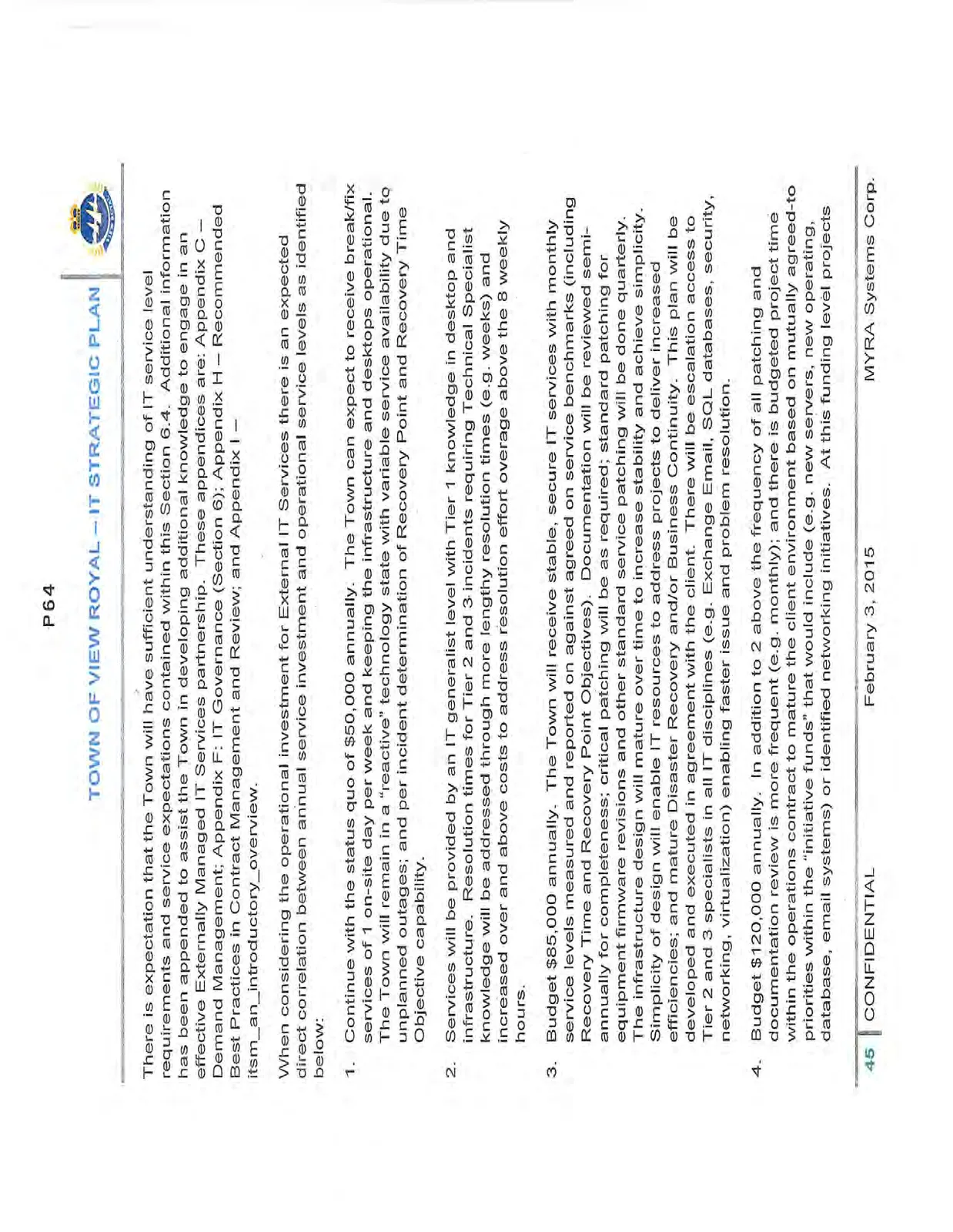
There is expectation that the Town will have sufficient understanding of IT service level requirements and service expectations contained within this Section 6.4. Additional information has been appended to assist the Town in developing additional knowledge to engage in an effective Externally Managed IT Services partnership. These appendices are: Appendix C – Demand Management; Appendix F: IT Governance (Section 6); Appendix H – Recommended Best Practices in Contract Management and Review; and Appendix I – itsm_an_introductory_overview.
When considering the operational investment for External IT Services there is an expected direct correlation between annual service investment and operational service levels as identified below:
- Continue with the status quo of $50,000 annually. The Town can expect to receive break/fix services of 1 on-site day per week and keeping the infrastructure and desktops operational. The Town will remain in a “reactive” technology state with variable service availability due to unplanned outages; and per incident determination of Recovery Point and Recovery Time Objective capability.
- Services will be provided by an IT generalist level with Tier 1 knowledge in desktop and infrastructure. Resolution times for Tier 2 and 3 incidents requiring Technical Specialist knowledge will be addressed through more lengthy resolution times (e.g. weeks) and increased over and above costs to address resolution effort overage above the 8 weekly hours.
- Budget $85,000 annually. The Town will receive stable, secure IT services with monthly service levels measured and reported on against agreed on service benchmarks (including Recovery Time and Recovery Point Objectives). Documentation will be reviewed semi-annually for completeness; critical patching will be as required; standard patching for equipment firmware revisions and other standard service patching will be done quarterly. The infrastructure design will mature over time to increase stability and achieve simplicity. Simplicity of design will enable IT resources to address projects to deliver increased efficiencies; and mature Disaster Recovery and/or Business Continuity. This plan will be developed and executed in agreement with the client. There will be escalation access to Tier 2 and 3 specialists in all IT disciplines (e.g. Exchange Email, SQL databases, security, networking, virtualization) enabling faster issue and problem resolution.
- Budget $120,000 annually. In addition to 2 above the frequency of all patching and documentation review is more frequent (e.g. monthly); and there is budgeted project time within the operations contract to mature the client environment based on mutually agreed-to priorities within the “initiative funds” that would include (e.g. new servers, new operating, database, email systems) or identified networking initiatives. At this funding level projects are known and operational activities are optimized to ensure best value for dollar. There will be regular access to Tier 2 and 3 specialists in all IT disciplines to manage service delivery (e.g. Exchange Email, SQL databases, security, networking, and virtualization). Regular maintenance by these specialists will result in consistent service delivery and reduced risk to the organization. Availability of consistent director level expertise for IT budgeting, planning and design of infrastructure upgrades (e.g. new servers, new operating, database, email systems) or new networking initiatives will support strategic objectives.
Recommendation
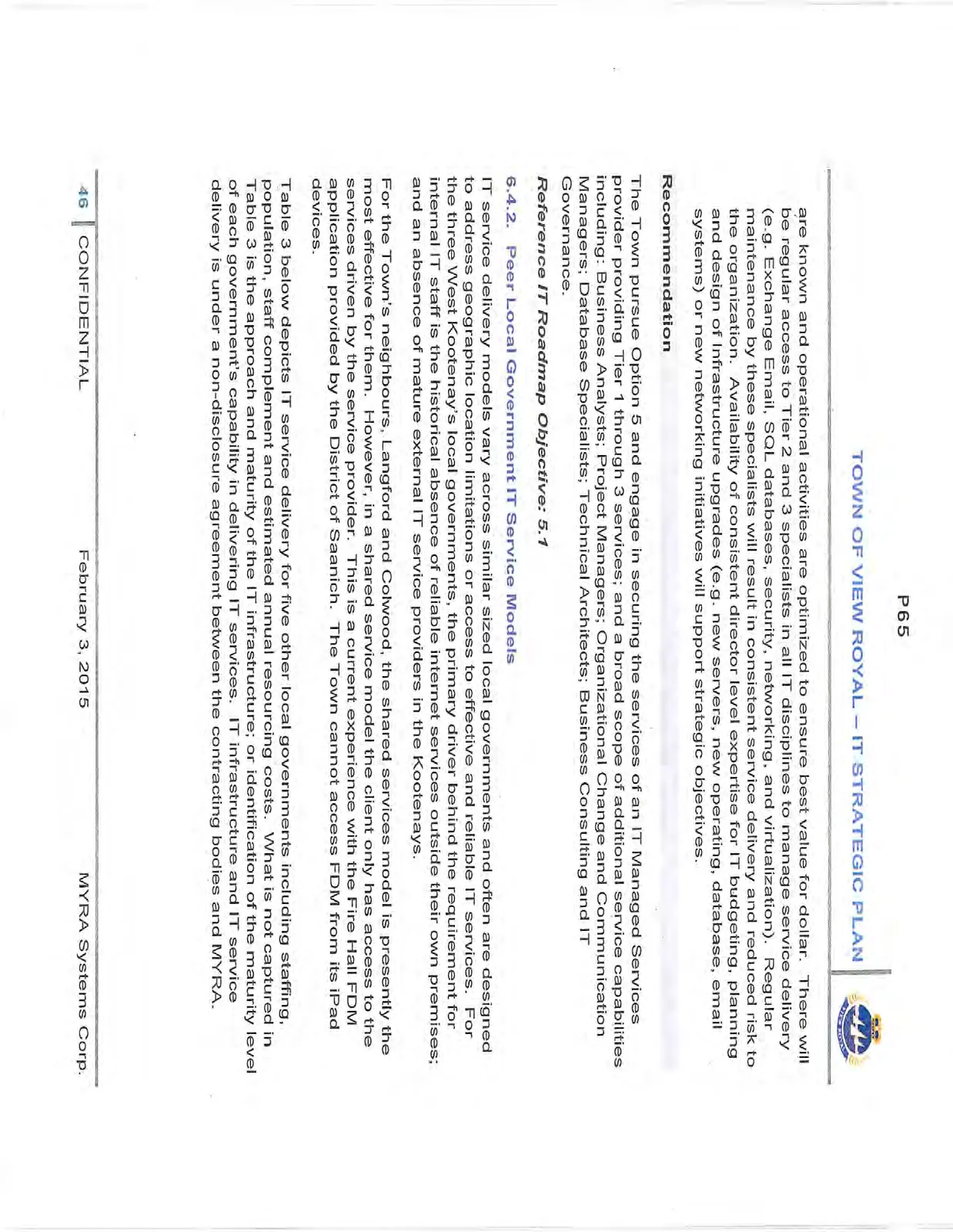
The Town pursue Option 5 and engage in securing the services of an IT Managed Services provider providing Tier 1 through 3 services; and a broad scope of additional service capabilities including: Business Analysts; Project Managers; Organizational Change and Communication Managers; Database Specialists; Technical Architects; Business Consulting and IT Governance.
Reference IT Roadmap Objective: 5.1
6.4.2. Peer Local Government IT Service Models
IT service delivery models vary across similar sized local governments and often are designed to address geographic location limitations or access to effective and reliable IT services. For the three West Kootenay’s local governments, the primary driver behind the requirement for internal IT staff is the historical absence of reliable internet services outside their own premises; and an absence of mature external IT service providers in the Kootenays.
For the Town’s neighbours, Langford and Colwood, the shared services model is presently the most effective for them. However, in a shared service model the client only has access to the services driven by the service provider. This is a current experience with the Fire Hall FDM application provided by the District of Saanich. The Town cannot access FDM from its iPad devices.
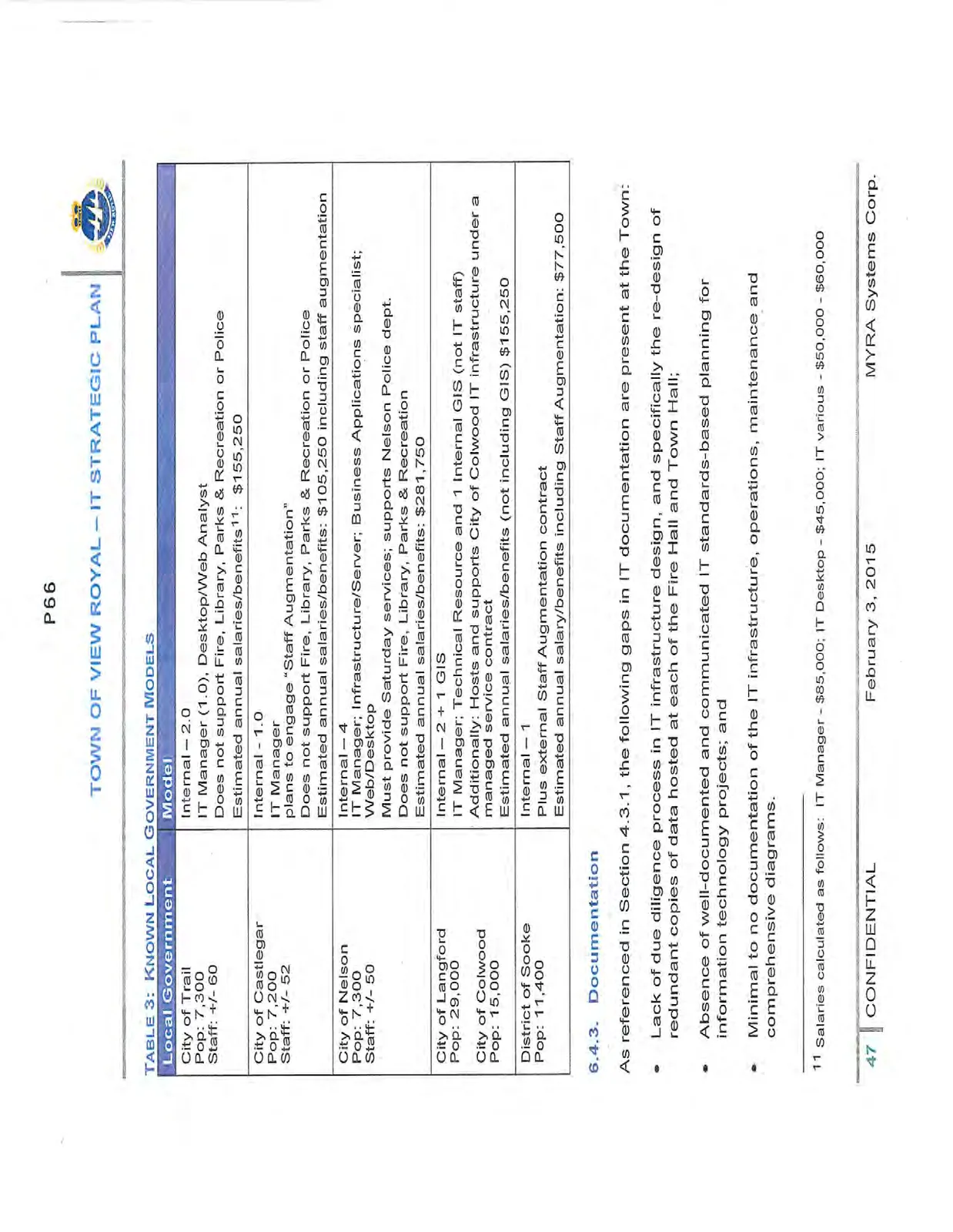
Table 3 below depicts IT service delivery for five other local governments including staffing, population, staff complement and estimated annual resourcing costs. What is not captured in Table 3 is the approach and maturity of the IT infrastructure; or identification of the maturity level of each government’s capability in delivering IT services. IT infrastructure and IT service delivery is under a non-disclosure agreement between the contracting bodies and MYRA.
TABLE 3: KNOWN LOCAL GOVERNMENT MODELS
| Local Government | Model |
|---|---|
| City of Trail Pop: 7,300 Staff: +/- 60 |
Internal – 2.0 IT Manager (1.0), Desktop/Web Analyst Does not support Fire, Library, Parks & Recreation or Police Estimated annual salaries/benefits¹¹: $155,250 |
| City of Castlegar Pop: 7,200 Staff: +/- 52 |
Internal – 1.0 IT Manager plans to engage “Staff Augmentation” Does not support Fire, Library, Parks & Recreation or Police Estimated annual salaries/benefits: $105,250 including staff augmentation |
| City of Nelson Pop: 7,300 Staff: +/- 50 |
Internal – 4 IT Manager; Infrastructure/Server; Business Applications specialist; Web/Desktop Must provide Saturday services; supports Nelson Police dept. Does not support Fire, Library, Parks & Recreation Estimated annual salaries/benefits: $281,750 |
| City of Langford Pop: 29,000 City of Colwood Pop: 15,000 |
Internal – 2 + 1 GIS IT Manager; Technical Resource and 1 Internal GIS (not IT staff) Additionally: Hosts and supports City of Colwood IT infrastructure under a managed service contract Estimated annual salaries/benefits (not including GIS) $155,250 |
| District of Sooke Pop: 11,400 |
Internal – 1 Plus external Staff Augmentation contract Estimated annual salary/benefits including Staff Augmentation: $77,500 |
¹¹ Salaries calculated as follows: IT Manager - $85,000; IT Desktop - $45,000; IT various - $50,000 - $60,000
6.4.3. Documentation
As referenced in Section 4.3.1, the following gaps in IT documentation are present at the Town:
- Lack of due diligence process in IT infrastructure design, and specifically the re-design of redundant copies of data hosted at each of the Fire Hall and Town Hall;
- Absence of well-documented and communicated IT standards-based planning for information technology projects; and
- Minimal to no documentation of the IT infrastructure, operations, maintenance and comprehensive diagrams.
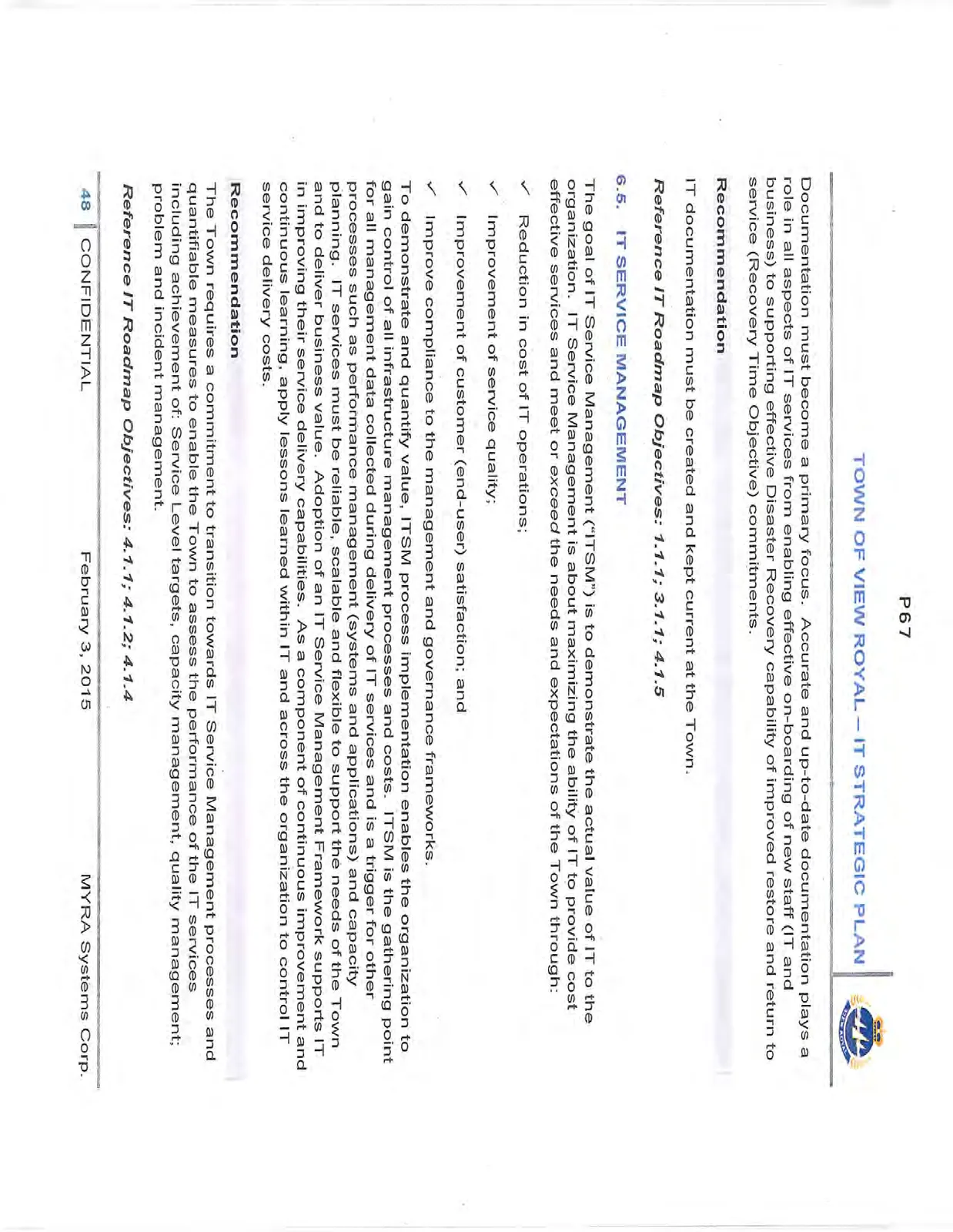
Documentation must become a primary focus. Accurate and up-to-date documentation plays a role in all aspects of IT services from enabling effective on-boarding of new staff (IT and business) to supporting effective Disaster Recovery capability of improved restore and return to service (Recovery Time Objective) commitments.
Recommendation
IT documentation must be created and kept current at the Town.
Reference IT Roadmap Objectives: 1.1.1; 3.1.1; 4.1.5
6.5. IT SERVICE MANAGEMENT
The goal of IT Service Management (“ITSM”) is to demonstrate the actual value of IT to the organization. IT Service Management is about maximizing the ability of IT to provide cost effective services and meet or exceed the needs and expectations of the Town through:
- Reduction in cost of IT operations;
- Improvement of service quality;
- Improvement of customer (end-user) satisfaction; and
- Improve compliance to the management and governance frameworks.
To demonstrate and quantify value, ITSM process implementation enables the organization to gain control of all infrastructure management processes and costs. ITSM is the gathering point for all management data collected during delivery of IT services and is a trigger for other processes such as performance management (systems and applications) and capacity planning. IT services must be reliable, scalable and flexible to support the needs of the Town and to deliver business value. Adoption of an IT Service Management Framework supports IT in improving their service delivery capabilities. As a component of continuous improvement and continuous learning, apply lessons learned within IT and across the organization to control IT service delivery costs.
Recommendation
The Town requires a commitment to transition towards IT Service Management processes and quantifiable measures to enable the Town to assess the performance of the IT services including achievement of: Service Level targets, capacity management, quality management; problem and incident management.
Reference IT Roadmap Objectives: 4.1.1; 4.1.2; 4.1.4
6.5.1. IT Contract Management
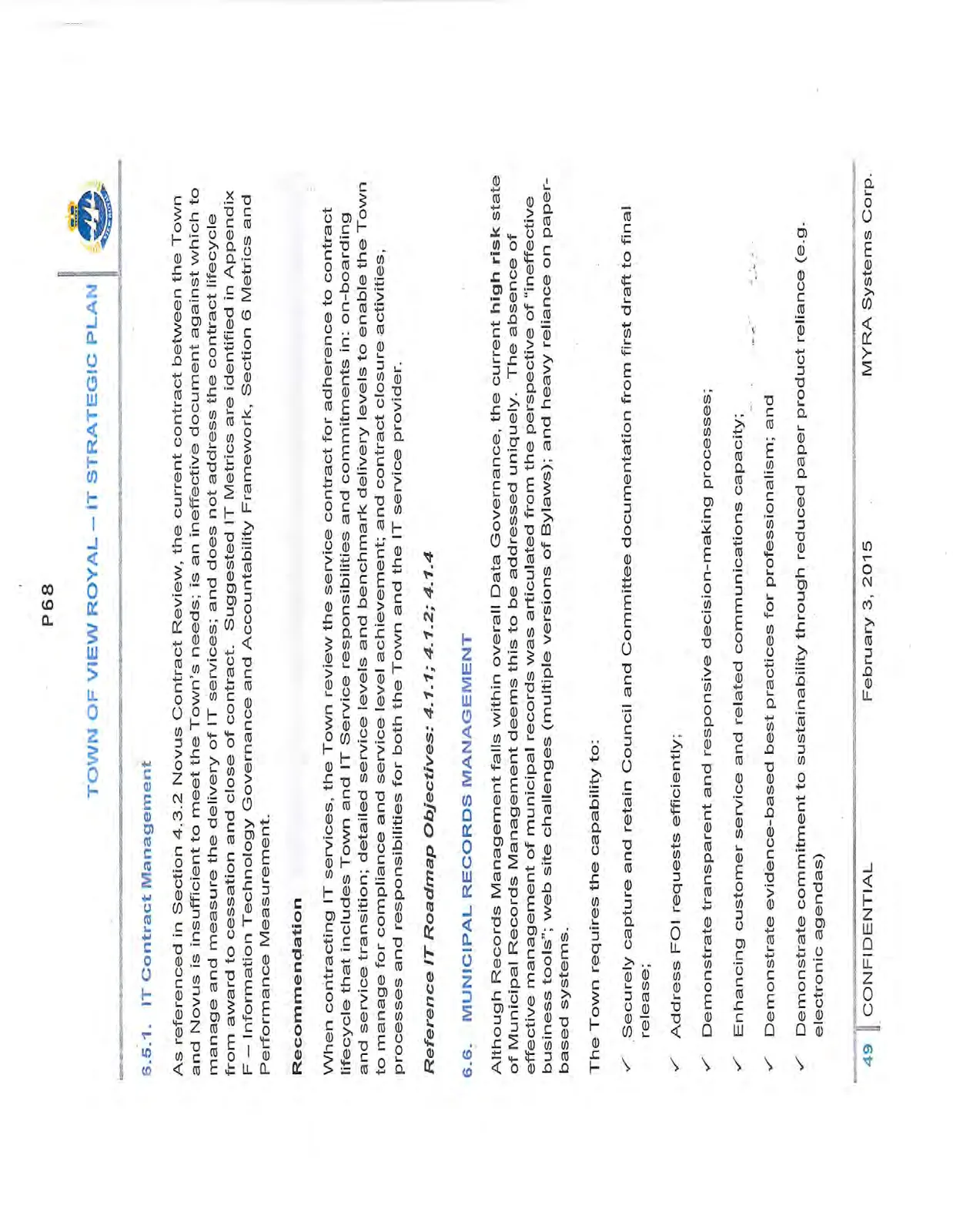
As referenced in Section 4.3.2 Novus Contract Review, the current contract between the Town and Novus is insufficient to meet the Town’s needs; is an ineffective document against which to manage and measure the delivery of IT services; and does not address the contract lifecycle from award to cessation and close of contract. Suggested IT Metrics are identified in Appendix F – Information Technology Governance and Accountability Framework, Section 6 Metrics and Performance Measurement.
Recommendation
When contracting IT services, the Town review the service contract for adherence to contract lifecycle that includes Town and IT Service responsibilities and commitments in: on-boarding and service transition; detailed service levels and benchmark delivery levels to enable the Town to manage for compliance and service level achievement; and contract closure activities, processes and responsibilities for both the Town and the IT service provider.
Reference IT Roadmap Objectives: 4.1.1; 4.1.2; 4.1.4
6.6. MUNICIPAL RECORDS MANAGEMENT
Although Records Management falls within overall Data Governance, the current high risk state of Municipal Records Management deems this to be addressed uniquely. The absence of effective management of municipal records was articulated from the perspective of “ineffective business tools”; web site challenges (multiple versions of Bylaws); and heavy reliance on paper-based systems.
The Town requires the capability to:
- Securely capture and retain Council and Committee documentation from first draft to final release;
- Address FOI requests efficiently;
- Demonstrate transparent and responsive decision-making processes;
- Enhancing customer service and related communications capacity;
- Demonstrate evidence-based best practices for professionalism; and
- Demonstrate commitment to sustainability through reduced paper product reliance (e.g. electronic agendas)
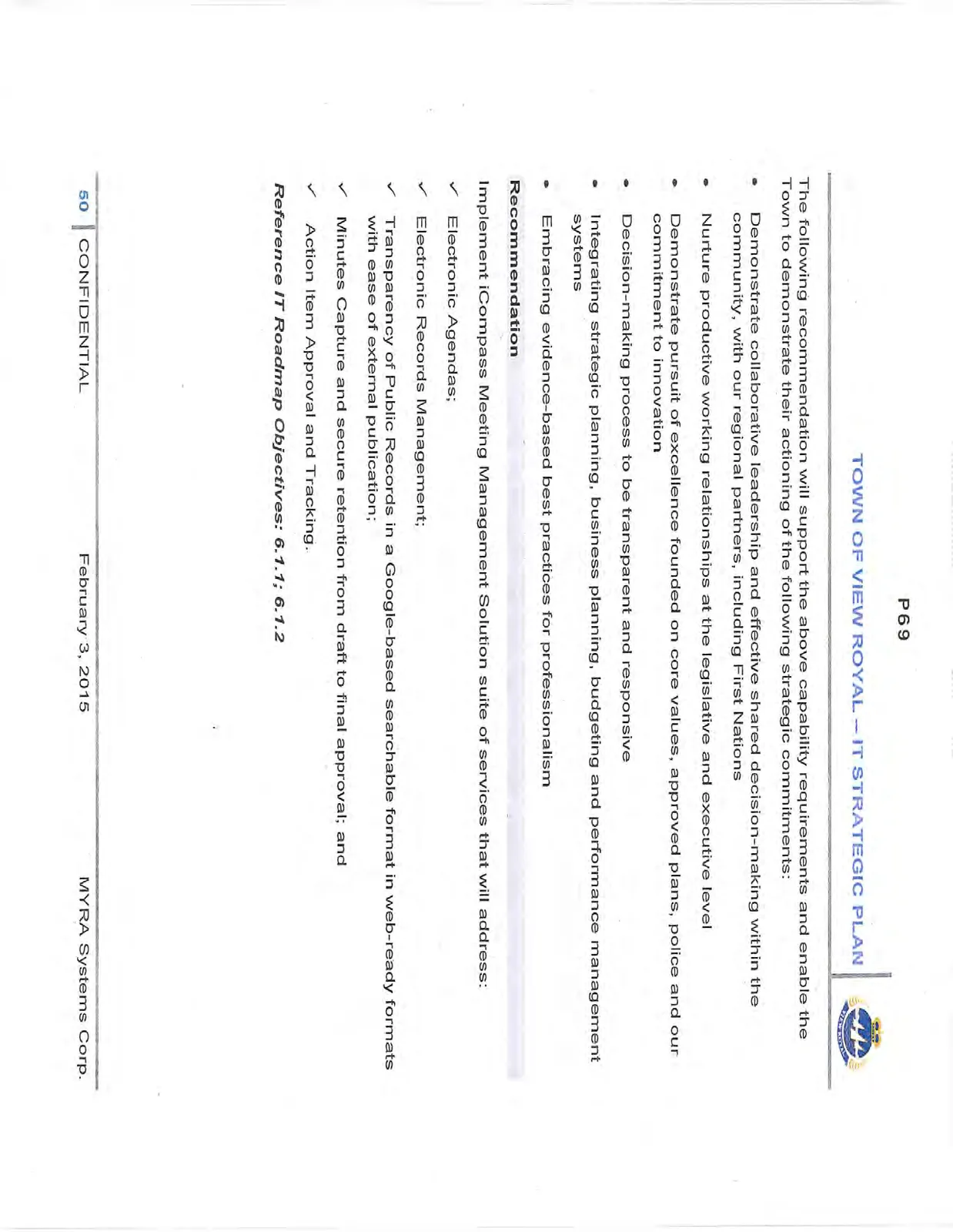
The following recommendation will support the above capability requirements and enable the Town to demonstrate their actioning of the following strategic commitments:
- Demonstrate collaborative leadership and effective shared decision-making within the community, with our regional partners, including First Nations
- Nurture productive working relationships at the legislative and executive level
- Demonstrate pursuit of excellence founded on core values, approved plans, police and our commitment to innovation
- Decision-making process to be transparent and responsive
- Integrating strategic planning, business planning, budgeting and performance management systems
- Embracing evidence-based best practices for professionalism
Recommendation
Implement iCompass Meeting Management Solution suite of services that will address:
- Electronic Agendas;
- Electronic Records Management;
- Transparency of Public Records in a Google-based searchable format in web-ready formats with ease of external publication;
- Minutes Capture and secure retention from draft to final approval; and
- Action Item Approval and Tracking.
Reference IT Roadmap Objectives: 6.1.1; 6.1.2
6.7. GIS
6.7.1. Overview
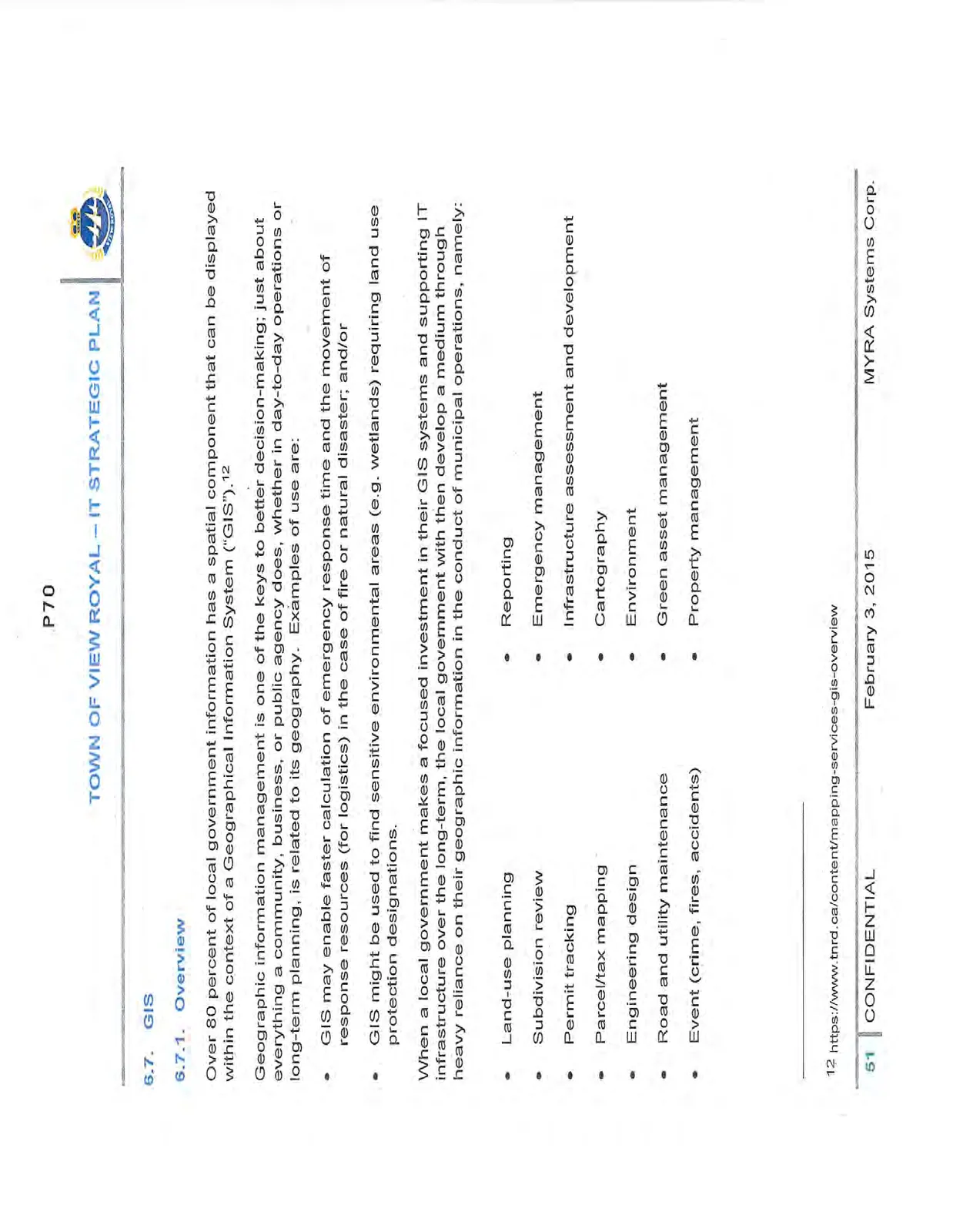
Over 80 percent of local government information has a spatial component that can be displayed within the context of a Geographical Information System (“GIS”).¹²
Geographic information management is one of the keys to better decision-making; just about everything a community, business, or public agency does, whether in day-to-day operations or long-term planning, is related to its geography. Examples of use are:
- GIS may enable faster calculation of emergency response time and the movement of response resources (for logistics) in the case of fire or natural disaster; and/or
- GIS might be used to find sensitive environmental areas (e.g. wetlands) requiring land use protection designations.
When a local government makes a focused investment in their GIS systems and supporting IT infrastructure over the long-term, the local government with then develop a medium through heavy reliance on their geographic information in the conduct of municipal operations, namely:
| • Land-use planning | • Reporting |
| • Subdivision review | • Emergency management |
| • Permit tracking | • Infrastructure assessment and development |
| • Parcel/tax mapping | • Cartography |
| • Engineering design | • Environment |
| • Road and utility maintenance | • Green asset management |
| • Event (crime, fires, accidents) | • Property management |
¹² https://www.tnrd.ca/content/mapping-services-gis-overview
6.7.2. GIS Benefits
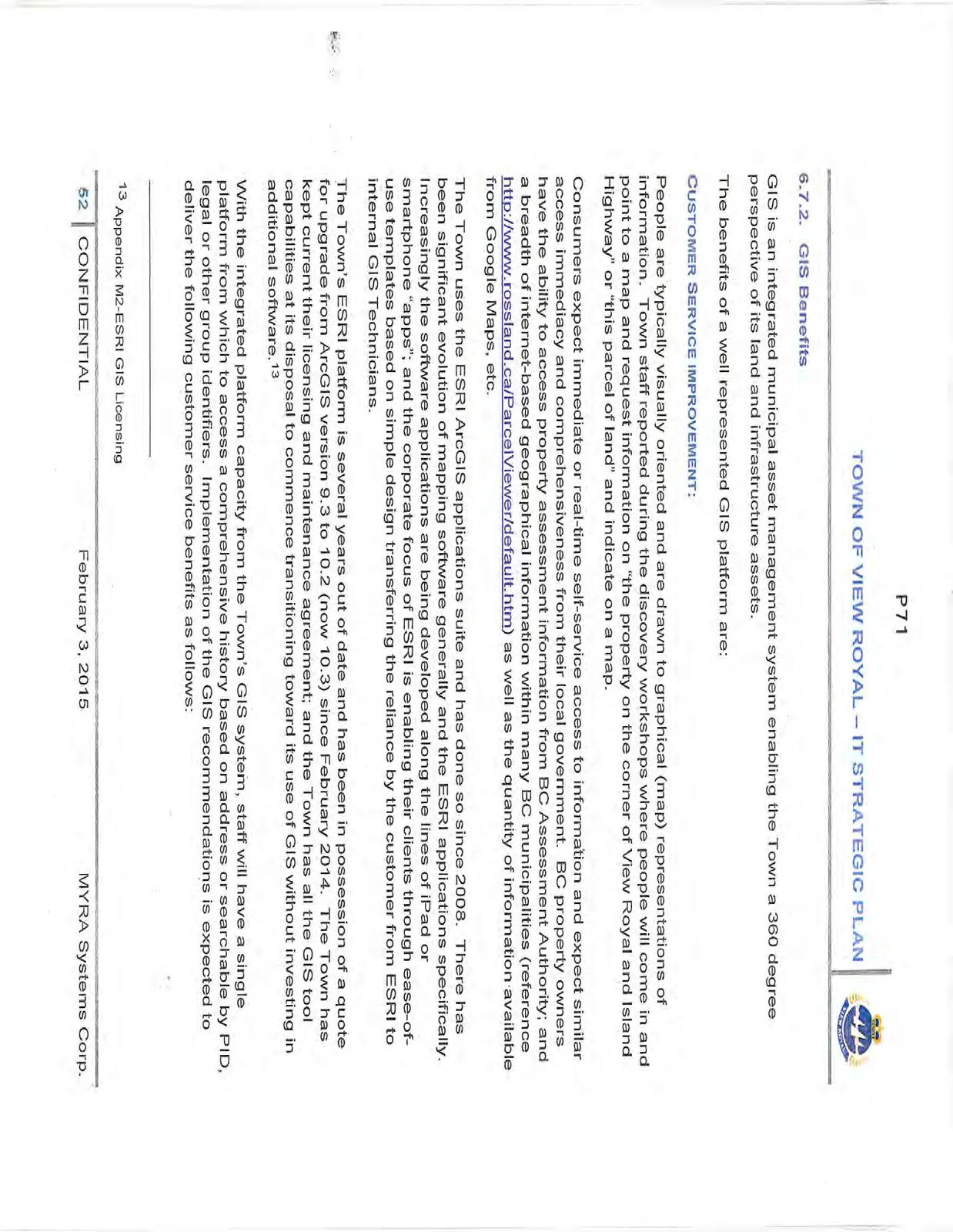
GIS is an integrated municipal asset management system enabling the Town a 360 degree perspective of its land and infrastructure assets.
The benefits of a well represented GIS platform are:
CUSTOMER SERVICE IMPROVEMENT:
People are typically visually oriented and are drawn to graphical (map) representations of information. Town staff reported during the discovery workshops where people will come in and point to a map and request information on “the property on the corner of View Royal and Island Highway” or “this parcel of land” and indicate on a map.
Consumers expect immediate or real-time self-service access to information and expect similar access immediacy and comprehensiveness from their local government. BC property owners have the ability to access property assessment information from BC Assessment Authority; and a breadth of internet-based geographical information within many BC municipalities (reference http://www.rossland.ca/ParcelViewer/default.htm) as well as the quantity of information available from Google Maps, etc.
The Town uses the ESRI ArcGIS applications suite and has done so since 2008. There has been significant evolution of mapping software generally and the ESRI applications specifically. Increasingly the software applications are being developed along the lines of iPad or smartphone “apps”; and the corporate focus of ESRI is enabling their clients through ease-of-use templates based on simple design transferring the reliance by the customer from ESRI to internal GIS Technicians.
The Town’s ESRI platform is several years out of date and has been in possession of a quote for upgrade from ArcGIS version 9.3 to 10.2 (now 10.3) since February 2014. The Town has kept current their licensing and maintenance agreement; and the Town has all the GIS tool capabilities at its disposal to commence transitioning toward its use of GIS without investing in additional software.¹³
With the integrated platform capacity from the Town’s GIS system, staff will have a single platform from which to access a comprehensive history based on address or searchable by PID, legal or other group identifiers. Implementation of the GIS recommendations is expected to deliver the following customer service benefits as follows:
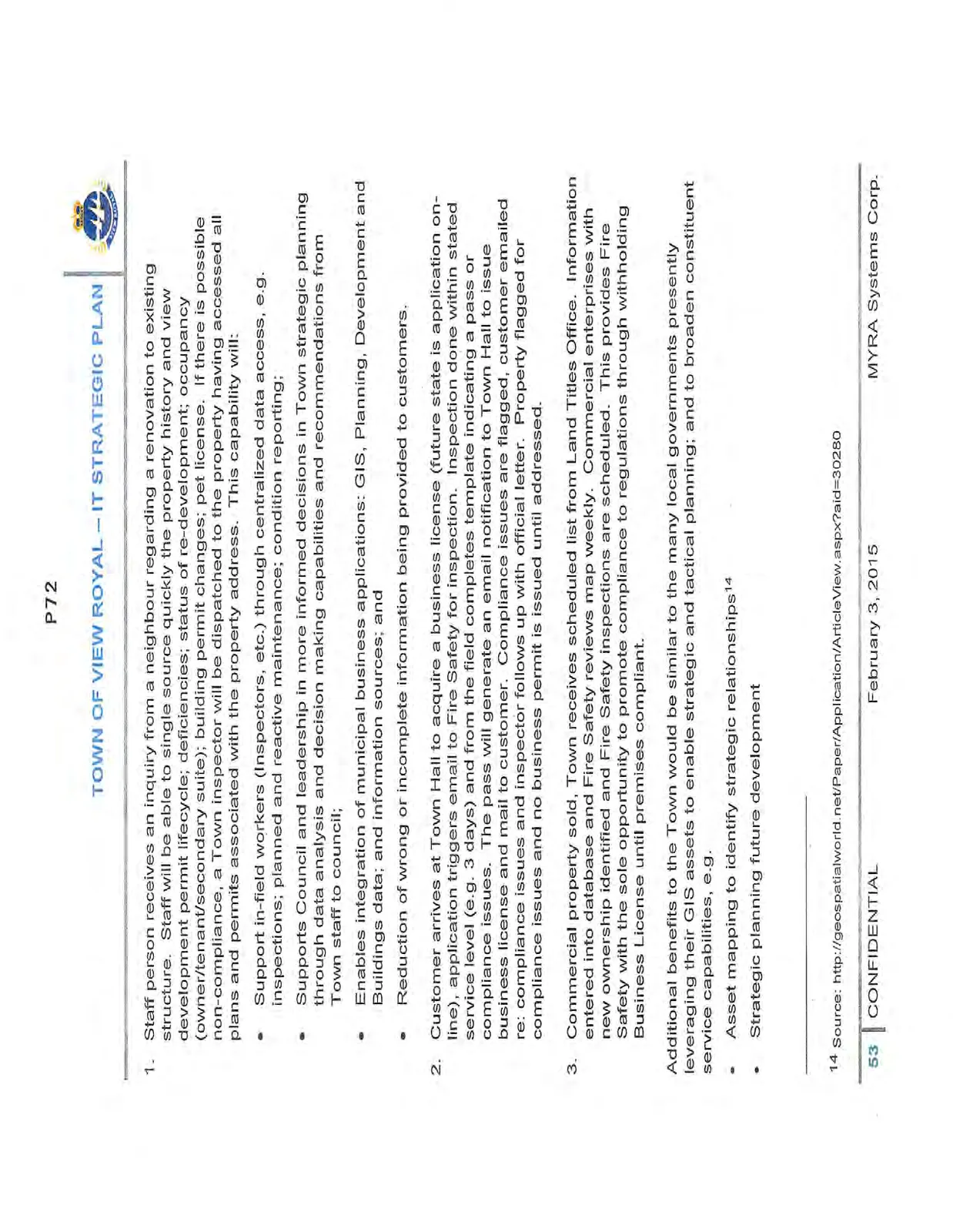
- Staff person receives an inquiry from a neighbour regarding a renovation to existing structure. Staff will be able to single source quickly the property history and view development permit lifecycle; deficiencies; status of re-development; occupancy (owner/tenant/secondary suite); building permit changes; pet license. If there is possible non-compliance, a Town inspector will be dispatched to the property having accessed all plans and permits associated with the property address. This capability will:
- Support in-field workers (Inspectors, etc.) through centralized data access, e.g. inspections; planned and reactive maintenance; condition reporting;
- Supports Council and leadership in more informed decisions in Town strategic planning through data analysis and decision making capabilities and recommendations from Town staff to council;
- Enables integration of municipal business applications: GIS, Planning, Development and Buildings data; and information sources; and
- Reduction of wrong or incomplete information being provided to customers.
- Customer arrives at Town Hall to acquire a business license (future state is application on-line), application triggers email to Fire Safety for inspection. Inspection done within stated service level (e.g. 3 days) and from the field completes template indicating a pass or compliance issues. The pass will generate an email notification to Town Hall to issue business license and mail to customer. Compliance issues are flagged, customer emailed re: compliance issues and inspector follows up with official letter. Property flagged for compliance issues and no business permit is issued until addressed.
- Commercial property sold, Town receives scheduled list from Land Titles Office. Information entered into database and Fire Safety reviews map weekly. Commercial enterprises with new ownership identified and Fire Safety inspections are scheduled. This provides Fire Safety with the sole opportunity to promote compliance to regulations through withholding Business License until premises compliant.
Additional benefits to the Town would be similar to the many local governments presently leveraging their GIS assets to enable strategic and tactical planning; and to broaden constituent service capabilities, e.g.
- Asset mapping to identify strategic relationships¹⁴
- Strategic planning future development
- Property identification, parcel boundaries
- Customer service, location of points of interest
- Demographic characteristics of population catchments
- Planning scheme maps easily accessible
- Emergency management, traffic route planning
- Emergency response, evacuation action plans
- Vegetation mapping, wildfire fuel load monitoring
- Identification of surface drainage hidden by vegetation
- Climate change scenarios relating to predicted sea level rise
The following recommendation will address the identified gaps of: “ineffective tools”; multiple differing sources of information; resource inefficiency; and improve customer service speed and quality of information.
There is an expectation of a marginal increase in revenue from fines assessed against non-compliant properties and commercial establishments; and an expectation of reduced liability over time presented by increased capability in coordinated and comprehensive inspection tracking enabled through an integrated view of municipal services.
Recommendations
Upgrade ESRI ArcGIS and invest resources in developing the Town’s ArcGIS system as the platform for integrated municipal services.
Reference IT Roadmap Objective: 7.1.1
¹³ Appendix M2-ESRI GIS Licensing ¹⁴ Source: http://geospatialworld.net/Paper/Application/ArticleView.aspx?aid=30280
6.7.3. GIS Technician
The focus on GIS as a valuable municipal business service tool has lapsed over the past several years. There has been some GIS work outsourced to address immediate and prioritized gaps however several attempts to have GIS services in-house have failed for varying reasons.
Similar sized Towns and Cities all trend towards internal GIS resources, even in environments where IT support is provided by external contractors (e.g. City of Rossland). Some local governments leverage split job functionalities: the City of Trail has a split GIS/Web Developer role due to their internal hosting of web services; and the Regional District of Kootenay Boundary serves their GIS requirements by splitting their GIS requirements with part-time IT desktop support.
To deliver customer centric services through an integrated visual platform the Town needs to invest in the services of a GIS Technician.
Recommendations
Hire a contract GIS Technician or Co-op Student to undertake templates for data capture (field inspections); integration of the Town’s licenses (e.g. building, dog, secondary suite, business), permits, etc. as well as ingesting of archival data (development, planning, etc.) from Engineering with the goal of having +/- 75% of historical data integrated into the GIS platform.
Reference IT Roadmap Objectives: 7.1.2
6.7.4. GIS Administrator
To support the commitment to an integrated municipal services platform, the Town is well advised to mitigate risk from loss of their primary GIS resource either from illness; vacation or resignation; and additionally to limit service bottlenecks presented by a single resource. This risk will be addressed through expanding the job functions of a current Town resource to include around a .2 (20%) Full Time Equivalent (FTE) assignment of GIS activities. The scope of tasks and responsibilities will be to undertake junior GIS activities and be a second resource to develop GIS templates to expand data integration.
Recommendation
Expand GIS resource capability through development of a GIS Administrator from within current staff complement. There is an expected .2 (20%) FTE time allocation to GIS activities, as well as providing vacation, illness and possible GIS Technician vacancy.
Reference IT Roadmap Objective: 7.1.2
6.8. SUPPORTING BUSINESS TOOLS
The following recommendations address the theme of inadequate tools that was the most dominant topic across the departmental discovery sessions accounting for 60% of all identified opportunities for improvement.
6.8.1. Adobe
The lack of access to tools to compile, edit and digitally sign documents was a gap identified within the Planning and Development group. The incremental loss of effective use of resource time was contributed to by limited access to Adobe-based tools. The Planning and Development group have been stonewalled by Novus on the purchase of Adobe-based tools due to Novus’ lack of understanding of the Department’s requirements.
Recommendation
Purchase either Adobe Standard or Adobe Pro¹⁵ in sufficient quantity (up to 3 licenses) to enable staff to be efficient in delivery of their services.
Reference IT Roadmap Objective: 8.1.1
6.8.2. Adobe Creative Suite
Adobe Creative Suite enables Planning and Development to produce brochures and other print materials in support of departmental services. Their current Adobe Creative Suite version is two full versions (CS4 versus CS 6/Cloud) behind. There is no continued support by Adobe for keeping CS4 current which presents potential security risks and incompatibilities between the current desktop operating system version (Windows 7) and CS4.
Recommendation
Determine the required Creative Suite functionalities needed for Development and Planning and purchase a monthly subscription. Subscription-based purchase will enable the Department to purchase services by component (e.g. in-Design, Illustrator, Photoshop) as required without the expense of the legacy purchase of the entire suite.
Reference IT Roadmap Objective: 8.1.2
6.8.3. Development Permit Project Lifecycle Tracking Tool
Tracking Development Permits through their lifecycle from initiation through public hearings/input and approval will support professional execution of the Town’s Economic Development strategy. With little undeveloped land available for service expansion, the Town has a significant reliance on re-development of existing properties. Formalized and documented tracking of the Development Permit Project lifecycle will enable risk mitigation through published and tracked deadlines; and availability of this information across the Town’s service departments.
¹⁵ http://www.adobe.com/ca/products/acrobatpro/buying-guide.html
Recommendation
Conduct a business process mapping exercise of the Development Permit lifecycle and identify where the lifecycle intersects with or impacts departments outside planning and development. Outcome of the mapping exercise is to formalize the Development Permit lifecycle (e.g. what needs to be tracked, who needs to know and when); and the range of options available to provide this information (e.g. basic shared Excel; GIS-based solution, integrated software).
Reference IT Roadmap Objective: 8.1.3
6.8.4. End-user Equipment
Adopt roles-based technology (hardware/software) inventory IT asset management that will enable easier hardware budgeting (e.g. volume purchases) and hardware/software provisioning for incremental hires. Presently there is a one-size fits all approach to technology that does not take into account job functionalities with considerable graphics or mapping requirements.
Recommendation
Establish and document roles-based hardware/software standards and inventory of technology equipment appropriate to job function (e.g. anything with a GIS or CAD mapping function requires 22” screen or 2 x 17” screen).
Reference IT Roadmap Objective: 4.1.3
6.8.5. Leveraging Current Business Tools for Centralized Information Sharing
The current absence of inter-departmental information sharing can be mitigated independently of any investment in the Town’s GIS platform. Many “tracking documents” are in use by single staff resources; single departments or available more broadly “on request” that could be hosted in a shared folder with a single staff resource responsible for document control and data rigour.
For information currently not shared (e.g. inspections) a shared Excel based document could be developed that would provide a source of common information tracking; and a hyper-link to the inspection document. Scanned inspection documents would be located in standard folders using an acceptable naming convention based on: type of inspection; address; date. There is a requirement for process and document owners; and they could be the same person.
The process of identifying information sources, types and required detail is a precedent activity to a single source of truth platform (e.g. GIS); and in the interim between now and when the Town is in a position to invest in its GIS platform the involved municipal departments can refine the types of data captured and understand their own processes. The internal knowledge of common information and processes will contribute to more informed input into the GIS platform; with the added benefit of a stand-alone information source in the interim.
Recommendation
Commence centralized information sharing through the location of current tracking documents in a centrally accessible location (e.g. file-server); and the formalization of process and data control and rigour.
Reference IT Roadmap Objective: 8.1.4
6.9. TRAINING
Reliance on unofficial peer knowledge sharing and self-managed training is a barrier to achieving the Town’s values of: innovation; proactivity; and efficient and effective municipal services. Efficiency is created when there is standard knowledge and skills in the available tools; and proactive and innovative solutions can only be identified when there is in-depth knowledge of the tools and their capabilities. Staff resources are effective when they understand where the tools support their tasks and outputs; and innovation is achieved when staff understands how the tools can streamline processes to reduce manual tasks and accomplish outputs more effectively.
Training is not the purview of IT. IT provides business tool availability through provision of stable infrastructure hosting the business applications. Training is the responsibility of the entire organization to enable organizational effectiveness through improved use of business tools facilitated through knowledge and skills development.
For organizations of similar size to the Town, budgeting for external training directly competes against other business priorities, and is typically the first casualty of mid-year reforecasting. An effective approach to maximizing training and developing organizational competency is through the formalization of Subject Matter Expertise. The benefit of the Subject Matter Expert, role and responsibilities is contained within Appendix L – Subject Matter R&R.
Recommendation
Each business application (e.g. Vadim, GIS, the Web Content Manager, Microsoft Office Productivity suite) should have at a minimum two (2) staff trained externally for each business application. This minimum requirement is to address loss of knowledge from staff vacations, unplanned absences and resignations. At all times there should be a minimum of 2 staff with formal vendor or industry level training.
The range of formal training should be based on the level of importance the business application presents to the Town (e.g. Vadim, GIS); and number of users of the tool within the Town (e.g. Microsoft Office Productivity Suite); and whether the Town adopts a culture of Subject Matter Experts delivering continuous learning and continuous improvement as referenced in 6.7.1 below
Reference IT Roadmap Objective: 9.1.1
6.9.1. Subject Matter Experts
The formally defined role of a subject matter expert (“SME”) is a resource with special, in-depth knowledge of a business area that enhances the team’s understanding of a specific business tool. SME’s have specific value in environments where there are integrated business tools (e.g. GIS); or when a business application is used across more than one department (e.g. Vadim). In the context of upgrading a business application or considering a change of application, the Subject Matter Expert is a key member in assessing potential opportunities, and often comprise part of the applications design team.
SME’s are particularly critical in working with either of a Business Analyst to envision new business functionalities; or where a SME is highly knowledgeable undertaking business analysis tasks themselves. Typically a SME is the most proficient end-user of an application or tool within a department or business unit and in addition to working with the Business Analyst in requirements and tool definition, their primary focus is direct knowledge transfer of applications tips, tricks and processes to their end-user colleagues. They also communicate training gaps to the Business Analyst or IT Manager and contribute to the content of continuous learning and improvement training seminars, and may in some instances deliver the in-house training.
Recommendation
Formalize the role of the SME, with a primary and secondary SME per key business application. There is direct benefit to the organization when the role of SME is formalized with specific responsibilities and accountabilities, and assessed for performance annually.
Reference IT Roadmap Objective: 9.1.1
6.10. IT GOVERNANCE
As technology and business converge, managing technology becomes less “custodial” operations and more about making decisions that support the organization holistically through a business enabling service platform. IT will transition to alignment with the Town’s goals and objectives through effective Corporate IT governance will take a broad, inclusive organizational process view glancing unique needs with those of the whole to facilitate prioritised strategic outcome. This is achieved through broadening the scope of considerations in technology decision-making through a process component that defines the decision-making rights associated with IT, metrics, mechanisms and policies used to control the methodology of IT decision making and implementing within the organization.
Recommendation
Creation of IT Steering Group (committee). This committee is to meet every second month (recommended) and at a minimum quarterly. Although membership in the committee is expected to mirror that of the Senior Management team, the focus of this group is to discuss technology planning from a tactical and strategic perspective; and to review, approve and prioritize IT projects and develop multi-year IT plans and budget allocation.
Reference IT Roadmap Objective: 10.1.1
6.11. PROCESS STANDARDIZATION
During the IT Strategic Plan Discovery Workshops the need for process maturation and some policy was communicated outside of IT, e.g.
- IT process for new staff (on-boarding and orientation)
- File sign-out process (Planning/Development)
- Social Media policy and process regarding editorial rigour to address grammar and typographical issues.
There is an expectation of additional process maturity requirements that exist but were not captured within the scope of the focused IT discussions.
Establishing processes and actively supporting their reinforcement enables staff to have direction in how information is captured; named; and the appropriate storage location(s). Well constructed processes add clarity, reduce errors and enable staff efficiency.
Recommendation
The Town adopt process improvement methodologies and integrate these methodologies within their Subject Matter Expertise capabilities.
Reference IT Roadmap Objective: 10.1.1
6.12. VIEWROYAL.CA
Local government websites reflect the Town, and external visitors develop their early perceptions from a website that is: informative; free from error; communicates clearly and concisely; and follows the natural flow of how external visitors process information.
The following recommendation is made to support enablement of visitor perception of a Town that is strategically working at “Enhancing customer service and related communications capacity”.
Recommendations
The Town standardize web processes for:
- Uploading of new and replacement of existing by-laws; as well as a search capability for ensuring removal of historical by-laws outside of the approved standard location;
- Undertaking editorial review of content for grammar, typographical and other errors; and
- Undertake a web functionality review process.
Reference IT Roadmap Objectives: 12.1.; 12.2
Document Images
(33)