Staff Report: 2014 Climate Action Revenue Incentive Program (CARIP)
Report detailing the Town's 2014 corporate greenhouse gas emissions and progress toward carbon neutrality.
TOWN OF VIEW ROYAL
Planning & Development Report
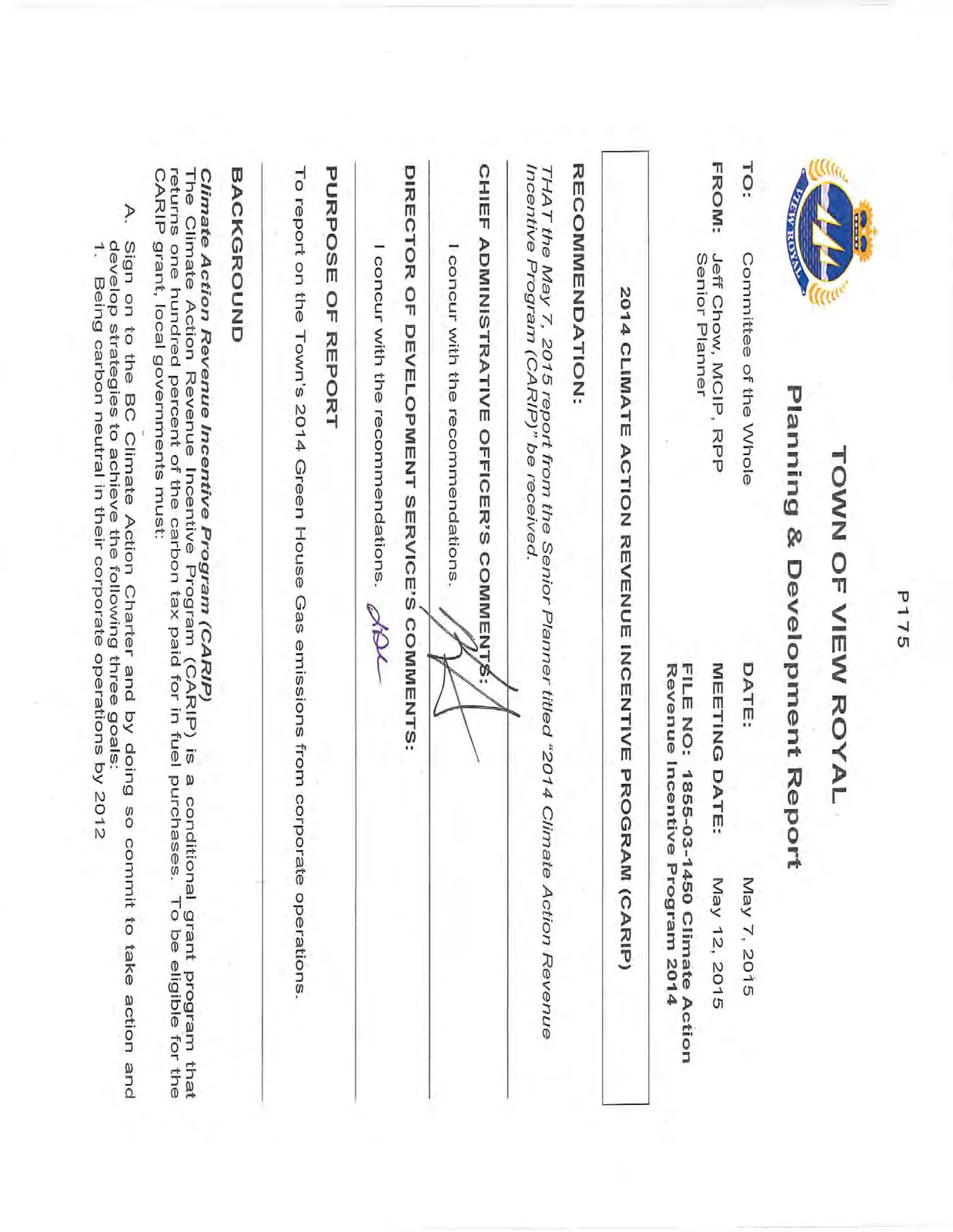
TO: Committee of the Whole DATE: May 7, 2015 FROM: Jeff Chow, MCIP, RPP Senior Planner MEETING DATE: May 12, 2015 FILE NO: 1855-03-1450 Climate Action Revenue Incentive Program 2014
2014 CLIMATE ACTION REVENUE INCENTIVE PROGRAM (CARIP)
RECOMMENDATION:
THAT the May 7, 2015 report from the Senior Planner titled "2014 Climate Action Revenue Incentive Program (CARIP)" be received.
CHIEF ADMINISTRATIVE OFFICER'S COMMENTS: I concur with the recommendations.
DIRECTOR OF DEVELOPMENT SERVICE'S COMMENTS: I concur with the recommendations.
PURPOSE OF REPORT
To report on the Town's 2014 Green House Gas emissions from corporate operations.
BACKGROUND
Climate Action Revenue Incentive Program (CARIP)
The Climate Action Revenue Incentive Program (CARIP) is a conditional grant program that returns one hundred percent of the carbon tax paid for in fuel purchases. To be eligible for the CARIP grant, local governments must:
A. Sign on to the BC Climate Action Charter and by doing so commit to take action and develop strategies to achieve the following three goals:
- Being carbon neutral in their corporate operations by 2012
- Measure and report on their community Green House Gas (GHG emission) profile
- Create complete, compact, energy efficient rural and urban communities
B. Report publicly on their plan and progress towards meeting their climate action goals.
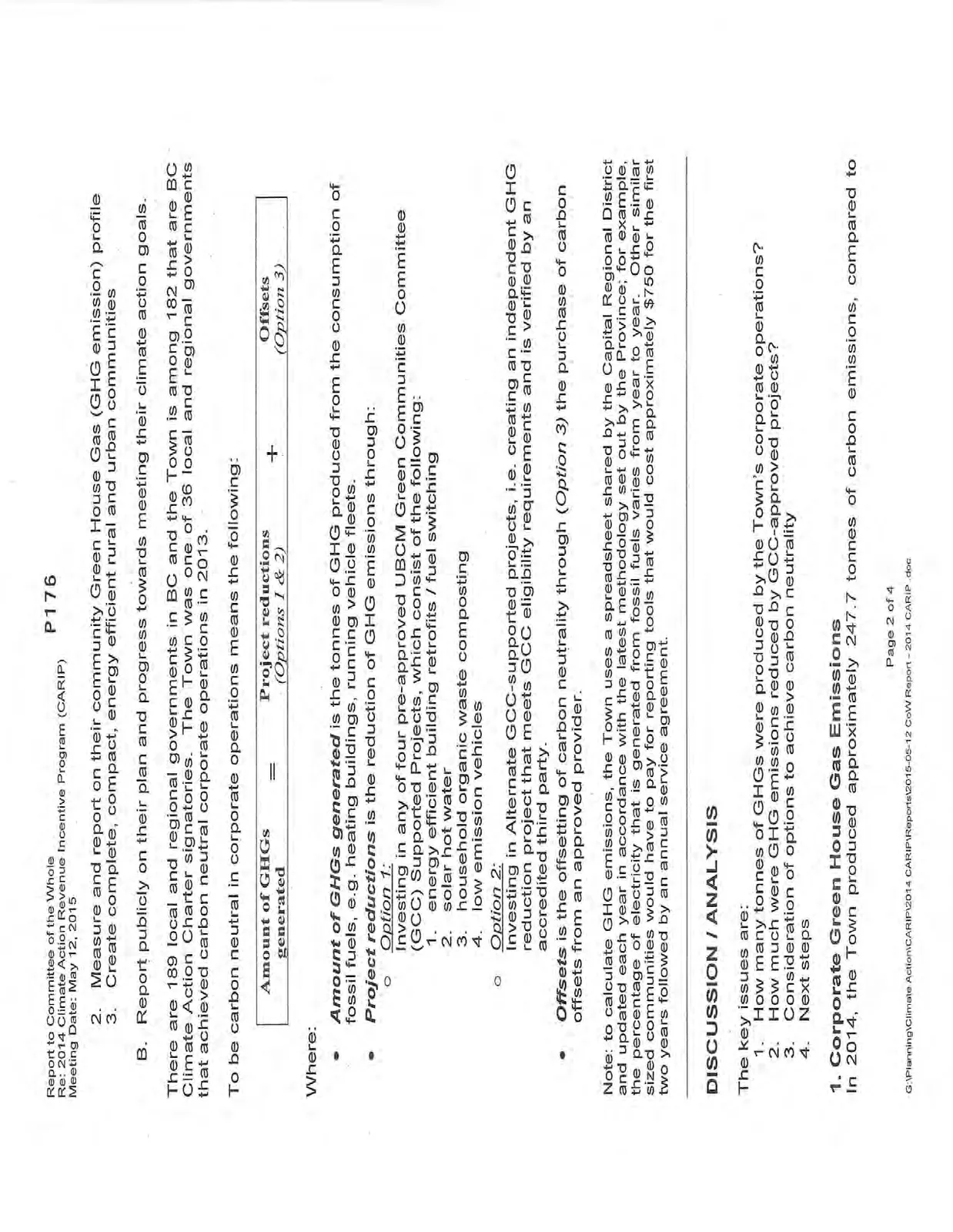
There are 189 local and regional governments in BC and the Town is among 182 that are BC Climate Action Charter signatories. The Town was one of 36 local and regional governments that achieved carbon neutral corporate operations in 2013.
To be carbon neutral in corporate operations means the following:
| Amount of GHGs generated | = | Project reductions (Options 1 & 2) | + | Offsets (Option 3) |
|---|
Where:
- Amount of GHGs generated is the tonnes of GHG produced from the consumption of fossil fuels, e.g. heating buildings, running vehicle fleets.
- Project reductions is the reduction of GHG emissions through:
- Option 1: Investing in any of four pre-approved UBCM Green Communities Committee (GCC) Supported Projects, which consist of the following:
- energy efficient building retrofits / fuel switching
- solar hot water
- household organic waste composting
- low emission vehicles
- Option 2: Investing in Alternate GCC-supported projects, i.e. creating an independent GHG reduction project that meets GCC eligibility requirements and is verified by an accredited third party.
- Option 1: Investing in any of four pre-approved UBCM Green Communities Committee (GCC) Supported Projects, which consist of the following:
- Offsets is the offsetting of carbon neutrality through (Option 3) the purchase of carbon offsets from an approved provider.
Note: to calculate GHG emissions, the Town uses a spreadsheet shared by the Capital Regional District and updated each year in accordance with the latest methodology set out by the Province; for example, the percentage of electricity that is generated from fossil fuels varies from year to year. Other similar sized communities would have to pay for reporting tools that would cost approximately $750 for the first two years followed by an annual service agreement.
DISCUSSION / ANALYSIS
The key issues are:
- How many tonnes of GHGs were produced by the Town's corporate operations?
- How much were GHG emissions reduced by GCC-approved projects?
- Consideration of options to achieve carbon neutrality
- Next steps
1. Corporate Green House Gas Emissions
In 2014, the Town produced approximately 247.7 tonnes of carbon emissions, compared to 252.5 tonnes in 2013. The 2014 emissions are comprised of 75.5 tonnes from municipal operations and an estimated 172.2 tonnes from contracted emissions.
The municipal GHG emissions are based on the amount of fossil fuels used in the Town's facilities, roads, and service operations. The emissions summarized in Attachment 1 include the following:
- Vehicles
- Traffic signals and street and ornamental lighting
- Building (heating, cooling and lighting)
- Sewer pump stations
- Park irrigation
Contracted emissions are generated by contractors engaged by the Town provide services such as solid and organic waste collection, road and boulevard maintenance, community water, recreation centres, and libraries. GHG emissions for water service have been addressed by the Capital Regional District in their calculations and the City of Victoria accounts for Town's share of the Central Public Library's GHG emissions. If the assistance provided by these two parties (who are consistently carbon neutral) were to end, the Town will have to account for the emissions.
2. GHG Project Reductions
The Town's household organic composting program is an eligible GHG-reduction project. The program includes curbside collection and the diversion of yard waste from the landfill though seasonal curbside pickups and local drop-off locations. 169.3 tonnes of GHGs were recovered in 2014 by this program, compared to 219.5 tonnes in 2013. The reduction was due to a 10% drop in the volume of kitchen scraps collected as shown in Attachment 3. Organics have been banned from Hartland Landfill in 2015 so with public education, there should be an increase for the 2015 reporting year.
3. Achieving Carbon Neutral Operations for 2014
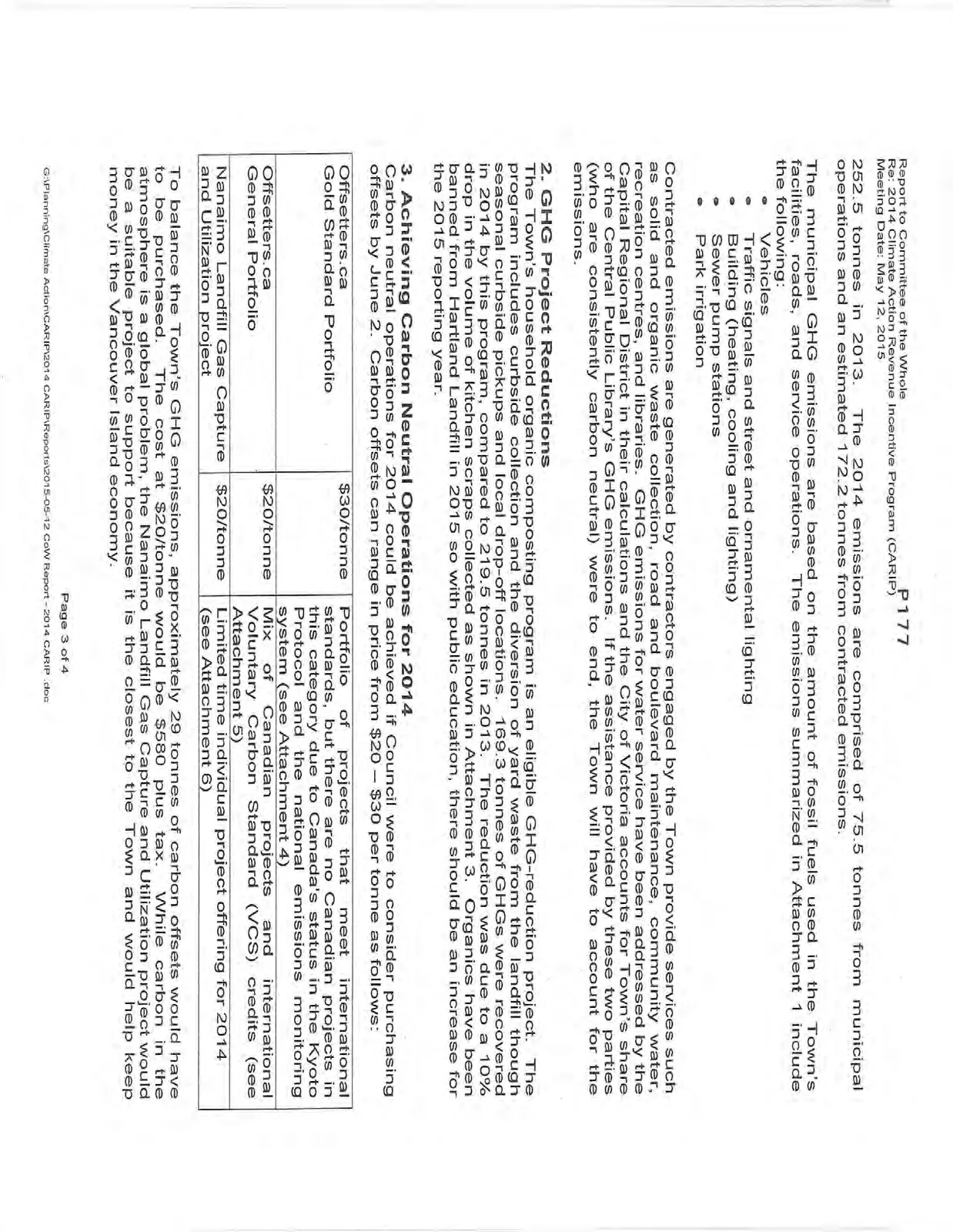
Carbon neutral operations for 2014 could be achieved if Council were to consider purchasing offsets by June 2. Carbon offsets can range in price from $20 – $30 per tonne as follows:
| Provider | Cost | Description |
|---|---|---|
| Offsetters.ca Gold Standard Portfolio | $30/tonne | Portfolio of projects that meet international standards, but there are no Canadian projects in this category due to Canada's status in the Kyoto Protocol and the national emissions monitoring system (see Attachment 4) |
| Offsetters.ca General Portfolio | $20/tonne | Mix of Canadian projects and international Voluntary Carbon Standard (VCS) credits (see Attachment 5) |
| Nanaimo Landfill Gas Capture and Utilization project | $20/tonne | Limited time individual project offering for 2014 (see Attachment 6) |
To balance the Town's GHG emissions, approximately 29 tonnes of carbon offsets would have to be purchased. The cost at $20/tonne would be $580 plus tax. While carbon in the atmosphere is a global problem, the Nanaimo Landfill Gas Capture and Utilization project would be a suitable project to support because it is the closest to the Town and would help keep money in the Vancouver Island economy.
For the 2013 reporting year, the Town purchased 33 tonnes of offsets at a cost of $660 in order to achieve carbon neutral status for corporate operations. The Town received $1804 in CARIP grants (carbon tax refunds) for the year 2014 by meeting BC Climate Action Charter reporting commitments and by working towards reducing greenhouse gas emissions both corporately and in support of the greater View Royal community. If Climate Action Charter commitments were not met, future eligibility for the grant could be in question without continuing demonstrated progress towards carbon neutral operations.
4. Next Steps
It is anticipated that a carbon neutral progress report with final green house gas emissions figures can be presented at the next Council meeting. At that time, Council could consider purchase of carbon offsets to achieve carbon neutral operations for the 2014 reporting year.
RECOMMENDATION
THAT the May 7, 2015 report from the Senior Planner titled "2014 Climate Action Revenue Incentive Program (CARIP)" be received.
ATTACHMENTS
- 2014 Town GHG Emissions
- 2014 Contractor GHG Emissions
- 2014 Organic Waste Composting figures
- Gold Standard Portfolio Profile
- General Portfolio Profile
- Nanaimo Landfill Gas Capture and Utilization Project Profile
Document Images
(4)