Tovey Shoreline Access Report
Assessment and recommendations for the Tovey shoreline access point, adjacent to a TOVR pump station.
Tovey Shoreline Access
General
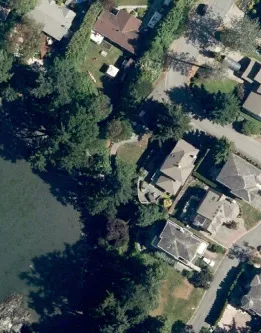
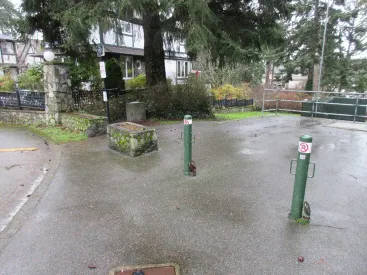
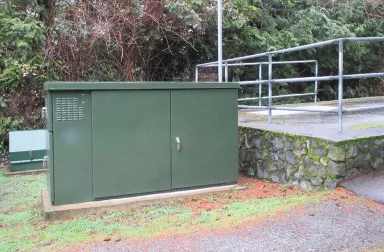
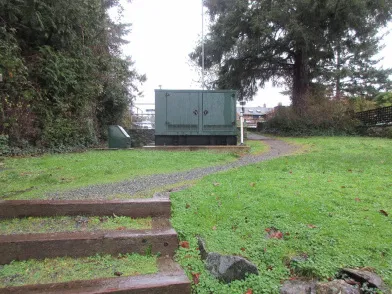
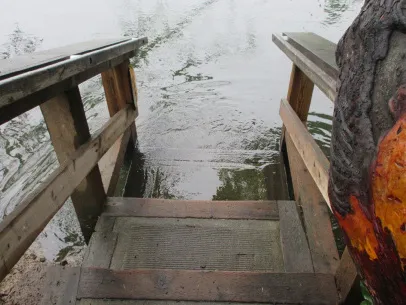
Tovey Shoreline Access is a signed water access at the south end of Tovey Crescent, next to the private Governors Point Road. The site includes a TOVR pump station, and its entrance is a large, paved parking area protected by removable bollards (in 2014 this area was a grass lawn and park land – no pump station). Immediate views from the street are to pump station infrastructure. Two remnants of the original stone entry planters along Tovey Crescent and a mature Douglas fir near the northeast corner of the site remain. A garbage receptacle is located near the fir. A universally accessible path on the east side of the parking pad provides access to a weedy grass lawn approximately 600mm below the pad, and to the staircase that leads to the shoreline. Pumping utilities and one bench are located at this level on concrete pads. The bench is tight to the west property line and adjacent the wood frame staircase which has (mostly) aggregate treads and landings, and approximately 45 wood risers. Weeds and grass are growing in the highest treads; the lowest few treads are below the HWM and made of concrete. The lowest 5 risers are double height. A second bench is located on a landing approximately 36 risers from the top.
There is a Tsunami danger warning sign posted about midway down the staircase (not visible from the upper park level), and a makeshift plywood retaining wall edging the staircase in the same location.
There is high potential for archaeological sites near the shoreline in this location.


Challenges
Views to the water from within the park are impeded by vegetation. Views to the park from the street are of pump station infrastructure. There is extensive English ivy adjacent the staircase, and it is also growing along the perimeter of the upper levels.
There is no ‘exit’ at the bottom of the staircase and no visibility from the upper park level to the lower stairs or the bench halfway down the staircase. When occupied the legs/feet of those sitting on the bench encroach on the travel path. However, this access was grandfathered before TOVR was incorporated and their intention is to keep, and maintain, the access as is. The stairs were recently replaced to the satisfaction of TOVR and are regularly maintained by TOVR Parks. The Town has indicated that if slippery treads become a future concern, they will apply a high friction surface to them.
The universally accessible path is concrete for the length of the parking pad, and hard packed, worn aggregate of varying widths beyond. The garbage receptacle adjacent the fir tree has no defined access to it. The retained planters along the street are empty due to ongoing maintenance and plant theft issues.
Tovey Shore Access Opportunities and Recommendations
- Removal of invasive species from the bank/foreshore, and planting of appropriate native and adaptive species to provide shelter and food for small birds, animals and beneficial insects, and to prevent erosion, is recommended. New planting should address the Town’s need for low maintenance and allow for anticipated effects of climate change (e.g. sea level rise, and hotter summers). Invasive species removal is best addressed as a long-term effort, and appropriately managed and monitored. (see recommended Plant list pages 9 and 10)
- Removal of invasive species throughout remainder of park (upper level), and replacement with appropriate native or adaptive species, is recommended. (see recommended Plant list pages 9 and 10)
- Install an automatic underground irrigation system after invasive species removal and prior to undertaking new planting on the upper level (there is an existing water service). Newly planted areas to be maintained for minimum 2-year establishment period.

- New vegetation on the bank and foreshore vegetation to be planted in the fall at the start of the rainy season and after invasive species removal; these areas will not be irrigated.
- After planting mulch beds immediately with 100mm depth organic mulch, such as composted leaf mulch, to help retain moisture and mitigate invasive species spread.
- Not all gaps created by invasive species removal need to be re-planted. It is recommended that areas suitable for topping with organic compost and left for native species to fill in be determined in the field, at time of clearing, by vegetation/restoration RPBio (e.g. Lehna Malmkvist, Swell Environmental).
- Newly planted areas to be maintained for minimum 2-year establishment period.
- Do not plant where site furniture and/or pathways will be located.
- The neighbourhood setting and easy pedestrian/cycling access to the grass level of this site make it a good location for a passive park with comfortable seating and good views. Creation of an all-season seating area(s) (minimum 2 benches or bench & picnic table, bike rack, garbage receptacle, shade) at the grass level is recommended. Judicious pruning of and careful new planting on the foreshore to ensure good water views is essential. Universal accessibility to each seating/viewing area is essential. Archaeological oversight or permitting may be required to excavate for the purpose of installing concrete pads for site furniture.
- Local First Nations to be advised of any archaeological finds; their input on how to appropriately acknowledge traditional sites to be sought.
- Replacing the existing grass lawn with a low maintenance and drought hardy native grass/ perennial mix that is walkable and has some tolerance for dogs is recommended. The grassed area should be universally accessible and as large and level as possible; a 2%-5% slope towards the water for drainage is all that is needed. Replace existing grass west side of the parking pad with native or adaptive species.
- Replace or refurbish the pathway between the end of the parking pad and top of the stairs. If replacing it need not go in the same location, and could be incorporated into the new park design. It is recommended the path be a minimum 1.2m wide, gently crowned, and constructed using CRD path mix over geotextile. Edge of path to be flush with finished grade.
- Using the remnant planters as a base for backless wood benches is recommended as it is unlikely new plantings would be maintained. The benches will frame the pedestrian and entrance to the park and could be designed to include an overhead structure to help make a statement gateway.
- Mitigate the visual impact of the pump station kiosks by covering them with decorative wrap.
- Introducing a secondary function for the parking pad is recommended, especially because the park lost at least half its level area after 2014 to the pump station and parking. Consider a painted maze, hopscotch, giant checkerboard, stamping, artistic painting, basketball hoop, etc. – anything the community can use when the pump station is not being serviced, and that would improve the streetside aesthetic of the valuable waterfront site.
Recommended Plant List (all native species)
Trees Suitable for Planting in Park, on Banks, and in Foreshore
| Common Name | Botanical Name | Notes |
|---|---|---|
| Douglas Fir | Pseudotsuga menziesii | 12m+ tall x 3.7m+ spread, evergreen conifer |
| Garry Oak | Quercus garryana | To 20m+ tall, slow growing, deciduous |
| Trembling Aspen | Populus tremuloides | To 25m tall, intolerant of shade, deciduous |
| Pacific Crabapple | Malus fusca | Small tree/large shrub 2-12m tall, saltwater/sea spray tolerant, deciduous |
Shrubs, Ferns & Perennials Suitable for Replacing Invasive Species in Park, Foreshore & Shoreline
| Common Name | Botanical Name | Notes |
|---|---|---|
| California Aster | Symphyotrichum chilense | 0.4-1m tall, saltwater/sea spray tolerant, sun to part shade, evergreen perennial |
| Common Silverweed | Potentilla anserina | Low and trailing, saltwater/sea spray tolerant, prefers full sun, evergreen perennial |
| Licorice Fern | Polypodium glycyrrhiza | 15-30cm tall, part to full shade, evergreen |
| Low Oregon Grape | Mahonia nervosa | To 60cm tall, broadleaf evergreen, sun or shade, leaves resemble holly (prickly). Also considered a small shrub. |
| Oceanspray | Holodiscus discolor | 1.2-1.5m tall, deciduous, sun to part shade |
| Red-flowering Currant | Ribes sanguineum | 1-3m tall, deciduous, sun to light shade |
| Red-osier Dogwood | Cornus stolonifera | 1.8-3.6m tall, deciduous, part shade |
| Scouler’s Willow | Salix scouleriana | ~12m tall, deciduous, sun or shade. Has typical ‘pussy willow’ flowers. |
| Snowberry | Symphoricarpos albus | 0.5-2m tall, saltwater/sea spray tolerant, light shade deciduous |
| Sword Fern | Polystichum munitum | To 1.5m tall, saltwater/sea spray tolerant, sun to part shade, evergreen |
| Sweetgale | Myrica gale | 1-2m tall, saltwater/sea spray tolerant, sun to part shade, deciduous |
| Nootka Rose | Rosa nutkana | 0.5-3m tall, saltwater/sea spray tolerant, full sun to part shade, aggressive spreader, thorny, deciduous. |
| Tall Oregon Grape | Mahonia aquifolium | To 1.8m tall, broadleaf evergreen, full sun or dappled shade, leaves prickly (resemble holly) |
| Yarrow | Achillea millefolium | 1m tall, saltwater/sea spray tolerant sun or shade but prefers sun, semi-evergreen perennial |
Site Photos
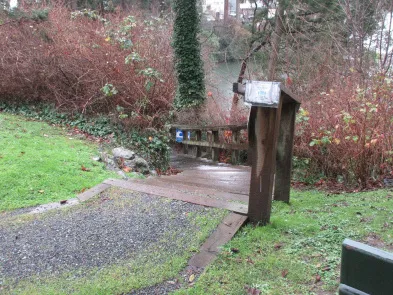
Top of stair
Stair with plywood retaining wall Plywood retaining wall
Bench on stair
Bottom of stair
Document Images
(7)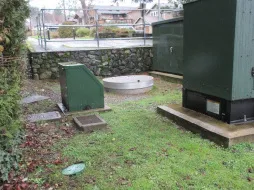
Pumping station infrastructure and concrete pads at the upper level
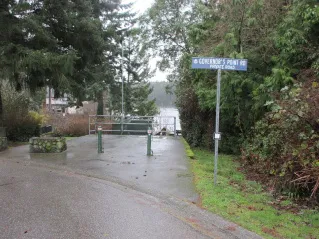
Entry to Tovey Shoreline Access area, looking south
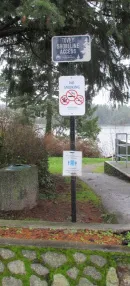
Signage at the entrance: Tovey Shoreline Access and No Smoking
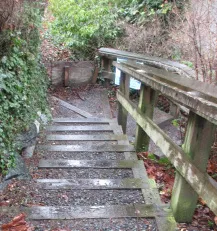
View down the staircase showing wooden handrails and a plywood retaining wall
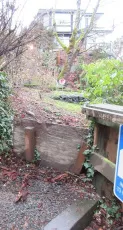
Close-up of the makeshift plywood retaining wall along the staircase
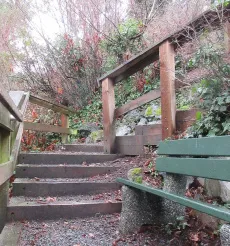
Green wooden bench located on a landing halfway down the staircase
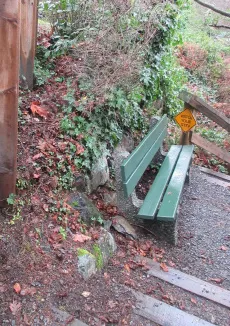
View of the stairs and bench with a yellow "Watch Your Step" sign