Staff Presentation: DP 2023-01 305 Anya Court
Presentation slides summarizing the Development Variance Permit application for 305 Anya Court.
1.0 Introduction
1.1 Background
The City of Victoria is examining the potential to introduce a new density bonus policy for the areas outside of the Downtown Core Area, in order to achieve higher redevelopment densities while also obtaining amenity contributions from rezonings that will address the impacts of growth and provide benefits to the neighbourhoods that are absorbing extra commercial or residential development.
The City already has a Community Amenity Contribution (CAC) policy in the Downtown Core Area, in which rezonings and amenity contributions are negotiated on a site-by-site basis.
The City's current practice for rezonings outside of the Downtown Core Area also involves negotiating CACs on a site-by-site basis. The City wants to explore the feasibility of using target fixed rates to calculate CACs outside of the Downtown Core Area.
The main reasons that City is interested in the possibility of using a target fixed rate approach include:
- The large number of sites outside of the Core Area designated for potential additional density and the opportunity for greater efficiency in using fixed rates over individual site-by-site negotiations.
- The recent guideline document published by the Provincial Government indicating that the use of fixed rates may offer greater transparency and predictability to the development process.
- Potential for greater clarity/certainty for all stakeholders if the CAC amount can be calculated up-front.
- Preference expressed by some stakeholders for fixed rates over site-by-site analysis.
Therefore, the City retained Coriolis Consulting Corp. and Landeca to evaluate the feasibility of implementing a fixed rate CAC system.
1.2 Approach
To evaluate the feasibility of implementing a fixed rate approach and to identify a preferred approach, we:
- Reviewed CAC and density bonus approaches in other municipalities.
- Reviewed the recently released provincial guide for density bonusing and amenity contributions.
- Interviewed representatives of UDI and the Victoria development industry to help understand their perspective on CACs in general and on a fixed-rate approach specifically.
- Completed detailed financial analysis for a cross section of different properties located in the four different designations to help determine if rezoning and redevelopment is financially viable and if so, whether there is additional property value created by the rezoning.
1.3 Report Organization
This report is organized as follows:
- Section 2.0 identifies the study area for the density bonus policy analysis.
- Section 3.0 provides an overview of density bonusing and amenity contributions, including existing legislation, different approaches that are used, the recently published Provincial guide, the urban land economics rationale, and examples of fixed rate CACs in other municipalities.
- Section 4.0 summarizes comments that were received from local Victoria developers and UDI as input to our analysis.
- Section 5.0 summarizes the case study financial analysis completed for the study.
- Section 6.0 identifies and evaluates the policy options that could be considered by the City.
- Section 7.0 provides our recommended approach for CACs outside of the Downtown Core Area.
- Section 8.0 identifies other issues identified during the course of our analysis that should be considered by the City.
- The Attachments include the detailed case study financial analysis.
1.4 Professional Disclaimer
This document may contain estimates and forecasts of future growth and urban development prospects, estimates of the financial performance of possible future urban development projects, opinions regarding the likelihood of approval of development projects, and recommendations regarding development strategy or municipal policy. All such estimates, forecasts, opinions, and recommendations are based in part on forecasts and assumptions regarding population change, economic growth, policy, market conditions, development costs and other variables. The assumptions, estimates, forecasts, opinions, and recommendations are based on interpreting past trends, gauging current conditions, and making judgments about the future. As with all judgments concerning future trends and events, however, there is uncertainty and risk that conditions change or unanticipated circumstances occur such that actual events turn out differently than as anticipated in this document, which is intended to be used as a reasonable indicator of potential outcomes rather than as a precise prediction of future events.
Nothing contained in this report, express or implied, shall confer rights or remedies upon, or create any contractual relationship with, or cause of action in favor of, any third party relying upon this document.
In no event shall Coriolis Consulting Corp. be liable to the City of Victoria or any third party for any indirect, incidental, special, or consequential damages whatsoever, including lost revenues or profits.
2.0 Study Area
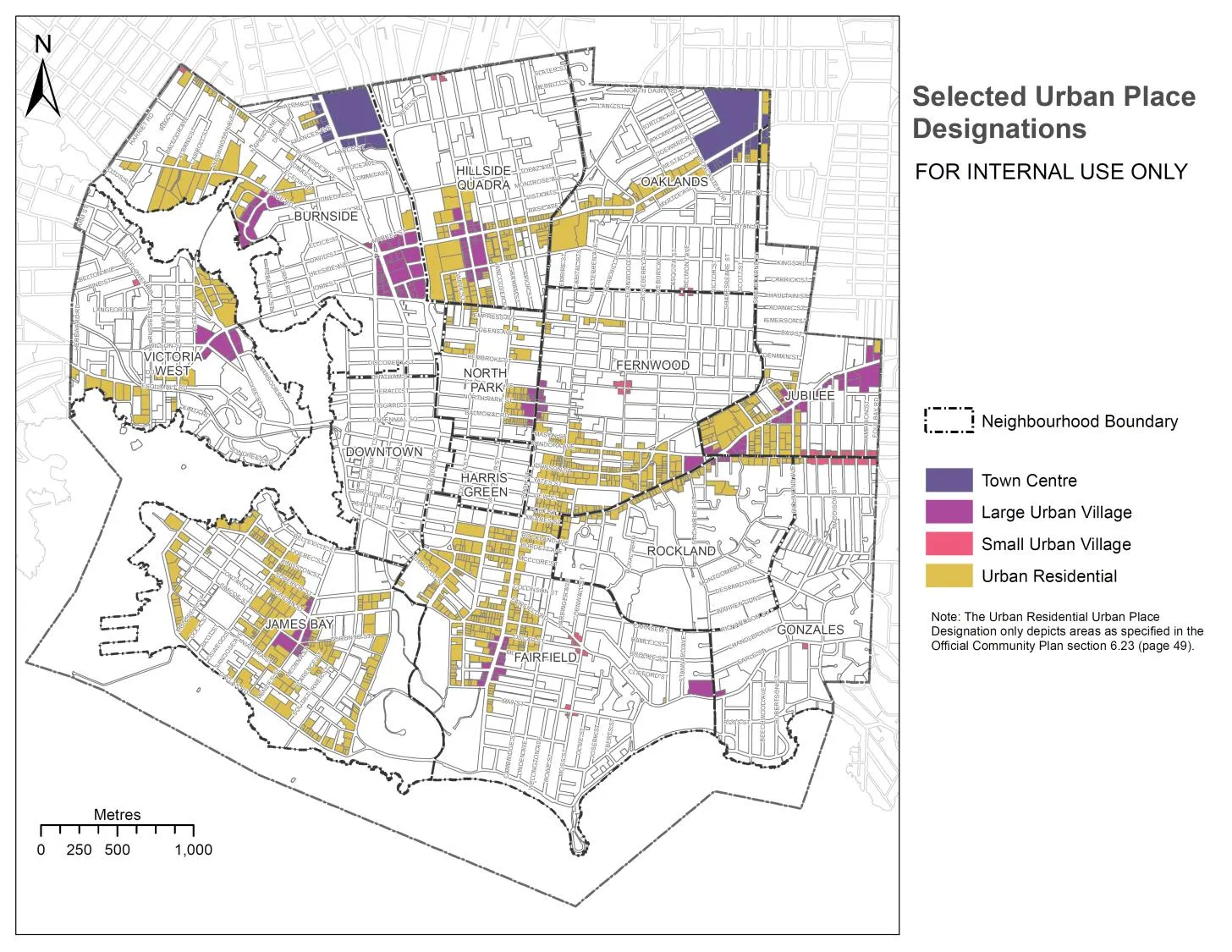
In specific areas outside the Downtown Core Area (shown in the map below), the OCP includes base densities and potential discretionary additional density to be considered for some sites in four specific land use categories.
- Town Centres, with base densities of up to 2.0 FSR and increased density up to approximately 3.0 FSR.
- Large Urban Villages, with base densities of up to 1.5 FSR and increased density up to approximately 2.5 FSR.
- Small Urban Villages, with base densities of up to 1.5 FSR and increased density up to approximately 2.0 FSR.
- Urban Residential, with base densities of up to 1.2 FSR and increased density up to approximately 2.0 FSR.
The study area for our analysis is comprised of the properties in these four OCP designations (Exhibit 1).
Exhibit 1: Study Area for Analysis
3.0 Overview of Density Bonusing and Amenity Contributions
3.1 Legislation
In BC, municipal authority to zone land (i.e. to regulate land use and urban development) flows from the Local Government Act. Municipalities can use their zoning authority to achieve amenities in two different ways:
- Zoning for amenities and affordable housing pursuant to Section 904 of the Local Government Act. The use of Section 904 is often called density bonus zoning or density bonusing.
- Negotiating the provision of amenities as part of a rezoning approval. Many municipalities refer to this as obtaining Community Amenity Contributions (CACs) via rezonings.
3.1.1 Density Bonus Zoning
Section 904 of the Local Government Act states that a zoning bylaw may establish different density regulations for a zone, with one density that is generally applicable in the zone and another that is available if certain conditions are met. These conditions can be related to the provision of amenities and the provision of affordable housing.²
Excerpt from Section 904 of the Local Government Act
“(1) A zoning bylaw may: (a) establish different density regulations for a zone, one generally applicable for the zone and the other or others to apply if the applicable conditions under paragraph (b) are met, and (b) establish conditions in accordance with subsection (2) that will entitle an owner to a higher density under paragraph (a).
(2) The following are conditions that may be included under subsection (1)(b): (a) conditions relating to the conservation or provision of amenities, including the number, kind and extent of amenities; (b) conditions relating to the provision of affordable and special needs housing, as such housing is defined in the bylaw, including the number, kind and extent of the housing; (c) a condition that the owner enter into a housing agreement under section 905 before a building permit is issued in relation to property to which the condition applies.
(3) A zoning bylaw may designate an area within a zone for affordable or special needs housing, as such housing is defined in the bylaw, if the owners of the property covered by the designation consent to the designation.”
Based on the language in the Local Government Act, a zoning district with density bonus provisions typically defines:
- A base density that can be developed without providing any amenities or affordable housing.
- Additional density, up to a defined maximum, that can be obtained by providing amenities (or cash-in lieu) or affordable housing as prescribed by the zoning bylaw.
The following conditions must be true for density bonusing to be effective and supported in a given community or development site:
- The identification of sites eligible for the extra density should be based on sound community and urban development planning. Presumably, density bonusing helps to implement a community planning and urban design process that identifies appropriate locations for additional density and determines appropriate increases in density or height.
- The extra density must be able to be physically and appropriately accommodated on the site.
- Developers must perceive that the extra density is marketable and financially attractive. They must have confidence that the additional units (or commercial space) can be marketed in a reasonable time, they must have the wherewithal to take on a larger project, and the extra units or space must be profitable. There are cases in which developers are not interested in the extra density, such as a case in which the extra density requires a shift from wood frame to concrete construction in a market that does not support the extra cost of concrete, a case in which the extra space will take too long to sell or lease, or a case in which the extra density triggers extraordinary costs (e.g. having to construct an entire new level of underground parking to accommodate a small increment in the number of units).
- The cost of any amenities or public benefits provided by the developer must be equal to or less than the value of the bonus density, or the developer will not view the density bonus as financially attractive.
- Typically, the use of the bonus density is at the discretion of the developer. The developer can choose to develop under the base density (without providing amenities) or develop at the higher density by providing the appropriate amenity.
- The process of determining the new density and the appropriate package of public benefits should be reasonably clear and predictable, so developers can decide if they are interested and so the community can decide if the trade-off between absorbing additional density and achieving certain benefits is reasonable.
- Redevelopment sites must trade in the market place at prices supported by the base density, so that developers can afford to pay for the amenities to be provided in exchange for the additional density. If developers build the value of the anticipated bonus density into their land acquisition cost, they will in effect be paying twice for the bonus density (once to the land seller and once to the municipality in the form of the benefits that must be provided). This is one of the key reasons that clarity and predictability are advantageous, so that the developers know what they can pay for sites.
In the absence of these conditions, developers will not be interested in rezoning into a density bonus zoning district and/or will not be interested in using the density bonus provisions within an existing density bonus district.
² The practice of using density bonus zoning for project design related features (e.g. a base density and a bonus density that is achievable if a project includes say underground parking) has been used by some municipalities for a long time. Over the past decade or so, there has been an increasing trend towards using density bonus zoning for obtaining amenities and other public benefits from new development.
3.1.2 Amenities Negotiated as Part of Rezonings
Other than Section 904, there is no explicit authority in the Local Government Act providing municipalities with the ability to obtain amenities from the rezoning process. However, the nature of the rezoning process in BC creates the opportunity for municipalities to obtain amenities as part of the approvals process as follows:
- Municipal Councils have the discretionary authority to rezone or not to rezone property. While Councils are not empowered to act contrary to their Official Community Plans (OCPs), there is not a positive obligation to implement policies in the OCP. In particular, there is no obligation to amend zoning to match OCP designations. Consequently, in their OCPs municipalities can designate areas for redevelopment and densification without immediately changing the zoning to match. Councils should determine whether rezonings are in the community interest, which can include considering whether the proposed rezoning generates community benefits that (in the broadest sense) offset any potential negative impacts of the development, help meet the needs of the new population growth, or avoid burdening existing tax payers.
- Rezoning can result in an increase in property value which provides the economic ability for a project to provide public benefits as part of the rezoning.
For this approach to be successful, the following conditions must be true:
- A developer must want the change in land use and/or density. The developer must see an opportunity to make a profitable project under the new (proposed) use and density.
- The cost of any amenity contribution the developer makes must be less than the increase in the property value associated with the rezoning, sometimes significantly less in order to create the financial room to provide an incentive to the land owner to sell their property to the developer.
- Developers must be able to buy development sites based on the value under the existing use and zoning. If developers pay for land based on its value after rezoning, then (from their perspective) the rezoning does not create any increase in property value and there is no financial “room” to make a voluntary amenity contribution.
3.2 Different Approaches to Obtaining Amenity Contributions
There are two different general approaches to obtaining amenity contributions from new development projects:
- Zoning for amenities and affordable housing pursuant to Section 904 of the Local Government Act (i.e., density bonus zoning).
- Negotiating the provision of amenities as part of a rezoning approval. This can be implemented through site-by-site negotiations or through the use of a target fixed rate CAC.
Like density bonus zoning, fixed rate CAC targets have the advantages of being predictable and easy to communicate so that developers can anticipate the likely costs of the amenity contribution and factor this into their bid price for land. However, this approach is not suitable for some kinds of rezonings (e.g. sites that are changing use as well as increasing density, sites that have an unusual ability to deliver on-site amenities not easily captured in a standard bylaw such as waterfront or heritage properties, and very large sites that can physically accommodate an array of amenities on-site).
The negotiated system of identifying the value of bonus density is more flexible, because the amenity package can include more site-specific consideration of the impacts and amenity needs of the development project and the project’s ability to afford the amenity contribution. The drawback to this approach is that it requires detailed analysis and negotiation, so it requires an investment of staff (or consultant) time and possibly a lengthy process. This is a good approach for large or complex sites that are not amenable to the formulaic approach used in a density bonus system or a fixed rate CAC target system.
Different municipalities use different approaches:
- Some municipalities set a target fixed rate CAC for use in amenity contribution negotiations during rezonings. This approach is often applied to rezonings that meet certain conditions, such as:
- Rezonings of small sites,
- Rezonings in defined geographic areas that have been identified for upzoning with specific guidelines for use, height and density.
- Rezonings for certain land use changes.
- Some municipalities negotiate CACs on a site-by-site basis. This approach is often used for more complex or unusual rezonings, such as:
- Sites that are changing use as well as increasing density, such as the transition from industrial to residential.
- Sites that have an unusual ability to deliver on-site amenities not easily captured in a standard bylaw (e.g. waterfront or heritage properties).
- Very large sites that can accommodate an array of on-site amenities.
- Some municipalities use a mix of the two different approaches.
3.3 Provincial Guide to CACs
In March 2014, the Provincial government published a guide “Community Amenity Contributions: Balancing Community Planning, Public Benefits, and Housing Affordability”. The guide's objective is to help “local governments understand the risks, challenges, and recommended practices related to obtaining community amenity contributions (CACs).”³
The guide encourages municipalities to think carefully about the approach to CACs to ensure that CACs do not reduce the supply of land available for redevelopment and, thereby, negatively affect housing prices.
The guide encourages the use of density bonus zoning and fixed rate target CACs when possible, but discourages negotiated CACs that focus solely on capturing all of the land lift created by a rezoning. It emphasizes that CAC rates should be moderate to help avoid impacts on development and specifies that there should be a nexus between the CAC and the needs of the community.
The guide focuses on CACs, but notes that density bonus zoning is another way for local governments to obtain community amenities from development and that most of the “recommended principles and practices apply equally to CAC and density bonus approaches.”⁴
The guide makes the following key points and recommendations:
- Use CACs for capital costs only, not operating costs. The guide notes that “it is reasonable to expect new development to contribute to the capital costs of infrastructure and amenities necessary to support that growth” but “once the new residents and businesses move into that development, they will contribute to the operating costs…through user fees, utility charges, and property taxes.”⁵
- Plan ahead. Local governments should identify amenities that are needed to address future growth in their Official Community Plans or neighbourhood plans, and ideally prioritize needed amenities in each neighbourhood.
- Remember that CACs are negotiated as part of a discretionary approval of rezoning. Local governments cannot, strictly speaking, require CACs as condition of rezoning. “Any contributions must be either at the initiative of the applicant/developer or emerge from rezoning negotiations between the applicant/developer and the local government.”⁶ Zoning should not be perceived as being “for sale”.
- Rezoning should be viewed as a means to implement policy for redevelopment and densification, and CACs should be viewed as a means to deal with the impacts and amenity needs of new development. Do not use rezoning as an arbitrary means of generating municipal revenues.
- Make sure that the amount of CAC being sought will not have a negative impact on the price of housing. The guide notes that the impact of CACs can be different in different areas or circumstances and that it is important for local governments to consider who ultimately pays for the CACs. The guide acknowledges that, based on urban land economics theory, the cost of amenity contributions cannot simply be added to the price of new housing because market prices are set by supply and demand and can’t arbitrarily be increased because of a new cost. The primary impact of CACs is to put downward pressure on land values (i.e. developer’s will offer lower prices for development sites) where there is a “good supply” of land available for development. The guide notes that there can be negative impacts on house prices (overall house prices not just prices for new units) if a CAC is material enough to decrease the supply of land available on the market (i.e. if too many land owners decide not to sell at the lower bid price), which can lead to a reduced supply of new units and (in the context of supply being less than demand), upward pressure on overall house prices. The guide suggests that amenity contributions should be “modest” to minimize the risk of impact, but does not define modest.
- Apply the DCC principles of nexus and proportion to CACs. The guide suggests that there should be a direct link between CACs and the impacts of new development or a direct link between CACs and the amenity needs of new residents or businesses in the redeveloping area. The guide suggests that CACs from individual applicants/developers should be “proportional to the impact that their development generates and consistent with the CACs made by other applicants/developers”⁷, but does not define what “proportional” means.
- In priority order, consider these strategies to obtaining amenities: a. First, consider using zoning measures themselves to increase affordable housing. Local governments should incorporate measures into their zoning bylaws/districts to allow design features that can reduce the cost of producing housing units and/or encourage additional units, to help increase the supply of affordable housing (e.g. reduce or eliminate setbacks and parking requirements, allow secondary units such as suites and laneway houses). b. Second, use density bonus zoning because it is predictable, transparent, and easy to implement. c. If “pre-zoning” land is not practical, set targets for CACs and be open to negotiation at the time of rezoning. The guide encourages local governments to consult “the development community and/or engage people with expertise in real estate market and financial analysis” to assist in determining appropriate targets.⁸
- Negotiating CACs solely on the basis of capturing all of the “land lift” is inconsistent with the principles of planning ahead, having a link between the amenity contributions and the impacts or needs of the development, and being proportional. There is clearly a place for land lift analysis in the overall process (as the guide supports the use of financial analysis to make sure that CACs are reasonable and affordable for individual projects, and do not have an impact on the housing market), but the guide discourages having a policy that simply seeks to capture 100% of the lift without considering impacts/needs, the nexus between the amenity contribution and those impacts/needs, and proportionality.
- Be transparent about CACs. Local governments should maintain public records of all types of CACs (e.g. financial, physical amenities, land).
³ Ministry of Community, Sport, and Cultural Development, “Community Amenity Contributions: Balancing Community Planning, Public Benefits, and Housing Affordability.” March 2014, page 1. ⁴ Ministry of Community, Sport, and Cultural Development, “Community Amenity Contributions: Balancing Community Planning, Public Benefits, and Housing Affordability.” March 2014, page 1. ⁵ Ministry of Community, Sport, and Cultural Development, “Community Amenity Contributions: Balancing Community Planning, Public Benefits, and Housing Affordability.” March 2014, page 12. ⁶ Ministry of Community, Sport, and Cultural Development, “Community Amenity Contributions: Balancing Community Planning, Public Benefits, and Housing Affordability.” March 2014, page 6. ⁷ Ministry of Community, Sport, and Cultural Development, “Community Amenity Contributions: Balancing Community Planning, Public Benefits, and Housing Affordability.” March 2014, page 10. ⁸ Ministry of Community, Sport, and Cultural Development, “Community Amenity Contributions: Balancing Community Planning, Public Benefits, and Housing Affordability.” March 2014, page 18.
3.4 Urban Land Economics Rationale
The reason that development projects are able, in financial terms, to provide amenities in exchange for additional development rights is that the additional development rights have value. Otherwise, a developer could not absorb the cost of an amenity contribution.
When a developer acquires a development site, the developer is buying land of course, but in land economics terms the developer is buying the development entitlements that go along with the land (in the form of zoning). The amount a developer is able to pay for a property is in large part a function of the type and amount of development likely to be approved and the anticipated financial performance of that development.
Exhibit 2 shows in very simple terms the financial performance of a hypothetical development project (in this case a multifamily residential development) in three different scenarios:
- The first scenario assumes the site is zoned for 20 apartment units.
- The second scenario assumes the site is upzoned to allow 30 apartment units with no amenity contribution.
- The third scenario assumes the site is upzoned to allow 30 apartment units with an amenity contribution of $5,000 per additional unit.
The site is assumed to be improved with an existing commercial building that is generating enough rent to support a market value of about $1,100,000 under its existing use (i.e. the value if an investor would pay to hold the property as an income-producing asset). In all three scenarios, the site size, the assumed average selling price of individual units (measured in dollars per square foot), and the assumed construction cost (measured in dollars per square foot) are the same.
Exhibit 2: Redevelopment Economics for Hypothetical Apartment Project
| Scenario 1 Site zoned for 20 unit MF project | Scenario 2 Site up-zoned to 30 units, no amenity contribution | Scenario 3 Site up-zoned to 30 units with $5,000 per additional unit amenity contribution | |
|---|---|---|---|
| Revenue ($360,000/unit) | $7,200,000 | $10,800,000 | $10,800,000 |
| Costs | |||
| Marketing/commissions (5% of revenue) | 360,000 | 540,000 | 540,000 |
| Hard & Soft Costs (240,000 per unit) | 4,800,000 | 7,200,000 | 7,200,000 |
| DCCs ($3,500 per unit) | 70,000 | 105,000 | 105,000 |
| Profit Allowance (15% of rev) | 1,080,000 | 1,620,000 | 1,620,000 |
| Cost of rezoning | 0 | 100,000 | 100,000 |
| Amenity Contribution | 0 | 0 | $50,000 |
| Land Value Supported by Development | $890,000 | $1,235,000 | $1,185,000 |
| Value Under Existing Use | $1,100,000 | $1,100,000 | $1,100,000 |
| Increase Over Existing Value | negative | $135,000 | $85,000 |
| Viable for Redevelopment | no | yes | yes |
Scenario 1 is the base case and shows how this project performs, in financial terms, under existing zoning. The developer in this case earns a typical profit (calculated as a margin of 15% of revenue), if the developer pays a maximum of $890,000 for the site. However, the existing use supports a value of about $1,100,000 (if sold to an investor or possibly more if it is an owner-occupier who needs an incentive to relocate) so the site is not attractive for redevelopment at the required profit margin. It is important to note that this is not always the case as some sites are financially attractive for redevelopment under existing zoning. However, this result is typical of the situation in Victoria outside of the Downtown Core Area so it is a good example for this study.
Scenario 2 shows how the project would perform if the site is rezoned to allow a higher density without providing an amenity contribution. The project is bigger so the total revenue from unit sales, total cost, total profit, and total supportable land value are of course higher. However, it is important to note that the profit margin is the same (15% of revenue). The developer’s ability to pay for the property increases to $1,235,000 (or $135,000 more than the existing value of $1,100,000) because it allows a larger project (more density). This is higher than the site's value under existing use as an income producing commercial property and also provides an incentive for the land owner to sell, so the site is now financially attractive for redevelopment.
In this case, the rezoning creates additional density and value which makes a site viable for redevelopment that was not viable for development under existing zoning (Scenario 1). The question is now whether the project can also support an amenity contribution.
Scenario 3 shows how the project would work if the site is rezoned with a $5,000 per additional unit ($50,000 in total) amenity contribution. The project is now the same size as in Scenario 2, so the sales revenues, development, costs, and profit are the same as in Scenario 2. However, in Scenario 3 the developer must provide an amenity contribution as part of the rezoning. In this scenario the developer can now afford to pay $1,185,000 to acquire the site. This illustrates that:
- The project is still financially viable to the developer.
- The municipality receives a $50,000 amenity contribution as part of the rezoning.
- The developer can afford to pay $1,185,000, which is higher than the $1,100,000 existing property value that an investor would pay for the property. This creates the opportunity for the developer to offer an incentive to the existing property owner if they make the property available for redevelopment.
It is important to note that if the municipality attempted to obtain a significantly higher CAC in Scenario 3 (say $15,000 per additional unit), then the rezoning would not be financially attractive for the developer.
These scenarios illustrate key points about rezonings and amenity contributions:
- The provision of the amenities does not change the price of housing (the units in Scenario 3 sell for the same price as in the other Scenarios).
- With the amenity contribution, the rezoning is still attractive to the developer, who earns the same profit margin in Scenarios 2 and 3. The difference is that the developer cannot pay the same amount to the land owner in Scenario 3.
- Land owners often require an incentive to sell their property (particularly if the site is not vacant). The cost of the CAC should be less than the additional value created by the rezoning to create an incentive for the property owner to sell to the developer.
- The additional value created by a rezoning:
- Can make redevelopment of a site financially viable when it is not viable under existing zoning.
- Creates the potential for an amenity contribution.
- Creates an incentive to the existing owner to sell for the property for redevelopment, if the cost of the amenity contribution is set appropriately.
3.5 Target Fixed Rate CACs in Other Municipalities
The City wants to explore the feasibility of using target fixed rates to calculate CACs for areas outside of the Downtown Core Area, an approach currently used by a number of different municipalities in BC. This section provides some examples of municipalities the Capital Region District and Metro Vancouver that use a target fixed rate approach. Some of these municipalities also use density bonus zoning and site-by-site CAC negotiations. The municipalities included in this section were selected to provide illustrations of the different approaches used by different municipalities. This is not intended to be a comprehensive list of all municipalities that use fixed rate CAC targets or density bonus zoning.
3.5.1 Langford
The City of Langford seeks contributions from rezonings for affordable housing and amenities. The City uses a target fixed rate to determine the appropriate contribution. The target varies by subarea within the municipality and by project type.
- For townhouse and apartment rezonings the target ranges from a low of $2,135 per unit to a high of about $4,270 per unit.