Environmental Development Permit with Variance 2022/11 - 302 Bessborough Avenue
Staff report regarding an application to replace a waterfront platform, stairs, and install a new gangway and floating dock at 302 Bessborough Avenue.
- For duplex and small lot single family rezonings the target ranges from a low of $2,310 per unit to a high of about $4,620 per unit (single family subdivisions with 15 lots or more have the option of meeting part of this contribution through the provision of affordable housing units).
- The rate for commercial, business park and industrial rezonings ranges from zero to $1.00 per square foot of floorspace, depending on the location.
3.5.2 Colwood
The City of Colwood seeks contributions from multifamily rezonings for affordable housing and amenities. The City uses a target fixed rate to determine the appropriate contribution. The target varies by project type.
- For apartment rezonings the target is $1,500 per additional unit permitted by rezoning.
- For detached, duplex and townhouse rezonings the target is $3,000 per additional unit permitted by rezoning.
3.5.3 North Saanich
The District of North Saanich seeks contributions from residential rezonings for affordable housing and a variety of amenities. The District uses a target fixed rate to determine the appropriate contribution. The target varies by project type.
- For apartment rezonings the target is $8,000 per unit permitted by rezoning.
- For townhouse rezonings the target is $9,500 per unit permitted by rezoning.
- For single family rezonings the target is $16,000 per additional lot permitted by rezoning.
3.5.4 Saanich
The District of Saanich does not have an official amenity contribution policy. However, planning staff indicated that it the District's practice to request an amenity contribution in the range of $1,000 to $1,500 per housing unit for rezonings. This is consistent with the contributions provided by recent rezonings in Saanich that we examined. The expected contribution ranges depending on the project's characteristics.
3.5.5 Vancouver
The City of Vancouver obtains amenity contributions from new projects that involve rezoning via site-by-site negotiations (for “non-standard” rezonings) and fixed rate target CACs (for “standard” rezonings and rezonings in some specific areas in the City). It also recently implemented density bonus zoning in the Marpole Community Plan area and in the West End Community Plan area.
There are two types of CAC policy areas in Vancouver (see Exhibit 3):
- The City-wide CAC area, which applies to most of the City. Vancouver sometimes seeks a fixed rate target City-wide CAC and sometimes negotiates the City-wide CAC, depending on the nature and location of the project.
- Area-specific CAC areas, which have their own area-specific CAC and/or public benefit policies and are not subject to the City-wide CAC. In most cases, these areas have a fixed rate target CAC (although some have a fixed rate target CAC that applies to certain types of rezonings and CACs are negotiated for other types of rezonings).
Exhibit 3: CAC Policy Areas in the City of Vancouver
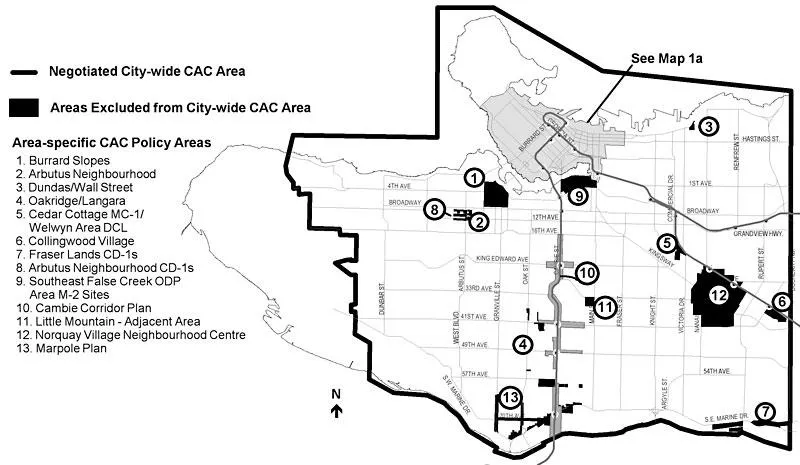
- Fixed Rate Target Amenity Contributions. Vancouver seeks a fixed rate target City-wide CAC of $3.00 per square foot of the net increase in floorspace permitted by the rezoning for “standard” rezonings, which include rezonings involving small projects outside of Downtown that do not involve a transition from industrial to residential use. However, City staff are currently reviewing the $3.00 per square foot fixed rate CAC as it has been in place since 1999 and is not reflective of the current market in Vancouver. In addition, this rate is rarely used as most rezonings are in locations that are excluded from the City-wide rate.
Specific areas of the City are excluded from the City-wide CAC and are subject to an Area-specific CAC. Vancouver is increasingly using Area-specific target CAC rates. In most cases, the Area-specific CAC includes a fixed rate target CAC (although this sometimes only applies to certain types of rezonings and amenity contributions are negotiated in other types of rezonings). As examples:
- An area-specific target CAC of $11.50 per square foot is sought from private M-2 (industrial) sites undergoing a rezoning in Southeast False Creek.
- An area-specific target CAC of $15 per square foot is sought from apartment rezonings in the Norquay Village Centre Transition Area.
- An area-specific target CAC of $23.00 per square foot is sought from all rezoning proposals for low to mid-rise apartments in the Little Mountain Adjacent Area.
- An area-specific target CAC of $55.00 per square foot is sought from all 4 to 6 storey multi-family rezoning proposals in the Cambie Corridor Plan Phase 2 Area. Amenity contributions from other rezoning applications in the Cambie Corridor Phase 2 Area will be negotiated on a site-by-site basis.
- An area-specific target CAC of $55.00 per square foot is sought from all multi-family rezoning proposals for projects up to 6 storeys in the Marpole Community Plan Area. We understand that this target CAC was set at about 75% of the estimated land lift. Amenity contributions from other rezoning applications in the Marpole Community Plan Area will be negotiated on a site-by-site basis.
- Negotiated Amenity Contributions. Vancouver seeks a negotiated CAC for “non-standard” rezonings which involve:
- Large sites (i.e. sites with a lot area greater than 2 acres in most cases, but greater than 1 acre if the site is in a Community Vision designated Neighbourhood Centre or Shopping Area).
- A change in use from industrial to residential.
- A site in Downtown.
As noted above, there are also some cases where a site is in an Area-specific CAC area, but the policy notes that the City will negotiate the CAC. For example, in the Marpole Community Plan Area the City has a fixed rate target CAC for some types of rezonings (i.e. rezonings to allow 6 storey multi-family residential projects) and negotiates the CAC for all other types of rezonings in this area.
Vancouver uses the land lift approach when negotiating CACs and typically seeks a CAC in the range of 75% to 80% of the increase in property value.
- Density Bonus Zoning. Vancouver has used density bonus zoning for a long time for project design-related items (e.g. underground parking), but until recently it has not used density bonus zoning for amenities. However, during 2014, the City implemented density bonus zoning in the Marpole Community Plan area (to obtain affordable housing, heritage retention, and amenities) and in the West End Community Plan area (to obtain social housing and market rental housing). For example, in Marpole:
- The Marpole Community Plan (which was adopted in 2 April 2014) identified some areas that are suitable for 4 storey apartment and townhouse/row-house development and noted that the City would initiate rezoning bylaws for these areas that include a density bonus provision where projects will contribute a per square foot value on the approved net increase in density towards community amenities.
- After the adoption of the Marpole Community Plan, the City drafted amendments to the Zoning Bylaw including four new zones (RM-8, RM-8N, RM-9, and RM-9N) and changes to the general regulations to support density bonusing in certain areas of Marpole.
- In May 2014, Vancouver City Council approved the proposed zoning amendments and they are now in effect. As envisioned in the Marpole Community Plan, the City pre-zoned sites into the new zoning districts.
- The new zones include a base density (0.75 FSR), a range of bonus density that can be obtained for providing an amenity (which varies depending on site size and frontage but the maximum density is up to 2.0 FSR), and details about the amenity contribution that must be provided in exchange for the bonus density. The amenity contribution is either secured market rental housing or social housing, heritage retention, and/or a defined contribution per square foot of the net increase in density towards amenities or affordable housing ($10 per square foot of additional floorspace up to 1.2 FSR and $55 per square foot of additional floorspace beyond 1.2 FSR).
3.5.6 New Westminster
New Westminster uses a variety of approaches to obtain amenities from new development:
- Density Bonus Zoning. New Westminster has existing density bonus zoning districts with defined base densities, defined bonus density, and a schedule of rates (dollars psf of bonus density) that apply to townhouse and low-rise multiple unit residential zoning districts. The bonus density rates currently range from $22.50 to $80.00 per square foot of bonus density depending on the type of project.
New Westminster is in the process of creating additional new bonus zoning districts with defined base densities, defined bonus densities, and a schedule of rates (dollars psf of bonus density) that developers can rezone sites in Downtown into (excluding heritage sites) for high density residential and mixed use projects. New Westminster is not planning to pre-zone properties into these new bonus zoning districts (as it did with the townhouse and low-rise zoning districts), so this approach means that (in theory) any given development project in Downtown will have three options:
- Proceed under the site’s existing zoning.
- Apply to rezone the site into one of the new density bonus zoning districts. In this case, developers may or may not attempt to negotiate some aspects of the zoning districts. In other words, there may still be some elements of negotiation regarding the bonus.
- Apply to rezone the site to a CD zone and negotiate amenity contributions on a site-specific basis.
Fixed rate Target Voluntary Amenity Contributions (VACs). For small scale rezonings from single family to low-rise apartment use (with a maximum density of 1.8 FSR and less than 80 units), the City often uses a fixed rate target VAC (dollars per unit) as the basis for negotiations with the applicant. The fixed rate target varies between the Mainland ($1,250 per unit) and Queensborough ($1,000 per unit).
Negotiated Amenity Contributions. For other rezonings (not including sites that will rezone into the new Downtown density bonus zoning districts), the City negotiates the VAC based on the estimated increase in property value associated with the rezoning approval (proforma approach).
3.5.7 District of North Vancouver
The District of North Vancouver obtains amenities from new development in two ways:
- The District negotiates a fixed rate target CAC from most residential projects that involve rezoning and that are not located in a Town or Village Centre. However, its policy notes that there may be rezoning applications where the District or developer finds that the fixed rate target CAC is not appropriate and therefore the CAC can be negotiated instead.
For sites within an area contemplated for increased density in the OCP but outside a Centre, the District’s policy notes that “CACs should be required and should be calculated as follows:
- $5.00 per square foot of increased residential gross floor area for townhouse, duplex, triplex, or similar development.
- $15.00 per square foot of increased residential gross floor area for apartment development.
The increase in residential gross floor area is calculated as the proposed gross floor area in the development project less a deemed base density for the site depending on its current zoning and building form, which is outlined in the District’s Amenity Contributions Policy. The deemed base density closely matches existing zoning.
- The District negotiates CACs on a case-by-case basis for residential rezonings in its four Centres (i.e. Lower Lynn, Lynn Valley, Lower Capilano, and Maplewood).
For sites within a Centre (i.e. Lower Lynn, Lynn Valley, Lower Capilano, and Maplewood) where a developer is seeking an increase in density or change in land use and for sites outside of Centres for which the District or developer finds the fixed rate target CAC to be inappropriate, CACs are negotiated on a case-by-case basis. The District typically retains a consulting firm to help estimate the increase in the market value of the land attributable to the proposed density increase and then seeks to negotiate about 75% of the land lift for sites in Centres and about 50% to 75% of the land lift for sites outside of Centres.
The District is currently reviewing its approach to obtaining amenities from new development with the objectives of updating the fixed rate target CAC figures it currently seeks outside of Centres and looking for more opportunities to use fixed rate target CACs.
3.5.8 Richmond
Richmond has formulaic density bonus zoning in most of its residential zones (including single detached, infill residential, townhouse, and apartment zones), its mixed use zones in the City Centre, and some of its industrial zones.
Individual zoning districts include a base density as well as bonus density (or tiers of bonus density) that can be achieved by meeting certain conditions. Some of the bonus density can be achieved by meeting criteria that are unrelated to the provision of community amenities (e.g. extra density that can be used to provide amenity space within the project that serves residents of the project). Some of the bonus density, though, is directly tied to the provision of community amenities (i.e. affordable housing; child care; community amenity spaces such as recreation, library/exhibit, and museum uses; the Capstan Way Canada Line Station, and the provision of commercial space). Richmond’s Zoning Bylaw defines the amount of amenity to be provided for projects depending on the zone. The charges range from:
- $1.00 to $4.00 per square foot buildable for contributions to the affordable housing reserve.
- $0.80 to $4.00 per square foot buildable for contributions to the child care reserve.
- $0.75 to $4.00 per square foot buildable for contributions towards community amenities (e.g. community recreation, library and exhibit space, heritage).
- $7,800 per dwelling unit for contributions to the Capstan station reserve (as of September 2011, with the rate to be adjusted annually based on the BC CPI).
In most cases, in order to use the bonus density the site must be rezoned (i.e. Richmond created zones with density bonus provisions but they did not automatically apply to any sites) and there are requirements to enter into other kinds of agreements (e.g. housing agreement).
For example, Richmond’s “Residential/Limited Commercial” zone accommodates mixed use projects with mid to high-rise apartments and a limited amount of commercial space in Richmond’s City Centre. The zone has five sub-zones which vary in terms of the base density, amount of bonus density, and the amenity that must be provided in order to achieve the bonus density. Some of the tiers of bonus density can be achieved for providing amenity space for the project itself, but some of the tiers of bonus density can be achieved for providing amenities that help the City achieve its goals related to affordable housing, child care (e.g. there is a 1.0 FAR commercial bonus if 5% of the bonus is used for child care space or community facilities), vitality of the City Centre, and the Capstan Way Canada Line Station.
The Zoning Bylaw and City Centre Area Plan set out the amount of bonus density that is available for developers at their discretion and the amenity that must be provided in return.
3.5.9 West Vancouver
West Vancouver obtains amenity contributions from new development via formulaic density bonus zoning in Ambleside and via negotiated amenity contributions at rezoning elsewhere in the municipality.
West Vancouver’s OCP outlines the broad objective of securing amenities from new development and it has a separate policy document (“Public Amenity Contribution Policy”) that outlines the framework for obtaining amenity contributions from new development.
- Density Bonus Zoning. West Vancouver has formulaic density bonus zoning in two of its zoning districts in the Ambleside Town Centre: Ambleside Centre Zone 1 (AC1) and Ambleside Centre Zone 2 (AC2).
The maximum permitted density for both the AC1 and AC2 zones is 1.0 FAR. If a community amenity contribution is provided in accordance with the formula outlined in the Zoning Bylaw, the density can be increased up to a maximum of 1.75 FAR. The formula can be summarized as follows:
- For mixed use commercial/residential buildings, the developer must provide $15.00 per square foot of bonus density between 1.0 and 1.4 FAR, and $50.00 per square foot of bonus density between 1.4 and 1.75 FAR.
- For primarily residential buildings where commercial floorspace is less than 20% of the building area, the developer must provide $50.00 per square foot of bonus density between 1.0 and 1.75 FAR.
- The above-noted rates were as of 2008. The CAC rate is adjusted on July 1st of each year based on the Statistics Canada Consumer Price Index for All Items in Greater Vancouver (2008=100).
- Negotiated Amenity Contributions. West Vancouver also negotiates amenity contributions from projects undergoing rezoning outside of Ambleside. The District’s policy notes that it will consider the size of the project, its impacts on the community, how well the project responds to the OCP and other policy objectives, and project viability in determining the appropriate amenity contribution. While not specifically expressed in the policy, staff reports regarding negotiated amenity contributions from individual projects note that it is the District’s practice to seek amenity contributions or cash-in-lieu equivalent to 75% of the land lift.
3.5.10 Summary
- Fixed rate CAC targets (and density bonus zoning with fixed rates for bonus density) are used by many municipalities in BC, including municipalities in the Capital Region.
- The use of fixed rate CAC targets is increasingly common in BC.
- Target CAC rates and density bonus rates range widely depending on:
- The location because the value of rezonings differs across locations due to differences in market conditions and land values.
- The type of rezoning project because different rezonings have different impacts on property value.
- The definition of the base density to which the rate is applied. Some CAC rates are applied to all units in the project and some just to the additional units (or floorspace) permitted by the rezoning.
- Local municipal practice.
- Many municipalities use a mix of approaches to obtain CACs.
3.6 Implications
There are different tools that municipal governments can use to obtain amenity contributions from new development projects, including rezoning sites into density bonus zoning districts or negotiating amenity contributions as part of a rezoning process (either site-by-site or using a fixed rate CAC target).
In order for either approach to be effective, some key conditions must be true:
- There must be market demand for the additional floorspace opportunity created by the new zoning.
- Development under the proposed new zoning district must be financially attractive.
- The cost of any amenity contribution the developer makes must be less than the increase in property value associated with the additional development rights created by the new zoning. If the cost is too high, it could reduce the supply of development sites in the municipality.
- The cost of the amenity contribution should be less than the additional value created by the rezoning so the developer can provide an incentive to the property owner to sell.
- Fixed rate CAC targets (and density bonus zoning with fixed rates for bonus density) are used in numerous municipalities in BC, including municipalities in the Capital Region.
- The use of fixed rate CAC targets is increasingly common in BC as they are supported by the Provincial guide and have a number of advantages over site-by-site negotiated CACs, such as:
- Increased certainty for developers, land owners, the City and the community.
- Reduced time during the rezoning process to determine the appropriate CAC value.
- Less cost during the rezoning process to determine the appropriate CAC value.
- Reduced load on City staff.
- Target CAC rates and density bonus rates range widely depending on:
- The municipality because the value of rezonings differs across municipalities due to differences in market conditions and land values.
- The type of rezoning project because different rezonings have different impacts on property value.
- The definition of the base density to which the rate is applied. Some CAC rates are applied to all units in the project and some just to the additional units (or floorspace) permitted by the rezoning.
- Many municipalities use a mix of different approaches to CACs, including fixed rate CAC targets, site-by-site negotiated CACs, and density bonus zoning.
4.0 Comments from Victoria Developers
As input to our analysis, we contacted developers who are active in the multifamily and mixed use market in Victoria, with a focus on developers who are active outside of the Downtown Core Area.
- We held a workshop with local developers at the start of the study. The intent of the workshop and interviews was to discuss the City's current approach to CACs, the advantages and disadvantages of a fixed rate approach, and market conditions in Victoria as input to our analysis.
- Because some developers were not available for the workshop, we held telephone interviews with the UDI and individual developers who could not attend the workshop.
- After we had completed our analysis, we presented our findings to local developers and UDI representatives to obtain feedback on our findings and recommendations.
Developer participants expressed some concerns about the current use of a negotiated CAC approach for the development sites outside of the Downtown Core Area, and indicated general support for the idea of a fixed rate approach provided the rate is set low enough to allow redevelopment to occur.
Developers that participated in our workshop and telephone interviews raised these points about CACs:
- CACs in Principle. Most developers were not supportive of CACs in principle, but acknowledged that amenity contributions are part of the approvals process in many municipalities and expected by local community groups as part of an upzoning. There is concern that a density bonus policy might act as a disincentive to achieving the type of vibrant, mixed-used development and additional density that the City’s OCP calls for; there is concern that the policy would be perceived as an additional fee on development. There is also a concern that a fixed rate approach may not allow for the optimal development of ‘the right building in the right place’ and result in development/density directed by a calculation rather than good urban planning and urban design principles.
- Fixed Rate Preferred over Negotiated Approach. A fixed rate approach offers more clarity/certainty. Developers expressed concern that the small lot sizes/project sizes in the areas outside of the Downtown Core Area would not support the costs of individual site analysis and negotiation.
- Need to Streamline Rezoning Process Time and Costs. There is concern that the current development approval process is too cumbersome, time-consuming (12 to 18 months or more) and uncertain, resulting in some applicants not electing to seek full development potential in an effort to save time/costs and to lower risk. It would seem that some sites are being developed under existing zoning, through Development Permit processes only to avoid the lengthy and uncertain rezoning and CAC process.
- Approvals Uncertainty. Developers indicated that it is often challenging to achieve the maximum density identified in the OCP due to community opposition toward building height. If the OCP density cannot be achieved, then there it has a negative impact on the ability of a rezoning to help fund amenities.
- Loss of Development to Other Communities. Other communities have had greater success in attracting development by streamlining the approval process. There is concern that some development may migrate to adjacent municipalities (i.e., to Saanich) if the CAC process or cost is onerous.
- Unique Market. The local Victoria market is unique and very different from Vancouver and the Lower Mainland communities, where land values, densities and market demand (pre-sales) support high CACs. Additional costs such as amenity contribution costs may act as a deterrent to redevelopment in Victoria.