TOWN OF VIEW ROYAL Finance and Administration Committee Report - Police Operating Reserve Requirement Forecast Update
An update on the financial impact of policing costs as the population nears the 15,000 threshold, requiring a shift from 70% to 90% cost-sharing.
TOWN OF VIEW ROYAL
Finance and Administration Committee Report
TO: Committee of the Whole FROM: D. Christenson, Director of Finance DATE: September 6, 2023 MEETING: September 12, 2023
Police Operating Reserve Requirement Forecast Update
RECOMMENDATION: THAT Council receive the Police Operating Reserve Requirement Forecast Update dated September 6, 2023, confirm the practice of contributing any surplus attributable to policing services to the Police Operating Reserve, and refer consideration of annual contributions to the Police Operating Reserve to the 2024-2028 Financial Plan discussions.
CHIEF ADMINISTRATIVE OFFICER’S COMMENTS: I concur with the recommendation.
PURPOSE OF REPORT: To provide updated information regarding the impacts to taxpayers on policing costs when View Royal’s population exceeds 15,000 and possible mitigation through use of reserve funding.
TIME CRITICAL: The draft 2024-2028 Financial Plan will be presented by staff and deliberated by Council during its February 13-20, 2024, budget workshop sessions. If Council wishes to mitigate future impacts of policing costs through reserve funding, the financial plan will need to ensure the accumulated balance in the Police Operating Reserve is sufficient to meet the anticipated need.
BACKGROUND DISCUSSION: At its February 11, 2020, meeting, the Director of Finance provided an overview of several scenarios regarding the Police Operating Reserve that considered the impact of population growth, increases to RCMP member strength, and taxable assessment inventory growth. Under the Municipal Police Service Agreement with the Province, municipalities with populations from 5,000 to 14,999 are responsible for 70% of the pooled costs per RCMP member. When a municipality’s population reaches 15,000, its contribution is based on 90% of actual costs per member. The federal government pays the remaining costs.
During the 2020 budget deliberations, Council directed staff to budget for a minimum of $17,000 annually to be contributed to the Police Operating Reserve to offset the need for future tax increases to fund RCMP contract costs. In addition to planned contributions, any surplus or deficit (the difference between the amount of property taxes collected for police services purposes and the amount spent on police services) is contributed (or drawn) each year to (from) the Police Operating Reserve. It is important to note that the amount of property taxes levied each year for police services is reduced by a prediction that the RCMP are typically unable to fulfill the full complement of authorized member strength. This is actualized in the annual budget by allocating the equivalent of the cost of 1.0 to 1.5 RCMP members to be funded from the Police Operating Reserve to the extent the full contingent is realized.
The Police Operating Reserve may also be used to phase in future debt service costs related to the planned expansion of the West Shore detachment facility. The 2023 budget includes a $100,000 contribution to the Police Operating Reserve allocated for this purpose.
Since 2020, the Police Operating Reserve actual or projected balances are as follows:
| Year | Opening balance | Contribution (Draw) | Ending balance |
|---|---|---|---|
| 2020 | 1,305,412 | 517,089 | 1,822,501 |
| 2021 | 1,822,501 | (168,912) | 1,653,589 |
| 2022 | 1,653,589 | 356,171 | 2,009,760 |
| 2023 (projected) | 2,009,760 | 117,000 | 2,126,760 |
Analysis of future policing costs considered the following questions:
- When will View Royal’s population exceed 15,000?
- Given various policing strength scenarios, how much more will the RCMP contract cost when the Town’s share goes from 70% to 90%?
- How much additional revenue will a 1% tax increase realize at that point in time given both assessments inventory growth and inflation?
- How much reserve funding would be needed to phase in the required tax increase for policing costs over a few years?
Staff built a model to analyze these questions with multiple variables and measures. While any number of scenarios could be studied, staff focused on the following range of likely factors and assumptions:
Population growth: 1.5% to 5.0% annually
Since 2006, View Royal’s population has increased an average of 2% per year (from 8,768 in 2006 to 11,575 in 2021). British Columbia population projections for the Capital region indicate an average 2% year-over-year increase for the next 5 years, and an overall average 1.5% increase each year in the longer term (to 2045). Schedule A – Population growth scenarios (attached) projects population growth from the last census year (2021) to 2045, based on annual growth between 1% and 5%. This analysis indicates that at the high end (5%), View Royal may see its population exceed 15,000 by 2027, and at the low end (1%) it could reach 15,000 by 2039 or 2040. The next census will be taken in 2026; if at that time View Royal’s population is less than 15,000, we might assume that View Royal’s population would not be evaluated in terms of its impact on the RCMP contract until the next census in 2031. However, for simplicity, this analysis does not consider the timing of census years or the related implications for View Royal’s share of RCMP costs.
RCMP strength per population value: 1 member for each 850 persons (status quo)
The current authorized RCMP strength for 2023 is 13.35 full-time equivalents, equating to a ratio of 1 full-time RCMP member per 867 View Royal residents (“cop per pop”). This analysis assumes an RCMP per population ratio of 1 RCMP member per 850 residents is maintained for all years.
Inflation rate: 2%
The federal government has indicated that its target inflation rate over the long term is 2%. While this may seem somewhat unrealistic in the short term, since this analysis covers a span of 20+ years, a long-term view is more appropriate. This analysis uses a 2% inflation rate to project RCMP contract costs, general property tax increases, and reserve interest earnings.
Maximum annual property tax increase for policing costs: 1%
Annual property tax increases are determined by Council each year. Policing costs are only one of many tax increase drivers. This analysis assumes that in general, property taxes will increase at a rate somewhat consistent with inflation. Additionally, property taxes will increase relative to population growth attributable to new development. In 2023, a 1% property tax increase equated to $111,000 and future projections of this value consider the scenario’s population growth and inflation rate.
Tax increase phase-in period: 5 years
The choice of how many years to phase in a tax increase influences the amount of reserve funding required to supplement tax funding. This analysis assumes a 1% tax increase per year over a 5-year phase-in period, using reserve funding to supplement tax revenue until the level of taxation is sufficient to support total police costs.
Scenario results:
The analysis returns the following estimates:
| Scenario | Annual population growth estimate | Year population exceeds 15,000 | RCMP strength | Total reserve required | Value of 1% tax increase | Tax increase required with no phase-in |
|---|---|---|---|---|---|---|
| A | 1.5% | 2039 | 17.80 | $2.43 M | $193 K | 5.4% |
| B | 3.0% | 2030 | 17.77 | $2.15 M | $156 K | 5.6% |
| C | 5.0% | 2027 | 18.25 | $2.24 M | $146 K | 5.8% |
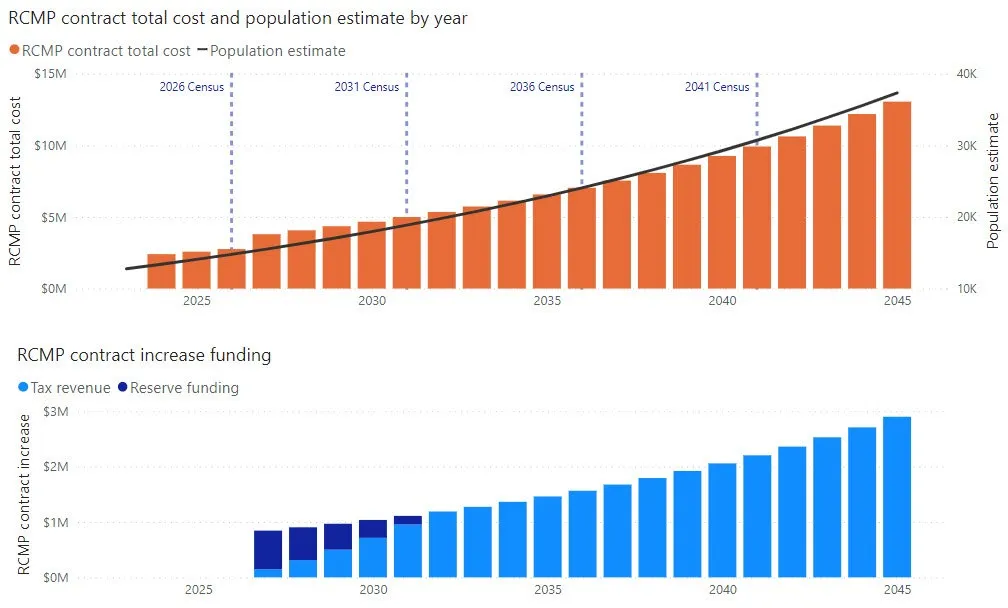
Using Scenario C – 5% annual population growth as an example, the following charts describe population growth and the projected escalation of RCMP contract total costs, as well as the use of reserves to supplement property tax revenue during the phase-in period. The other two scenarios follow a very similar pattern, the only difference being the year in which the population exceeds 15,000.
Scenario C: 5% annual population growth
BUDGET IMPLICATIONS:
If View Royal’s population exceeds 15,000 at the next census (2026), the projected balance in the Policing Operating Reserve would likely be sufficient to support a phased tax increase to meet the additional costs of the RCMP contract. Council may wish to consider allocating future contributions to this reserve to phase in future significant capital costs, such as debt servicing for the West Shore RCMP facility expansion. Council will have opportunity at the Financial Planning workshops in February 2024 to debate this matter.
RECOMMENDATION: THAT Council receive the Police Operating Reserve Requirement Forecast Update dated September 6, 2023, confirm the practice of contributing any surplus attributable to policing services to the Police Operating Reserve, and refer consideration of annual contributions to the Police Operating Reserve to the 2024-2028 Financial Plan discussions.
SUBMITTED BY:
REVIEWED BY: K. Anema, Chief Administrative Officer
Attachment: Schedule A: Population growth scenarios
Document Images
(3)