Presentation: CRD TRANSPORTATION GOVERNANCE WORKBOOK – FINAL
A slide deck presenting the final collated Council responses to the CRD regarding transportation governance trade-offs, connectivity, and funding priorities.
CRD TRANSPORTATION GOVERNANCE WORKBOOK – FINAL
THAT each member of Council complete the “Capital Regional District Transportation Governance Engagement Workbook” and return to staff for collating and presenting to the September 12, 2023 Committee of the Whole Meeting.
WHAT WILL WE BE DOING TODAY?
Objectives
To complete a unified response to the questionnaire
Outcomes
- Holistic understanding
- Exchanging information
- Ownership of Council responses
Outputs
- A record of decisions made
- Direction to Staff
QUESTION 1:
In each category below, which focus would have the greatest impact on improving mobility for your residents? Please consider the trade-offs and select only one statement from each category using the radio buttons.
A. Funding
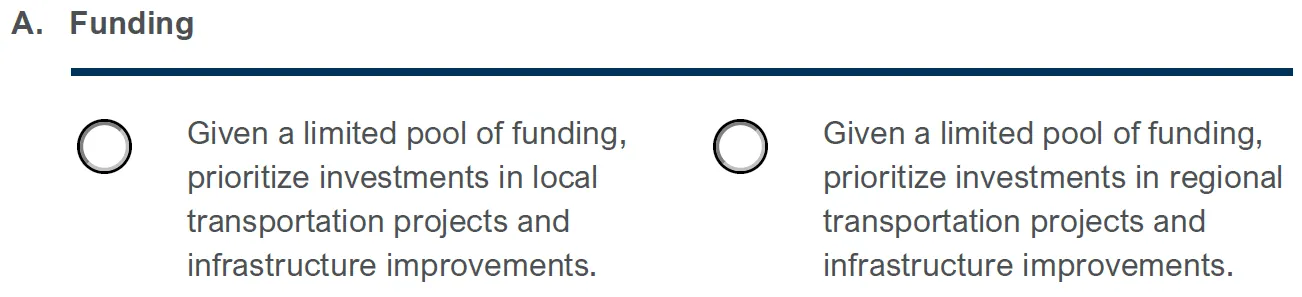
- Option 1: Given a limited pool of funding, prioritize investments in local transportation projects and infrastructure improvements.
- Responses: DB, GL, AM
- Option 2: Given a limited pool of funding, prioritize investments in regional transportation projects and infrastructure improvements.
- Responses: ST, JR, DK, RM
B. Connectivity
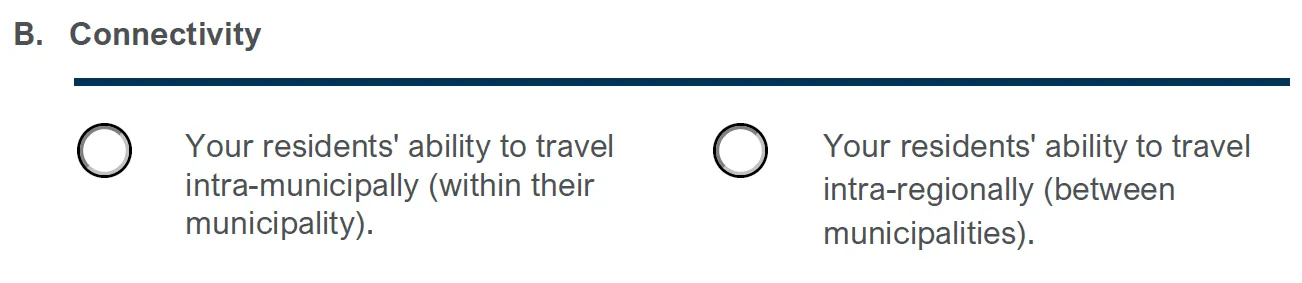
- Option 1: Your residents' ability to travel intra-municipally (within their municipality).
- Responses: (None selected)
- Option 2: Your residents' ability to travel intra-regionally (between municipalities).
- Responses: ALL
C. Transit
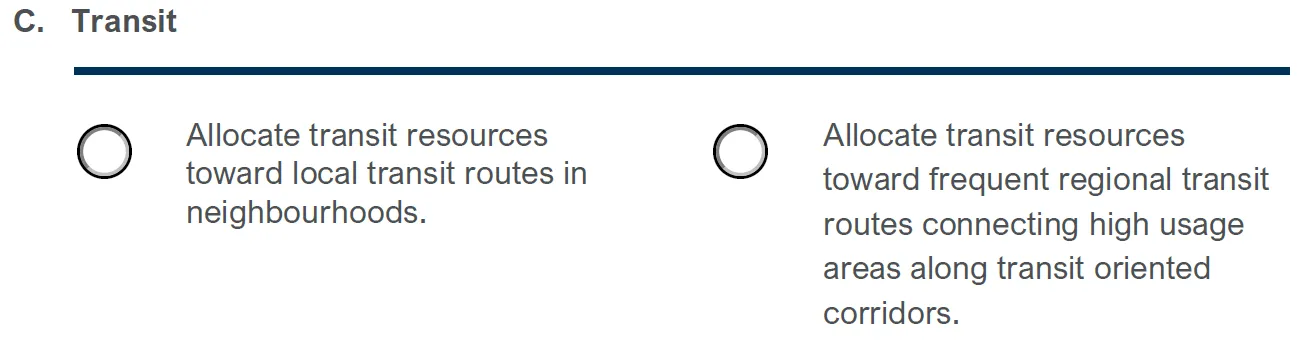
- Option 1: Allocate transit resources toward local transit routes in neighbourhoods.
- Responses: AM
- Option 2: Allocate transit resources toward frequent regional transit routes connecting high usage areas along transit oriented corridors.
- Responses: DB, ST, JR, GL, DK, RM
D. Active transportation (includes regional trails)
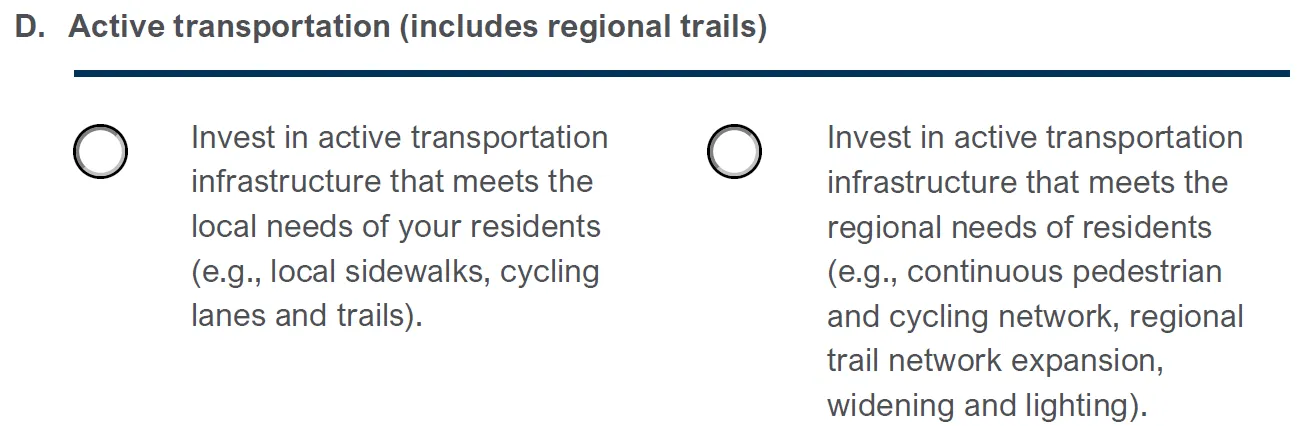
- Option 1: Invest in active transportation infrastructure that meets the local needs of your residents (e.g., local sidewalks, cycling lanes and trails).
- Responses: DB, GL, AM
- Option 2: Invest in active transportation infrastructure that meets the regional needs of residents (e.g., continuous pedestrian and cycling network, regional trail network expansion, widening and lighting).
- Responses: ST, JR, DK, RM
E. Traffic flow and congestion
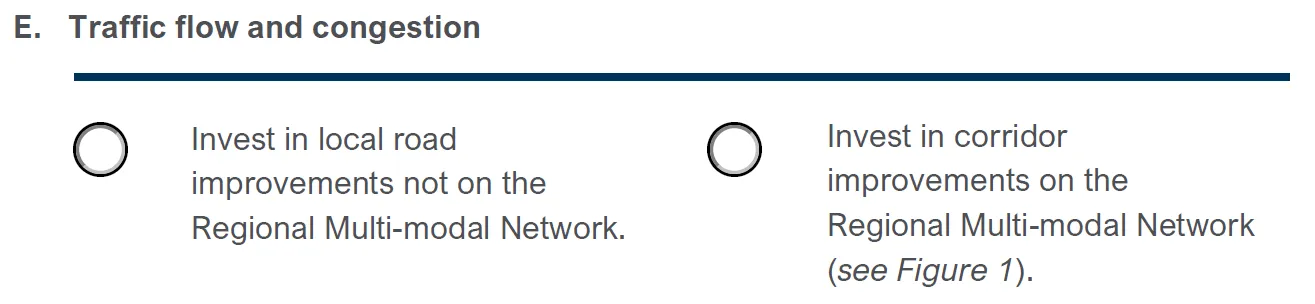
- Option 1: Invest in local road improvements not on the Regional Multi-modal Network.
- Responses: GL
- Option 2: Invest in corridor improvements on the Regional Multi-modal Network (see Figure 1).
- Responses: DB, ST, JR, AM, DK, RM
F. Transportation planning
- Option 1: Municipal transportation plans inform the Regional Transportation Plan (RTP).
- Responses: DB, JR, GL, AM, RM
- Option 2: The RTP takes precedence and directs municipal transportation plans.
- Responses: ST, DK
G. Behaviour change
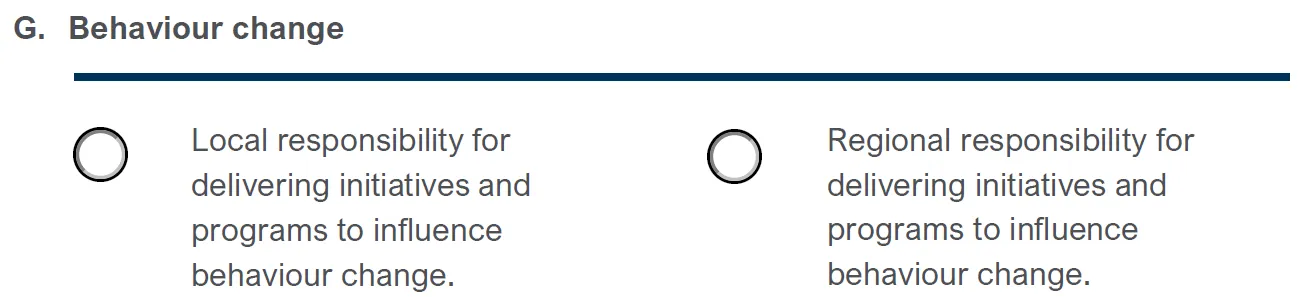
- Option 1: Local responsibility for delivering initiatives and programs to influence behaviour change.
- Responses: DB, GL
- Option 2: Regional responsibility for delivering initiatives and programs to influence behaviour change.
- Responses: ST, JR, AM, DK, RM
H. New mobility services (e.g., ride hailing)
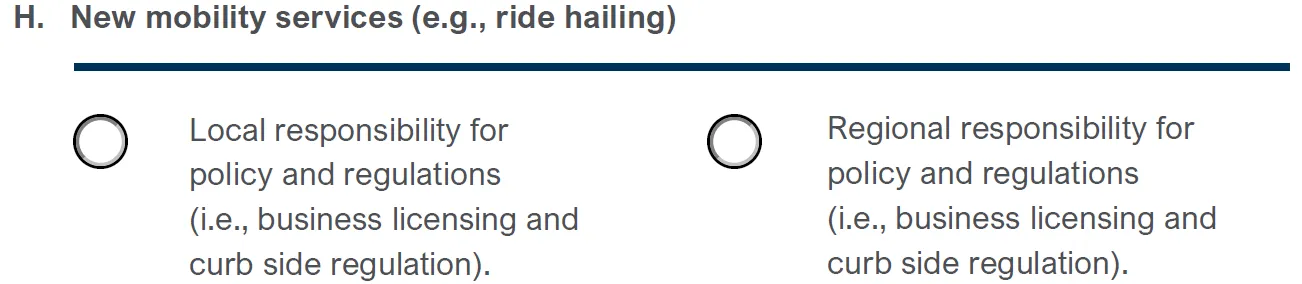
- Option 1: Local responsibility for policy and regulations (i.e., business licensing and curb side regulation).
- Responses: GL
- Option 2: Regional responsibility for policy and regulations (i.e., business licensing and curb side regulation).
- Responses: DB, ST, JR, AM, DK, RM
I. Grants
- Option 1: Individually pursue grant funding for local transportation projects.
- Responses: DB, GL, RM
- Option 2: Collaboratively pursue grant funding for priority projects identified on the Regional Multi-modal Network.
- Responses: ST, JR, AM, DK
QUESTION 2:
With a change in transportation governance, it is important to acknowledge that some regional transportation projects may not have a direct local impact/benefit but will significantly improve regional mobility for residents. Please select whether you agree, neither agree nor disagree, or disagree with each statement using the radio buttons.
A. A new governance structure should strike a balance between regional and local priorities.
- Agree: DB, JR, AM, DK
- Neither agree nor disagree: GL
- Disagree: ST, RM
B. A new governance structure should focus on projects that have the greatest impact on improving regional mobility, even if it means fewer local projects in your jurisdiction.
- Agree: DK
- Neither agree nor disagree: JR
- Disagree: DB, ST, GL, AM, RM
C. A new governance structure should require decision-makers to consider the regional impacts of local decisions when making policy, funding and service-level decisions.
- Agree: DB, JR, AM, DK
- Neither agree nor disagree: GL
- Disagree: ST, RM
D. Some transportation services could be more efficiently delivered at a regional level by a new governance structure. If you agree, and have examples, please list up to three services for consideration.
- Agree: JR, GL, AM, RM
- Neither agree nor disagree: DB
- Disagree: ST
Member Additions for Services:
- Equity of influence between smaller vs. larger local govts
- Consultation & partnerships with First Nations
- Putting regional trails to work. Extend widening projects through View Royal
- Bike lanes and sidewalk connectivity. TCH focus for vehicles
- Extend regional transit bus lanes through View Royal and beyond
- Loss of Control Result in lower level of service
QUESTIONS 3 TO 7:
Governance changes create new opportunities and challenges. The next series of questions gather information about the benefits and concerns that matter most to municipalities, electoral areas and partner agencies. This helps CRD staff understand areas of agreement and disagreement across the region and provides the information need to scope governance options.
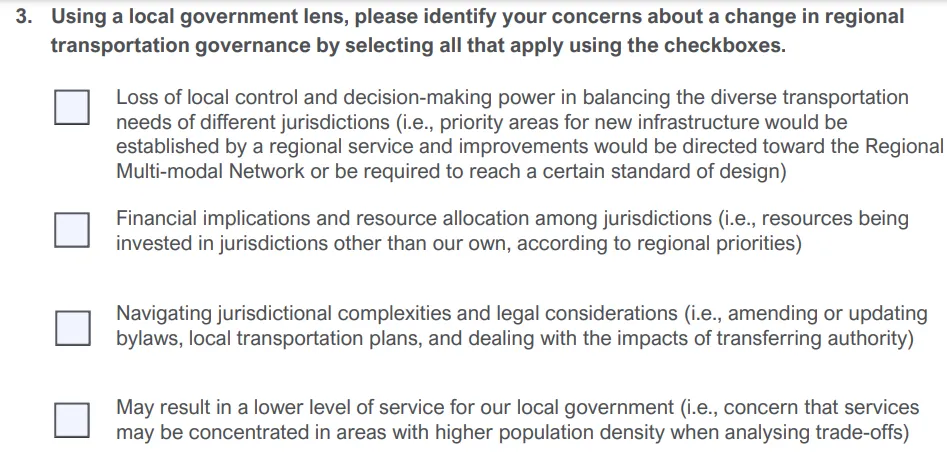
3. Using a local government lens, please identify your concerns about a change in regional transportation governance by selecting all that apply using the checkboxes.
| Concern | DB | ST | JR | GL | AM | DK | RM |
|---|---|---|---|---|---|---|---|
| Loss of local control and decision-making power in balancing the diverse transportation needs of different jurisdictions (i.e., priority areas for new infrastructure would be established by a regional service and improvements would be directed toward the Regional Multi-modal Network or be required to reach a certain standard of design) | ✓ | ✓ | ✓ | ✓ | ✓ | ✓ | |
| Financial implications and resource allocation among jurisdictions (i.e., resources being invested in jurisdictions other than our own, according to regional priorities) | ✓ | ✓ | ✓ | ✓ | ✓ | ✓ | ✓ |
| Navigating jurisdictional complexities and legal considerations (i.e., amending or updating bylaws, local transportation plans, and dealing with the impacts of transferring authority) | ✓ | ✓ | ✓ | ✓ | |||
| May result in a lower level of service for our local government (i.e., concern that services may be concentrated in areas with higher population density when analysing trade-offs) | ✓ | ✓ | ✓ | ✓ | ✓ | ✓ |
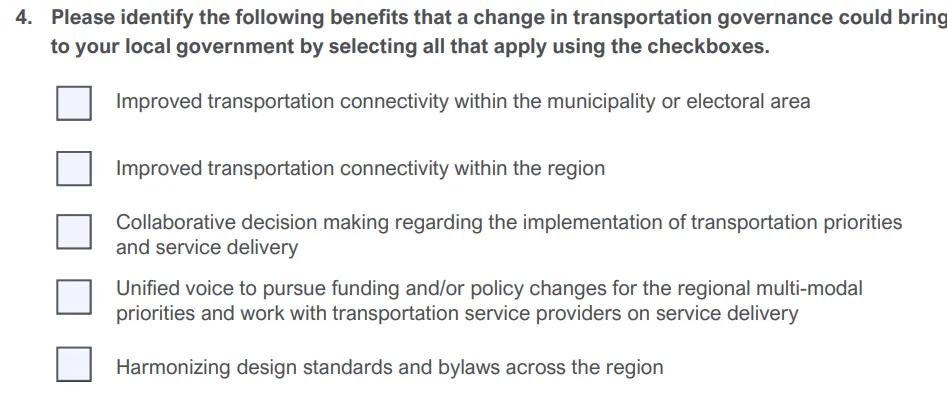
4. Please identify the following benefits that a change in transportation governance could bring to your local government by selecting all that apply using the checkboxes.
| Benefit | DB | ST | JR | GL | AM | DK | RM |
|---|---|---|---|---|---|---|---|
| Improved transportation connectivity within the municipality or electoral area | ✓ | ✓ | ✓ | ✓ | ✓ | ✓ | |
| Improved transportation connectivity within the region | ✓ | ✓ | ✓ | ✓ | ✓ | ✓ | |
| Collaborative decision making regarding the implementation of transportation priorities and service delivery | ✓ | ✓ | ✓ | ✓ | ✓ | ||
| Unified voice to pursue funding and/or policy changes for the regional multi-modal priorities and work with transportation service providers on service delivery | ✓ | ✓ | ✓ | ✓ | ✓ | ✓ | |
| Harmonizing design standards and bylaws across the region | ✓ | ✓ | ✓ | ✓ | ✓ | ✓ |
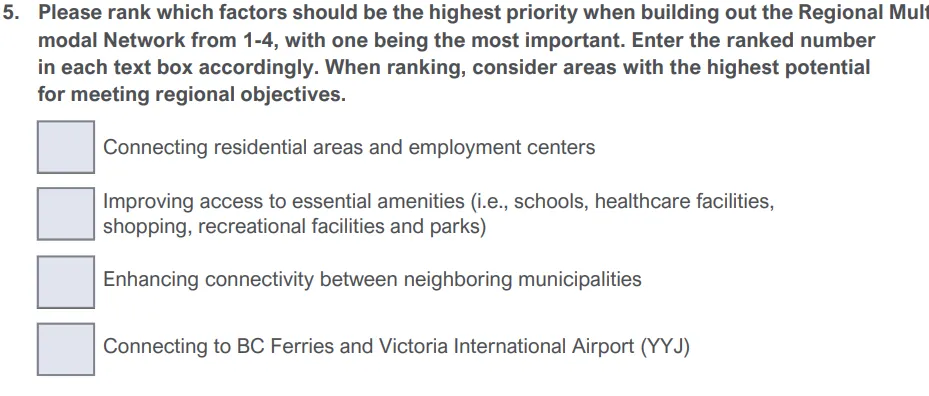
5. Please rank which factors should be the highest priority when building out the Regional Multi-modal Network from 1-4, with one being the most important. Enter the ranked number in each text box accordingly. When ranking, consider areas with the highest potential for meeting regional objectives.
| Factor | DB | ST | JR | GL | AM | DK | RM | Mod | Avg |
|---|---|---|---|---|---|---|---|---|---|
| Connecting residential areas and employment centers | 3 | 1 | 4 | 1 | 4 | 2 | 2 | 1, 2, 4 | 2.4 |
| Improving access to essential amenities (i.e., schools, healthcare facilities, shopping, recreational facilities and parks) | 1 | 3 | 2 | 2 | 1 | 1 | 1 | 1 | 1.6 |
| Enhancing connectivity between neighboring municipalities | 2 | 2 | 3 | 3 | 2 | 3 | 3 | 3 | 2.6 |
| Connecting to BC Ferries and Victoria International Airport (YYJ) | 4 | 4 | 1 | 4 | 3 | 4 | 4 | 4 | 3.4 |
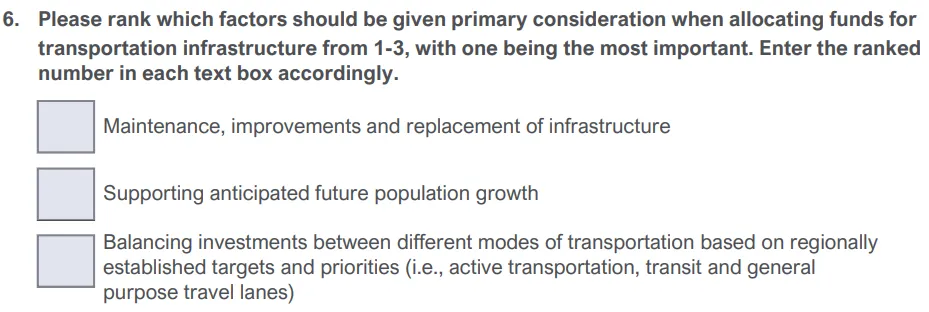
6. Please rank which factors should be given primary consideration when allocating funds for transportation infrastructure from 1-3, with one being the most important. Enter the ranked number in each text box accordingly.
| Factor | DB | ST | JR | GL | AM | DK | RM | Mod | Avg |
|---|---|---|---|---|---|---|---|---|---|
| Maintenance, improvements and replacement of infrastructure | 2 | 3 | 2 | 2 | 2 | 2 | 2 | 2 | 2.1 |
| Supporting anticipated future population growth | 1 | 2 | 3 | 1 | 1 | 3 | 1 | 1 | 1.7 |
| Balancing investments between different modes of transportation based on regionally established targets and priorities (i.e., active transportation, transit and general purpose travel lanes) | 3 | 1 | 1 | 3 | 3 | 1 | 3 | 3 | 2.1 |
QUESTION 7:
7. Are there any additional comments or suggestions you would like to provide regarding the understanding of and support for a change in transportation governance in our region?
- Tiered approach to governance to provide equitable voice amongst the larger local governments.
- 50kph speed standards along all major collector roads in region
- Push to establish regional bus routes (eg #40) and rapid transit routes to airport & ferries
- Prioritize transportation to improve access to businesses and services. Consider remote work affecting transportation network
- Transit & province to be more forthcoming on projects and their impacts
- Concerns that outcome will result in new taxation body, deplete local infrastructure budgets
- Improve access to transportation hubs that is convenient. Collaboration required with local governments
- Invest in data systems that inform on priorities Share information with CRD, etc.
RECOMMENDATION
THAT the Committee recommend to Council that Staff forward Council’s response the CRD regarding its Transportation Governance Questionnaire.
Thank You Ivan Leung, P.Eng Director of Engineering and Parks engineering@viewroyal.ca
Document Images
(1)