Review: View Royal 2020 Housing Needs Report (HNR)
A critical analysis of the 2020 Housing Needs Report, highlighting inaccuracies and the need for synchronization with the Canada Census cycle.
View Royal 2020 Housing Needs Report (2020 HNR)
This is a high-level overview of the utility of the 2020 HNR.
- Housing Needs Reports (HNR’s) are required by the Local Government Act
- The 2020 HNR uses data that is out of date; new data is available
- Legislated life cycle of an HNR is five years, renewing now would sync the HNR with the Canada Census five-year data cycle, the primary source of data for all HNR’s.
- The number of dwellings in View Royal has grown over 18% (750) since the 2020 HNR data was collected so they are not counted in the 2020 HNR.
- Over 500 additional dwellings have been approved or are under construction. Over 300 more are under review. These dwellings are not counted in the 2020 HNR.
- The 2020 HNR lacks clarity and the conclusions required by legislation are not clearly addressed.
- The extraordinary number of typographical errors and conflicting statements render the document unreliable and unsuitable for the intended use.
A more detailed report with a more detailed summary is available.
Review: View Royal 2020 Housing Needs Report (HNR)
Summary
Legislative Requirements:
- HNR’s must be created/updated on a five-year cycle
- 2020 HNR is based on obsolete 2016 census data
- Opportunity: Rewrite the HNR in 2023 to synchronize with the Canada Census cycle
- The HNR must include current and anticipated housing
- 2020 HNR is missing over 750 dwellings from 2016 to 2021
- 2020 HNR is missing over 800 post-2021 anticipated dwellings (approved, under construction, approval under review)
- 2020 HNR does not meet legislated requirements to contain this data
- Opportunity: base a new HNR on accurate knowledge of View Royal housing
- HNR’s must forecast the state of housing for at least the next five years
- 2020 HNR focus is on the long term 2038 projection with limited attention to the mandatory five-year forecast
- 2020 HNR provides several conflicting dwelling projections
- Opportunity: careful consideration of the drivers of population growth and a focus on housing need will enable View Royal to identify appropriate development objectives
- HNR’s are implemented through the Official Community Plan
- Opportunity: the value of using a 2023 up-to-date HNR in the Official Community Plan update project cannot be overstated
- Provincial Summary Form
- Provincial review of HNR’s was announced in late 2022
- Summary Form will be central to the review process
- 2020 HNR Summary Form suffers from data errors that contradict the data tables
Accuracy Concerns:
- Typographical errors throughout the 2020 HNR create a low reliability report
- Does not meet legislated requirements to include anticipated dwelling numbers
- Multiple inconsistent five-year dwelling projections cloud the 2020 HNR conclusions
- Lacks the clarity that is found in HNR’s completed in BC jurisdictions outside the CRD
- Missing data that is now available renders the 2020 HNR obsolete
- Two conflicting methodologies, “Status Quo” and “Headship Shift,” produce unreasonably divergent results from the same data
Overview of BC Housing Needs Reports (HNR’s)
Legislation requires local governments to collect data, analyze trends and present reports that describe current and anticipated housing needs in their community.
HNR’s are a way for communities to better understand their current and future housing needs. These reports can help identify existing and projected gaps in housing supply by collecting and analyzing quantitative and qualitative information about local demographics, economics, housing stock, and other factors. A HNR is critical to developing an Official Community Plan.
Requirements for HNR’s include:
- Collecting information to prepare and publish an online HNR which shows current and projected housing needs for at least the next five years, and
- Considering the HNR when amending Official Community Plans.
To help determine current and projected housing needs, local governments are required to collect approximately 56 distinct kinds of data related to current and projected population and dwelling numbers, household income and housing costs.
HNR’s are required to contain the following information:
- Statements about key areas of local need, including affordable housing, rental housing, special needs housing, seniors housing, family housing, and shelters and housing for people at risk of homelessness
- The number of housing units required to meet current and anticipated housing needs for at least the next five years, by housing type (number of bedrooms)
- The number and percentage of households in core and extreme core housing need
Local governments must also complete and include a standardized Summary Form that includes key information on their housing needs. The form also provides space for local governments to identify other housing issues or needs that are not captured elsewhere. The intent of the form is to provide an easily-comparable snapshot of housing needs in each jurisdiction.
The requirements related to HNR’s are detailed in the legislation and regulations:
Local Government Act
- Section 429 (2.1) – Content of regional growth strategy
- Section 473 (2.1) – Official community plan content and process requirements
- Part 14, Division 22 – Housing needs reports
- Housing Needs Report Regulation (OIC, Order-in-Council 205)
Evaluation of the 2020 View Royal Housing Needs Report (2020 HNR)
Legislative Requirements:
HNR’s must be created/updated on a five-year cycle
The VR HNR is out of step with the five-year Canada Census cycle. The census is the primary source of data used in the HNR. The VR HNR gathered data in 2019 based on the 2016 census. That 2016 data is now seven years old and was made obsolete when the new 2021 census data became available in 2022.
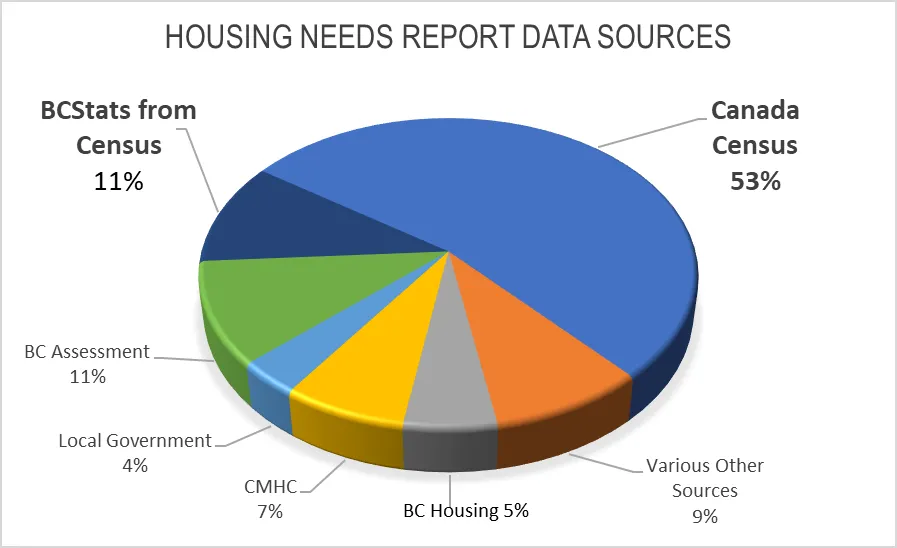
Figure 1 Canada Census data is the largest source of HNR data.
| 2016 | 2017 | 2018 | 2019 | 2020 | 2021 | 2022 | 2023 | 2024 | 2025 | 2026 | 2027 | 2028 | 2029 | 2030 | 2031 | 2032 | 2033 | |
|---|---|---|---|---|---|---|---|---|---|---|---|---|---|---|---|---|---|---|
| Census Years | [X] | [X] | [X] | [X] | ||||||||||||||
| Census Data Release | [X] | [X] | [X] | [X] | ||||||||||||||
| View Royal HNR Cycle | Old Data | Old Data | Old Data | |||||||||||||||
| Syncronized HNR Cycle | New Data | New Data | New Data |
Figure 2 The 2020 HNR is out of step with the Canada Census cycle. Unless steps are taken to synchronize with the census cycle the 2020 HNR will continue to rely on obsolete data.
The opportunity to re-write the 2020 HNR comes with significant benefit. The 2020 HNR data is out of date and the document is more than half way through its life cycle. New data from the 2021 census is available and using it now would begin the process of synchronizing the HNR cycle with the census cycle. Updating the Official Community Plan without first updating the HNR would be a missed opportunity that devalues the entire updating project.
The HNR must include current and anticipated housing
The first goal of the HNR is to provide an up-to-date picture of housing and housing needs. The Local Government Act specifies that the HNR includes “information about currently available housing units and housing units that are anticipated to be available”.
The data on housing that is anticipated to be available is supposed to come from the local government development application and approval records. The 2020 HNR does not contain this information and does not meet the legislative requirement.
An up-to-date HNR would show a very different picture of housing in View Royal. The current HNR does not show the 761 dwellings added in View Royal in the 2016-2021 census period, over 500 units approved or under construction post 2021 census and over 300 anticipated units that are currently under review. This missing data represents about 38% of the current and anticipated housing in View Royal, a gap that renders the 2020 HNR unusable as a planning tool in the Official Community Plan.
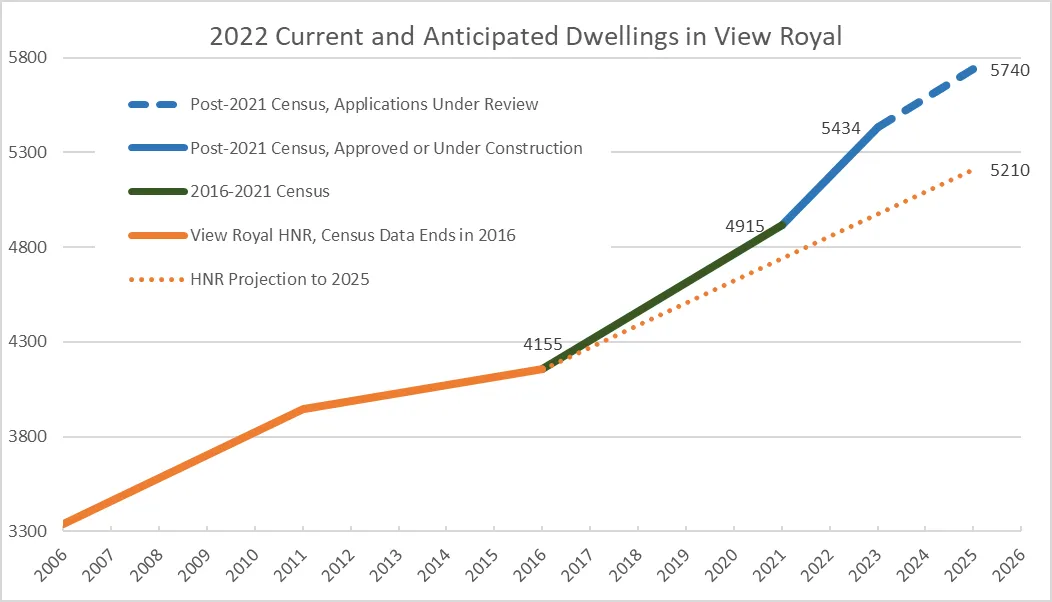
Figure 3 Shows the large increase in dwelling numbers since the 2016 census data used in the HNR. The HNR projection of 5210 dwellings in 2025 was already surpassed in 2022.
Findings must be entered into a provincial Housing Needs Reports – Summary Form
The Summary Form contains numerical information on current and future population, dwelling numbers and population age. Figures for current household income, workforce participation, cost of housing and housing availability. Numbers for the Key Findings of the report – households in core and extreme core housing need along with the numbers and type of new dwellings needed to address the need over five years are also given. The form includes information on housing issues such as affordability, special needs, seniors, families and the underhoused.
In late 2022 the BC Provincial Government announced that HNR’s will be reviewed in 2023 to ensure that individual communities are endeavoring to address housing issues. The Summary Form is the main component that all HNR’s have in common and is the likely first element of each HNR that will be scrutinized in the provincial review.
The 2020 HNR Summary Form is not filled out correctly and some of the numbers stated in the form conflict with numbers in the original data tables or stated elsewhere in the report.
HNR’s must forecast the state of housing and housing need for at least the next five years
While the HNR uses Canada Census data for much of the HNR, including current population and dwelling figures, the HNR uses BC Stats information as a forecast of anticipated population, demographics and number of households for the next five years. That BC Stats forecast information is based on Canada Census data. Population forecasts are referred to as projections.
The five-year projection period in the 2020 HNR is somewhat challenging to interpret. The data tables for the HNR appear in Appendix B of the document. The data tables for the anticipated population and number of households span the five years from 2019 to 2024, starting in the year when the projection was created. However, the HNR was not completed until 2020 and the population projection on the Summary Form contains an unattributed figure (12,500) for the 2025 population which represents an out of step one year growth of 504 or 4.2%.
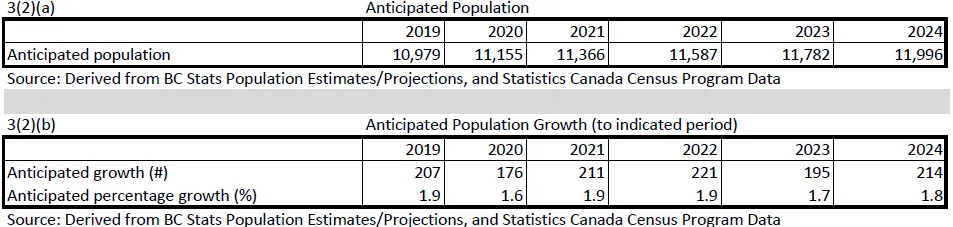
3(2)(a) Anticipated Population
| 2019 | 2020 | 2021 | 2022 | 2023 | 2024 | |
|---|---|---|---|---|---|---|
| Anticipated population | 10,979 | 11,155 | 11,366 | 11,587 | 11,782 | 11,996 |
| Source: Derived from BC Stats Population Estimates/Projections, and Statistics Canada Census Program Data |
3(2)(b) Anticipated Population Growth (to indicated period)
| 2019 | 2020 | 2021 | 2022 | 2023 | 2024 | |
|---|---|---|---|---|---|---|
| Anticipated growth (#) | 207 | 176 | 211 | 221 | 195 | 214 |
| Anticipated percentage growth (%) | 1.9 | 1.6 | 1.9 | 1.9 | 1.7 | 1.8 |
| Source: Derived from BC Stats Population Estimates/Projections, and Statistics Canada Census Program Data |
Figure 4 2019-2024 Anticipated Population Data Table, five-year projection from 2020 HNR ends in 2024, not 2025
Similarly, the data table for the five-year projection of dwellings also ends in 2024 and an unattributed and out of step figure of 5210 dwellings is entered into the Summary Form.
3(2)(f) Anticipated Households
| 2019 | 2020 | 2021 | 2022 | 2023 | 2024 | |
|---|---|---|---|---|---|---|
| Anticipated households | 4467 | 4592 | 4731 | 4879 | 5020 | 5166 |
| Source: Derived from BC Stats Population Estimates/Projections, and Statistics Canada Census Program Data |
Figure 5 2019-2024 Anticipated Households Data Table, five year projection from the 2020 HNR ends in 2024, not 2025
A large portion of the 2020 HNR makes predictions for the 2019-2038 time period. A population projection produced by the CRD for 2019 to 2038 is used extensively in the HNR for population and dwelling projections. This CRD projection is now obsolete; it was replaced with a new and very different CRD projection in 2020 that is also based on old data.
Projecting population growth for the entire CRD may be a reasonable endeavor. Projecting population growth for small sub-populations of a region greatly reduces the accuracy of the output. The population of View Royal, in 2021, was only 3.0% of the CRD population.
The growth of View Royal became disengaged from the overall growth rate of the CRD around 1996. The largest determining factor of individual municipality growth is now the development of new dwellings. Using projections of population growth to predict the growth of View Royal has been unsuccessful. Basing future growth projections on an assessment of land carrying capacity coupled with planning for housing need and a clear vision of land use would likely produce more accurate and useful results in the Official Community Plan.
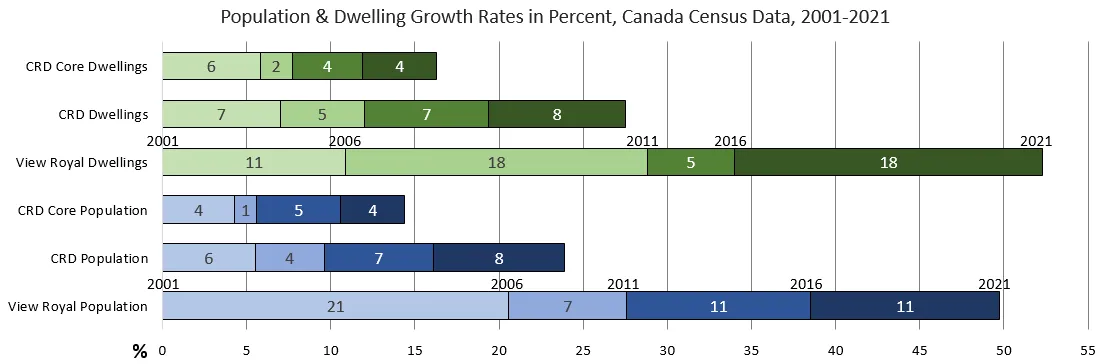
Figure 6 Comparison of View Royal growth to the growth of the CRD. The CRD or CRD Core growth rates are not predictors of View Royal growth rates.
Simply put, municipalities that build new dwellings grow, those that do not build do not grow. There is no direct correlation between Provincial or CRD population projections and View Royal growth rates.
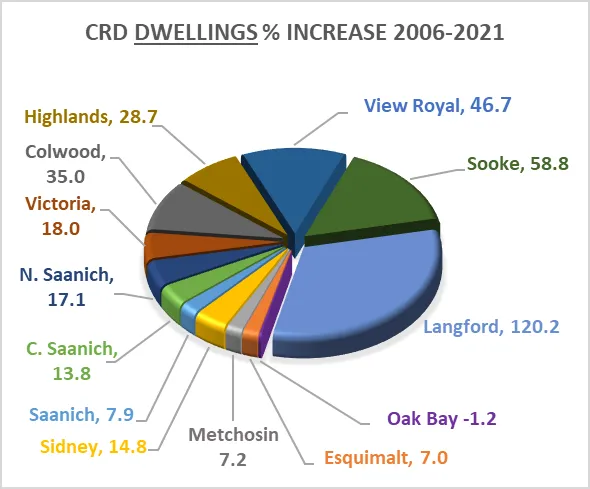
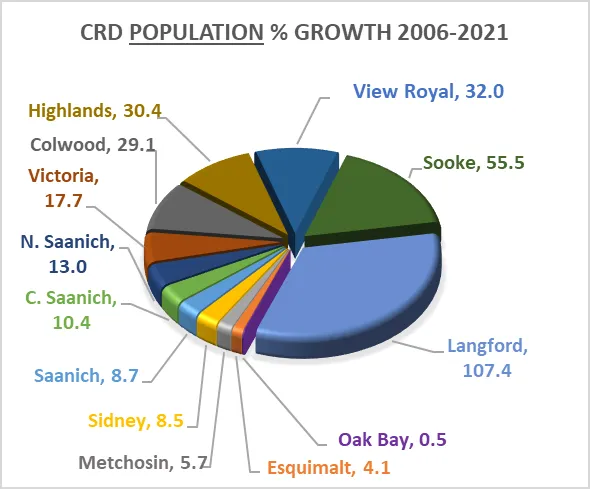
Figure 7 Dwelling and population growth rates by municipality, 2006-2021 Canada Census data.
HNR’s are implemented through the Official Community Plan
The Local Government Act requires municipalities to consider the content of the latest HNR when developing or amending an Official Community Plan. Renewing the HNR before proceeding with the update of the View Royal Official Community Plan will put both documents on a much stronger footing. At this date, the beginning of 2023, using the outdated 2020 HNR in the Official Community Plan update would be a waste of funds and a significant missed opportunity.
Accuracy Concerns
As noted above, there are shortcomings in the data due to age and availability.
The large number of typographical errors and conflicting statistical statements throughout the 2020 HNR results in an overall low reliability report. The inability to rely on the accuracy of any individual statement greatly diminishes the value of the document as a whole. Many organizations would consider this level of inaccuracy unacceptable; the document cannot be used as intended.
The 2020HNR is largely focused on a long-range growth projection to 2038. Significantly less attention is given to producing a clear projection of new dwellings needed over the five-year forecast period, a specific output required in the legislation and one of the main goals of the entire exercise. The accuracy of the entire report is clouded when the reader is presented with four exclusive and markedly different conclusions about the number of dwellings needed by 2025:
- Page 69, the “status quo” projection calls for 643 units in the 2016-2025 period.
- Page 69, the text describing a second or “headship shift” projection calls for 777 new units (typo?) while the data table for that projection calls for 1205 units in the 2016-2025 period.
- Appendix E is an attempt to clarify the confusion in a memorandum that generates yet another number, 820 units needed in 2025 over 2016 numbers. This number is apparently generated from the same data that produced the projections on page 69.
- None of those numbers are used on the Summary Form which shows a projected increase of dwellings from 4155 in 2016 (Canada Census data) to 5210 dwellings in 2025 for an increase of 1055 units.
Conclusion
All HNR’s should provide, at the minimum, a clear understanding of current housing and a clear projection of the housing that will be needed in five years. The View Royal 2020 HNR does not meet those objectives.
Creating a new HNR for View Royal in 2023 will capture up-to-date data and synchronize future updates with the Canada Census cycle.