Official Community Plan Review and Update: What We Heard Report #4 – Western Gateway Community Corridor Engagement (Staff Report)
Staff report presenting the results of public consultation regarding the future of the Western Gateway Community Corridor.
TOWN OF VIEW ROYAL COMMITTEE OF THE WHOLE REPORT
TO: Committee of the Whole DATE: December 12, 2025 FROM: Stirling Scory, RPP, MCIP, Senior Planner MEETING DATE: January 13, 2026
OFFICIAL COMMUNITY PLAN REVIEW AND UPDATE: WHAT WE HEARD REPORT #4 – WESTERN GATEWAY COMMUNITY CORRIDOR ENGAGEMENT
RECOMMENDATION:
THAT the report dated December 12, 2025 from the Senior Planner titled “Official Community Plan Review and Update: What We Heard Report #4 – Western Gateway Community Corridor Engagement” be received for information.
PURPOSE:
The purpose of this report is to present the Committee with a summary of “What We Heard” from the Western Gateway Community Corridor survey that launched on October 7 and closed on November 12, 2025, and Engagement Week #3, which took place between October 17 to 24, 2025.
BACKGROUND:
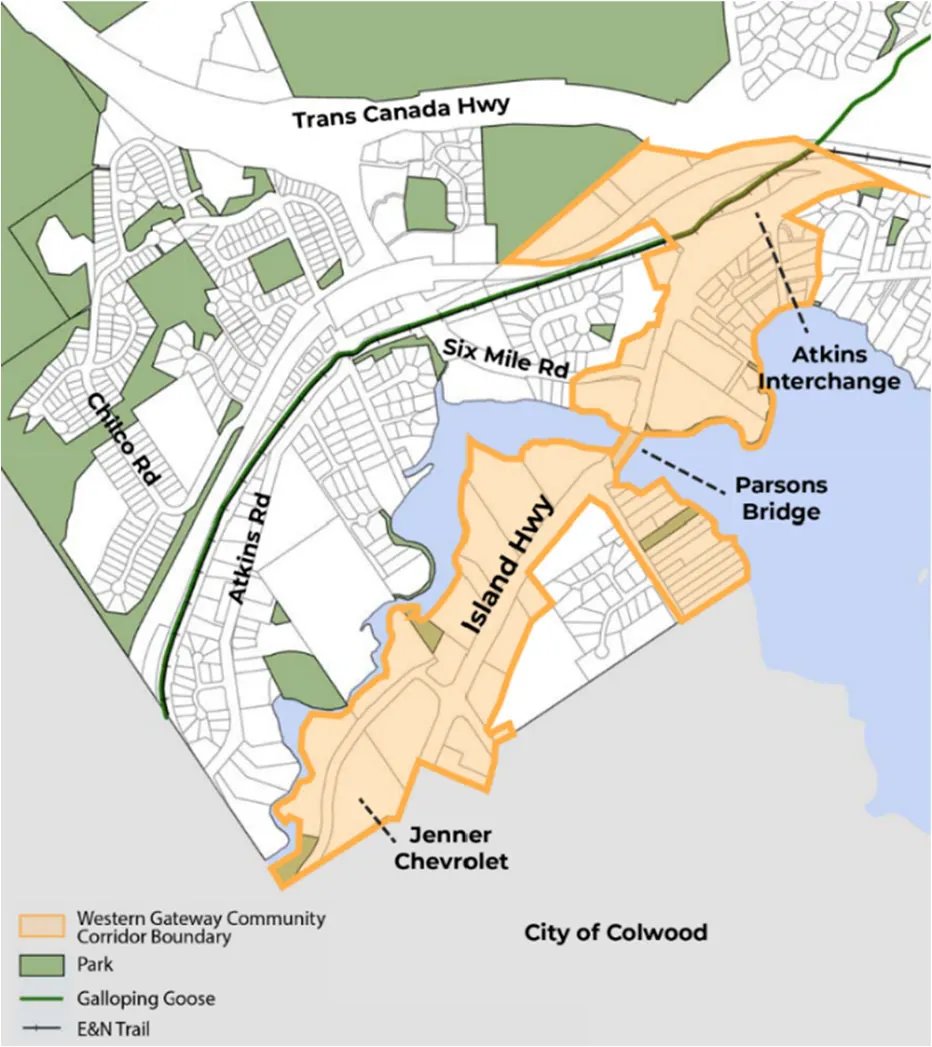
During the June 17, 2025, Council meeting, Council identified the need to engage on the Western Gateway Community Corridor (WGCC), as a potential future employment hub capable of supporting higher density commercial, light industrial, and some mixed residential uses. To support this potential for growth, Council advised the project team that the existing area of the WGCC should be expanded to include lands north of Parson Bridge, to the Atkins Interchange. An image of the WGCC area is provided below for reference.
The focus of this engagement touchpoint was to gather insight into the preferred land use and densities for the WGCC, and to determine how the area may continue to grow and develop in the future. To support participation and raise awareness through this fourth engagement touchpoint, the project team used both digital and print media to inform the community of opportunities to get involved. A list of all methods is included below:
- View Royal 2050 webpage (engage.viewroyal.ca/view-royal-2050);
- Town’s official website (viewroyal.ca);
- Social Media (Facebook, Instagram, Bluesky);
- Inside View Royal e-newsletter;
- Engage View Royal subscriber campaign;
- Posters;
- Project ‘business’ cards;
- Newspaper ad;
- Hand-delivered letters; and
- Stakeholder emails.
On October 7, 2025, the Town launched the Western Gateway Community Corridor survey, which allowed respondents to review and select their preferred land use scenario for the WGCC. Respondents were given three scenarios to choose from, including Scenario 1 (high-growth), Scenario 2 (medium-growth), and Scenario 3 (low-growth – no change from 2011 OCP). Each scenario provided different approaches to land use and densities; however, only Scenarios 1 and 2 offered a new light industrial use, and higher densities than Scenario 3. Scenario 3 was kept as a potential consideration to understand community interest, despite Council’s interests to explore the potential for this area to develop as an employment hub.
Survey participants were also asked high-level visioning questions to explore what respondents like and dislike about the corridor, and what considerations and priorities should be explored in the future. The survey closed on November 7 and received 59 responses.
In addition to the online survey, the project team hosted two come-and-go open house events. The first open house was held on October 18 and had a total of 34 participants, and the second open house was held on October 22 and had a total of 9 participants. Each open house featured panel boards with important background information to ensure community members could provide informed feedback. Interactive panel boards were also available to collect feedback from those in attendance. These boards aligned with questions from the WGCC survey. Participants could provide feedback by placing stickers or sticky notes with comments on the panel boards and were also able to complete a marble voting exercise to identify their preferred land use scenario for the WGCC.
The project team also hosted two workshops, one for the public and another that catered to business and landowners in the WGCC. The public workshop was held on October 18 and had a total of 11 participants. The business and landowner workshop was held on October 21 and had a total of 7 participants. Each workshop asked participants to consider three high-level questions, including what they like and dislike about the WGCC, and what are important considerations for the future of this area. Both workshops also featured a mapping and land use exercise where participants were encouraged to think about each scenario and provide recommendations or improvements, changes, or other insights.
Due to the Canada Post strike prior to the scheduled workshops and open houses, the project team was unable mail invitations that had been prepared for businesses, landowners, and residents in the area. Staff made an attempt to hand deliver invitations. An invitation was delivered to each business along the corridor and approximately 50 letters were delivered to nearby homes. Staff were also able to coordinate with the strata managers of two apartment buildings to distribute letters to their residents (485 Island Highway & 286 and 290 Wilfert Road). It is unknown how many residents of the strata buildings received notification. Approximately 30% of survey respondents indicated they live within the Wilfert neighbourhood.
ANALYSIS:
All feedback collected through the survey, workshops, and open houses is available for review in the attached What We Heard Report – Western Gateway Community Corridor Engagement (Attachment 1). A high-level summary is summarized below.
Western Gateway Community Corridor Survey
Who Participated
- 86% of respondents are residents of View Royal.
- The majority (30%) of respondents live in the Wilfert neighbourhood.
- 18% of respondents are between the ages of 35 and 39.
- 32% of respondents found out about the engagement process through the Town’s website.
- 58% of respondents indicated that this was their first time participating in the View Royal 2050: Our Future View Official Community Plan Review and Update.
Preferred Land Use Scenario
- 41% of respondents preferred Scenario 2 (Medium Growth), 34% of respondents preferred Scenario 1 (High Growth), and 17% of respondents preferred Scenario 3 (No Change).
- Overall, 75% of respondents preferred growth.
Values, Challenges, and Opportunities in the Western Gateway Community Corridor
- 54% of respondents believe the greatest value of the WGCC is its function and role as a gateway between communities.
- 80% of respondents said that a current challenge for the WGCC is the heavy traffic.
- 93% of respondents said that looking to the future, traffic and congestion will be the most important thing to address.
- 67% of respondents said that in the future, priority should be given to improve transit, cycling, and walking infrastructure.
- 55% of respondents felt that the quality of landscaping and sidewalks should be improved.
Community Workshop
- Participants felt that the area provides a good mix of businesses and its proximity to nature is desirable.
- Participants felt that traffic congestion is a challenge for the area and that the size of Parson’s Bridge is a barrier to further development. Others felt that there was a lack of connections to parks, particularly the Galloping Goose Trail.
- Participants provided mixed feedback for future considerations. Many felt that additional services would be nice, whereas others felt that increased density would create further traffic problems. Beautification along Island Highway and additional trees were an interest to some participants.
Focus Group (Business) Workshop
- Participants felt positive about the proximity of the area to the Trans-Canada Highway to the West Shore.
- Participants felt that walkability, road design, and the size of Parson’s Bridge as challenges for the area and would restrict the area from growing.
- Participants felt that access to public transit, providing a mix of uses, improving walkability, and making use of the access to park and waterfront would help this area develop in the future.
- 83% of participants preferred Scenario 1, the remaining 17% preferred Scenario 2.
Participants were asked to complete an anonymous exit survey, which asked what the respondents liked or disliked about the workshop. Overall, participants were satisfied with the workshop and valued the open, honest conversations amongst their neighbours and the project team.
Open Houses
Relationship to Western Gateway Community Corridor
- Of the 37 responses, 8 respondents said they live within the boundaries of the Western Gateway, 9 said they commute through the area, 10 said they visit the area for shopping, 9 said they visit the area for recreation, and 1 said they have no direct connection to the area.
- Participants said that they either visited the area daily or a few times a week.
- Participants said that they stop at a business in the WGCC daily or a few times a week.
Likes, Dislikes, and Priorities for the Future
- Participants indicated that access to the 95 Blink RapidBus, E&N and Galloping Goose Trail, and Westshore were all benefits to the area.
- Participants felt strongly that traffic congestion remains a challenge for the area, and that poor street design and lack of sidewalks is not welcoming to pedestrians.
Marbel Voting Exercise (Open House Voting)
During the October 18 community workshop, participants suggested offering a ‘hybrid’ option for the marble voting exercise. The project team agreed to make this change for the open houses and asked that those interested in picking this option to submit a note detailing what combination was desired.
A total of 34 responses were received between the two open house events. Scenario 2 received the greatest number of votes (40%), followed closely by the hybrid option (37%). Scenario 3 received 11% of the total votes. Both Scenario 1 and the “Don’t Like Any Scenario” options received approximately 6% of the total votes (12% total).
It was observed that some individuals attended more than one event and provided similar feedback more than once. Staff tried to encourage these individuals to avoid providing the same feedback again. Members of the project team also observed that some individuals that attend events did not actively participate in providing feedback and chose to participate by viewing content and asking questions. This can explain the discrepancy in the number of responses provided via the dotmocracy panel boards, and the number of sticky notes provided, as well as the number of marble votes.
CONCLUSION
A total of 100 votes were provided for the preferred land use scenario in the WGCC. This includes all votes captured in the survey, open house marble exercises, and the focus group workshop. In review of the results summarized in the table below, Scenario 2 is the preferred option. Unfortunately, most that voted for the hybrid scenario did not provide detailed information indicating which combinations of scenarios they prefer; however, staff will carry out a comprehensive review of all the feedback provided in the survey, workshops and open houses to inform a proposed land use scenario in the draft OCP for further consultation in the spring.
| Survey | Focus Group Workshop | Open Houses (Marble Voting)* | Total Votes | Total Vote % | |
|---|---|---|---|---|---|
| Scenario 1 | (20) 34% | (5) 83% | (2) 6% | 27 | 27% |
| Scenario 2 | (24) 41% | (1) 17% | (14) 40% | 39 | 39% |
| Scenario 3 | (10) 17% | (0) 0% | (4) 11% | 14 | 14% |
| Hybrid | (4) 3% | (0) 0% | (13) 37%** | 17 | 17% |
| Don’t Like Any Scenario | (1) 2% | (0) 0% | (2) 6% | 3 | 3% |
*Note: Participants that attended the October 18 Workshop provided an official vote via the open-house marble voting exercise, whereas the Focus Group workshop was provided an exit survey and provided their vote this way. **Note: The large number of votes for the hybrid scenario via the open house engagement (37%) could be explained by participants opportunity to discuss the scenarios further with the project team, and to seek greater clarity and understanding of land use planning concepts that informed the draft scenarios.
Impacts and implications can be summarized as follows:
| Community Impact: | Engagement during the OCP review and update provides an opportunity for the public to be involved in a critical decision-making process. |
| Financial Implication: | The Western Gateway Community Corridor survey is within the project scope and budget approved by Council. |
| Inter-governmental Relations Impact: | The Town will notify neighbouring municipalities and the required provincial ministries of the OCP update as the project advances. |
ALIGNMENT:
The recommended option aligns with the Town’s following core guiding documents as follows:
Strategic Plan:
- Sustainable Development Goal 1: Manage Growth Official Community Plan (OCP) review to align with Housing Needs Report and Zoning Bylaw, update Development Permit Area design guidelines, and other aspects of the OCP.
- Sustainable Development Goal 3b: Hold a visioning session for the employment corridor (“Western Gateway”).
- Community Engagement and Good Governance Goal 1: Strong and active citizen participation in community engagement in Town of View Royal meetings, open houses, surveys, budget development.
Official Community Plan:
- Goal 2: Create an inclusive community that provides housing, transportation and healthy living options, and services and facilities for families and individuals of diverse backgrounds, cultures, ages and economic means.
- Goal 9: Ensure that all citizens of View Royal have opportunities to be informed and meaningfully involved in planning and decision-making processes.
Other Policy Documents: N/A
PUBLIC PARTICIPATION GOAL:
The desired level of public participation for the recommended option is:
[X] Inform [ ] Consult [ ] Involve [ ] Collaborate [ ] Empower [ ] N/A
TIME CRITICAL:
The report is time critical. Sharing the feedback collected through this engagement touchpoint with Council, the OCP Review Advisory Committee, and the general public is important so that each of these stakeholders is aware of what is informing the first draft of the OCP. The project team has provided the survey results and feedback to the project consultant, Urban Systems. Opportunity to review and revise the Western Gateway land use objectives and policies, may be considered in the Spring of 2026 once a first draft of the OCP has been completed.
CONCURRENCE:
| Initials | Comments |
|---|---|
| Chief Administrative Officer | SS |
REVIEWED BY:
| Initials | |
|---|---|
| Director of Corporate Administration/Deputy CAO | N/A |
| Director of Finance & Technology | N/A |
| Director of Development Services | LT |
| Director of Engineering | N/A |
| Director of Protective Services | N/A |
ATTACHMENTS:
- What We Heard Report #4 – Western Gateway Community Corridor
Document Images
(1)