Finance and Administration Report: Draft Asset Replacement Funding Plan
Staff report introducing the draft Asset Replacement Funding Plan, which projects funding requirements for infrastructure over a 30-year period.
TOWN OF VIEW ROYAL
Finance and Administration Report
TO: Committee of the Whole DATE: June 3, 2021 FROM: S. Vella, Manager of Accounting; B. Lubberts, Engineering Technologist MEETING: June 8, 2021
Draft Asset Replacement Funding Plan
RECOMMENDATION:
THAT the Committee receive the Draft Asset Replacement Funding Plan for information.
CHIEF ADMINISTRATIVE OFFICER’S COMMENTS:
I concur with the recommendation.
PURPOSE OF REPORT:
The purpose of this report is to present to Council the draft Asset Replacement Funding Plan (“Funding Plan”), attached to this report as Appendix A.
This plan looks at how much funding will be required to replace infrastructure assets over a 30-year planning period. Assets considered in this plan include:
- Sanitary Sewer
- Storm Drain
- Transportation
- Buildings
- Land Improvements (fences, irrigation, landscaping, lighting, etc.)
Note that the term “asset replacement funding” is analogous with “reserve contributions for asset renewals”.
BACKGROUND DISCUSSION:
The Asset Replacement Funding Plan, is identified as a goal of project N-42 in the 2020 – 2024 Financial Plan. The Funding Plan is one of two strategic documents that will inform the Town’s Long-term Financial Plan and the Financial Sustainability Review, the second document being the Asset Replacement Funding Strategy (“Funding Strategy”). The Funding Strategy is within the scope of the next phase of this project.
The Funding Plan supports Council’s 2019 – 2022 Strategic Plan goal of raising confidence in the fiscal health and financial sustainability of the Town (ref. page 15).
The Funding Plan was prepared by consultant Cory Sivell of YourCity, in consultation with staff and was 100% funded by a grant through UBCM’s 2019 Asset Management Planning Program.
The Funding Plan utilizes YourCity’s Asset HealthScore Framework to help inform asset replacement funding decisions by assessing the Asset HealthScore and Sustainable Service Delivery Score of each asset class.
The Asset HealthScore is a measurement of an asset class’s combined Consumption Ratio and Past Life Ratio. Consumption and Past Life Ratios are the calculation of how far assets are into their estimated life and the percent of assets at or past their expected lives, respectively. These ratios were calculated using data from the Town’s Tangible Capital Asset registry.¹
The Sustainable Service Delivery Score is the measurement of Town asset classes’ Levels of Service and Impact Risk. Essentially, the higher Levels of Service that an asset provides (i.e., Helmcken Road provides higher Levels of Service than Atkins Road) and/or higher Impact Risk (i.e., the failure of a sewage pump station has more Impact Risk than the failure of a park bench), the higher the asset’s Sustainable Service Delivery Score. The assigned values for each metric were determined by the consultant in consultation with Town staff.
The figure below visually depicts the relationships between Sustainable Service Delivery Score, AssetHealth Score, and the Forecasted Budget using YourCity’s Asset HealthScore Framework.
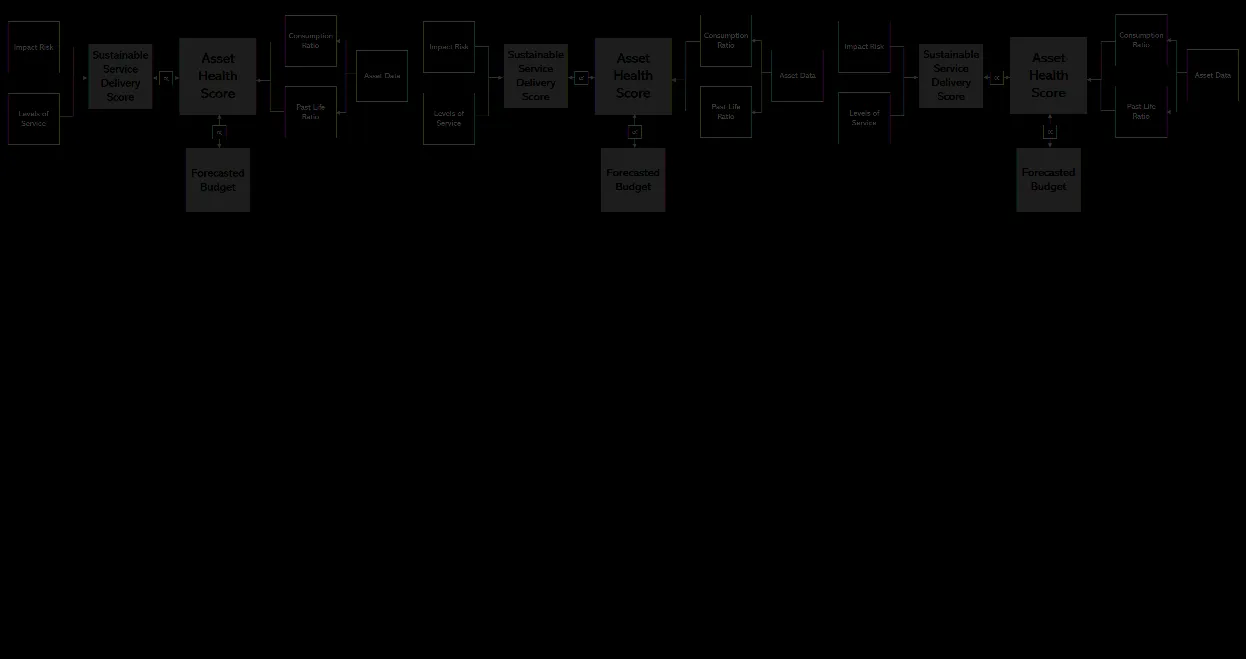
The Asset HealthScore Framework provides decision-makers with a multi-variable tool to balance asset replacement funding demand with Levels of Service and Impact Risk. This balance helps to achieve financial sustainability for each asset class over a 30-year planning period.
The Funding Plan presents four hypothetical scenarios that extend over the planning period that are based on theoretical forecasted budgets and targeted HealthScores. The scenarios are:
Scenario 1: HealthScore based on maintaining average annual reserve funding level of $456,800. Scenario 2: Funding based on maintaining 2020 HealthScore of 96%. Scenario 3: Funding based on maintaining a 70% targeted HealthScore. Scenario 4: Funding based on maintaining a 55% targeted HealthScore.
The hypothetical scenarios are for the purpose of providing staff and Council with insight into the full scope of the Town’s long-term options for funding asset renewal.
The Funding Plan, however, does not speak to the Town’s successes in sustainably planning its operations and maintenance of infrastructure assets. Operations and maintenance (“O&M”) play a significant role in prolonging the life and eventual renewal of infrastructure assets. O&M also enhances the Town’s awareness of the condition and performance of its infrastructure. As the Town’s O&M programs mature so does the data that drives the Asset Replacement Funding Plan scenarios. A key component of the next steps to determine sustainable reserve contribution levels is to formalize the Town’s condition assessment protocols. This effort is currently underway by the Engineering Department.
To its credit, the Town has responsibly invested in developing infrastructure planning documents during the past decade, such as master plans for transportation, storm drain, sanitary sewer, and parks. Coupled with O&M regimes for critical, high impact risk infrastructure, and due to the nature of its relatively young age, View Royal is able to investigate its future renewal obligations from a position of a high AssetHealth Score; a score that is in the upper echelon of BC municipalities.
Another aspect of the Town’s strong position is the current state of its Capital Reserve funds. Council’s Reserves and Surplus Policy (“Policy”), adopted in 2020 and attached to this report as Appendix B, prescribes minimum and optimal capital reserve balance levels. Levels are maintained yearly while balancing sustainable tax rate increases during the financial plan process. Optimum reserve target levels, as prescribed by the Policy, will consider future cash flow requirements set out in the Funding Plan. When finalized, the Funding Plan will forecast these cash flow requirements and enable the Town to establish optimum reserve level targets as part of its long-term financial plan.
CONCLUSION:
View Royal is working toward achievement of minimum reserve funding targets and has relatively young assets maintained in good health. The development of our Asset Replacement Plan will provide information to better understand minimum reserve targets in our future. Maintaining acceptable asset health in the long term will require an ongoing commitment to reserves contributions. Future steps toward the Town’s goal of fiscal health and long-term financial sustainability will be influenced by the Funding Plan.
Staff are required to continue the work initiated by the consultant and will refresh and refine the data such that Council will have more concrete funding requirements when asked to make final funding level decisions. The final Funding Plan will be presented to Council in advance of the development of the funding strategy and long-term financial plan.
RECOMMENDATION:
THAT the Committee receive the Draft Asset Replacement Funding Plan for information.
SUBMITTED BY:
S. Vella, Manager of Accounting B. Lubberts, Engineering Technologist
REVIEWED BY:
D. Christenson, Director of Finance J. Rosenberg, Director of Engineering
APPENDICES:
Appendix A: Asset Replacement Funding Plan Report Appendix B: 2021-2025 Financial Plan Project Summary N-42 Appendix C: 1600-020 – Reserves and Surplus Policy
¹ The data contained within the Town’s Tangible Capital Asset Registry is for the purpose of satisfying reporting standards (PSAB 3150) set by the Public Sector Accounting Board of Canada and has not been optimized for the use of asset management planning. Although the financial accuracy of the Funding Plan is acceptable for long-range planning and forecasting, the funding scenarios reflected in the Plan are conceptual, subject to change upon refinement of the data, and for information only at this time.
Document Images
(4)