TOWN OF VIEW ROYAL – HOUSING CAPACITY ASSESSMENT REPORT
A research report by Urban Matters assessing View Royal's housing needs and identifying best practices for local government roles in supporting housing development, specifically to inform the Official Community Plan (OCP) review.
CONTENTS
1 Introduction .......................................................................................................................................... 4 1.1 Context: Federal and Provincial Actions ....................................................................................... 4 National Housing Strategy .................................................................................................................... 4 Provincial Housing Plan ......................................................................................................................... 5 2 The Role of Local Government .............................................................................................................. 6 2.1 Overview ....................................................................................................................................... 6 2.2 The Housing Wheelhouse ............................................................................................................. 8 2.3 Existing Initiatives ......................................................................................................................... 8 Capital Regional District ........................................................................................................................ 8 Town of View Royal ............................................................................................................................... 9 2.4 Supporting Needs Throughout the Housing Wheelhouse in View Royal ..................................... 9 3 Best Practices ...................................................................................................................................... 11 3.1 Facilitate Development ............................................................................................................... 11 Best Practice # 1: Density Bonusing .................................................................................................... 11 Best Practice # 2: Inclusionary Zoning ................................................................................................ 13 Best Practice # 3: Pre-Zoning .............................................................................................................. 15 3.2 Invest and Incentivize ................................................................................................................. 17 Best Practice # 4: Develop an Affordable Housing Reserve Fund ....................................................... 17 Best Practice # 5: Strategic Land Acquisition and Management ........................................................ 18 Best Practice # 6: Development Incentives ......................................................................................... 20 3.3 Regulate ...................................................................................................................................... 23 Best Practice # 7: Protecting Rentals .................................................................................................. 23 Best Practice # 8: Regulating Land Use and Density ........................................................................... 25 3.4 Educate and Advocate ................................................................................................................ 27 Best Practice # 9: Communicating and Promoting Existing Options .................................................. 27 Best Practice # 10: Generating Community Buy-In ............................................................................. 29 Best Practice # 11: Advocating to Other Governments, Agencies, and Prospective Partners ........... 30 3.5 Partnerships ................................................................................................................................ 32 Best Practice # 12: Fostering Partnerships to Meet Housing Needs .................................................. 32 4 Recommendations .............................................................................................................................. 35 Appendix A: Glossary of Terms Used in This Report ..................................................................................... 1
1 INTRODUCTION
In September 2019, the Town of View Royal engaged Urban Matters to conduct research into the housing needs and demands in View Royal through a study comprised of the following phases:
- Phase 1 was completed to meet the provincial requirements for housing needs reports data collection by local governments as outlined in Part 14, Division 22 of the Local Government Act.
- During Phase 2, consultants and Town staff engaged with stakeholders and residents of View Royal to understand housing issues not addressed through the data. The results of Phases 1 and 2 are summarized in the Town of View Royal’s Housing Needs Assessment Report.
- In Phase 3, in order to provide the Town with options and ideas about how to address the areas of need identified in the Housing Needs Assessment Report, best practices research was conducted on local government roles in supporting housing. Research primarily focused on communities in BC because of the common political, economic, social and regulatory context.
This report summarizes the findings of Phase 3. It provides an overview of the housing context in Canada, outlines the role of local governments in addressing housing challenges, and reviews actions by View Royal, including key themes uncovered through the Housing Needs Assessment. Best practices have been identified to address these key themes and are presented in Section 3. These are intended to be a suite of options that the Town can consider implementing to support the development of in-demand housing, and to support the upcoming Official Community Plan (OCP) review planned to take place later in 2020. They also offer information to help the Town estimate the level of effort and cost associated with each action. The Town may use these practices and potential actions to inform future policies and plans, including updates to the OCP.
1.1 Context: Federal and Provincial Actions
National Housing Strategy
In 2017, the Government of Canada released the country’s first national housing strategy: A Place to Call Home. This 10-year plan sets the stage for more than $55 billion in investments and represents the first significant investment in housing made by the federal government in more than 25 years. The overarching goal is to make sure that Canadians have access to affordable housing that meets their needs by creating a new generation of mixed-income, mixed-use, accessible, and sustainable housing. Specific targets include:
- Reducing chronic homelessness by 50%
- Removing 530,000 families from housing need
- Building up to 125,000 new affordable homes
- Renovating and modernizing 300,000 homes
The strategy identifies 6 priority action areas:
- Housing for vulnerable populations
- Social housing sustainability
- Indigenous housing
- Northern housing
- Sustainable housing and communities
- A balanced supply of housing
The strategy prioritizes housing for vulnerable populations, including women and children fleeing domestic violence, seniors, Indigenous peoples, homeless people, people with disabilities, those dealing with mental health and addiction, veterans, young adults, racialized groups, and newcomers. The strategy is being implemented through a number of programs including (but not limited to):
- CMHC’s Seed Funding program
- CMHC’s Co-Investment program
- The Rental Construction Financing program, offering favourable, long-term (50 year) loans to construct rental housing
- Reaching Home: Canada’s Homeless Strategy
Provincial Housing Plan
In 2018, the BC Government released Homes for BC: A 30-Point Plan for Housing Affordability in BC in conjunction with the new provincial budget. Actions identified in the Plan and budget represent the largest investment in housing affordability in the BC’s history: more than $7 billion over 10 years, with a commitment of building 114,000 new homes across the housing continuum. Broadly, the Plan aims to improve housing affordability challenges across the province. It presents actions and strategies grouped into five themes:
- Stabilizing the market
- Cracking down on tax fraud and closing loopholes
- Building the homes people need
- Security for renters
- Supporting partners to build and preserve affordable housing
To support this Plan, the Province is supporting several new programs through BC Housing, such as capital funding for mixed-income, Indigenous and/or supportive housing to address homelessness, as well as expanding funding for existing BC Housing programs. These programs include:
- Building BC: Community Housing Fund
- Building BC: Indigenous Housing Fund
- Building BC: Supportive Housing Fund
- Building BC: Women’s Transition Housing Fund
- Community Partnerships Initiatives
- Regional Housing First Program
- Housing Hub
2 THE ROLE OF LOCAL GOVERNMENT
2.1 Overview
Local government policies and plans play a key role in facilitating, supporting, and incentivizing the development of new housing. Municipalities are expanding their role in supporting housing initiatives, moving beyond more traditional advocacy, policy and regulatory functions, to adopt roles that include research and innovation, education, investment and partnership development. Increasingly, senior government funders at the provincial and federal levels are seeking cross-sectoral partnerships consisting of non-profits, local governments and developers. Typically, local governments can come as either active partners of the project (e.g. contributing land or capital dollars) or as supporting partners (e.g. expediting development approvals if possible or providing incentivizes where appropriate). However, with a few exceptions (e.g. Whistler Housing Authority, Vancouver Affordable Housing Authority), local governments do not typically take on the role of developer or proponent of housing projects, operator of housing, nor do many have the resources to be the primary funder. These roles would fall to the non-profits, developers and builders, and senior levels of government. Table 1 below outlines the roles of various partners in developing new housing initiatives. Tick marks indicate roles or opportunities for each sector.
Table 1 Roles in Supporting Housing
| Opportunities / Roles in Supporting Housing | Local Governments | Indigenous Governments | Non-profits | Developers and Builders | Senior Government | Multi-Sectoral Cooperation |
|---|---|---|---|---|---|---|
| (Continue to) Participate in Regional Initiatives to Address Housing Issues | ✓ | ✓ | ||||
| Facilitate Development | ✓ | ✓ | ||||
| Regulate and Incentivize | ✓ | ✓ | ||||
| Invest | ✓ | ✓ | ✓ | |||
| Monitor, Research & Innovate | ✓ | ✓ | ✓ | ✓ | ✓ | ✓ |
| Education & Advocacy | ✓ | ✓ | ✓ | ✓ | ✓ | ✓ |
| Partnerships | ✓ | ✓ | ✓ | ✓ | ✓ | ✓ |
| Build Affordable Housing | ✓ | ✓ | ✓ | ✓ | ||
| Operate Affordable Housing | ✓ | ✓ | ✓ | |||
| Operate Support Services | ✓ | ✓ |
2.2 The Housing Wheelhouse
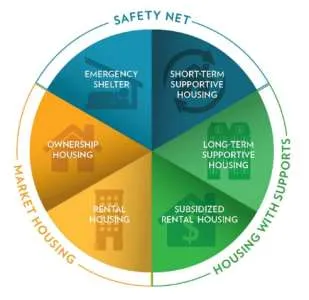
The housing wheelhouse can help local governments to identify specific actions and interventions required to meet local housing needs. Developed by the City of Kelowna in 2017, it is a way of thinking about the different housing options available to households of different income levels, ranging from emergency shelter to market homeownership (Figure 1).
This model demonstrates that progression through housing options may not always be linear, moving towards market homeownership. Rather, over the course of one’s lifetime, an individual may flow between different forms of housing according to financial, family, health, and other considerations. Considering the wheelhouse approach can help local governments to respond to changing, more diverse housing needs.
2.3 Existing Initiatives
The Capital Regional District (CRD) and the Town of View Royal have already taken significant actions to address needs in the community.
Capital Regional District
The Capital Regional District’s (CRD) housing initiatives date back 40 years when the CRD established a Land Banking and Housing service and the Capital Region Housing Corporation (CRHC). The CRD currently:
- Owns and operates more than 1,400 units in 46 complexes through the CRHC, serving more than 4,000 individuals.
- Implements the Regional Housing First Program, focused on creating new rental units to support the needs of individuals across the housing continuum.
- Provides funding to the Greater Victoria Coalition to End Homelessness, supporting community initiatives to end homelessness across the region.
- Provides capital investment in new projects through the Regional Housing Trust Fund, which has provided $11.7 million in funding to build nearly 1,000 units of affordable housing through the region.
- Engages in research and analysis to support local governments, community housing providers, and other stakeholders such as private industry and funders.
The CRD’s housing work also involves the implementation of the Regional Housing Affordability Strategy, aligning with directions set out in the CRD’s Regional Growth Strategy.
Currently the CRHC operates one development in View Royal, called Portage Place. This contains 17 two- and three-bedroom townhouses for families. There is another project under development at 1938 West Park Lane, which will provide 152 new units of housing. In this project, 20% of units will be offered at shelter rates, about 30% at affordable rental rates, and the remaining units will be at / near market rates.
View Royal contributes to regional housing initiatives through annual contributions to the Regional Housing Trust Fund and has contributed $354,000 over the last 15 years.
Town of View Royal
To-date, the Town has used a variety of tools and undertaken several initiatives to support the development of diverse new housing forms and tenures. Existing work includes:
- Participating in regional housing initiative
- Secondary Suites bylaw (2005)
- Official Community Plan (OCP) (2011) – includes high-level discussion of density bonusing
- Decommissioning of Unauthorized Secondary Suites (2012)
- Zoning Bylaw (2014)
- Guide to Secondary Suites (2014)
- Development Cost Charge Bylaw (2019)
- West Park Lane DCC Waiver (2019) – under consideration
- Community Amenity Contribution policy (2019)
- Housing Needs Assessment Report and Capacity Gap Assessment (2020)
A summary of existing work related to housing is provided in the Background Review included as an appendix to the Housing Needs Assessment Report. The Housing Needs Assessment Report provides a comprehensive picture of population and demographics, economy and income, housing stock and trends, and affordability as these considerations relate to current and future housing needs. Stakeholder engagement was undertaken to inform the Housing Needs Assessment, to better understand the qualitative impacts of shifting demographic and market realities facing the Town. The Report also presents several conclusions that the Town can consider in taking future action on housing issues. Key themes identified in the Housing Needs Assessment include:
- The high cost of housing is a barrier for new residents and the ‘missing middle’ in View Royal
- The lack of diversity of housing stock is a barrier to first-time owners
- Purpose-built rental is not keeping pace with demand
- A need for non-market units to support lower-income and vulnerable residents
- Planning for an aging population is a priority
2.4 Supporting Needs Throughout the Housing Wheelhouse in View Royal
The wheelhouse recognizes three types of housing: safety net, housing with supports, and market housing (Figure 1). Safety net housing includes temporary housing, such as emergency shelters and short-term transitional housing. Housing with supports refers to long-term or permanent housing arrangements, like residential care or subsidized rentals. Finally, there is market housing, which includes primary and secondary market rental, as well as homeownership.
While the work already undertaken by the Town supports a range of housing, there are ways the Town can build on this work and findings from the Housing Needs Assessment to further address needs throughout the wheelhouse.
Table 2 outlines potential next steps for the Town to consider.
Table 2 Supporting Housing Needs Throughout the Wheelhouse
| Housing Type | Potential Next Steps for the Town |
|---|---|
| Safety Net | • Continue to work with regional partners through the Regional Housing First Initiative • If projects are proposed for vulnerable populations apply incentives where relevant and appropriate |
| Housing with Supports | • Continue to work with regional partners to build housing • Develop / formalize incentive programs for developments that address non-market housing Needs • Formalize existing renter / tenant protection tools |
| Market Housing | • Strengthen options for more diverse housing in appropriate areas (e.g., near transit and Town Centre) • Capture value through developer contributions that can help finance incentives • Consider partial incentive programs for rental housing • Consider a partnership with BC Housing through the Affordable Home Ownership Program |
3 BEST PRACTICES
This section describes best practices, which were identified based on the themes uncovered in the Housing Needs Assessment. Best practices were reviewed with a local government lens to present opportunities that fall within the local government sphere of power and responsibility. The best practice review is organized around the following action areas to offer practical options and insights for the Town to consider in future decision-making:
- Facilitate development
- Invest and incentivize
- Regulate
- Educate and advocate
- Partnerships
Each best practice is accompanied by a Implementation Considerations table that identifies key theme(s) intended to be addressed through that practice. Key themes are drawn from the Housing Needs Assessment. As outlined in Section 2.3, these include:
- The high cost of housing is a barrier for new residents and the ‘missing middle’ in View Royal
- The lack of diversity of housing stock is a barrier to first-time owners
- Purpose-built rental is not keeping pace with demand
- A need for non-market units to support lower-income and vulnerable residents
- Planning for an aging population is a priority
The tables also offer qualitative considerations regarding potential implementation of the practice in View Royal.
This review recognizes that any new initiatives would build on significant work that has already been done by the Town, as described in the previous section of this report.
3.1 Facilitate Development
Local governments have a range of tools available to shape land use and development in their communities. These tools can be used to facilitate the development of certain needed housing types, forms, and tenures, or require that certain contributions are made toward affordable housing goals.
Best Practice # 1: Density Bonusing
Where there is sufficient market demand, density bonusing can be used as a means of exchanging development potential for community benefits, such as accessible, affordable, and / or rental housing. In this case, a municipality allows additional density beyond what is permitted by zoning and the developer would provide a certain number of accessible, affordable, and / or rental housing units in return.
City of Nanaimo The City of Nanaimo has a comprehensive density bonusing program that looks at criteria across seven different categories, including “Social and Cultural Sustainability”, which awards points for the provision of affordable or protected housing. Provisions are laid out in Schedule D of the Zoning Bylaw.
Specifically, points are awarded when the developer enters a Housing Agreement with the City to ensure that one or more of the following conditions are met:
- “At least 10% of residential units sold will be sold for at least 20% less than the median sales price for condos, as provided by the Vancouver Island Real Estate Board for the current year and cannot be sold for greater than the original sale price for a period of ten years. The Gross Floor Area of the units provided for within the Housing Agreement must be greater than 29m² in area.”
- “At least 50% of all residential units shall not be stratified or sold independently for at least ten years after the building receives final occupancy.”
- “Where the residential units are subdivided under the Strata Property Act or otherwise sold separately, the strata corporation will not place restrictions which prevent the rental of individual residential units.”
Points are added up to determine how many additional units may be permitted.
Staff are now working to develop a recommendation to Council to award additional points for the provision for affordable rental units.
The density bonusing program is one part of a package of incentives outlined in the City’s Affordable Housing Strategy, which are intended to facilitate development to meet identified housing needs.
Implementation Considerations
Best Practice: Density bonusing
Themes Potentially Addressed:
- Purpose-built rental is not keeping pace with demand
- A need for non-market units to support lower-income and vulnerable residents
- Planning for an aging population is a priority
| Consideration | Rating | Comments |
|---|---|---|
| Timeframe | Medium | • Staff time to review and develop criteria, thresholds, and policy • External consultant likely required to test acceptable threshold for density and contributions in order to appropriately incentivize and not discourage developers from taking advantage of this • Council time to review staff report(s) and decide on new policy • Ongoing staff time to review developments, market to developers and respond to inquiries |
| Effort Level | Medium to High | • Research and review by staff or consultant to develop criteria, thresholds, and policy • Could reduce negotiations required between developer and Town • Would require non-profit housing partners to be ready to purchase (at-cost) and manage units • Staff effort to manage consultant |
| Cost | Medium | • Staff or consultant time cost • Ongoing staff time costs to manage program and review every few years |
Other Communities to Consider: Coquitlam, Kelowna, Sechelt, Burnaby
Best Practice # 2: Inclusionary Zoning
Inclusionary zoning is the establishment of zoning regulations that require the development of or a contribution to affordable housing. Some regulations require a percentage of developed units to be affordable, others allow off-site construction of affordable units, and others allow cash-in-lieu to be paid into a housing fund.
This concept is based on the premise that the developer achieves added value by increasing the development capacity of the land and can therefore afford to give something back to the municipality in terms of needed housing or community services.
City of Richmond The City of Richmond’s Inclusionary Housing Policy has seen significant success in building low-end-of-market rental units or collecting cash-in-lieu. This Policy requires that multi-family buildings with more than 60 units build at least 10% (or a minimum eight units) of the total building area (based on the residential Floor Area Ratio) as low-end market rental units. These units have minimum unit sizes ranging from 400 square feet (sqf) to 980 sqf, with corresponding maximum rents ranging from $811 to $1,480 per month. For developments with less than 80 residential units, the City requires a cash contribution based on square footage, which goes to the City’s Affordable Housing Reserve Fund.
City of Langford Langford has used inclusionary zoning to encourage the development of affordable homeownership for first-time buyers. The City created an Affordable Housing Strategy in 2004, which contained a Home Ownership Program targeting local residents and people working in the City. Through this program, Langford uses inclusionary zoning and density bonusing approaches to having affordable units developed, with affordability secured through housing agreements on title that restrict sale prices and require purchasers to be approved by the City’s Affordable Housing Committee. Langford’s inclusionary zoning is approached through their Affordable Housing, Park and Amenity Contribution Policy, which requires developers to provide one small lot and affordable housing unit for every 15 lots rezoned for single-family home development. A cash-in-lieu contribution to the Affordable Housing Reserve Fund is required per lot for rezoning all single-family lots outside of multiples of 15. A cash-in-lieu contribution to the Fund is also required for all multi-family dwelling units created. Prospective purchasers are drawn from a list of qualified buyers who are within a certain income threshold, meet residency / employment requirements, do not own real estate, and must obtain pre-approval for the mortgage.
Implementation Considerations
Best Practice: Inclusionary zoning
Themes Potentially Addressed:
- Purpose-built rental is not keeping pace with demand
- A need for non-market units to support lower-income and vulnerable residents
- Planning for an aging population is a priority
| Consideration | Rating | Comments |
|---|---|---|
| Timeframe | Medium | • Develop the policy / regulation: Staff time to review existing and develop new land use policies and / or regulations, Council time to review staff report(s) and decide • Implement the regulation: Staff time to review existing zones and identify potential areas for inclusionary zoning, Council time to review staff report(s) and decide on application • Ongoing staff time to respond to inquiries |
| Effort Level | Medium to High | • Significant research and review effort by staff to develop and implement the policy / regulation • Effort for Council to consider, review thoroughly, and make decisions • Regular program reviews • Potential to reduce if a consultant is engaged |
| Cost | Medium | • Staff or consultant time cost to develop • Ongoing staff time costs to manage and review every few years |
Other Communities to Consider: Kelowna, New Westminster
Best Practice # 3: Pre-Zoning
To achieve visions expressed in an OCP, a local government must have zoning consistent with those visions. By setting visions for supporting affordable housing, a local government can set the foundation for zones for more diverse and flexible development, and even for affordable housing projects specifically. Pre-zoning is used by local governments to proactively set zones in a community that are suited for certain uses, without waiting for a rezoning application to be initiated by a project or applicant. Related to housing, pre-zoning can be used to encourage affordable housing development, and other forms of density and diversity in greenfield or existing neighbourhoods.
Having zoning in place helps avoid delays in the development process associated with rezoning and can set the stage for other complementary tools, such as inclusionary zoning policies or density bonusing, to further incentivize the development of needed housing units.
Pre-zoning for Flexible Density and / or Increased Diversity of Housing Choices
Pre-zoning can be used to offer flexible density for infill of existing single-family neighbourhoods. Allowing two, three, or four housing units per single-family residential lot can help diversify and gently densify an area while maintaining neighbourhood character.
Provincial best practices Through pre-zoning, local governments can leverage the zoning process to better align community development with goals identified in the OCP, such as those for more diverse housing types and compact complete community development. By engaging in pre-zoning across a number of sites or an area designated by the OCP, municipalities may be able to streamline the regulatory approvals process associated with site-by-site rezoning (even where proposed changes conform to the OCP). However, such an approach would require a comprehensive engagement program in order to ensure implementation of the OCP meets community needs. Pre-zoning for more diverse housing types can, over time, help phase out existing uses that do not align with OCP goals while encouraging desired ones.
City of Kelowna Kelowna’s RU7 Infill Housing Zone allows up to four units of housing on 800 existing single-family lots across the city centre area. Lots were pre-zoned to allow for two, three, or four units depending on lot size, enabling infill that remains sensitive to existing neighbourhood character. Stratification or rental housing is permitted.
Before formally adopting the RU7 zoning, the City hosted a design contest, inviting architects to create new designs for infill housing. The winners’ designs are pre-approved, allowing property owners to waive the development permitting process and possibly qualify for an expedited building permit process.
City of Coquitlam In Coquitlam, 700 RS-1 and RS-3 lots city-wide were pre-zoned to RT-1 Infill Housing in 2017. This allows up to four ground-oriented units to be developed on lots that were previously for one-family residential only. RT-1 zones are located in areas designated as Neighbourhood Attached Residential in the OCP under the Housing Choices Program, which aimed to provide new small-scale, ground-oriented housing options in some residential areas.
By pre-zoning to RT-1, the City has made it easier for property owners to develop one of the denser housing options on their lot, as most no longer have to go through the rezoning process. This helps facilitate development of infill housing.
Pre-zoning for Affordable Housing
Pre-zoning can be used to fast-track affordable housing projects. By formally identifying properties as future sites for affordable housing development, local government staff can start preparations to make projects move more quickly when approved.
City of Burnaby In 2019, Burnaby pre-zoned six city-owned sites to support the development of mixed income / affordable housing in partnership with BC Housing. The City is also speaking with CMHC about a federally owned site, which could also be pre-zoned for affordable housing. Once projects are more clearly defined, the sites will likely be rezoned to match the specifics of each development. The Mayor indicated that the City intends to keep the sites as assets and pre-zoning allows staff to start preparatory work.
Untested Pre-zoning could also be used to identify sites or areas in a municipality for rental-only development. In 2018, the Province introduced legislation enabling local governments to zone areas for rental residential (local governments can zone undeveloped land for rental housing or require a certain proportion of units to be rental and / or can ensure existing rental properties remain rental after redevelopment). Although relatively untested, pre-zoning for this use could help facilitate the development of more rental units.
Implementation Considerations
Best Practice: Pre-zoning
Themes Potentially Addressed:
- The high cost of housing is a barrier for new residents and the ‘missing middle’ in View Royal
- The lack of diversity of housing stock is also a barrier to first-time owners
- Purpose-built rental is not keeping pace with demand
- A need for non-market units to support lower-income and vulnerable residents
- Planning for an aging population is a priority
| Consideration | Rating | Comments |
|---|---|---|
| Timeframe | High | • Staff time to research, review and develop recommendations and identify sites • Staff time to engage with community as necessary • Council time to review staff report(s) and decide on application • Reduces future staff time |
| Effort Level | High (staff) or medium (consultant) | • Research and review by staff • Identification of suitable sites by staff • Develop community engagement program • Reduces future staff effort |
| Cost | High | • Staff time cost • Ongoing staff time costs to manage program and review sites every few years • Likely to require considerable engagement program |
Other Communities to Consider: All communities reviewed are described above.
3.2 Invest and Incentivize
Investing can be a powerful tool to signal the Town’s willingness to partner on important projects, such as large non-market or mixed-market developments. Local governments can choose to invest through contributions of land or cash, or by waiving or reducing typical development fees. While waiving or reducing fees is one form of incentivizing, local governments can also consider reducing parking requirements and fast-tracking certain applications to further incentivize development of desired housing types.
Best Practice # 4: Develop an Affordable Housing Reserve Fund
Through the Community Charter, municipalities have the power, by bylaw, to establish one or more reserve funds “for a specified purpose and direct that money be placed to the credit of the reserve fund” (s.188(1)). Some municipalities establish reserve funds to contribute towards the development of needed housing types in their community such as affordable, non-market, or rental.
City of Nanaimo Since 2005, the City of Nanaimo has maintained a Housing Legacy Reserve Fund, which had more than $2.3 million in it as of 2017. Funds are, by bylaw, designated “to support affordable housing in the community including but not limited to property acquisition and capital investment.” They can be used for land and building acquisition, project planning / legal / development / engineering costs, and project capital costs like construction. The primary focus is on developing social housing, with a secondary focus on non-market housing. The Fund is identified and supported in OCP policy.
City of Colwood The City of Colwood has an Affordable Housing Reserve Fund, which developers are required to contribute to when they develop in the community. The Fund has been used to offer grants and offset municipal fees, development charges, and community amenity contributions for certain affordable housing projects, as considered on a case-by-case basis. Grants only apply for units with rents that do not exceed BC Housing’s Housing Income Limits. The City uses restrictive covenants to ensure that these units remain affordable into the future.
Implementation Considerations
Best Practice: Develop an Affordable Housing Reserve Fund
Themes Potentially Addressed:
- Purpose-built rental is not keeping pace with demand
- A need for non-market units to support lower-income and vulnerable residents
- Planning for an aging population is a priority
| Consideration | Rating | Comments |
|---|---|---|
| Timeframe | Short | • Staff time to research and recommend to Council • Council time to review staff report(s) and decide |
| Effort Level | Short | • Research and review by staff and decision by Council |
| Cost | High | • Minimal ongoing staff time required, but financial contributions necessary to make it work, likely contingent upon existing CACs or a new density bonus contribution program with a cash-in-lieu section • Could redirect funds (e.g. CAC) that could go to other projects |
Other Communities to Consider: Kelowna, Richmond, Port Moody
Best Practice # 5: Strategic Land Acquisition and Management
Strategic approaches to acquiring and managing land holdings can help a community to formally identify and prioritize properties for purchase for the prospective development of needed housing.
City of Kamloops In their Affordable Housing Strategy, the City of Kamloops identifies developing a formalized Land Acquisition Strategy as a priority action. The purpose of such a Strategy would be “to clearly rationalize criteria for acquiring land, in order to communicate this rationale publicly.” The Strategy is expected to contain:
- Criteria to identify properties for acquisition that are suited to the development of certain housing types (e.g., seniors housing closer to services)
- Number and type of units to be built per year based on an Affordable Housing Needs Assessment
- Anticipated land acquisition costs per year
- Potential funding streams or sources of revenue
Kamloops has pursued land acquisition for affordable housing for several years but would like to develop a formal Acquisition Strategy with clear targets and goals.
District of Squamish Squamish has a Real Estate and Facilities Strategy and Master Plan that identifies what and when investments into facilities and property / land need to be made and how much funding is available to support these investments. While the Strategy / Plan focus on community services and facilities like civic offices, community centres, and recreation assets, it also considers how to align facility and land management with other areas of mutual interest, such as affordable housing and regional transit. It expressly identifies how space will be acquired for affordable housing opportunities. Strategies for acquiring affordable housing space include:
- “Acquiring units through the rezoning process”
- “[Utilizing] Crown Land where possible”
- “Partnering with organizations such as BC Housing”
- “Include affordable housing components in any sales of District land, where possible”
According to the Strategy / Plan, the District will also consider how to achieve additional community benefits like affordable housing or day care when disposing of District-owned properties. The District will not consider purchasing private land to pursue affordable housing opportunities at this time.
Implementation Considerations
Best Practice: Strategic Land Acquisition and Management
Themes Potentially Addressed:
- Purpose-built rental is not keeping pace with demand
- A need for non-market units to support lower-income and vulnerable residents
- Planning for an aging population is a priority
| Consideration | Rating | Comments |
|---|---|---|
| Timeframe | Medium | • Staff or consultant time to research examples, review existing Town initiatives, plans, and policies and develop a strategic approach to managing land holdings • Council time to review, revise and potentially adopt a strategy or strategic approach to management, potentially involved in development |
| Effort Level | Medium (staff) to low (consultant) | • Research and review effort by staff or consultant to develop a strategy or strategic approach • Staff effort to manage consultant • Council effort to review strategy |
| Cost | High | • Staff or consultant time cost • Ongoing staff time costs to maintain property inventory • High cost of land and limited land left will mean additional cost burden on CACs and/or any density bonusing or inclusionary zoning • Would compete with affordable housing reserve and incentives for resources • Staff or consultant time costs to review and update every few years |
Other Communities to Consider: Nanaimo
Best Practice # 6: Development Incentives
There are various examples of local governments incentivizing the development of priority unit types through the development process. Some local governments package these for easy marketing and understanding by prospective applicants, which can help increase uptake. Incentives described in the following best practices include:
- Waiving / reducing development fees for target housing types: Local governments can waive or reduce the fees charged during the development process for certain priority housing types, such as affordable, attainable, adaptable, family, etc., making these units more attractive and affordable for prospective developers.
- Waving property taxes: Waiving property taxes is a well-understood way of incentivizing the development of priority types of housing.
- Relaxing parking requirements: Reducing parking requirements can reduce the overall cost of a development, which can result in savings for the purchaser or end user and can be used to incentivize priority types.
- Expedited approvals: Speeding up the processing and approval of permits needed for priority types can save applicants time and money, making these types of development projects more attractive.
City of Kelowna Kelowna’s Healthy Housing Strategy contains a suite of incentives aimed at increasing affordability of rental and market housing. These include:
- Development cost charge (DCC) grant for non-market, purpose-built affordable rental housing. Currently, the City has an annual budget of $120,000 allocated to offset the cost of DCCs, although the Strategy recommends increasing that amount to $180,000.
- Tax incentive program to allow all purpose-built rental housing projects located within certain areas (including the urban core and university neighbourhoods) to apply for a 100% municipal tax exemption. Projects must be constructed to meet Step Four of the Energy Step Code.
City of Nanaimo The City’s Affordable Housing Strategy aims to develop a package of incentives that includes density bonus for 100% rental housing, reducing or waiving of community amenity contributions (CACs), parking relaxations in transit nodes and corridors, other financial incentives, and concurrent processing of different applications (e.g., development permit and building permit) for the same project.
The City is exploring the possibility of additional incentives where a share of the rental units is available at below market rent levels, targeting households with low and moderate incomes. These include revitalization agreements for lowering property taxes when below-market rents are secured for a period of time, additional density, and reduced parking standards near transit.
City of Port Coquitlam The Parking and Management Development Bylaw includes the following provisions to incentivize the development of family-sized units, non-market projects, and secured market rental:
- Reduce the required spaces for 3-bedroom units to 1.5
- Require non-market projects to provide a minimum of 1 space per unit
- Allow secured market rental projects to reduce parking requirements by 10%
City of Kamloops Kamloops offers reductions in minimum parking requirements for priority unit types. Multiple-family social housing, multiple-family dwellings, seniors’ housing, bachelor suites, or affordable developments qualify for reduced requirements. Social housing and seniors’ housing have lower requirements than other types. Upon the submission of a Housing Agreement, a development can receive a 7% reduction in parking supply requirements if they provide a minimum of 50% of the total units as affordable housing.
These incentives are listed alongside others in the City’s Affordable Housing Developers’ Package, which is described in more detail in Section 3.4.
Town of Canmore Canmore incentivizes the installation of secondary suites in privately owned homes. Homeowners are eligible for reimbursement of up to 50% of expenses, with a maximum of $10,000, if they commit to rent the suite to a Canmore resident at 10% below market rental rate for at least five years.
City of Victoria Victoria has experienced recent success in incentivizing the development of new primary rental units. In their Strategic Plan 2019 – 2022, the City includes the following action: “Incentivize development of rental housing and look for further opportunities to expedite and simplify development processes for affordable rental housing”, with additional actions focusing on family-sized units (two or three-bedrooms), affordable garden suites, and co-op housing.
The City offers DCC, fee, and tax exemptions and has aligned contributions from its affordable housing fund with targets for affordable housing, most specifically, primary rental. Permissive tax exemptions are offered to encourage the development of new affordable rental housing.
In the recent Victoria Housing Strategy Phase 2, the City states it will “Explore additional incentives and regulations, including licensing, to preserve existing rental housing stock, ensure capital improvements are completed, protect tenancies, and prevent renovictions” and “develop a Secured Market Rental Policy to incentivize the development of rental housing and look for further opportunities to expedite and simplify development processes for affordable rental housing.”
Implementation Considerations
Best Practice: Development incentives
Themes Potentially Addressed:
- The high cost of housing is a barrier for new residents and the ‘missing middle’ in View Royal
- The lack of diversity of housing stock is also a barrier to first-time owners
- Purpose-built rental is not keeping pace with demand
- A need for non-market units to support lower-income and vulnerable residents
- Planning for an aging population is a priority
| Consideration | Rating | Comments |
|---|---|---|
| Timeframe | Short | • Staff or consultant time to review existing development process, fees, and charges, and identify opportunities for adding incentivizes • Where Council decision required, Council time to review staff report(s) and decide • If formalized, reduces future staff time (compared to case-by-case basis) |
| Effort Level | Medium (staff) or low (consultant) | • Review effort by staff or consultant • Staff effort to manage consultant • If formalized, reduces future staff effort (compared to case-by-case basis) |
| Cost | Medium | • Staff or consultant time costs to prepare and review / update every few years • Reduces future staff time costs (compared to case-by-case basis) |
Other Communities to Consider: Courtenay
3.3 Regulate
Local governments have a variety of regulatory powers provided through the Local Government Act and associated legislation, which can be used to protect or enable the development of priority housing types.
Best Practice # 7: Protecting Rentals
As evicting and redeveloping old rental housing has become more common, protecting existing rental stock has become a key priority for many local governments.
City of Maple Ridge In 2018, Maple Ridge adopted a new Rental Tenant Relocation Assistance Policy and updated their existing Modular Home Park Tenant Relocation Policy to align with it. The Rental Tenant Policy is intended to provide assistance to tenants at risk of displacement due to redevelopment, while the Modular Home Park Policy is intended to supplement Provincial regulations and provide assistance to tenants of modular home parks at risk of displacement due to redevelopment.
The Policy and updates are the result of research on the rate of “demovictions” in the City. Where applicants are proposing to redevelop purpose-built rental units, the Rental Tenant Policy requires the applicant to provide:
- Proof of tenant notification about redevelopment
- Relocation Assistance Plan, which includes:
- List of tenants with unit type, unit size, number, length of occupancy, and current rent
- Right of first refusal for current tenants to live in the new building if redeveloped as rental at rents at least 10% below the average rent for the City as per the CMHC Rental Market Report from the previous year
- Commitment to identify at least three comparative alternative rental options for each current tenant located in Maple Ridge, with at least one in the same neighbourhood. Options should be at or within 10% of the tenant’s current rent or average rent for the City.
- Financial compensation to each current tenant to assist in relocation, based on the equivalent of at least 2 months current rent.
- Minimum of two months notice to end tenancies (after Final Approval by City Council)
Policies can be applied at the time of rezoning, heritage revitalisation agreement, strata conversion of a previously occupied building, or where changes are proposed to rental units that are already covered through a Housing Agreement.
In the Modular Home Park Policy, prior to receiving First Approval, a rezoning applicant must:
- Engage in early and ongoing engagement with tenants
- Provide a Relocation Assistance Plan that includes an assessment of tenant ability to secure accommodation
- Commit to hiring a qualified professional to support tenants by identifying three comparable alternative housing options for each current tenant that are preferably in Maple Ridge, helping tenants access and liaise with appropriate programs and agencies, and provide updates to the City on the progress of the Relocation Assistance Plan.
City of New Westminster New Westminster has developed a draft Rental Replacement Policy, which applies to all existing purpose-built market rental housing sites where redevelopment will remove more than six rental units. Any rezoning applicants are expected to provide the equivalent of 100% secure market rentals, including 10% below-market rentals (non-profit management preferred) secured through a Housing Agreement. The Policy also outlines guidelines for unit mix and size as well as rental rates, which must be provided at 10% below CMHC rental market median rent, all years, for the City. The Policy also includes a cash-in-lieu provision through which Council may consider contributions of $200,000 per unit, to be placed into the City’s Affordable Housing Reserve Fund.
Town of Ladysmith Ladysmith has a Strata Conversion Policy that prohibits the conversion to strata of a previously occupied residential rental building with at least three units when the relevant rental vacancy rate has been at or below 3% as reported in the CMHC Rental Market Report for the two most recent reporting periods.
Town of View Royal In response to a development proposal that included the demolition of approximately 160 apartments, the Town required the developer to prepare a Tenant Relocation Package specific to the project. The Package exceeds the minimum required under the BC Residential Tenancy Act and was achieved through the rezoning process. It includes the following commitments:
- 12 months’ notice of demolition date for tenants
- One to four months’ rent compensation based on length of tenancy
- Moving allowance of $1,000 or moving services for a maximum of two moves, including moves to another building or into the new development, as well as packing services for tenants with physical limitations
- Compensation for other costs (i.e., mail-forwarding, disconnection and reconnection of services)
- Right of first offer to rent apartments in the new development at the new rental rates
- Grandfathered rents for up to 33 tenants, determined by the developer based on length of tenure, who accept the right of first offer and sign a lease
- Other tenants who return to the new development will be compensated an additional two months’ rent in the first year
Implementation Considerations
Best Practice: Protecting rentals
Themes Potentially Addressed:
- The high cost of housing is a barrier for new residents and the ‘missing middle’ in View Royal
- Purpose-built rental is not keeping pace with demand
- Planning for an aging population is a priority
| Consideration | Rating | Comments |
|---|---|---|
| Timeframe | Medium | • On a case-by-case basis: Staff time to review development, Council time to review staff report(s) and decide • If formalized into a policy: Staff time to research, review existing Town policies, regulation and development processes, and develop policy, Council time to review staff report(s) and decide but reduces future staff and Council time (compared to case-by-case basis) |
| Effort Level | Medium | • On a case-by-case basis: Staff effort to review development, Council effort to review and decide could range from low to high depending on complexity of development • If formalized into a policy: Medium level of effort to develop the policy for staff and Council, potential to reduce if consultants hired, but reduces ongoing / future staff and Council time (compared to case-by-case basis) |
| Cost | Low | • On a case-by-case basis: Potential for higher staff time costs depending on complexity of development • If formalized into a policy: Low to medium cost to develop the policy, low ongoing costs once policy in place |
Other Communities to Consider: Victoria
Best Practice # 8: Regulating Land Use and Density
Local governments have a range of tools available to shape land use and development in their communities, which can help facilitate development of priority housing types. Reviewing and expanding existing regulations to allow more diverse types of housing can improve affordability across the community (i.e., for homeowners, renters, and priority groups like seniors or young families).
City of Nanaimo In 2008, Nanaimo amended their Zoning Bylaw to allow for secondary suites within accessory buildings, also known as carriage, coach, or laneway houses. Carriage houses are allowed on lots that meet the following specifications:
- No secondary suite exists within the principal dwelling
- A minimum of 30 m² of private outdoor space is provided
- The lot is a corner lot or is accessed by a laneway or is greater than an 800 m² in lot area
SFU Land Trust In 2002, Burnaby’s forward-looking planners and Council worked with the SFU Community Trust to allow lock-off suites within multi-family development (“secondary suites in the sky”). The City made zoning changes to allow lock-off suites in up to 50% of the apartments in multi-storey buildings and townhouses, subject to certain conditions. The suites must have a minimum size of 240 sqf and comprise no more than 35% of the total suite size.
Lock-off suites allow condo dwellers to rent their suite for additional income and provide flexibility over time as family needs change, meaning they can support the needs of young homebuyers needing a mortgage helper or extra bedroom for a growing family, as well as seniors who require live-in care or want to have extra space for visiting family. They have been reported to be popular with buyers.
District of West Vancouver Following a pilot project that designated a single block for infill housing development to raise awareness and demonstrate how infill housing can be developed in a way that maintains neighbourhood character, the District amended their OCP and Zoning Bylaw to permit detached secondary suites in all residential zones that already permit secondary suites.
Applicants are required to obtain form and character development permit for siting and building / landscaping to ensure that all development maintains neighbourhood feel and character. To encourage uptake, the District provides comprehensive information guides to assist prospective applicants with the design and development process.
Richmond Secondary suites can be used as mortgage helpers, for family members, or as extra space, allowing a high level of flexibility as a household’s needs change over time. However, for many homeowners, renovating an existing home to create a secondary suite can be a significant challenge. Richmond requires all new single-family developments to be built with secondary suites, which has resulted in a large stock of ready-built secondary suites in the community.
Various Pre-zoning for flexible, moderate density and increased housing diversity is another form of regulation and is described in Section 3.1.
Implementation Considerations
Best Practice: Regulating land use and density
Themes Potentially Addressed:
- The high cost of housing is a barrier for new residents and the ‘missing middle’ in View Royal
- The lack of diversity of housing stock is also a barrier to first-time owners
- Planning for an aging population is a priority
| Consideration | Rating | Comments |
|---|---|---|
| Timeframe | Medium | • Staff time to research, review existing regulations and policies, and draft new regulations • Council time to review staff report(s) and decide on new regulations • Ongoing staff time to manage, market and respond to inquiries |
| Effort Level | Medium | • Staff effort to research, review, and develop • Council effort to review staff report(s) and decide |
| Cost | Medium | • Staff time cost • Ongoing staff time costs hours to manage regulations and respond to inquiries |
Other Communities to Consider: City of North Vancouver, Canmore, Langford
3.4 Educate and Advocate
To increase the success of regulations, investments, incentives, and other measures, local governments can help educate, raise awareness, and advocate for identified housing needs in their community. Education can help bring community members on board with new ideas and can encourage the uptake of existing municipal initiatives. Municipalities can also advocate for what is best for their community; both to build awareness and support from their residents for needed housing types, and to access funding and resources through other levels of government.
Best Practice # 9: Communicating and Promoting Existing Options
Communicating and promoting expanded regulations, incentive programs, opportunities for partnership, and more can help encourage uptake. Having incentives for developers to build more affordable units aren’t effective unless developers know about them.
City of Kamloops Kamloops has an Affordable Housing Developers’ Package, which provides information for “anyone interested in becoming involved in the affordable housing sector in Kamloops.” The Package describes various incentives and programs available to support the development of affordable housing in the City, including:
- Accessing funds from the Affordable Housing Reserve
- DCC exemptions
- Tax exemptions
- Reduced parking requirements
- Expedited application processes and processing support
- City-owned properties available for below market real estate sales or long-term leases for development of housing for target groups
- Assistance with public consultation and / or site-specific variances and zoning changes
The Package also provides information on federal and provincial programming and partnership opportunities. It helps to communicate the importance and ease the process of developing affordable housing.
City of Kelowna Kelowna has a Communications and Engagement Strategy focused on the City's priorities and directions across the housing continuum. The purpose is to ensure the public understands what the City’s priorities are with regards to providing and that stakeholders know of municipal opportunities to support housing projects.
Implementation Considerations
Best Practice: Communicating and promoting existing options
Themes Potentially Addressed:
- The high cost of housing is a barrier for new residents and the ‘missing middle’ in View Royal
- The lack of diversity of housing stock is a barrier to first-time owners
- Purpose-built rental is not keeping pace with demand
- A need for non-market units to support lower-income and vulnerable residents
- Planning for an aging population is a priority
| Consideration | Rating | Comments |
|---|---|---|
| Timeframe | Medium | • Staff or consultant time to collect and review existing policies, programs, incentives, etc. and develop communications materials • Council time to review communications materials |
| Effort Level | Medium | • Staff effort to research, review, and develop strategy or manage consultant • Council effort to review |
| Cost | Medium | • Staff or consultant time cost • Potential for higher costs depending on graphics and cost of communications materials • Ongoing staff time costs to respond to inquiries |
Other Communities to Consider: BC Housing, District of West Vancouver, Nanaimo
Best Practice # 10: Generating Community Buy-In
Education and awareness building can help bring community members on board with new ideas and new forms of development. Local governments can also advocate for certain initiatives, which are important to meet identified housing needs.
Town of Canmore As part of their Livable Canmore strategic planning process, the Town of Canmore developed a community engagement process to explore how the town could create affordable housing and maintain neighbourhood character. The process was marketed as the “Everyone Needs a Home” campaign. This was a deep engagement process, focusing mainly on informing, consulting, and involving residents and resulting in more than 500 points of input. Activities included:
- Early stakeholder meetings
- Promotion and communication of project and background via website, local newspapers, weekly emails to stakeholders, and Ideas Walls (including FAQs, case studies, housing profile, and more)
- Included three background briefs to inform conversations and six housing situation stories to help people to understand the need for housing
- Expert presentation on affordable housing in resort towns
- Online survey
- Seven Ideas Walls posted at various community buildings (posters that encourage passers-by to provide input and comments, with guiding questions)
- Ten resident-led “Kitchen Table Pizza Parties” (conversations about housing hosted by residents who were provided with workbooks of discussion questions and reimbursed for up to $35 of pizza)
- Two “Neighbourhood Block Party” open houses with interactive stations and guides
- Materials were set up at Civic Centre for two weeks afterwards to allow for additional input from passers-by
- “Housing Solutions Workshop” in open house format with stations, plus structured World Café conversations
This campaign helped to communicate the importance of diverse housing options to community members and generate community buy-in.
City of Kamloops Kamloops hosts regular meetings with neighbourhood associations about a range of development and planning issues on a regular (semi-annual) basis. These meetings cover a range of topics; however, they allow for advance community conversations on the nature and type of development that neighbours can anticipate in coming years and provide an indication of where additional staff or consulting resources might be required to engage with community around specific projects.
Implementation Considerations
Best Practice: Generating community buy-in
Themes Potentially Addressed:
- The high cost of housing is a barrier for new residents and the ‘missing middle’ in View Royal
- The lack of diversity of housing stock is also a barrier to first-time owners
- Purpose-built rental is not keeping pace with demand
- A need for non-market units to support lower-income and vulnerable residents
- Planning for an aging population is a priority
| Consideration | Rating | Comments |
|---|---|---|
| Timeframe | Medium | • Range depending on extent of engagement; low for a pilot program, high for a comprehensive engagement program • Staff or consultant time to develop engagement strategy and host sessions |
| Effort Level | Medium | • Range depending on extent of engagement; low for a pilot program, high for a comprehensive engagement program • Staff effort to develop engagement strategy and host sessions or manage consultant |
| Cost | Medium | • Range depending on extent of engagement; low for a pilot program, high for a comprehensive engagement program with extensive graphics and materials • Staff or consultant time costs to prepare and run program |
Other Communities to Consider: Kamloops, District of West Vancouver
Best Practice # 11: Advocating to Other Governments, Agencies, and Prospective Partners
While local governments play key roles in developing policies and plans to facilitate, support, and incentivize the development of new housing, the Provincial and Federal Governments also have important roles to play, such as providing funding, other resources, and high-level direction. Government agencies, non-profits, developers, and others are also key partners who need to be at the table to effectively meet any community’s housing needs. To gain support from all these players in a way that works for their local context, local governments need to advocate for what their community needs.
City of Burnaby The City of Burnaby advocates to senior levels of government for a range of housing issues in their community, such as zoning for rental housing, DCCs to replace affordable housing, supports for social housing, and more. The City also works closely with BC Housing, CMHC, non-profit agencies, and the private sector to deliver housing. Since 1988, the City has advocated to higher levels of government through letters directly to the Provincial and Federal Governments, as well as resolutions through the Union of BC Municipalities and Federation of Canadian Municipalities. Burnaby is expressly committed to advocating for senior government support for the following:
- Providing non-market affordable housing
- Addressing the affordability of market housing
- Providing for social and income supports
- Finding solutions to homelessness
Implementation Considerations
Best Practice: Advocating to other levels of government, agencies, and prospective partners
Themes Potentially Addressed:
- The high cost of housing is a barrier for new residents and the ‘missing middle’ in View Royal
- The lack of diversity of housing stock is a barrier to first-time owners
- Purpose-built rental is not keeping pace with demand
- A need for non-market units to support lower-income and vulnerable residents
- Planning for an aging population is a priority
| Consideration | Rating | Comments |
|---|---|---|
| Timeframe | Long | • Ongoing staff time to research, review changing conditions and new opportunities, and advocate accordingly • Potential for Council time to review / approve certain communications and initiatives |
| Effort Level | Medium | • Most effective with ongoing, committed ‘champion’ or staff contact |
| Cost | Low | • Staff or consultant time cost • Potential for higher costs depending on graphics and cost of communications materials • Ongoing staff time costs to respond to inquiries |
Other Communities to Consider: Victoria
3.5 Partnerships
Typically, local governments can come as either active partners of housing projects (e.g. contributing land or capital dollars) or as supporting partners (e.g. expediting development approvals if possible or providing incentivizes where appropriate) in developing priority housing types in their community. Because a local government has a more comprehensive and strategic view of what is going on in their community, they are uniquely positioned to act as convener and conversation starter for partners such as non-profits and service providers, developers, real estate groups, faith-based organizations, Provincial and federal agencies, and more. This includes the potential to initiate conversations between potential partners, such as faith-based or non-profit landholders with developers and funders, to identify development opportunities.
Best Practice # 12: Fostering Partnerships to Meet Housing Needs
Local governments can participate in or foster partnerships between a variety of agencies, senior levels of government, and others to advance the development of priority housing types for their communities.
Capital Regional District
Regional Housing First Program The Capital Regional District partners with the federal and provincial governments and Island Health to deliver the Regional Housing First Program. The Regional Housing First Program aims to reduce chronic homelessness and generate new rental housing options by building new supported housing units, offered at the provincial assistance rate ($375 per month) to individuals experiencing homelessness who are ready to live supported housing. The CRD takes three approaches to providing units:
- Administering a request for proposal process, through which developers and non-profits can propose housing projects, with access to low interest construction financing through CMHC or BC Housing. When built, CRD and BC Housing purchase the units and use the revenue to cover operations and maintenance costs.
- Pursuing land acquisition opportunities to provide more opportunities for development.
- Negotiating the purchase of units from developers for ongoing ownership and operation by CRD and the Capital Region Housing Corporation.
As part of this program, the CRD secures units for ongoing use as supported housing by purchasing and maintaining ownership of the developed units. The CRD enters into operating agreements with non-profit or private market housing organizations for providing supported housing and is currently working to identify the appropriate forms of ownership and agreement to effectively secure the investment over the long term.
Affordable Housing Agreements Service The CRD also offers a program to support member municipalities, electoral areas, and land trust areas with the ongoing operation of affordable housing units through housing agreements. Through the Affordable Housing Agreements Service, the CRD may enter into housing agreements with developers to support administration of affordable units located within their member communities. The member municipality (or electoral area, or land trust area) is responsible for developer approvals and entering into a housing agreement with the developer to secure the units for affordable purposes. The CRD will then work with the municipality and other stakeholders to enter into a housing agreement for administration of the operations of the units on an ongoing basis, such as facilitating all necessary administrative functions to support resales of below-market units. The CRD works with the member community to determine terms of each agreement (e.g., rent levels, below-market selling price, qualified household income, etc.).
Currently, the CRD administers an agreement for the restricted re-sale (affordable) ownership units at the Dockside Green development in Victoria and another for income testing for rental units at the Travino development in Saanich.
BC Housing BC Housing’s Housing Hub works with community, government and non-profit and private-sector stakeholders to facilitate the creation of new affordable rental housing and homeownership options for middle-income earners in BC. HousingHub delivers the Affordable Home Ownership Program (AHOP), which supports the development of new, affordable homes for eligible middle-income earners to purchase. AHOP could be explored as a developer contribution, because developers can receive low-cost financing in exchange for building affordable housing. HousingHub also works with municipalities to reduce regulatory barriers and expedite the full development process.
Pacific Mountain Regional Council of United Church of Canada In 2018, the United Church of Canada launched a new partnership program, the 3-Point Redevelopment Portfolio, with BC Housing to redevelop select properties into mixed-use developments, including new church spaces and purpose-built affordable rental housing. Projects are expected to happen in Coquitlam, Richmond, Nanaimo, and Vancouver. Housing units provided through the program will be designed to be affordable for low to moderate income households, based on BC Housing affordability criteria and local municipal thresholds. BC Housing is financing the redevelopment, the church will use income from the rental housing to repay the loan to BC housing, and each project will align with municipal planning policies and neighbourhood character. Housing units will be owned and operated by the 3-Point Housing Society, a non-profit organization.
Implementation Considerations
Best Practice: Fostering Partnerships to Meet Housing Needs
Themes Potentially Addressed:
- The high cost of housing is a barrier for new residents and the ‘missing middle’ in View Royal
- Purpose-built rental is not keeping pace with demand
- A need for non-market units to support lower-income and vulnerable residents
- Planning for an aging population is a priority
| Consideration | Rating | Comments |
|---|---|---|
| Timeframe | Long | • Staff time to organize and convene partners, time for partners to develop a relationship and identify suitable opportunities • Potential for Council time participating in meetings or relationship building |
| Effort Level | Low | • Low but ongoing, some staff effort to organize and convene |
| Cost | Low | • Ongoing staff time costs to organize and convene |
Other Communities to Consider: Gibsons, Vernon (Social Planning Council for the North Okanagan), Sunshine Coast Housing Committee, Cowichan Valley Regional District Housing Association, Nelson
4 RECOMMENDATIONS
This section identifies recommendations to address current capacity gaps in View Royal to support the development of new housing to meet the diversity of needs in View Royal. These are divided into considerations for the upcoming Official Community Plan update, and future work that can be undertaken upon completion of the OCP.
Recommendations for the OCP
Recommendation #1: Use the OCP as an opportunity to communicate the need for new housing development and generate buy-in on new housing directions with the community The OCP update represents a key tool for broadly and deeply engaging with residents of View Royal around key issues and concerns they may have for their community. It also represents an important avenue for the Town to convey information about upcoming initiatives and potential community changes that could result from new OCP directions. It is therefore a valuable opportunity to communicate with residents about the outcomes of the housing needs assessment study, and new directions that the Town may be considering to develop a range of housing options in the community, while communicating the importance of this range of housing choices to residents.
Recommendation #2: Identify areas suitable for a diversity of housing types that provides choice and affordability to residents, and the tools to achieve these The Housing Needs Assessment identifies a number of housing gaps in View Royal, including non-market rental, market rental, and opportunities for affordable ownership. The OCP should identify areas suitable for each of these types of housing within the Town, and ensure that provisions for the development of a range of housing options are integrated into the OCP. In particular, the following tools should be identified as central to achieving a diversity of housing: (a) a density bonusing program that integrates a cash-in-lieu or unit contribution from developers; (b) measures to protect renters in existing purpose built housing stock; (c) partnership agreements with non-profits and BC Housing; and (d) incentive programs for priority housing projects.
Recommendation #3: Use the OCP to identify whether certain areas may be suitable for pre-zoning Through the OCP process, the Town will identify areas where growth and demographic changes may require changes to land use designations. Typically, even when land use designations change through an OCP update, land owners are still required to undertake a rezoning process. Through the OCP process, the Town can identify areas of the community, particularly those close to the Town Centre and transit, that might be suitable for pre-zoning, which would facilitate development on those lands. This approach would need to be considered for only those lands and housing types which are identified as priorities by the Town.
Recommendation #4: Integrate language allowing lock-off suites in multi-family housing into the OCP With the provision of more multi-family housing in View Royal, one tool that can support both rental supply and increase owner affordability is the provision of more options for ‘mortgage helper’ units. Changes announced to the BC Building Code will allow the provision of secondary suites in multi-family (condominium and townhouse) developments. The OCP update process will allow the Town and residents to identify if there are areas more suited to the provision of secondary suites in multi-family housing, or whether it should be focused on specific areas (e.g. near the Town Centre).
Recommendation #5: Identify areas in the community that can sustain more gentle density Through the OCP process, the Town can identify whether any areas of the community can sustain a gentle approach to increased density, where greater flexibility in land use is provided (e.g. Kelowna’s RU7 zoning) while maintaining the form and character of existing single-family neighbourhoods.
Implementation Measures After the OCP Update
Recommendation #6: Implement a density bonusing approach to new development that would allow the Town to acquire units and/or support the development of an Affordable Housing Reserve The Town’s OCP already currently contains language for density bonusing. However, currently the zoning bylaw does not identify the amount of density that could be added to a project through an affordable housing contribution from a developer. A land economics study in order to determine an appropriate contribution would lead to policy and zoning bylaw changes for the Town.
Recommendation #7: Formalize existing initiatives to protect renters View Royal has already implemented a tenant relocation plan specific to a single development. Formalizing and expanding this program to cover any redevelopment of purpose-built rental housing represents a logical next step in ensuring renters in View Royal are protected, and that the disruption of redevelopment does not adversely impact their housing stability or security.
Recommendation #8: Continue to foster and strengthen partnerships with other communities, the Capital Regional District, non-profits, developers and BC Housing Effective housing actions are typically partner-oriented initiatives, and a successful development requires co-operation between multiple levels of government, non-profits, and the private. Some of these are existing partnerships, such as the Town’s contribution to the Regional Housing First Program. Other forms of partnership could include: strengthened ties between View Royal and neighbouring municipalities and First Nations communities; formalized partnership with BC Housing and the development community to implement the Affordable Home Ownership Program (AHOP) in View Royal; and the development of an incentive program for target housing types.
Recommendation #9: Identify suitable incentives for non-market rentals and determine feasibility of providing incentives for affordable ownership or market rental housing The Town does not currently incentivize non-market housing development. There are a number of tools the Town can use to incentivize a project or demonstrate support for it. The two primary incentive approaches appropriate to View Royal are reduced parking requirements near transit and the Town Centre, and reducing or offsetting development costs. The latter can be achieved by using any cash contributions from density bonusing to offset these development costs for non-profits, while also ensuring the Town does not need to make up those costs elsewhere.
Recommendation #10: Based on the updated OCP, consider adopting a pre-zoning approach to lands in close proximity to the Town Centre and/or transit and allow greater density Undertaking a pre-zoning process after an OCP update is one tool the Town can use to stimulate desirable development that aligns with the OCP. This would necessitate community consultation and engagement for affected areas, and a strong rationale for what is possible and desirable in these areas (highest and best use), and should include opportunities for market ownership, affordable ownership, market rental and affordable rental in the new zoning designation.
Recommendations #11: Monitor opportunities for land acquisition or partnership for sites suitable for affordable housing A formal land acquisition program can be a resource-intensive program and is not recommended for View Royal at this point. However, the Town should continue to monitor sites that may be well-suited for affordable housing based on location, and could accommodate a project (e.g. churches, institutional lands, etc.) at a later date. Either partnership or acquisition of these lands may be an appropriate avenue for developing these types of sites, depending on site ownership and costs.