Staff Report - Intersection of Watkiss Way/Burnside Road W.
Engineering response to safety concerns, noting ongoing CRD corridor studies and listing safety measures already implemented.
March 12, 2019
Currently the Capital Regional District is conducting a study of both the Galloping Goose Regional Trail and E&N Rail Trail corridors and the crossings at intersections along the corridors. The intent is to create a standardized approach that provides consistency. Staff recommends that the Town wait until the study is complete before completing additional work at the intersection of Watkiss Way/Burnside Road West.
The Engineering Department has reviewed the Watkiss Way/Burnside Road W. intersection several times. The intersection has been reviewed by the Town’s traffic consultant and the Town has had a safety audit performed by ICBC. It is important to recognize that solutions for one mode of transportation, i.e. cycling can create issues of safety and frustration for other modes of transportation. Since the installation of the signals at this intersection, staff have made several changes to improve the performance and safety at the intersection.
The safety audit from ICBC had several comments:
“When cyclists were waiting at the intersection to cross, their bike-signal green started at the same time as the Watkiss green. As a result, the Watkiss drivers and GG cyclists all started up at the same time. Consequently, the risk of conflicts was fairly limited since waiting cyclists were clearly visible and all modes (cyclists as well as drivers turning across the bike crossing) were just starting up from a stop.”
- Staff agree with this conclusion and consequently see no need to make changes based on this comment.
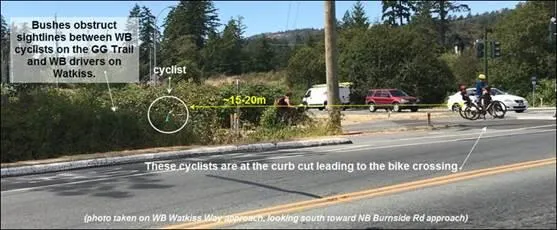
“However, when cyclists approached and entered the bike crossing later in the Watkiss/bike green phase, they did so (1) at a cycling speed (say about 20-25 kph for commuter cyclists) and (2) from a location where sightlines were limited by bushes and negative elevation. Similarly, Watkiss drivers turning left may be travelling at higher speeds, since they are approaching a signal that is already green. In this situation, there is an increased risk of conflict between cyclists and WB drivers on Watkiss Way, when a driver starts to turn left across an empty bike crossing at the same time as a cyclist approaches and enters the crossing at cycling speed and from a position with obstructed sightlines and partly behind the driver. “
- A solution to this conflict would be to install baffles on the Galloping Goose Regional Trail to force cyclists to slow down. This solution would greatly increase the cyclists safety, however it is likely cycling groups and the CRD would be opposed to this and the CRD is responsible for the corridor.
- Staff have scheduled cutting back vegetation on the Galloping Goose Regional Trail near intersection approaches to help improve site lines
ICBC recommendations included:
- Provide a dedicated cycling signal phase, so Trail cyclists cross on their own cyclist-only green (all other signal displays red).
- this would have a detrimental impact on vehicle traffic flow as well as lead to potential frustration and confusion by drivers and could create conflict with pedestrians; and
- would also require that right turns on red be prohibited.
- A dedicated left turn on westbound Watkiss Way to southbound Burnside.
- requires reconfiguration of the intersection;
- would allow a conflict free turn for vehicles as bikes would have a stop signal during this phase; and
- would impact other legs level of service performance.
- Installing green “conflict zone” markings.
- this would create better awareness for motorists and cyclists.
To date, changes made by staff include:
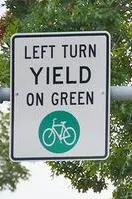
- installation of “left hand turn yield to cyclist on green“ sign on the signal head for westbound traffic turning onto Burnside Road West;
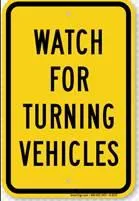
- installation of signs along the Galloping Goose Regional Trail warning Trail users to “Watch for Turning Vehicles”;
- installation of deflectors on the signal head to reduce cars from looking at the wrong signal; and
- shifted the angle of the bike/pedestrian signals to improve visibility.