Planning & Development Report: DEVELOPMENT PERMIT APPLICATION 2019/03 - FORM AND CHARACTER - 1938 WEST PARK LANE
A staff report introducing a development permit application for a 152-unit multifamily residential project in two six-storey buildings.
MAP 4: RENEWABLE RESOURCE LANDS - DETAIL
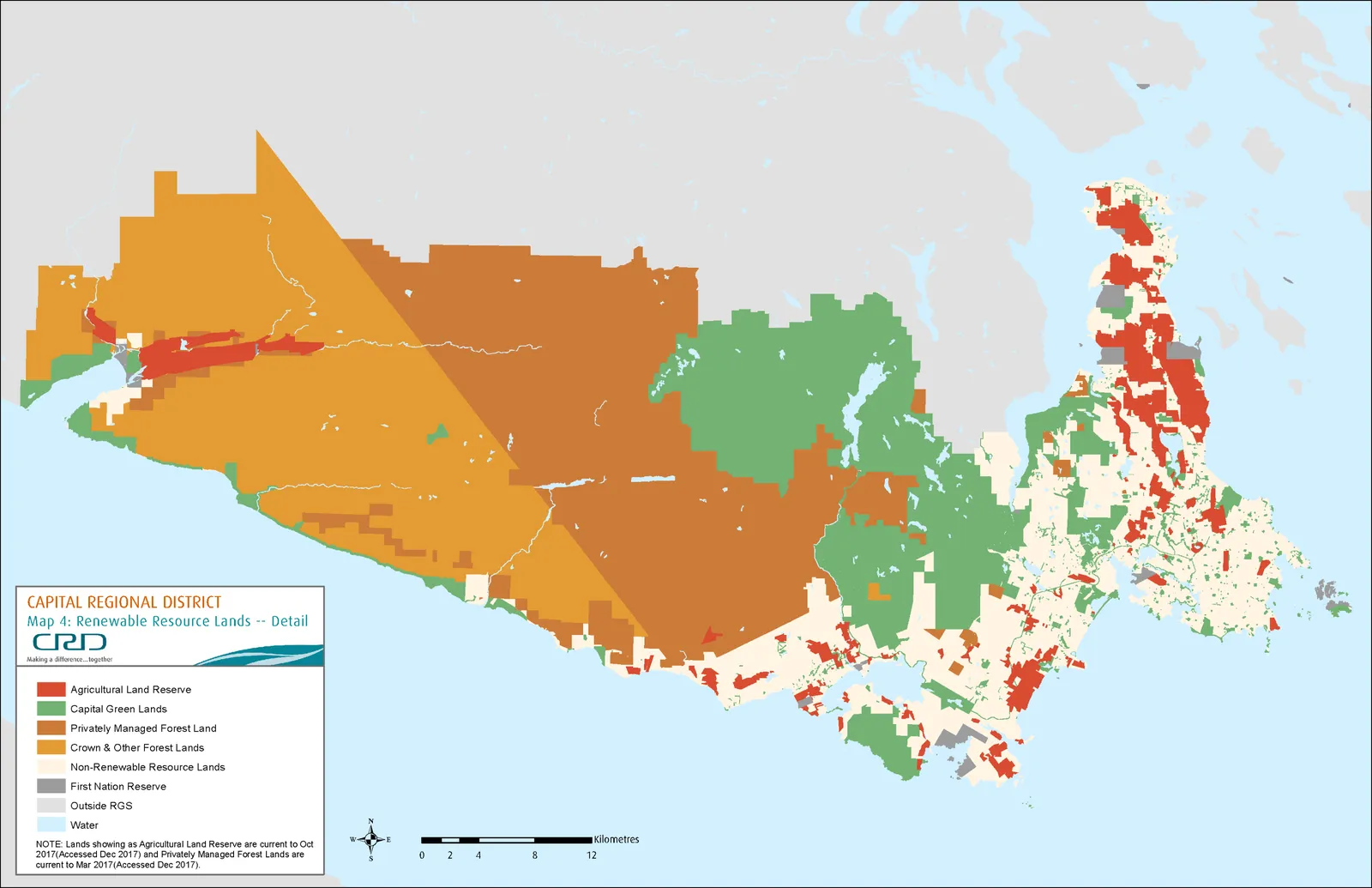
Legend
- Agricultural Land Reserve
- Capital Green Lands
- Privately Managed Forest Land
- Crown & Other Forest Lands
- Non-Renewable Resource Lands
- First Nation Reserve
- Outside RGS
- Water
NOTE: Lands showing as Agricultural Land Reserve are current to Oct 2017 (Accessed Dec 2017) and Privately Managed Forest Lands are current to Mar 2017 (Accessed Dec 2017).
This page intentionally blank.
Policies
- Provide for land uses consistent with the Growth Management Concept Plan depicted on Map 3(a) and adopt policies to implement the Growth Management Concept Plan consistent with the land use policy designations described in Objective 1.1.
- Adopt policies regarding the protection, buffering and long term maintenance of the Urban Containment Policy Area Boundary.
- Permit amendment to the Urban Containment Policy Area designation generally, only as an outcome of a comprehensive 5–year review of the Regional Growth Strategy, recognizing that municipal councils and the Capital Regional District Board are free to initiate at any time amendments to official community plans and the regional growth strategy they deem necessary, through statutory processes established in the Local Government Act.
- Maintain Victoria as the primary regional employment, business and cultural centre.
- Enhance or develop major employment and population centres in areas that meet criteria, as set out in Objective 3.1, for complete communities.
- Encourage planned growth in the nodes shown on Map 3(b) and described in Objective 1.1 and plan for transportation infrastructure to align. It is recognized that the location of the nodes is conceptual and that municipal conformance may vary. Local planning decisions relating to nodes will not require a Regional Growth Strategy amendment.
1.2 Protect the Integrity of Rural Communities
Keeping urban settlement compact will help protect the character and quality of rural communities, ensure that they remain strongly rooted in the agricultural and resource land base, and allow the rural countryside and natural landscape to remain a durable fact of life in the Capital Region. The protection of rural communities starts with clearly defining and distinguishing between urban and rural areas. The Regional Growth Strategy does this by designating for long term protection as Capital Green Lands and Renewable Resource Lands those natural assets including parks, ecological reserves, forests, farmland and watersheds that make up the region’s green infrastructure and contribute to the regional economy. The designation of an Urban Containment Policy Area reinforces the protection of Capital Green Lands, Renewable Resource Lands and Rural/Rural Residential Policy Areas and has the further benefit of supporting the long–term effort to keep urban settlement compact.
Rural and rural–residential communities offer a choice of rural lifestyles and outdoor recreation opportunities that complement the surrounding working landscapes and preserve ecological diversity. New development in the Rural/Rural Residential Policy Area is not intended to exceed 5% of the region’s new dwelling units. Policy 1.1 protects rural communities by requiring that local municipalities and the Juan de Fuca Electoral Area provide for land uses consistent with the Growth Management Concept Plan and adopt policies that would prevent lands designated as Rural/Rural Residential from becoming future urban areas. Strengthening the character and quality of rural communities can be achieved by planning for development in accordance with the principles set out below.
Principles
I. Maintain working landscapes including agriculture, forestry and outdoor recreation activities that contribute to the region’s economy; II. Avoid the creation of future urban areas through development patterns that complement rural form, density and character; III. Minimize impacts to the natural environment and surrounding working landscapes; and, IV. Accommodate a slow to moderate rate of growth, contributing to no more than 5% of the region’s new residential units.
Policies
- Plan for development in the Rural/Rural Residential Policy Area depicted on Map 3(a) in a manner that is consistent with the principles set out in Objective 1.2.
2. Environment and Infrastructure
2.1 Protect, Conserve and Manage Ecosystem Health
The Capital Region has a rich inheritance of natural lands and waters of great beauty and biophysical diversity. Residents of the Capital Region enjoy a healthy environment where environmental quality is improved and the inheritance of renewable and non-renewable natural resources is carefully stewarded. Many of the region’s terrestrial, fresh water and marine environments – its green and blue spaces – are of provincial, national and international significance.² The system of green and blue spaces that make up the region’s natural environment spans a diverse range of ecosystems and land uses and requires integrated, collaborative and co-operative management of land and water resources. The Regional Growth Strategy aims to protect the landscape character, ecological heritage and biodiversity of the Capital Region by protecting, conserving and managing lands according to the principles set out below.
Principles
I. Waste discharges of all types should not exceed the assimilative capacity of the natural environment (including land, air and water); II. Depletion rates for natural resources should not exceed the regenerative capacity of the ecosystems that produce them; III. Consumption of scarce renewable and non–renewable resources should be minimized through conservation, efficiency and application of technology and reduce, reuse and recycle practices; IV. Benefits derived from healthy ecosystems should be recognized and integrated into land use management and service delivery decisions; and, V. Decision–making should give first priority to options that maintain ecosystem and population health and support the ongoing ability of natural systems to sustain life.
Parkland acquisition protects lands for conservation and recreation by establishing a connected system of natural areas. Central to this system is the protection of a sea to sea green/blue belt running from Saanich Inlet south to Juan de Fuca Strait, and the development of an integrated system of parks and trails linking urban areas to rural green space areas. By applying these principles, it will be possible to improve human health, reduce negative impacts on the natural environment and mitigate and adapt to the impacts of climate change.
² The Regional Green/Blue Spaces Strategy was a foundational document for the development of the 2003 Regional Growth Strategy. The Strategy has been superseded by subsequent planning initiatives such as the Regional Parks Strategic Plan, the Integrated Watershed Management Program Plan, the Regional Parks Land Acquisition Strategy and park management plans for the Sooke Hills Wilderness and Sea to Sea Regional Parks.
Policies
- Ensure the long–term protection of Capital Green Lands depicted on Map 3(a). Recognizing the varied ecological and recreational contexts of the Capital Green Lands, this could include municipal policies and CRD electoral area policies for buffering and land use transition between Capital Green Lands and adjacent settled areas (i.e., lands within the Rural/Rural Residential Land Use Policy Area as well as the Urban Containment Policy Area), as well as policies aimed at enhancing, restoring or naturalizing Capital Green Lands. Notwithstanding the above, local governments will retain the ability to dispose of or rezone parklands.
- Municipalities will identify regionally significant parks through their Regional Context Statements. The Juan de Fuca Electoral Area will identify regionally significant parks in Official Community Plans.
- Prioritize community and regional park land acquisition, public and private land stewardship programs and regional trail network construction that contributes to completion of the sea to sea green/blue belt running from Saanich Inlet south to Juan de Fuca Strait.
- Identify, protect, enhance and restore healthy ecosystems using tools that may consist of policies, regulations, development permit area guidelines, incentives, initiatives and education and outreach delivered at the local level consistent with the principles set out in Objective 2.1.
- Protect the ecological integrity of watersheds and marine areas through collaborative initiatives consistent with the principles set out in Objective 2.1.
- Manage surface water, drainage and groundwater in non–catchment watersheds throughout the region using an integrated watershed planning approach consistent with the principles set out in Objective 2.1.
- Plan for the long term strategic resource needs in the Capital Region – including food (paying specific attention to local food production), energy, water, and aggregate materials consistent with the principles set out in Objectives 2.1 and 7.1. Plans will consider long term demand, security of supply and potential impacts of factors such as long term climate change, fossil fuel depletion and water reclamation where feasible, and make policy and program recommendations to ensure that future needs are successfully anticipated and met.
2.2 Manage Regional Infrastructure Services Sustainably
Regional infrastructure services include drinking water, liquid and solid waste. These services must be efficiently and cost-effectively managed for the long-term in order to accommodate the anticipated population increase.
The Sooke reservoir, managed and operated by the CRD, is the drinking water supply for the Capital Region. The CRD provides treated bulk water to multiple distribution systems around the region. The distribution systems differ by municipality and require ongoing cooperation for the planning and management of the service. Private wells and community water systems supply water to many residents in rural areas.
The Hartland Landfill provides solid waste disposal services for the Capital Region. The CRD sees waste as a commodity and seeks the highest and best use for these resources by applying the 5R hierarchy of Reduce, Reuse, Recycle, Resource Recovery and Residual Management. This includes a focus towards zero waste in our landfill, recycling programs, organics diversion, landfill gas capture and emerging opportunities.
The Saanich Peninsula Wastewater Treatment Plant provides secondary wastewater treatment to residents in the Saanich Peninsula. At the time of writing the Regional Growth Strategy, implementation of the Wastewater Treatment Project is underway. The project will provide tertiary wastewater treatment for residents of the core area municipalities, Colwood and Langford, and the Esquimalt and Songhees Nations. Private septic fields treat liquid waste for residents in rural areas.
Infrastructure services may be impacted not only by an increased demand for the service as the population grows, but also by the form, pattern and location of new development. Servicing new development with limited or low density, which adds fewer new users per unit length of water or sewer pipe than the system average, would generally be more expensive than in denser areas. The costs of operating and maintaining this infrastructure over its lifecycle require consideration beyond the one-time capital investment. Keeping urban settlement compact will help create the densities needed to create efficient infrastructure services. It is also necessary to acknowledge and plan for the effects of a changing climate on regional infrastructure.
Managing regional infrastructure services according to the principles below and as outlined in Objective 2.1 will help minimize social, environmental and financial costs of providing regional infrastructure.
Principles
I. Promote settlement patterns that are cost-effective and efficient to service; II. Consider the current and future costs of infrastructure design, construction, maintenance and operation when considering whether to provide for new services or extend existing services; III. Minimize negative financial impacts to those currently serviced (impacts to consider system life cycle costs); and, IV. Avoid negatively impacting the long-term availability of the service for existing development and planned growth within the Urban Containment Policy Area boundary, recognizing the impacts of climate change.
Policies
- Manage infrastructure services, including water supply and distribution, in accordance with the principles set out in Objectives 2.1 (Protect, Conserve and Manage Ecosystem Health) and 2.2 (Manage Regional Infrastructure Services Sustainably). Before approving a new water service bylaw, the full CRD Board must review the request for the new bylaw as it relates to the Regional Growth Strategy and deem the new bylaw consistent with the Regional Growth Strategy. This review is to include a detailed analysis of costs and cost recovery implications, including implications related to parcel taxes, fees, charges and grants, and subject to the principles as noted above. Full costs of water service extensions will be borne by new users. Lifecycle costs of water service extensions will be borne to the maximum extent possible by new users.
- Provide new water system services (public or private) only to areas where Official Community Plans contain strong growth management provisions and where: a. For a municipality, the areas to be serviced are shown on Map 3(a) as either Urban Containment Policy Area or Rural/Rural Residential Policy Area and the area to be serviced is consistent with Official Community Plan servicing provisions and an accepted Regional Context Statement identifies the population to be serviced and how growth in water demand will be addressed. b. For the Juan de Fuca Electoral Area outside the Urban Containment Policy Area, the areas to be serviced are limited to East Sooke and Otter Point as shown on Map 5 as within a Water Service Area, with total development of existing and new units in East Sooke and Otter Point not exceeding 3384 units. The applicable Official Community Plan must identify the population to be serviced and how growth in water demand will be addressed. c. For the Juan de Fuca Electoral Area inside the Urban Containment Policy Area, the area to be serviced is shown on Map 3(a) as Urban Containment Policy Area.