BC Energy Step Code - Introduction
A report from the Building Inspector introducing the BC Energy Step Code and recommending that the Town wait for provincial adoption rather than adopting it locally now.
TOWN OF VIEW ROYAL Protective Services Report
TO: Committee of the Whole FROM: Gary Faykes, RBO DATE: May 6, 2019 MEETING: May 14, 2019
BC Energy Step Code - Introduction
RECOMMENDATION:
THAT the Committee recommend to Council that no adoption of any steps occur at this time and that the Step Code be allowed to occur at a pace established by the Province through the Building Code.
CHIEF ADMINISTRATIVE OFFICER’S COMMENTS: I concur with the recommendation.
DIRECTOR OF PROTECTIVE SERVICES’ COMMENTS: I concur with the recommendation.
PURPOSE OF REPORT:
- To introduce the BC Energy Step Code
- To consider options to address the BC Energy Step Code
BACKGROUND:
At the March 5, 2019 Council meeting the following resolution was passed:
“THAT the Town of View Royal declare a climate emergency and work toward carbon neutrality by 2030; AND THAT the Town make climate action a priority and that it be incorporated into the Town’s Strategic Plan.”
Traditionally, the BC Building Code has used a prescriptive approach to building construction standards, setting out minimum requirements for components such as insulation, windows, furnaces, water heaters, and lighting. However, even utilizing prescriptive measures, buildings sometimes do not perform well in terms of energy efficiency.
In the fall of 2015, the Province established a working group to review the policies and regulations related to energy efficiency in construction and sought input from stakeholders from around the industry on how to best handle the Energy Step Code.
In August 2016, the group renamed itself the Stretch Code Implementation Working Group and published its final report and recommendations, including adoption of a Step Code into a voluntary provincial regulation.
DISCUSSION:
What is the BC Energy Step Code?
The Province describes the Step Code as “a voluntary provincial standard enacted in April 2017 that provides an incremental and consistent approach to achieving more energy-efficient buildings that go beyond the requirements of the base BC Building Code. It does so by establishing a series of measurable, performance-based energy efficiency requirements for construction that builders can choose to build to, and communities may voluntarily choose to adopt in bylaws and policies.”
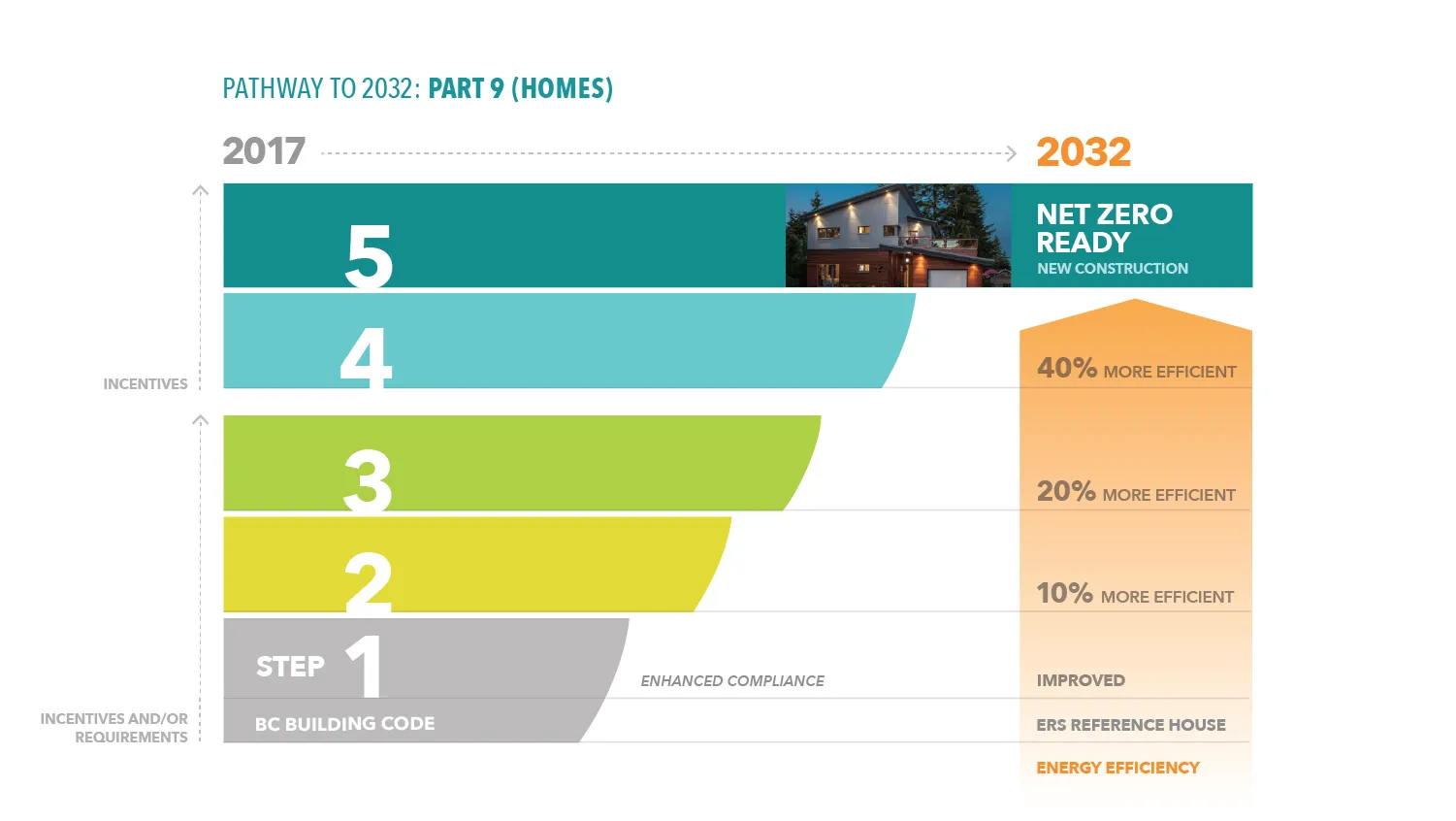
There are 5 steps in the Step Code. Step 1 is achievable with the current prescriptive building code design, good workmanship and adding on the requirement for energy modeling and conducting blower door testing on each new build. Step 5 is a “passive” building design that would see the build be net-zero ready.
Net-zero energy buildings and net-zero energy ready buildings are described as:
Net-zero energy buildings produce as much clean energy as they consume. They are up to 80 percent more energy efficient than a typical new building and use on-site (or near on-site) renewable energy systems to produce the remaining energy they need.
A Net-zero energy ready building is one that has been designed and built to a level of performance such that it could, with the addition of solar panels or other renewable energy technologies, achieve net-zero energy performance.
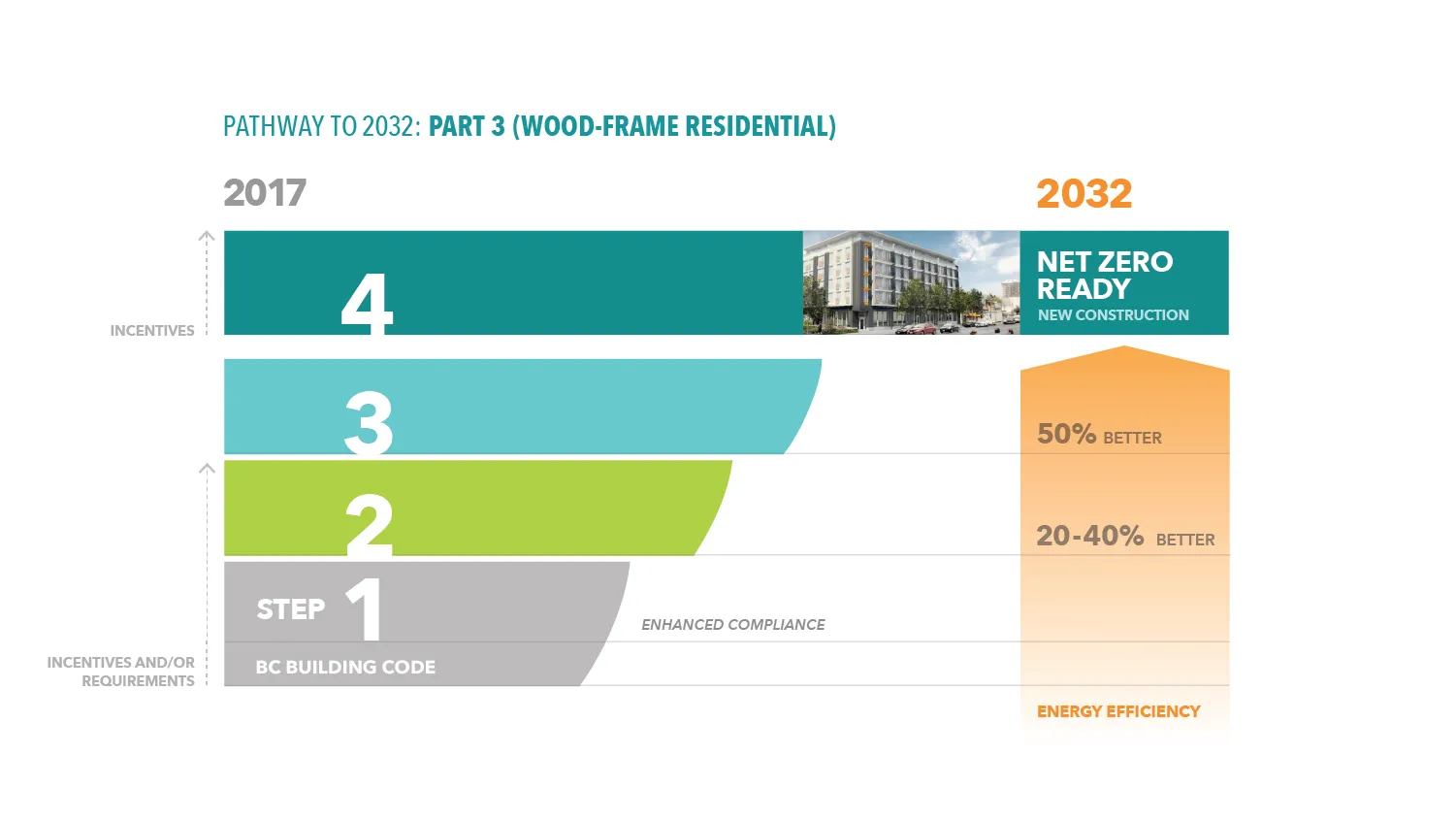
The Province is committed to make all construction in BC Net-zero ready for 2032. The steps towards this goal are:
Why do we have the Energy Step Code?
The BC Energy Step Code will provide a single standard for industry. Current practice where local governments have encouraged or required green building standards (such as LEED, Energy Star, R2000 to name a few) will become more consistent as the program is established and long-term improvements will become part of the BC Building Code.
After transportation, the heating and cooling of buildings is the second largest generator of greenhouse gases in View Royal. The Step Code requirements for new buildings to be more energy efficient will help to reduce greenhouse gas emissions and combat climate change. These results are consistent with and support the goals of the Official Community Plan and the Community Energy Emissions Plan Community Climate Action Plan.
How does the Energy Step Code work?
Rather than the current prescriptive method used in previous editions of the building code, the new 2018 building code has taken a performance-based approach. While the prescriptive method is still acceptable, builders and designers are now able to design buildings by meeting intents, and energy efficiency targets established by the Province.
Energy modeling must be used, adding the need for a certified energy advisor on the design team, taking the project from a conception to a functioning and proven energy efficient structure. Builders can now seek innovative, creative, cost effective solutions and incorporate leading edge technology as it becomes available.
Is the Step Code required?
No, the Step Code is currently a voluntary standard that builders can use when designing buildings. In addition, local governments can choose to exceed the building code and encourage or require builders to meet one or more of the steps.
When does the Step Code take effect?
Builders have had the option of voluntarily selecting a step since April 2017. Local governments were able to establish individual bylaws since December of 2017.
Conversation with Building Safety and Standards representatives at various Building Official meetings have consistently shown the Provinces intent of implementing each step through building code updates in a timeline approximately:
- Part 9 buildings: Step 3 by 2022, Step 4 by 2027, Step 5 by 2032
- Part 3 buildings: Step 2 by 2022, Step 3 by 2027, Step 4 by 2032
Part 9 buildings consist of buildings 3 story’s or less in building height, having a building area not exceeding 600m2, and used for major occupancies classified as a) Group C, residential occupancies, b) Group D, business and personal services occupancies, c) Group E, mercantile occupancies, or d) Group F, Divisions 2 and 3, medium- and low-hazard industrial occupancies.
Part 3 buildings comprise of all remaining buildings except for farm related buildings. Part 3 buildings include structures such as the Eagle Creek Development, the Town’s Fire Hall.
Steps 1 and 2 in residential construction are often already met or are only missing items such as enrolling an energy auditor as part of the team. Several builders do use blower door testing as part of other energy efficiency programs they design to which is likely why the Province will go to Step 3 as of 2022 for Part 9 buildings.
What are the implications of the Step Code?
Implications of implementing the step code prior to adoption by the building code has been discussed at length between the municipal building officials and with the Building Safety Standards representatives at numerous meetings since the inception.
Issues discussed include, but were not limited to:
- The availability and certification of trained energy advisors. It is felt that at this time there has not been adequate time to produce the number of professionals that will be required to facilitate the need created by the initiative for the Province as a whole.
- Approved documentation to be used consistently Province wide. (This issue may have been resolved as there are now forms for review and acceptance).
- Adequate training for building officials, builders and designers. While there have been sessions on what the step code will require, concern lies with having proper training established on methods that will be applied.
- Costs and cost increases. The Province has supplied estimates on what they believe will be incurred, however the two main organizations (CHBA – Canadian Home Builders Association and the VRBA – Victoria Residential Builders Association) that represent the building community have differing thoughts on these cost impacts.
- Availability of new products required to meet the higher steps. It is unknown if there has been adequate time to produce the required products for the higher steps and what impact that might have on construction timelines.
- Push back from the building community. Conversation on work sites shows differing levels of support. As it is a voluntary measure currently, it is more digestible for builders. The consensus of builders is they would prefer the initiative being driven provincially as opposed to each individual municipality establishing differing guidelines, creating a divide in standards.
- After transportation, the heating and cooling of buildings is the second largest generator of greenhouse gases in View Royal. The Step Code requirements for new buildings to be more energy efficient will help to reduce greenhouse gas emissions and combat climate change. These results are consistent with and support the goals of the Official Community Plan and the Community Energy Emissions Plan Community Climate Action Plan.
Regional response:
There have been 42 communities (see appendix A) that have implemented the step code since 2017. The following are the local communities have taken steps towards or adopted the Step Code:
- Victoria
- Saanich
- Oak Bay
- North Saanich
- Central Saanich
The remaining local governments have taken a “wait and see” type of approach. It has been discussed by the Building Officials that this should be a provincially driven approach in the interest of maintaining equal standards across communities.
Incentives used by other regions to gain buy in of the step code included reduced building permit fees, increased densities in subdivisions as well as other initiatives that would give back to the builder/developer in exchange for using the required step set by Council.
BUDGET IMPLICATIONS:
Budget implications will be impacted only by how Council would like to proceed with the initiative. Requiring step one or step two should have minimal impact on the Town, however impact to builders will show an increase to cost of construction with the need of a further consultant and possible materials.
The full financial implication cannot be known until a program is put in place and further evaluation is undertaken. Particularly if an incentive program is used to encourage voluntary Step compliance.
ALTERNATIVE RECOMMENDATION:
That Council provide direction to begin a community engagement/consultation program with a view to implementing Step 1 and 2 sooner than the provincial timeline for both Part 9 buildings, as well as Part 3 buildings.
RECOMMENDATION:
THAT the Committee recommend to Council that no adoption of any steps occur at this time and that the Step Code be allowed to occur at a pace established by the Province through the Building Code.
SUBMITTED BY: G. Faykes, Building Official REVIEWED BY: P. Hurst, Director of Protective Services
Document Images
(5)