2018 CRD Regional Growth Strategy
A regional strategy document outlining sustainable infrastructure management, housing affordability, multi-modal transportation, and economic development objectives for the Capital Regional District.
2.2 Manage Regional Infrastructure Services Sustainably
Regional infrastructure services include drinking water, liquid and solid waste. These services must be efficiently and cost-effectively managed for the long-term in order to accommodate the anticipated population increase.
The Sooke reservoir, managed and operated by the CRD, is the drinking water supply for the Capital Region. The CRD provides treated bulk water to multiple distribution systems around the region. The distribution systems differ by municipality and require ongoing cooperation for the planning and management of the service. Private wells and community water systems supply water to many residents in rural areas.
The Hartland Landfill provides solid waste disposal services for the Capital Region. The CRD sees waste as a commodity and seeks the highest and best use for these resources by applying the 5R hierarchy of Reduce, Reuse, Recycle, Resource Recovery and Residual Management. This includes a focus towards zero waste in our landfill, recycling programs, organics diversion, landfill gas capture and emerging opportunities.
The Saanich Peninsula Wastewater Treatment Plant provides secondary wastewater treatment to residents in the Saanich Peninsula. At the time of writing the Regional Growth Strategy, implementation of the Wastewater Treatment Project is underway. The project will provide tertiary wastewater treatment for residents of the core area municipalities, Colwood and Langford, and the Esquimalt and Songhees Nations. Private septic fields treat liquid waste for residents in rural areas.
Infrastructure services may be impacted not only by an increased demand for the service as the population grows, but also by the form, pattern and location of new development. Servicing new development with limited or low density, which adds fewer new users per unit length of water or sewer pipe than the system average, would generally be more expensive than in denser areas. The costs of operating and maintaining this infrastructure over its lifecycle require consideration beyond the one-time capital investment. Keeping urban settlement compact will help create the densities needed to create efficient infrastructure services. It is also necessary to acknowledge and plan for the effects of a changing climate on regional infrastructure.
Managing regional infrastructure services according to the principles below and as outlined in Objective 2.1 will help minimize social, environmental and financial costs of providing regional infrastructure.
Principles
I. Promote settlement patterns that are cost-effective and efficient to service; II. Consider the current and future costs of infrastructure design, construction, maintenance and operation when considering whether to provide for new services or extend existing services; III. Minimize negative financial impacts to those currently serviced (impacts to consider system life cycle costs); and, IV. Avoid negatively impacting the long-term availability of the service for existing development and planned growth within the Urban Containment Policy Area boundary, recognizing the impacts of climate change.
Policies
- Manage infrastructure services, including water supply and distribution, in accordance with the principles set out in Objectives 2.1 (Protect, Conserve and Manage Ecosystem Health) and 2.2 (Manage Regional Infrastructure Services Sustainably). Before approving a new water service bylaw, the full CRD Board must review the request for the new bylaw as it relates to the Regional Growth Strategy and deem the new bylaw consistent with the Regional Growth Strategy. This review is to include a detailed analysis of costs and cost recovery implications, including implications related to parcel taxes, fees, charges and grants, and subject to the principles as noted above. Full costs of water service extensions will be borne by new users. Lifecycle costs of water service extensions will be borne to the maximum extent possible by new users.
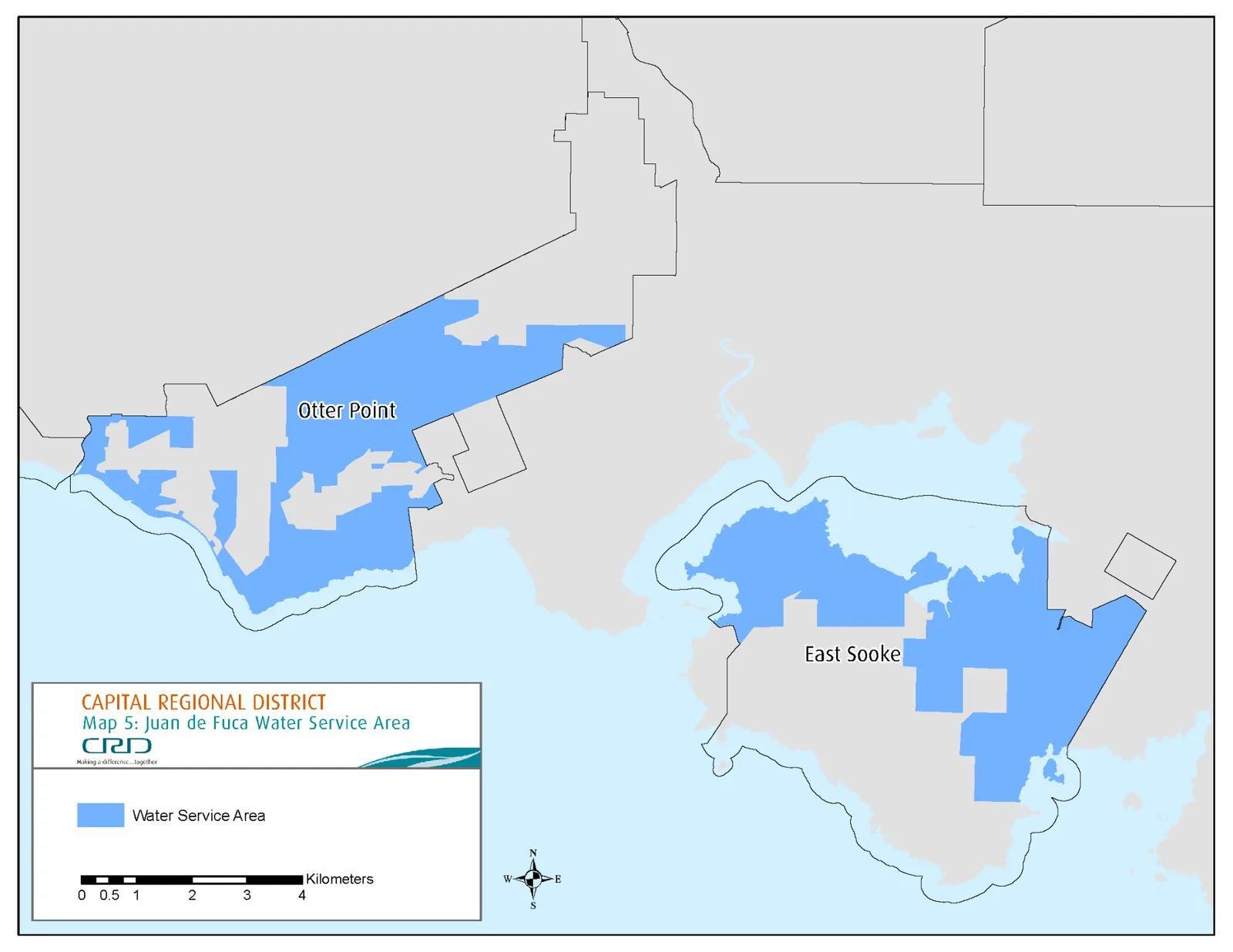
- Provide new water system services (public or private) only to areas where Official Community Plans contain strong growth management provisions and where: a. For a municipality, the areas to be serviced are shown on Map 3(a) as either Urban Containment Policy Area or Rural/Rural Residential Policy Area and the area to be serviced is consistent with Official Community Plan servicing provisions and an accepted Regional Context Statement identifies the population to be serviced and how growth in water demand will be addressed. b. For the Juan de Fuca Electoral Area outside the Urban Containment Policy Area, the areas to be serviced are limited to East Sooke and Otter Point as shown on Map 5 as within a Water Service Area, with total development of existing and new units in East Sooke and Otter Point not exceeding 3384 units. The applicable Official Community Plan must identify the population to be serviced and how growth in water demand will be addressed. c. For the Juan de Fuca Electoral Area inside the Urban Containment Policy Area, the area to be serviced is shown on Map 3(a) as Urban Containment Policy Area and the area to be serviced is consistent with Official Community Plan servicing provisions and the applicable Official Community Plan identifies the population to be serviced and how growth in water demand will be addressed.
- Notwithstanding policy 2.2(2), the CRD may extend water service if required to address a pressing public health, public safety or environmental issue relating to existing units.
- Notwithstanding policy 2.2(2), the CRD may extend water service to service agriculture. Where water service is extended to service agriculture, water service may be provided to residential units along the serviced line on lands within the Agricultural Land Reserve as long as an OCP is in place that prevents further subdivision or an increase in permitted residential density.
- Do not further extend urban sewer services outside the Urban Containment Policy Area Boundary depicted on Map 3(a).
- Notwithstanding policies 2.2(2) and 2.2(4), evaluate requests for services from jurisdictions outside of Capital Regional District membership with a view towards supporting mutually beneficial relationships and fostering development consistent with all RGS objectives and policies.
MAP 5: JUAN DE FUCA WATER SERVICE AREA
3. Housing and Community
3.1 Create Safe and Complete Communities
The Regional Growth Strategy supports the development of complete communities within the Urban Containment Policy Area that enable residents to undertake a wider range of daily activities closer to home. It does this by supporting the development of communities that offer a variety of housing types and tenures in proximity to places of work, schools, shopping, recreation, parks and green space. Complete communities provide a better balance and distribution of jobs and housing, a wider choice of affordable housing types, a better distribution of public services and more opportunity to walk, cycle, and use public transit conveniently. Complete communities, are safe, socially diverse, openly accessible, livable and attract economic investment, thereby enhancing social sustainability and health and well-being.
The characteristics of a complete community are highly dependent on context. In some locations, the addition of employment opportunities or commercial services may be required while in others it may be the provision of a greater mix of housing types. In still others, the development of a park, footpaths or cycling facilities may help create a complete community. The criteria for a complete community within the Urban Containment Policy Area are listed below. Outside the Urban Containment Policy Area, the notion of what makes a community complete may be yet different and the criteria set out for complete communities does not apply to the Rural/Rural Residential Policy Area.
Complete Communities Criteria
I. Multiple modes can be used to move to, from and within the community; II. Places of work, shopping, learning, recreation and parks and green space can be easily accessed by a ten minute walk or a fifteen minute bike ride; III. A range of housing types and tenures across the housing spectrum is available for people through all stages of their lives; and, IV. The community is demographically diverse, with a mix of people of all ages, incomes and abilities.
Lands vulnerable to natural hazards risks may be located throughout the Growth Management Planning Area. Risks may limit or eliminate development.
Policies
- Identify locations within the Urban Containment Policy Area that support the wellbeing of residents, consistent with the Complete Communities Criteria outlined in Objective 3.1, and adopt policies to direct growth to these locations.
- Create complete communities consistent with the criteria in Objective 3.1 by adopting policies, developing regulations or pursuing strategies focusing on matters such as densification, mix of uses, diverse housing types and tenures and multi-modal transportation.
- Avoid locating new development in the Growth Management Planning Area in areas with high seismic hazard associated with ground-motion amplification, liquification, slope instability or in areas prone to flooding, or incorporate appropriate engineering and planning measures to mitigate risk.
- Design, manage and construct climate change-adaptive and risk-adaptive infrastructure and utilities in the Growth Management Planning Area.
3.2 Improve Housing Affordability
Maintaining a broad range of affordable housing types and forms is necessary for individual quality of life, community health, and economic competitiveness. Central to affordability is the provision of housing along a broad spectrum that acknowledges different market and non-market tenures, ranging from shelters to social housing, assisted and market rental to home ownership.
Growth management may have mixed results for housing affordability. In urban areas, increased residential densities and an expanded stock of attached housing may enhance affordability by expanding choice and by reducing the need to rely on travel by car to reach services. In rural areas, mobile homes, secondary suites and detached accessory suites may provide more affordable housing.
Growth management measures could have the effect of limiting the supply of new lands for the urban housing market, thereby putting upward pressure on housing prices, particularly for single detached homes. The provision of affordable housing to accommodate the anticipated population increase is the responsibility of many stakeholders including the Capital Regional District, local and senior levels of government, industry and the not-for-profit sector.
The Capital Region Housing Corporation will continue to provide affordable housing to meet the needs associated with anticipated population growth, recognizing that implementation relies on funding and partnerships with other stakeholders. In addition to the provision of affordable housing, the Regional Housing Affordability Strategy has been developed to support all residents of the Capital Region – especially low and moderate-income households, the elderly, youth, those with special health and other needs, and the homeless – to have reasonable choice of housing by type, tenure, price and location. Five approaches to housing affordability underlie the Regional Housing Affordability Strategy.
Approaches to Housing Affordability
I. Work across the housing spectrum when identifying the current and anticipated future issues concerning market and non-market housing affordability for no, low and middle income and special needs households; II. Analyze the extent of present issues and forecast future problems; III. Focus on developing practical policies, and gaining commitments to action to address identified needs and problems in the short, medium and long term across the Capital Region; IV. Involve the broader community in the development of the strategy and its recommended solutions; and, V. Act as a catalyst for activities to improve housing affordability in the Capital Region.
Policies
- Provide for an adequate, accessible and diverse supply of affordable housing across the housing spectrum.
4. Transportation
4.1 Improve Multi-Modal Connectivity and Mobility
The Regional Growth Strategy supports the development of a balanced and sustainable transportation system providing residents with reasonable and affordable transportation choices that enhance overall regional quality of life. Increasing congestion and travel delays and desires for a more effective, connected, sustainable and multi-modal transportation system are of central concern to regional residents. The majority of transportation movements in the region cross municipal boundaries. Although some transportation issues can be addressed at the local level, resolution of most transportation challenges will require collaborative, multi-jurisdictional, region-wide action.
To improve multi-modal connectivity and mobility, the Regional Growth Strategy relies on two related initiatives. First, the coordination of land use and transportation so that the majority of regional residents do not have to rely solely on travel by automobile to meet their daily needs. The Regional Growth Strategy’s aim to keep urban settlement compact and build complete communities (Objectives 1.1 and 3.1) will tend to increase average urban densities and put people and their activities (homes, jobs, services) closer together. Creating communities where housing is close to activities will enhance opportunities for using walking, cycling, and public transit to meet daily needs.
Secondly, transportation choice will be enhanced with the planning, development and implementation of the Regional Multi-Modal Network identified in the Regional Transportation Plan. The Regional Transportation Plan provides actions and outcomes to develop an effective inter-municipal arterial road network that provides travel choices and supports smart growth and livable, complete communities. Implementing the Regional Multi-Modal Network is the responsibility of many actors, including the Capital Regional District, local and senior levels of government and BC Transit. Seven principles guide the Regional Transportation Plan and support the multi-modal and connected approach to transportation across the region.
Principles
I. Take a coordinated and engaged approach to transportation and land use planning; II. Prioritize strategic investments that serve regional mobility needs; III. Reduce greenhouse gas emissions and prepare for climate change; IV. Integrate transportation and land use planning; V. Capitalize on the potential for alternatives to driving alone; VI. Enhance the role for public transit; and, VII. Maximize efficiency of existing transportation corridors for multiple modes.
Policies
- Implement the Regional Transportation Plan in accordance with the principles outlined in Objective 4.1.
- Locate growth and major trip-generating uses where such can be efficiently serviced by transit and active transportation.
- Prioritize transit and active modes in community planning and in the design and implementation of infrastructure, facilities and programs.
- Advocate for improved public transit to major employment centres, complete communities and transportation hubs in the region.
5. Economic Development
5.1 Realize the Region’s Economic Potential
For residents of the Capital Region, economic prosperity is a foundation of high regional quality of life. Economic sustainability means the production and distribution of wealth to meet present and future generations’ needs for goods and services in ways that ensure the long–term promotion of a satisfying and high quality of life for all residents. A sustainable economy is one that exhibits diverse and viable economic opportunities and is resilient and responsive to changing circumstances. Further characteristics of a sustainable economy are the involvement of a broad range of parties and interests in economic decision–making and contribution to the achievement of environmental and social sustainability.
The Capital Region already has a highly diversified economy. Current strengths include the internationally significant tourism industry, agri-tourism, colleges and universities, provincial capital services and functions, major national defense headquarters and facilities, a growing high technology sector, health services, small business, environmental consulting, retirement services, the film industry and a natural environment and livable communities that attract others to live here. These advantages notwithstanding, significant regional growth management and quality of life considerations remain un-addressed.
Economic Development Considerations
I. Finding ways to achieve a minimum jobs/population ratio of: i. 0.60 in the Core Area ii. 0.53 in the Saanich Peninsula iii. 0.36 in the West Shore; II. Finding ways to work collaboratively on regional economic development considerations, including cooperation with First Nations; III. Finding ways to expand and diversify the economy of formerly resource–dependent communities in Sooke and the Juan de Fuca Electoral Area, such as through low impact recreation and tourism; IV. Finding ways to ensure the long term, affordable supply of strategic economic resources such as water, aggregate and energy; V. Finding ways to increase economic activity in forestry and agriculture including high–value and specialized agriculture and value-added forestry; VI. Finding ways to address the shortage of designated space–extensive industrial/business land in the region in locations consistent with overall goals regarding community completeness, transportation balance, and a network of major centres within an urban containment boundary; VII. Finding ways to enhance established employment centres; VIII. Finding ways to integrate high–value, clean industry and business in complete communities; IX. Finding ways to attract, develop and maintain a highly skilled workforce; and, X. Finding ways to reduce poverty in the Capital Region.
Policies
- Collaboratively build on the region’s economic, environmental and quality of life advantages to position the region as a highly desirable location for investing in existing and new businesses, working to address the economic development considerations identified in Objective 5.1.
- Provide for land development patterns that maintain an adequate supply of employment land, industrial land, transportation infrastructure and services to support a diverse regional economy.
- Prioritize the attraction of new businesses and investment that will support climate action, while supporting the retention and growth of existing businesses and economic activities in the region.
- Ensure the long–term protection of Renewable Resource Lands depicted on Maps 3(a) and 4. This could include policies aimed at buffering and land use transition between Renewable Resource Lands and settled areas (i.e., lands within the Rural/Rural Residential Land Use Policy Area as well as the Urban Containment Policy Area), and policies that support farming within the Agricultural Land Reserve, and forestry, silviculture, forestry-related industrial uses and low-impact tourism within the Private Managed Forest Land and Crown and other forest lands.
6. Food Systems
6.1 Foster a Resilient Food and Agriculture System
Food and agriculture are part of a food system which includes planting, irrigation, harvesting, processing, distribution, preparation and marketing and consumption, in addition to food waste management and soil betterments.
A viable and resilient local food and agriculture system is important to the Capital Regional District’s health, sustainability, security and visual/cultural identity.
Changes in climate, energy costs and water availability will impact agricultural production and will draw greater attention to regional food system resiliency.
The widespread impact of food and agriculture and the nature of the challenges likely to be faced in coming years make food and agriculture a matter of regional interest. Challenges include loss of farmland, lack of farm profitability and financial sustainability, increasing average age of farmers, increasing food prices, limited (72 hour) supply of fresh food in an emergency, food wastage, need to revitalize indigenous food systems, lack of knowledge of how to grow and prepare healthy food, increasing rates of food insecure people and increasing rates of diet-related chronic disease. Regional alignment will strengthen the food and agricultural sector.
The Regional Food and Agriculture Strategy recommends actions to create a viable, healthy and resilient food system. Regional Growth Strategy policies are intended to work in tandem with the Regional Food and Agriculture Strategy to guide future decisions.
Achieving a healthy, viable and resilient local food and agriculture system will require adherence to the following related principles:
Principles
I. Support First Nations food interests and rights; II. Protect and enhance the region’s food and farmlands; III. Avoid urban/agricultural land use conflict; mitigate where avoidance is not possible; IV. Enhance local food security; V. Expand food system economic opportunities; VI. Encourage food system education and agri-tourism; and, VII. Foster resiliency in the face of an unpredictable climate, increased pest resistance, and declining, increasingly expensive water and energy supplies.
Policies
- Implement initiatives in accordance with the principles outlined in Objective 6.1, based on voluntary participation of local governments in any new services.
- Enable food production, processing and distribution that will foster a place-based food economy that increases local food security.
- Support food waste management that is environmentally sustainable, benefits the regional economy and improves residents’ connections to rural and agricultural landscapes.
- Monitor the status of agricultural land, including the amount of actively farmed land, with the objective of promoting agricultural viability and food production.
7. Climate Action
7.1 Significantly Reduce Community-Based Greenhouse Gas Emissions
The Regional Growth Strategy supports the reduction of community-based greenhouse gas emissions to address the effects of a changing climate. In the Capital Region, community greenhouse gas emissions come from the transportation system, the heating, cooling and energizing of buildings, waste, energy production, the production of goods and agriculture.3
The Capital Regional District and local governments have long-standing commitments to make decisions, target investments and build capacity for reducing the use of fossil fuels and expanding the clean energy economy. Further, the Regional Growth Strategy’s aim to keep urban settlement compact, protect, conserve and manage ecosystem health, build safe and complete communities, increase transportation choice, strengthen the regional economy and foster a resilient regional food and agriculture system will support the low-carbon built form that is the foundation for reducing energy demand.
Reducing community greenhouse gas emissions requires action on many fronts and is the responsibility of many actors including the Capital Regional District, local and senior levels of government, industry, institutions, businesses and residents. It requires coordinated, consistently applied action focusing on people, land use, transportation, infrastructure and technology. Achieving community greenhouse gas reduction targets means following six related principles.
Principles
I. Create a low-carbon built form to reduce energy demand; II. Increase energy efficiency and recovery from retrofits and new development; III. Promote energy efficiency and the use of renewable, clean energy to reduce reliance on fossil fuels; IV. Protect and assess the carbon sequestration and ecosystem values of natural systems, including forested lands, agricultural lands and wetlands; V. Be resilient to climate change impacts, including climate-related natural hazards; and, VI. Promote adaptation principles of managed retreat, avoid, accommodate and protect.
3 Source: Community Energy and Emissions Inventory (CEEI). Province of BC.
Policies
- Prioritize investment that will provide for a low-carbon built form that supports efficient energy use, the provision of clean and renewable district energy, active transportation modes, transit service, and low/zero emissions vehicles.
- Design, manage and fund and operate programs, services and infrastructure to reduce greenhouse gas emissions to mitigate and adapt to climate change in keeping with the principles outlined in Objective 7.1.
- Strategically acquire protected areas that contribute to climate change mitigation.
Implementation Measures
The Capital Regional District Board, working in partnership with local municipalities, the Province, the Federal Government and others, will undertake the following implementation measures to realize the vision, objectives and policies of the Regional Growth Strategy:
I-1(a) Maintain a collaborative regional strategic planning program directed to work towards achievement of the long term objectives of the Regional Growth Strategy.
I-1(b) At least once every five years, consider whether the Regional Growth Strategy should be reviewed for possible revision and amendment.
I-2(a) Monitor, evaluate and annually report on trends and progress towards achievement of Regional Growth Strategy vision and objectives.
1-2(b) Ensure that actions are appropriate to achieve integration between the objectives and targets.
I-3(a) Prepare a Climate Action Strategy to support the implementation of community-based greenhouse gas reduction initiatives.
I-3(b) Support local governments and the Juan de Fuca Electoral Area through regional capacity building, education and projects that reduce greenhouse gas emissions.
I-4(a) Work to reach agreement with local municipalities on Regional Context Statements within two years of the adoption of the Regional Growth Strategy. Regional Context Statements, adopted within the applicable Official Community Plan, set out how each municipality will address Regional Growth Strategy objectives and policies.
I-4(b) Adopt Official Community Plans in the Juan de Fuca Electoral Area that are consistent with the Regional Growth Strategy. The Official Community Plans will identify how they are consistent with the objectives and policies of the Regional Growth Strategy.
I-5 Establish a mechanism to ensure that the vision, goals and objectives of the Regional Growth Strategy cascade to Capital Regional District plans, bylaws, services, funding applications and spending.
I-6 Coordinate the review and update of regional planning documents to inform future updates to the Regional Growth Strategy and guide CRD action on housing, transportation, regional district services, parks and natural areas and economic development. Documents may include, but are not limited to:
- Housing Affordability Strategy4
- Regional Transportation Plan
- Pedestrian and Cycling Master Plan
- Liquid Waste Management Plan
- Integrated Watershed Management Plan
- Solid Waste and Resource Management Plan
- Regional Parks Strategic Plan
- Food and Agriculture Strategy
- Climate Action Strategy
- Population, Dwelling Unit and Employment Projections5
I-7 Implement the Regional Growth Strategy without prejudice to any aboriginal rights or title that may currently exist, or be defined further through treaty or other processes. The Board will do this with the full recognition that Capital Region First Nations have asserted within their traditional territories, aboriginal rights and title and treaty rights currently undergoing formal definition through the modern treaty and other processes. The Board recognizes that First Nations Councils are neighbouring governments in the Capital Region, with a shared interest in managing long term development to enhance regional quality of life.
I-8 Coordinate with the Cowichan Valley Regional District and the Islands Trust to ensure that long term planning and development policies and initiatives in those jurisdictions are compatible with the vision and objectives of the Capital Region’s Regional Growth Strategy.
I-9 The Capital Regional District will work with the Province, agencies such as the Vancouver Island Health Authority and BC Transit, and the federal government to coordinate implementation of the Regional Growth Strategy while respecting the authority of each jurisdiction.
4 At the time of writing, the Housing Affordability Strategy is under development. 5 Population, dwelling unit and employment projections presented in Table 1 based on the 2011 Census data will be updated using the most recent census data at the time of the first update to the 2018 Regional Growth Strategy.
TABLE 2: 2038 TARGETS BY PRIORITY AREA AND OBJECTIVE
| PRIORITY AREA | OBJECTIVE | TARGETS BY 2038 |
|---|---|---|
| 1) Managing and Balancing Growth | 1.1 Keep Urban Settlement Compact | • Accommodate a minimum of 95% of the region’s new dwelling units within the Urban Containment Policy Area. |
| 1.2 Protect the Integrity of Rural Communities | ||
| 2) Environment and Infrastructure | 2.1 Protect, Conserve and Manage Ecosystem Health | • Acquire 100% of the sea-to-sea green/blue belt. • Complete 100% of the Regional Trail Network. • Reduce contaminants to fresh and marine water bodies. |
| 2.2 Deliver Services Consistent with RGS Objectives | • Prepare long-term capital plans for Capital Regional District utilities and major infrastructure improvements that take into consideration the conservation of land, water and energy resources and the impacts of climate change and natural hazards. | |
| 3) Housing and Community | 3.1 Create Safe and Complete Communities | • Municipal targets for the number of people living in complete communities to be identified by municipalities in Regional Context Statements. |
| 3.2 Improve Housing Affordability | • Increase the supply of more affordable housing. • Reduce the number of people in core housing need. • Reduce the number of people who are homeless.⁶ |
|
| 4) Transportation | 4.1 Improve Multi-Modal Connectivity and Mobility | • Achieve a transportation system that sees 42% of all trips made by walking, cycling, transit. |
| 5) Economic Development | 5.1 Realize the Region’s Economic Potential | • Achieve a jobs/population ratio of: − 0.60 in Core Area − 0.53 in Saanich Peninsula − 0.36 in West Shore |
| 6) Food Systems | 6.1 Foster a Resilient Food and Agriculture System | • Increase the amount of land in crop production for food by 5,000 ha to enhance local food security. • Municipal targets to increase the amount of land in crop production for food and to encourage agricultural land to be identified by municipalities in Regional Context Statements. |
| 7) Climate Action | 7.1 Significantly reduce community-based greenhouse gas emissions | • Reduce community greenhouse gas emissions by 33% (from 2007 levels) by 2020, and by 61% by 2038. |
⁶ Numeric targets will be identified in an updated Regional Housing Affordability Strategy. At the time of writing, the targets in the approved Regional Housing Affordability Strategy are inconsistent with the legislated timeline of the Regional Growth Strategy.