Pilot Energy Refit Program - Councillor Lemon
Excerpts from a proposal for a two-year Home Energy Retrofit Municipal Financing Pilot, originally prepared for the District of Saanich.
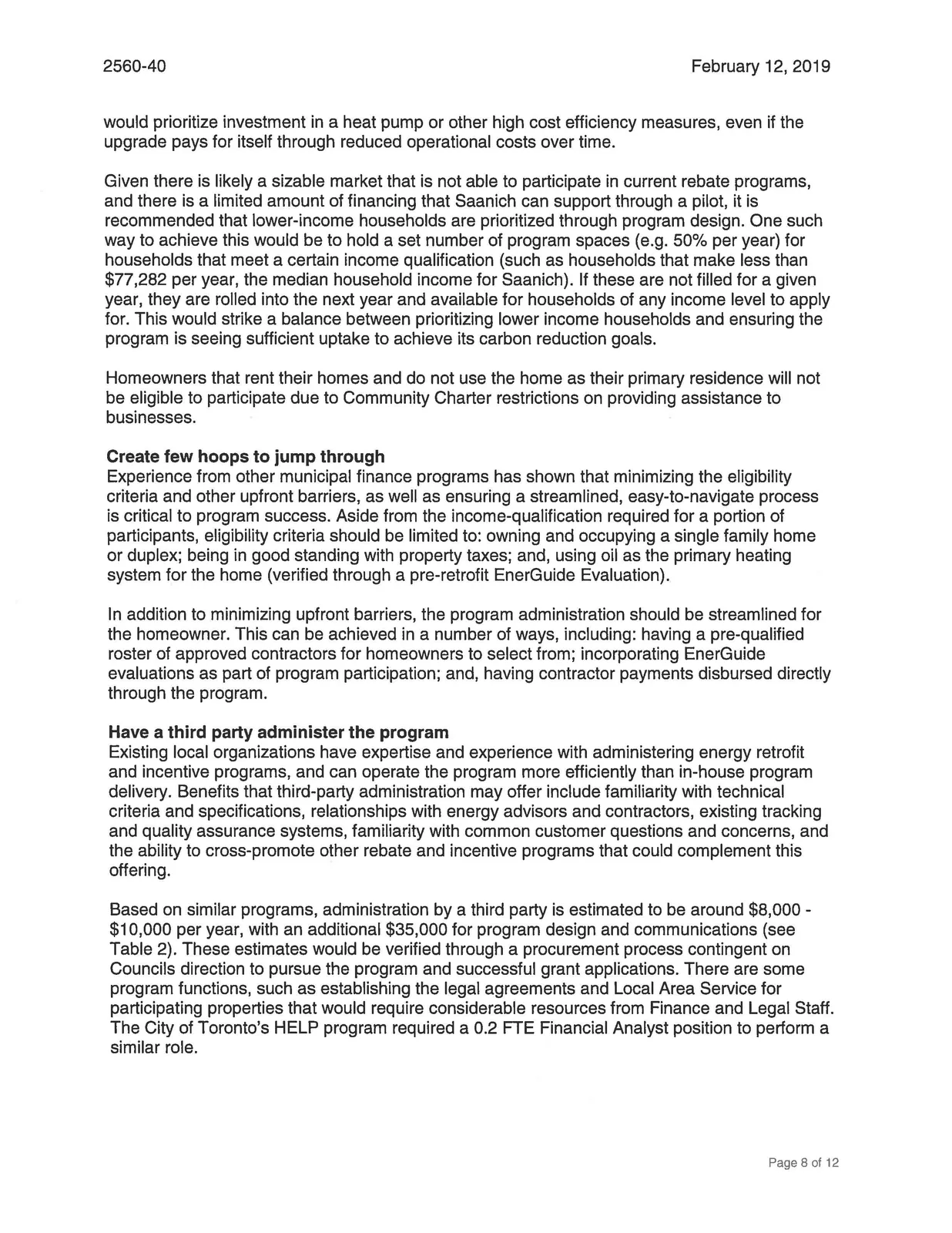
would prioritize investment in a heat pump or other high cost efficiency measures, even if the upgrade pays for itself through reduced operational costs over time.
Given there is likely a sizable market that is not able to participate in current rebate programs, and there is a limited amount of financing that Saanich can support through a pilot, it is recommended that lower-income households are prioritized through program design. One such way to achieve this would be to hold a set number of program spaces (e.g. 50% per year) for households that meet a certain income qualification (such as households that make less than $77,282 per year, the median household income for Saanich). If these are not filled for a given year, they are rolled into the next year and available for households of any income level to apply for. This would strike a balance between prioritizing lower income households and ensuring the program is seeing sufficient uptake to achieve its carbon reduction goals.
Homeowners that rent their homes and do not use the home as their primary residence will not be eligible to participate due to Community Charter restrictions on providing assistance to businesses.
Create few hoops to jump through
Experience from other municipal finance programs has shown that minimizing the eligibility criteria and other upfront barriers, as well as ensuring a streamlined, easy-to-navigate process is critical to program success. Aside from the income-qualification required for a portion of participants, eligibility criteria should be limited to: owning and occupying a single family home or duplex; being in good standing with property taxes; and, using oil as the primary heating system for the home (verified through a pre-retrofit EnerGuide Evaluation).
In addition to minimizing upfront barriers, the program administration should be streamlined for the homeowner. This can be achieved in a number of ways, including: having a pre-qualified roster of approved contractors for homeowners to select from; incorporating EnerGuide evaluations as part of program participation; and, having contractor payments disbursed directly through the program.
Have a third party administer the program
Existing local organizations have expertise and experience with administering energy retrofit and incentive programs, and can operate the program more efficiently than in-house program delivery. Benefits that third-party administration may offer include familiarity with technical criteria and specifications, relationships with energy advisors and contractors, existing tracking and quality assurance systems, familiarity with common customer questions and concerns, and the ability to cross-promote other rebate and incentive programs that could complement this offering.
Based on similar programs, administration by a third party is estimated to be around $8,000 - $10,000 per year, with an additional $35,000 for program design and communications (see Table 2). These estimates would be verified through a procurement process contingent on Councils direction to pursue the program and successful grant applications. There are some program functions, such as establishing the legal agreements and Local Area Service for participating properties that would require considerable resources from Finance and Legal Staff. The City of Toronto's HELP program required a 0.2 FTE Financial Analyst position to perform a similar role.
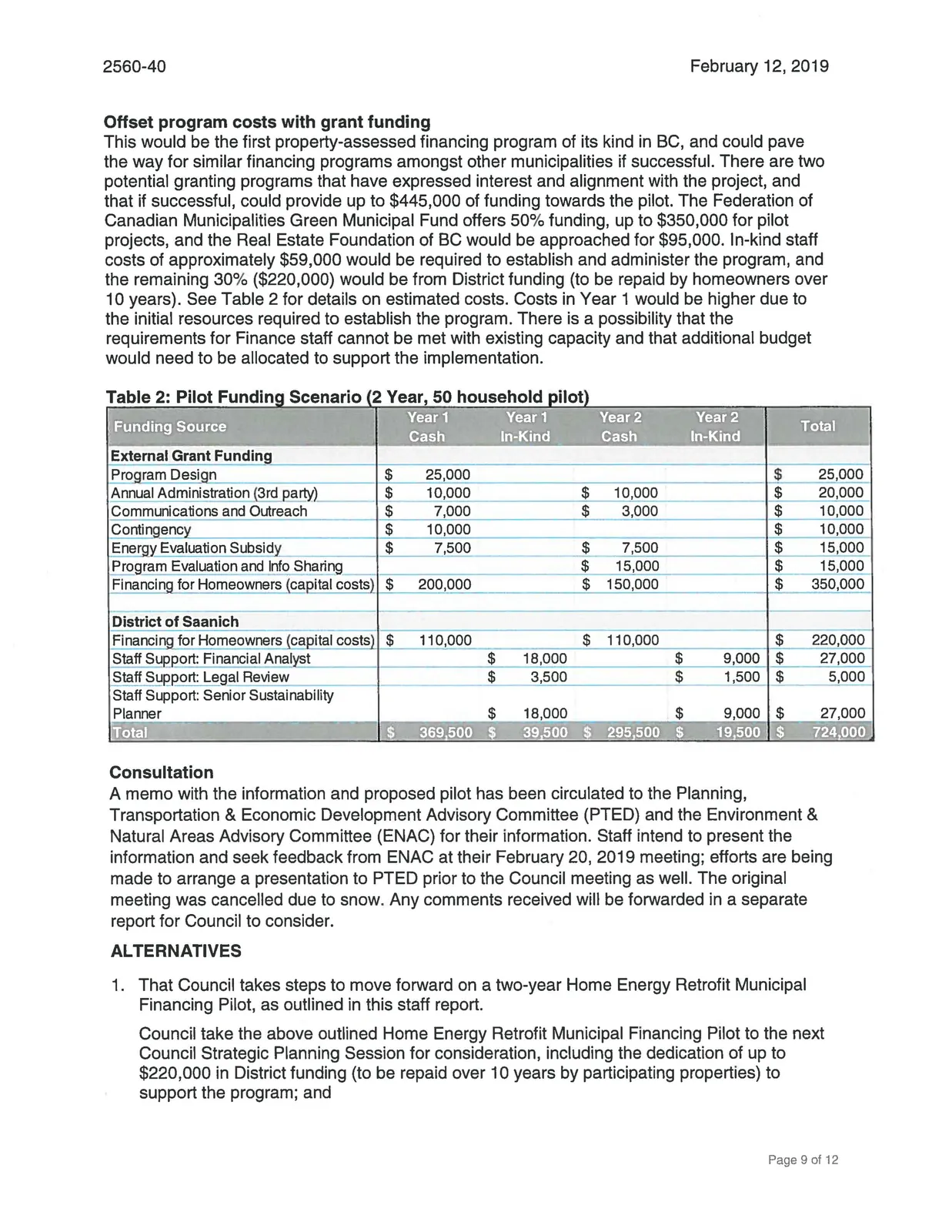
Offset program costs with grant funding
This would be the first property-assessed financing program of its kind in BC, and could pave the way for similar financing programs amongst other municipalities if successful. There are two potential granting programs that have expressed interest and alignment with the project, and that if successful, could provide up to $445,000 of funding towards the pilot. The Federation of Canadian Municipalities Green Municipal Fund offers 50% funding, up to $350,000 for pilot projects, and the Real Estate Foundation of BC would be approached for $95,000. In-kind staff costs of approximately $59,000 would be required to establish and administer the program, and the remaining 30% ($220,000) would be from District funding (to be repaid by homeowners over 10 years). See Table 2 for details on estimated costs. Costs in Year 1 would be higher due to the initial resources required to establish the program. There is a possibility that the requirements for Finance staff cannot be met with existing capacity and that additional budget would need to be allocated to support the implementation.
Table 2: Pilot Funding Scenario (2 Year, 50 household pilot)
| Funding Source | Year 1 Cash | Year 1 In-Kind | Year 2 Cash | Year 2 In-Kind | Total |
|---|---|---|---|---|---|
| External Grant Funding | |||||
| Program Design | $ 25,000 | $ 25,000 | |||
| Annual Administration (3rd party) | $ 10,000 | $ 10,000 | $ 20,000 | ||
| Communications and Outreach | $ 7,000 | $ 3,000 | $ 10,000 | ||
| Contingency | $ 10,000 | $ 10,000 | |||
| Energy Evaluation Subsidy | $ 7,500 | $ 7,500 | $ 15,000 | ||
| Program Evaluation and Info Sharing | $ 15,000 | $ 15,000 | |||
| Financing for Homeowners (capital costs) | $ 200,000 | $ 150,000 | $ 350,000 | ||
| District of Saanich | |||||
| Financing for Homeowners (capital costs) | $ 110,000 | $ 110,000 | $ 220,000 | ||
| Staff Support: Financial Analyst | $ 18,000 | $ 9,000 | $ 27,000 | ||
| Staff Support: Legal Review | $ 3,500 | $ 1,500 | $ 5,000 | ||
| Staff Support: Senior Sustainability Planner | $ 18,000 | $ 9,000 | $ 27,000 | ||
| Total | $ 369,500 | $ 39,500 | $ 295,500 | $ 19,500 | $ 724,000 |
Consultation
A memo with the information and proposed pilot has been circulated to the Planning, Transportation & Economic Development Advisory Committee (PTED) and the Environment & Natural Areas Advisory Committee (ENAC) for their information. Staff intend to present the information and seek feedback from ENAC at their February 20, 2019 meeting; efforts are being made to arrange a presentation to PTED prior to the Council meeting as well. The original meeting was cancelled due to snow. Any comments received will be forwarded in a separate report for Council to consider.
ALTERNATIVES
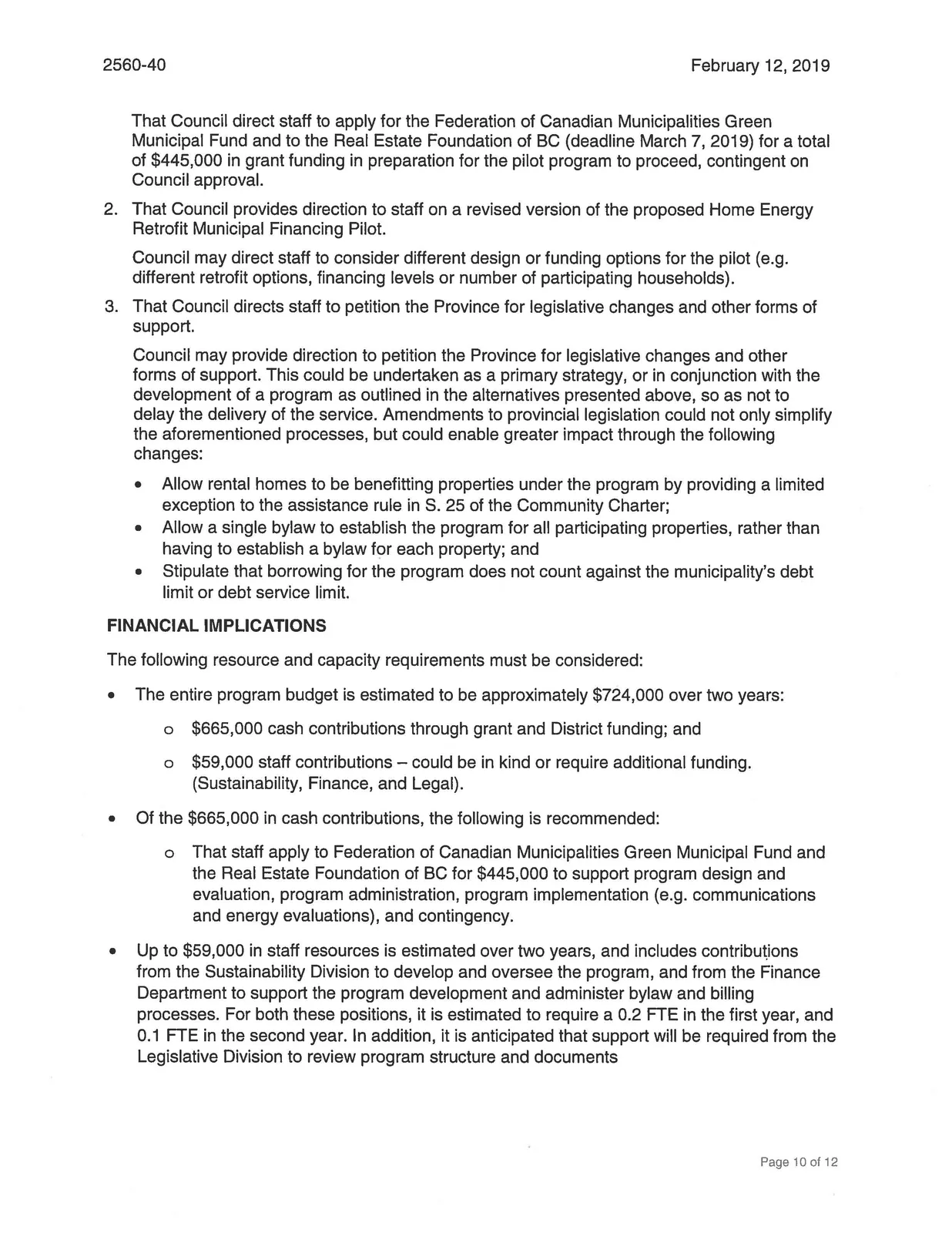
That Council takes steps to move forward on a two-year Home Energy Retrofit Municipal Financing Pilot, as outlined in this staff report.
Council take the above outlined Home Energy Retrofit Municipal Financing Pilot to the next Council Strategic Planning Session for consideration, including the dedication of up to $220,000 in District funding (to be repaid over 10 years by participating properties) to support the program; and
That Council direct staff to apply for the Federation of Canadian Municipalities Green Municipal Fund and to the Real Estate Foundation of BC (deadline March 7, 2019) for a total of $445,000 in grant funding in preparation for the pilot program to proceed, contingent on Council approval.
That Council provides direction to staff on a revised version of the proposed Home Energy Retrofit Municipal Financing Pilot.
Council may direct staff to consider different design or funding options for the pilot (e.g. different retrofit options, financing levels or number of participating households).
That Council directs staff to petition the Province for legislative changes and other forms of support.
Council may provide direction to petition the Province for legislative changes and other forms of support. This could be undertaken as a primary strategy, or in conjunction with the development of a program as outlined in the alternatives presented above, so as not to delay the delivery of the service. Amendments to provincial legislation could not only simplify the aforementioned processes, but could enable greater impact through the following changes:
- Allow rental homes to be benefitting properties under the program by providing a limited exception to the assistance rule in S. 25 of the Community Charter;
- Allow a single bylaw to establish the program for all participating properties, rather than having to establish a bylaw for each property; and
- Stipulate that borrowing for the program does not count against the municipality's debt limit or debt service limit.
FINANCIAL IMPLICATIONS
The following resource and capacity requirements must be considered:
- The entire program budget is estimated to be approximately $724,000 over two years:
- $665,000 cash contributions through grant and District funding; and
- $59,000 staff contributions - could be in kind or require additional funding. (Sustainability, Finance, and Legal).
- Of the $665,000 in cash contributions, the following is recommended:
- That staff apply to Federation of Canadian Municipalities Green Municipal Fund and the Real Estate Foundation of BC for $445,000 to support program design and evaluation, program administration, program implementation (e.g. communications and energy evaluations), and contingency.
- Up to $59,000 in staff resources is estimated over two years, and includes contributions from the Sustainability Division to develop and oversee the program, and from the Finance Department to support the program development and administer bylaw and billing processes. For both these positions, it is estimated to require a 0.2 FTE in the first year, and 0.1 FTE in the second year. In addition, it is anticipated that support will be required from the Legislative Division to review program structure and documents
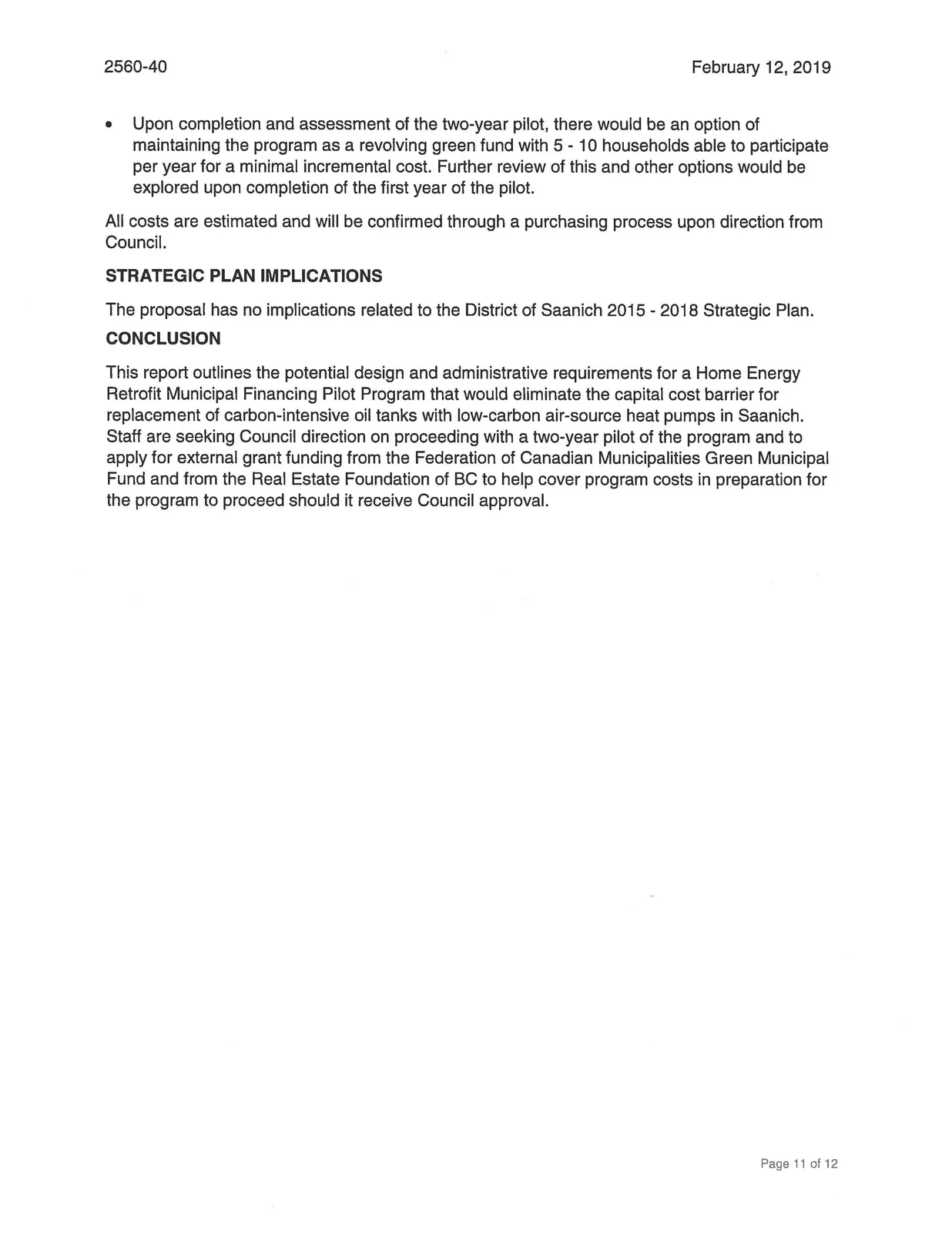
- Upon completion and assessment of the two-year pilot, there would be an option of maintaining the program as a revolving green fund with 5 - 10 households able to participate per year for a minimal incremental cost. Further review of this and other options would be explored upon completion of the first year of the pilot.
All costs are estimated and will be confirmed through a purchasing process upon direction from Council.
STRATEGIC PLAN IMPLICATIONS
The proposal has no implications related to the District of Saanich 2015 - 2018 Strategic Plan.
CONCLUSION
This report outlines the potential design and administrative requirements for a Home Energy Retrofit Municipal Financing Pilot Program that would eliminate the capital cost barrier for replacement of carbon-intensive oil tanks with low-carbon air-source heat pumps in Saanich. Staff are seeking Council direction on proceeding with a two-year pilot of the program and to apply for external grant funding from the Federation of Canadian Municipalities Green Municipal Fund and from the Real Estate Foundation of BC to help cover program costs in preparation for the program to proceed should it receive Council approval.
ADMINISTRATOR'S COMMENTS:
I endorse the recommendation from the Director of Planning and the Director of Finance.
Document Images
(5)