HART ROAD LIME KILN, VIEW ROYAL, BC GEOTECHNICAL ASSESSMENT
Assessment of the foundation support system and site geology to determine the impacts of proposed restoration and future development.
January 24, 2012
File: 19-5682-1
Donald Luxton & Associates Ltd. 1030 – 470 Granville Street Vancouver, BC V6C 1V5
Attention: Christin Doeinghaus
HART ROAD LIME KILN, VIEW ROYAL, BC GEOTECHNICAL ASSESSMENT
Dear Christin:
This letter provides our geotechnical assessment of the foundation support system for the existing historic lime kiln on Hart Road in View Royal, BC. Impacts of the proposed restoration of the kiln are also provided.
Use of this report is subject to the Statement of Limitations and Conditions, attached at the end of this letter.
1. BACKGROUND
The lime kiln is a historic structure located on Hart Road, south of Parsons Bridge, at the northwest edge of Esquimalt Harbour. The site is densely vegetated and slopes gently towards Hart Road.
The site has been recently zoned for use as a park that will be developed in the future by the Town of View Royal. It is proposed to preserve the lime kiln as a commemoration of the Town's early industrial history.
The kiln was constructed in the late 1880's and operated until the 1930's. The Hart Road lime kiln was constructed on a rubble stone foundation that varies in height up to about 2.5 m. The circular chamber above the base was constructed with bricks and clad with a metal liner. The kiln has been decaying and is now overgrown with vegetation.
2. SITE GEOLOGY
A large bedrock outcrop is present to the south and west of the site. Bedrock has also been excavated to the west of the property immediately north of the kiln site.
The bedrock in this area is mapped as a massive grey coarse-crystalline limestone typical of the Upper Triassic Age Quatsino Formation. In the greater Victoria area, the Quatsino Formation limestone outcrops as small isolated lenticular northwest-striking pockets within and adjacent to the more locally widespread Wark Gneiss.
The Quatsino Formation and Wark Gneiss are not conformable (not formed at the same time) but are separated by steeply dipping northwest-southeast trending faults. A number of the local Quatsino Formation limestone outcrops were quarried for lime and or cement production during the late 19th and into the 20th century. The previous limestone quarries at Bamberton in Saanich Inlet and at Todd Inlet (now the Butchart Gardens) are well known examples of limestone quarries in the area.
The rubble stone foundation for the kiln has been constructed with limestone blocks, likely obtained from local excavations in the area.
Overburden soils at the site are anticipated to be relatively thin (less than 1 or 2 m thick).
2. SITE INSPECTION AND INITIAL ENGINEERING ASSESSMENT
A site inspection was conducted with the design team members on January 12, 2012.
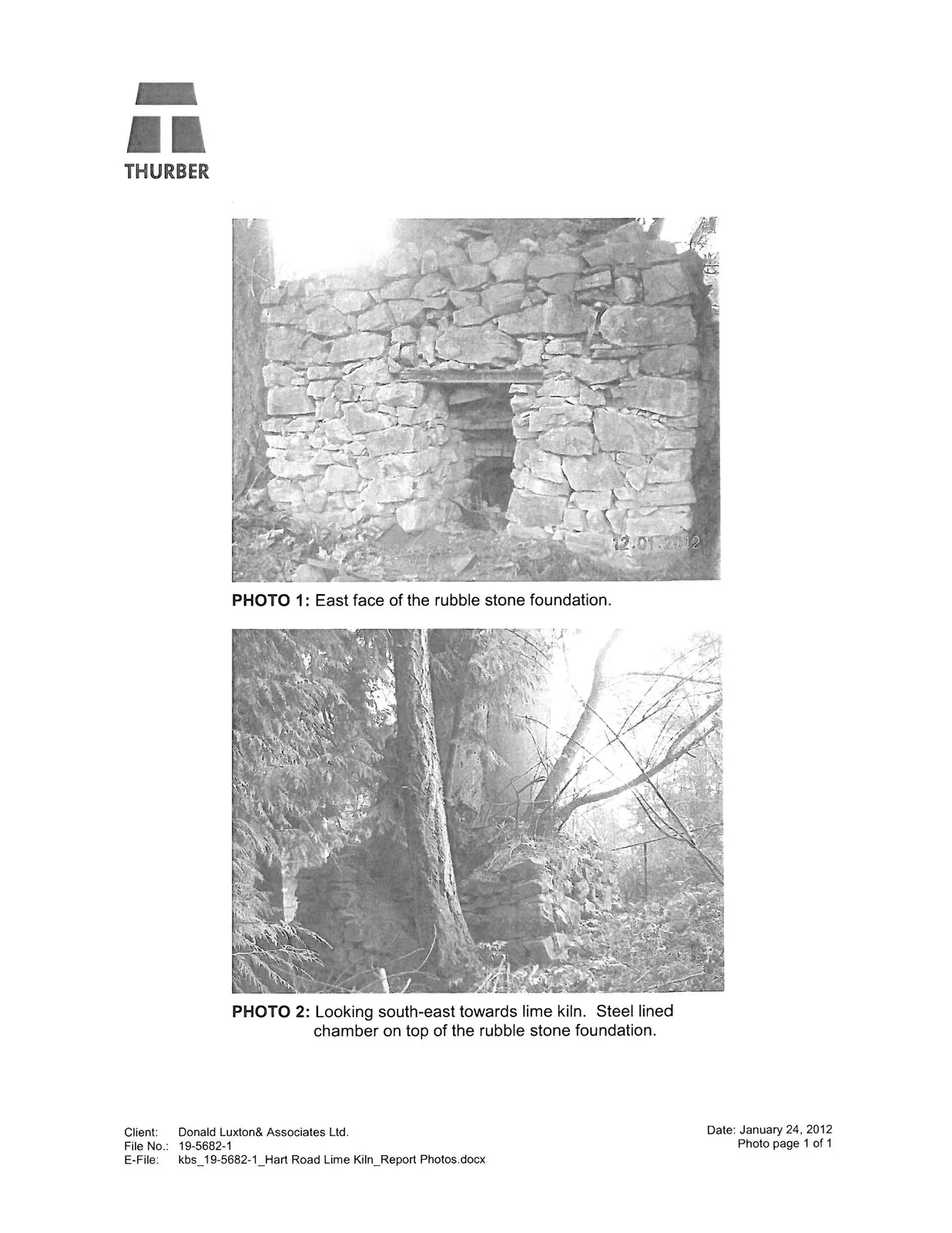
The rubble stone foundation consists of sizes generally in the order of 600 mm. It appears that the stone was originally mortared, however the mortar has eroded with time and the individual stones now generally form a rubble mound. The bricks and steel cladding above the rubble stone foundation are in poor condition. The attached Photos 1 and 2 taken by GOAL Engineering Ltd. show the rubble stone foundation.
It became evident during this site visit that preservation of the existing lime kiln would most likely consist of leaving the rubble stone foundation in place, and deconstructing the bricks and steel cladding above the foundation. From a geotechnical perspective, we agree with this approach.
The rubble stone foundation has been in place a long time and any settlement that may have occurred in the overburden soils (if present beneath the foundations) would have ceased a long time ago. Provided the reconstruction of the chamber above the rubble foundation does not result in any increase in load on the existing foundations, the risk of significant additional settlement is considered to be small.
3. BEDROCK BLASTING
A large bedrock outcrop is present to the south and west of the lime kiln site. Vibrations from blasting for future developments in this area should be controlled to reduce impacts on the kiln.
Blasts should be designed to limit peak particle velocities (ppv) to less than 15 mm/sec at the kiln. Depending on how close future blasting is carried out to the kiln, this may require the use of low weight of explosives per delay, and removal of rock in small areas at a time (shallow lifts).
The Town of View Royal should require submittal of blast plans for review prior to approving development plans in the immediate area. Blast plans should address how the blasting will be conducted to maintain vibration levels below specified criteria.
4. CLOSURE
We trust the above provides the information you require at this time. If you have any questions regarding this assessment or require further information, please contact us at your earliest convenience.
Yours truly, Thurber Engineering Ltd.
Stephen Bean, M.Eng., P.Eng. Review Principal
Kevin Sterne, M.Sc., P.Eng. Senior Geotechnical Engineer
Attachments
STATEMENT OF LIMITATIONS AND CONDITIONS
1. STANDARD OF CARE
This study and Report have been prepared in accordance with generally accepted engineering or environmental consulting practices in this area. No other warranty, expressed or implied, is made.
2. COMPLETE REPORT
All documents, records, data and files, whether electronic or otherwise, generated as part of this assignment are a part of the Report which is of a summary nature and is not intended to stand alone without reference to the instructions given to us by the Client, communications between us and the Client, and to any other reports, writings, proposals or documents prepared by us for the Client relative to the specific site described herein, all of which constitute the Report.
IN ORDER TO PROPERLY UNDERSTAND THE SUGGESTIONS, RECOMMENDATIONS AND OPINIONS EXPRESSED HEREIN, REFERENCE MUST BE MADE TO THE WHOLE OF THE REPORT. WE CANNOT BE RESPONSIBLE FOR USE BY ANY PARTY OF PORTIONS OF THE REPORT WITHOUT REFERENCE TO THE WHOLE REPORT.
3. BASIS OF REPORT
The Report has been prepared for the specific site, development, design objectives and purposes that were described to us by the Client. The applicability and reliability of any of the findings, recommendations, suggestions, or opinions expressed in the document, subject to the limitations provided herein, are only valid to the extent that this Report expressly addresses proposed development, design objectives and purposes, and then only to the extent there has been no material alteration to or variation from any of the said descriptions provided to us unless we are specifically requested by the Client to review and revise the Report in light of such alteration or variation or to consider such representations, information and instructions.
4. USE OF THE REPORT
The information and opinions expressed in the Report, or any document forming part of the Report, are for the sole benefit of the Client. NO OTHER PARTY MAY USE OR RELY UPON THE REPORT OR ANY PORTION THEREOF WITHOUT OUR WRITTEN CONSENT AND SUCH USE SHALL BE ON SUCH TERMS AND CONDITIONS AS WE MAY EXPRESSLY APPROVE. The contents of the Report remain our copyright property. The Client may not give, lend or, sell the Report, or otherwise make the Report, or any portion thereof, available to any person without our prior written permission. Any use which a third party makes of the Report, are the sole responsibility of such third parties. Unless expressly permitted by us, no person other than the Client is entitled to rely on this Report. We accept no responsibility whatsoever for damages suffered by any third party resulting from use of the Report without our express written permission.
5. INTERPRETATION OF THE REPORT
a) Nature and Exactness of Soil and Contaminant Description: Classification and identification of soils, rocks, geological units, contaminant materials and quantities have been based on investigations performed in accordance with the standards set out in Paragraph 1. Classification and identification of these factors are judgmental in nature. Comprehensive sampling and testing programs implemented with the appropriate equipment by experienced personnel, may fail to locate some conditions. All investigations utilizing the standards of Paragraph 1 will involve an inherent risk that some conditions will not be detected and all documents or records summarizing such investigations will be based on assumptions of what exists between the actual points sampled. Actual conditions may vary significantly between the points investigated and the Client and all other persons making use of such documents or records with our express written consent should be aware of this risk and this report is delivered on the express condition that such risk is accepted by the Client and such other persons. Some conditions are subject to change over time and those making use of the Report should be aware of this possibility and understand that the Report only presents the conditions at the sampled points at the time of sampling. Where special concerns exist, or the Client has special considerations or requirements, the Client should disclose them so that additional or special investigations may be undertaken which would not otherwise be within the scope of investigations made for the purposes of the Report.
b) Reliance on Provided Information: The evaluation and conclusions contained in the Report have been prepared on the basis of conditions in evidence at the time of site inspections and on the basis of information provided to us. We have relied in good faith upon representations, information and instructions provided by the Client and others concerning the site. Accordingly, we cannot accept responsibility for any deficiency, misstatement or inaccuracy contained in the Report as a result of misstatements, omissions, misrepresentations, or fraudulent acts of the Client or other persons providing information relied on by us. We are entitled to rely on such representations, information and instructions and are not required to carry out investigations to determine the truth or accuracy of such representations, information and instructions.
c) Design Services: The Report may form part of the design and construction documents for information purposes even though it may have been issued prior to the final design being completed. We should be retained to review the final design, project plans and documents prior to construction to confirm that they are consistent with the intent of the Report. Any differences that may exist between the report recommendations and the final design detailed in the contract documents should be reported to us immediately so that we can address potential conflicts.
d) Construction Services: During construction we must be retained to provide field reviews. Field reviews consist of performing sufficient and timely observations of encountered conditions to confirm and document that the site conditions do not materially differ from those interpreted conditions considered in the preparation of the report. Adequate field reviews are necessary for Thurber to provide letters of assurance, in accordance with the requirements of many regulatory authorities.
6. RISK LIMITATION
Geotechnical engineering and environmental consulting projects often have the potential to encounter pollutants or hazardous substances and the potential to cause an accidental release of those substances. In consideration of the provision of the services by us, which are for the Client's benefit, the Client agrees to hold harmless and to indemnify and defend us and our directors, officers, servants, agents, employees, workmen and contractors (hereinafter referred to as the "Company") from and against any and all claims, losses, damages, demands, disputes, liability and legal investigative costs of defence, whether for personal injury including death, or any other loss whatsoever, regardless of any action or omission on the part of the Company, that result from an accidental release of pollutants or hazardous substances occurring as a result of carrying out this Project. This indemnification shall extend to all Claims brought or threatened against the Company under any federal or provincial statute as a result of conducting work on this Project. In addition to the above indemnification, the Client further agrees not to bring any claims against the Company in connection with any of the aforementioned causes.
7. SERVICES OF SUBCONSULTANTS AND CONTRACTORS
The conduct of engineering and environmental studies frequently requires hiring the services of individuals and companies with special expertise and/or services which we do not provide. We may arrange the hiring of these services as a convenience to our Clients. As these services are for the Client's benefit, the Client agrees to hold the Company harmless and to indemnify and defend us from and against all claims arising through such hirings to the extent that the Client would incur had he hired those services directly. This includes responsibility for payment for services rendered and pursuit of damages for errors, omissions or negligence by those parties in carrying out their work. In particular, these conditions apply to the use of drilling, excavation and laboratory testing services.
8. CONTROL OF WORK AND JOBSITE SAFETY
We are responsible only for the activities of our employees on the jobsite. The presence of our personnel on the site shall not be construed in any way to relieve the Client or any contractors on site from their responsibilities for site safety. The Client acknowledges that he, his representatives, contractors or others retain control of the site and that we never occupy a position of control of the site. The Client undertakes to inform us of all hazardous conditions, or other relevant conditions of which the Client is aware. The Client also recognizes that our activities may uncover previously unknown hazardous conditions or materials and that such a discovery may result in the necessity to undertake emergency procedures to protect our employees as well as the public at large and the environment in general. These procedures may well involve additional costs outside of any budgets previously agreed to. The Client agrees to pay us for any expenses incurred as the result of such discoveries and to compensate us through payment of additional fees and expenses for time spent by us to deal with the consequences of such discoveries. The Client also acknowledges that in some cases the discovery of hazardous conditions and materials will require that certain regulatory bodies be informed and the Client agrees that notification to such bodies by us will not be a cause of action or dispute.
9. INDEPENDENT JUDGEMENTS OF CLIENT
The information, interpretations and conclusions in the Report are based on our interpretation of conditions revealed through limited investigation conducted within a defined scope of services. We cannot accept responsibility for independent conclusions, interpretations, interpolations and/or decisions of the Client, or others who may come into possession of the Report, or any part thereof, which may be based on information contained in the Report. This restriction of liability includes but is not limited to decisions made to develop, purchase or sell land.
Document Images
(5)