View Royal Lime Kiln Restoration Tree Issues
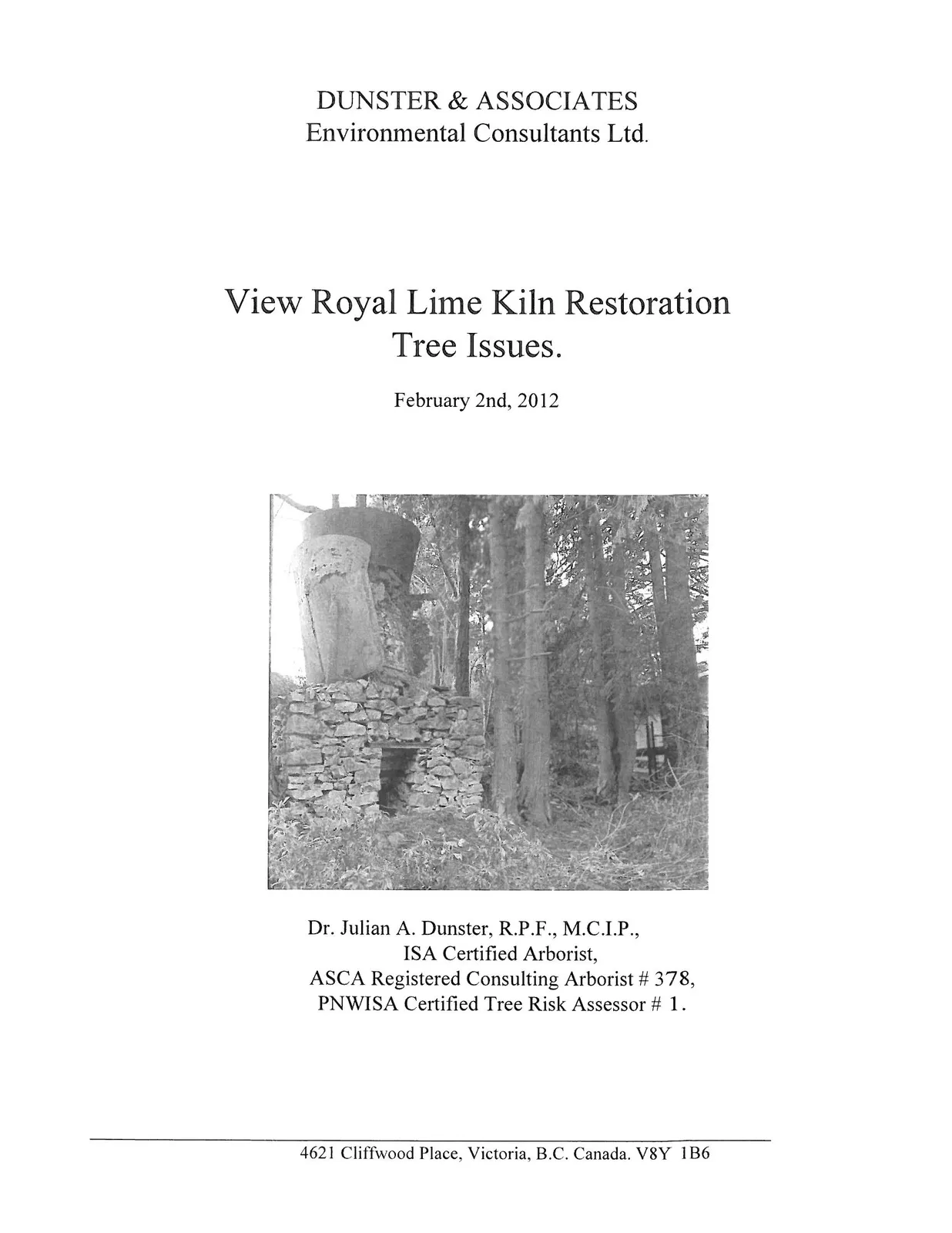
Arborist report evaluating the impact of trees growing on or near the kiln structure and providing recommendations for their removal or preservation.
View Royal Lime Kiln Restoration Tree Issues
February 2nd, 2012
Dr. Julian A. Dunster, R.P.F., M.C.I.P., ISA Certified Arborist, ASCA Registered Consulting Arborist # 378, PNWISA Certified Tree Risk Assessor # 1.
4621 Cliffwood Place, Victoria, B.C. Canada. V8Y 1B6
Background
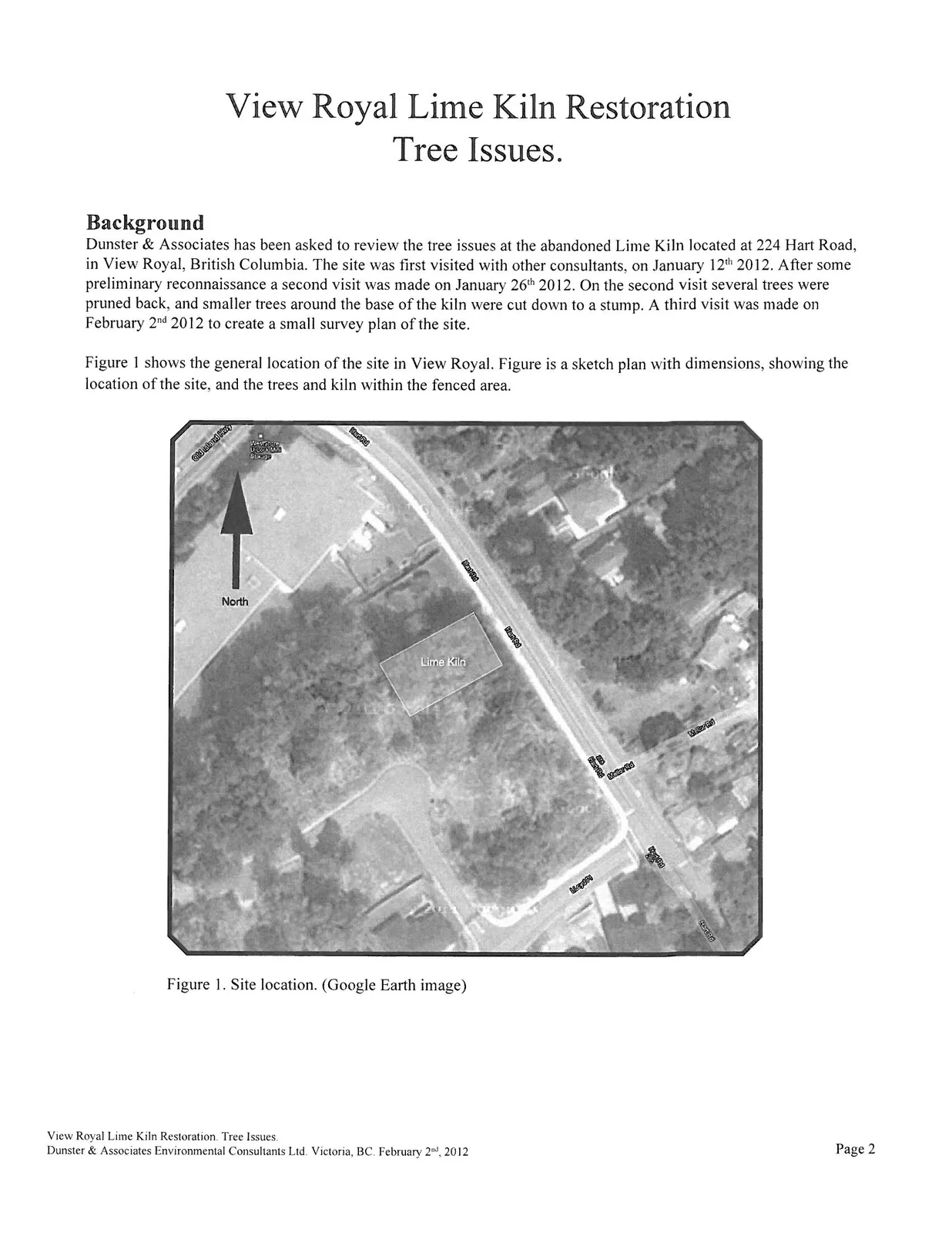
Dunster & Associates has been asked to review the tree issues at the abandoned Lime Kiln located at 224 Hart Road, in View Royal, British Columbia. The site was first visited with other consultants, on January 12th 2012. After some preliminary reconnaissance a second visit was made on January 26th 2012. On the second visit several trees were pruned back, and smaller trees around the base of the kiln were cut down to a stump. A third visit was made on February 2nd 2012 to create a small survey plan of the site.
Figure 1 shows the general location of the site in View Royal. Figure is a sketch plan with dimensions, showing the location of the site, and the trees and kiln within the fenced area.
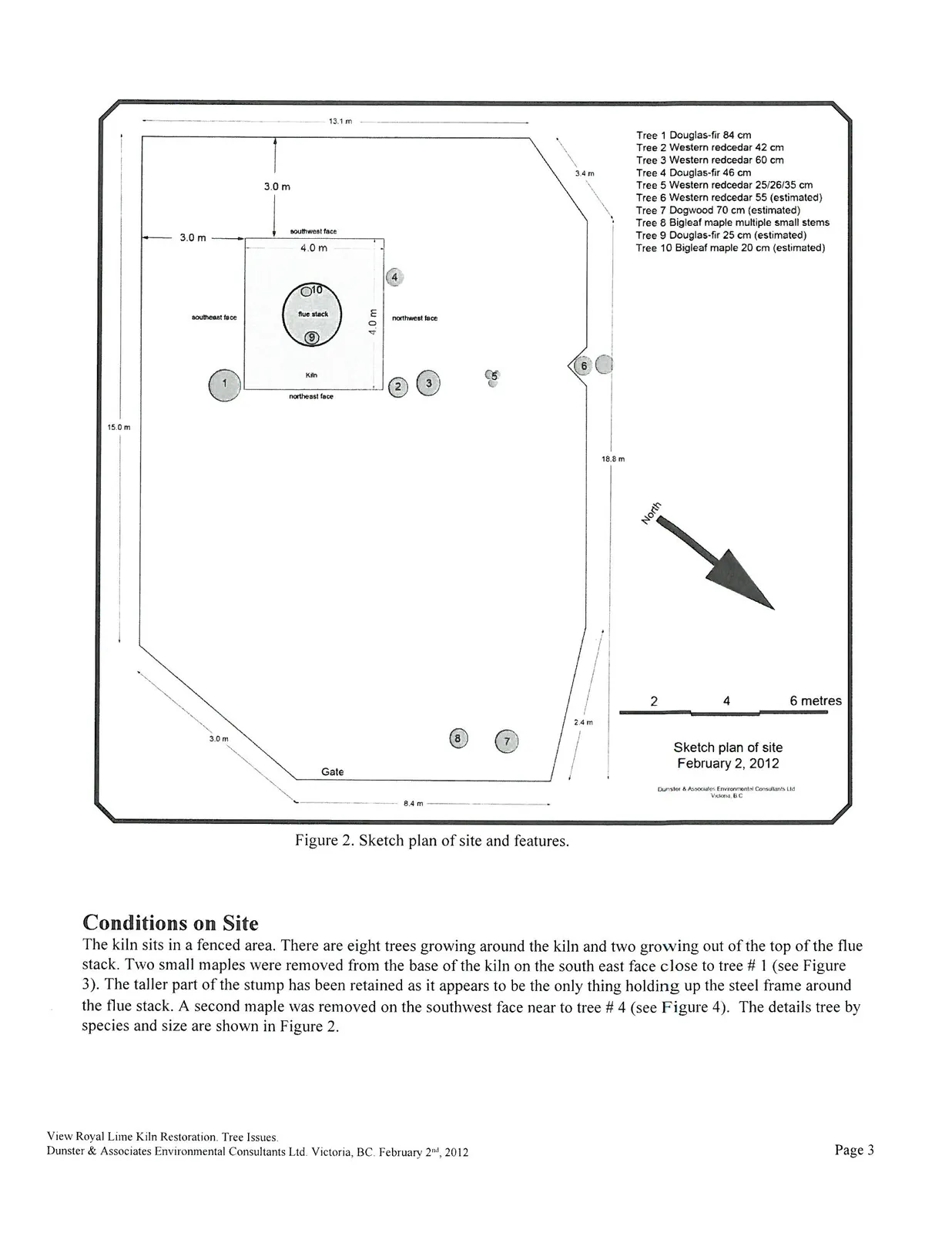
Tree List from Figure 2:
- Tree 1: Douglas-fir 84 cm
- Tree 2: Western redcedar 42 cm
- Tree 3: Western redcedar 60 cm
- Tree 4: Douglas-fir 46 cm
- Tree 5: Western redcedar 25/26/35 cm
- Tree 6: Western redcedar 55 (estimated)
- Tree 7: Dogwood 70 cm (estimated)
- Tree 8: Bigleaf maple multiple small stems
- Tree 9: Douglas-fir 25 cm (estimated)
- Tree 10: Bigleaf maple 20 cm (estimated)
Conditions on Site
The kiln sits in a fenced area. There are eight trees growing around the kiln and two growing out of the top of the flue stack. Two small maples were removed from the base of the kiln on the south east face close to tree # 1 (see Figure 3). The taller part of the stump has been retained as it appears to be the only thing holding up the steel frame around the flue stack. A second maple was removed on the southwest face near to tree # 4 (see Figure 4). The details tree by species and size are shown in Figure 2.
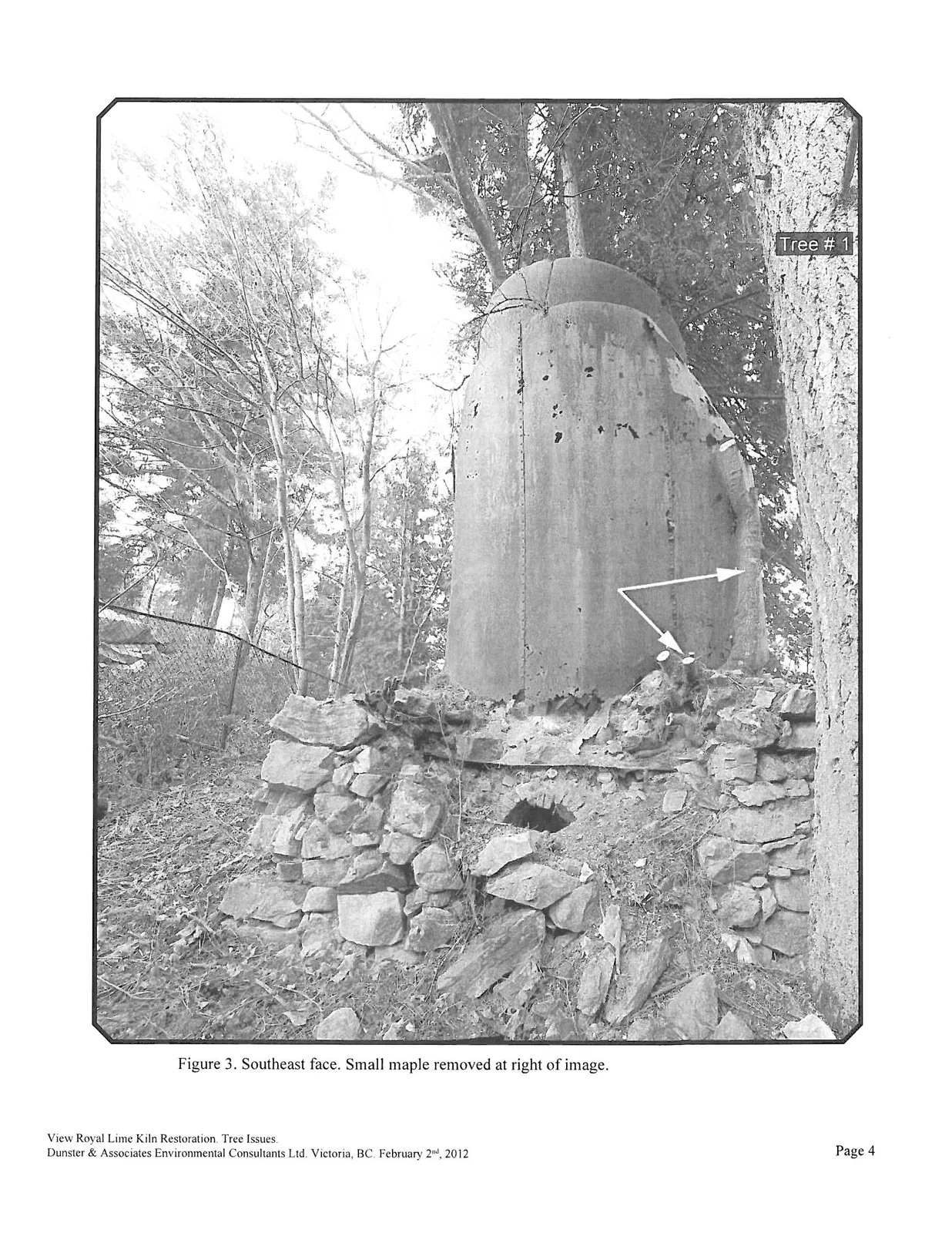
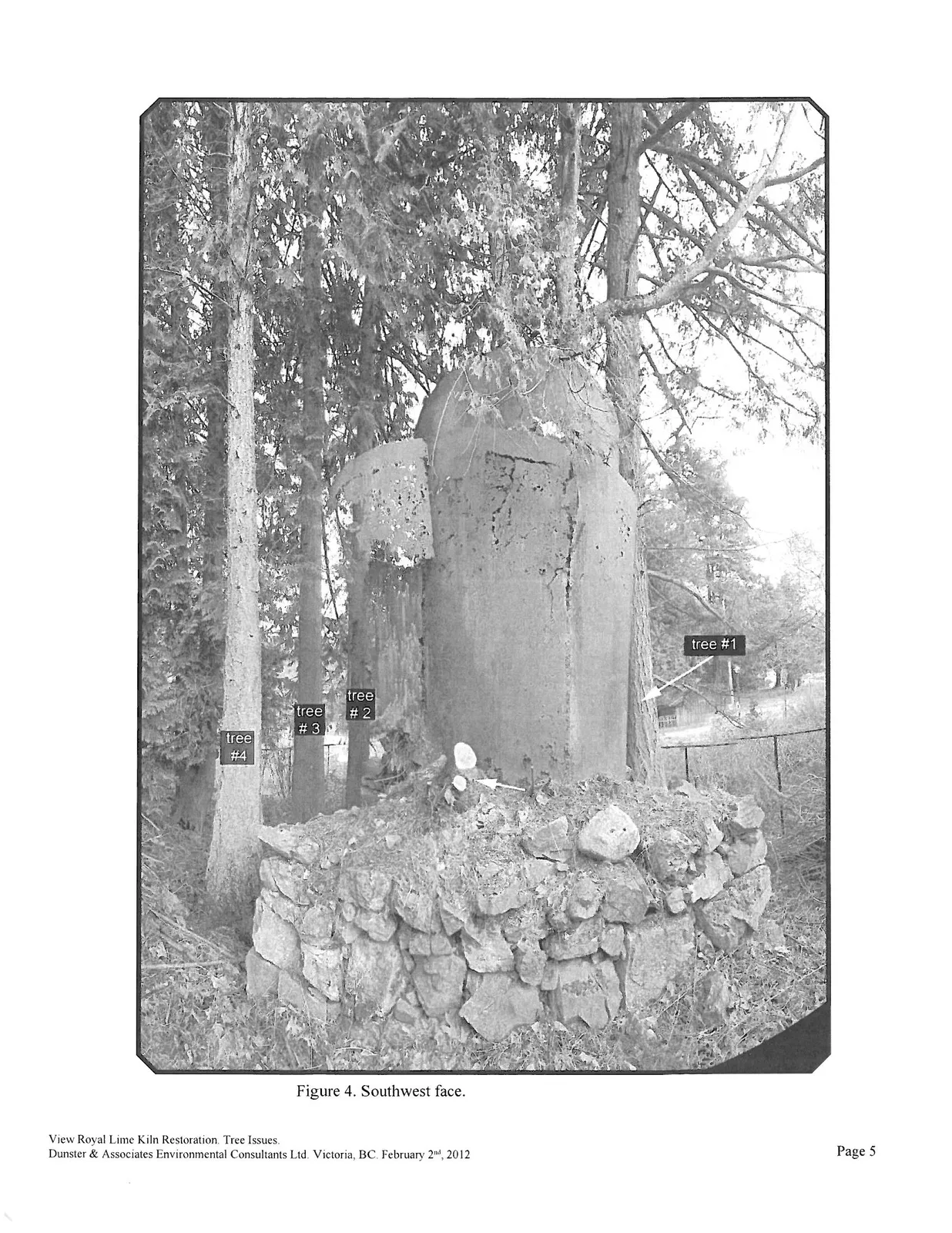
Figure 5 is a view of the northwest face showing tree # 4. Figure 6 shows the northeast face.
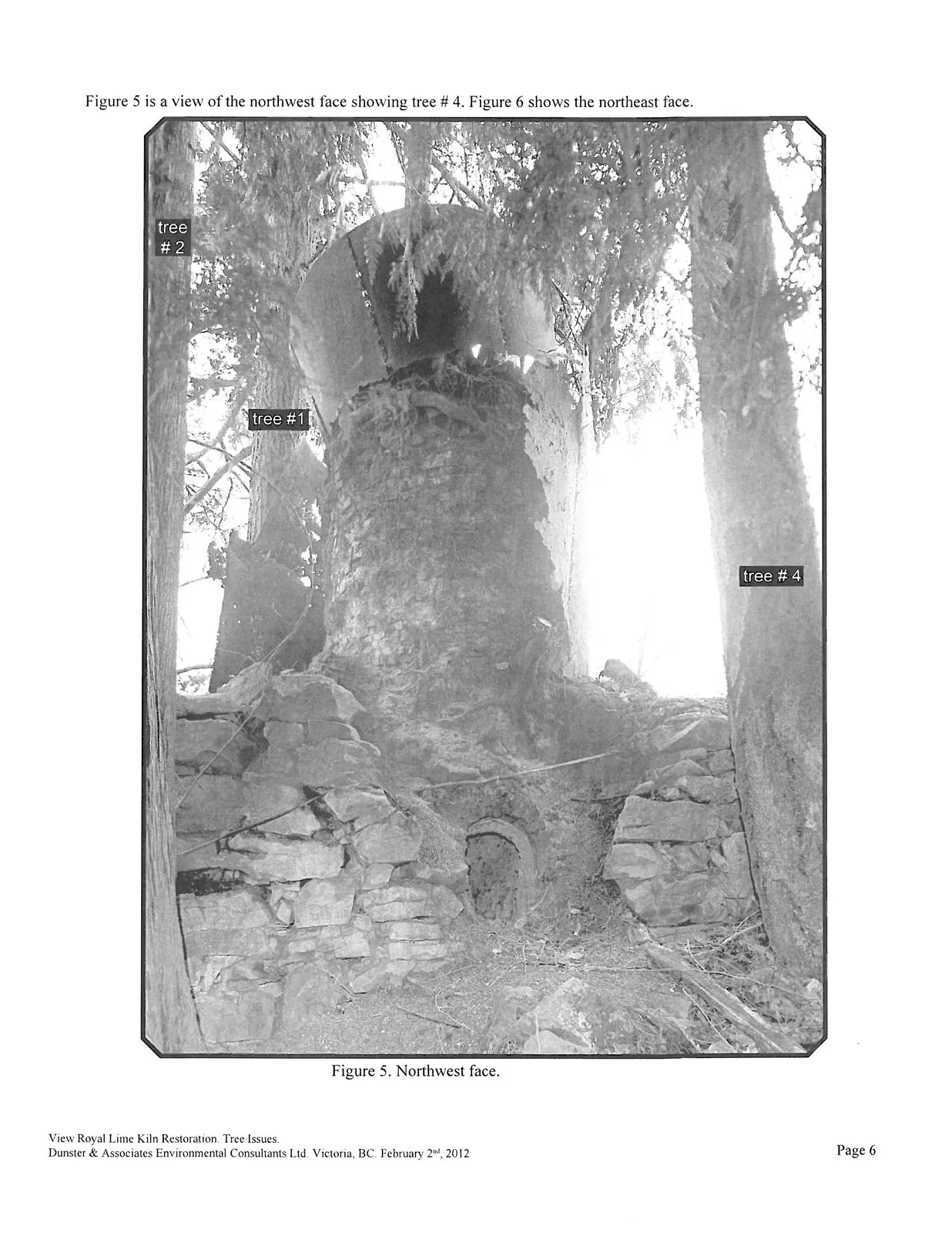
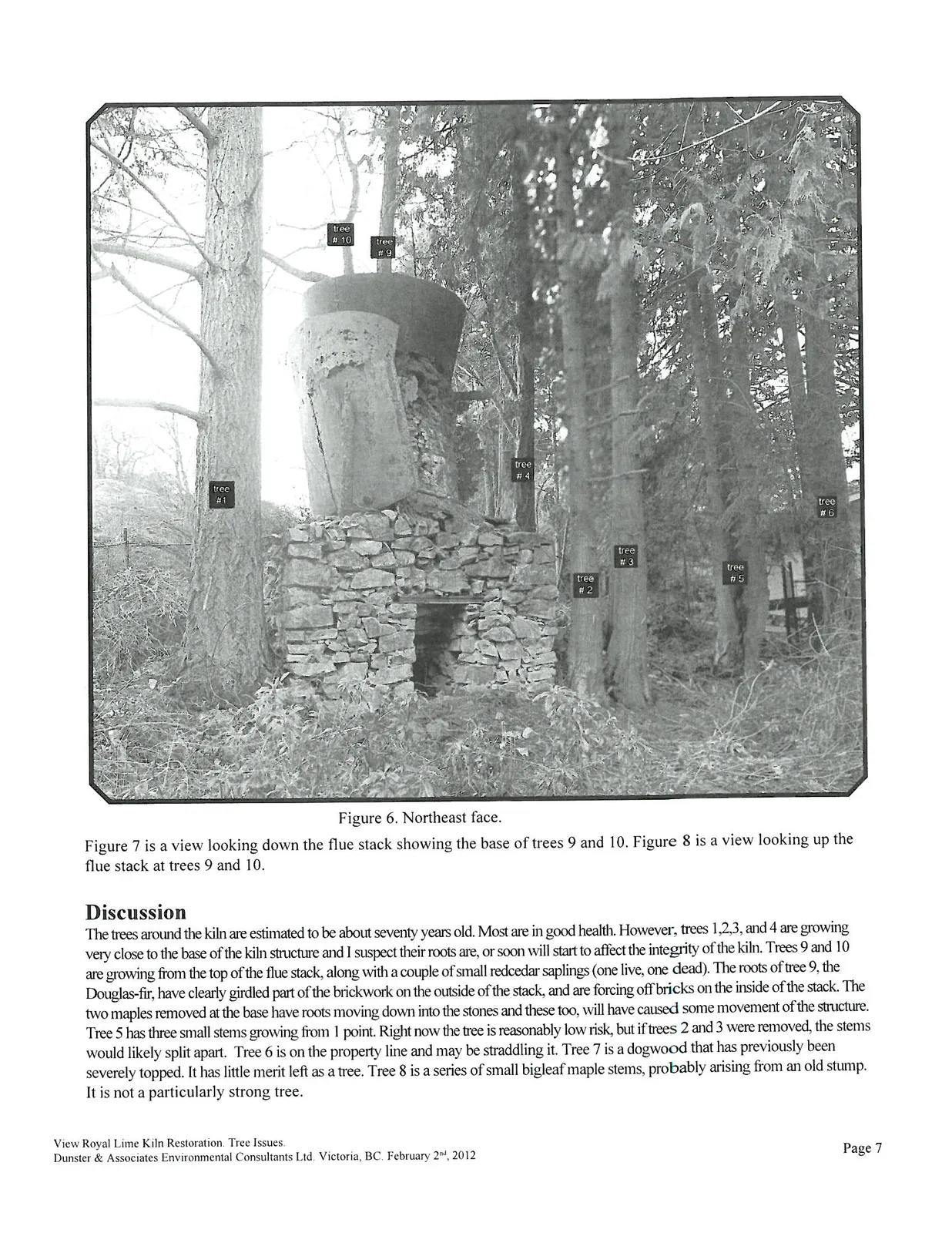
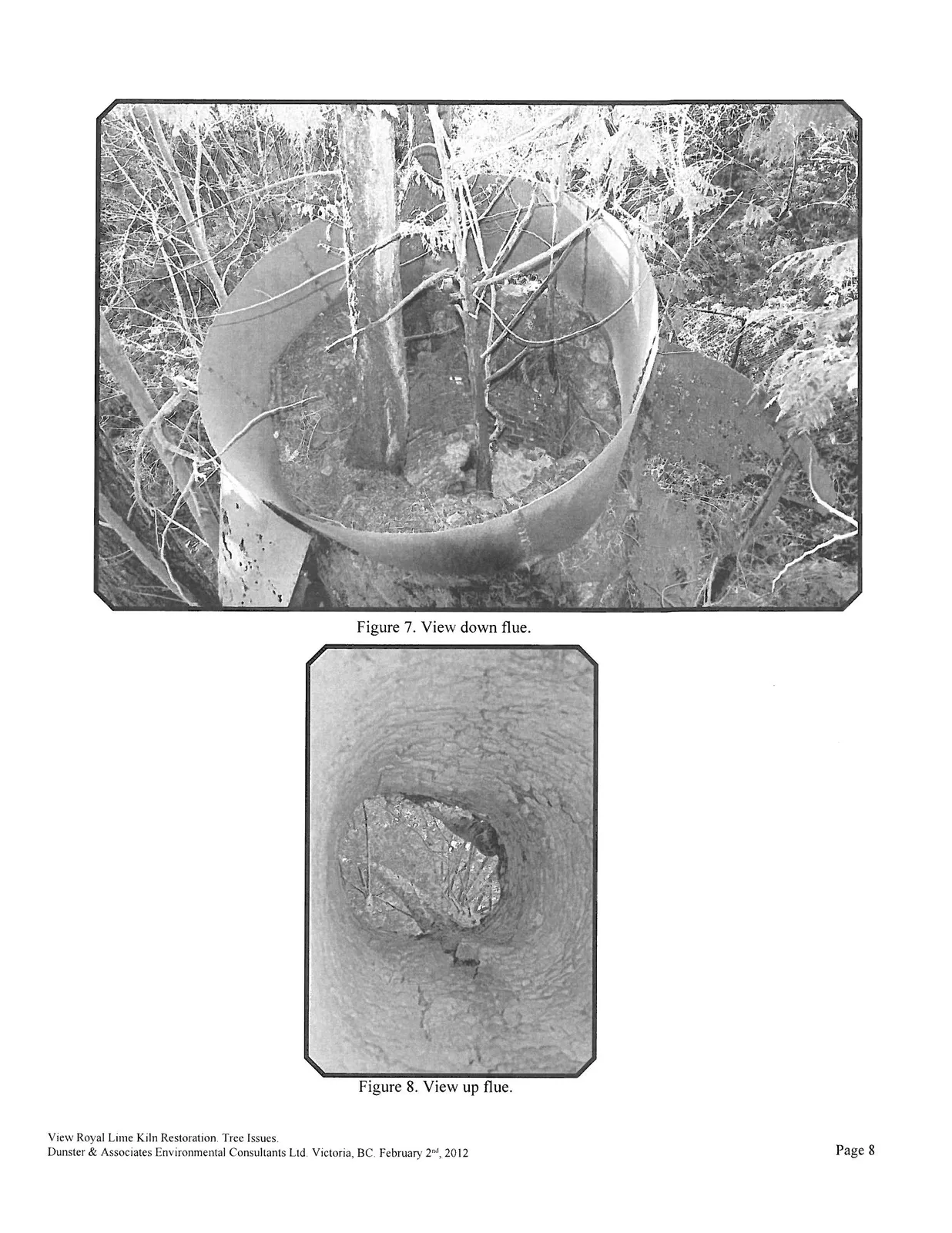
Figure 7 is a view looking down the flue stack showing the base of trees 9 and 10. Figure 8 is a view looking up the flue stack at trees 9 and 10.
Discussion
The trees around the kiln are estimated to be about seventy years old. Most are in good health. However, trees 1,2,3, and 4 are growing very close to the base of the kiln structure and I suspect their roots are, or soon will start to affect the integrity of the kiln. Trees 9 and 10 are growing from the top of the flue stack, along with a couple of small redcedar saplings (one live, one dead). The roots of tree 9, the Douglas-fir, have clearly girdled part of the brickwork on the outside of the stack, and are forcing off bricks on the inside of the stack. The two maples removed at the base have roots moving down into the stones and these too, will have caused some movement of the structure. Tree 5 has three small stems growing from 1 point. Right now the tree is reasonably low risk, but if trees 2 and 3 were removed, the stems would likely split apart. Tree 6 is on the property line and may be straddling it. Tree 7 is a dogwood that has previously been severely topped. It has little merit left as a tree. Tree 8 is a series of small bigleaf maple stems, probably arising from an old stump. It is not a particularly strong tree.
Recommendations
If the kiln is to be retained in some form, then trees 1,2,3,4,5, 9, and 10 all need to be removed. Assuming that some new landscaping would be installed, I would also suggest removing trees 7 and 8. Tree 6 is close to or straddles the property line. It may be feasible to retain that tree, but it would require a further assessment once other trees have been removed, before I can evaluate its health and risk.
Removing trees 9 and 10 from the top of the flue stack will require considerable care and skill to avoid damaging the kiln structure, and ensure worker safety. I would be pleased to organise and supervise that work when it arises. All of the trees will need to be removed in pieces to avoid damaging the kiln. The roots of the small maples recently cut down will need to be removed by hand, although that may be simple enough if a few of the rocks can be simply moved and then replaced.
The flue stack is not very stable and is shedding bricks on the inside and outside. Likewise, the steel plates around the outer side of the stack are not well attached and largely held in place by the tall stump of the maple, near to tree # 1. Before any further work is done on site, the steel plates should be strapped up with one or two ropes so that a) they cannot fall off, and b) any loose materials such as bricks on the inside of the steel plates and outside of the stack, can also be held in place. I recommend that this step is implemented right away.
If the top steel collar of the flue stack is wanted for the restoration, or as a template for that, it may be wise to cut it off and move it out of the way after the lower steel has been strapped. Removal of the two trees on the top of the stack will require a slow and very safe approach because there is some chance that the entire stack could collapse. I don't think that is a big risk at the moment, but it does need to be considered.
Once the trees have been removed from the flue stack, and the other trees nearby have been cut down, then the steel plates can be removed and other work on the kiln can proceed as deemed necessary by the heritage team.
Conclusions
There are ten trees documented on site, two of which grow from the top of the flue stack. If the Lime Kiln is to be retained and restored in some form, nine of the trees should be removed, with the tenth (tree # 6) being subject to review once other clearing is completed.
On Behalf of Dunster & Associates Environmental Consultants Ltd.
Dr. Julian A. Dunster, R.P.F., M.C.I.P., ISA Certified Arborist ASCA Registered Consulting Arborist # 378 PNWISA Certified Tree Risk Assessor #1
Date. February 2nd 2012