Town of View Royal, Statement of Significance, 2010: ALL SAINTS ANGLICAN CHURCH
Heritage assessment detailing the history, architectural features, and community significance of All Saints Anglican Church.
Town of View Royal, Statement of Significance, 2010
ALL SAINTS ANGLICAN CHURCH
287 Pallisier Avenue, View Royal, British Columbia
Owner: Anglican Synod Diocese of British Columbia Legal Description: Lot A, Block 9, Plan 1688, Section 8, Esquimalt Land District Architect: J.H. Wilson Date: 1955
Description of Historic Place
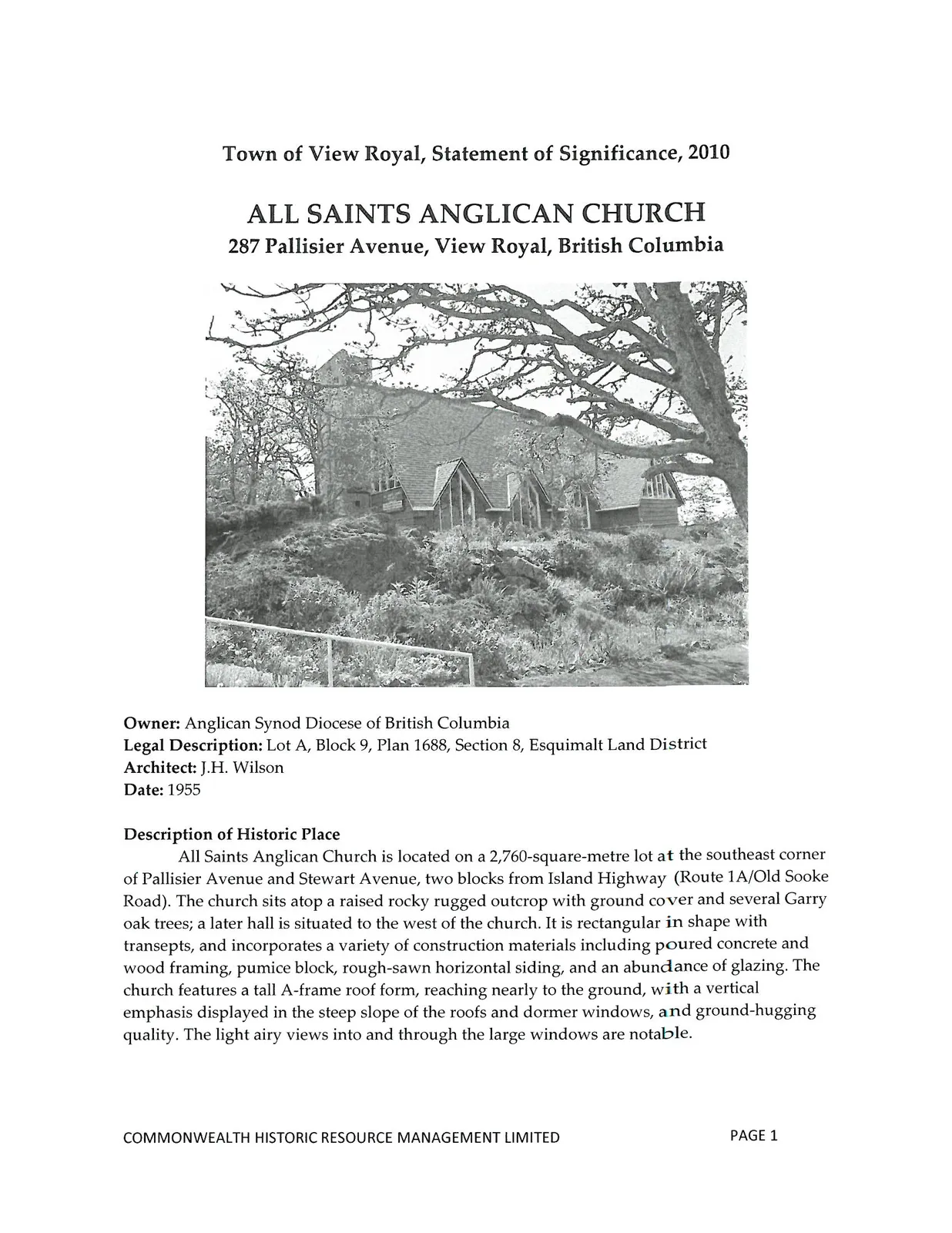
All Saints Anglican Church is located on a 2,760-square-metre lot at the southeast corner of Pallisier Avenue and Stewart Avenue, two blocks from Island Highway (Route 1A/Old Sooke Road). The church sits atop a raised rocky rugged outcrop with ground cover and several Garry oak trees; a later hall is situated to the west of the church. It is rectangular in shape with transepts, and incorporates a variety of construction materials including poured concrete and wood framing, pumice block, rough-sawn horizontal siding, and an abundance of glazing. The church features a tall A-frame roof form, reaching nearly to the ground, with a vertical emphasis displayed in the steep slope of the roofs and dormer windows, and ground-hugging quality. The light airy views into and through the large windows are notable.
Heritage Value of Historic Place
All Saints Anglican Church, built in 1955, is of historic value as a tangible expression of Greater Victoria’s tremendous growth and suburban expansion after World War II, between 1946 and 1966 when Victoria’s population doubled. The return of veterans, a pent-up wartime demand for adequate housing, the creation of new families, and the widespread ownership of automobiles all contributed to unprecedented growth during these two booming decades.
All Saints Anglican Church also represent innovations in building materials and practices and accompanying modern architectural designs. This new type of post-war construction discarded traditional architectural styles and replaced it with less expensive materials, simple construction methods and expressive of new technology. Victoria and View Royal readily accepted these contemporary building materials and modern styles of architecture. All Saints Anglican Church mirrors these broader patterns of architectural shifts taking place throughout Victoria, while at the same time, the modern A-frame form was ideally suited to perpetuate the vertical emphasis featured in the Gothic Revival style associated with Anglican Church architecture.
All Saints Anglican Church possesses social-cultural value as well. Located in the middle of a residential neighbourhood south of a major transportation corridor, the church has been a magnet to groups of diverse ages and interests in the community. With the completion of the parish hall in 1962, the church continued to hold social and fund-raising activities such as bazaars, teas and dinners, and lectures and concerts. The church has served as a gathering place for local residents and a symbol of neighbourhood identity for many decades.
Character-Defining Elements
- siting on a rocky outcrop shaded by Garry oak trees;
- continuous use as a church;
- rectangular shape with transepts;
- various building materials such as poured concrete, wood, pumice block and rough-sawn wooden siding;
- bell tower at the front with cross outlined in brick;
- vertical emphasis of the steeply-pitched roofs and wall dormers combined with a ground-hugging quality created by roof eaves descending nearly to the ground;
- light airy quality of the church created by the multiple large windows in the dormers and the gable ends; and
- interior ceiling and walls of unpainted angled wood boards.
Document Images
(1)