Statement of Significance – Atkins Lime Kiln, Hart Road
A detailed heritage profile of the Atkins Lime Kiln on Hart Road, documenting its construction, history in the lime industry, and character-defining elements.
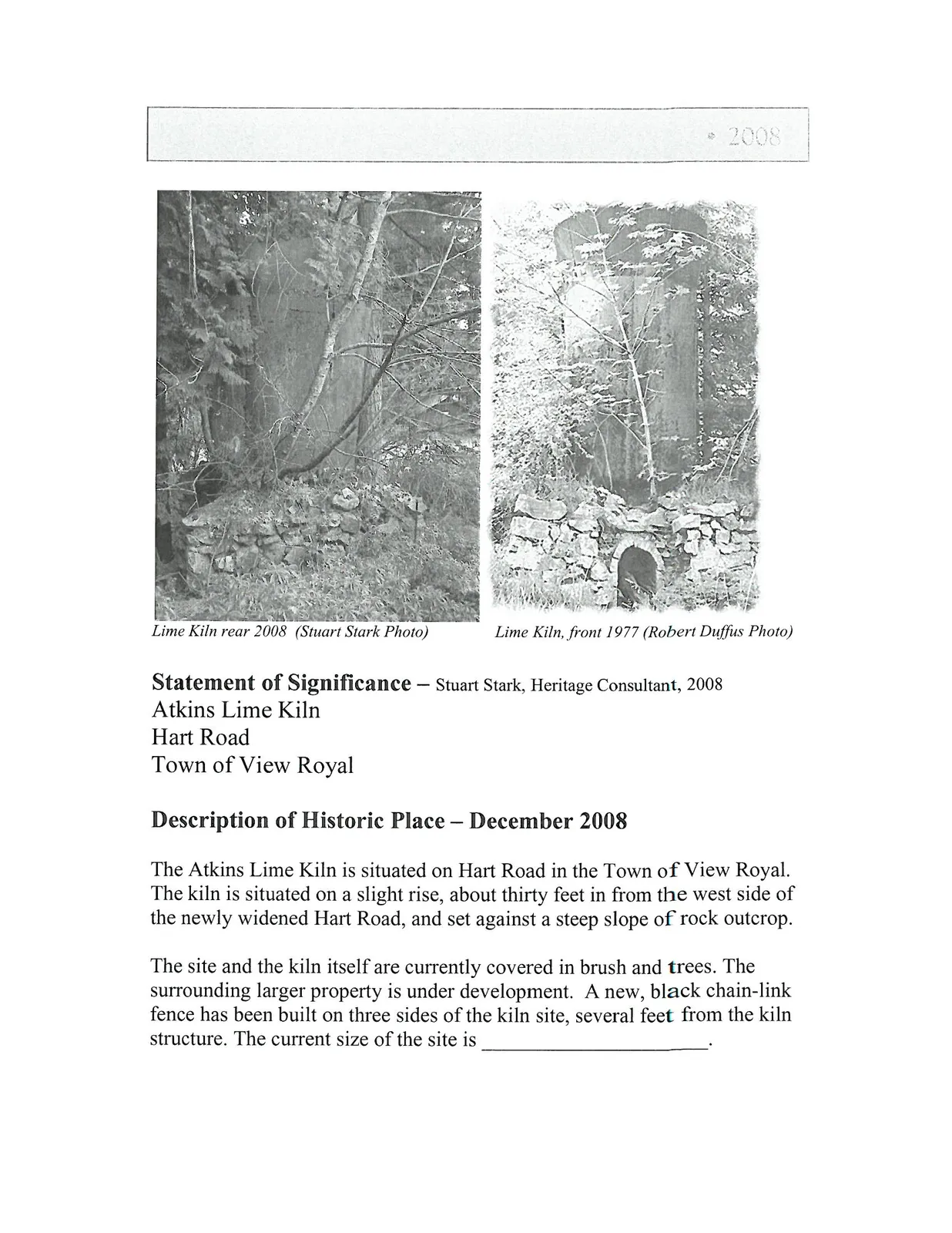
Lime Kiln rear 2008 (Stuart Stark Photo) Lime Kiln, front 1977 (Robert Duffus Photo)
Statement of Significance – Stuart Stark, Heritage Consultant, 2008
Atkins Lime Kiln
Hart Road Town of View Royal
Description of Historic Place – December 2008
The Atkins Lime Kiln is situated on Hart Road in the Town of View Royal. The kiln is situated on a slight rise, about thirty feet in from the west side of the newly widened Hart Road, and set against a steep slope of rock outcrop.
The site and the kiln itself are currently covered in brush and trees. The surrounding larger property is under development. A new, black chain-link fence has been built on three sides of the kiln site, several feet from the kiln structure. The current size of the site is _______________________.
The kiln, reportedly constructed in the late 1880’s, is a type known as a “vertical lime kiln”. The kiln is formed of two distinct parts: a rubble stone base about 12 feet square varying in height from 4’ to 8’, and an upper circular brick structure clad in sheet metal about 14’ in height.
The kiln was abandoned in the 1930’s, is derelict and requires conservation.
The lime kiln has been recognized for its heritage value by the Town of View Royal which has planned for its preservation by the site being dedicated as parkland from the larger surrounding development.
Heritage Significance
This lime kiln is valued as the only surviving remnant of a once important industry owned and operated by the local Atkins family. The kiln reportedly dates from the late 1880’s.
Lime kilns had been established in greater Victoria as early as 1852 by Kenneth Mackenzie at Craigflower Farm. Others were established in Victoria Harbour, Esquimalt Harbour, and at Brentwood (now Butchart Gardens), as well as at nearby Parson’s Bridge and in the Highlands, where the stone base of another kiln is beside the Municipal office.
This kiln is the only remaining part of a larger works on this site, which included a quarry, the wooden trestle that led to the top of the funnel from the quarry above, a brick-making shed and a platform at the front of the kiln where the lime and bricks were loaded onto wagons. A nearby dock provided easy access to shipping both the lime and bricks.
The kiln itself was used to burn limestone to make ‘quicklime’ (or calcium oxide). After it cooled, the ‘quicklime’ was drawn out of the base of the kiln through draw-holes, ground into a powder and packed in barrels for sale for use as mortar and plaster.
As a unique survivor of a near-intact lime kiln in Greater Victoria, this kiln is valued for its rarity, and as an example of the utilitarian construction of the kiln itself. It is further valued as a tangible example of an early local industry using local materials - limestone and either coal or wood for fuel - to make products that made construction of permanent brick and stone buildings and chimneys possible on Vancouver Island.
The location of the kiln is further valued as the reason for much of the residential development and construction in the immediate area, including houses on Hart Road for members of the Atkins family, the moving of the Atkins house from Atkins Road to become ‘Val’s Antiques’ beside Parson’s Bridge, as well as the carriage house at the rear of the antique shop fronting on Hart Road. An associated ship landing dock was at the base of Mellor Road (now Mellor Park).
Character-Defining Elements
- The size and scale of the lime kiln.
- The location of the kiln against the rocky hillside which expresses its relationship to the quarry above and the former shipping dock.
- The materials – stone, brick and metal cladding – that were used to build it.
- The rustic quality of the stonework of the base of the kiln.
- The three draw-holes in the stone base where the quicklime was extracted from the kiln
- The small, double metal doors on the main draw-hole
- The open nature of the base of the kiln, which can be seen through the draw holes.
- The remains of other features indicated by metal brackets, supports, etc.
- The metal cladding on the upper brick parts of the kiln, and its method of construction, joints, type of metal, size of metal plates etc.
- The brick lining of the stone base and the brick lining of the upper part of the kiln, the type and size of bricks and method and placement of laying.
- The remains of ash in the surrounding soil as an indication of the historic activity at the site.
Associated people of significance to the site
The Atkins family who owned the property as well as other nearby industry, including brick-works and other lime kilns in the area
Associated documents, reports or information sources relating to the site and their locations
- Hart Road Lime Kiln: Information supporting Historical Significance. A binder of associated research collected by Councillor John Rogers
- Telephone interview with Kerry Sutton, 715 Lorimer, 250-474-4122 (a twenty year employee of the Atkins family) who described the site and the date of the site.
- 1975 Photograph of the lime kiln, courtesy of Maureen Duffus.
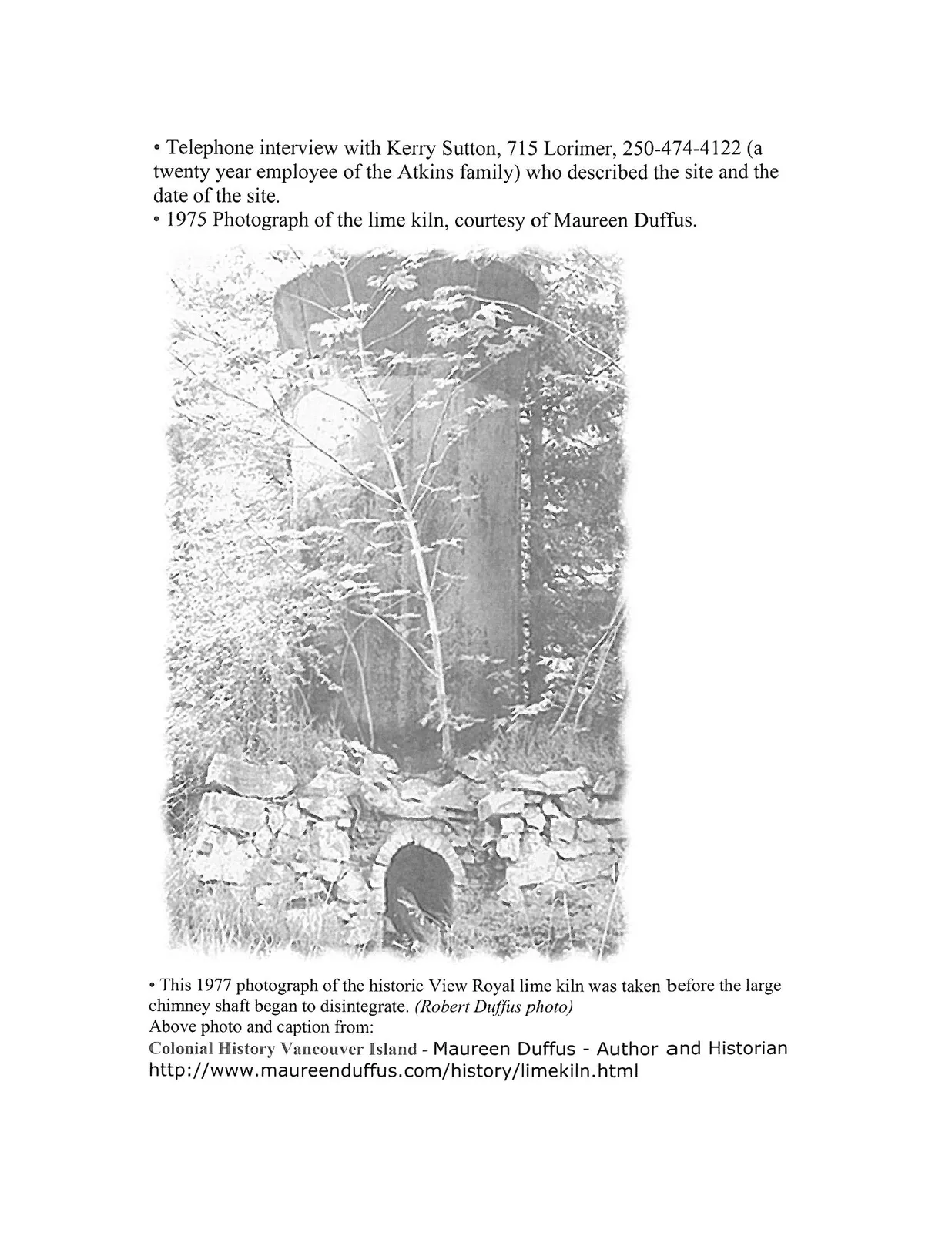
- This 1977 photograph of the historic View Royal lime kiln was taken before the large chimney shaft began to disintegrate. (Robert Duffus photo)
Above photo and caption from: Colonial History Vancouver Island - Maureen Duffus - Author and Historian http://www.maureenduffus.com/history/limekiln.html
Document Images
(2)