VIEW ROYAL LIME KILN HERITAGE CONSERVATION PLAN TERMS OF REFERENCE - REQUEST FOR PROPOSALS
Draft request for proposals outlining the requirements for professional consultants to prepare a heritage conservation plan for the Lime Kiln.
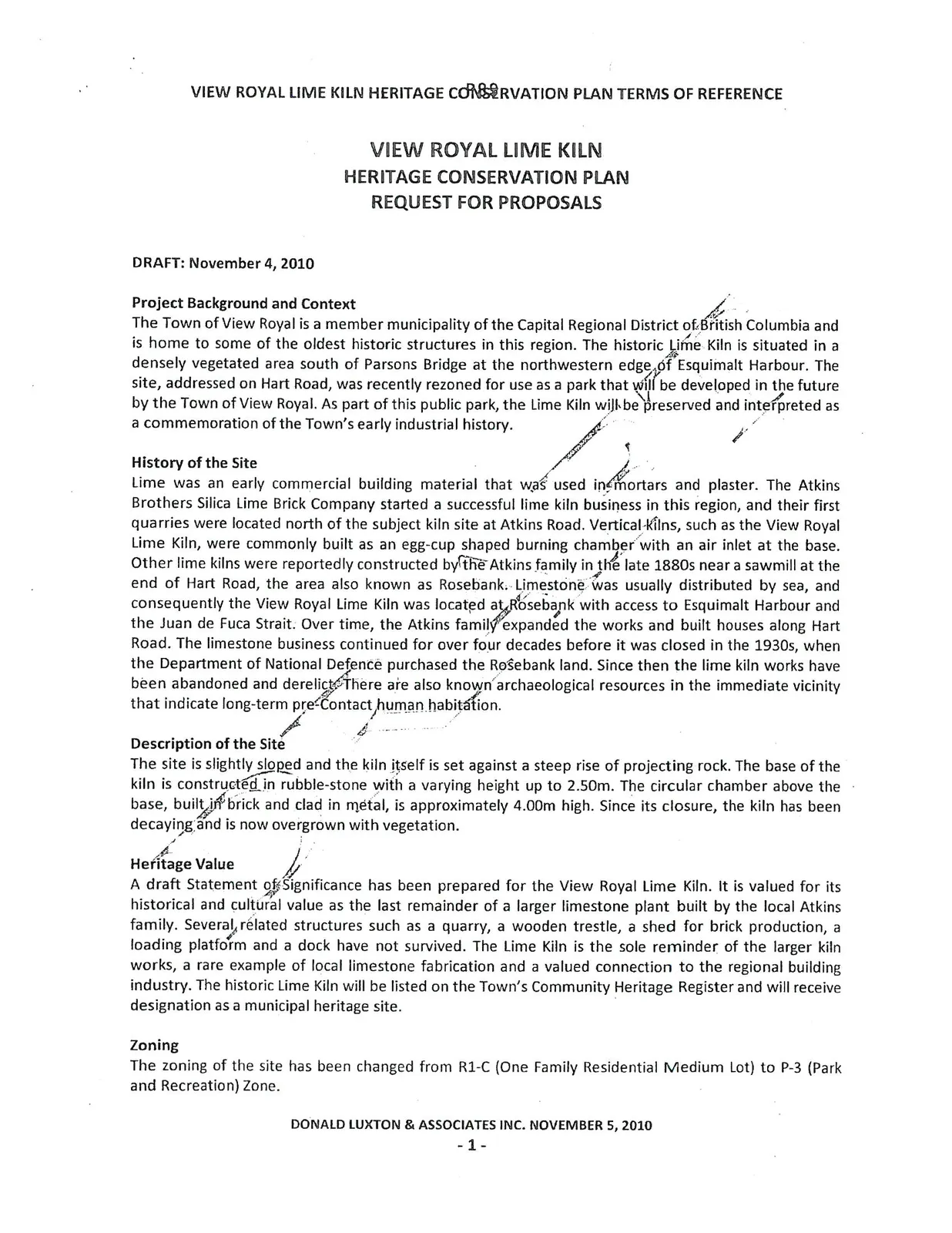
VIEW ROYAL LIME KILN HERITAGE CONSERVATION PLAN REQUEST FOR PROPOSALS
DRAFT: November 4, 2010
Project Background and Context
The Town of View Royal is a member municipality of the Capital Regional District of British Columbia and is home to some of the oldest historic structures in this region. The historic Lime Kiln is situated in a densely vegetated area south of Parsons Bridge at the northwestern edge of Esquimalt Harbour. The site, addressed on Hart Road, was recently rezoned for use as a park that will be developed in the future by the Town of View Royal. As part of this public park, the Lime Kiln will be preserved and interpreted as a commemoration of the Town’s early industrial history.
History of the Site
Lime was an early commercial building material that was used in mortars and plaster. The Atkins Brothers Silica Lime Brick Company started a successful lime kiln business in this region, and their first quarries were located north of the subject kiln site at Atkins Road. Vertical Kilns, such as the View Royal Lime Kiln, were commonly built as an egg-cup shaped burning chamber with an air inlet at the base. Other lime kilns were reportedly constructed by the Atkins family in the late 1880s near a sawmill at the end of Hart Road, the area also known as Rosebank. Limestone was usually distributed by sea, and consequently the View Royal Lime Kiln was located at Rosebank with access to Esquimalt Harbour and the Juan de Fuca Strait. Over time, the Atkins family expanded the works and built houses along Hart Road. The limestone business continued for over four decades before it was closed in the 1930s, when the Department of National Defence purchased the Rosebank land. Since then the lime kiln works have been abandoned and derelict. There are also known archaeological resources in the immediate vicinity that indicate long-term pre-Contact human habitation.
Description of the Site
The site is slightly sloped and the kiln itself is set against a steep rise of projecting rock. The base of the kiln is constructed in rubble-stone with a varying height up to 2.50m. The circular chamber above the base, built in brick and clad in metal, is approximately 4.00m high. Since its closure, the kiln has been decaying and is now overgrown with vegetation.
Heritage Value
A draft Statement of Significance has been prepared for the View Royal Lime Kiln. It is valued for its historical and cultural value as the last remainder of a larger limestone plant built by the local Atkins family. Several related structures such as a quarry, a wooden trestle, a shed for brick production, a loading platform and a dock have not survived. The Lime Kiln is the sole reminder of the larger kiln works, a rare example of local limestone fabrication and a valued connection to the regional building industry. The historic Lime Kiln will be listed on the Town’s Community Heritage Register and will receive designation as a municipal heritage site.
Zoning
The zoning of the site has been changed from R1-C (One Family Residential Medium Lot) to P-3 (Park and Recreation) Zone.
Objectives
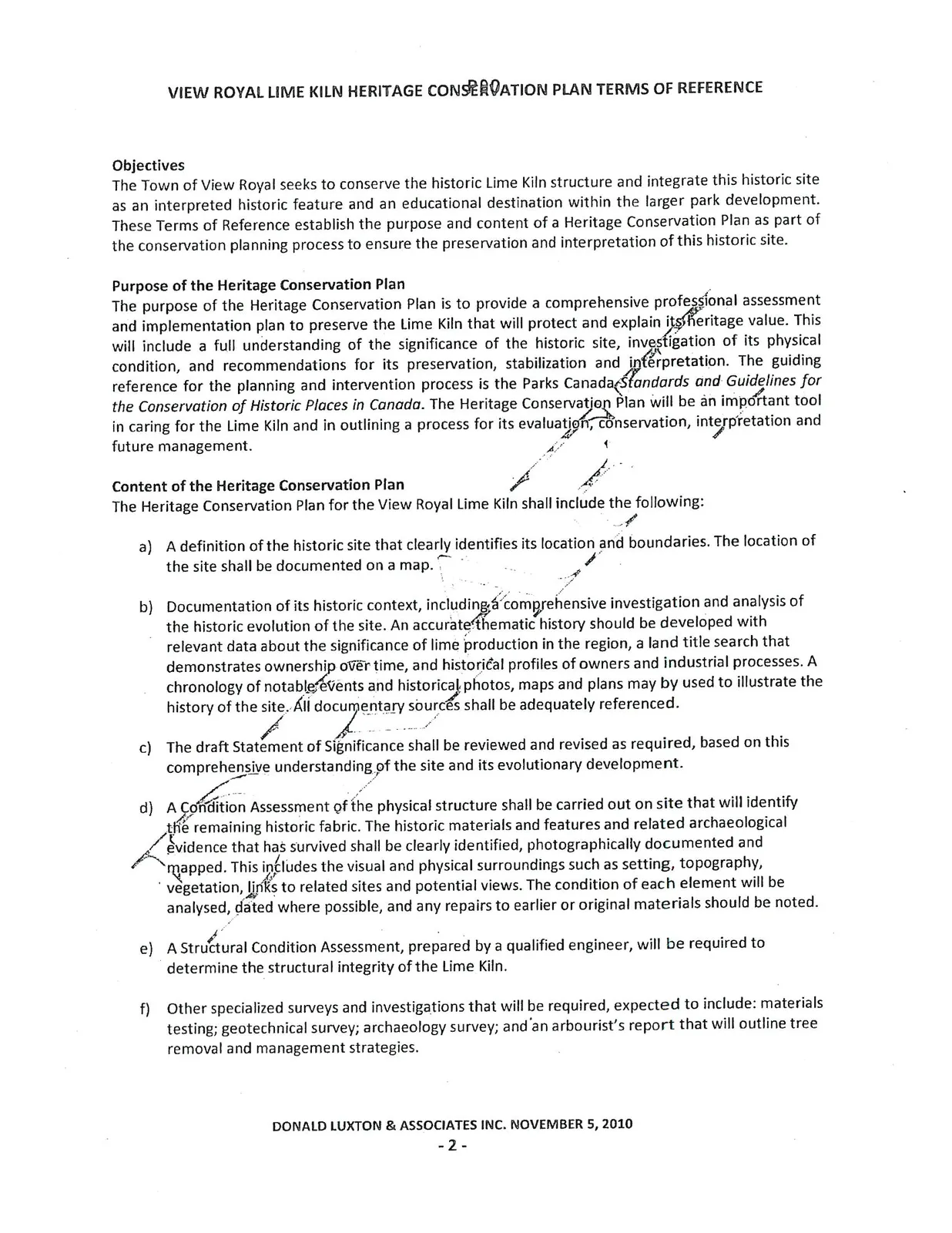
The Town of View Royal seeks to conserve the historic Lime Kiln structure and integrate this historic site as an interpreted historic feature and an educational destination within the larger park development. These Terms of Reference establish the purpose and content of a Heritage Conservation Plan as part of the conservation planning process to ensure the preservation and interpretation of this historic site.
Purpose of the Heritage Conservation Plan
The purpose of the Heritage Conservation Plan is to provide a comprehensive professional assessment and implementation plan to preserve the Lime Kiln that will protect and explain its heritage value. This will include a full understanding of the significance of the historic site, investigation of its physical condition, and recommendations for its preservation, stabilization and interpretation. The guiding reference for the planning and intervention process is the Parks Canada Standards and Guidelines for the Conservation of Historic Places in Canada. The Heritage Conservation Plan will be an important tool in caring for the Lime Kiln and in outlining a process for its evaluation, conservation, interpretation and future management.
Content of the Heritage Conservation Plan
The Heritage Conservation Plan for the View Royal Lime Kiln shall include the following:
a) A definition of the historic site that clearly identifies its location and boundaries. The location of the site shall be documented on a map.
b) Documentation of its historic context, including a comprehensive investigation and analysis of the historic evolution of the site. An accurate thematic history should be developed with relevant data about the significance of lime production in the region, a land title search that demonstrates ownership over time, and historical profiles of owners and industrial processes. A chronology of notable events and historical photos, maps and plans may by used to illustrate the history of the site. All documentary sources shall be adequately referenced.
c) The draft Statement of Significance shall be reviewed and revised as required, based on this comprehensive understanding of the site and its evolutionary development.
d) A Condition Assessment of the physical structure shall be carried out on site that will identify the remaining historic fabric. The historic materials and features and related archaeological evidence that has survived shall be clearly identified, photographically documented and mapped. This includes the visual and physical surroundings such as setting, topography, vegetation, links to related sites and potential views. The condition of each element will be analysed, dated where possible, and any repairs to earlier or original materials should be noted.
e) A Structural Condition Assessment, prepared by a qualified engineer, will be required to determine the structural integrity of the Lime Kiln.
f) Other specialized surveys and investigations that will be required, expected to include: materials testing; geotechnical survey; archaeology survey; and an arbourist’s report that will outline tree removal and management strategies.
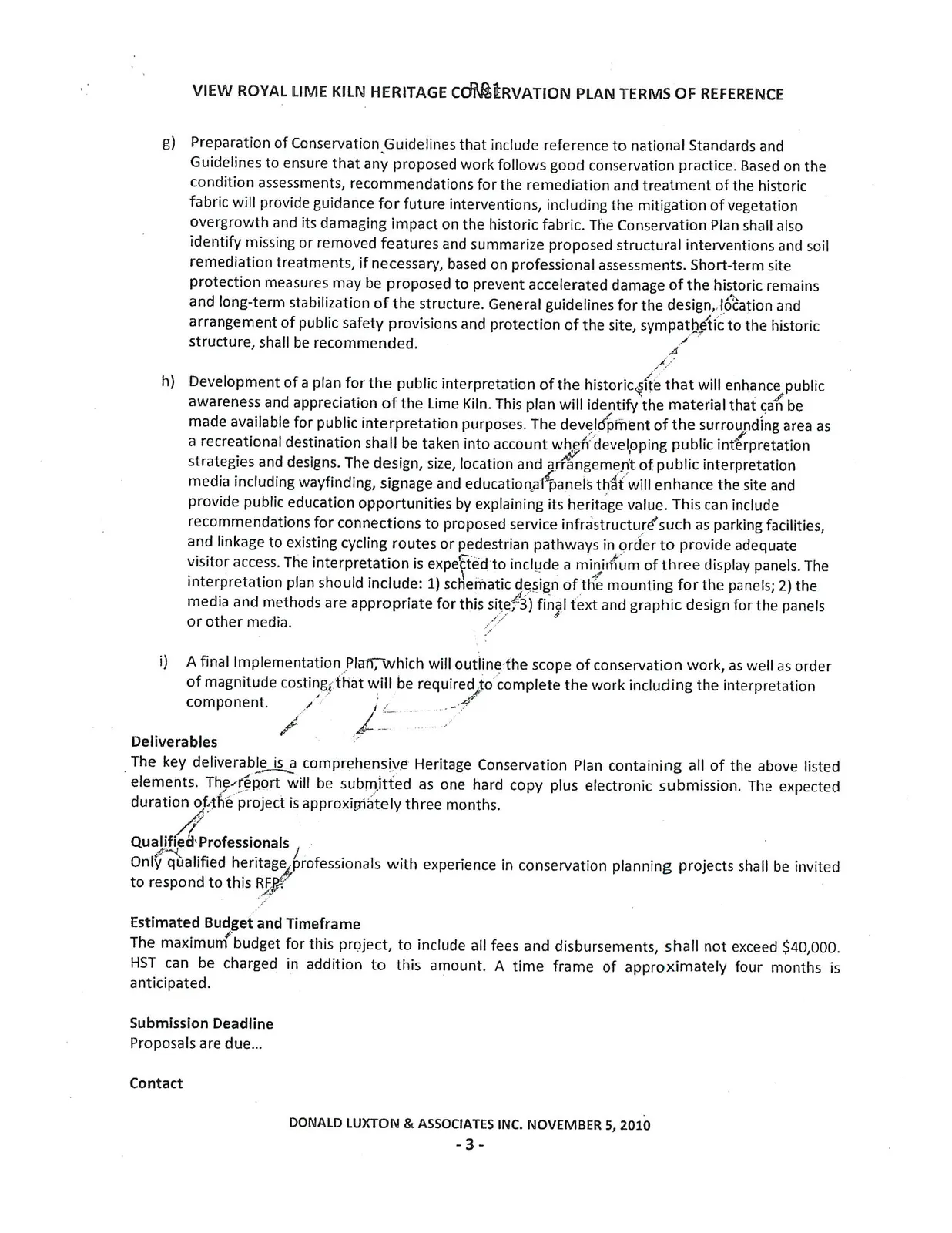
g) Preparation of Conservation Guidelines that include reference to national Standards and Guidelines to ensure that any proposed work follows good conservation practice. Based on the condition assessments, recommendations for the remediation and treatment of the historic fabric will provide guidance for future interventions, including the mitigation of vegetation overgrowth and its damaging impact on the historic fabric. The Conservation Plan shall also identify missing or removed features and summarize proposed structural interventions and soil remediation treatments, if necessary, based on professional assessments. Short-term site protection measures may be proposed to prevent accelerated damage of the historic remains and long-term stabilization of the structure. General guidelines for the design, location and arrangement of public safety provisions and protection of the site, sympathetic to the historic structure, shall be recommended.
h) Development of a plan for the public interpretation of the historic site that will enhance public awareness and appreciation of the Lime Kiln. This plan will identify the material that can be made available for public interpretation purposes. The development of the surrounding area as a recreational destination shall be taken into account when developing public interpretation strategies and designs. The design, size, location and arrangement of public interpretation media including wayfinding, signage and educational panels that will enhance the site and provide public education opportunities by explaining its heritage value. This can include recommendations for connections to proposed service infrastructure such as parking facilities, and linkage to existing cycling routes or pedestrian pathways in order to provide adequate visitor access. The interpretation is expected to include a minimum of three display panels. The interpretation plan should include: 1) schematic design of the mounting for the panels; 2) the media and methods are appropriate for this site; 3) final text and graphic design for the panels or other media.
i) A final Implementation Plan, which will outline the scope of conservation work, as well as order of magnitude costing, that will be required to complete the work including the interpretation component.
Deliverables
The key deliverable is a comprehensive Heritage Conservation Plan containing all of the above listed elements. The report will be submitted as one hard copy plus electronic submission. The expected duration of the project is approximately three months.
Qualified Professionals
Only qualified heritage professionals with experience in conservation planning projects shall be invited to respond to this RFP.
Estimated Budget and Timeframe
The maximum budget for this project, to include all fees and disbursements, shall not exceed $40,000. HST can be charged in addition to this amount. A time frame of approximately four months is anticipated.
Submission Deadline
Proposals are due...
Contact
For further information please contact:
Lindsay Chase, MCIP, Director of Development Services Town of View Royal 45 View Royal Ave. Victoria, BC V9B 1A6 Tel: 250-479-6800 Email: lchase@viewroyal.ca
Document Images
(4)