Letter regarding Bird Friendly Design Guidelines in View Royal
A letter from various conservation groups urging View Royal to adopt bird-friendly design standards for new buildings to prevent collisions.
Bird-Friendly Building Design Standards
25 November 2020
Dear Mayor Screech and View Royal Council,
Greater Victoria is well-known for its sustainable and environmentally friendly policies, which are widely supported by its residents. We are writing today to bring your attention to an important way in which all 13 municipalities within the Capital Regional District (CRD) could have a very positive impact on biodiversity and wildlife, following the lead of cities like Toronto and New York City.
Simply put, glass kills birds. They see reflections of plants and trees as real, and fly towards them, only to collide with the glass. In the case of glass walkways or railings, as well as corner windows, they collide when they fly towards habitat visible on the other side, but do not see the deadly obstacle in their way. These collisions are usually fatal to birds. An estimated one billion birds are thought to be killed by collisions with glass each year in North America alone, and countless more are injured. A recent survey at the University of Victoria found over a hundred dead birds at only a handful of buildings. Luckily, the danger posed to birds by glass can be mitigated through bird-friendly design for new buildings.
Bird-friendly design doesn’t mean getting rid of windows. Instead, it reduces the risk windows pose by using patterned glass and exterior screens, and by using architectural features and landscape design techniques to reduce collisions. When bird-friendly design is incorporated at the planning stage, it can be cost neutral, and complement other design goals like energy efficiency. In addition, there are ways to make existing buildings safer for birds using visual markers and other products and techniques.
More and more cities are making bird-friendly design mandatory for new buildings and major renovations. New York City recently enacted bird friendly standards and Toronto and San Francisco have had standards in place for many years. A bill requiring bird-friendly design at federal properties is currently making its way through the U.S. Congress. The Canadian Standards Association introduced a bird-friendly design standard in 2019, which can be included as a requirement for new developments to ensure they don’t pose a risk to birds. Toronto’s standards (link at the end of this letter) have also been the basis of many cities’ bird-friendly standards.
North America has lost almost a third of its bird population in the past 50 years. Given its location on a major migration pathway, efforts to make the Victoria area safer for birds are essential for reversing this trend. Greater Victoria is a birding hotspot with a large and very active community of people who strongly support bird conservation, from those with a backyard feeder to dedicated birdwatchers. In an area where tourism is a major source of revenue, protecting birds is important when they can attract visitors who travel from afar to see rare birds.
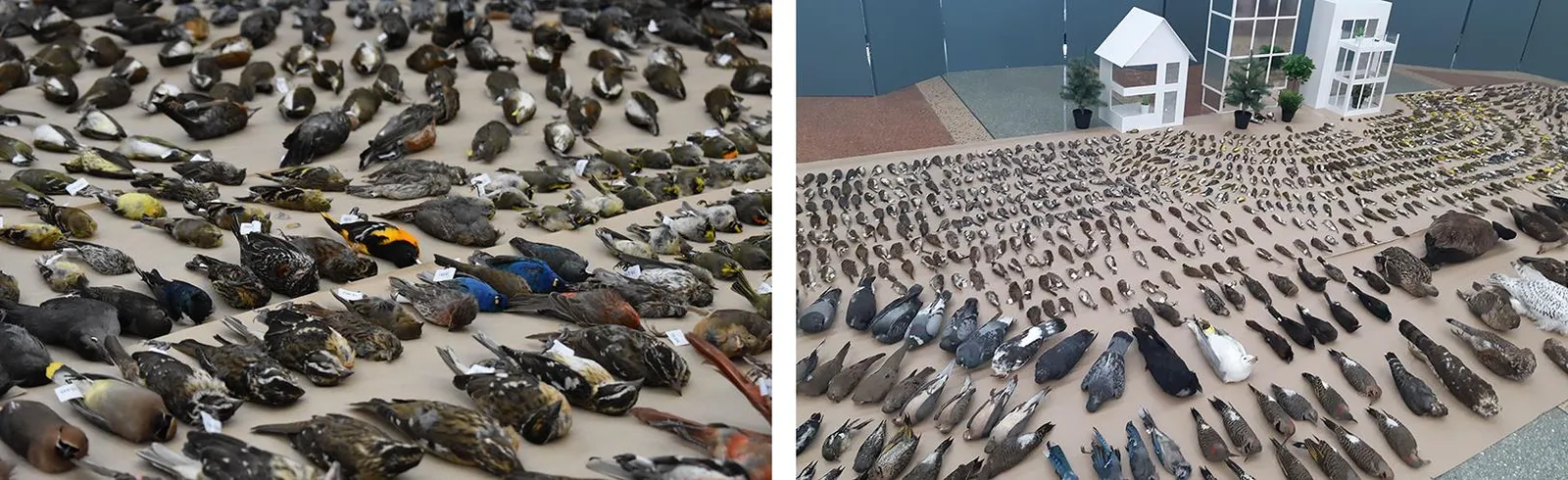
Birds killed by window collisions in Ottawa, ON, are collected by Safe Wings volunteers for a yearly display showing the diversity of species affected and raising awareness of the problem. This display shows only a small fraction of the tens of millions of birds killed by collisions every year in Canada.
The undersigned groups, which represent thousands of Canadians who support conservation and biodiversity, hope communities within the CRD can follow the lead of other cities and make bird-safe buildings a priority.
Regards,
Erin Dlabola MSc. and Willow English MSc.
With support from the following organizations:
The links below provide additional information on this issue.
- Toronto Bird-friendly Design Guidelines
- American Bird Conservancy Bird-friendly Design
- General information on bird-window collisions
Document Images
(11)